

Why Do I Sweat at Night? Causes, Fixes and When to Worry

You wake at 3am with your pyjama top stuck to your back and a cool patch on the sheet where you were lying. The duvet lands on the floor, the window comes open, and you lie there wondering what's wrong with you. By morning the bed has dried and the question has faded, until the next time.
Sweating at night is one of the most common sleep complaints there is, and in most cases it has a plain explanation. Sometimes the bedroom is too warm, or the duvet is doing what a thick duvet does. Sometimes the body's own temperature control has shifted, which is what happens through perimenopause and menopause. Occasionally it points to something that needs medical attention, and that possibility is why people type "why do I sweat at night" into a phone at three in the morning.
The trick is telling those apart without panicking and without spending money on the wrong fix. There's a straightforward test, set out below, that separates a sweat caused by the bed from a sweat caused by the body. Get that distinction right and everything else follows.
Table of Contents
- The Common Causes Behind Night Sweats
- How Hormonal Change Can Trigger Sweats
- How Your Bedroom and Bedding Make Sweating Worse
- When Night Sweats Need a Doctor
- How to Cool Your Bed Step by Step
- Looking After Your Protector So It Keeps Breathing
- Choose Your Next Step for Night Sweats
The Common Causes Behind Night Sweats
Say you swapped a 13.5 tog duvet for a 4.5 tog one, opened the window, and still woke with a damp back. That result is useful, because it tells you the bed wasn't the whole story. Night sweats have a broad range of causes, and the first job is matching your pattern to one of them rather than buying something and hoping.
The NHS guidance on night sweats lists the common ones plainly: menopause, anxiety, medicines including some antidepressants, steroids and painkillers, low blood sugar, alcohol or drug use, and hyperhidrosis. Those fall into four groups that behave differently. Everyday triggers sit outside the body and change with the season or the evening. Body-related causes sit inside it and recur regardless of the room. Medicines are their own group, and their timing gives them away. Medical causes are the smallest group, and they tend to arrive with company: sweats plus fever, sweats plus weight loss, sweats plus a cough that won't settle.
The word drenching does a lot of work here. Feeling warm under a heavy cover is uncomfortable but ordinary. Sweating heavily enough to soak nightwear or bedding, in a room that isn't hot, is the pattern clinicians take seriously. Hold that difference in mind and the list gets much easier to read.
This isn't a rare complaint either. A 2025 Good Housekeeping UK survey of more than 1,400 respondents found that 71% of respondents experiencing perimenopause or menopause identified night sweats as a sleep disruptor. Plenty of people are awake at the same hour as you.
| Cause | Typical pattern | Clues to check |
|---|---|---|
| Menopause or perimenopause | Recurring hot flushes and sweats, often with sleep disruption | Irregular periods, mood changes, hot flushes by day |
| Warm room or heavy bedding | Damp nightwear on warm nights, easing with a lighter duvet | Worse in summer or under thick covers |
| Alcohol or late caffeine | Sweating after drinking or caffeine close to bedtime | Pattern matches evenings with alcohol or coffee |
| Medicines | Starts or worsens after a new or changed prescription | Antidepressants, steroids and painkillers are common culprits |
| Anxiety | Sweating with a racing heart or tense feeling on waking | Worry-driven wakefulness or panic-like episodes |
| Low blood sugar | Sweating with shakiness or palpitations, often in people on glucose-lowering treatment | Episodes linked to diabetes treatment or skipped meals |
| Infection | Drenching sweats with fever, shivering or cough | Recent illness or ongoing symptoms |
| Overactive thyroid | Sweating with weight loss, fast heartbeat and feeling hot by day | Daytime heat intolerance and tremor |
| Sleep apnoea | Sweating with snoring, gasping or pauses in breathing | Partner notices breathing pauses; daytime tiredness |
| Hyperhidrosis | Heavy sweating in many settings, not only at night | Sweating on hands, feet or face in daytime too |
Three questions narrow your row down before you read any further:
- Wet or just warm? Damp nightwear points to a genuine sweat. A clammy, overheated feeling usually points to bedding or room temperature.
- Cool room, same result? If light covers in a cool bedroom still leave you soaked, the cause is more likely inside the body.
- Daytime symptoms too? Flushes or heavy sweating during the day raise the odds of a hormonal cause or hyperhidrosis.
Find your row, then follow the section that fits it.
How Hormonal Change Can Trigger Sweats
Your thermostat sits in a small patch of the brain called the hypothalamus, and it behaves like a heating system with a target temperature. Falling oestrogen makes that system twitchy. A rise in core temperature that would once have passed unnoticed now registers as overheating, so the body responds: blood vessels near the skin widen, the skin flushes, and sweat glands switch on to cool you down. Nothing in the room has changed. The set point has.
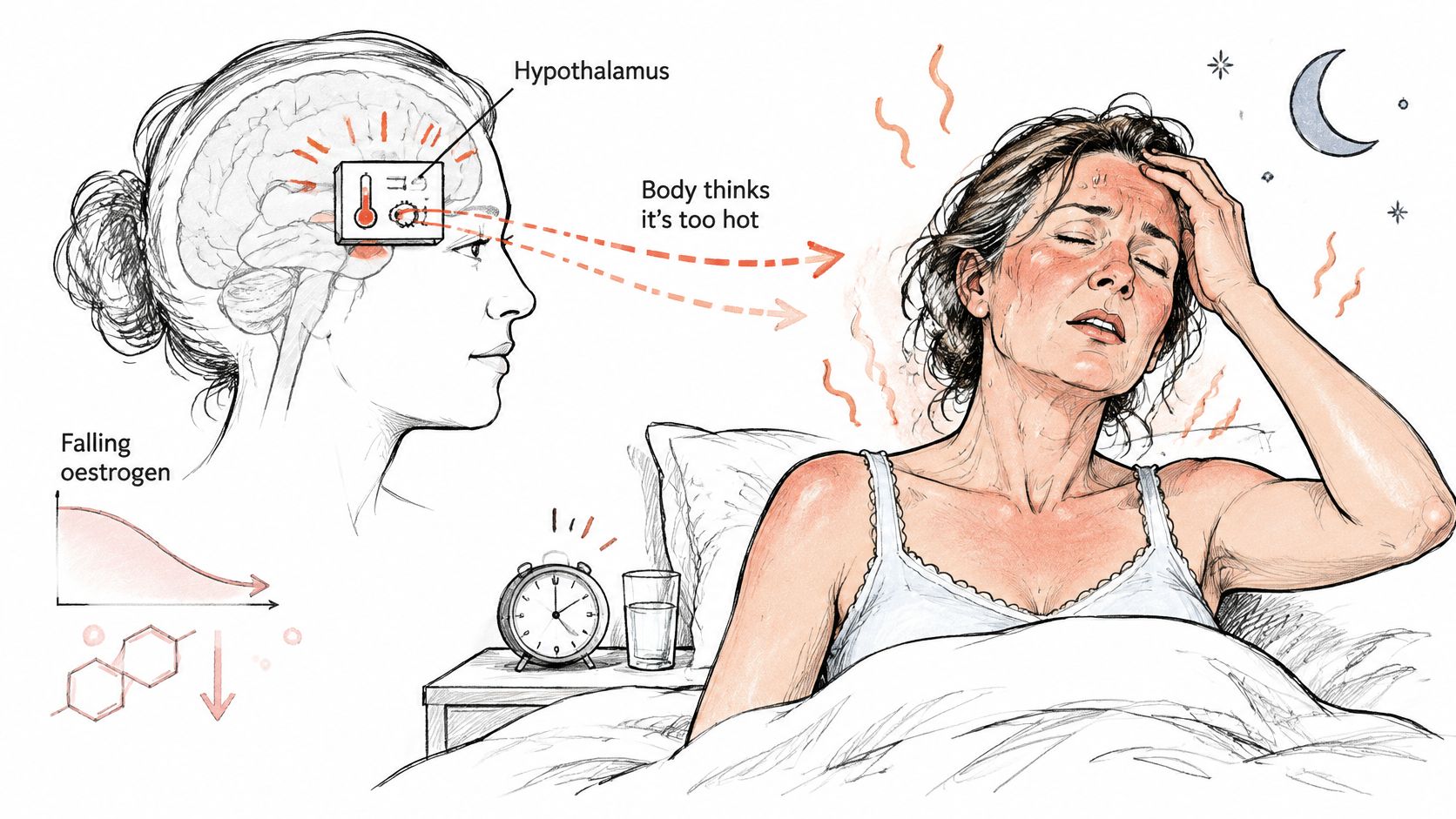
At night the misfire is easier to spot, because core temperature naturally dips as you fall asleep and the body defends that dip by sweating. The result is the pattern many women in their forties and fifties recognise: a wave of heat that wakes you, nightwear that needs changing, and a return to sleep that takes longer each time. Repeated waking does more than make you tired. It deepens the fog that makes low mood and a short temper harder to manage.
This is a mainstream experience, not an edge case. A 2023 study published in BMC Women's Health of 953 women aged 35 to 70 living in the UK found that 80.7% reported hot flushes or night sweats. A 2016 British Menopause Society and Ipsos MORI survey of 1,200 women aged 45 to 65 across Great Britain found that among the 1,000 respondents who had experienced menopausal symptoms in the previous 10 years, 70% reported night sweats and 79% reported hot flushes.
Signs that point to hormones
Four things make a hormonal cause more likely than a bedroom one:
- Your periods have changed, becoming irregular, heavier, lighter or further apart.
- The heat arrives in waves rather than building slowly through the night.
- You flush in the daytime too, often across the chest, neck and face.
- Symptoms began in your forties or fifties, rather than after a change of duvet or a new prescription.
For the wider hormonal picture across those years, explore hormonal changes during perimenopause and you'll see why the symptoms cluster rather than arrive one at a time.
Keep a two-week note of when sweats happen and what came before them, then book a GP appointment to talk through options. The NHS advice on menopause symptoms notes that NICE-linked guidance identifies hormone replacement therapy as an effective option for vasomotor symptoms, following an individual discussion of risks and benefits.
How Your Bedroom and Bedding Make Sweating Worse
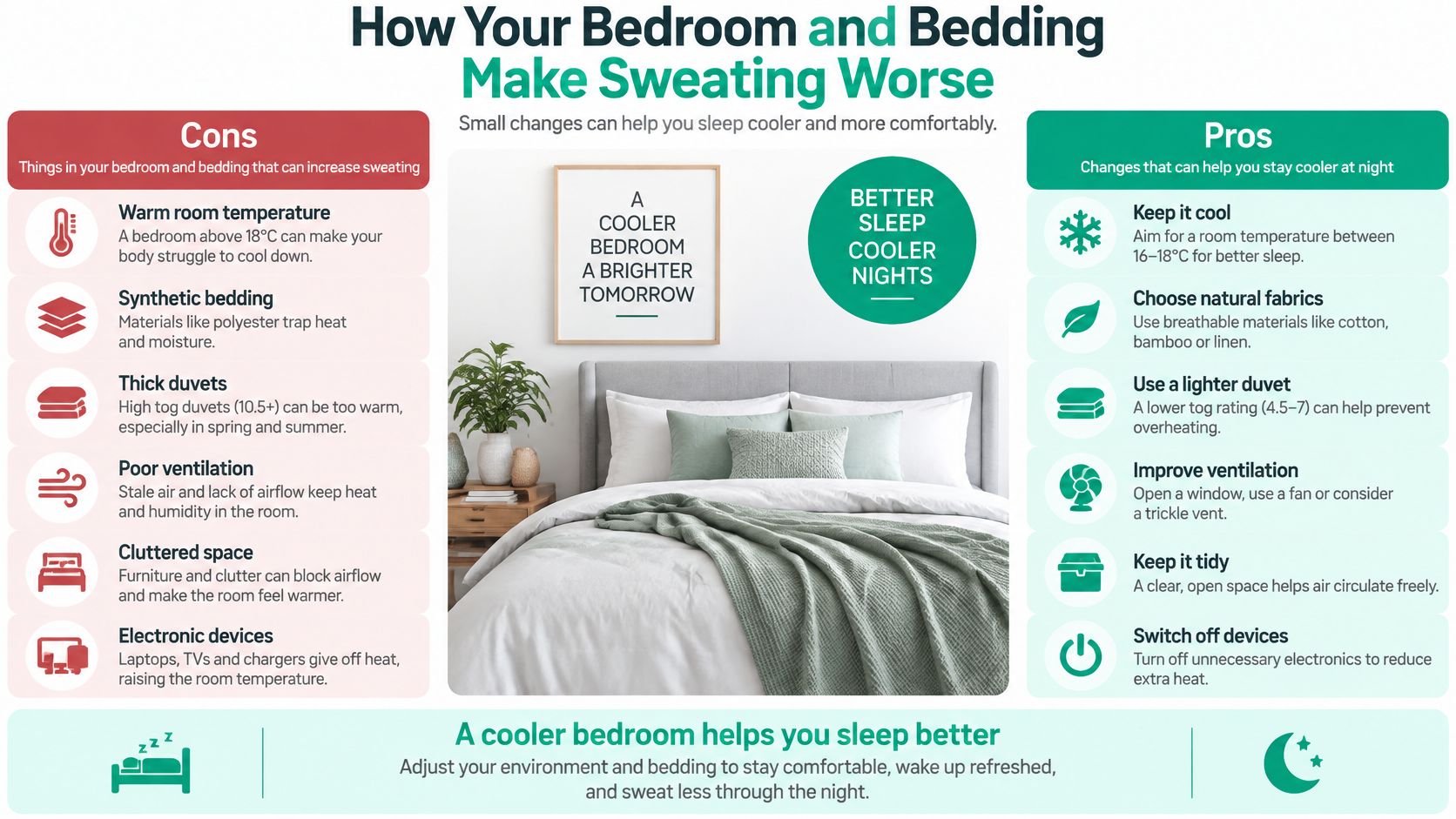
A warm bedroom or a heavy duvet can leave you soaked with nothing wrong with you at all. That is why the room comes first: it is the cheapest thing to change and the easiest to rule out. Aim for a bedroom around 16 to 18°C, and match your duvet to the season rather than using the same tog all year.
The twenty minute bed test
Lie on the made bed in a cool room, under the covers you normally use, and wait twenty minutes. Then feel your back and the sheet beneath you. If both are dry and comfortable, your bedding is unlikely to be the cause and you can turn to body-side explanations. If your back feels warm or damp, the layers are trapping heat and you have found something you can fix tonight. Run the test on a normal evening, not after a hot bath or a glass of wine.
This test matters because it separates two problems that feel identical at 3am. Sweat caused by trapped heat fades once the layers change. Sweat that keeps coming in a cool, dry bed points somewhere else entirely.
The most common trap is a waterproof layer with no breathability. A protector that blocks liquid and air alike works like a raincoat worn indoors: it holds sweat and warmth against your body all night, so the bed feels hotter each time you get in. Breathable waterproofing works differently, keeping moisture out of the mattress while letting air and vapour pass through.
Plenty of people run hot at night and struggle to cool down under ordinary bedding, so needing a cooler setup does not make you unusual. What sits against your skin matters most, and the common layers behave very differently.
| Layer | How it handles heat | Likely effect on night sweats |
|---|---|---|
| Cotton sheets | Breathable and absorbent | Comfortable, but slow to dry if soaked |
| Tencel (lyocell) | Absorbs and releases moisture quickly | Often recommended for hot sleepers |
| Polyester microfibre | Retains heat, less absorbent | Can feel clammy on warm nights |
| Wool | Regulates temperature and wicks moisture | Suits cool and warm nights, depending on weight |
| Standard waterproof protector | Blocks moisture and limits airflow | Traps warmth against the body |
| Breathable waterproof protector | Blocks liquids while letting air through | Keeps moisture off the mattress with less heat build-up |
Cooler bedding improves comfort and keeps the mattress clean. It cannot diagnose or treat a cause, so use the split the test gives you. If your sweats show up only in warm weather, under thick covers or after evening alcohol, and never by day, the bed is your lever. If you soak through in a cool room, or sweat during daylight hours, treat the bedding as maintenance and look at the body instead. For the room-side changes in more detail, our guide to how to cool down at night covers airflow and layering.
Rearranging the room helps too, as long as the furniture does not block the breeze. If you are reworking the space anyway, these ideas on how to style a room with accent seating show how to place a chair without crowding the window or the path of a fan.
When Night Sweats Need a Doctor
Most night sweats aren't dangerous, and that's worth saying plainly before anything else. The line that matters isn't sweaty or not sweaty. It's the pattern. Occasional dampness in a warm room is ordinary. Sweats that soak bedding, or wake you repeatedly, deserve a conversation with a GP.
The cancer question arises because many articles list lymphoma alongside common causes without clarifying the difference. NHS Scotland haematology guidance on night sweats is clear about this: the majority of people with night sweats do not have an underlying blood cancer, and isolated sweats in an otherwise healthy person with a normal full blood count are unlikely to indicate lymphoma. Concern increases when sweats are drenching and occur with unexplained weight loss, fever, enlarged lymph nodes, or an abnormal blood count.
| Pattern | What to do |
|---|---|
| Occasional damp night, no other symptoms | Keep a diary and review if it continues |
| Sweats regularly wake you or cause concern | Book a routine GP appointment |
| Very high temperature, shivering or diarrhoea with sweats | Seek same-day medical advice |
| Sweats with weight loss over 10%, fever or swollen glands | Arrange a prompt GP review |
| Cough lasting over three weeks with night sweats or fever | Contact a GP promptly, and urgently if worsening |
| Severe breathlessness, confusion or coughing blood | Seek urgent help straight away |
Infection is the reason the cough row exists. The NHS guidance on tuberculosis lists night sweats alongside a cough lasting more than three weeks, fatigue and fever, with symptoms that usually develop gradually. That doesn't mean night sweats suggest TB, and common causes remain far more likely. It does mean that drenching sweats paired with a cough that won't settle, fever, weight loss, a reduced appetite, breathlessness or blood when you cough shouldn't be managed by changing the bedding.
If you do book, arrive with evidence. Note the time each episode happens, whether nightwear or sheets were soaked, the room temperature, any alcohol that evening, recent changes to your medicines, and any other symptoms in the same fortnight. Add your weight if it has moved without trying. That record turns a vague complaint into something a GP can work with.
Don't adjust a prescription to fix a sweat. Never stop or change antidepressants, steroids or diabetes treatment without speaking to the prescriber first. If you suspect low blood sugar overnight, raise it with your GP or diabetes team promptly, because untreated hypoglycaemia can become dangerous.
How to Cool Your Bed Step by Step
These steps run from cheapest to most involved. Change one a week rather than all at once, or you won't know which one did the work.
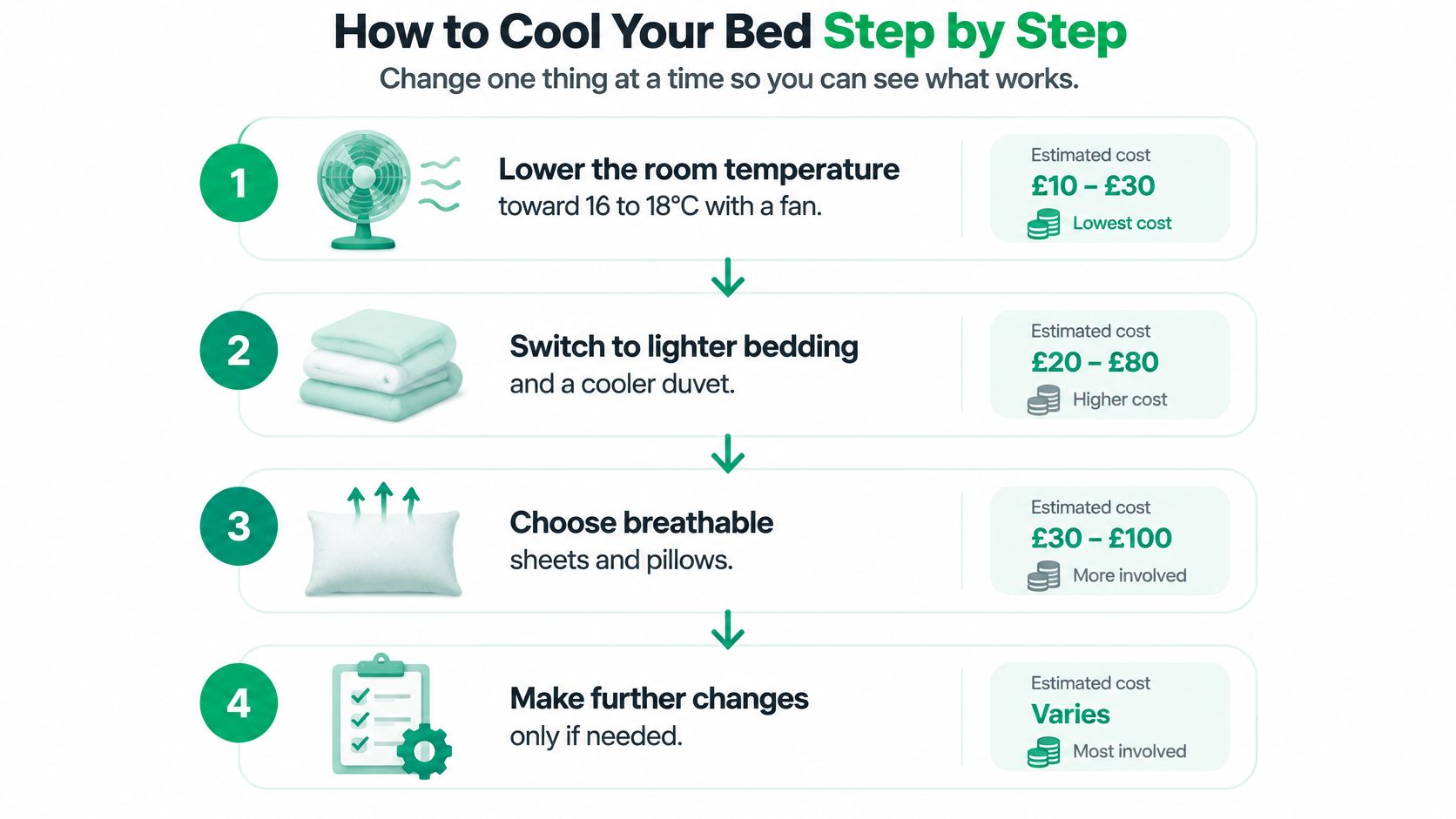
- Drop the room temperature first. Aim for 16 to 18°C with a fan moving air across the bed rather than into your face. Cool air carries heat away from skin far faster than still air, and this lever costs nothing but a window.
- Switch to a lighter duvet or a lower tog. A 4.5 tog suits summer and a 10.5 tog suits most of the year in a normally heated UK bedroom. If you sleep under two layers, lose one before you buy anything.
- Wear nightwear that moves moisture. Cotton, Tencel, linen and silk let sweat evaporate. Polyester holds it against your skin and feels cold and clammy within minutes of waking.
- Add a breathable waterproof protector if moisture is the issue. It keeps sweat out of the mattress; it won't lower room temperature.
- Cut the evening triggers. Alcohol, caffeine after midday, spicy food and hot drinks close to bedtime all widen the window for a sweat. Drop the most likely one first, since they're easy to blame and hard to isolate together.
- Track the change, not just the sweat. Give each adjustment a week and note whether the sheets stay dry. That record doubles as your test: if dry sheets follow a cooler room and lighter bedding, the bed was the cause. If nothing shifts the pattern, something else is driving it.
- Take the pattern to a GP if it fits a cause you can't fix. If the diary points to hormonal change or a medicine, book an appointment to discuss treatment options rather than buying more bedding.
A realistic order looks like this: week one, the fan and the window; week two, the lighter duvet; week three, the nightwear swap. The trigger cuts and the diary run alongside each week, so by the end of the month you know which lever moved the result.
You should see dry sheets within two weeks of the first change. Fewer soaked sheets, fewer 3am changes of nightwear, and a clear note of which single change made the difference. If you've tried the room, the bedding and the evening triggers and nothing has shifted, that's information too, and it's the point to book the appointment.
If your head is the part that overheats, choosing a cooler pillow for UK summers covers fills and covers worth considering. And when the pattern sits with hormonal change rather than bedding, sleep better through menopausal night sweats sets out the clinical approaches worth raising with your GP.
Looking After Your Protector So It Keeps Breathing
A protector washed or dried the wrong way loses the breathability you paid for, and the cooling benefit fades without any visible damage. Fabric softener is the usual culprit: it coats the fibres and slows the movement of vapour. Skip it entirely and use a mild detergent instead.
- Wash at the temperature on the care label. Hotter isn't cleaner when a membrane is involved, and the label is the only reliable guide for your specific product.
- Dry it with bed linen or towels, never alone. A medium dryer setting alongside other items keeps the heat moving evenly. A protector tumbling by itself can overheat its lining.
- Check the lining before it goes back on the bed. If blisters or bubbling have formed from dryer overheating, the Snow Pillow Protector must be stopped from use, and the same caution applies to any protector with a damaged membrane.
- Air the bed every morning. Pull the duvet back for an hour so the night's moisture can evaporate instead of sitting in the layers all day.
- Replace it when the membrane looks worn. A protector that no longer keeps liquid out has stopped doing its main job, whatever it still looks like.
Wash frequency matters as much as temperature, and this guide to how often to wash a mattress protector covers the right interval for night-sweat use.
The one-minute check is simple. After a night's sleep, press your palm on the protector under where your back lay. If it feels damp or noticeably warm, the breathable layer isn't working as it should, and it's either due a wash or ready for replacing.
Choose Your Next Step for Night Sweats
The decision splits two ways, and you already have the evidence for it in the table above.
If your sweats track a warm room or heavy bedding, start with the room: cooler air, a lighter duvet, breathable nightwear, then run the twenty minute bed test again once the changes settle. If your sweats soak bedding, keep recurring, or arrive with any warning sign, book a GP appointment before you spend anything on the bed.
Where moisture is the main problem and the pattern points to the bed, a breathable waterproof protector keeps sweat out of the mattress while still letting air move through. Protect-A-Bed's Tencel Cool protector is one option: the Miracle Membrane blocks dust mites, allergens, liquids and sweat from penetrating the bed, and Nordic Chill fabric dissipates body heat up to 10 times faster than cotton. Check the warranty terms before buying, because cover applies to the sleeping surface of the mattress, not the sides.
Start with the diary this week. Find your pattern in the causes table, change one bedroom factor and give it seven days to show a difference. If any warning sign from the medical section applies to you, book the GP appointment first and let the bedding changes follow.
If your pattern points to the bed, visit Protect-A-Bed to compare waterproof, breathable protectors and find the size that fits your mattress.