

Cool Pillow UK: Which Cooling Pillow Suits You?

Approximately 4.6 million English main bedrooms, 19% of the total, overheated in the hot summer of 2018 under an adaptive thermal-comfort criterion, and about 7.4 million people were exposed to those bedrooms, according to Loughborough University's housing analysis. A cool pillow UK search is a response to a widespread sleep problem, not a niche gadget hunt.
A pillow changes the small climate around your head and neck. It does not cool the room. The useful job is narrower: shift heat off the skin, move moisture, and avoid a cover that traps both. Words such as "cooling" or "ice feel" do not show whether that job still happens at 3am.
The checks below use UK sleep and housing evidence, plus figures a seller can supply, to separate a heat-management surface from a cold first touch. They also take the trade-off most round-ups skip. Dust-mite control often needs a tight, hot-washable barrier, and that barrier can change how cool the pillow feels.
Table of Contents
- Cooling Pillow Types Compared Side by Side
- How Cooling Pillows Keep Your Head Cool
- Testing Cooling Claims Before You Buy
- Balancing Allergy Protection and Cooler Sleep
- UK Sizes, Pricing and Availability Checks
- Who Should Buy Which Cooling Option and How to Decide
Cooling Pillow Types Compared Side by Side
Start from the mechanism, not the adjective on the listing. These five constructions are the ones UK shoppers meet.
| Type | How it cools | Washable | Feel | Best for |
|---|---|---|---|---|
| Tencel Cool lyocell fibre | Wicks moisture away and sheds heat from the surface | Usually machine washable; check the label | Smooth and cool to touch | Night sweats and hot sleepers |
| Cooling gel fills | Absorbs heat on contact until saturated | Often cover only; check the label | Cool at first, then neutral | Short-term surface cooling |
| Breathable fills (open-cell foam, loose microfibre) | Lets air move through an open structure | Cover yes; many fills are spot-clean only | Lighter and softer | Side sleepers who want airflow |
| 3D spacer fabric | Air channels keep air moving around the head | Usually washable | Structured and springy | Heat-prone sleepers who sleep on the back or side |
| Cotton or copper-infused covers | Natural fibre absorbs moisture; copper is a thermal and antimicrobial claim | Usually machine washable | Familiar and slightly warm | Budget buyers and allergy-conscious sleepers with a washable cover |
Lyocell spreads sweat across the fibre so it does not sit in a wet patch at the neck. Gel feels cold for the first minutes, then rises toward skin temperature, so read it as a surface feel rather than all-night cooling. Open fills only help if air can pass through them. Spacer fabric holds channels open and keeps its height, which matters if you hate a pillow that collapses. Cotton and copper covers are familiar and usually easy to wash, but any antimicrobial line on the label needs a stated test, not a slogan.
Match the row to the problem
If the complaint is a damp neck, start with lyocell or spacer. If the complaint is a sore neck on your side, an open fill that still holds height beats a flat cool sheet. If the complaint is mites, skip straight to whether the cover zips fully shut and survives a hot wash. Shape still matters for side sleeping, and a contoured memory foam pillow only stays comfortable if the cover does not seal the foam into a warm pocket.
Before you commit, read how to care for your pillow so the wash routine matches the fill you are about to buy. A type that cannot be cleaned on the cycle you will use is the wrong type, however cold it feels in the shop.
The right row is the one that answers the heat problem you have, not the one with the coldest first touch.
How Cooling Pillows Keep Your Head Cool
Bedroom heat is common enough in English homes that a cooling surface is a fair question. It is still only one layer of the bed.
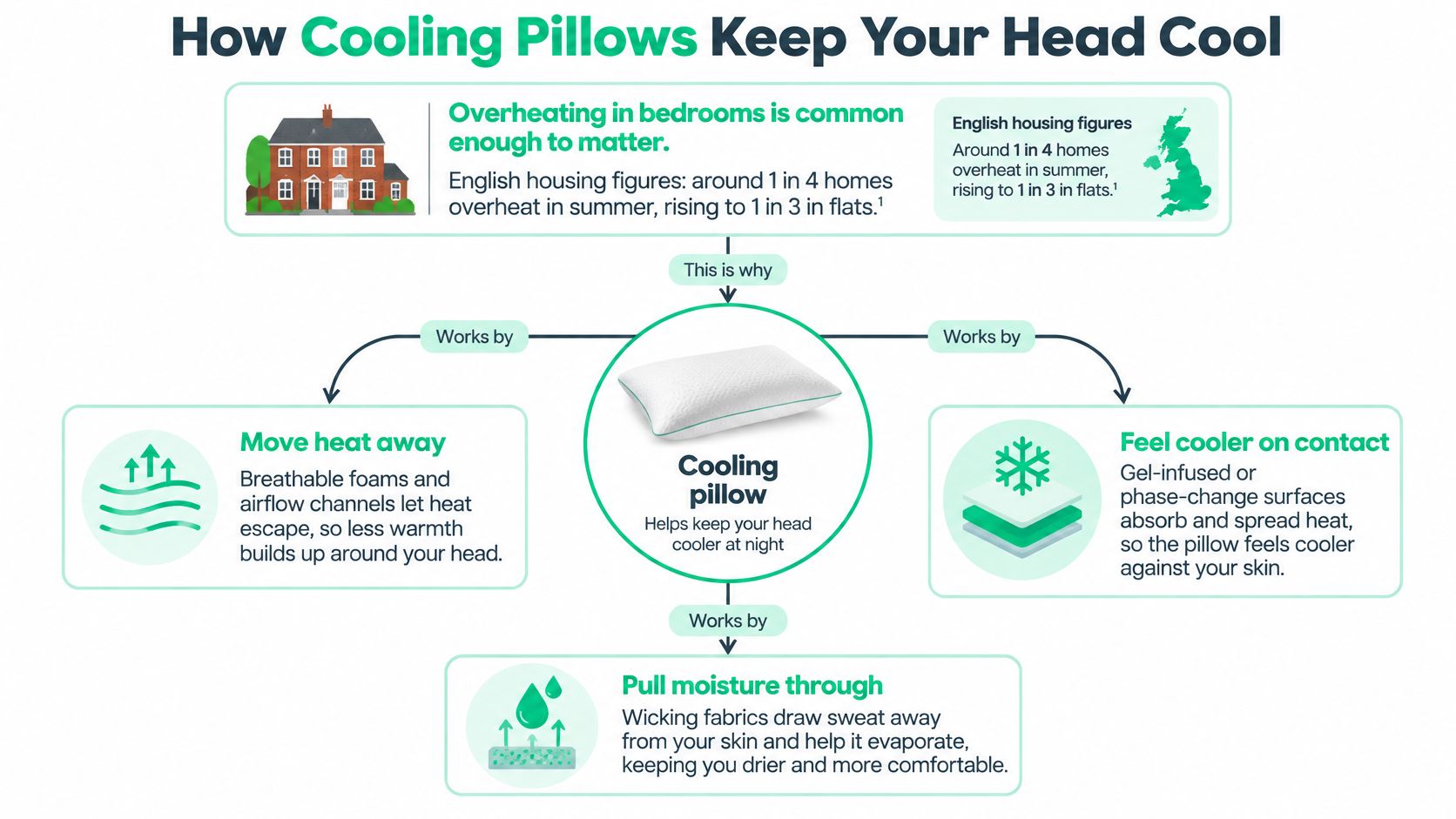
A pillow moves heat in three ways. Judge each one over hours, not over the first minute you lie down.
Conduction, moisture and moving air
Conduction is the cold-to-the-touch moment. A smooth fibre draws heat from cheek and ear on contact. That is why a fresh pillowcase feels promising at lights-out and ordinary by the time you turn over. It explains the shop demo. It does not explain 4am.
Moisture transfer often matters more if you wake with a damp hairline. Fibres that absorb sweat and spread it keep the skin surface drier, and dry skin feels cooler even when the room has not changed. People dealing with hormonal flushing can pair that surface with wider managing night sweats during perimenopause habits, such as lighter layers and a cooler pre-bed routine. The pillow still only treats the patch under your head.
Convection is air leaving the pillow. Open-cell foam and spacer channels let warm air move away from the scalp, but only if the bedroom itself has some air movement. A shut window and a heavy duvet cap on top of the channels cancel the design.
Gel is a different mechanism. It soaks up heat until the gel is about as warm as you are, then the "cool" feeling fades. A phase-change surface can delay that moment. It does not keep absorbing all night.
A cool face on the pillow at minute one is not evidence of how that same surface behaves after several hours of sleep.
A bedroom held near 30°C will still break sleep. The pillow manages the microclimate at the head. It does not set the room temperature. Score it after a full night: is the cover dry, has the loft stayed open, and did the cool feeling survive past the first turn?
Testing Cooling Claims Before You Buy
In a study of 25 residents in East London apartments, hotter summer bedroom conditions were linked with significantly lower reported sleep quality and poorer thermal comfort, and sleep disturbance rose at p<0.001, in Loughborough University conference research. Ordinary UK flats follow the same pattern: hotter bedrooms, worse nights. A seller should show how a pillow handles heat. The study supports measuring heat performance; it does not prove any single fill improves sleep.
| Criterion | What to ask for | Good sign | Red flag |
|---|---|---|---|
| Thermal resistance | Tog or clo value of the cover and fill | Stated value, comparable across products | Only the word cooling, no figure |
| Moisture vapour transmission | Test result in grams per square metre per 24 hours | Reported figure with a named test method | Breathable claim with no data |
| Airflow | Air permeability or pressure-drop figures | Figures given for both fill and cover | No airflow data |
| Washing | Care-label temperature and drying instructions | Machine washable at 60°C where the label allows | Dry clean only or no care information |
| Overnight temperature | Surface temperature change over a full night | Evidence from user or lab tests | Single ice-feel claim |
Thermal resistance is how much the product insulates you. A lower tog or clo means less of a blanket effect. Two listings with no number cannot be ranked against each other.
Moisture vapour transmission, in grams per square metre over 24 hours, shows whether sweat can leave the fabric. "Breathable" with no method named is a slogan.
Airflow has to cover both fill and cover. A tight outer cloth can cancel an open foam even when the fill itself moves air.
Washing belongs in the heat test, and it is the dust-mite half that most UK cooling comparisons skip. A cover you cannot clean crusts with sweat and sleeps warmer. The care label's temperature, including whether 60°C is allowed, is what lets you judge mite hygiene and cooling on the same product. Dry clean only, or a blank label, fails both.
Overnight temperature is the reading that matches a whole night. Look for a surface change recorded across hours, from users or a lab. A claim that only describes first contact does not supply that figure.
Two checks you can run at home
Twenty-minute lie-down. Use the pillow in the bedroom you sleep in. Note whether the surface is still cool and whether your hairline stays dry.
Same-room pair. Put two pillows side by side for the same twenty minutes. The one that stays damp, or goes slack, is the weaker heat manager, whatever the hang-tag says.
A listing that only says cooling has already told you something: tog, moisture and airflow were never published, so the tag is a feel. Cover specifications are often clearer than the pillow's. A cooling pillow protector that states tog, wash limit and moisture claims gives you figures the pillow listing withheld. Those twenty minutes still are not a full-night temperature.
Balancing Allergy Protection and Cooler Sleep
The coolest-feeling pillow is a poor pick for dust-mite allergy if its cover cannot come off and be washed. Cambridge University Hospitals patient information says dust mites thrive in warm, humid conditions, recommends fully enclosing pillows in allergen-barrier covers, and advises washing uncovered bedding at 60°C where the material allows it. A tight barrier can reduce how much air the cover passes. That is the trade-off.
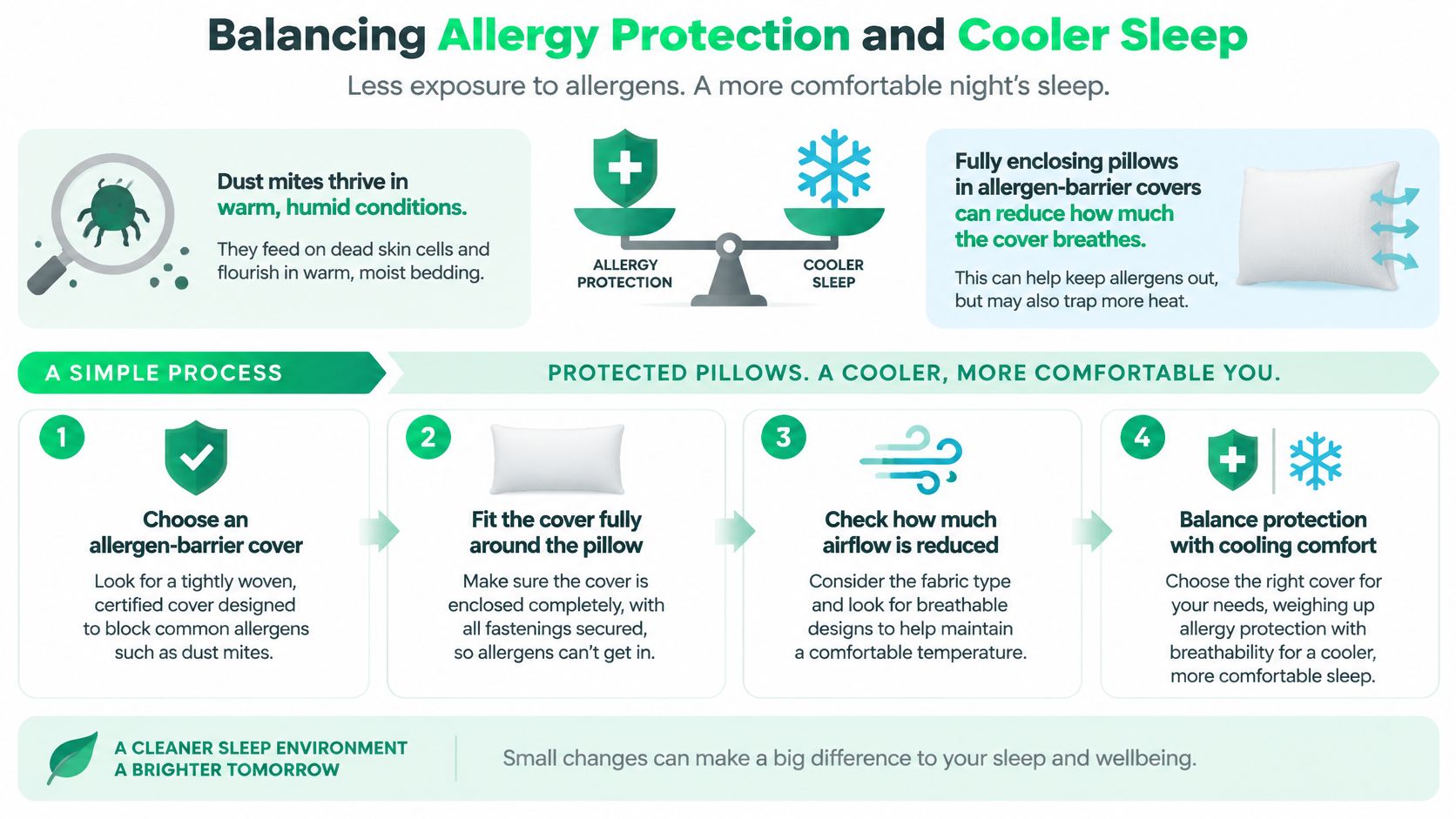
"Breathable" does not mean mite-proof. Mites live in the warm, slightly damp fill. An open pillow with a loosely tucked case still offers them a home. The same guidance is a reason to treat cooler washes cautiously: cooler washing only partly kills mites, so a low-temperature cycle is not a finished hygiene plan. Check the care label rather than assuming a cool wash is "good enough".
A routine that keeps both aims
- Enclose the pillow fully. Choose a zipped cover cut to that pillow, or a pillow already sealed, because gaps at the cuff let mites back in.
- Read the care label before you buy. Confirm a 60°C wash where the cloth allows it, plus the drying rule, so the cooling finish is not ruined by the clean you need.
- Wash uncovered bedding at 60°C on a set rhythm. Sheets and cases that can take that heat should go through it regularly, because the pillow cover is only one surface.
- Dry until the fibres are fully dry. Damp cloth holds humidity, and humidity is what mites favour, even after a hot wash.
- Replace the pillow when loft collapses or the cover can no longer take the heat. A tired fill sleeps warmer and is harder to keep clean.
Each step trades a little of the open, airy feel for a surface you can maintain. An anti-allergy pillow protector is the right comparison point when enclosure matters more than an ice-cool shop demo. You may feel slightly warmer at first contact. You gain a cover you can wash to temperature without guessing.
For allergy, enclosure and washability decide the purchase before cooling does. Pick the coolest option that still survives that routine.
UK Sizes, Pricing and Availability Checks
A cooling cover on the wrong pillow wastes the mechanism. Fit is length, width and loft. A hang-tag only names the range.
| Size | Common use | Check before buying |
|---|---|---|
| Standard, 48 x 74 cm | Everyday UK pillows | Measure length, width and loft, then match the cover's internal size |
| Housewife, 48 x 74 cm with a deeper fill | Deeper-fill pillows on the same footprint | Measure the cover's internal size, not just the label |
| Continental, 65 x 65 cm | Square pillows | Check the square footprint and the gusset depth |
Housewife and standard share a 48 x 74 cm footprint. Fill depth is the difference, so a cover pulled tight across a plump housewife pillow closes the air channels you paid for. Measure the pillow with a tape, then compare those figures with the cover's internal size.
What the Price Covers
In 2024, Expert Reviews listed the Silentnight Wellbeing Cool Touch pillow at a reviewed price of £30. Treat that £30 as one reviewed pillow from one year, a single benchmark rather than a band for every cooling type.
Price tiers rarely track cooling performance on their own. Fibre, a full zip closure, a stated wash temperature and the length of the guarantee change the cost more than an ice graphic. Check whether the figure is for one pillow or a pair. Protect-A-Bed pillow protectors start from £24.98. The Tencel Cool Pillow Protector Pair costs £30.00, and the Snow Pillow Protector Pair costs £35.00. A pair price can look modest per item and still be a different spend once you add a second cover. Orders over £90 get free shipping.
Stock, returns and the guarantee
Stock status: An in-stock cover you can wash beats a delayed cooling pillow with no care data.
Delivery and returns: You need time to lie on it in your own room and send it back if the surface heats up or the fit is tight.
Guarantee length: Pillow protectors have a 5-year manufacturer's guarantee against defects in workmanship or materials only. Value is a cover you can keep washing to the right temperature for that whole period, not the lowest ticket on the page.
Cooling and dust-mite control sit in the same buy. The Snow Pillow Protector's Miracle Membrane barrier protects against dust mites and allergens, including mould, mildew, pet dander and pollen. Its waterproof pad blocks accidents, incontinence, perspiration, spills and stains while staying air permeable. It can be washed in hot water, must not be bleached or dry cleaned, and can be tumble dried on medium heat for about 40 minutes with other bed linen or towels.
Buy the size that matches the pillow you own, at a price that still includes a washable closure. The £30 figure is a single 2024 benchmark, not a target for every construction.
Who Should Buy Which Cooling Option and How to Decide
A pillow choice depends on what is causing discomfort: trapped moisture, neck pressure, allergy concerns or a warm bedroom. Room conditions still set the limit. UK research involving 22 healthy adults found shorter sleep and poorer sleep quality in a bedroom held at 30°C ±0.5°C than in participants' own English bedrooms. The researchers proposed 29°C as an upper threshold for mean night-time bedroom temperature, in research published via Oxford Academic. A cooling pillow may help manage contact heat, but it cannot control the room temperature.
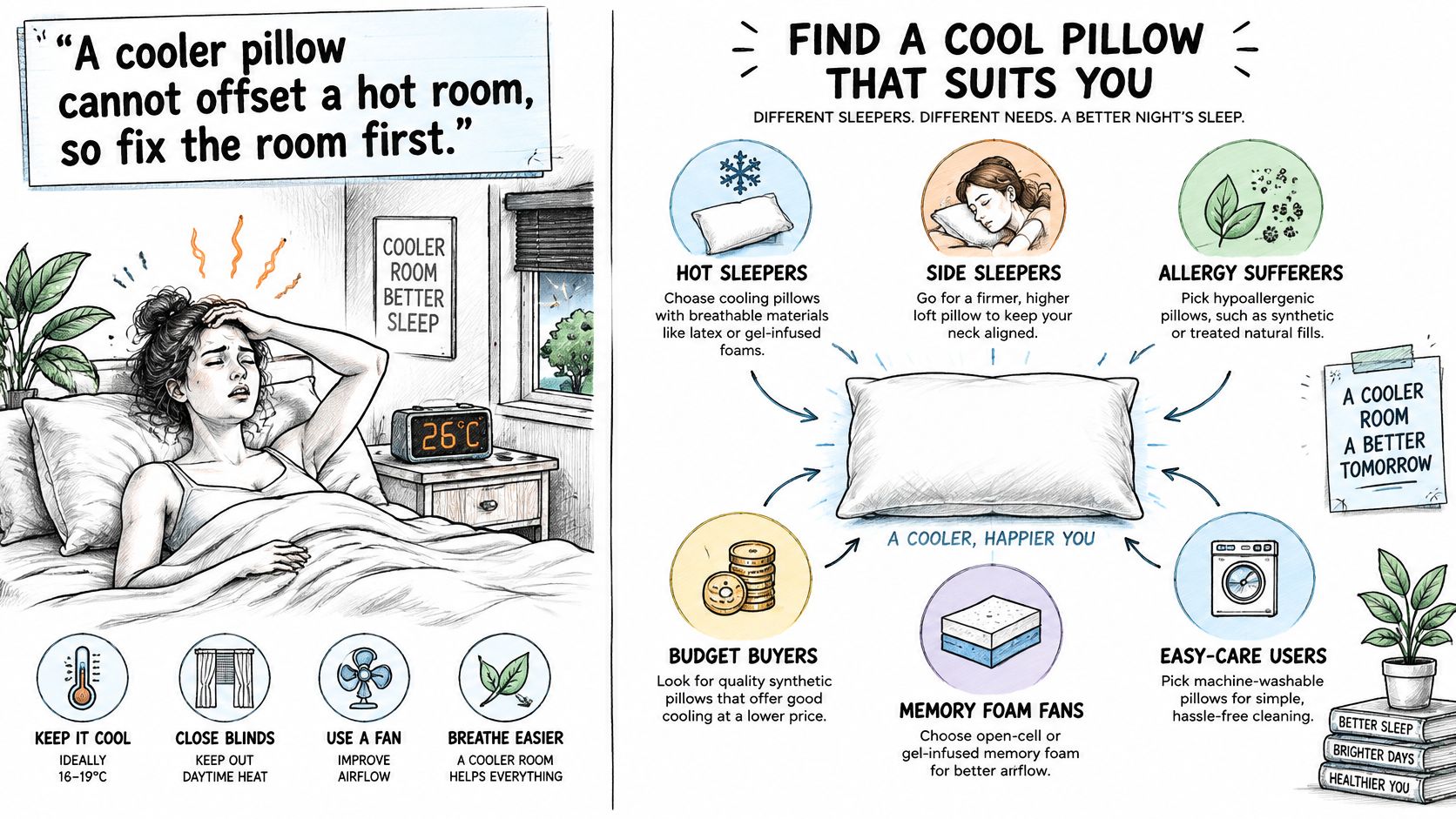
Six situations, six different picks
Hot sleepers with night sweats should prioritise moisture transfer. Lyocell or spacer fabric can suit this need; gel is mainly relevant if a cool first-touch sensation is the priority.
Side sleepers with neck pressure need a breathable fill that maintains enough height to support the neck. Open-cell foam or a sprung spacer layer may allow more airflow without the pillow losing its loft. For guidance on matching pillow height to sleeping position, see the Willis Furniture & Mattress pillow guide.
People with dust-mite allergy should weigh cleaning against surface cooling. A fully enclosed pillow protector with a 60°C care label offers a practical hygiene advantage over an open cover that cannot be washed at that temperature.
Flat dwellers without air conditioning can choose a breathable, washable cover and use evening cross-ventilation where possible. A pillow addresses the immediate sleep surface; airflow addresses heat in the room.
Couples who sleep at different temperatures may be better served by separate pillows. One person can choose a gel surface while the other chooses a moisture-wicking fabric, rather than settling on a fill that suits neither.
Parents should check care instructions against likely washing needs. A cool-touch finish with dry-clean-only care may be impractical when spills and frequent laundering are part of the routine.
From shortlist to purchase
Use the Testing section's checks to compare cooling mechanism, evidence and care instructions, then apply them to the situation above. Confirm the pillow's size and fit, and check whether the listed price covers one pillow or a pair. A surface that feels cool at first is not the same as one that manages moisture through the night.
Protect-A-Bed's Tencel Cool Pillow Protector Pair costs £30.00. Pillow protectors have a 5-year manufacturer's guarantee against defects in workmanship or materials only. A protector can add a washable layer to a pillow that already suits your head and neck; it is a different purchase from replacing the pillow itself.
Protect-A-Bed's pillow protectors offer an option for people who want a washable layer over a supportive pillow. Compare the Tencel Cool pair with the care and comfort criteria that matter to your household, then check current options, sizes and care details at Protect-A-Bed.