

What to Look for in a Mattress Protector: A UK Checklist

You're standing in a shop aisle or scrolling late at night, trying to work out what to look for in a mattress protector while every pack promises something slightly different. Waterproof, breathable, anti-allergy, hygienic, cooling. Those words don't all mean the same job, and a product that does one well may do another badly. The sensible approach is to verify each claim separately, starting with fit and liquid protection, then moving to allergy or bed bug needs, care, and paperwork.
Table of Contents
- Nine Checks Before You Buy a Mattress Protector
- Why Waterproof and Breathable Pull Against Each Other
- Fabric, Fit and Depth Checks Before You Order
- Allergy Covers, Bed Bug Encasements and Standard Protectors Compared
- How to Wash and Care for a Protector Without Losing Its Barrier
- Warranty, Certifications and Returns Worth Checking
- Choose the Right Protector for Your Situation
Nine Checks Before You Buy a Mattress Protector
It's 2am, a drink has gone over, and the sheet is already damp underneath. That moment is when you find out whether you bought a liquid barrier or a thin pad with optimistic packaging. Many shoppers buy before that test. In 2025, 49% of 1,000 UK consumers who had bought a bed or mattress in the previous 12 months also purchased a mattress protector, according to the National Bed Federation Consumer Bed Buying Survey as reported in market research.
Use the table as a lookup before you read any detail. If a listing won't answer a row clearly, that's information in itself.
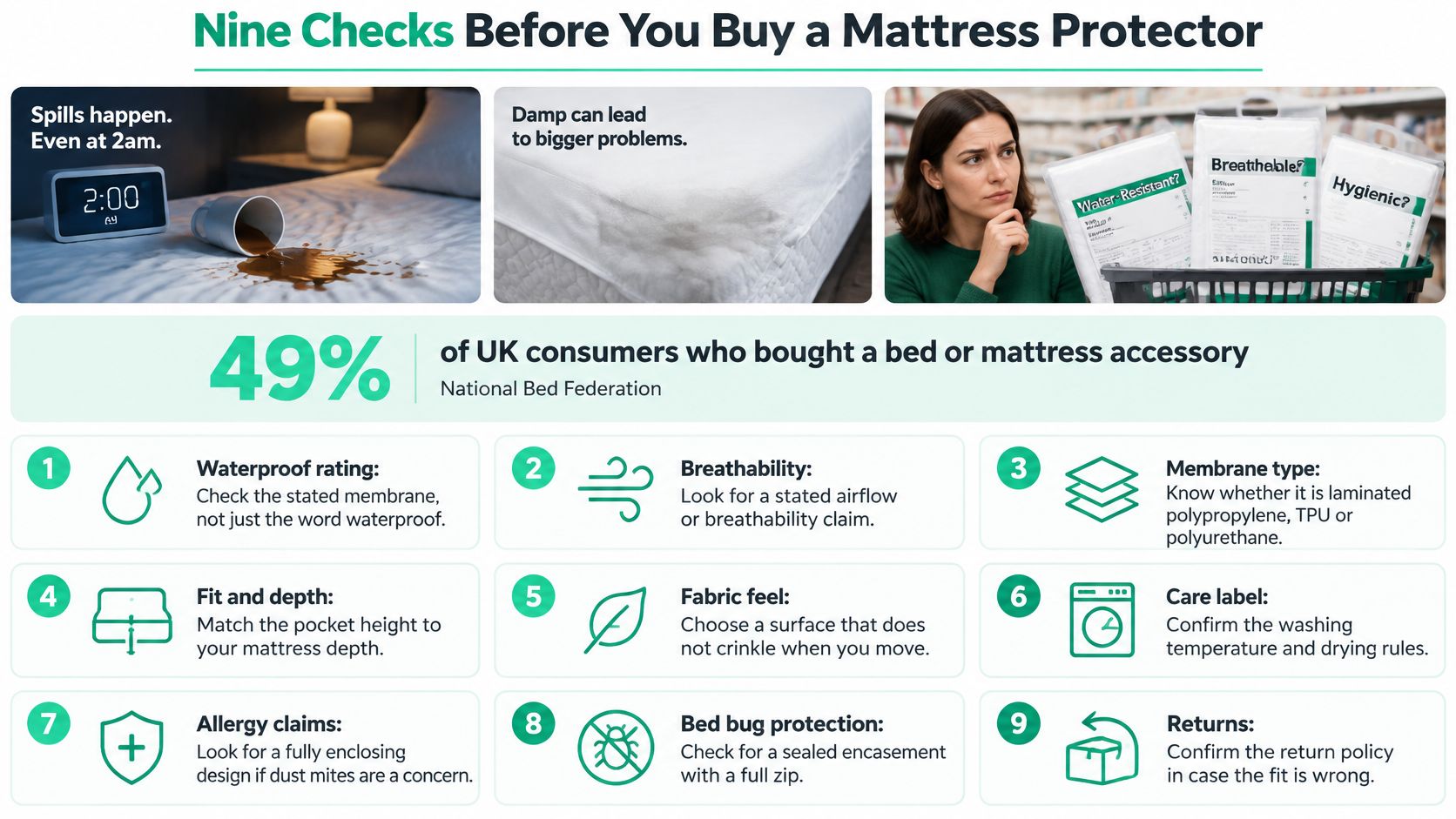
| Factor | What to check | Good sign | Red flag |
|---|---|---|---|
| Waterproofing | Liquid barrier on top and sides | Named membrane, sealed seams, stated liquid protection | Only a fabric finish or water resistant with no membrane named |
| Breathability | Vapour and airflow through the top layer | Cotton, Tencel or open-weave top; quiet when moved | Crinkly plastic feel or a claim with no supporting detail |
| Fabric | Top-layer fibre and feel | Stated fibre content such as cotton, Tencel or polyester blend | Vague terms like luxury or cooling with no fibre listed |
| Fit and depth | Length, width and maximum mattress depth | Pocket depth above your mattress height, with a deep option | Only length and width listed, no depth stated |
| Allergy barrier | Coverage and closure | Full enclosure with zip or tight closure, plus a named test | Hypoallergenic on an open-sided protector |
| Bed bug protection | Enclosure design and seals | Full zip-around encasement with secure zip and seams | Standard protector sold as bed bug protection |
| Durability and warranty | Guarantee length and terms | Written warranty covering defects, with replacement terms | No warranty, or terms that exclude every realistic failure |
| Care and washing | Label temperature and drying rules | Machine washable at a stated temperature, tumble-drying allowed | Dry clean only, or no care label |
| Certifications and returns | Named test standard and return window | Named standard with report reference, clear return period | No standard named and no return policy |
Work from the top down. Liquid protection and fit affect every sleeper, while allergy and bed bug needs change the type of product entirely. Care, warranty, and returns tell you what ownership will be like in practice.
Rule of thumb: A protector that fails the fit or waterproofing check shouldn't be bought, however good its other claims sound.
Why Waterproof and Breathable Pull Against Each Other
A protector can stop a spill and still feel hot or noisy overnight. Waterproofing and breathability depend on the same thin barrier, so improving one can affect the other. Check what the product listing specifies: a membrane type, a test method, or only the words "waterproof" and "breathable." If it offers no way to verify those claims, treat them as unconfirmed.
The membrane underneath the fabric
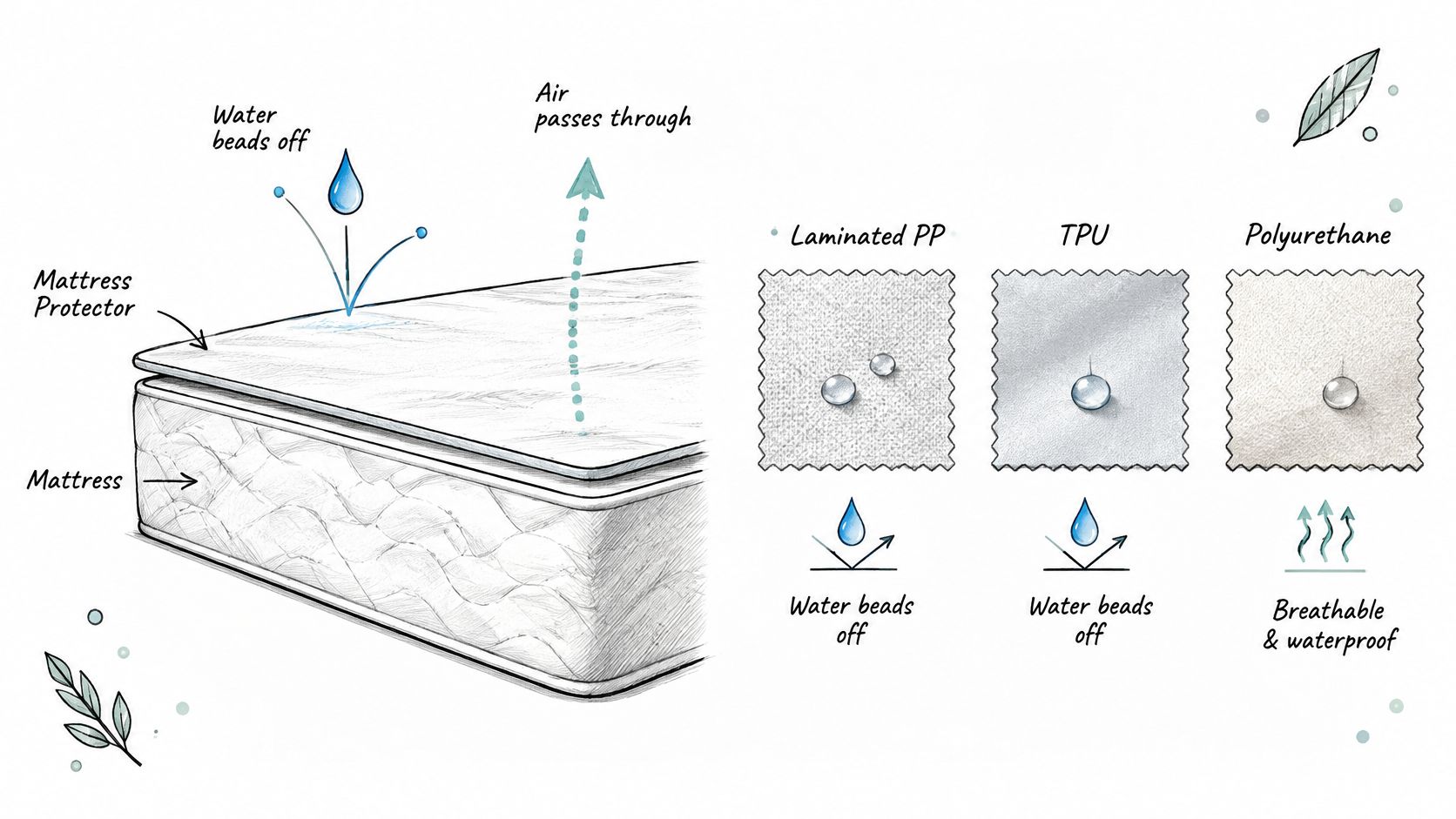
The top fabric touches your skin; the membrane underneath blocks liquid. Different constructions involve different trade-offs.
- Laminated polypropylene: An inexpensive, effective liquid barrier. Some versions may feel hot or make noise, so check the care and material details rather than assuming the top fabric determines comfort.
- Polyurethane and TPU membranes: Often more flexible and quieter, with vapour transfer that varies by thickness and lamination.
- Cotton-rich tops over any membrane: These can feel more comfortable against the skin, but the top layer alone does not show how well vapour passes through the membrane.
Protect-A-Bed describes its Miracle Membrane as flexible, silent and thin, blocking liquids while remaining air permeable. Those are product claims; consider the membrane details and how you sleep before choosing. For more on the comfort trade-off, read whether waterproof protectors make you sweat.
Who should prioritise which side
Choose based on the problem you need the protector to address. If you sleep hot, you may prefer a quieter, more breathable-feeling surface, accepting that the barrier may offer less liquid protection. If you need to contain spills from children, pets or incontinence, put liquid protection first and be prepared for a warmer feel.
These are separate jobs. A waterproof layer does not automatically control allergies or protect against bed bugs; those needs call for the relevant coverage and product design. A single protector may not do every job equally well.
A home test that settles it
Before the return window closes, test the liquid barrier and comfort. Pour a small amount of water onto the surface and check whether it beads or soaks in. Place a white towel underneath, press down, then check the towel after two minutes. Scrunch the protector to listen for crinkling, and lie on it under a sheet for a few minutes to assess warmth and noise as you move.
A damp towel means the barrier has not kept out the water in your test. Noticeable crinkling or heat may also make the protector uncomfortable for you. Use these checks alongside the product details, and judge the claims against your actual needs.
Fabric, Fit and Depth Checks Before You Order
Fabric decides how the protector feels at 3am. Cotton feels absorbent and familiar, and it's what many sleepers picture first. Tencel lyocell is often chosen for a cooler, smoother surface. Polyester and microfibre blends are usually cheaper and can feel warmer against the skin.
Don't trust adjectives. Read the fibre percentage on the label or specification. A protector described as cotton may be mostly polyester with a cotton-rich top, and words like cooling or luxury tell you nothing measurable. The stated blend does.
Measure the mattress, not the bed
Fit fails more orders than fabric does. Measure length, width, and height at the highest point, including any topper you'll leave in place. A protector with a shallow pocket won't stay on a deep mattress with a topper on top, and it'll pull off a corner within a few nights.
Check the skirt and corner construction too. A short skirt leaves the lower sides and base edge exposed, which matters if liquid runs sideways. If your mattress is deep, start with guidance on choosing a protector for deep mattresses and compare the stated maximum depth rather than guessing.
| UK bed size | Mattress size (cm) |
|---|---|
| Single | 90 x 190 |
| Small double | 120 x 190 |
| Double | 135 x 190 |
| King | 150 x 200 |
| Super king | 180 x 200 |
Confirm those dimensions against the supplier size chart, because brands don't always cut identically.
Edge cases that catch people out
- Two-piece divan bases: Measure the mattress only, not the combined base footprint.
- Mattresses with a raised border: Include the border height in your depth measurement.
- Bunk beds: The lower bunk often takes a thinner mattress, so don't order two of the same depth by default.
- Toppers added later: A protector bought today may not fit if you add a topper next year.
Order to the mattress size on its label, not the bed frame size. Frame descriptions are marketing categories. The label measurement is what has to fit inside the pocket.
Allergy Covers, Bed Bug Encasements and Standard Protectors Compared
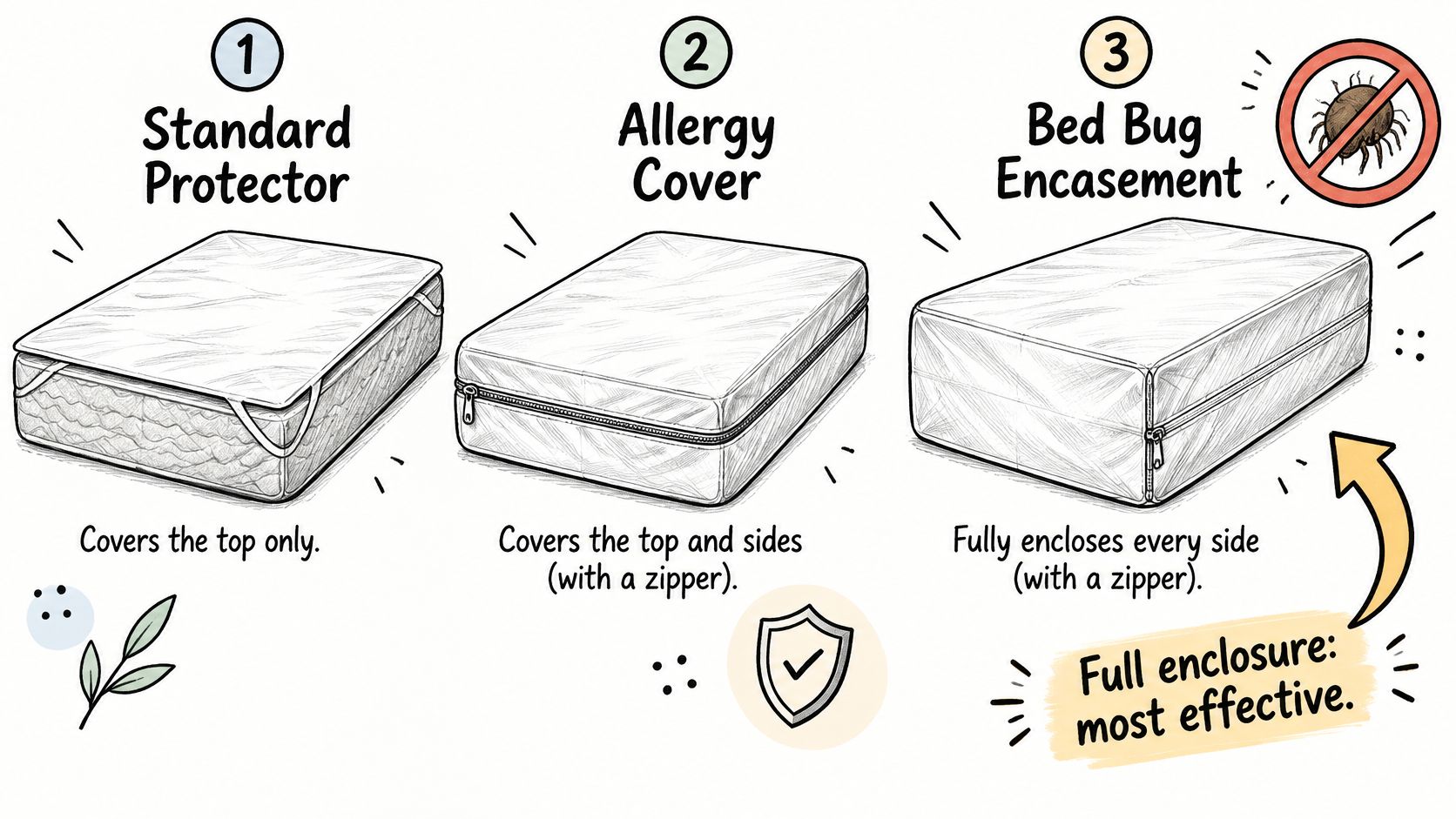
These three products get sold as if they're interchangeable. They're not, and confusing them is the most expensive mistake in this category.
The allergy case needs full enclosure
For dust-mite sensitivity, the important feature is a complete, tested allergen barrier, not padding or waterproofing. Cambridge University Hospitals guidance on dust mites in the home describes fully enclosing mattresses with barrier bedding as the “single most effective measure” for reducing exposure, while warning that the cover must also be breathable so body moisture can pass through.
NHS guidance adds a practical specification: a mite-impermeable cover should surround the entire mattress and fasten with a zip. A standard waterproof protector normally covers the top and sides only, leaving the base, seams, and gaps exposed. That doesn't make it a dust-mite barrier, whatever the word hypoallergenic on the pack suggests.
Bed bugs need a sealed encasement
The risk is growing. UK local-authority pest-control services recorded 14,882 bed-bug infestations in 2024, a 35% increase from 11,028 in 2022, according to Direct Line Home Insurance analysis reported by Aviva.
A bed bug encasement must fully enclose the mattress with a secure zip and sound seams, and be designed to stay closed during treatment. It's containment and prevention, not a cure, and it doesn't replace professional pest control. If that's your situation, read the detail on how a mattress encasement works in the UK before assuming a fitted protector will do.
| Product type | Stops spills | Dust-mite barrier | Bed bug containment | Best for |
|---|---|---|---|---|
| Standard waterproof protector | Yes | Partial, top and sides only | No | Spills, accidents, bedwetting |
| Zipped allergy cover | Often, if waterproof | Yes, if fully enclosed and tested | No, unless also rated for bed bugs | Dust-mite sensitivity, asthma, eczema |
| Bed bug encasement | Often | Yes, if sealed | Yes, with secure zip and seams | Prevention or containment of an infestation |
Read across each row rather than down the product names. Symptom improvement also can't be predicted for every sensitised person, so treat an allergy cover as exposure reduction, not a promise of relief.
How to Wash and Care for a Protector Without Losing Its Barrier
A protector is only useful if it survives your actual laundry routine. Judge it as part of a complete dust-mite control protocol, not as a standalone product, following the approach set out in NHS house dust mite information from Norfolk and Norwich.
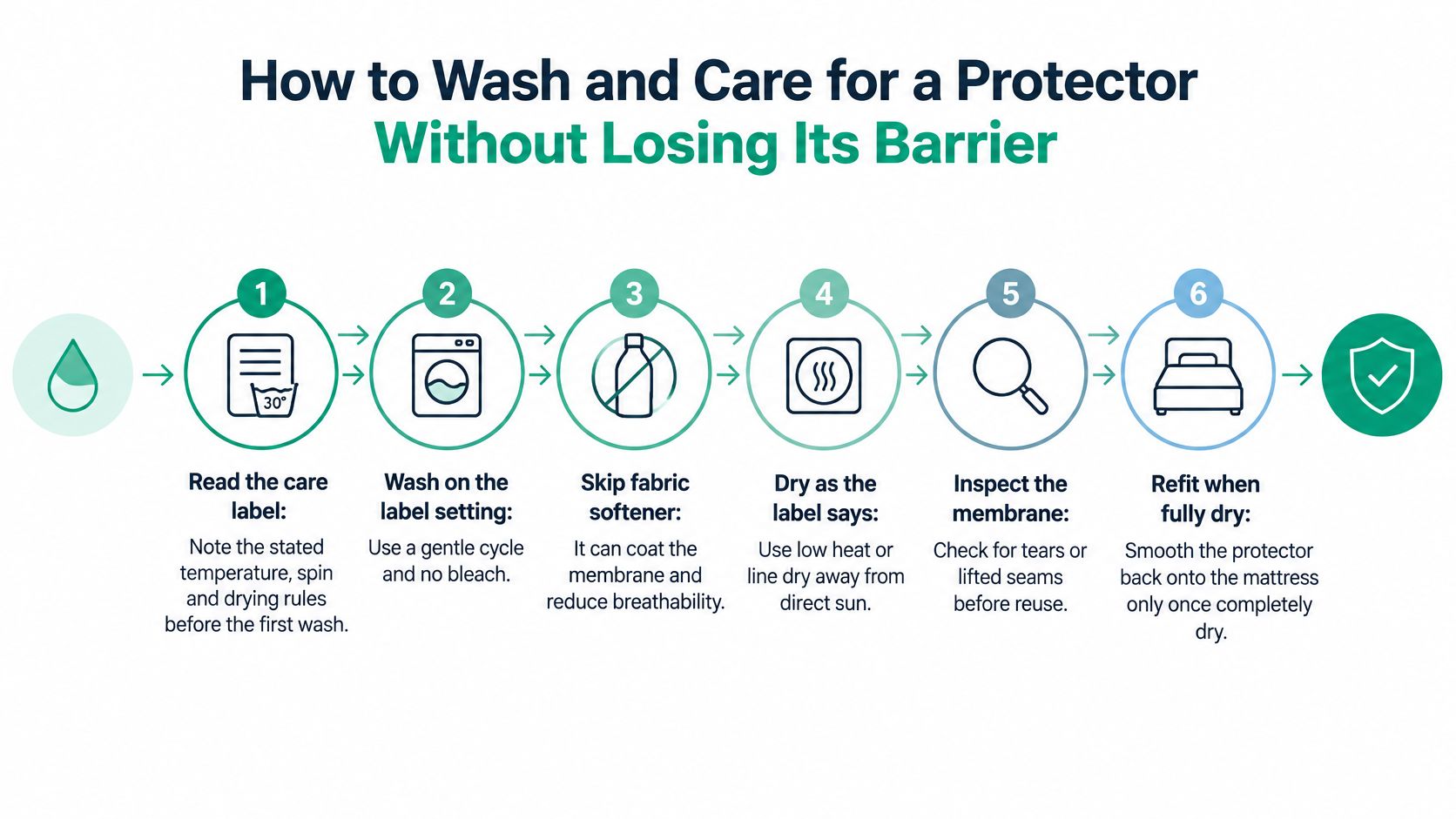
- Read the care label first: Note the stated temperature, spin, and drying rules before the first wash. This tells you whether the product fits your machine and your habits at all.
- Wash on the label setting: Use a gentle cycle and skip fabric conditioner, which can coat the surface and reduce breathability. Don't improvise a hotter wash in the hope of doing better.
- Wash other bedding weekly at 60°C: NHS guidance identifies that temperature as the benchmark for reducing dust mites, and cooler washing only partly kills them. This applies to sheets and blankets not protected by allergy covers.
- Dry fully before remaking the bed: Avoid drying wet textiles indoors where you can, since that raises bedroom humidity and works against mite control. Ventilation helps here too.
- Check the barrier after several washes: Inspect seams, zip, and skirt, then pour a little water on the top to confirm it still beads. A barrier that has delaminated won't announce itself.
Washing only the protector while leaving sheets and blankets at lower temperatures is the common pitfall. The routine only works as a whole.
Shrinkage and tumble-dryer limits explain why a protector that fits well on day one can fit poorly months later. If your household can't line dry, a protector that won't tolerate the dryer is the wrong purchase, regardless of how well it performs when new.
Warranty, Certifications and Returns Worth Checking
A warranty is only as useful as its definitions. A stated cover of up to 10 years against material or manufacturing defects sounds generous, but the value sits in what's excluded. Does staining count, or only a manufacturing fault? Is a torn zip a defect or wear? Is the remedy a like-for-like replacement, a repair, or a credit? Washing wear is often where claims fail.
Certifications need a named standard
A claim such as anti-allergy or antibacterial should name a test standard and ideally a report reference. Judge it separately from waterproof performance, because a waterproof layer alone doesn't establish dust-mite or allergen control. If a seller can't name the standard, treat the claim as decoration.
Returns and the four questions
Check the return window, whether an opened encasement can be returned for hygiene reasons, and who pays return postage. Then ask before paying:
- What counts as a defect: Get the definition, not the headline term.
- What replacement looks like: New product, credit, or partial refund.
- Which test standard applies: Ask for the named standard behind any health claim.
- How long returns take: Include refund timing, not just the window to send it back.
Commercial buyers should go further. Confirm warranty cover per unit, replacement lead times, and the wash-life assumption in writing, so you can compare suppliers on equal terms rather than on headline years.
Choose the Right Protector for Your Situation
A protector that suits a hot sleeper may not contain bed bugs or control allergens. Choose for the job you need, then check the label and construction: waterproofing, breathability, allergy control and pest containment are separate functions, and one product may only partly deliver each.
| Situation | Priority | Protector to look for | Check before buying |
|---|---|---|---|
| Hot sleeper | Airflow and low noise | Cotton or Tencel surface with a membrane described as vapour permeable | Listen for rustling and check how the fabric feels beneath a sheet |
| Young child or baby | Liquid protection and a safe fit | Waterproof protector suited to the mattress and sleep-system instructions | Confirm it fits securely and follows the manufacturer's guidance |
| Dust-mite allergy or asthma | Allergen containment | Fully enclosed, zipped cover with a named allergen test | Check the closure and whether the care label allows laundering at 60°C |
| Bed bug risk | Sealed containment | Purpose-designed encasement | Inspect zip security and seams; a standard protector is not a substitute |
| Incontinence or pets | Washable liquid barrier | Waterproof construction with a washable top layer | Check care instructions and barrier performance after washing |
| Landlord, hotel or care home | Durability and frequent turnover | Heavy-duty waterproof protector or encasement | Confirm the warranty terms and stated wash-life expectations |
These jobs call for different checks. A waterproof membrane can help contain spills, but it does not establish breathability, allergen control or bed bug protection. Likewise, an encasement's zip and seams matter for containment, while allergy claims need a named test. A protector cannot replace laundering, humidity control, professional pest control, or child-sleep and fire-safety compliance.
For babies and young children, check the complete sleep system and the mattress maker's instructions before adding a cover. The UK's Furniture and Furnishings (Fire) (Safety) Regulations address mattresses, including those intended for babies and children within specified dimensions. Do not assume any protector is suitable just because it fits.
Your final sequence
- Measure the mattress length, width and depth at its highest point, including any topper.
- Choose the row that matches your main need, then check whether the product is designed for that job.
- Verify the relevant label, test, closure or care instructions. Do not infer one function from another.
- Compare warranty and return terms before considering price.
- Order the exact size and confirm the maximum mattress depth the protector accepts.
If you're ready to apply these checks to real products, Protect-A-Bed sells waterproof mattress protectors in cotton, Tencel, and other fabric options alongside sealed bed bug encasements and pillow protectors for homes and commercial settings. Compare the stated depth, membrane, care label, and warranty terms on each product against your situation row, then order the size that matches your mattress label.