

How to Choose a Mattress Protector for Deep Mattresses

You've bought a thick, comfortable mattress, added a plush topper, and now the fitted protector keeps pulling off one corner during the night. The problem often isn't poor elastic or an awkward bed frame. It's that the protector was chosen for the mattress label or surface size, rather than the complete height of the mattress and everything resting on it.
A mattress protector for deep mattresses needs to fit the full sleeping profile, protect without restricting the mattress, and remain comfortable after repeated washing. The deepest option on the shelf isn't automatically the right one. A properly measured protector with a secure skirt, suitable membrane and appropriate fabric will usually perform better than an oversized cover that bunches beneath the bed.
Table of Contents
- Why Deep Mattress Protection Needs a Different Approach
- Measure the Mattress and Match the Fitted Skirt
- Compare Waterproof, Breathable and Cooling Fabrics
- Choose a Protector for Memory Foam and Pillow-Top Beds
- Fit, Wash and Maintain the Protector Correctly
- Buy by Features Rather Than Depth Labels Alone
- Make Your Final Deep Mattress Protector Decision
Why Deep Mattress Protection Needs a Different Approach
The familiar fitting routine goes wrong quickly. You stretch one corner over the mattress, pull the opposite corner into place, and the first side springs loose. After a few attempts, the protector appears to fit, but the fabric is strained across the top and the skirt barely reaches beneath the mattress. Overnight movement then exposes the corners and leaves the waterproof layer working under unnecessary tension.
That happens because depth is more than the foam or spring unit inside the mattress. A pillow-top, sewn comfort layer or separate topper adds height to the surface you need to protect. A mattress can also have softer, rounded edges that give elastic less firm material to grip. Which? found no single standard mattress depth in the UK. Its tested mattresses ranged from under 20 cm to more than 30 cm, with measurements from 11.5 cm to 69.5 cm deep, as documented in its UK mattress sizing evidence.
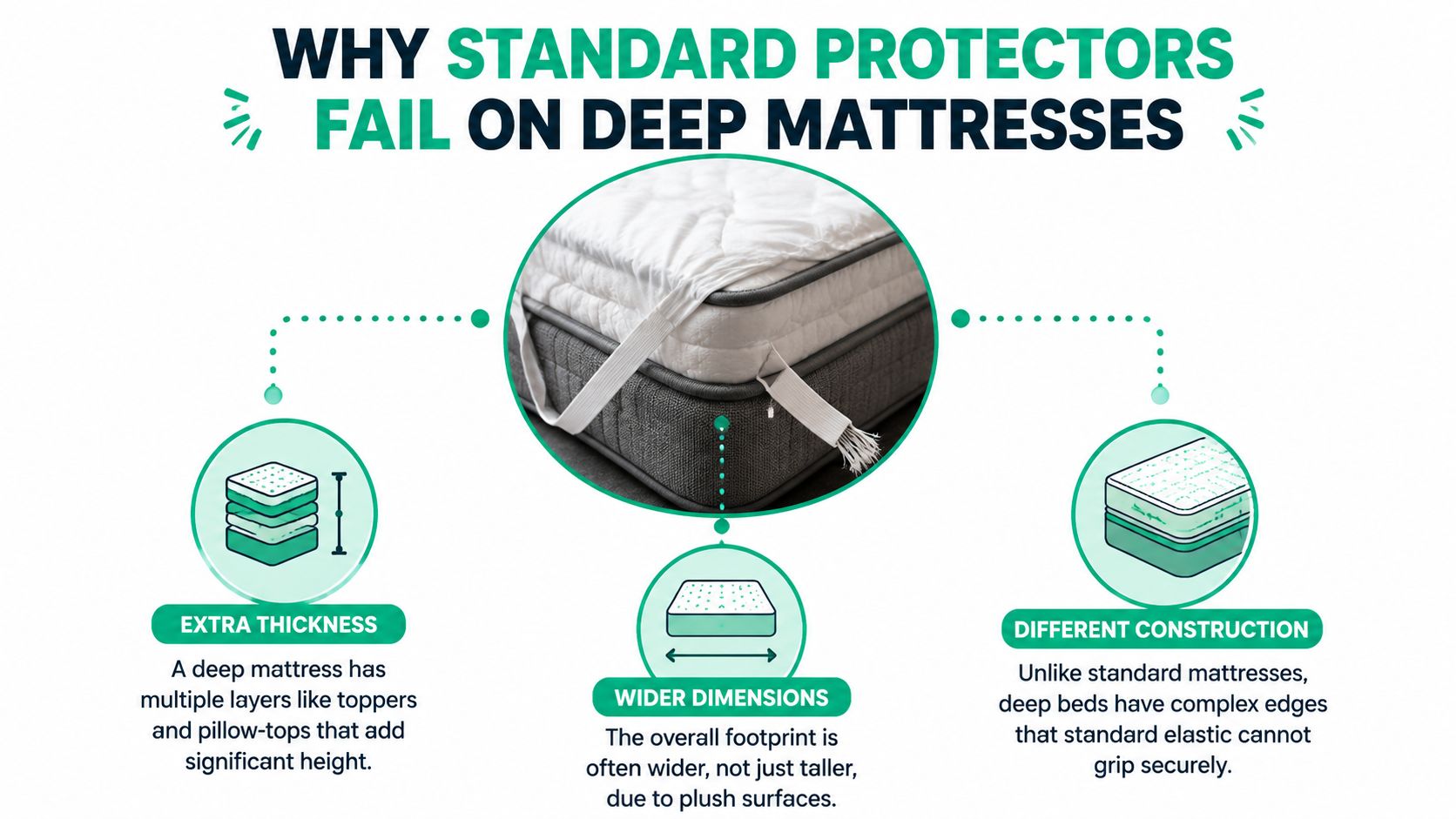
Depth labels can hide the real fitting problem
Retail descriptions such as standard, deep and extra deep are useful starting points, but they aren't universal measurements. One manufacturer's “deep” skirt may be designed for a different profile from another's. A protector that fits the mattress alone may fail once a topper is included.
The Tip Top Furniture & Mattresses bedding guide offers useful general bedding context, but your own tape measurement should decide the size. Start with the bed as it's used, not with a marketing category.
Practical rule: Choose protection for the complete mattress-and-topper profile first. Fabric, cooling finishes and design features only matter once the cover stays in place.
A secure fit also supports hygiene. UK allergy research found that new mattresses can become a significant source of mite allergen exposure in less than four months, while a controlled trial recorded a mean Der p 1 concentration reduction of 25.7 in the active cover group compared with 4.5 in the placebo group. The findings, available through the UK bedding allergen research record, support the value of a sealed, washable barrier, although a protector alone doesn't guarantee symptom improvement.
Measure the Mattress and Match the Fitted Skirt
Measure before comparing materials. The most reliable result comes from an uncovered bed, a rigid tape measure and the thickest part of the sleeping surface.
Use the bed's complete profile
Remove sheets and decide where the protector will sit. If it needs to cover both mattress and topper, leave the topper in place. Measure vertically from the bottom edge of the mattress or foundation to the highest usable point on the top surface. Don't press the tape into a soft pillow-top, because compression will make the result look smaller than the profile the skirt must clear.
Take a second check at the side, especially if the mattress has a rounded edge or uneven construction. The BS EN 1334 domestic mattress measurement standard explains how mattress dimensions are defined, while practical protector fitting still depends on the actual depth of your assembled bed.
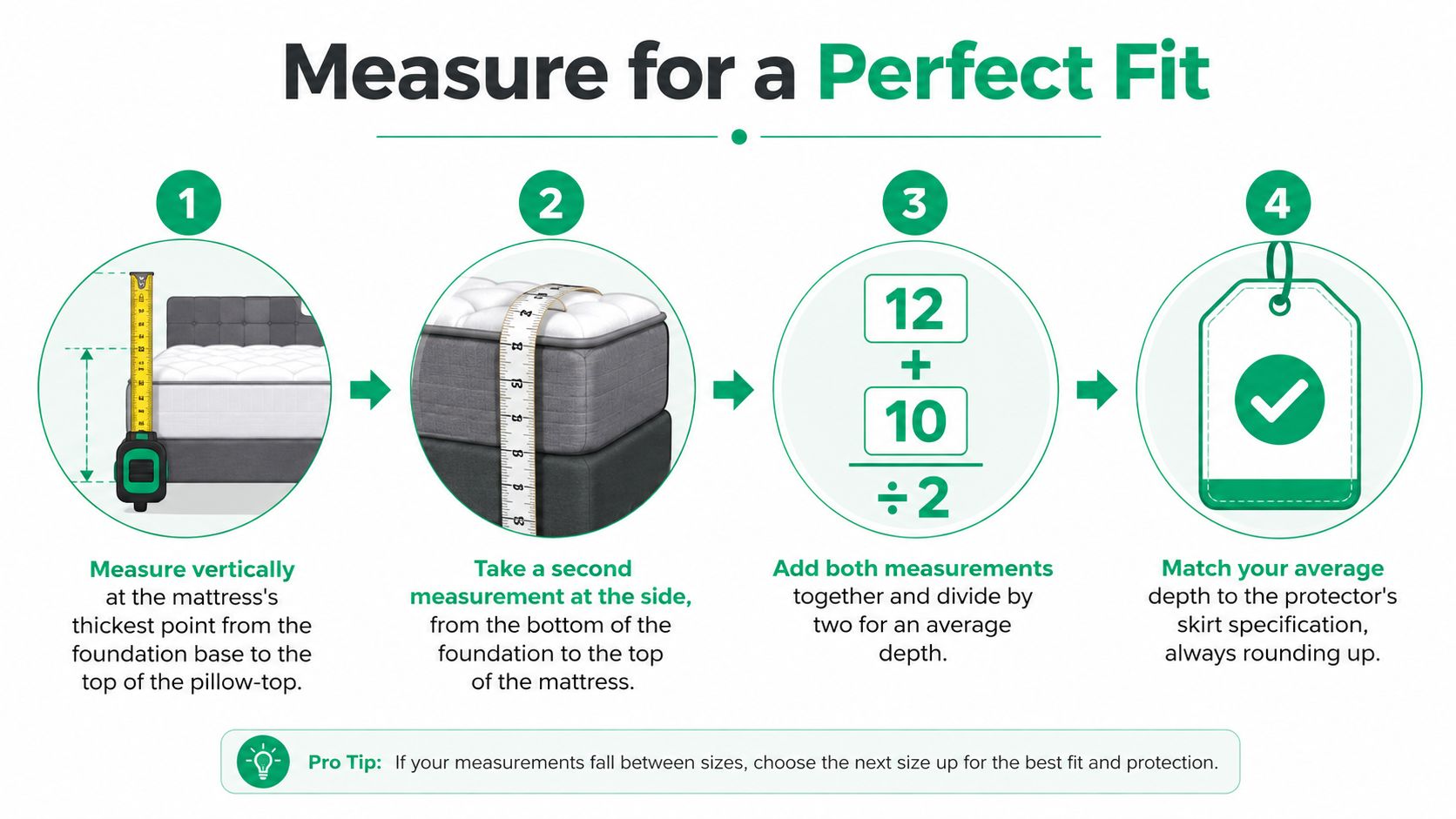
Use this process:
- Measure the highest point. Include a topper or comfort layer if the protector will cover it.
- Check the side profile. Confirm that the first measurement represents the thickest area, not a compressed or recessed edge.
- Record the footprint separately. Length and width determine the protector size, while depth determines whether the skirt can reach underneath.
- Compare the measurement with the product specification. Look for the actual fitted depth, not just the words “deep” or “extra deep”.
A small amount of spare skirt is helpful because soft materials compress when you fit the cover and move in bed. If you're between specifications, rounding up generally makes fitting easier, but excessive spare fabric can gather underneath and affect the surface above.
Understand skirt behaviour
The skirt is the elasticated fabric that travels down the mattress sides. Its quality depends on more than its advertised reach. A full-perimeter elastic edge normally distributes tension more evenly than corner-only elastic, while a flexible knit can conform to rounded edges more readily than a rigid woven fabric.
Run three checks after fitting:
- Coverage: The skirt should reach below the mattress side and sit securely underneath.
- Tension: Elastic should lie flat without rolling, cutting into the fabric or pulling a corner upwards.
- Surface: The protector should smooth across the top without visible strain, ridges or exposed areas.
If the skirt clears the top but cannot sit beneath the mattress, it's too shallow. If it reaches underneath but forms thick folds across the sleeping surface, it may be unnecessarily deep or poorly shaped. For a detailed visual process, use this guide to measuring mattress depth.
Compare Waterproof, Breathable and Cooling Fabrics
A protector has two jobs that can conflict. The top surface should feel comfortable against the sleeper, while the backing must stop liquid from reaching the mattress. A soft fabric alone isn't necessarily waterproof, and a completely impermeable material may feel hot or noisy.
Polyurethane films are widely used because they can block spills while remaining flexible and relatively quiet. Their trade-off is that any waterproof backing can reduce the sensation of airflow compared with an uncoated sheet. A laminated polyester blend may give a smoother hand and useful spill resistance, while vinyl offers a more rigid, fully waterproof surface that can feel warmer and noisier.
Cotton or bamboo terry fabrics can feel absorbent and comfortable, but they usually need a separate membrane for full liquid protection. Moisture-wicking finishes and cooling fibres can make a covered surface feel drier, yet they won't compensate for a protector that fits badly and shifts away from the areas at risk.
| Fabric or Membrane | Waterproofing | Breathability | Noise | Feel | Best For |
|---|---|---|---|---|---|
| Polyurethane film | Strong liquid barrier | Moderate, depending on construction | Low | Flexible and smooth | Everyday spill and perspiration protection |
| Laminated polyester blend | Strong when fully bonded | Moderate | Low to moderate | Soft, smooth or lightly textured | Families wanting a balance of comfort and defence |
| Vinyl | Very strong | Low | Moderate to high | Firmer and more plastic-like | Situations where maximum liquid resistance matters most |
| Cotton terry with membrane | Strong when backed | Moderate to good | Low | Soft and absorbent | Sleepers who prefer a natural-feeling surface |
| Bamboo-style terry with membrane | Strong when backed | Moderate to good | Low | Soft and moisture-friendly | Hot sleepers who prefer a gentler surface feel |
The right selection depends on the room and sleeper. Children, pets or frequent spills justify prioritising a dependable membrane. Someone who sleeps warm may prefer a quieter, more flexible waterproof layer with a breathable top fabric rather than a thick, rigid barrier.
Protect-A-Bed's waterproof protector guide provides further explanation of how waterproofing and comfort features interact. The useful question is not “Which fabric is best?” It's “Which combination protects this bed without making the sleep surface unpleasant?”
Choose a Protector for Memory Foam and Pillow-Top Beds
Memory foam changes shape under pressure. A thick foam mattress may compress noticeably where you sleep, but you still need to fit the protector around its full, unloaded height. Choosing only for the compressed sleeping area can leave the skirt overstretched at the corners or unable to return smoothly when the bed is empty.
A pillow-top creates a different challenge. Its upper comfort layer is attached to the mattress, so it behaves like a built-in topper. The side transition can be soft and rounded, giving a shallow or weakly elasticated protector less structure to grip. A deeper skirt with strong recovery is generally more reliable, provided it doesn't leave excess material gathered under the sleeper.
Match the construction, not just the thickness
Stretch-knit fabrics tend to follow foam contours and plush edges more easily than crisp woven covers. That flexibility can reduce tugging as the mattress compresses, but the material still needs a stable waterproof backing if liquid protection is required.
For a hybrid or pillow-top bed, check that the protector's dimensions suit the mattress footprint as well as its depth. A protector can have generous vertical reach and still fit poorly if its length or width is wrong. Full-perimeter elastic also helps distribute movement around the bed rather than concentrating pull at four corners.
Consider allergens without overpromising
Foam can absorb dust, skin particles and other household debris within its open structure. A fully fitted or encased protector can create a washable barrier over the mattress surface and sides, which is particularly useful when cleaning the mattress itself isn't practical.
The clinical evidence is more nuanced than a simple allergy promise. The King's College London trial recorded lower measured mite allergen in the active cover group, but it found no significant improvement in peak flow or asthma symptoms. The New England Journal of Medicine trial report also concluded that allergen-impermeable bed covers alone weren't effective for routine adult asthma management.
For a hot sleeper, prioritise a light, flexible top fabric and avoid unnecessary bulk. For an allergy-sensitive household, prioritise complete coverage, a secure seal and washing instructions you can follow consistently. A protector should support wider bedroom hygiene, not replace it.
For more detail on foam compatibility, see this memory foam mattress protector guide.
Fit, Wash and Maintain the Protector Correctly
Even the right protector can perform poorly if it's fitted under tension. Start at the head of the bed, place the top corners fully over the mattress, then work down the sides rather than stretching one corner as far as possible. This distributes the elastic and reduces the chance of pulling the waterproof layer sideways.
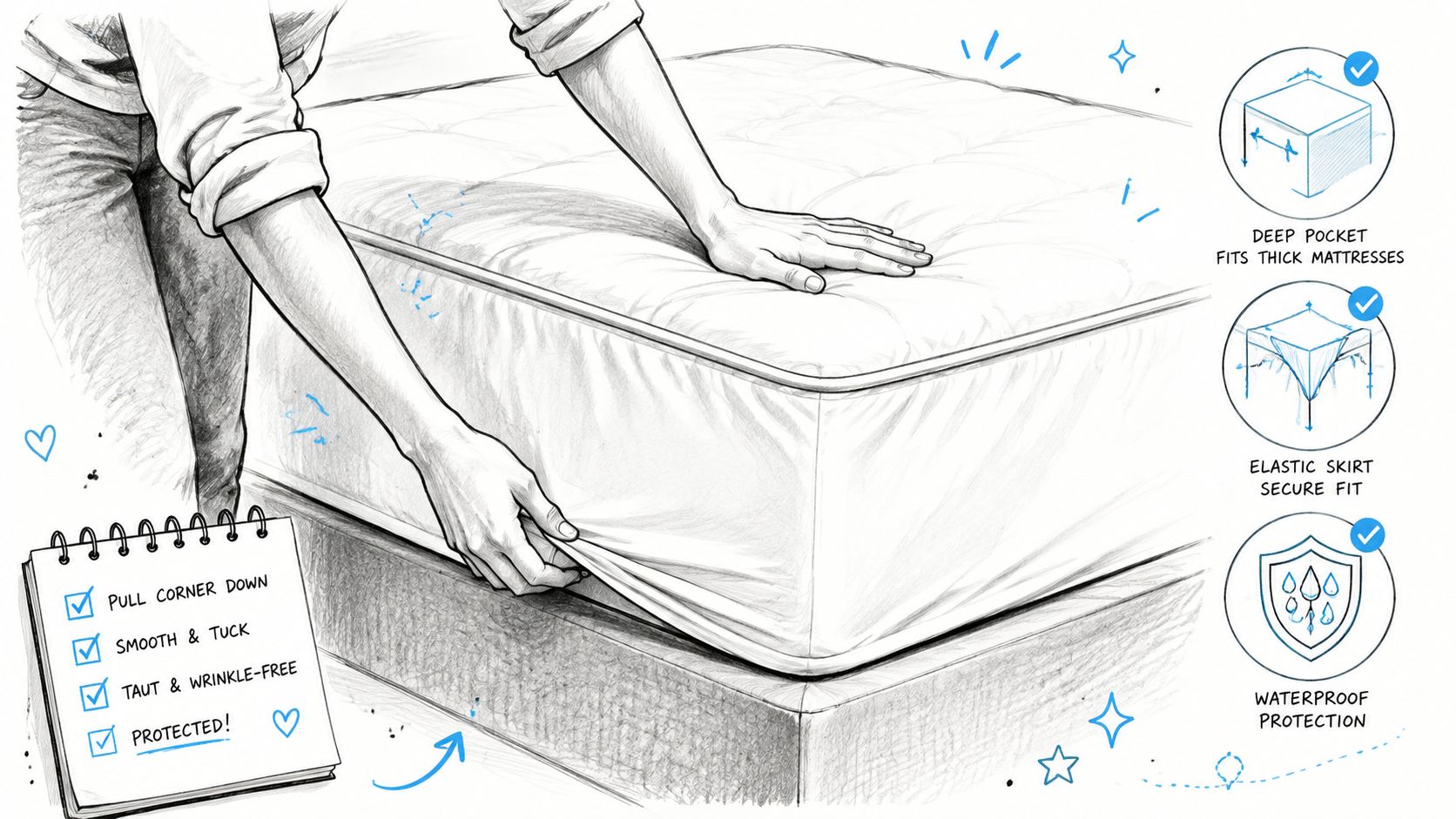
Install it without creating stress points
Once all corners are in position, smooth the top from the centre towards the edges. Check that seams aren't folded beneath the sleeper and that the skirt extends below the mattress rather than stopping at the side seam. If the protector has a waterproof face, keep that surface facing the mattress as directed by the care label.
Use these checks before replacing the sheet:
- Corners stay anchored: Lift each corner of the sheet lightly. The protector should remain in place.
- Elastic lies flat: A rolled or twisted edge can pull unevenly and create gaps.
- Top surface is smooth: Wrinkles can become pressure points and may signal an undersized skirt.
- Sides remain covered: No exposed strip should appear when the mattress is pressed.
Wash according to the manufacturer's instructions. In general, cool or warm water, mild detergent and low-heat drying are gentler choices for waterproof membranes. Chlorine bleach and fabric softener can weaken or coat components, so avoid them unless the care label specifically permits their use.
Diagnose changes after laundering
Corner lift usually points to insufficient skirt depth or a profile that includes an unmeasured topper. If the protector fitted well at first but now slips, worn elastic or repeated high-heat drying may be responsible. A damp mattress surface suggests the membrane has been compromised, which can result from age, abrasion or harsh washing.
Keep a simple care rhythm. Rotate the protector when its design allows, spot-clean small marks promptly and deep-wash it at a regular interval suited to your household. Recheck the fit after washing, because fabric and elastic can settle as they dry.
Buy by Features Rather Than Depth Labels Alone
A depth label is only useful when you know what it measures. Some specifications describe the maximum mattress depth, while others describe the skirt length before stretching. Read the fitting instructions and look for a clear range, particularly if your bed combines a thick mattress with a topper.
The UK market commonly lists deep protectors around 30 cm and extra-deep options around 38 cm, while fewer listings explicitly reach 40 cm, 50 cm or 60 cm, as illustrated by current UK deep protector listings. That range suggests why pillow-top and topper combinations need a measurement-led approach rather than a simple regular-versus-deep choice.
| Priority Feature | What to Check | Where Higher Budget Helps |
|---|---|---|
| Accurate skirt depth | The stated range and whether it includes stretch | Useful when the complete profile is unusually deep |
| Waterproof membrane | Construction details and any available testing information | Can support quieter, more durable protection |
| Breathable top fabric | Fibre content, surface texture and moisture handling | May improve comfort for warm sleepers |
| Textile safety certification | Recognised certification named in the specification | Helpful when skin contact and household sensitivity matter |
| Elastic construction | Full-perimeter design, reinforced attachment and recovery | Worth considering for heavy mattresses and frequent washing |
| Warranty terms | What defects are covered and for how long | Valuable when the protector is used often or commercially |
Spend on performance, not decoration
A higher-priced protector may offer a softer hand, a more flexible membrane, stronger stitching or a longer warranty. Those differences can matter if the cover will be washed frequently, used on a heavy pillow-top or relied on for allergy and spill control.
Extra cost is harder to justify for printed patterns or scent finishes that don't improve fit, protection or care. Likewise, an oversized protector isn't automatically better. If your measured profile needs a moderate deep fit, excess fabric can bunch beneath the mattress, while an undersized skirt may shift and leave the waterproof surface out of position.
The best value is the protector that fits the profile you measured and survives the care routine you'll actually follow.
Protect-A-Bed offers fitted waterproof protectors with stretch-based skirt designs for deep mattress profiles, alongside fabric options intended to balance liquid protection and sleep comfort. Treat those specifications as part of your shortlist, then compare them with the measured height, construction and washing requirements of your own bed.
Make Your Final Deep Mattress Protector Decision
Bring the decision down to four checks. First, measure the mattress plus topper as one complete profile if both will sit beneath the protector. Second, choose a skirt that reaches underneath without pulling the corners up or leaving folds across the sleep surface.
Third, pair a waterproof membrane with a top fabric suited to the sleeper. A warm sleeper may value a lighter, breathable surface, while a household dealing with frequent spills may prioritise a stronger liquid barrier. Fourth, check the protector against the mattress construction. Memory foam needs flexible coverage that can follow compression, while pillow-top beds need enough skirt reach to clear their softer upper edge.
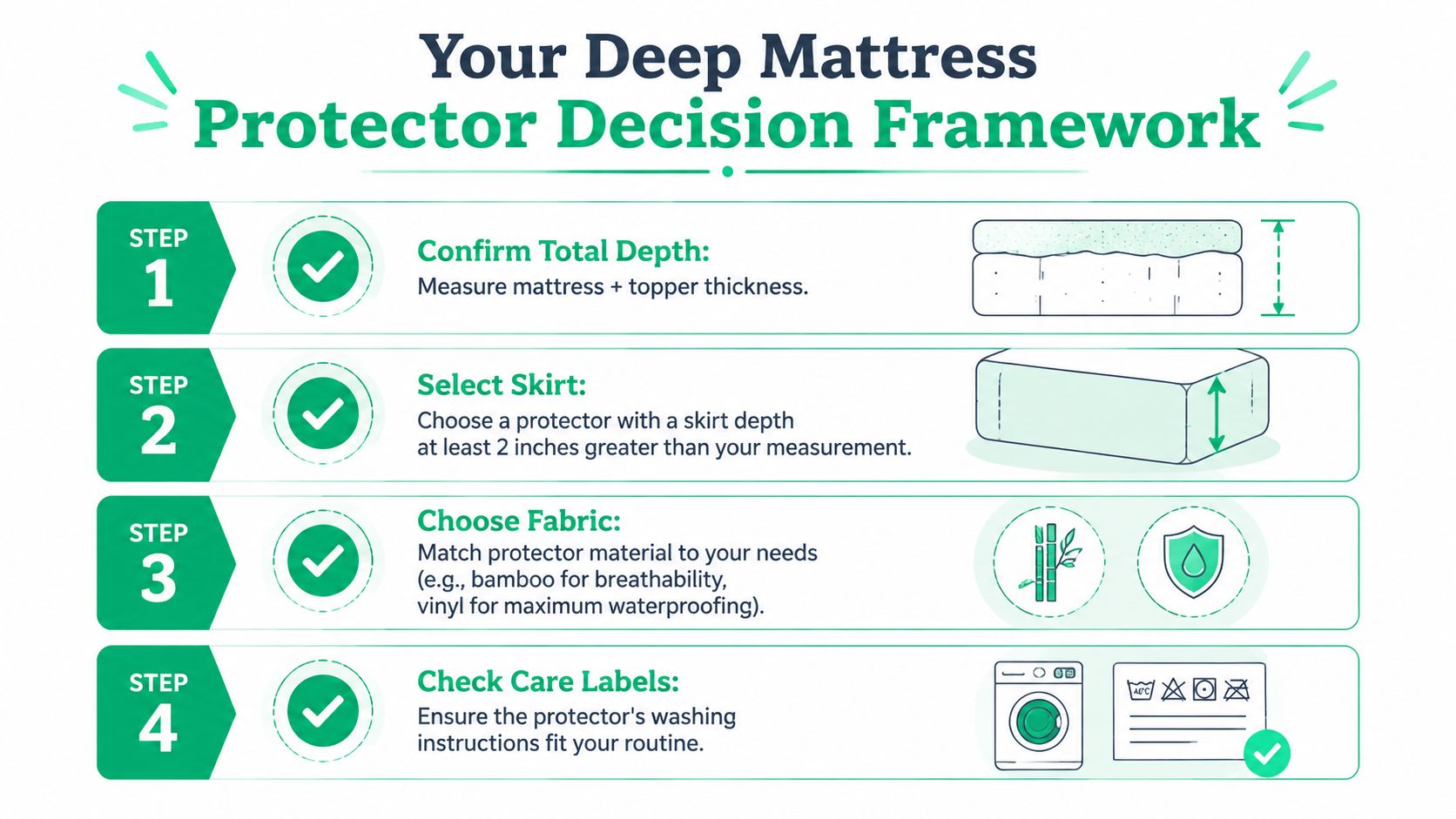
Use this final pass before buying
- Confirm total depth: Measure the mattress, topper and any fixed comfort layer together.
- Select the skirt: Choose a specification that clears the measured profile without excessive loose material.
- Choose the fabric: Balance waterproofing, breathability, noise and surface feel for your household.
- Check care labels: Make sure the washing and drying routine is realistic for you.
Depth labels alone can mislead. The right mattress protector for deep mattresses is the one that stays anchored, covers the complete sleeping profile, protects the underlying construction and remains comfortable after care. Recheck the corners after the first wash and whenever you add or remove a topper.
Protect-A-Bed offers UK mattress protectors with waterproof, air-permeable Miracle Membrane technology, stretch-fit designs and options for different sleep preferences and mattress depths. Use your measurements to review the suitable fitted styles, then visit Protect-A-Bed to choose protection that matches your bed's complete profile.