

What to Do if You Find Bed Bugs: A Step-by-Step Plan

You've pulled back the sheet and found a small brown insect near the mattress seam. Now you're looking at the bedding, wondering whether to strip everything off, move into the spare room or throw the mattress away. Don't carry bedding or furniture into another room. That well-meant clear-out can spread the problem before you've identified it.
Knowing what to do if you find bed bugs starts with containment, not a shopping list of sprays. The first day matters because you can stop belongings travelling, preserve useful evidence and arrange help before a bedroom problem becomes a household or building-wide one.
Table of Contents
- The First 24 Hours After Finding Bed Bugs
- Laundering and Heat Treating Belongings by Item
- Inspecting Your Room for Signs and Spread
- Encasements and Everyday Prevention
- Who Pays and Acts
- Booking Professional Treatment and Follow-Up Visits
The First 24 Hours After Finding Bed Bugs
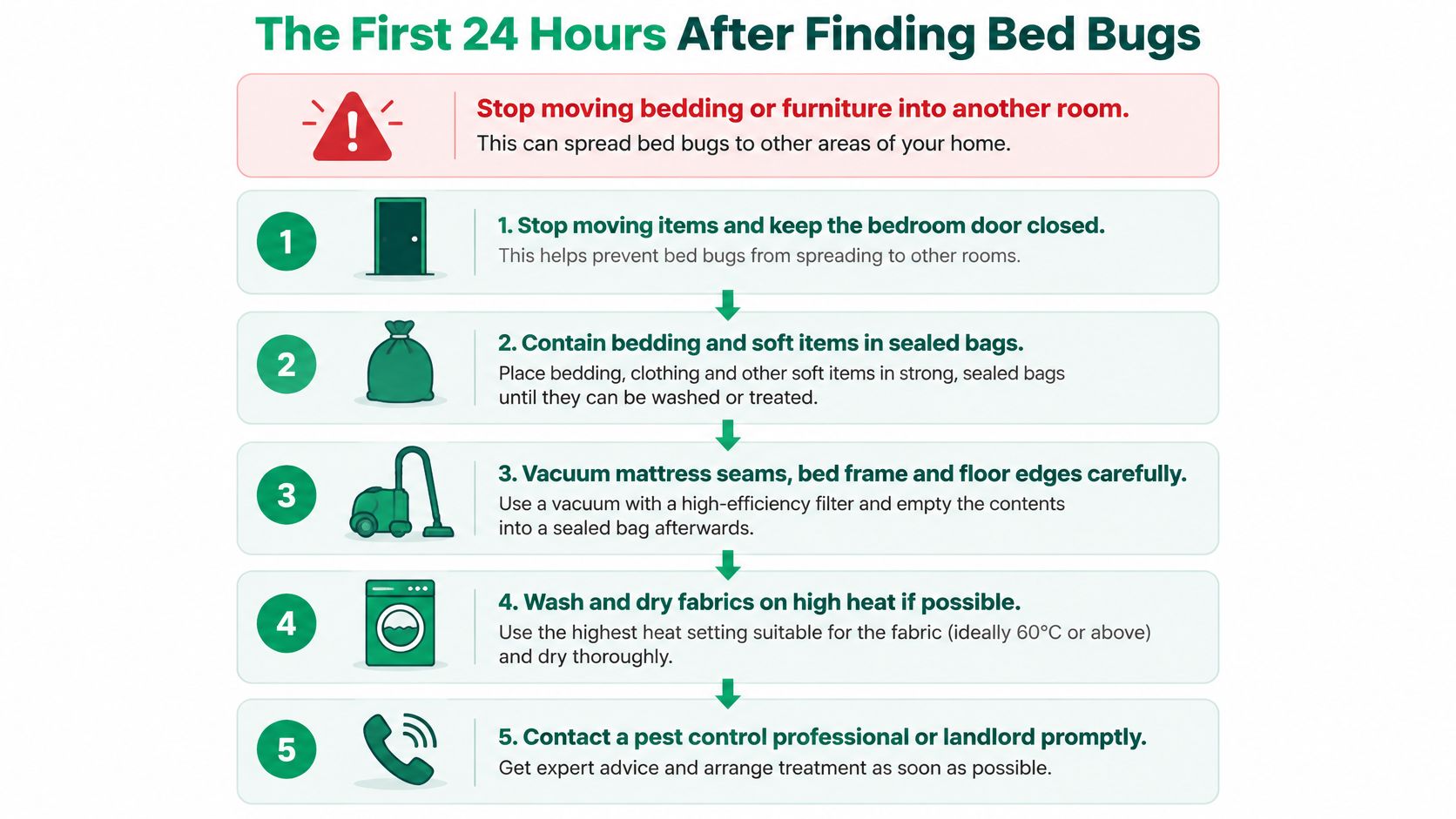
Keep your response deliberate. You don't need to empty the house, and a closed bedroom door won't make the room bug-proof, but controlling access helps stop people carrying loose textiles elsewhere.
Contain the room before cleaning
- Stop moving items and close the bedroom door. Keep visitors, pets and household laundry traffic out while you organise containment.
- Photograph the evidence. Capture insects, shed skins, dark spots and bedding stains, then note where and when you found them before disturbing anything.
- Separate the bed from its surroundings. Move it clear of walls, lift trailing bedding off the floor and bag belongings from underneath rather than carrying them elsewhere.
- Seal loose bedding and clothing in plastic bags. Bag items beside the bed, without shaking them, so insects aren't scattered during handling.
- Vacuum accessible hiding places. Use a crevice attachment on mattress seams, frame joints, skirting boards, cracks and drawers, then seal the vacuum contents and put them straight into an outside bin.
- Don't move the furniture or switch bedrooms. Sleeping on the sofa or relocating the bed can spread bugs to fresh hiding places.
- Contact your council or a professional pest-control service. Describe the evidence and ask for identification, inspection and preparation instructions.
Vacuuming reduces accessible insects; it doesn't reach every concealed bug or egg. Don't dismantle the whole room in a panic, spray unidentified insects with shop-bought pesticides or order a replacement bed while the surrounding furniture remains untreated.
Practical rule: Bag first, move only for a planned treatment, and never use another bedroom as temporary storage.
For another household-focused checklist, FullScope Pest Control's Kingwood homeowner's guide to bed bugs offers a useful companion resource. For a UK home, follow local preparation advice and the treating professional's instructions rather than assuming every treatment approach transfers unchanged.
Look after bites without confusing relief with control
Keep affected skin clean, avoid scratching and apply a cool, clean damp cloth. A pharmacist can advise on antihistamines or mild hydrocortisone, but the NHS bedbug guidance says children under 10 and pregnant people should obtain medical advice before using hydrocortisone.
Get medical attention if pain, swelling or itching remains severe after pharmacy treatment, or swelling or pain spreads. Treating the skin won't remove the infestation, so make the inspection call even if the itching settles.
Laundering and Heat Treating Belongings by Item
Treatment for each belonging
The British Pest Control Association's bed-bug control guidance specifies washing at a minimum of 60°C, or tumble-drying on a hot setting for at least 30 minutes, and accepts sealed deep-freezing for at least three days for suitable non-washable items; these are the treatment settings used below.
| Item | Can it be washed? | Treatment | Temperature or time |
|---|---|---|---|
| Bedding and sheets | Yes | Wash, then tumble-dry on hot if the fabric permits | Use the wash and dryer settings above |
| Clothing | Yes | Wash, then tumble-dry on hot if the fabric permits | Use the wash and dryer settings above |
| Delicate fabrics | Sometimes | Dry-clean, or seal in plastic and deep-freeze if suitable | Use the freezing minimum above |
| Pillows and soft toys | Check the label | Hot-wash and dry only where permitted; otherwise assess for freezing | Use the stated heat settings only if the label permits |
| Shoes and bags | Usually no | Seal and deep-freeze if the materials are suitable | Use the freezing minimum above |
| Books and paper | No | Seal and deep-freeze if suitable; seek advice for valuable material | Use the freezing minimum above |
| Electronics | No | Don't freeze or heat; contain safely and ask a pest controller | Keep isolated pending an item-specific treatment plan |
| Mattress | No | Professional treatment in place; fit a suitable encasement when advised | Follow the treatment and drying instructions |
Heat must reach the whole load
A packed dryer doesn't heat evenly. Leave room for fabrics to tumble, and don't assume a quick warm cycle has treated the centre of a bulky load.
The freezing period is a minimum, not a promise that any household freezer and tightly packed bag will work. Thick belongings cool slowly, so ask the controller whether the item, freezer and proposed treatment are suitable before relying on cold alone.
Care labels still matter. Waterproof membranes, adhesives, leather and delicate fillings can suffer damage from aggressive treatment; don't sacrifice an expensive item to a method that may not penetrate it properly.
Keep treated and untreated belongings separate
Open suspect bags only at the washing machine, place contents directly inside and dispose of the empty bags securely. Put treated, dry items into fresh bags or clean lidded containers, labelled so nobody mixes them with untreated laundry.
- Soft furnishings: Leave upholstered furniture in place for assessment rather than trying to wash cushions while ignoring the frame.
- Pillows and covers: Check the construction as well as the filling; the guide to pillow protectors and bed bugs explains why a cover's design matters.
- Uncertain items: Keep them sealed where found until the controller gives instructions.
Transport bagged laundry directly to its treatment point, not through a sorting session in the lounge. Before throwing anything away, ask whether it can be treated safely.
Inspecting Your Room for Signs and Spread
Bites alone don't confirm bed bugs. A useful inspection connects physical evidence to particular hiding places, giving the pest controller a clearer starting point than a general report of itching.
Follow the hiding places outwards
- Start at the mattress. Examine seams, piping, tufts and labels, then inspect the headboard, screw recesses and bed-frame joints.
- Check the room edges. Look along skirting gaps, around window frames, behind pictures and beside cracks in plaster.
- Inspect nearby furniture. Open drawers and examine their joints, wardrobe seams, bedside cabinets and upholstered chairs.
- Use a torch and a stiff card. Illuminate narrow gaps and gently lift loose fabric edges without tearing upholstery or scattering debris.
- Monitor movement. Purpose-made interceptor traps under suitable bed legs can help reveal activity, but an empty trap doesn't establish that the room is clear.
Don't remove socket covers or probe electrical fittings. Photograph suspicious marks around them and leave electrical access to someone qualified.
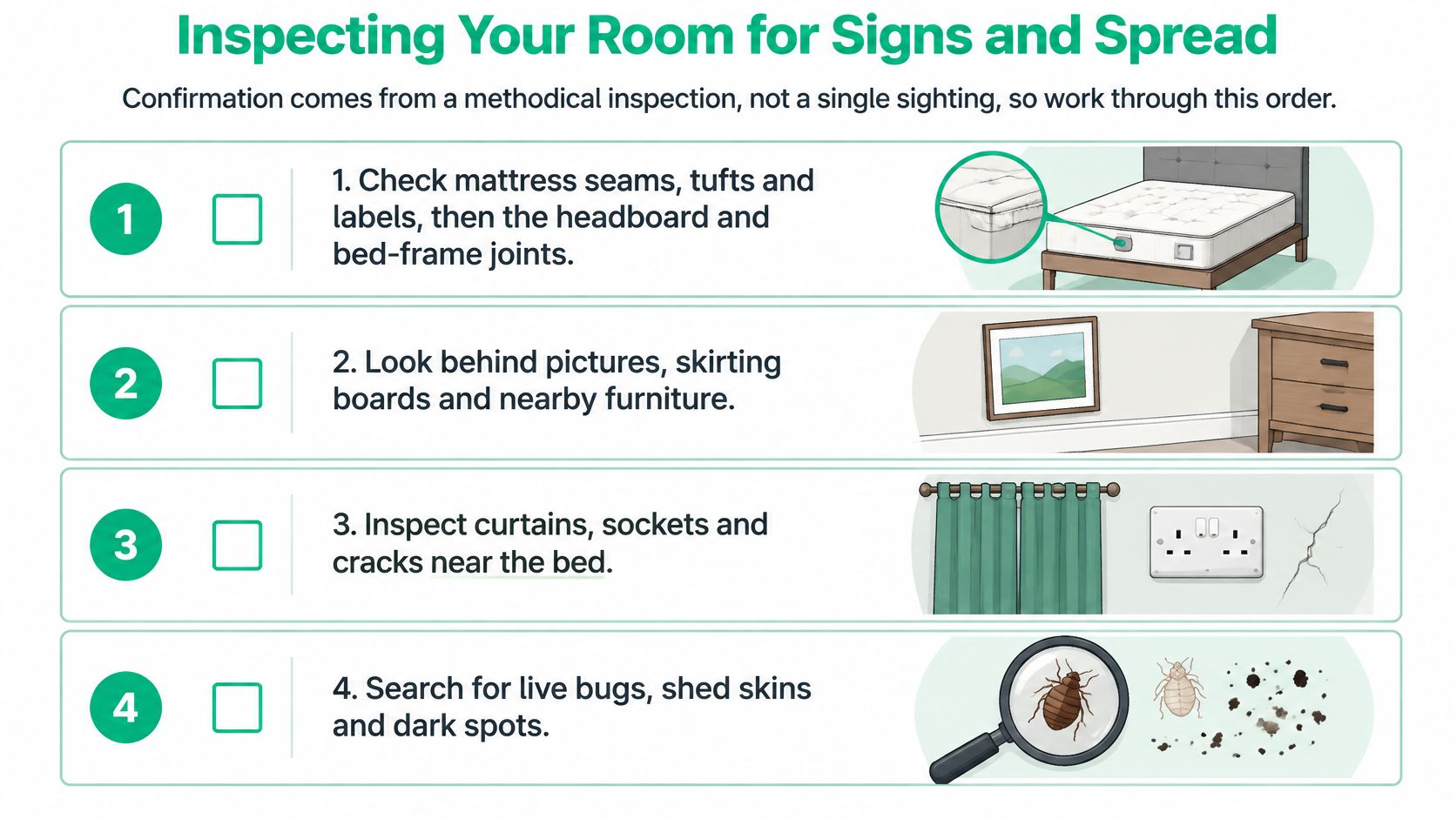
Look for flat, oval brown insects, pale hollow shed skins, dark faecal spots and rusty or blood-spotted bedding. These signs are clues rather than a diagnosis; retain a specimen in a sealed transparent container if you can capture it without spreading it.
The mattress inspection guide can help you work systematically around the sleeping surface. Don't stop there if a headboard, chair or adjoining room also shows evidence.
Record locations rather than guessing the source
The British Pest Control Association's bed-bug overview reports 15,067 bed-bug control treatments administered by UK local authorities during 2011–12. That historical figure describes council treatment activity, not your household's likelihood of infestation or proof that neighbouring flats are affected.
Your own evidence should determine the inspection's scope. Record the room, exact location, date, whether the insect moved and the photograph's filename; distinguish confirmed bugs from unexplained marks.
A clear photograph labelled “bedroom, rear headboard joint” is more useful than a collection of unlabelled pictures of bites.
If signs appear beside a shared wall or in another sleeping area, tell the inspector. Don't enter neighbouring homes to investigate or move suspect belongings into communal corridors.
Encasements and Everyday Prevention
Standard mattress protector vs bed bug encasement
| Feature | Standard mattress protector | Bed bug encasement |
|---|---|---|
| Main purpose | Spills and stains; some designs also provide dust-mite barriers | Sealing the mattress against bed bugs, with dust-mite and allergen protection where specified |
| Closure | Usually fitted, partial or open underneath | Full enclosure with a bed-bug-resistant sealed zipper |
| Stops bed bugs | Not designed to | Designed to block bed bugs from entering or escaping the enclosed mattress |
| Helps with inspection | Limited | Creates a simpler outer surface to inspect |
| Replaces professional treatment | No | No; use alongside treatment |
A bed bug encasement encloses the entire mattress, including its underside. A fitted protector can feel substantial and still leave the base, edges and fastening points accessible.
Choose the enclosure, not just the fabric
The zipper closure is as important as the fabric. Check that the product is explicitly designed for bed bugs, fits the mattress depth and closes fully without stretching or leaving gaps.
An encasement doesn't remove bugs from a headboard, skirting gap or bedside cabinet. It supports mattress containment and inspection while the pest controller treats the room; it isn't a room-wide cure.
For a closer explanation of that distinction, the guide to whether bed bug encasements work sets out their role in a treatment plan. Ask the treating professional when to fit one so you don't obstruct inspection or enclose a surface before it has dried.
Don't unzip an encasement repeatedly to check underneath. Inspect its outside and closure, and agree any removal with the pest controller.
Reduce the chances of bringing bugs home
Prevention means changing how belongings enter and move through your home, not trying to make every surface sterile.
- Check accommodation on arrival: Inspect mattress seams and the headboard before unpacking, and report suspicious evidence to the manager.
- Keep luggage separate: Use a luggage rack away from the bed and walls rather than spreading open cases across the duvet.
- Inspect second-hand furniture: Examine upholstery seams, undersides and joints before bringing it indoors. Decline anything you can't inspect adequately.
- Reduce bedside clutter: Fewer bags, cardboard boxes and loose fabrics make hiding places easier to find and treatment easier to prepare.
- Vacuum with a purpose: Pay attention to edges and joints rather than treating a quick pass over the carpet as pest control.
- Maintain separation: Where practical, keep the bed clear of walls and prevent bedding from touching the floor.
These habits reduce opportunities for introduction and make evidence easier to spot. They can't guarantee that bugs won't arrive, particularly in shared accommodation, so prompt reporting remains important.
Who Pays and Acts
Bed bugs aren't reliable evidence of poor hygiene. They can occur in clean and dirty homes, and in rented or shared housing the response may need to extend beyond the person who first notices them.
The Housing Ombudsman's guidance on pests says tenants should notify their landlord immediately and explains that landlord responsibility may depend on the infestation's source or cause. Don't assume either that the landlord must always pay or that finding bugs in your bedroom automatically makes you responsible.
Put the report and the response in writing
- Preserve evidence. Attach photographs and a dated account of the rooms and furniture affected.
- Send a written notification. Use the landlord's or managing agent's reporting channel and retain the acknowledgement.
- Request the pest policy. Ask who arranges inspection, handles related repairs and provides progress updates.
- Ask about adjoining dwellings. The inspection plan should consider neighbouring flats or rooms where movement between properties is plausible.
- Clarify responsibilities before treatment. Confirm preparation, access, re-entry, follow-up arrangements and who will meet the costs.
A disagreement about payment shouldn't become a reason to stop communicating. Keep reporting new evidence and ask for a written explanation of any decision, including the basis for assigning responsibility.
Manage the building, not just the complaint
For landlords and accommodation managers, appoint a named contact and keep a shared treatment record. Coordinate access so the pest controller can assess connected areas rather than repeatedly treating an isolated room.
Residents also need practical instructions about laundry routes, communal storage and furniture disposal. Leaving an uncovered mattress in a stairwell can expose other households even when the original resident believes they're solving the problem.
If a report stalls, use the landlord's formal complaints procedure and retain correspondence. Treat the building as a coordinated management problem without assuming every dwelling needs the same treatment.
Booking Professional Treatment and Follow-Up Visits
Book an inspection now rather than waiting to see whether DIY works. Choose a qualified pest-control service or contact your council, and describe both the evidence and the type of property, especially if you share walls, corridors or laundry facilities.
Ask for accurate identification before authorising treatment. A credible plan explains where the bugs are hiding, how the controller will reach them and how success will be checked.
Prepare for access rather than a cosmetic tidy
The BPCA's professional bed-bug treatment guidance describes a UK council protocol using two treatment visits approximately three weeks apart, with residents potentially kept outside treated rooms for several hours and one council advising against cleaning treated surfaces for at least two weeks.
Those are examples, not universal appointment or re-entry rules. Obtain written instructions for the actual products and methods being used in your home.
- Expose the hiding places: Make bed structures, furniture joints and room edges accessible without relocating furniture to another room.
- Prepare storage carefully: Empty drawers and under-bed spaces into sealed bags as instructed, rather than piling their contents in the hallway.
- Coordinate laundering: Tell the controller what has been treated and what remains contained.
- Plan household access: Explain any children, pets, pregnancy, mobility issues or difficulty leaving the property before the appointment.
Residual insecticides may form part of the plan, alongside cleaning, steam, heat, cold and other non-chemical measures. The controller should assess mattress seams, frames, headboards, skirting, cracks and furniture interiors rather than spraying the sleeping surface.
Agree aftercare before the controller leaves
Get the re-entry time and ventilation instructions in writing. Ask which surfaces must remain undisturbed, where ordinary cleaning can continue and when to resume using the room.
Don't add shop-bought sprays between appointments or wipe away a residual treatment because the surface looks dusty. Report continuing activity with locations and photographs so the controller can distinguish expected post-treatment findings from an area needing further attention.
Before accepting the booking, clarify:
- Scope: Will adjoining rooms or flats be assessed?
- Follow-up: What inspections are included, and what happens if live bugs remain?
- Cost: What does the quoted work cover, and when would additional charges apply?
Keep the existing bed until the controller advises otherwise. Replacing it prematurely can waste money and leave the same untreated hiding places ready to affect the replacement.
For bedding protection, our Mattress Protector doesn't prevent bed bugs; our Mattress Encasement uses patented BugLock construction with a three-sided zipper and AllerZip seal to protect against bed bugs, dust mites and allergens. Select protection as part of the agreed treatment plan, not instead of booking the inspection.
Your action today is straightforward: arrange that inspection, then contain the room while you wait.
Protect-A-Bed offers mattress protectors, pillow protectors and bed bug encasements for different bedding-protection needs. Visit Protect-A-Bed to explore sealed mattress protection that can support your pest controller's containment and monitoring plan.