

Pillow Protector Bed Bugs

You pull the pillow close, turn towards the wall, and notice a rust-coloured fleck beside the seam. Then you find another mark near the zip. The mattress gets checked first in most homes, but the pillow sits directly against your face for the entire night, making it one of the most overlooked surfaces in a bed bug investigation.
A pillow protector for bed bugs can be useful, but only if it's built as a sealed barrier. It won't disinfect a room, remove bugs from a headboard, or replace professional treatment. Used properly, though, it can protect the pillow, contain insects already inside it, and make future inspections far easier.
Table of Contents
- The Pillow Nobody Thinks to Check
- What a Pillow Protector Actually Does Against Bed Bugs
- Protective Features Worth Paying For
- Pillow Protectors and Mattress Encasements Working Together
- Building a Layered Bed Bug Defence for Your Bedroom
- Why UK Bed Bug Trends Make This Conversation Urgent
- Buying and Caring for a Pillow Protector in the UK
- Your Bed Bug Protection Checklist Before You Sleep Tonight
The Pillow Nobody Thinks to Check
The usual inspection starts with the mattress piping. That makes sense, because bed bugs often hide in seams, folds and protected edges. But stopping there leaves the pillow exposed, even though it's the sleep surface closest to your mouth, nose and skin.
A pillow also offers several places for insects to shelter. Look closely at the gusset seams, stitched edges, zip track and the point where the filling meets the casing. A pillow that has been carried between rooms, stored in a guest bedroom or placed against an upholstered headboard deserves particular attention.
What to look for
Use a bright torch and examine the pillow in good light. You're looking for:
- Rust-coloured marks: Small reddish or brownish stains can come from crushed insects or faecal spotting.
- Pale shed skins: These may sit along seams or in creases.
- Tiny pale eggs: Check protected stitching and folds rather than only the centre of the pillow.
- Live insects: Bed bugs are flat, brownish insects that can hide quickly when disturbed.
- Unexplained bites: Bites alone don't confirm bed bugs, but they justify a careful inspection.
The pillow's position matters. Your head produces warmth and carbon dioxide, while your face and neck provide regular contact with the fabric. That doesn't mean every pillow contains bed bugs, but it does mean the pillow shouldn't be treated as an afterthought.
Practical rule: If you're checking the mattress, check the pillow at the same time. A sealed pillow protector is only useful when you know what it's designed to contain.
The question isn't whether a decorative cover makes a pillow “bed bug proof”. It doesn't. The useful question is whether a properly designed, zipped protector can close the pillow's seams and filling inside a barrier that bugs can't enter or leave. That answer depends on construction, closure and how the protector fits into the wider room response.
What a Pillow Protector Actually Does Against Bed Bugs
A standard pillowcase or loose waterproof cover doesn't repel bed bugs. It may protect against sweat and spills, but an open edge, envelope flap or poorly sealed zip still leaves access points. A fitted cover that protects only the top of the pillow also leaves the underside and seams available for harbourage.
A genuine bed-bug-rated protector works more like a small encasement. It surrounds the pillow and closes with a properly protected zip. The purpose isn't to create a chemical repellent. It's to remove access to the filling and close the routes insects use to enter or escape.
Its three practical jobs
First, a sealed protector can contain insects already inside the pillow. That stops them from moving freely onto the sleeping surface, although it doesn't make an active room infestation disappear. The UK guidance on encasements makes the same limitation clear for mattresses. An encasement prevents infestation of the protected item, but it should form part of a broader control strategy, not act as a standalone cure. Read the UK bed bug encasement guidance before relying on any barrier during an active infestation.
Second, the protector blocks new insects from colonising the pillow's filling. That matters because an unprotected pillow contains seams and internal spaces that are difficult to inspect thoroughly. Once the barrier is zipped closed, the outside becomes much easier to examine.
Third, a smooth outer surface improves monitoring. Fresh marks are more visible on a clean, plain protector than on patterned fabric, and you can wipe the surface without disturbing the pillow itself.
What it can't do
A pillow protector won't:
- Treat the room: Bugs can remain in the bed frame, headboard, skirting, furniture and floor edges.
- Replace mattress protection: An unsealed mattress remains a separate harbourage zone.
- Guarantee immediate elimination: Trapped insects may survive for a prolonged period, so follow the product instructions and pest-control advice.
- Fix a damaged closure: A broken zip or split seam turns a barrier into ordinary bedding.
For a useful explanation of how bed bug protection differs from a conventional mattress cover, see this guide to mattress protectors and bed bugs. The same principle applies at pillow level. Coverage and closure matter more than the word “protector” on the packaging.
Protective Features Worth Paying For
Don't buy a pillow cover because the listing uses the words “anti-allergy” or “waterproof”. Those features can be useful, but they don't automatically create a bed bug barrier. A buyer needs to inspect the actual construction.
Must-have features
The closure comes first. Look for a full-length zip with a covered flap, sealed terminus or bug-flap design. The zip should close the entire opening, not stop short of one edge. If the product page doesn't show the zip end clearly, ask the seller for a photograph or choose a product with better technical information.
Seams deserve equal attention. Bound, taped or welded seams are preferable to exposed stitching that creates a narrow tunnel. The fabric should also be described as a barrier material, with a stated pore size or test information that specifically names bed bugs.
A pore-size claim of one micron or below, where independently supported by product documentation, indicates a tightly engineered barrier. Don't assume that a general dust-mite claim proves bed bug performance. The product should name the pest and explain how the closure was tested.
| Feature | Why It Matters for Bed Bugs | Priority |
|---|---|---|
| Full-length sealed zip | Closes the main entry and escape route | Must-have |
| Covered zip end | Prevents a gap where the zip terminates | Must-have |
| Bound, taped or welded seams | Reduces openings along stitched joins | Must-have |
| Stated barrier pore size | Gives technical detail about fabric construction | Must-have |
| Bed bug-specific testing | Confirms the claim relates to bed bugs, not only allergens | Must-have |
| Breathable membrane | Helps reduce heat and moisture discomfort | Nice-to-have |
| Soft, quiet outer fabric | Makes the protector easier to live with nightly | Nice-to-have |
| Dust-mite allergen barrier | Adds value for allergy-sensitive sleepers | Nice-to-have |
Comfort still affects compliance
A protector that feels hot, stiff or noisy often gets removed. That creates a greater practical risk than choosing a softer barrier that stays on the pillow. Breathable membrane fabrics, including Miracle Membrane-style constructions or Tencel blends, can make sealed protection less intrusive, but check the actual product specification rather than relying on a lifestyle photograph.
For allergy-sensitive households, the added benefit can be meaningful. UK-relevant guidance summarises evidence that encasing both mattresses and pillows, alongside suitable bedding washing, reduced house-dust-mite allergen by almost 10-fold, with the reduction maintained over an extended period. See the guidance on dust-mite control in bedding.
My buying rule is simple. If the listing doesn't name bed bugs, explain the closure and provide meaningful barrier information, treat it as a comfort cover, not a bed bug protector.
Pillow Protectors and Mattress Encasements Working Together
A pillow protector and a mattress encasement solve different problems. One seals the pillow, the other covers the mattress and its edges. Neither product closes every harbourage zone in a bedroom by itself.
A full mattress encasement should surround the mattress on all six sides, including the underside and the areas around piping and seams. A pillow protector applies the same containment logic to the head-level sleep surface. Ordinary pillowcases protect neither the filling nor the zip and stitching beneath them.
| Coverage Zone | Pillow Protector | Mattress Encasement |
|---|---|---|
| Pillow filling | Seals it inside the cover | Not covered |
| Pillow seams and zip | Covers and closes them | Not covered |
| Mattress sleeping surface | Not covered | Sealed |
| Mattress sides and piping | Not covered | Sealed |
| Mattress underside | Not covered | Sealed |
| Headboard and bed frame | Not covered | Not covered |
Close the obvious gap
A mattress encasement without pillow protection leaves the surface closest to your face unsealed. Pillow protectors on an untreated mattress offer only partial defence, because insects can continue to shelter below the sleeping surface and travel towards the pillow.
Choose compatible products where possible. The pillow protector should fit without forcing the zip, while the mattress encasement should remain smooth and fully closed after installation. Never stretch a barrier so tightly that the seam or zip strains under normal movement.
The bed bug mattress encasement guide explains why a full encasement is different from a fitted mattress protector. That distinction is important here too. A fitted cover protects a surface. An encasement closes a harbourage item.
For a household responding to a confirmed sighting, I'd seal both the mattress and pillows, then inspect the bed frame and headboard separately. For a landlord or hospitality operator, standardising the combination across every sleeping space makes inspections easier and reduces the chance that staff protect one surface while ignoring another.
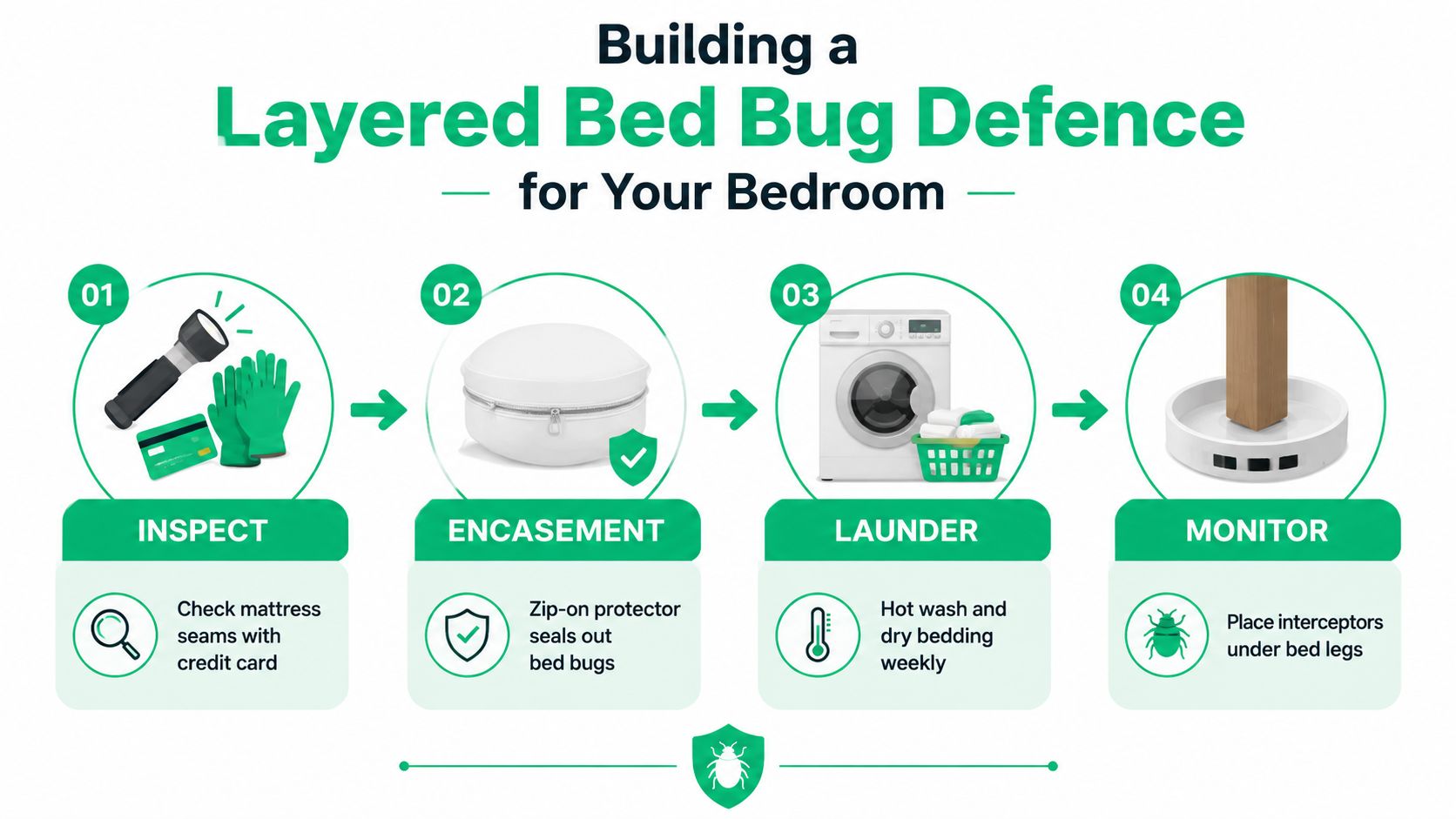
Building a Layered Bed Bug Defence for Your Bedroom
A pillow protector belongs in a layered plan. It's valuable because it protects a high-contact item, but it can't carry the whole response.
Begin with inspection
Use a torch, gloves and a bank card or similar thin edge to examine the mattress seams. Continue to the headboard joints, bedside drawer runners, bed base, skirting and the pillow's gusset and stitching. The aim is to identify signs and harbourage, not to disturb the room unnecessarily.
If you find a live insect, preserve it in a sealed container or clear bag for identification. Avoid moving pillows, bedding or furniture between rooms, because that can spread the problem.
Seal the bed
Install the mattress encasement and pillow protector carefully. Close every zip fully and check the zip ends, seam lines and corners. Don't puncture the material with pins, staples or improvised fasteners.
Leave a bed bug encasement in place for the period specified by the manufacturer or pest professional. Removing it too soon can release insects or expose the item again.
Use heat and containment
Wash bedding according to its care label, using a hot cycle where the fabric permits. The supplied control plan specifies 60°C washing and hot tumble drying for bedding, but not every protector can tolerate identical heat, so follow the product instructions for the barrier itself.
Bag pillows and bedding during transport. Keep luggage away from the bed after travel, and inspect it before returning it to storage.
Reset the room
Reduce clutter beneath and beside the bed. Vacuum the headboard, bed base and nearby floor edges with a machine that allows safe disposal of the collected contents. Isolate coats and suitcases from the sleeping area, then monitor the bed regularly for fresh signs.
A layered response works because each measure closes a different weakness. Skip inspection and you may seal the wrong items. Skip encasement and the pillow remains exposed. Skip laundering and contaminated textiles can move insects elsewhere.
Why UK Bed Bug Trends Make This Conversation Urgent
A pillow sits against the face and hair for hours, yet it is often the last item anyone checks during a bed bug inspection. UK activity makes that oversight harder to justify. Councils recorded over 14,587 bed bug callouts in 2023, compared with 11,819 visits in 2022, a 23% increase, as reported in UK reporting on council bed bug callouts.
The wider trend also points upward. Rentokil reported a 68% increase in UK bed bug activity from 2023 to 2024, while industry reporting recorded an average 44% year-on-year rise in confirmed activity between 2023 and 2025. One London borough recorded 155 infestations in the first half of 2026, 40% higher than the same period in 2024 and 50% higher than 2025, according to UK bed bug activity reporting.
| Indicator | UK Trend Signal |
|---|---|
| Council callouts in 2023 | Over 14,587 visits |
| Change from 2022 to 2023 | 23% increase |
| Reported activity from 2023 to 2024 | 68% increase |
| Average confirmed activity change from 2023 to 2025 | 44% year-on-year rise |
| One London borough in early 2026 | 155 infestations |
These figures do not call for panic. They call for a better order of priorities. A sealed pillow should sit alongside a mattress encasement, regular inspection, laundering and professional treatment where required. The pillow deserves attention first because it is the sleep surface in closest contact with the face, and a protector helps contain that exposure without solving an infestation by itself.
Resistance concerns make a layered approach more practical. UK-facing reporting has linked rising infestations with insecticide-control difficulties and supports washable, zippered barriers as part of broader management. Read the discussion in reporting on insecticide resistance and UK bed bug control.
| Buyer | Sensible priority |
|---|---|
| Household | Seal pillows and mattress, then inspect regularly |
| Landlord | Standardise barriers across sleeping spaces |
| Hospitality operator | Use consistent covers and document inspections |
| Shared accommodation manager | Combine encasements with room-level treatment protocols |
Buying and Caring for a Pillow Protector in the UK
Start with the pillow dimensions, not the label on the old pillowcase. Common UK formats include 50 × 75 cm standard pillows, 65 × 65 cm square pillows and 50 × 90 cm extra-long pillows. Measure the pillow itself, especially if it's overfilled or unusually deep, because a strained zip can compromise the barrier.
Fabric choice affects whether the protector stays on the bed. Cotton-faced materials often feel familiar, polyester can be practical and easy to maintain, while Tencel-style fabrics are chosen for a softer, cooler hand feel. A breathable waterproof membrane can block liquid and allergen ingress without the stiff, noisy sensation associated with older plastic covers.
| Factor | What to Look For | UK-Specific Note |
|---|---|---|
| Size | Exact pillow dimensions and suitable depth | Check standard, square or extra-long sizing |
| Closure | Full zip, covered end and secure fit | Inspect the zip before putting on a pillowcase |
| Fabric | Soft outer layer with breathable barrier | Choose for comfort as well as protection |
| Care | Clear washing and drying instructions | Confirm the protector's permitted temperature |
| Certification | Bed bug and allergen claims with documentation | Don't treat generic “anti-bacterial” wording as proof |
| Delivery | UK fulfilment and visible returns terms | Check availability before ordering for a property |
| Warranty | Written cover for manufacturing defects | Keep purchase records and care instructions |
Protect-A-Bed's UK range includes waterproof pillow protectors and breathable membrane options, with stated UK fulfilment, delivery information and warranty-backed support. Review the UK pillow protector range against the features above rather than buying on appearance alone.
Installation and maintenance
Slide the protector over the pillow without forcing corners into the zip. Smooth the fabric before closing it, then run your fingers along the zip and seams to check for gaps. Add the ordinary pillowcase over the sealed protector for comfort and routine washing.
Wash the protector according to its care label. Launder the outer pillowcase regularly, and inspect the sealed cover for staining, split seams, loose stitching or a zip that no longer closes cleanly. Replace it if the barrier is damaged. No brand warranty can compensate for a punctured or poorly closed protector.
For online purchases, compare the exact model, dimensions, closure design, care label, returns policy and warranty. Be wary of overseas listings that make broad allergen claims but provide no bed bug-specific testing or technical construction details.
Your Bed Bug Protection Checklist Before You Sleep Tonight
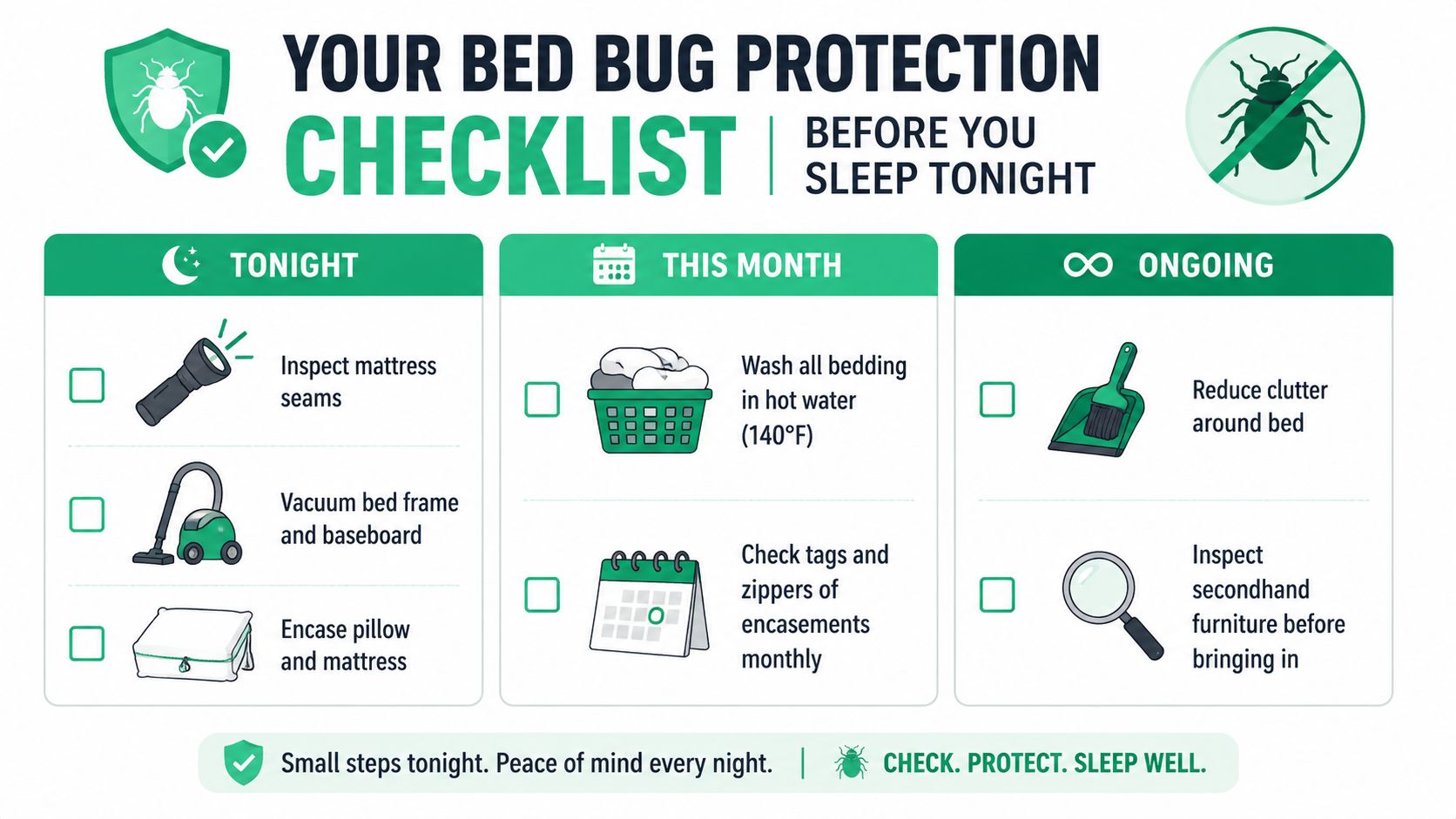
The fastest useful response is organised by urgency. Don't strip every room and move belongings around without a plan. Protect the bed, contain textiles and document what you find.
Tonight
- Inspect the pillow: Check the zip, gusset and seams with a torch.
- Check the bed: Examine mattress piping, the headboard, frame joints and nearby skirting.
- Vacuum carefully: Focus on the bed frame and floor edges, then seal or dispose of vacuum contents safely.
- Seal sleeping surfaces: Fit the pillow protector and mattress encasement without forcing the closures.
- Contain luggage: Keep suitcases, coats and recently transported textiles away from the bed.
This month
- Wash bedding hot: Use a 60°C cycle where the care label permits, followed by suitable hot drying.
- Review closures: Check zips, seams and corners for damage.
- Reduce clutter: Clear storage from beneath the bed and keep inspection routes accessible.
- Record findings: Photograph marks and note where you found them.
If you suspect an infestation
Don't rely on bites alone. Seek professional pest-control advice if you find live insects, repeated spotting, shed skins or signs in more than one harbourage area. Avoid repeatedly applying household insecticide without a coordinated plan, particularly where resistance may affect control.
Three useful actions can happen this evening: seal the pillow, run an appropriate hot wash and inspect the headboard seam. Those actions won't replace room treatment, but they protect the most immediate sleep surface while you decide on the next response.
Protect-A-Bed offers UK pillow protectors, waterproof mattress protectors and bed bug encasements designed to create breathable barriers around key sleep surfaces. Visit Protect-A-Bed to compare pillow and mattress protection for your home, rental property or accommodation setting, then fit the barriers before the next inspection rather than after another sighting.