

How Often Should You Wash Pillow Protectors

You pull off the pillowcase, ready to put on a clean one, and notice a yellow patch on the cover underneath. The pillowcase is heading for the wash, but the protector suddenly looks overdue too. If you can't remember when you last washed it, it's time to give that hidden layer its own routine.
So, how often should you wash pillow protectors? My recommendation is weekly for a regularly used bed, with a fortnightly option for a healthy, low-sweat sleeper whose protector stays clean beneath a freshly changed pillowcase. Wash sooner whenever it becomes damp, stained or soiled. The right decision depends on the layers, the sleeper and the care label, not just the calendar.
Table of Contents
- Why the Protector Under Your Pillowcase Gets Dirtier Than You Think
- A Practical Wash Schedule for Every Type of Sleeper
- Fabric-Specific Care for Miracle Membrane, Tencel and Cotton Protectors
- Washing, Drying and Temperatures Without Ruining the Membrane
- When to Step Outside the Routine and Wash Sooner
- Warning Signs It Is Time to Replace, Not Just Rewash
Why the Protector Under Your Pillowcase Gets Dirtier Than You Think
Pull a grubby pillow away from an equally tired pillowcase and it's tempting to blame the pillow itself. Before deciding what needs cleaning, unzip the protector and inspect each layer separately. The mark might be on the washable cover rather than the filling, which is precisely why that cover deserves attention.
A pillowcase takes direct contact from your face and hair. The protector underneath catches perspiration, skin oils, saliva and cosmetic residue that reach beyond it. A fresh outer case doesn't mean everything underneath is fresh.
Consider someone who applies a rich night cream, goes to bed with damp hair or regularly wakes with a sweaty neck. Their protector has a different workload from one on a rarely used guest bed. Neither should be judged solely by whether the pillowcase looks presentable.
Think in layers, not appearances
The useful distinction is between covering a pillow and maintaining its protective barrier. A protector needs washing even when it's doing its job successfully. Keeping moisture away from the pillow doesn't make the cover itself clean.
For dust-mite-sensitive households, the construction matters too. A loose cover and a fully enclosing allergen barrier aren't interchangeable. Our guide to pillow protectors for dust mites is a useful starting point when checking what sort of protection you have.
Fully enclosing, breathable barrier covers can reduce exposure, but they aren't a standalone answer. Cambridge University Hospitals' dust-mite guidance identifies them as an important intervention while making clear that other bedding measures still matter.
Don't assume a clean protector means a dirty pillow needs no attention, either. If moisture or staining has reached the filling, assess the pillow separately and follow its own washing instructions.
Change the pillowcase, inspect the protector, and wash the protector whenever its condition or your household routine calls for it.
A Practical Wash Schedule for Every Type of Sleeper
Choose weekly as your working default, rather than waiting for visible dirt. It makes the protector part of an ordinary bedding change instead of a separate chore you're likely to forget.
A fortnightly routine is a reasonable lower-risk option, not a universal recommendation. Reserve it for an adult without relevant sensitivities, with ordinary perspiration, a clean pillowcase and no accidents or spills. If those conditions change, the schedule changes.
Frimley Health NHS Foundation Trust advises weekly bedding changes and hot washing at 60°C in its house-dust-allergy guidance. Applying that exposed-bedding standard to removable pillow protectors gives households a practical baseline, provided the selected temperature is permitted by the protector's label.
Pillow Protector Wash Schedule by Situation
| Situation | Recommended Frequency | Target Temperature |
|---|---|---|
| Regular nightly use | Weekly, aligned with the NHS bedding-change baseline above | The NHS hot-wash target above, if the label permits |
| Healthy adult with low perspiration and a clean outer pillowcase | Fortnightly as a lower-risk household option | Hottest temperature permitted by the label |
| Dust-mite allergy, asthma or eczema | Weekly, with earlier washing after soiling | Label-permitted hot wash |
| Heavy night sweating | Weekly at minimum, sooner whenever damp or noticeably soiled | Follow the protector's instructions |
| Children's bedding | Weekly, immediately after accidents or spills | Follow the label and assess the soiling |
| Illness, incontinence or contaminated bedding | Promptly after the event, not at the next scheduled change | Follow suitable cleaning advice and product limits |
| Occasionally used guest bed | Inspect after use and wash before the next guest | Follow the care label |
Let the sleeper override the diary
For heavy sweaters, don't turn a more frequent wash into another rigid rule. If the cover is wet or soiled before laundry day, remove it then. Equally, don't prescribe extra washes because someone has allergies without considering the barrier cover, outer bedding and their existing allergy-management advice.
Children don't need every protector washed immediately after every ordinary night's sleep. Accidents need immediate action; normal use needs a dependable routine. That distinction keeps the advice practical for busy households.
For a broader bedding review, Guynn Furniture & Mattress's guide to when to replace your bedding offers a companion resource. Keep replacement decisions separate from wash-day decisions: a sound protector may only need cleaning, while a damaged one needs more.
Finally, the care label sets the limits. If it can't tolerate your household's necessary wash process, choose a more suitable protector rather than repeatedly washing beyond its instructions.
Fabric-Specific Care for Miracle Membrane, Tencel and Cotton Protectors
Buy for the wash routine you need, not just the fabric name you like. A cooling surface, a cotton face and a waterproof backing describe different parts of a protector. Don't assume any one of them tells you how to wash the complete product.
Miracle Membrane describes the waterproof layer, not a universal laundry programme. Tencel and cotton describe fabric choices, but those fabrics may be combined with a backing, zip, edging or other components. The complete protector's instructions take priority over advice for an unbacked piece of cloth.
Read the construction as well as the fabric
Use the comparison below as a visual reminder of the care questions to check, not as product-specific washing instructions. Its temperatures, drying settings and treatment suggestions must all be confirmed against the label on your own protector.
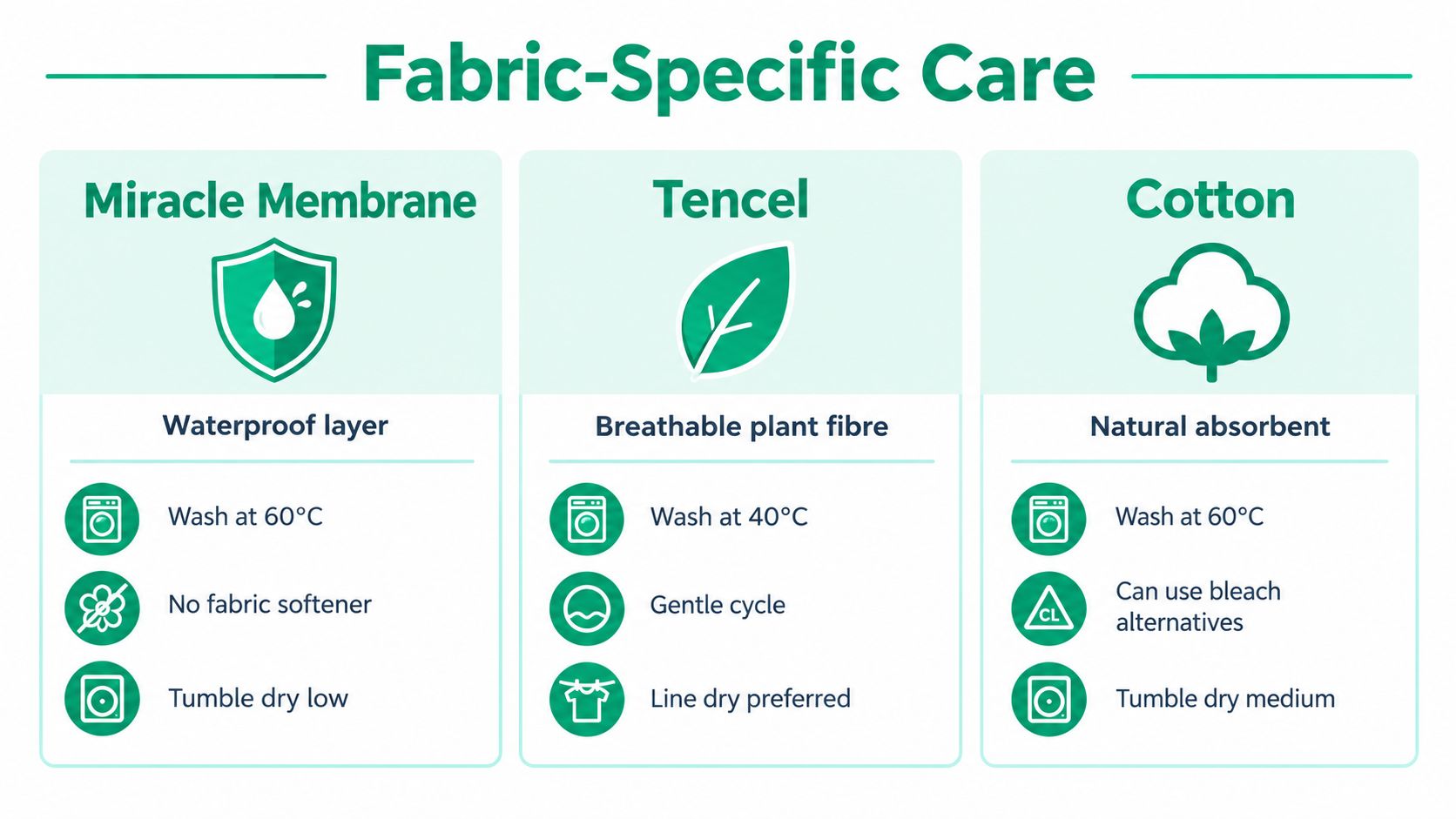
- Miracle Membrane constructions: Check the permitted wash, spin and drying settings for the assembled protector. Don't choose a hotter dryer setting just because the surface feels sturdy.
- Tencel and cooling variants: Follow the product's specified programme rather than assuming that every cooling cover needs the same gentle cycle or drying method.
- Cotton protectors: Check whether the cotton is backed or unbacked. A cotton face isn't permission to use bleach, high heat or an aggressive stain treatment.
For a closer look at closure and fit, the guide to cotton pillow protectors with a zip helps distinguish the fabric choice from the way the cover encloses the pillow.
Choose comfort without relaxing hygiene
Don't assume a cooling protector lets a heavy sweater wash less often. Judge the actual result: is the cover dry, clean and comfortable when you strip the bed? Choose a fabric you enjoy sleeping on, then maintain the schedule its condition demands.
Likewise, don't assume cotton automatically tolerates hotter washing than a Tencel variant. Without the individual label, that comparison isn't reliable enough to base a laundry routine on.
Buying rule: If allergy control or frequent accidents make hot washing important, confirm the permitted care programme before ordering.
That check is more useful than discovering after an accident that the cover can't tolerate the cleaning process you intended to use.
Washing, Drying and Temperatures Without Ruining the Membrane
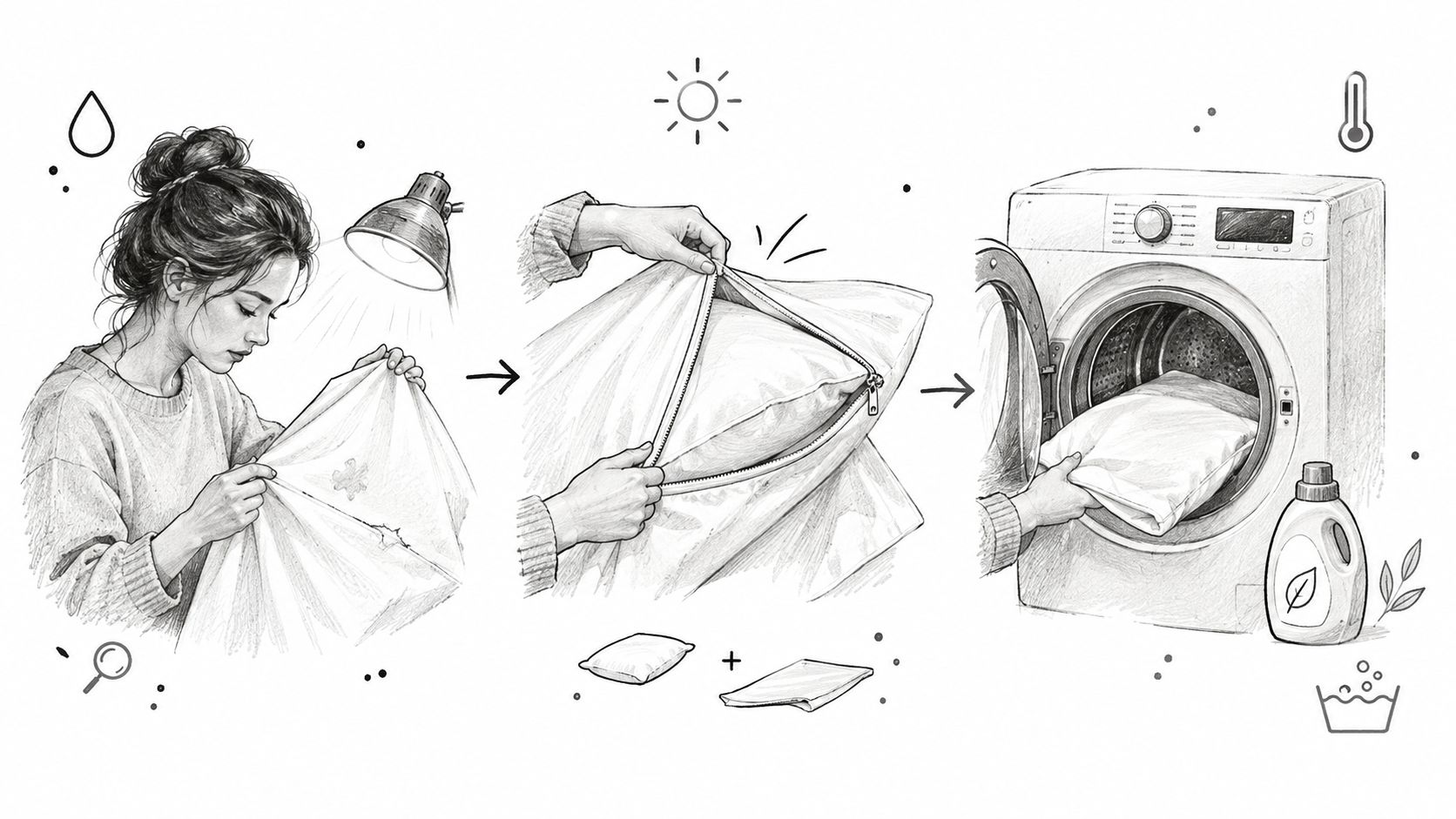
Start at the bed, not at the washing-machine dial. Remove the pillowcase and protector separately, inspect both, and check whether any moisture has reached the pillow. Don't put everything into the same load automatically.
The aim is straightforward: remove the soil without exceeding the protector's care limits. A rushed wash followed by excessive drying heat isn't better care than a properly selected programme.
Before you press start
- Inspect the cover: Look for stains, open seams, zip damage and changes to the backing. Follow the manufacturer's instructions for the zip position during washing.
- Separate unsuitable items: Keep heavily contaminated laundry out of an ordinary bedding load. Don't mix items that require incompatible programmes.
- Check treatments: Use stain removers only when they're permitted for the whole protector, including its membrane.
- Leave room in the drum: Don't cram protectors into an already packed bedding load. Give the items space to move through the wash.
Choose detergent according to the protector's instructions and the sleeper's needs. Don't treat biological detergent as automatic disinfection, or non-biological detergent as an automatic guarantee against irritation. Use the detergent's dosing instructions rather than adding extra because the cover looks grubby.
My conservative approach is to leave out fabric conditioner and bleaching products unless the manufacturer permits them. A protector is a functional cover, not just a white textile you're trying to brighten.
For background reading alongside your appliance manual, the washing temperature tips from BacteriaFAQ.com can help frame the temperature question. They don't override the protector's care label or provide a substitute for advice on contaminated laundry.
Finish the job with proper drying
If tumble drying is allowed, use the specified setting. If you're air-drying, arrange the cover so air can reach its surfaces, and follow any instructions about hanging or laying it flat. Don't assume cotton must be dried flat or that every waterproof cover can go in a dryer.
Check the zip area, edging and seams before refitting. The protector must be completely dry, not merely dry enough on the broad central panel. Keep a clean spare available so you're not tempted to put a damp cover back on the bed.
Our guide to a breathable waterproof pillow protector provides context on choosing this type of cover. Whatever construction you choose, careful washing and complete drying belong together.
When to Step Outside the Routine and Wash Sooner
A scheduled bedding change is for ordinary use. Vomit, faeces, blood, urine or suspected infectious soiling require a different response. Remove the affected protector promptly and assess the contamination, rather than leaving it until the next routine wash.
Repeated heavy sweating, spills and an unpleasant damp smell also justify earlier attention, but they aren't all equivalent to infectious soiling. Keep those categories separate so you neither underreact to contamination nor treat every sweaty night like a healthcare incident.
Routine soil and contamination need different decisions
| What has happened | What to do |
|---|---|
| Sweat, cosmetic residue or an ordinary spill | Remove and wash according to the label; check the pillow underneath |
| Vomit, faeces, blood or suspected infection | Keep affected items separate and seek appropriate cleaning guidance |
| A pet has soiled the bed | Deal with the contamination promptly rather than relying on the usual schedule |
| Suspected bedbugs | Follow a coordinated pest-management plan rather than treating washing as the complete response |
| Persistent dampness or mustiness | Investigate drying, storage and the condition of the protector and pillow |
The checklist below is a prompt to act sooner. Its temperature and treatment suggestions aren't universal instructions for every protector or every type of contamination.
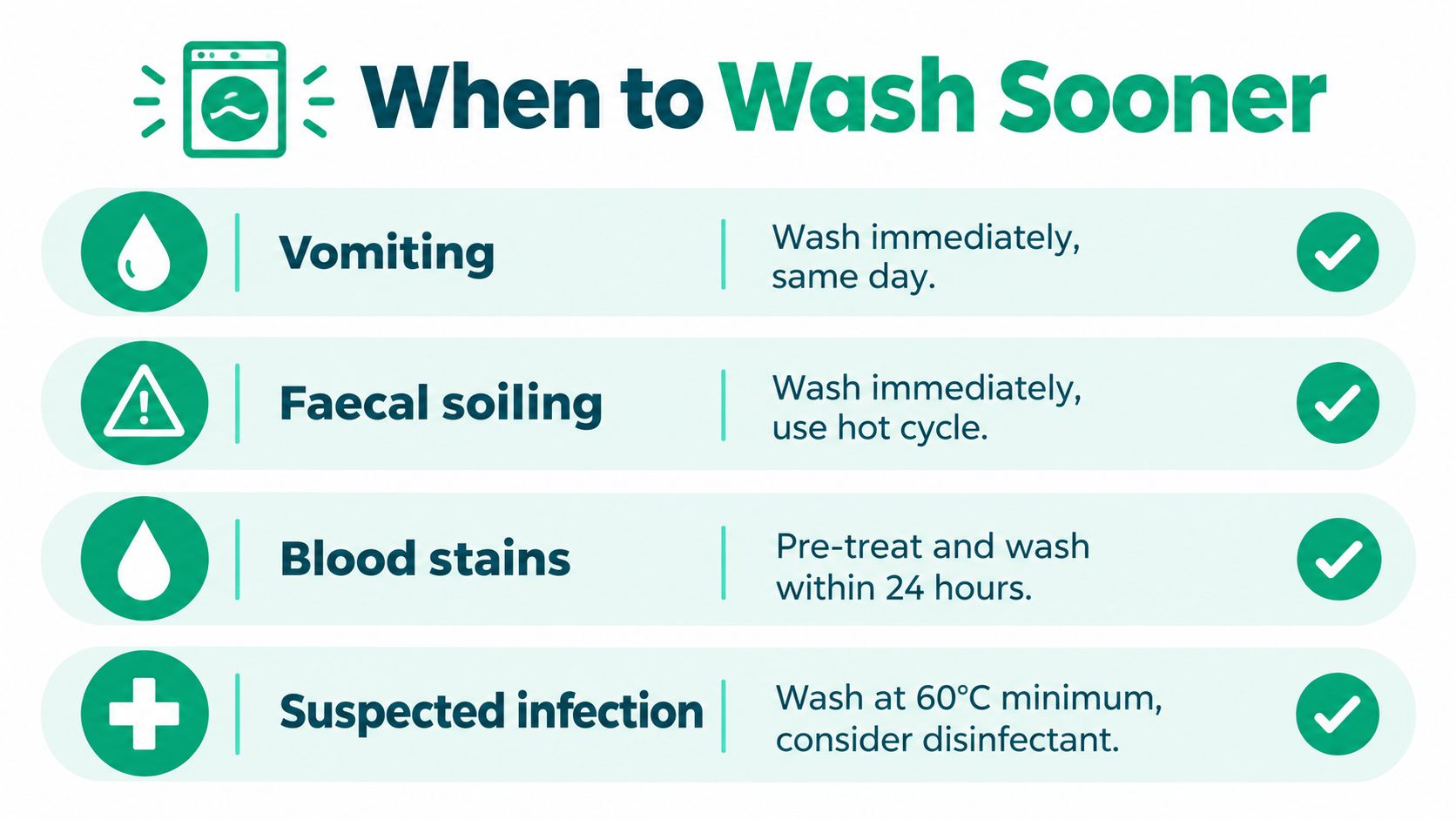
Don't improvise a disinfection programme
Keep contaminated items separate, avoid unnecessary handling and follow relevant health advice. For a care home or other managed setting, use the setting's laundry policy rather than domestic bedding advice. A household wash programme shouldn't be described as validated healthcare disinfection.
For ordinary allergy-related cleaning, Milton Keynes University Hospital's house-dust-mite advice is relevant background. Dust-mite management and infectious-laundry management are different jobs, so don't use allergy advice as proof that a particular cycle will deal with every contamination event.
Pets on the bed, illness recovery and seasonal allergy discomfort are also reasons to review what you're doing. Look at the outer pillowcase, the protector and the sleeper's actual needs before changing the routine.
A more frequent wash can't compensate for unsuitable handling, an incompatible programme or a cover put back on while damp.
Don't diagnose the cause of congestion or skin irritation from bedding alone. Clean the bedding appropriately, but get medical advice for persistent symptoms rather than repeatedly increasing the wash frequency and expecting that to solve everything.
Warning Signs It Is Time to Replace, Not Just Rewash
Waterproof doesn't mean maintenance-free, and washable doesn't mean permanently serviceable. If a protector no longer closes properly or no longer performs its protective job, another wash isn't a repair.
Don't replace it because it looks less new. Judge whether it's cleanable, intact and fit for the purpose you bought it for. A cosmetic mark and a failed barrier are different problems.
Distinguish wear from failure
Thinning fabric and pilling deserve inspection, but they don't automatically prove the waterproof layer has failed. Persistent yellowing may be a cosmetic stain rather than evidence that the cover remains dirty. Conversely, a tidy-looking face fabric doesn't tell you whether the backing and seams are sound.
Check the protector when it's clean, dry and off the pillow:
- Closure: Does the zip close fully without gaps, snagging or separation?
- Seams: Are there open sections, loose joins or areas pulling apart?
- Backing: Can you see peeling, splitting or separation between layers?
- Fit: Does it still sit properly around the pillow without excessive strain?
- Performance: Has moisture reached the pillow during an event the protector was intended to contain?
- Cleanliness: Does an unpleasant smell remain after correct washing and complete drying?
Where performance is uncertain, ask the manufacturer how to assess it. Don't improvise a test that could damage the protector or soak the pillow underneath.
Replace according to condition, not an invented expiry date
A nightly sleeper, a child with frequent accidents and an occasional guest won't put their protectors through identical use. There's no honest universal replacement deadline without product-specific instructions and an assessment of wear.
Allergy-sensitive households should pay particular attention to enclosure integrity. If the reason for buying the protector was a fully enclosed barrier, a zip that won't close isn't a minor cosmetic defect.
Make inspection part of your bedding change. Keep washing a cover that's intact and performing properly; replace one whose protective construction has failed. That decision is more useful than keeping a damaged protector because it hasn't reached an arbitrary age.
Protect-A-Bed offers pillow protectors in different fabric options, including waterproof designs for everyday bedding protection. Visit Protect-A-Bed to choose a cover suited to your sleeper, then check its care instructions before building it into your wash routine.