

Pillow Protector for Dust Mites: A Practical UK Guide

You wake with a blocked nose, itchy eyes, or a tight chest, even though you took your hay fever tablet earlier. The obvious suspects are pollen and dust, but your pillow deserves attention too. It sits against your face for hours each night, collecting skin scales, moisture, and allergen particles in the one place you breathe closest to.
A pillow protector for dust mites can reduce that direct exposure, but only if it forms a genuine barrier. A quilted cover that merely feels thick, or a label that says “anti-allergy” without naming a test standard, isn't enough. The practical answer is a fully enclosed, breathable cover used alongside hot washing, sensible humidity control, and wider bedroom cleaning.
Table of Contents
- Why Your Pillow Is an Allergy Hotspot
- How Dust Mite Barriers Actually Work
- Fabrics and Membranes Compared
- Encasement vs Standard Pillow Protector
- Washing and Long-Term Maintenance
- Where a Pillow Protector Fits in an Allergy Control Plan
- Choosing the Right Pillow Protector for Dust Mites in the UK
Why Your Pillow Is an Allergy Hotspot
You wake sneezing, reach for tissues, and start the morning with a blocked nose. Your pillow looks clean and the bedroom is regularly aired, yet symptoms continue. Treat the pillow as a potential allergen reservoir, not just another soft furnishing.
UK NHS guidance says house dust mites live in mattresses and pillows, feeding on human skin scales. Bedding gives them a ready-made home, so a pillow can contribute to symptoms even when the room appears tidy. House dust mites are found in all homes, according to NHS house dust mite avoidance guidance. For a clearer explanation of how mites persist in bedding, see this guide to dust mites in bedding.
Why symptoms appear at night
The pillow is the sleep surface closest to your airway. Your face presses into it for hours, your breath warms the surrounding fabric, and moisture from your skin and airways collects near the filling. That combination increases exposure at the point where it matters most.
The allergen is not just “dust”. Sensitive people react to proteins linked to mite faeces and body fragments. Movement can disturb those particles, while ordinary airing leaves the filling exposed and creates no sealed separation between you and the source.
The issue is widespread, although exposure does not guarantee symptoms. A North West NHS allergy network leaflet says about one in 20 young children and one in five adults in the UK will test positive for house dust mite allergy, while almost all children with eczema will test positive. Not everyone with a positive test develops symptoms. These figures are included in the NHS allergy leaflet on house dust mite avoidance.
Practical rule: If symptoms are strongest after waking, protect the sleep surface first. Keep cleaning and humidity control in place, but add a fully enclosed pillow barrier so the filling is not directly beside your airway.
A standard pillowcase handles stains and some surface debris. It does not seal the pillow or stop allergens passing through the fabric. For confirmed or suspected mite sensitivity, choose a cover that encloses the entire pillow and seals the fabric, zip, and seams. Check the product specification for a stated pore size, suitable barrier fabric or membrane, and construction that keeps those closures secure.
How Dust Mite Barriers Actually Work
A proper dust mite barrier uses physics, not a vague treatment claim. The fabric or membrane contains openings small enough to stop mites and their allergen particles passing through, while allowing air and water vapour to move sufficiently for comfortable sleep.
Read the pore-size specification
Pore size is the useful technical detail. A barrier with pores of 10 microns or smaller is intended to block mite bodies and associated allergen particles. The tighter fabrics can reach below 5 microns, and a UK clinical report cited by Astex Allergy Bedding states that a 5.9-micron fabric pore size is small enough to block house dust mites and their allergens from passing through encasements. That claim is presented on Astex Allergy Bedding's clinical information page.
Don't confuse pore size with thread count. Thread count describes how many threads a manufacturer claims are woven into a given area, but it doesn't tell you the size of the gaps, the consistency of the weave, or whether the seams and zip remain sealed. A lower thread-count fabric with a tested membrane may provide a more dependable barrier than a high thread-count cover with no pore-size evidence.
Understand the construction
Three common approaches create the barrier:
- Dense microfibre uses very fine fibres and a tight weave to reduce openings. It can feel quiet and soft, though some sleepers find it warmer.
- Tightly woven cotton offers a more natural hand feel. Its performance depends on the actual weave, finishing, and construction, not the word “cotton” alone.
- Polyurethane membrane laminate adds a continuous protective layer beneath the face fabric. It can block allergens and liquids while remaining flexible and relatively quiet.
A membrane is especially useful when you want both allergen protection and waterproofing. For a plain-language explanation of how an air-permeable waterproof layer is built, see this guide to breathable waterproof membrane construction.
Barrier versus chemical treatment
An allergen-impermeable barrier traps material and separates your face from the pillow filling. An anti-mite finish attempts to affect the organisms through a treatment applied to the textile. Those approaches aren't interchangeable.
For an allergy sufferer, I favour a documented physical barrier over treatment-only language. UK guidance focuses on micro-porous membrane covers, washing, and environmental control rather than asking shoppers to rely on an unspecified active finish. A product that names its pore size, test method, or certification gives you something concrete to assess. “Dust mite resistant” on its own doesn't.
Fabrics and Membranes Compared
Comfort and protection depend on the whole construction. A cover can have a tight fabric but poor seams, or a strong membrane that feels unpleasant against the face. The right choice is the one that maintains its barrier through your washing routine without making you remove it after a restless, overheated night.
The table below is a practical comparison. Treat the pore-size column as a shopping prompt, not a guarantee. Manufacturers should state the tested value for their specific product, and you shouldn't assume a category automatically meets it.
Dust Mite Barrier Fabrics at a Glance
| Fabric or Membrane | Typical Pore Size | Breathability | Max Wash Temp | Best For |
|---|---|---|---|---|
| Tightly woven microfibre | Can be below 10 microns when tested | Good, depending on density | Check the label, ideally compatible with 60°C washing | Quiet protection and everyday use |
| Dense cotton | Varies by weave and finish | Naturally comfortable, but construction matters | Check the label, as high heat may affect fit or finish | Sleepers who prioritise a natural feel |
| Polyester with PU membrane | Continuous membrane can provide a reliable barrier | Good when the membrane is air permeable | Follow the care label, avoid excessive heat or hot ironing | Allergen and liquid protection together |
| Vinyl or PVC encasement | Impermeable surface | Limited compared with textile barriers | Follow the manufacturer's instructions | Maximum sealing where comfort is secondary |
Tightly woven microfibre is usually the easiest starting point. It tends to be quiet and smooth, but a dense weave can feel warm. Cotton feels familiar and breathable, although its protection depends heavily on the specified pore size and whether repeated washing changes the fit.
A PU membrane is my preferred compromise for many allergy sufferers. It can create a continuous barrier without the stiff, plastic feel associated with older waterproof covers. It still needs careful laundering, and hot ironing can damage the laminate, so the care label matters.
What to reject
Avoid cheap quilted protectors that state only “anti-allergy” or “dust mite resistant”. Quilting, padding, and a waterproof claim don't prove that the pores are small enough or that the zip and seams prevent escape.
Look for:
- A stated pore size, preferably within the small-micron barrier range.
- A named allergen or mite test, such as testing against a recognised bedding-barrier standard.
- Full enclosure, including a protected zip and sealed or well-finished seams.
- Care instructions compatible with your routine, especially if you want to follow NHS hot-washing advice.
- A fabric you can tolerate nightly, because an uncomfortable cover won't stay on the pillow.
For context on how a cotton-faced waterproof protector can be constructed, see this guide to cotton waterproof mattress protection. The same principle applies to shopping for pillow protection: inspect the membrane, not just the surface fabric.
Encasement vs Standard Pillow Protector
If you wake with a blocked nose despite washing your pillowcase, inspect the pillow itself. A standard protector covers the upper surface and sides, while its underside, opening, zip, or seams may remain exposed. It helps with sweat, skin oils, spills, and surface debris, but it may leave the filling in contact with the sleeper.
A full encasement closes around the entire pillow, usually with a zip. That coverage matters because the filling can already hold allergen material. An open-sided cover cannot isolate it fully.
The practical difference
For an established dust mite allergy, choose a full zip-around encasement. UK clinical guidance advises covering pillows, duvets, and mattresses in the sufferer's bedroom with micro-porous membrane covers. It also advises replacing pillows every six months unless they have special covers, as set out in this NHS patient leaflet on house dust mite avoidance.
Use that advice as a specification, not as a reason to trust every “anti-allergy” label. Look for a stated small pore size, a continuous fabric or membrane barrier, a protected zip, and finished seams. The cover should separate your face from the pillow and make regular cleaning manageable.
| Feature | Standard Protector | Full Encasement |
|---|---|---|
| Coverage | Usually the upper surface and sides | All sides of the pillow |
| Main role | Surface hygiene and spill protection | Physical separation from the pillow filling |
| Existing allergens inside pillow | Not fully contained | Trapped behind the barrier |
| Zip and seam protection | May be open or exposed | Should include a closed zip and protected seams |
| Comfort | Often feels familiar and light | Can feel warmer or slightly crinkly |
| Best use | Basic hygiene or supplementary protection | Confirmed or suspected mite allergy |
Which one should you buy?
Choose an encasement if symptoms continue despite clean pillowcases, if the pillow has been used for a long time, or if testing has confirmed mite sensitisation. It should sit within a wider UK allergy-control routine, alongside suitable bedding covers and the recommended hot washing of washable bedding.
Choose a standard protector when surface cleanliness is the priority and the pillow is already enclosed by another complete barrier. Its familiar feel may suit nightly use, but comfort does not make an incomplete cover an allergen barrier.
The trade-off is straightforward. A full cover may retain more heat, make a faint rustle, and cost more. For a mite-sensitive sleeper, those drawbacks are usually preferable to an unsealed pillow next to the nose and mouth. Check the fit before buying. A loose cover can gap at the zip or seams, while an over-tight one may strain the barrier during use.
Washing and Long-Term Maintenance
A dust mite protector works only while its fabric, membrane, seams, and zip remain intact. Washing removes surface allergen and body residue, but rough handling, unsuitable heat, or a damaged laminate can weaken the barrier.
Wash sheets, pillowcases, and duvet covers at a minimum of 60°C to kill house dust mites, and repeat the wash at least every two weeks, following the earlier NHS guidance. Follow the protector's care label too. Membranes, coatings, and finishes do not all tolerate the same treatment.
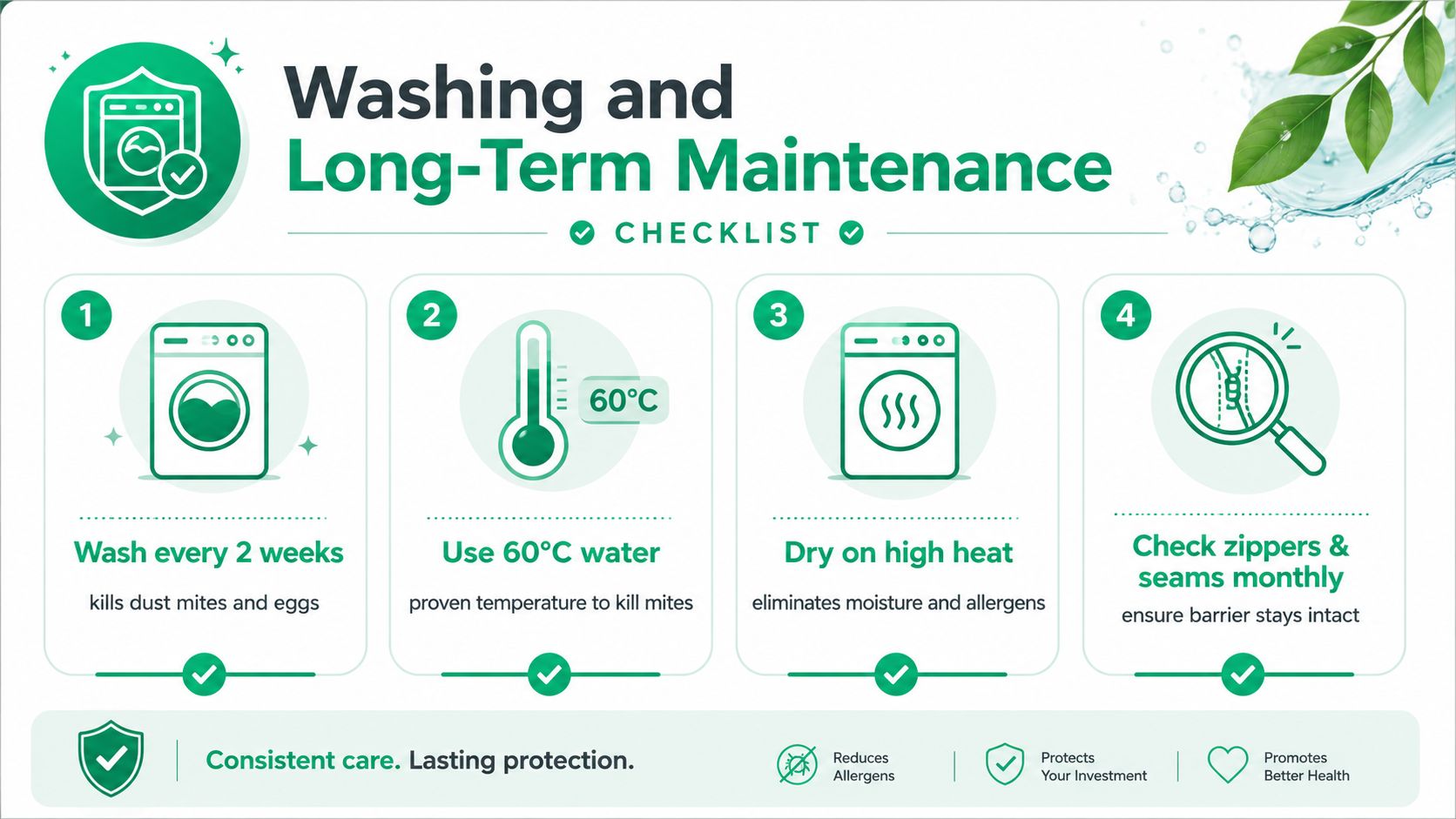
Use a simple care routine
- Wash on the hottest permitted cycle: If the protector is designed for 60°C washing, use that setting rather than a cool refresh.
- Avoid damaging additives: Skip fabric softener if the manufacturer advises against it. Residue can affect some coatings and membranes.
- Dry according to the label: Excessive heat may affect polyurethane layers, adhesives, elastic, and zip components. Do not assume high heat is safe because of a generic laundry tip.
- Inspect the barrier regularly: Check the zip, zip guard, corners, and seams for gaps, fraying, pinholes, or peeling.
Replace a protector when the zip fails, the membrane cracks or peels, or a damaged seam lets light through. A cover that has stretched may no longer close properly around the pillow. An intact-looking outer fabric does not prove that the barrier still works.
The pillow inside still needs sensible care. A sealed cover protects the filling from new contamination, but it does not restore lost support or remove existing odour. Replace an old pillow when it has lost support, developed odour, or become difficult to clean under its care instructions. Covering the pillow can also reduce the need for frequent replacement, as recognised in the NHS guidance cited earlier.
Where a Pillow Protector Fits in an Allergy Control Plan
A pillow protector is the closest layer to your airway, not the whole solution. UK NHS and respiratory guidance places it alongside bedding hygiene, lower indoor damp, vacuuming, and barriers for other sleep surfaces. That combination makes sense because mites and their allergens aren't confined to one pillow.
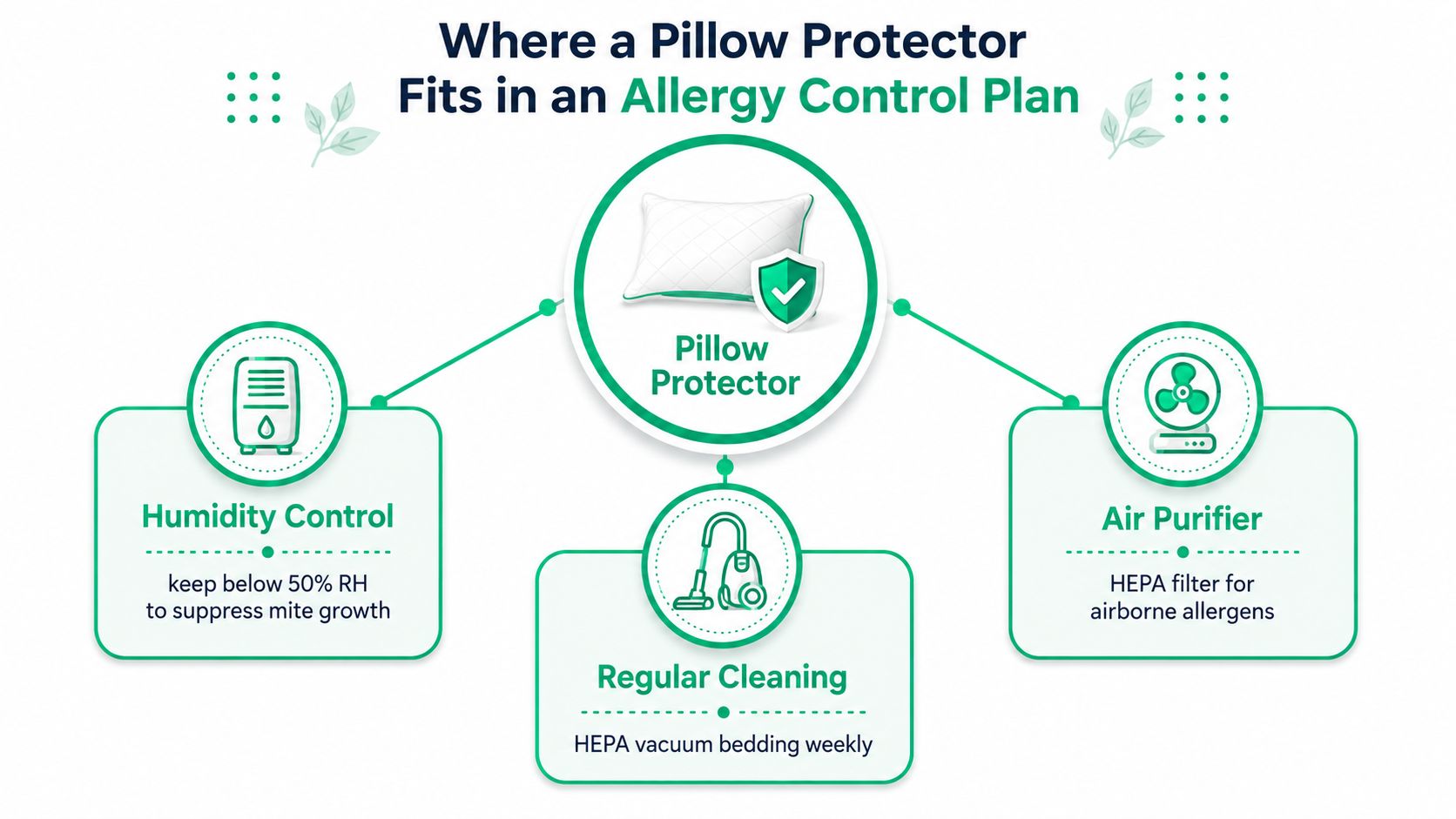
Build the bedroom in layers
Start with the sleep surfaces. Encase the pillow, mattress, and duvet where practical, and wash removable bedding at the temperature recommended by UK guidance. A pillow barrier protects the area closest to your face, while mattress and duvet protection reduces the chance that other reservoirs undermine the effort.
Then manage moisture. Dust mites favour warm, humid bedding, so ventilation and humidity reduction are important parts of the plan. Don't treat a dehumidifier as a substitute for a barrier, and don't expect a cover to solve a damp bedroom.
Clean without redistributing the problem
Use a HEPA-filtered vacuum on mattresses, carpets, and upholstered items where appropriate. Vacuuming can remove loose material from surfaces, but it won't seal an infested pillow or replace hot laundering. For broader household strategies, this resource on how to reduce household dust naturally offers practical cleaning context without turning the pillow protector into a miracle product.
An air purifier can help capture airborne particles, but it doesn't remove the reservoir inside a pillow or mattress. Hard flooring may also simplify cleaning compared with fabric-heavy rooms, particularly for people whose symptoms remain severe despite bedding controls.
A pillow protector buys you protected contact with the pillow. It doesn't make the rest of the bedroom allergen-free.
Keep the plan manageable. Protect the pillow first, then add mattress and duvet barriers, hot washing, moisture control, and targeted vacuuming. If symptoms remain disruptive, speak with a GP or allergy clinician rather than endlessly adding bedding products.
Choosing the Right Pillow Protector for Dust Mites in the UK
Buy the specification, not the slogan. A credible pillow protector for dust mites should state how its barrier works and how the product was tested.
My UK buying checklist
- Pore size: Look for a stated pore size of 10 microns or smaller. A claim without a measurement gives you little basis for comparison.
- Complete enclosure: Choose a zip-around design when the pillow itself may be the reservoir. Check that the zip has a guard and that the seams don't leave an open path.
- Test evidence: Look for documented mite and allergen testing, or a recognised certification body. Allergy UK guidance says covers should be breathable and fully enclose the pillow to prevent allergen escape, as explained in this UK pillow barrier-cover guidance.
- Wash compatibility: Select a product whose care instructions fit your household routine. If you want to follow 60°C bedding guidance, don't buy a cover that only tolerates gentle cool washing.
- Sleep feel: Choose breathable microfibre, tightly woven cotton, or an air-permeable membrane if heat and noise bother you. A technically sound cover that you remove after a week protects nobody.
Don't give much weight to thread count alone. Check the pore size, membrane construction, zip, seam finish, and care instructions together. On the Protect-A-Bed UK site, filter first for a documented allergen barrier, then compare fabric feel, pillow size, and the washing guidance. Protect-A-Bed's range includes pillow protectors using breathable membrane construction, so assess the individual product specification rather than assuming every style has identical performance.
Use a complete encasement when you've got persistent morning symptoms, an older pillow, or confirmed mite sensitisation. Use a standard protector only for surface hygiene or as an additional layer over a properly sealed barrier. If symptoms include wheezing, chest tightness, or poorly controlled asthma, bedding changes should support, not replace, clinical advice.
Protect-A-Bed offers UK pillow protectors designed to place a breathable protective layer between you and the pillow, with options including cotton, cooling fabrics, and membrane-based constructions. Visit Protect-A-Bed to compare the available pillow protection and choose a design that matches your allergy-control routine, sleep comfort, and washing requirements.