

Cotton Pillow Protectors with Zip: A UK Buying Guide

A cotton zip pillow protector is best understood as a washable hygiene barrier, not a guaranteed allergy or pest fix. For practical hygiene, wash it at 60°C, close the zip before laundering, and replace it when the fabric, seams, or closure stop maintaining a reliable fit.
The popular advice says to choose the softest protector you can find. That's incomplete. Softness affects comfort, but the protector's real job is to sit between your pillow and pillowcase, absorb sweat and skin oils, and give you a removable layer that can be washed without repeatedly laundering the pillow itself.
Cotton is a sensible UK choice because it feels natural and breathes better than many plastic-feeling alternatives. It isn't automatically an allergen-proof material, though. The zip, seams, fabric density, internal barrier, and care label determine whether you've bought ordinary bedding protection or a more serious encasement.
Table of Contents
- Why a Cotton Zip Pillow Protector Is a Hygiene Product First
- What a Cotton Zip Pillow Protector Actually Is
- Cotton Compared to Other Pillow Protector Fabrics
- Why the Zip Closure Matters More Than Most Buyers Realise
- Getting the Right Size for a UK Pillow
- Washing and Caring for a Cotton Zip Protector
- Where Cotton Zip Protectors Fall Short on Allergies and Pests
- Who Should Buy One and What to Look For Next
Why a Cotton Zip Pillow Protector Is a Hygiene Product First
A pillow protector isn't a luxury pillowcase with a higher thread count. It's a maintenance layer. Your face, hair, sweat, oils, skin flakes, and airborne bedroom dust all meet the pillow night after night, while the pillow itself is awkward to wash thoroughly. A removable protector takes that workload instead.
UK consumer guidance has long treated pillow protectors as a hygiene measure because pillows can collect oils, dead skin, sweat, and allergens. Retail guidance also notes that pillows may collect dust mites quickly because warmth and moisture from breathing create a favourable environment. A closed protector gives you a washable barrier between that material and the pillow filling, while a normal pillowcase remains on top for everyday comfort. UK pillow protector guidance reflects that practical role.
The useful test is simple: does the protector make routine cleaning easier without damaging the pillow or disrupting sleep? If the answer is yes, it's doing its job. Advice on why use pillow protectors is most useful when read through that hygiene lens, rather than as a promise of improved softness.
What the protector should take
A good cotton zip protector should handle the mess that would otherwise reach the pillow core:
- Body oils and sweat: Cotton can absorb moisture, while the removable cover allows regular laundering.
- Skin flakes: These are part of ordinary bedding debris and can accumulate inside pillows if no washable layer intervenes.
- Dust and allergen residue: A protector can reduce direct transfer, but basic cotton alone isn't a certified sealed allergy barrier.
- Spills and staining: Only a protector with a waterproof internal layer can provide meaningful liquid protection.
That last distinction matters. A plain cotton shell can improve hygiene and washability, but it won't perform like a waterproof or specialist allergen encasement merely because it has a zip.
Practical rule: Buy cotton zip protectors for repeatable hygiene maintenance first. Treat allergy or pest control as a separate performance requirement.
The zip must also close fully. An open zip, damaged seam, or loose envelope fold turns a potentially useful barrier into a fabric cover with a convenient opening. Judge the product by what happens after repeated washing, not by how pleasant it feels on the first night.
What a Cotton Zip Pillow Protector Actually Is
Think of a cotton zip pillow protector as three separate components. Each one solves a different problem, and a product can perform well in one area while failing in another.
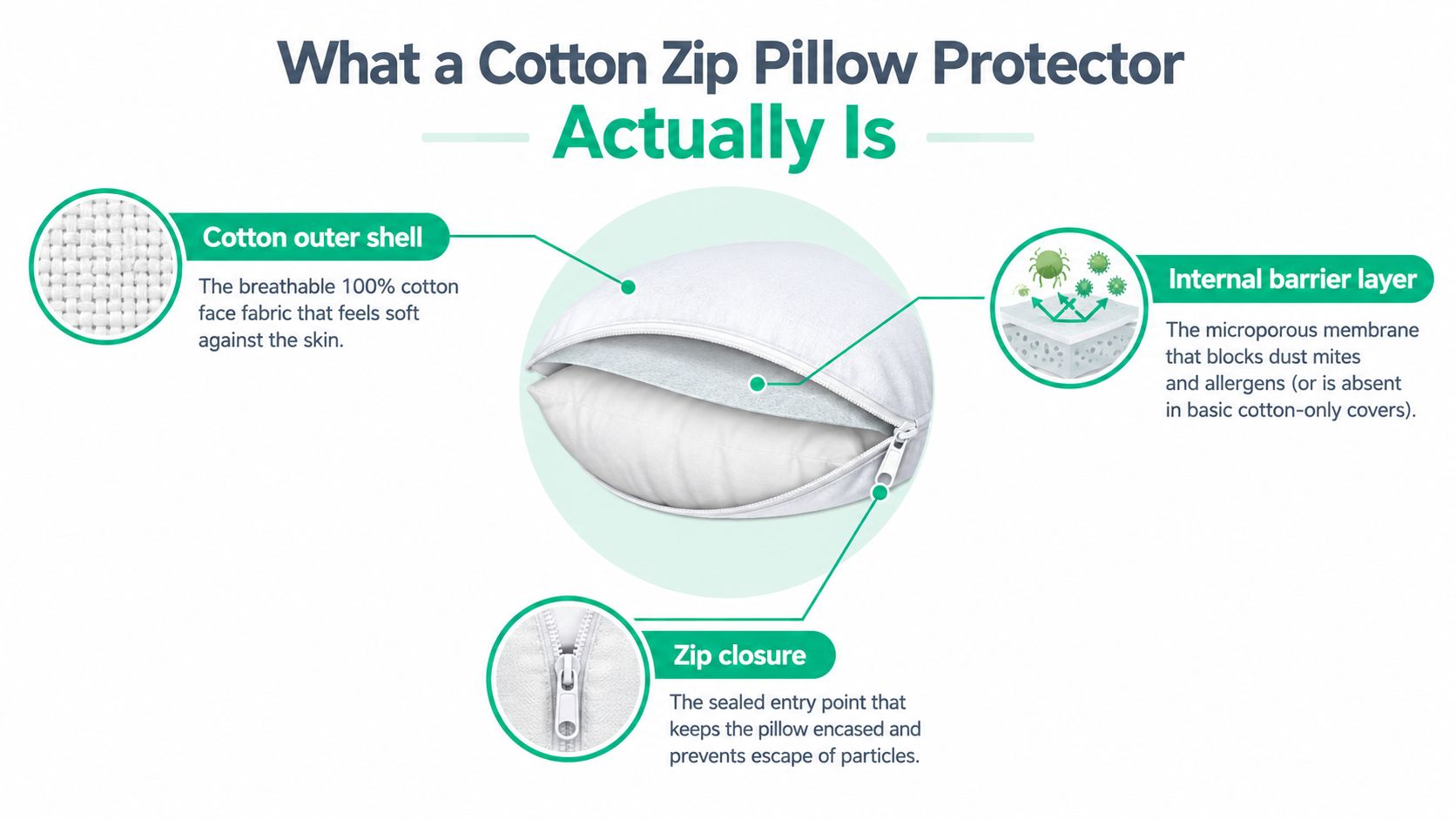
1. The cotton outer shell
The outer shell is the fabric you handle and, depending on the design, the layer closest to the pillowcase. It may be woven cotton, cotton terry, or a cotton-rich fabric. Cotton is breathable, relatively quiet, and comfortable in ordinary UK bedding use.
Breathability doesn't mean allergen-proof performance. A woven cotton shell can allow air and moisture vapour to pass, but it isn't automatically engineered to block microscopic allergen particles. The tighter the weave may help, yet buyers shouldn't confuse “dense cotton” with a tested sealed barrier.
2. The internal barrier layer
Some protectors contain no separate membrane. They're cotton-only covers designed to keep the pillow cleaner and make laundering easier. Others add a waterproof layer, often made from a thin polyurethane-style laminate or another flexible membrane.
This layer changes the product's purpose. Without it, the protector mainly controls contact, staining, and washability. With it, the protector may also resist liquids and provide a more continuous barrier, although performance still depends on the seams and zip construction.
3. The zip closure
A fully zipped protector encases the pillow rather than folding fabric underneath it. That's different from an envelope-style cover, where the opening remains behind an overlapping flap.
Look at the product description and photographs carefully. “Zipped” should mean the pillow is enclosed around its perimeter, not that a small zip secures only part of the cover. The closure is the access point, the pressure point, and often the weakest part of the design.
A cotton protector is not one material doing one job. It's a fabric shell, an optional membrane, and a closure system working together.
Once you separate those elements, shopping becomes clearer. Ask whether you want comfort and washability, liquid protection, allergen containment, or pest isolation. A basic cotton zip cover may be excellent for the first purpose and unsuitable for the last.
Cotton Compared to Other Pillow Protector Fabrics
There's no universal winner among protector fabrics. Each option prioritises a different failure mode, from overheating to noise, slow drying, liquid leakage, or inadequate sealing.
| Fabric | Breathability | Wash durability 60–90°C | Waterproofing | Allergen barrier | Typical feel |
|---|---|---|---|---|---|
| Cotton | Good, especially without a membrane | Depends on the care label and shrink control | None in cotton-only versions | Limited unless tightly woven and fully enclosed | Natural, quiet, familiar |
| Polyester | Usually moderate | Often practical for frequent washing | Usually none without a coating | Depends on weave and construction | Smooth, sometimes less natural |
| Cotton-polyester blend | Moderate to good | Often more dimensionally stable than pure cotton | None unless laminated | Limited to moderate, depending on design | Soft with a slightly synthetic finish |
| Bamboo-derived viscose | Soft and moisture-friendly | Follow the specific care label carefully | Usually none without a membrane | Not inherently sealed | Very soft, smooth |
| Cotton with a TPU-style membrane | Lower than uncoated cotton, depending on membrane | Must be confirmed on the label | Yes, where the membrane and seams are intact | Stronger potential, but closure and testing still matter | Cotton face with a slight protective feel |
Where cotton earns its place
Cotton works well for sleepers who dislike crinkle, plastic textures, or synthetic-feeling bedding. It's also a sensible choice when the priority is a washable layer over an everyday pillow rather than a liquid-proof enclosure. A cotton face can feel less clinical, especially under a standard pillowcase.
The compromise is maintenance. Pure cotton can shrink, hold more moisture, and take longer to dry than lightweight synthetics. A membrane improves liquid resistance but can reduce the airy feel that makes cotton attractive in the first place.
Choose by the problem you're solving
If the main problem is ordinary sweat, oils, and staining, uncoated cotton is often enough. If rapid drying matters, a synthetic or blended fabric may be more practical. If liquid protection matters, choose a product with a stated waterproof membrane rather than assuming cotton will perform that role.
For allergy management, don't stop at the fabric name. Allergy UK recommends breathable barrier covers that completely enclose mattresses, duvets, and pillows, and says covers should be tested to prevent house dust mite allergen escaping. Allergy UK's house dust mite guidance points towards enclosure and tested performance, not cotton content alone.
Why the Zip Closure Matters More Than Most Buyers Realise
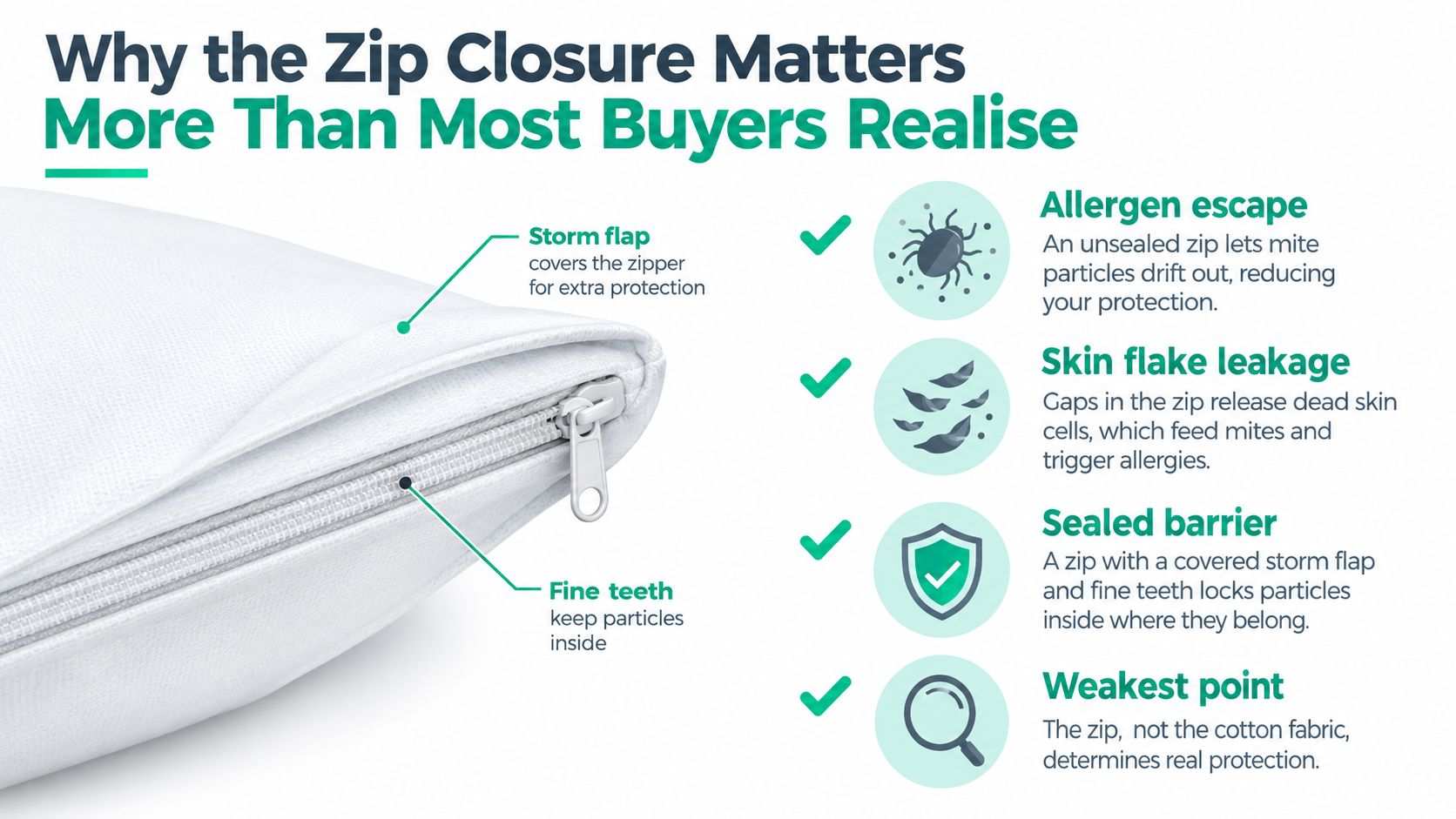
The cotton face gets most of the marketing attention. The zip determines whether the pillow is actually enclosed.
A protector with an excellent fabric but a partly open edge still leaves a route for dust, skin flakes, and allergen residue to move between the pillow and bedroom. An envelope closure may look tidy, but movement inside the bed can expose the opening. A continuous zip around the edge gives you a more definite enclosure, provided it closes cleanly and the surrounding seams remain intact.
Inspect the closure, not just the photograph
A buyer should look for four details:
- Full perimeter coverage: The zip should run around the opening far enough to let the pillow enter without forcing the corners.
- A covered closure: A fabric flap or storm flap can reduce direct exposure around the zip line.
- A smooth slider: The slider should move without catching, separating the teeth, or pulling the fabric tunnel out of shape.
- Reinforced stitching: The tape and end stops need to survive repeated removal and washing.
A standard nylon zip may be quiet and flexible. Fine-tooth metal hardware can feel sturdy but may require more care around high heat and corrosion. Neither is automatically superior. The surrounding seam, fabric quality, and construction decide whether the closure remains reliable.
Hot washing exposes weak construction
UK guidance for zipped pillow protectors commonly recommends washing at 60°C, closing the zip first, and choosing breathable construction. That advice matters because an open fastener can catch on other laundry, distort the cover, or expose the pillow during the wash. UK zipped pillow protector guidance also reflects the practical importance of full coverage and closure handling.
Repeated hot cycles can reveal shrinkage around the zip tunnel, warped teeth, stretched stitching, or a slider that no longer meets the end stop. Check the closure after every wash, especially if the protector is used for allergy-sensitive bedding.
Zippered mattress cover guidance offers a useful principle that applies here too: the closure isn't decorative hardware. It's part of the barrier system. If the zip no longer closes smoothly and completely, the protector has reached the end of its useful life, even if the cotton still looks presentable.
Getting the Right Size for a UK Pillow
Size labels are only a starting point. Pillow filling changes shape under pressure, and a protector that fits a flat display sample may behave differently on a full feather pillow or a firm memory foam design.
Common UK pillow formats include a rectangular standard shape around 48cm by 74cm, a square style around 65cm by 65cm, and a king-size format around 50cm by 90cm. These dimensions are useful reference points, but manufacturers can label products differently, so measure the pillow you own before ordering.
| Pillow Type | Pillow Size (cm) | Typical Protector Size (cm) | Fit Notes |
|---|---|---|---|
| Standard UK rectangular | 48 x 74 | Match the manufacturer's stated standard size | Aim for a close fit without forcing the zip |
| Square UK pillow | 65 x 65 | Match the stated square size | Check depth, especially with fuller fillings |
| King-size rectangular | 50 x 90 | Match the stated king-size format | Confirm both length and width, not just “king” |
| Between labelled sizes | Measure the actual pillow | Choose the nearest compatible size | Avoid relying on the label alone |
Measure the pillow before buying
Lay the pillow flat without compressing it. Measure its length and width from seam to seam, then note whether it has a gusset or unusually deep edge. A filled pillow can need more room than its relaxed measurements suggest, particularly if the protector has a shallow profile.
A protector often fits slightly snugly because the fabric needs to hold the pillow in place. Too much spare fabric allows the filling to bunch, while an undersized cover puts stress on the zip and corners. Feather and down compress differently from hollowfibre, while memory foam tends to resist being forced into a tight enclosure.
A close fit is good. A strained fit isn't. If you have to compress the pillow aggressively to close the zip, choose a deeper or larger compatible protector.
If you're between sizes, check the return policy and the product's depth information before buying. Don't assume a larger cover is safer. Excess fabric can create folds that make the pillow uncomfortable and put uneven pressure on the closure.
Washing and Caring for a Cotton Zip Protector
A cotton zip protector only works as a hygiene product if you'll wash it regularly. Treat it as part of the bedding routine, not as a cover you fit once and forget.
UK guidance for allergen-sensitive bedding commonly points to 60°C washing, while independent product guidance describes 40°C monthly washing as a practical hygiene cycle for some cotton protectors. Follow the product's own care label first, then choose the highest permitted temperature that suits your purpose. A 40°C cycle can refresh a protector, but allergy-focused households should prioritise the stated 60°C guidance where the construction permits it.
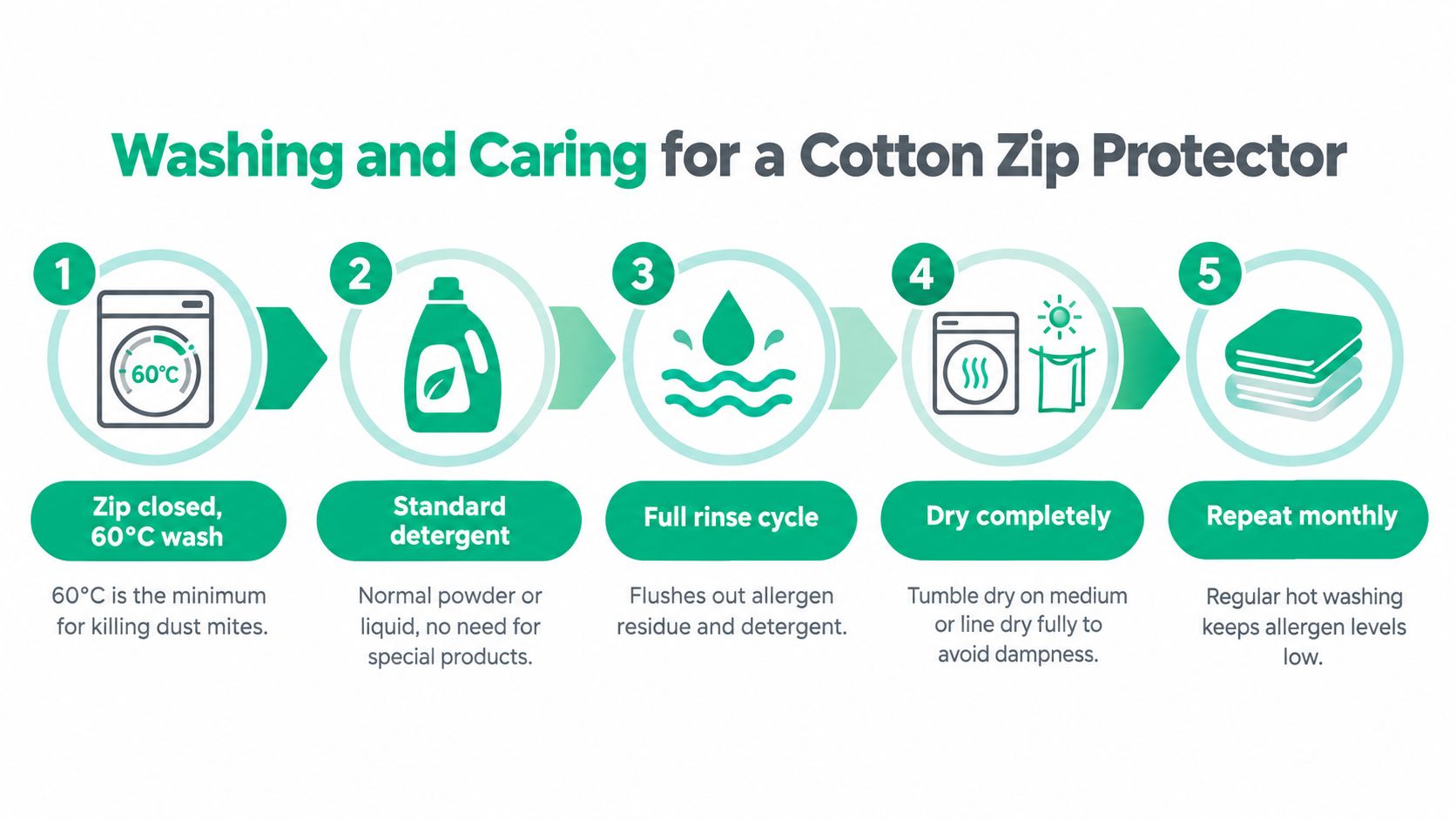
A reliable wash routine
- Close the zip completely. This protects the teeth, keeps the cover's shape, and prevents the opening catching on other items.
- Use ordinary detergent. You don't need a specialist product for routine laundering unless a clinician or manufacturer advises otherwise.
- Avoid harsh chlorine bleach. It can weaken cotton fibres and damage coatings or membrane materials.
- Rinse fully. Residual detergent can irritate sensitive skin and may affect the hand-feel of the fabric.
- Dry the entire protector. Dampness trapped around seams or the zip can create an unpleasant sleeping surface and encourage deterioration.
High tumble heat can accelerate cotton shrinkage and put stress on the closure. Low heat or line drying is kinder to the material, but never refit the protector while it's damp. If you use a laundry service because your household schedule is tight, laundry care for busy professionals can help you plan regular washing without leaving bedding in the basket for weeks.
Know when to replace it
Look for thinning fabric, persistent pilling, distorted seams, a loose zip tape, missing teeth, or a slider that separates the closure. A small stain isn't necessarily a structural problem, but a gap at the zip or seam is.
For general use, a wash every one to two weeks is a realistic routine. Allergy-sensitive sleepers may prefer weekly laundering, provided the protector's label permits the required temperature. Keep a spare protector available so you can change the bed while the washed one dries completely.
Where Cotton Zip Protectors Fall Short on Allergies and Pests
The most misleading claim in this category is that cotton plus a zip automatically solves dust-mite allergies. It doesn't.
Allergy UK advises using breathable, allergen-proof barrier covers that completely enclose pillows and other bedding, and recommends covers tested to prevent house dust mite allergen escaping. That requirement is more demanding than just buying a woven cotton protector with a zip. The fabric, seams, zip construction, and test evidence all matter.
NHS patient guidance also distinguishes between ordinary bedding hygiene and specialist anti-allergy encasements. It advises encasing pillows and washing non-encased bedding at 60°C, while noting that mites are found in bedroom dust in all homes. Dust-mite allergy guidance makes the limitation clear for shoppers who want clinical-level control from a comfort-led cotton product.
| Feature | Cotton zip protector | Sealed allergen encasement |
|---|---|---|
| Main purpose | Washable hygiene and pillow protection | Physical containment of allergens |
| Outer feel | Often natural and quiet | Varies by construction |
| Closure | Zip, quality varies | Designed for continuous enclosure |
| Waterproofing | Only if a membrane is included | Often included, but verify the specification |
| Allergy evidence | Must be checked product by product | Look for tested barrier performance |
| Bed-bug role | Usually limited unless specifically engineered | Requires pest-specific design and claims |
Bed bugs require a different question
A cotton zip protector may reduce staining and make laundering easier, but that doesn't make it a reliable bed-bug control layer. Recent UK reporting has connected bed-bug spread with insecticide resistance, which makes sealed encasement design more relevant than generic breathable-cotton language. UK bedroom maintenance advice is useful for broader cleaning habits, but hygiene habits shouldn't be mistaken for pest eradication.
Pest professionals generally focus on specialist mattress encasements after treatment to prevent harbourage and reinfestation. A pillow cover should only be treated as part of a pest-control plan if its fabric, zip, seams, and closure have been designed and tested for that purpose.
For dust-mite concerns, pillow protector advice for dust mites reinforces the need to distinguish a washable protector from a tested allergen barrier. If symptoms are significant, ask a healthcare professional about the appropriate bedding strategy rather than relying on the word “cotton” on a product page.
Who Should Buy One and What to Look For Next
Cotton zip protectors suit people who want a cleaner, easier-to-maintain pillow without changing the feel of their bedding. They're particularly practical for households that wash bedding regularly, sleepers who dislike noisy waterproof covers, and anyone protecting a pillow that would be difficult or expensive to replace.
They're also reasonable for allergy-sensitive sleepers who want a breathable washable layer, as long as they understand the difference between reducing contact and creating a tested allergen seal. If you need evidence-grade containment, choose a fully enclosed specialist product instead of assuming a standard cotton cover is enough.
Match the product to your priority
Choose a cotton zip protector when:
- You want a removable barrier against sweat, oils, skin flakes, and everyday dust.
- You'll wash it routinely and can follow the temperature stated on the label.
- You prefer a quiet, natural-feeling cover beneath a normal pillowcase.
- You need basic pillow protection rather than guaranteed allergen or pest isolation.
Choose a sealed allergen encasement when:
- A clinician has recommended specialist bedding protection.
- You need the pillow completely enclosed with tested allergen-barrier performance.
- You're managing a serious dust-mite sensitivity and want more than a washable outer layer.
- You're addressing bed bugs and need a product designed specifically for pest containment.
Inspect these details before checkout
- Closure quality: Look for a full enclosure, smooth slider, reinforced stitching, and a covered zip if available.
- Fabric construction: Check whether the product states pure cotton, a blend, terry, jersey, or a laminated inner layer.
- Wash instructions: Confirm that the care label supports the temperature you intend to use. Product guidance for cotton protectors may differ.
- Fit: Match the actual pillow dimensions and depth, not just “standard” or “king”.
- Certification: Look for recognised textile safety certification where it matters to you, but don't treat certification as proof of allergen or bed-bug performance.
- Barrier claims: If the product promises liquid, allergen, or pest protection, look for specific construction and testing information rather than broad words such as “fresh” or “anti-allergy”.
Protect-A-Bed offers cotton zippered pillow protectors, waterproof zippered options, and fully encased AllerZip pillow protection, so shoppers can select between a cotton-led hygiene layer and a more sealed construction according to their needs.
The decisive question is not “Does this feel soft?” It's “What do I need this cover to control?” For everyday hygiene, buy a well-sized cotton protector with a dependable zip and a care label you'll follow. For allergy or bed-bug management, move to a specialist sealed encasement and check the evidence behind the claim.
If you want a washable cotton layer for everyday pillow hygiene, browse the Protect-A-Bed range and compare the cotton zippered options with fully encased designs. Choose the construction that matches your actual priority, then commit to the washing routine that keeps the barrier clean, dry, and functional.