

Zipper Mattress Covers: A Practical UK Buyer's Guide

You've found a listing called a zipper mattress cover, but the product photographs don't settle anything. One looks like a thin waterproof layer with a short zip, another completely surrounds the mattress, and a third promises dust-mite or bed-bug protection. The prices vary sharply, yet the titles use almost identical language.
That confusion is understandable. Retail listings often blur protectors, covers and encasements into one category, although they don't provide the same level of protection. This guide cuts through the wording and focuses on the parts that matter: zip construction, seam integrity, membrane performance and the UK bedroom situation the cover needs to handle.
Table of Contents
- Why Zipper Mattress Covers Confuse So Many UK Shoppers
- What a Zipper Mattress Cover Actually Is
- Zipper Covers vs Other Closure Types
- Where Zipper Covers Make the Most Sense
- Sealing Effectiveness and What the Evidence Shows
- How to Choose the Right Zipper Mattress Cover
- Care, Washing and Long-Term Use
- Matching the Right Cover to Your Situation
Why Zipper Mattress Covers Confuse So Many UK Shoppers
The first mistake is treating the word zipper as a specification. It only describes the closure. A short zip may secure a topper-style protector over the sleeping surface, while a full encasement uses a zip to surround the mattress on every side. Both can appear in search results for the same phrase.
A fitted waterproof protector usually covers the top and sides, then stays in place with elastic. An envelope closure relies on fabric tucked beneath the mattress. A genuine encasement is a sealed shell, and its performance depends on whether the zip runs around the mattress and whether the end, teeth and seams are properly protected.
Retailer's rule: Don't buy from the title alone. Check the product photographs, the closure diagram and the exact wording about coverage.
Price can offer a useful warning, although it isn't proof of quality. A low-cost zip-on waterproof sheet and a more expensive sealed encasement are solving different problems, so comparing them as though they're interchangeable leads to false savings. The cheaper item may be perfectly suitable for spill protection, but it's the wrong purchase for serious allergen or bed-bug control.
The useful questions are straightforward:
- Does the cover surround all six sides?
- Does the zip close the entire opening?
- Is there a flap or other barrier behind the zip?
- Are the seams sealed, bound or merely stitched?
- Does the material protect against liquid, allergens, pests, or only surface dirt?
Once those answers are clear, the choice becomes much easier. Zipper mattress covers earn their price when the seal itself matters, not because a product has a zip.
What a Zipper Mattress Cover Actually Is
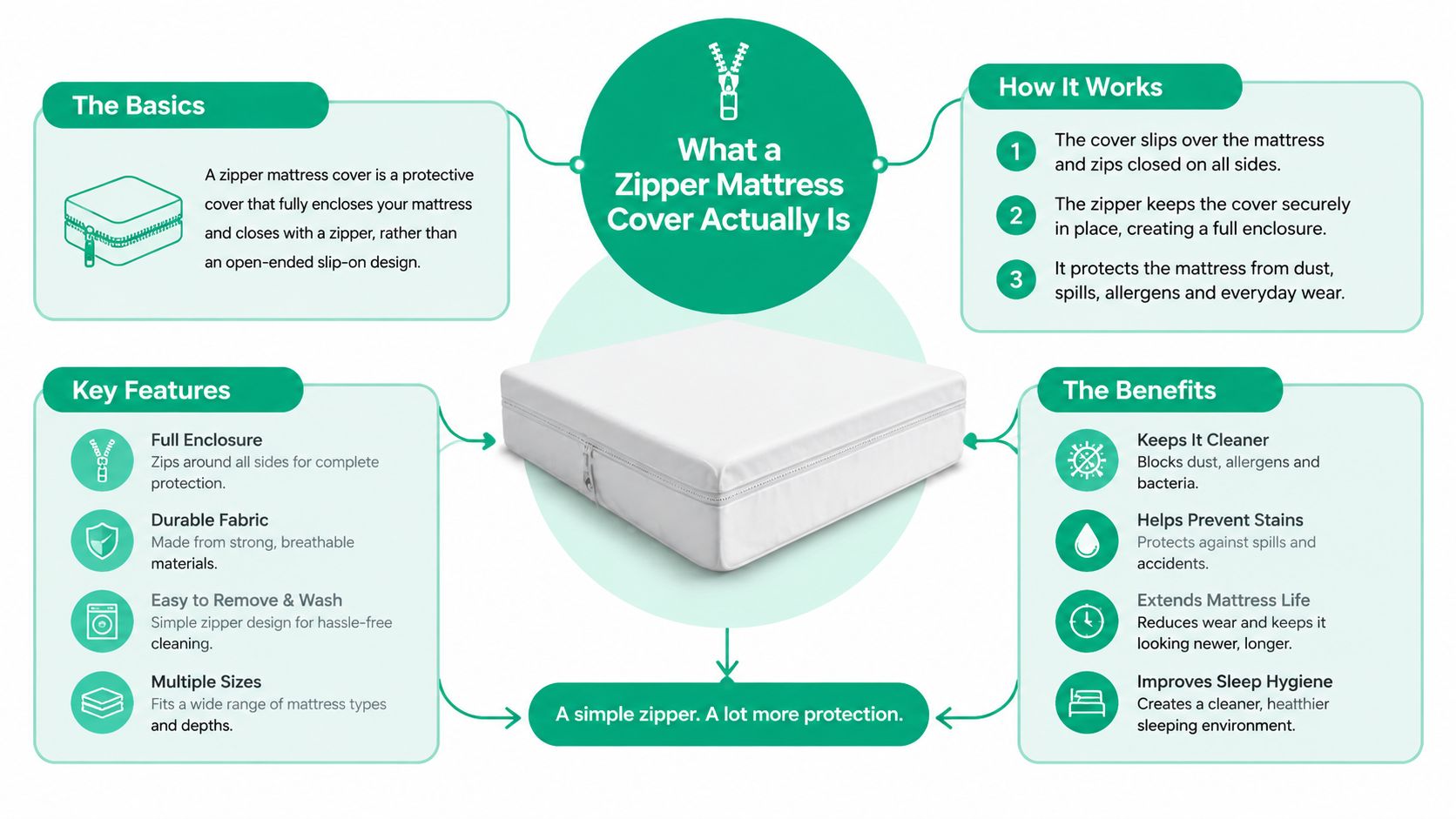
A zipper mattress cover is a fabric sleeve or shell that encloses part or all of a mattress and closes with a zip. The important distinction is coverage. A cover that sits over the top and sides is a protective layer, while a full encasement closes around the mattress, including the underside.
UK shoppers generally encounter three zip arrangements:
- Short side zip: This is common on topper-style covers. It makes the product easier to put on, but it usually doesn't create a complete barrier around the mattress.
- Full-perimeter zip: The mattress goes inside the shell, and the zip travels around the edges so the cover can close on all sides. This is the construction to look for when containment matters.
- L-shaped or U-shaped zip: The opening travels along two or three sides. It's easier to fit than a narrow opening, particularly on a heavy mattress, but the seal still depends on the zip's end treatment and the surrounding seams.
That differs from a fitted protector, which stretches over the mattress like a sheet and leaves the underside exposed. An envelope-style cover goes further than a fitted sheet but still relies on tucked fabric rather than a mechanical closure.
The components that decide whether it works
The zip may use a coil or Vislon-style tooth construction. Coil zips can flex smoothly around curves, while larger moulded teeth can feel more substantial. Neither is automatically superior. What matters is whether the slider closes consistently and whether the zip remains aligned under tension.
A strong design also places a flap behind the zip. That flap reduces a direct path through the teeth and protects the mattress from the zip edge. A flap-free zip can still be useful for basic waterproofing, but it gives you less margin for imperfect closure.
The final component is the membrane or laminate bonded to the fabric. A modern PU or TPU membrane can block liquid while allowing air and water vapour exchange, unlike older vinyl-style designs that are commonly louder and less breathable. UK buying guidance describes PU membrane protectors as silent, waterproof and breathable for everyday use, family beds and incontinence protection.
For a wider explanation of protectors, pads and encasements, this complete mattress protector guide is a useful companion. The serious combination is simple: full coverage, a reliable slider, a protected zip path, secure seams and a membrane suited to the risk.
Zipper Covers vs Other Closure Types
Zippers win on repeatability. Once the mattress is inside, you close the track in a defined direction and can inspect whether the slider has reached the end. That makes a properly designed zip more dependable than fabric that has merely been tucked underneath.
They're not perfect. A full encasement takes longer to remove for washing, and the zip introduces mechanical failure points. A slider left slightly open, a broken tooth or an unprotected zip terminus can undermine an otherwise good cover.
| Closure Type | Sealing Effectiveness | Ease of Use | Allergen Containment |
|---|---|---|---|
| Full zip encasement | Highest when the zip, end and seams are sealed | Slower to fit, but repeatable once installed | Strongest option because the mattress is enclosed |
| Fitted-sheet protector | Protects the sleeping surface and sides | Fastest to fit and remove | Limited, since the underside remains exposed |
| Envelope closure | Better coverage than a simple fitted sheet | Simple, but fabric can shift during handling | Reasonable for light needs, weaker where complete enclosure matters |
| Buckle or strap system | Depends heavily on tension and overlap | Can be fiddly, especially on a deep mattress | Variable, with possible gaps around the closure |
Where each alternative still has a place
A fitted protector is sensible when the main concern is a drink spill, perspiration or routine surface hygiene. Modern PU and TPU membranes are favoured over PVC or vinyl in UK buying guidance because they're generally quieter and more breathable. That's a comfort decision, not a bed-bug or full allergen-containment decision.
Envelope closures suit shoppers who want more coverage without managing a zip. They're also easier to remove frequently. I wouldn't choose one for a household that needs a dependable six-sided barrier, because tucked fabric is not the same as a closed mechanical seal.
Buckle and strap systems can work in specialist designs, but they demand closer inspection. Look for overlapping panels, secure tension and no open route at the corners. In practice, a full zip encasement is the credible choice for bed-bug containment, provided the manufacturer demonstrates how the zip end and seams are protected. It's also the strongest closure type for keeping mattress-contained allergens behind a barrier.
The deciding factor isn't convenience alone. It's whether the cover must block a route around the entire mattress.
Where Zipper Covers Make the Most Sense
A zipper cover earns its premium when a surface protector leaves too much of the mattress exposed. Four UK situations justify choosing an encasement rather than a basic fitted layer.
Allergy and asthma bedrooms
Cambridge University Hospitals NHS Foundation Trust describes breathable, fully enclosing barrier covers as the single most effective measure for dust-mite control. The cover must allow water and body moisture to pass through while preventing mite passage and allergen escape. The same NHS guidance says that, when a mattress cover is used, there's no need to vacuum the mattress (NHS-aligned UK dust-mite bedding guidance).
That doesn't make the cover a complete routine by itself. Unencased bedding still needs regular washing at 60°C, since cooler cycles only partly kill mites. Choose a cover with documented allergen-barrier performance, breathable fabric and a zip that closes fully.
Rentals and HMOs
A rental mattress has to cope with changing occupants, spills and inconsistent housekeeping. A washable encasement gives the mattress a continuous barrier between users, but check the cover's fire-safety labelling and laundering instructions before fitting it in a managed property.
Short-let hosts should prioritise a zip, reinforced corners and a membrane that won't become noisy or brittle with use. A cover that takes too long to remove may also slow turnover, so an L-shaped opening can be a reasonable compromise when bed-bug containment isn't the primary requirement.
Hotels, care homes and bed-bug risk
Hospitality and care settings need a documented process rather than vague “bug-proof” wording. Look for a stated testing standard, protected zip end and instructions covering inspection after treatment. The cover should remain part of the housekeeping routine, not replace it.
For more detail on the role of encasements in a wider bed-bug response, see this bed-bug mattress encasement guide. UK reporting has recorded confirmed bed-bug activity rising by an average of 44% year-on-year between 2023 and 2025 (UK bed-bug activity reporting). An encasement can support prevention and remediation, but it isn't a substitute for inspection or professional treatment.
Sealing Effectiveness and What the Evidence Shows
The label “sealed” doesn't tell you enough. Performance comes from three connected elements: the barrier fabric, the zip closure and the seams. If one fails, the mattress may still be protected from spills while offering little useful allergen or pest containment.
A study discussed in UK mattress-protector coverage found that a microporous encasement reduced mite allergen by more than 90%. It also found that complete encasing didn't outperform partial encasing in a tropical environment, and that higher mite allergen levels were found inside the mattress at the end of the study. For UK buyers, that's a reason to judge the membrane and seal integrity rather than assume that “full zip” guarantees the result.
The features worth paying for
A flap behind the teeth is valuable because it removes a direct, exposed route through the closure. A wraparound zip can simplify complete enclosure, while bound or welded seams offer a more controlled barrier than ordinary stitched seams. Waterproofing adds another requirement: the membrane must remain bonded after repeated washing and normal movement.
| Feature | What It Protects Against | Evidence or Standard |
|---|---|---|
| Breathable allergen barrier | Dust-mite passage and allergen escape | NHS guidance requires breathable, fully enclosing barriers |
| Protected zip path | Reduces leakage through the closure | Inspect for a continuous flap and secure zip end |
| PU or TPU membrane | Liquid penetration while supporting vapour exchange | UK buying guidance favours these over PVC or vinyl for everyday use |
| Bound or sealed seams | Reduces leakage at stitched joins | Prefer explicit construction details over broad marketing language |
| Bed-bug testing claim | Supports containment and prevention routines | Require a named test method or certification, not just “bug proof” |
A cotton-rich outer face may feel pleasant, but it shouldn't distract you from the barrier underneath. Membrane performance and closure integrity matter more than cooling language or fabric percentages. For a clearer explanation of breathable waterproof layers, consult this waterproof membrane guide.
How to Choose the Right Zipper Mattress Cover
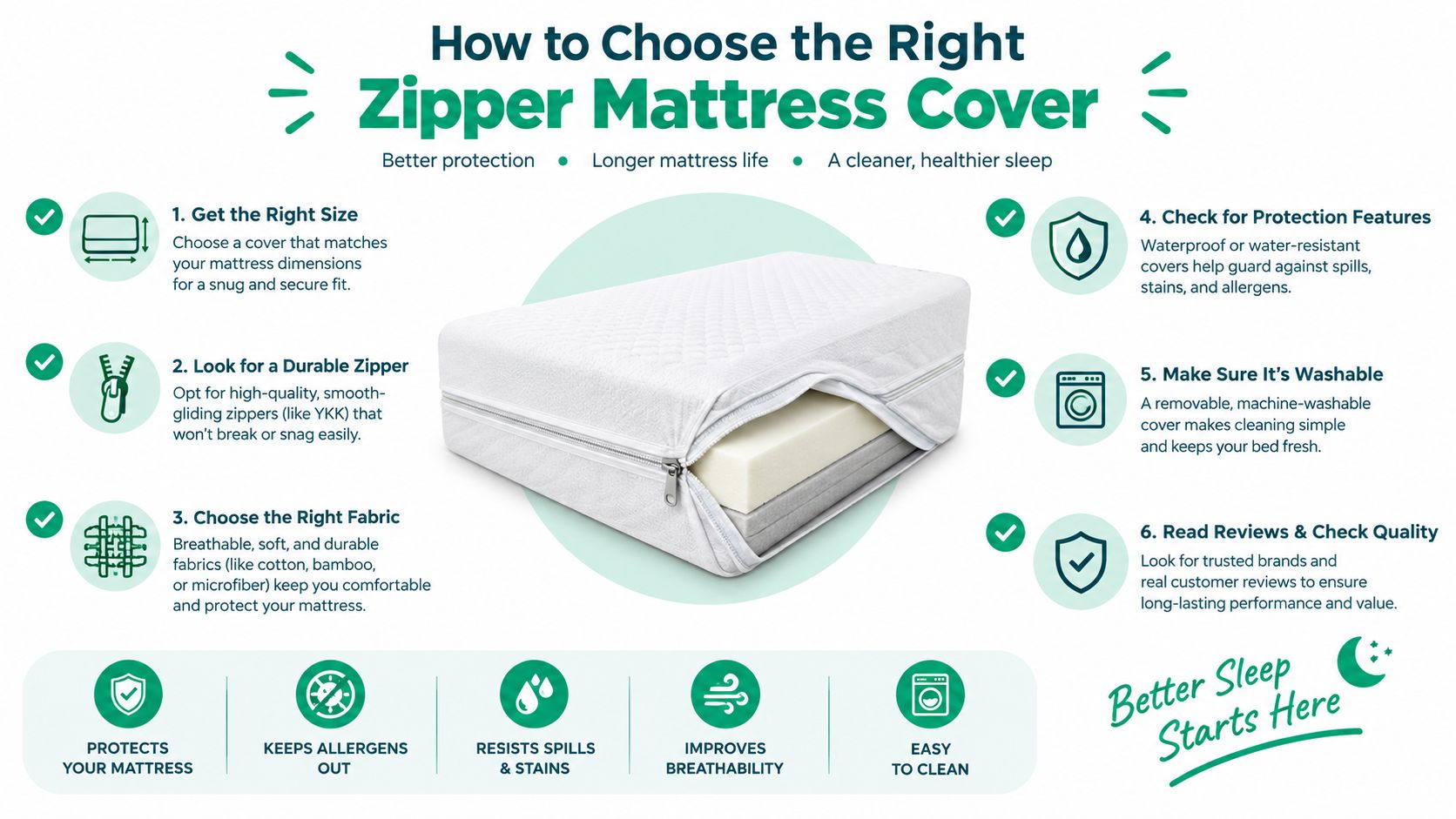
Start with the mattress, not the product description. Measure its width, length and depth, including any pillow-top or extra upholstery. A cover that's too shallow will strain the zip and corners, while excess fabric can bunch beneath the sheet and create pressure points.
A practical inspection checklist
- Measure the depth: Don't rely on the standard size name. Compare your measurement with the manufacturer's depth range and allow enough room for fitting without forcing the zip.
- Select the membrane: PU or TPU is the sensible everyday choice for waterproofing, especially if you sleep warm or dislike crinkling. Cotton-faced options can feel more natural, but they may cost more and require closer attention to washing.
- Inspect the opening: Choose a full-perimeter or generously wrapping zip for a true encasement. A short side zip is a surface protector, regardless of how prominently the listing uses the word “encasement”.
- Check the slider: Heavy-duty plastic or metal can be appropriate, but the key test is smooth, complete closure without snagging. A stiff slider on a new product is a warning sign.
- Look for the flap: The zip should have a continuous fabric barrier behind it, with special attention at the end where the track finishes.
- Read the care label: A waterproof product that can't tolerate the washing routine your household needs will frustrate you and may deteriorate early.
Breathability matters for hot sleepers, children and anyone prone to night sweating. If the listing provides a moisture-vapour transmission rating, use it as a useful comparison. If it doesn't, focus on the membrane type and avoid assuming that a smooth, thin cover is automatically breathable.
A clear warranty also helps. A manufacturer willing to state coverage for material and manufacturing defects is giving you more information than one that only promises “long-lasting” performance. Availability of replacement sliders or repair support is another practical advantage.
This complete bedding protector guide can help if you're comparing a protector, pad and encasement for the same bed. My strongest advice is to buy by risk first, closure second and feel third. A soft cover with the wrong seal is still the wrong cover.
Care, Washing and Long-Term Use
A zipper mattress cover only works while the fabric, seams and closure remain intact. Start by reading the sewn-in care label, because PU and vinyl constructions don't tolerate the same treatment. PU-laminated covers are generally chosen for quieter, more breathable use, while vinyl-style products may be better suited to wipe-clean routines rather than repeated machine washing.
For allergy households, the surrounding bedding should be washed at 60°C, following the NHS guidance cited earlier. The cover itself must follow its own care label. If it's limited to a cooler cycle, don't force a hotter wash and risk damaging the membrane. You'll need to balance allergen control with the product's stated temperature tolerance.
A routine that works in practice
Wash the cover when it has accumulated sweat, dust or visible soil, and inspect it during laundering. General-use covers can follow a less frequent routine than allergy-focused bedding, but a property with repeated occupancy needs a documented inspection and cleaning schedule rather than an occasional check.
Before washing, close the zip completely. This protects the teeth and prevents the cover from twisting in the drum. Use the recommended detergent, avoid harsh treatments unless the manufacturer permits them, and choose low heat or air drying when the care label warns that high temperatures can affect the membrane.
After a professional bed-bug treatment, don't remove an encasement casually. Follow the treatment provider's instructions, examine the seams and zip end, and reclose the cover carefully if it has been opened. The bed-bug response needs to include the mattress, surrounding bed structure and room, because an encasement is a supporting barrier rather than a standalone cure.
For a practical laundering routine, use this guide to washing a mattress protector. When refitting, don't cram the mattress into an undersized shell. Keep fibres away from the teeth, guide the corners into place and never force a slider over trapped fabric.
Replace the cover when seam tape lifts, the membrane separates, the zip no longer closes completely or the slider repeatedly opens. A small cosmetic mark is harmless. An opening in the barrier isn't.
Matching the Right Cover to Your Situation
Choose the cover by the problem you're preventing, not by the most impressive product wording.
- Allergy or asthma household: Buy a breathable, fully enclosing zip cover with documented allergen-barrier performance and secure seams. Keep washing the unencased bedding at the NHS-recommended temperature, because the encasement is one part of the routine.
- Rental, HMO or short-let property: Choose a durable, washable encasement with a strong zip, reinforced corners and clear fire-safety information. Frequent turnover makes fit and cleaning speed just as important as the barrier.
- Active or recent bed-bug concern: Choose a full six-sided cover with a protected zip end, secure closure and a stated testing or certification basis. Keep it fitted according to treatment guidance and inspect it rather than assuming the shell solves the whole infestation.
- Memory foam mattress: Prioritise a breathable PU-laminated construction with enough depth and flexibility for fitting. A cover that traps moisture or strains at the corners is a poor match for a mattress that's difficult to turn.
The cheapest zip cover often saves money by omitting the details that matter most, such as a continuous flap, stronger seam treatment or dependable membrane bonding. Spend according to the risk. A better closure and clearer warranty can be more valuable than a softer top fabric.
Protect-A-Bed offers UK mattress protectors and full encasements, including waterproof breathable options and zip-based bed-bug protection, so you can compare the construction against your specific need rather than buying on the word “zipper” alone.
If you're choosing between a surface protector and a genuine encasement, start with the risk you need to control and check the zip, seams and membrane before considering colour or softness. Visit Protect-A-Bed to review UK mattress and bed-bug protection options, then select the cover that matches your mattress depth and care routine.