

Full Mattress Covers in the UK: A Practical 2026 Guide

A glass of water tips over beside the bed. You lift the sheet and find the mattress already damp, then start searching for a “full mattress cover” that can stop it happening again. The results seem to disagree: some show a fitted protector, others a zipped cover, and several use “full” as though it means the same size everywhere.
The confusion comes from two separate questions: what kind of cover do you need, and what size will fit your mattress? A fitted protector can help with everyday spills and perspiration; a zip-around encasement covers the whole mattress for a more complete barrier. In the UK, the word "full" also doesn't reliably identify a standard mattress size. A useful decision starts with function, then checks width, length and depth.
Table of Contents
- Why the Term Full Mattress Cover Confuses UK Shoppers
- What a Full Mattress Cover Actually Is
- Materials and Features That Actually Matter
- Why UK Bed Bug Pressure Makes Encasements Worth Considering
- Getting the Fit Right on a UK Double Mattress
- Allergen Claims, Asthma and What the Evidence Shows
- Care, Maintenance and Choosing the Right Cover
Why the Term Full Mattress Cover Confuses UK Shoppers
A shopper looking for a cover for a UK double bed can quickly run into a muddle of product names. One listing may call a fitted layer a protector, another may use “cover” for a zipped sleeve, and an international size label such as “full” may not match the shopper's mattress. Those terms aren't interchangeable, even when the products all go beneath the sheet.
It helps to separate size from construction. Size tells you whether the product can fit the mattress. Construction tells you which parts it covers and what kind of protection it offers. A protector that covers the top and sides may suit ordinary cleaning and spill concerns; an encasement closes around the whole mattress when a sealed barrier is the priority.
The other common misunderstanding is expecting one cover to solve every problem. A liquid barrier can help protect a mattress from spills, but that doesn't mean it's also a sealed bed-bug barrier or a treatment for allergy symptoms. The right choice depends on the concern, the mattress dimensions and the product's care instructions.
Start with the job, not the label. Decide whether you need everyday surface protection or a full enclosure, then measure the mattress you actually own.
The buying path is straightforward once those questions are separated. First, identify the difference between a fitted protector and an encasement. Then compare useful features such as waterproofing, breathability and barrier construction. Finally, check the UK safety context, measure the mattress in three dimensions and treat allergy claims carefully.
That turns “full mattress cover” from a possibly misleading size name into a practical decision about fit and function on a UK double bed. You don't need to guess what a label means; you need to know what the product covers and whether its dimensions match your mattress.
What a Full Mattress Cover Actually Is
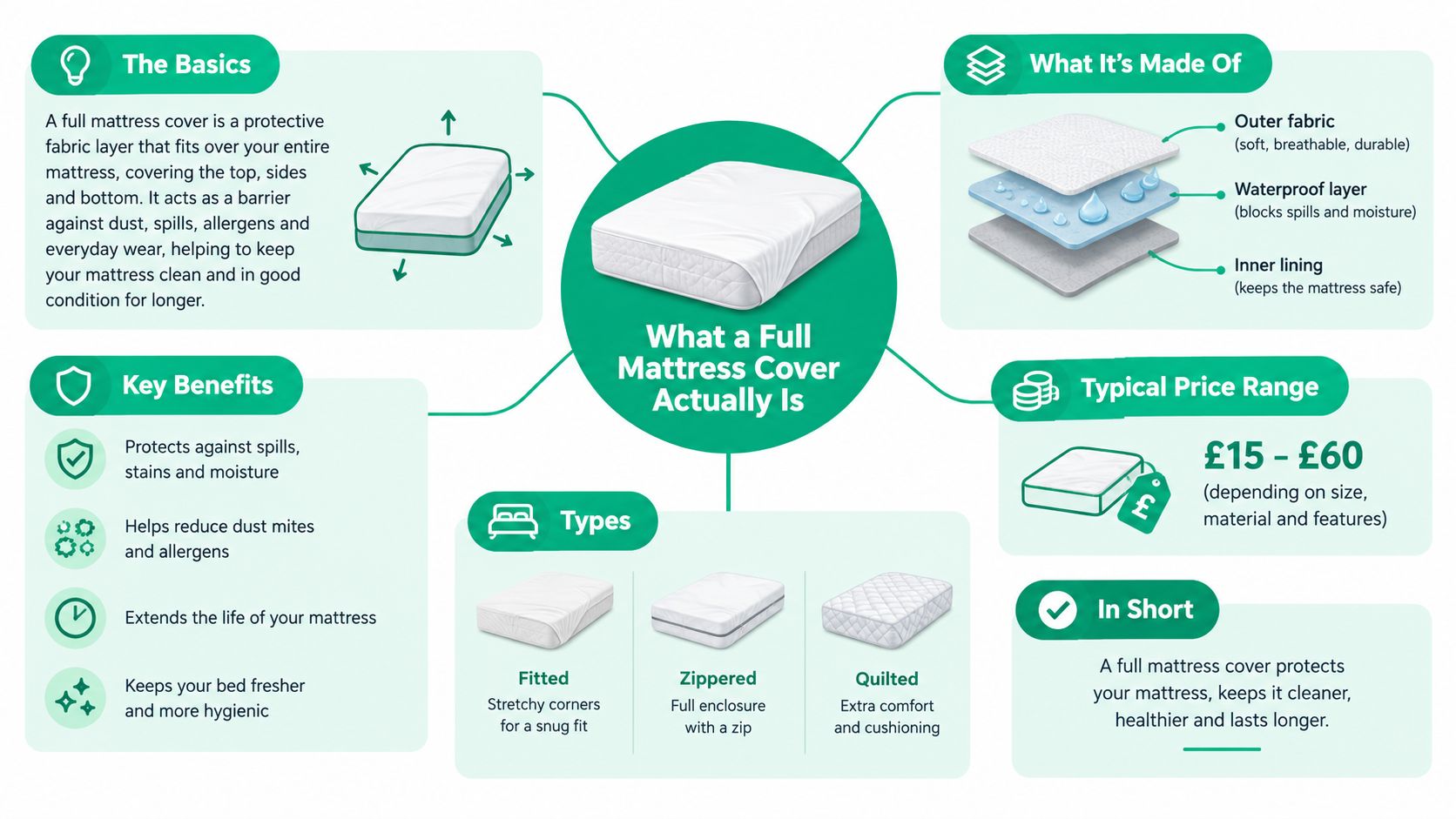
A mattress protector is a washable layer that sits over the mattress, much like a fitted sheet. It usually covers the sleeping surface and the sides, held in place by elastic or a fitted skirt. Depending on its design, it may add a waterproof barrier or make routine cleaning easier, but it doesn't necessarily enclose the underside.
A mattress encasement works differently. It's a sleeve that wraps around the mattress on all sides and closes with a zip. Think of the difference between a duvet cover, which protects the surface of a duvet, and a zippered pillow protector, which encloses the pillow. A fitted protector is the duvet-cover-like layer; an encasement is the close-fitting, sealed option.
That distinction matters if you're shopping because of bed bugs or want a barrier around an older mattress. A top-and-side protector leaves the underside open, whereas a fully enclosed design gives you a continuous cover around the mattress. The zip and seams matter too, so check how the product closes rather than relying on the word “cover”.
Why “Full” May Not Mean UK Double
In some markets, “full” names a mattress size. UK shoppers are more likely to need a cover labelled for a double, but size names aren't a substitute for measurements. Treat the label like a clothing size: it's a useful starting point, not proof that the item will fit your particular mattress.
Protect-A-Bed's range includes fitted protectors for UK sizes such as Double, alongside bed-bug encasements. Its Miracle Membrane technology is used in waterproof protectors. Those are product-family distinctions, not a reason to skip checking the stated construction and fit.
If the main concern is sweat, accidental spills or everyday mattress hygiene, a fitted protector may be the simpler choice. If you need the mattress enclosed on every side, look for a zip-around encasement and confirm that its dimensions and depth range suit your bed.
Materials and Features That Actually Matter
Start with the problem you want the cover to handle. A waterproof membrane is useful when drinks, perspiration, pet mess or bedwetting could reach the mattress. The membrane sits below the surface fabric, so the sleeper touches the fabric rather than the waterproof layer itself.
A breathable membrane aims to let air pass while limiting liquid transfer. A helpful analogy is an outdoor jacket: its barrier is designed to manage moisture without feeling like a sheet of stiff plastic. The comparison is about how a layered material can work, not a promise that all membranes feel or perform alike. Check the product's own description and care label.
Match the feature to the concern
| Concern | Feature to look for | What to check |
|---|---|---|
| Spills or accidents | Waterproof membrane | Whether the product is machine washable and how it should be dried |
| Hot sleeping | Breathable construction or a cooling fabric option | Whether the fabric suits your preferred feel and laundering routine |
| Mattress-associated allergens | Enclosing or barrier-style design | How the seams, zip and fit are constructed |
| Bed-bug concerns | Full zip-around encasement | Whether the mattress is enclosed on all sides |
A quiet, thin layer is often more comfortable under a sheet than a thick, stiff cover. But “thin” alone doesn't tell you whether the product is waterproof, washable or suitable for a particular barrier purpose. Look for clear descriptions of the membrane, surface fabric and closure.
Cooling textiles, including options such as Tencel Cool, Snow and Charcoal, are intended for shoppers who want a particular fabric feel or a cooler sleep surface. Consider these as comfort choices rather than substitutes for waterproofing or full enclosure. If eczema, asthma or allergies are part of the decision, don't assume a fabric name guarantees a medical benefit.
A protector remains a fitted, removable layer over the mattress. It isn't the mattress itself, and it can change how the mattress feels or how easily bedding fits. That's why a useful feature list still needs to be paired with accurate measurements, especially the mattress depth.
Why UK Bed Bug Pressure Makes Encasements Worth Considering
If you're checking a guest bed after a change of occupants, the underside matters as much as the sleeping surface. A full encasement addresses that practical concern by enclosing the whole mattress, giving you a removable outer surface to inspect.
UK council data recorded more than 14,587 bed-bug callouts in 2023, a 23% rise from 2022, while the same reporting described a 68% increase in activity across the UK during 2024 (UK bed-bug callout and city data). Its city reporting covered London, Bristol, Newcastle upon Tyne, Birmingham, Leeds, Edinburgh, Glasgow and Manchester, showing that service demand extends beyond one location. These figures describe pest-control and local-authority activity. They should not be read as the proportion of homes with bed bugs.
What the figures mean for a mattress cover
An encasement is a precaution to consider, rather than a requirement for every household.
For households, landlords, hotels and care providers, the useful question is whether enclosing the mattress would support their inspection and hygiene routines. Where different people use the same bed, a removable cover can make the mattress easier to inspect and protect. Its value depends on its construction and intended use, not just the words "full mattress cover" on the packaging.
A top-only protector leaves the underside accessible to pests; a zip-around encasement encloses all surfaces. For bed-bug concerns, that makes the closure and complete coverage part of the buying decision alongside size. Check that the product is designed for this purpose. Enclosing a mattress does not replace inspection, cleaning or professional remediation where needed.
If you suspect bed bugs, start with a careful inspection. The guide to checking a mattress for bed bugs explains what to examine, so you can assess the concern rather than treating a cover as a cure-all. For a confirmed infestation, follow suitable pest-control advice about using an encasement within the treatment routine.
Getting the Fit Right on a UK Double Mattress
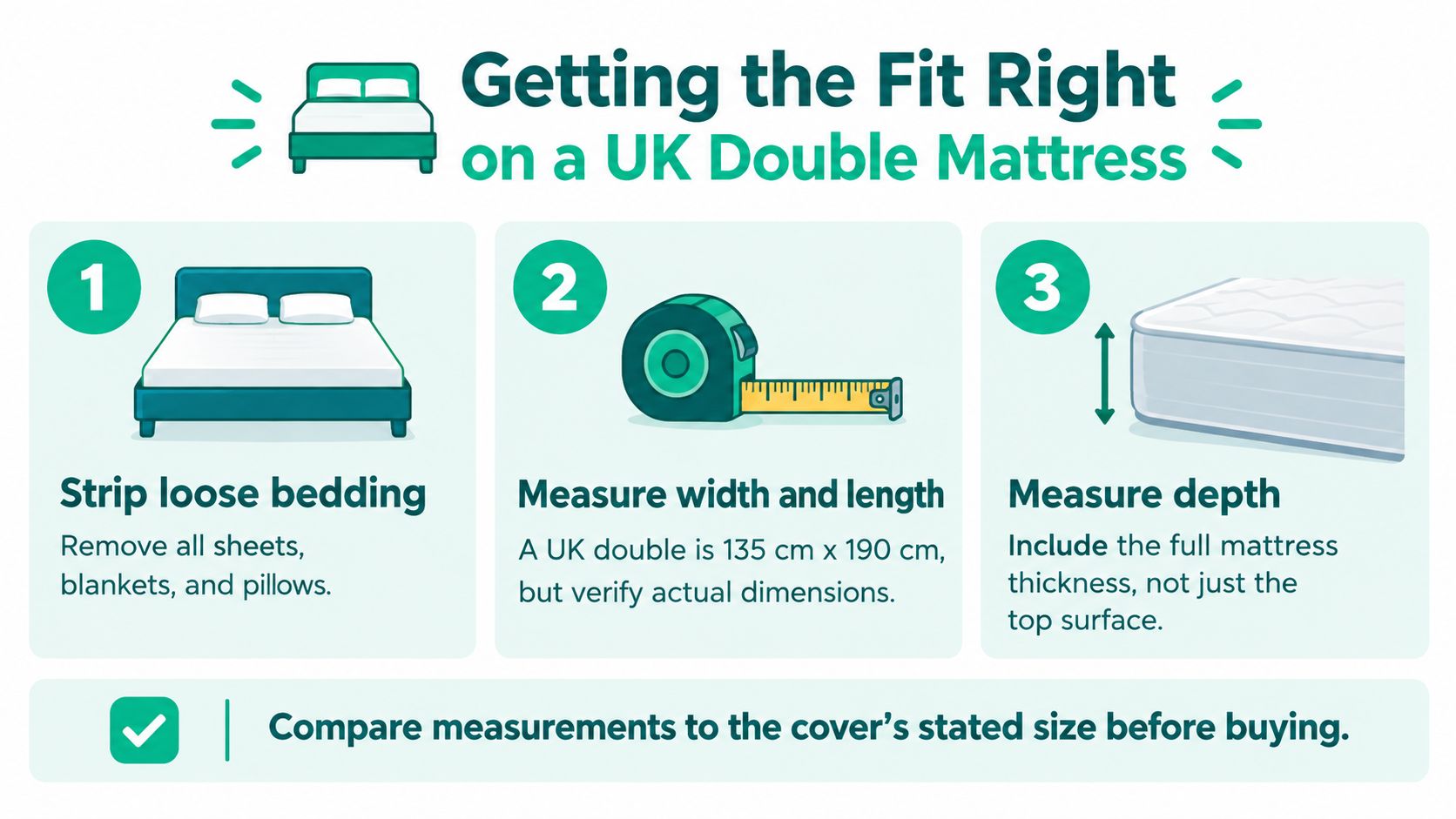
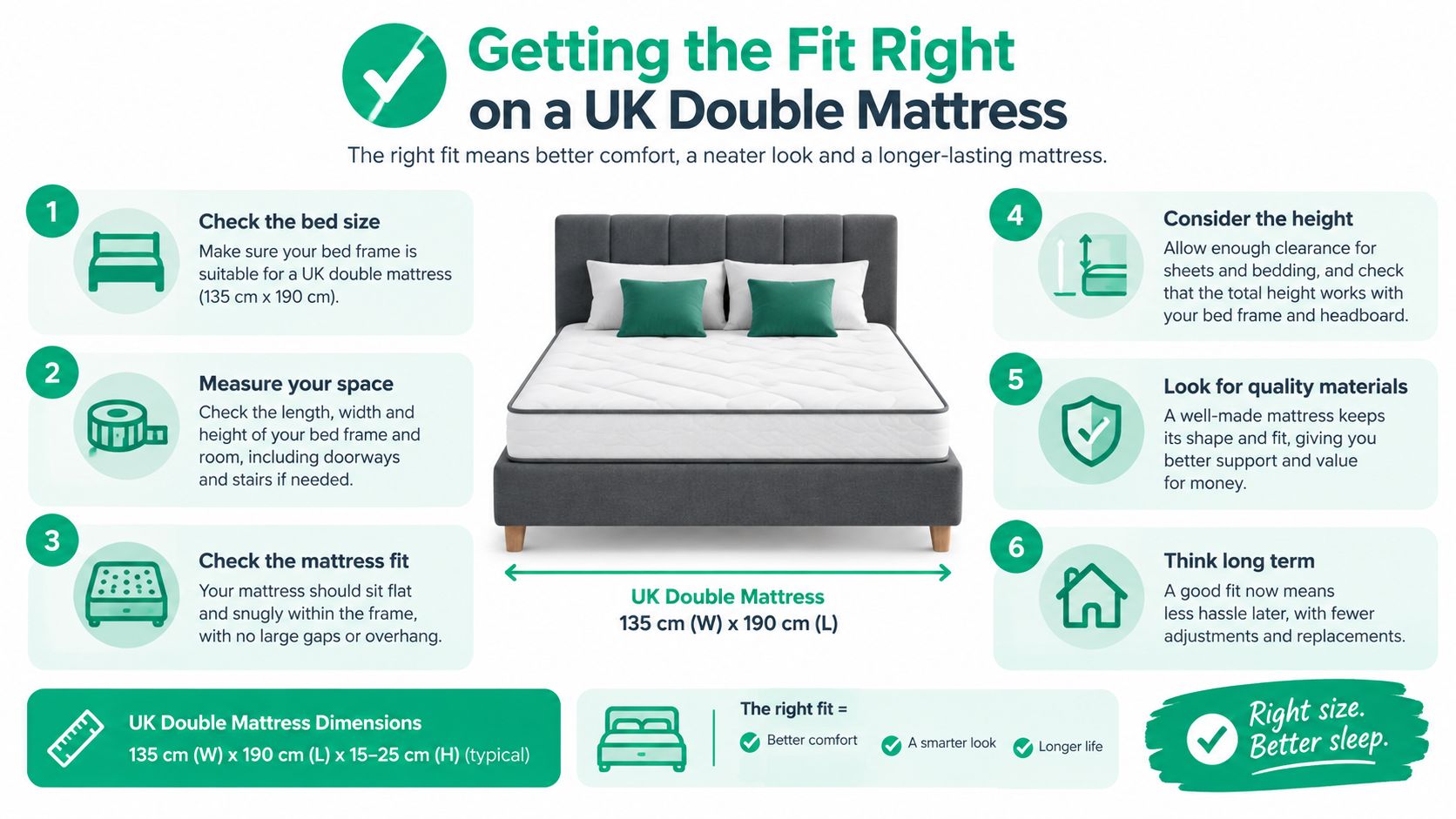
A size label can't tell you whether the cover will reach over a deep pillow-top or a permanent comfort layer. UK consumer guidance gives a standard double mattress as approximately 135 × 190 cm, while advising shoppers to check the retailer's actual measurement chart rather than assume a size name is universal. Measure the mattress you'll cover, including any topper that will stay in place.
Measure width, length and depth
- Strip the loose bedding. Remove sheets, blankets and pillows so they don't distort the measurements.
- Measure the width and length. Measure across the widest points of the mattress, not the bed frame.
- Measure the depth. Measure from the base to the highest sleeping surface, including built-in padding or a permanent topper.
Then compare all three measurements with the product's stated dimensions and maximum supported depth. If the depth range is unclear, ask the seller before ordering. A guide to protectors for deep mattresses can help you understand why a standard pocket may not suit a thicker bed.
An undersized cover behaves like a fitted sheet that's pulled too tight. It may creep off the corners, strain the elastic or expose parts of the mattress. If it's too large, it can bunch and shift under the bedding, which may make the bed less comfortable and leave coverage uneven.
Practical rule: Include the topper if it stays on the mattress every night. A cover must fit the whole sleeping surface you plan to use.
For beds where moisture management is a key concern, it can also help to review a specialist incontinence mattress protectors guide for care-focused considerations. Before buying, write down the mattress's width, length and depth, note any permanent topper, and check that the cover's stated range accommodates each measurement.
Allergen Claims, Asthma and What the Evidence Shows
A full mattress cover creates a barrier around one source of allergen exposure. It works like enclosing a dusty cushion: the barrier can limit what escapes, while dust elsewhere remains. Carpets, upholstery, exposed bedding and airborne dust can also contribute to exposure. A product claim therefore needs to describe the cover's role without promising relief from asthma symptoms.
A Cochrane review of dust-mite control and asthma, covering 55 randomised trials involving 3,121 people, found no meaningful improvement in peak flow, asthma symptoms, medication scores or self-reported improvement from dust-mite control measures overall.
The UKHSA-linked trial of allergen-impermeable bed covers, involving 1,122 adults with asthma, also found that covers used as the sole intervention appeared clinically ineffective for reducing symptoms. These findings set a limit on what a cover alone can reasonably promise.
Treat a cover as one layer of exposure control
“Helps reduce exposure to mattress-associated allergens” describes the intended barrier function without claiming to prevent or treat asthma. For that purpose, full enclosure matters alongside fit: the cover needs to surround the mattress. Exposed bedding still needs cleaning.
UK hospital guidance recommends washing bedding weekly at 60°C, alongside using barrier covers. Bedroom humidity also needs attention, and anyone with established asthma or sensitisation should follow medical advice.
You can compare air purifiers for allergies when considering airborne exposure, while keeping expectations realistic about their role. Guidance on dust-mite-proof bedding can help you understand how mattress barriers and exposed bedding fit into the same routine. Neither replaces medical advice.

Care, Maintenance and Choosing the Right Cover
Follow the care label rather than guessing at a washing temperature. Use the recommended cycle and detergent, avoid harsh chemicals that could damage a membrane, and dry the cover as instructed. Check the elastic, seams and zip periodically. Thinning fabric, a damaged closure or failed waterproofing are signs the cover may no longer be doing its job.
Match the construction to your main concern. Families and pet owners may prefer a washable waterproof protector; landlords and hospitality or care settings may consider a full encasement where inspection and pest planning matter. Hot sleepers can compare fabric options, while people focused on dust-mite exposure should prioritise a correctly fitted barrier and realistic care routine.
At checkout, confirm the size, maximum mattress depth, coverage type, closure, waterproof or barrier claims, and washing instructions. If you can answer those points from the product details, you're less likely to end up with a cover that fits the label but not the bed.
If you're ready to choose a cover for your UK double, visit Protect-A-Bed to compare fitted waterproof protectors and full mattress encasements. Check the product dimensions and care instructions against your mattress before ordering.