

Dust Mite Proof Bedding: A Practical UK Guide

You've washed the sheets, changed the pillowcases and perhaps even bought detergent labelled “anti-allergy”. Yet you still wake with a blocked nose, itchy eyes or a cough that settles after you leave the bedroom. That can be extremely frustrating, especially when the bed looks clean.
The missing detail is that clean-looking bedding isn't necessarily allergen-impermeable bedding. Dust mite allergens can remain within mattresses, pillows and other soft furnishings, where ordinary sheets don't create a sealed barrier. This guide uses UK clinical guidance to separate genuine dust mite proof bedding from broad comfort claims, so you can choose protection based on construction, testing and coverage.
Table of Contents
- Why Your Bedding Might Still Be Triggering Allergies
- What Dust Mite Proof Bedding Actually Means
- Why the Bed Is the Worst Place in Your Home
- The Three Core Product Types Explained
- How to Verify a Product Will Actually Work
- Fitting Covers Into a Complete Allergen Control Routine
- Practical Buying Advice for Homes and Institutions
- Key Takeaways and Your First Step
Why Your Bedding Might Still Be Triggering Allergies
Clean sheets don't seal the bed
Weekly washing helps manage the bedding that sits closest to your skin, but it doesn't enclose the mattress or pillow. A fitted sheet is designed for comfort and easy removal. It isn't normally designed to stop allergens moving from an older mattress or pillow into the sleeping area.
Mattresses and pillows also have internal spaces where dust mites and their allergens can accumulate over time. Vacuuming the visible surface may remove some material from the outside, but it doesn't turn the whole item into a sealed allergen barrier. That's why a person can follow a sensible cleaning routine and still experience symptoms overnight.
The same problem applies to many products labelled “hypoallergenic” or “anti-allergy”. Those terms may describe the feel or material of a product, but the label alone doesn't prove that the item has been tested to prevent house-dust-mite allergen escape.
Look for a tested barrier
UK guidance focuses on practical specifications rather than vague wording. Cambridge University Hospitals advises using covers that are breathable, completely enclose the mattress, duvet or pillow, and have been tested to prevent allergen escape. Its guidance identifies 5.9 microns as a key technical benchmark and describes fully encased bedding as preventing 99% of house-dust-mite allergens from passing through the fabric. Cambridge University Hospitals' dust-mite guidance provides the useful distinction: a genuine barrier is a construction and testing claim, not merely a marketing adjective.
Practical rule: If a product page doesn't explain what the cover encloses or provide evidence of allergen-barrier testing, treat “anti-allergy” as an invitation to ask more questions, not as proof.
Symptoms that are severe, persistent or affecting asthma deserve professional attention. For readers who need help understanding recurring hay fever or allergy symptoms, consultant led allergy care can provide a more personalised route than changing bedding alone.
What Dust Mite Proof Bedding Actually Means
A cover is a barrier system
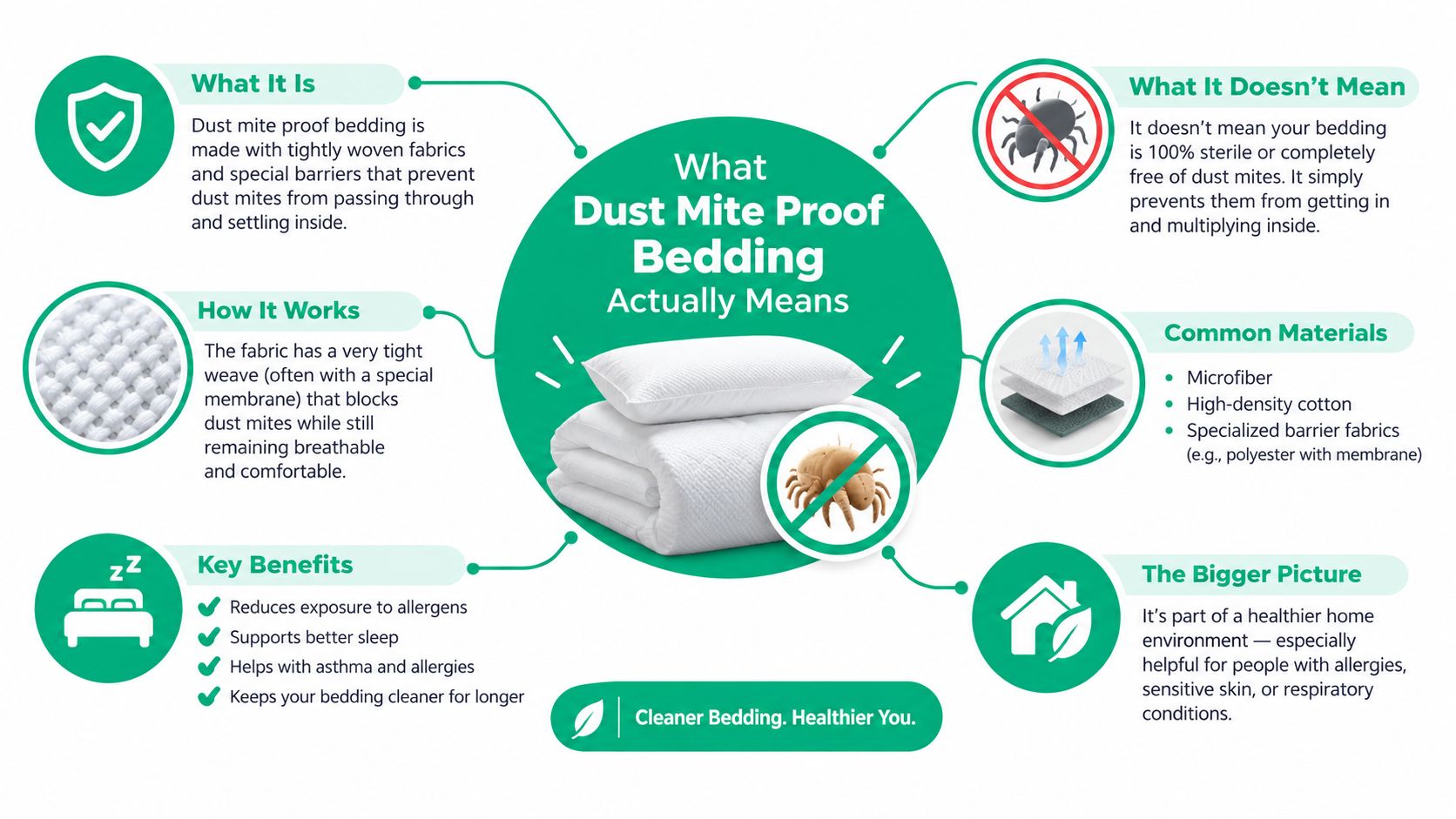
A dust mite cover works through its construction. The fabric, seams, closure and coverage must function together, like a sealed outer layer around a mattress, pillow or duvet. The aim is to reduce allergen movement through the bedding, rather than give the product a reassuring label.
The fabric needs a sufficiently tight structure and documented performance. As noted earlier, UK guidance sets a 5.9-micron pore-size benchmark and describes fully encased bedding as preventing 99% of house-dust-mite allergens from passing through the fabric. The Cambridge University Hospitals guidance also stresses breathability. A barrier that holds in excessive heat and moisture may be difficult to sleep on, even if its construction is suitable for allergen control.
Complete enclosure is the second part. A cover placed over only the top of a mattress leaves its sides and edges outside the protected zone. An encasement closes around the whole item, separating it from the sleeper and limiting contact with contamination at the surface.
Four details need to work together
- Pore size and tested performance. A tight weave may sound convincing, but evidence that the finished cover prevents allergen escape gives a clearer basis for judging it.
- Full coverage. The mattress, pillow or duvet should be enclosed rather than covered on one face. Seams and closures deserve equal attention, because one opening can weaken the protection provided by the fabric.
- Breathability. The material should allow air and moisture vapour to move while retaining its barrier function. Breathable describes sleep comfort and moisture handling. It does not mean the relevant allergen can pass through freely.
- A durable closure. Zips, flaps and seams should stay closed during ordinary use, removal and laundering. If fitting is awkward, consistent protection becomes harder to achieve.
An antimicrobial finish addresses surface treatment. It does not necessarily prevent allergens inside a mattress or pillow from escaping. Waterproofing addresses liquid, so it may be useful for another purpose without demonstrating dust-mite allergen protection.
Why the Bed Is the Worst Place in Your Home
Bedrooms create a particularly persistent exposure point because people spend long periods there, usually with their face close to pillows, mattresses and duvets. House dust mites thrive in the warmth and humidity found in UK homes, and hospital guidance identifies bedrooms as inviting environments because mites can be found in beds, mattresses, pillows, carpets and soft furnishings.
University Hospitals Coventry and Warwickshire describes house dust mites as one of the most common causes of indoor allergies. Its UK hospital guidance on house-dust-mite avoidance explains why bedding protection developed as part of practical management for conditions including asthma, eczema, rhinitis and perennial hay fever.
Where allergen tends to collect
The table below uses qualitative priorities rather than pretending that every bedroom has the same distribution. Room humidity, bedding materials, age of the items and cleaning habits all affect the relative burden.
| Location | Typical allergen share | Why it accumulates |
|---|---|---|
| Mattress | High | It remains in place, receives regular use and is difficult to wash thoroughly |
| Pillow | High at the breathing zone | It sits close to the face and receives moisture from breathing and perspiration |
| Duvet | Variable | It can collect allergen, but many duvets are easier to remove and launder |
| Carpet and soft furnishings | Meaningful background source | Fibres and upholstery can hold settled dust and allergens |
| Sheets and pillowcases | Surface exposure | They contact the sleeper directly but can usually be washed regularly |
This is also why a mattress encasement can be more useful than buying another set of sheets. It targets a fixed reservoir that is otherwise hard to clean, while the sheets remain a washable outer layer.
Shared accommodation creates an extra practical challenge because bedding may be older, laundering routines may vary and the sleeper may not know the history of the mattress. Advice about budget solo travel dorms is not clinical guidance, but it highlights the everyday importance of checking the sleeping environment when you have limited control over the room.
The Three Core Product Types Explained
A buyer usually encounters three formats: mattress encasements, pillow protectors and duvet covers. They aren't interchangeable, because each one protects a different item and creates a different level of coverage.
Mattress encasements
A true mattress encasement encloses the mattress around its complete exterior, including the underside and sides, rather than covering only the sleeping surface. Its purpose is to isolate the existing mattress as a reservoir and prevent allergens from passing freely into the bed environment.
Measure the mattress before ordering. UK sizes such as single, double, king and super king describe the surface dimensions, but mattresses also vary in depth. A cover that is too shallow may pull at the zip or seams, while one that is excessively loose may move during use. Check the stated fitting depth and account for any existing protector that will remain underneath.
Pillow protectors
A pillow protector encloses the pillow filling beneath the ordinary pillowcase. This is important because the sleeper's face rests directly against the pillow for much of the night, and the pillow can be difficult to wash as thoroughly as a pillowcase.
Look for a protector that closes securely and is designed to remain breathable. You'll still wash the pillowcase as part of the normal routine. The protector is the barrier layer beneath it.
Duvet covers
A dust-mite barrier duvet cover encloses the duvet itself, rather than just adding another decorative cover over it. It may be useful where the duvet is difficult to launder, shared between sleepers or likely to retain allergen.
For many households, however, the first priority is the mattress, followed by pillows. Duvet protection can follow if budget allows or if the duvet cannot be washed in line with the care instructions.
| Product type | What it covers | Priority level | Key buying consideration |
|---|---|---|---|
| Mattress encasement | The complete mattress | Highest for an existing mattress | Confirm full enclosure, closure security and mattress depth |
| Pillow protector | The pillow and its filling | High, especially for close face contact | Check barrier testing, breathability and fit |
| Duvet cover | The duvet filling | Useful additional layer | Check laundering instructions and the correct duvet dimensions |
The distinction between a full encasement and a surface-only protector is important enough to check before purchase. This guide to full-cover mattress protection gives buyers a useful way to think about coverage, particularly when product names use “protector” and “encasement” loosely.
How to Verify a Product Will Actually Work
A product page should answer practical questions. If it only describes softness, freshness or a general “hypoallergenic” finish, you don't yet know whether it provides an allergen barrier.
Start with the specification
Ask the seller to identify the tested pore size or the relevant allergen-impermeability result. The UK clinical benchmark cited in the guidance is 5.9 microns, alongside full enclosure, breathability and testing that prevents allergen escape. Don't assume that a lower-sounding number is meaningful unless the manufacturer explains what was tested and by whom.
Then inspect the construction. Does the cover enclose every side? Does the closure remain protected when shut? Are seams covered or sealed in a way that supports the barrier? A highly impermeable fabric can still fail as a system if the opening or edges leave a route around it.
Separate protection types
A waterproof cover and a dust-mite barrier may overlap, but they solve different problems. Waterproofing addresses liquid movement. Dust mite proof bedding must address the movement of allergens from the enclosed item into the sleeping environment.
Breathability also deserves attention. A solid, uncomfortable cover may encourage people to remove it or leave it incorrectly fitted. A suitable barrier should be practical to sleep on, compatible with the mattress and easy enough to maintain.
For a plain-language explanation of the difference between a surface protector and an allergen barrier, see how dust mite covers work.
Use a short buyer checklist
- Coverage: Does it completely enclose the mattress, pillow or duvet?
- Testing: Is allergen-barrier performance documented?
- Benchmark: Does the specification identify a pore-size result, with 5.9 microns recognised in UK-facing guidance?
- Comfort: Is the material breathable and quiet enough for regular sleep?
- Closure: Does the zip or fastening close the opening securely?
- Care: Can you launder or clean it without damaging the barrier?
- Fit: Does the stated size match the item's dimensions and depth?
Independent endorsement can add confidence, but it should complement, not replace, the technical details. A recognised allergy-focused approval is more useful when the product also explains its coverage and test performance.
Fitting Covers Into a Complete Allergen Control Routine
A cover is a control layer, not a magic reset button. It helps separate the sleeper from the mattress, pillow or duvet, but allergens can also remain on sheets, pillowcases, carpets and other soft furnishings.
The most practical routine combines the barrier with regular laundering. Allergy UK recommends washing non-encased bedding at 60°C or above, a temperature that kills mites. Its house-dust-mite allergy factsheet also recommends enclosing mattresses, duvets and pillows with breathable covers that completely enclose each item and have been tested to prevent allergen escape.
Keep the jobs separate
The encasement is the long-term barrier beneath the ordinary bedding. Follow its care instructions, clean its exposed surface as directed and inspect the closure after fitting.
Sheets, pillowcases and duvet covers remain the washable layer. They should be changed and laundered according to the household's needs and the product care label. This division makes the routine manageable: the barrier protects the difficult-to-wash item, while the outer bedding carries the regular laundry burden.
Vacuuming can help remove settled dust from accessible surfaces, but it shouldn't be treated as a substitute for enclosure. Environmental measures such as ventilation and sensible humidity management can also support the routine. If symptoms continue, don't assume that bedding is the only trigger. A clinician can help identify whether dust mites, pollen, mould, pets or another allergen is involved.
For families trying to organise sleep routines alongside bedroom hygiene, a practical Nursery Advice sleep guide may help with the wider bedtime context. For bedding-specific prevention steps, this dust-mite allergy prevention guide can sit alongside clinical advice.
A useful expectation: Covers reduce exposure at the protected item. They don't remove every allergen from the bedroom, so give the wider routine time to work and keep checking the actual source of symptoms.
Practical Buying Advice for Homes and Institutions
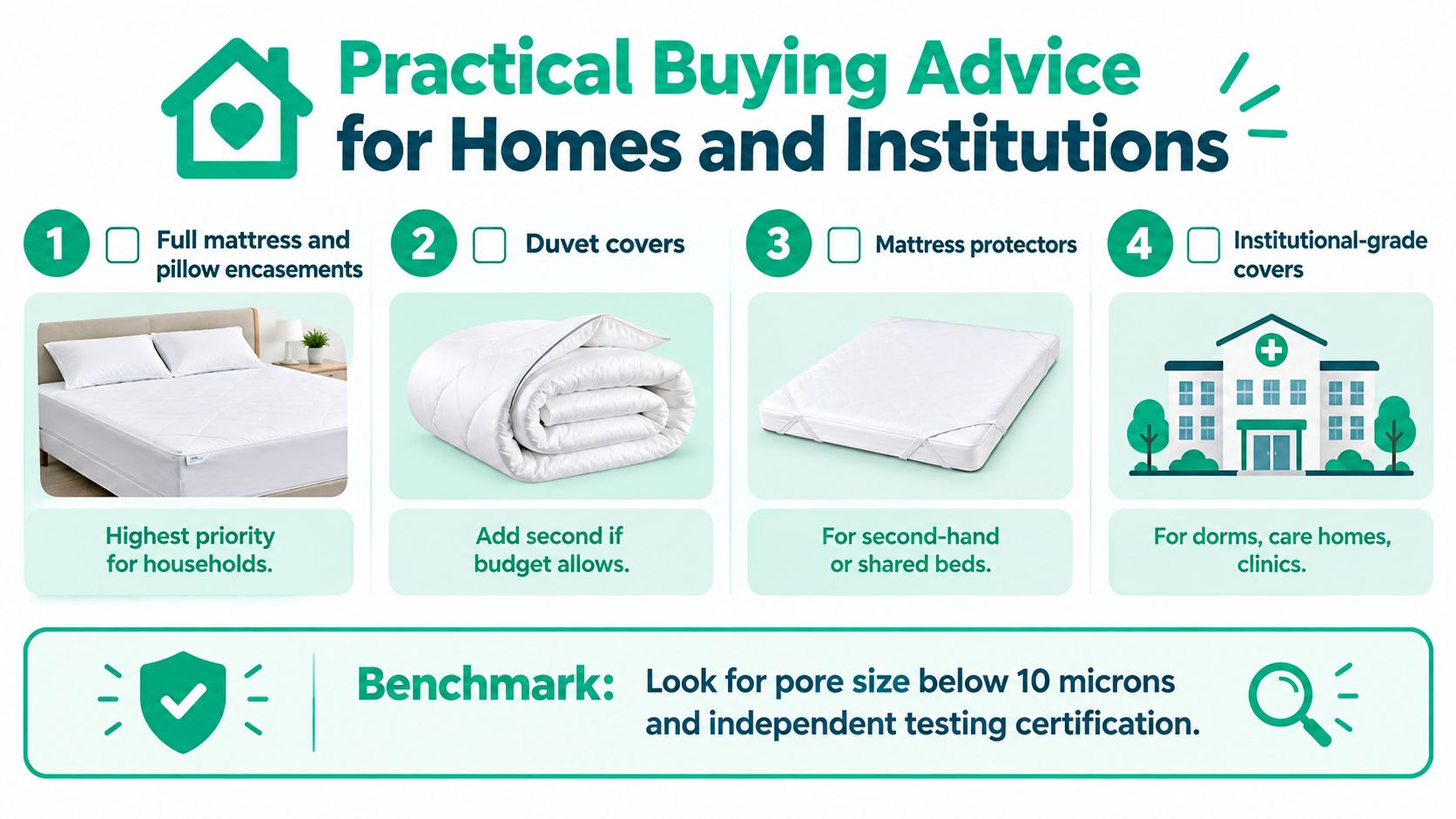
The right purchase depends on the sleeping environment, the item you're protecting and how consistently the cover can be used. A household with an older mattress should usually begin with a full mattress encasement, then add pillow protectors. A duvet barrier can come later where laundering is difficult or the duvet is a particular concern.
For a child's room, guest room or second bedroom, prioritise the beds that are used most often. A spare bed still deserves protection if different sleepers use it or if its mattress is difficult to clean between stays.
A household checklist
- Measure first: Record the mattress length, width and depth, and check pillow and duvet dimensions.
- Prioritise enclosure: Choose a complete mattress and pillow barrier before adding decorative or surface-only layers.
- Check the feel: Look for breathable material that won't encourage you to remove the cover.
- Read the care label: Confirm how the cover should be cleaned and whether the closure needs special handling.
- Inspect the zip: Look for a secure closure that stays shut and doesn't expose a large opening.
- Keep the paperwork: Save the product specifications, test information and warranty details.
Institutional buyers have a wider operational brief. Care homes, hotels, student accommodation, clinics and other shared settings need covers that fit a repeatable laundering process, match the available mattress sizes and come with clear documentation. Procurement teams should ask for barrier test results, care instructions, replacement arrangements and evidence that the product can tolerate the intended cleaning routine.
A product that works in one household may be impractical in a facility if staff can't fit it correctly or if the care process damages the barrier. The best specification is therefore one that combines tested performance with reliable day-to-day use.
Key Takeaways and Your First Step
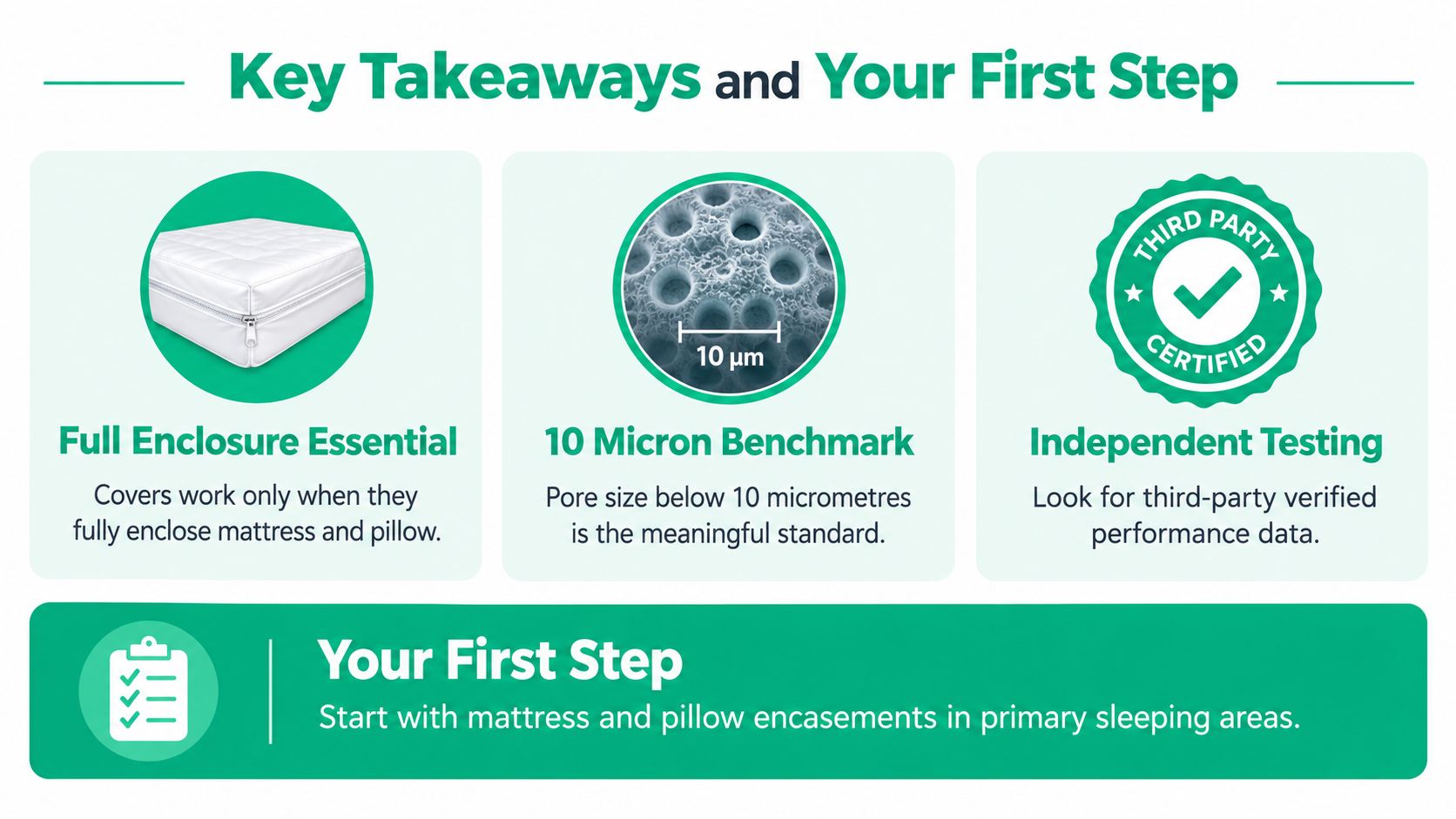
A dust mite proof bedding cover works through full coverage and a tested barrier, not through a reassuring label alone. The mattress, pillow, or duvet needs to be fully enclosed, stay breathable, and show evidence that house-dust-mite allergens are kept from passing through the fabric.
The UK benchmark gives you a practical standard to ask about. As covered earlier, 5.9 microns is the pore-size figure to compare against, alongside documented allergen-barrier testing for fully encased bedding. Use that benchmark to judge technical claims, rather than choosing by softness, colour, or the word “hypoallergenic”.
Start with the part of the bed that is hardest to wash.
- Measure the mattress depth and dimensions.
- Choose a tested, breathable full encasement for the main mattress.
- Add a matching pillow protector if symptoms are strongest around the face and nose.
- Keep sheets and pillowcases in the regular wash routine, following the care label and using 60°C or above where suitable.
- Review the whole bedroom, including carpets, soft furnishings, ventilation and other possible allergens.
One certified mattress and pillow barrier can be a sensible first move because it targets the items closest to the sleeper and least easy to clean. It does not replace medical advice or wider cleaning habits, but it gives your routine a clear, measurable base.
Measure your mattress today, check the enclosure details and test information, and wash your existing bedding at the highest suitable temperature this week. Once you have measured your mattress and checked the cover details, Protect-A-Bed's mattress and pillow encasements are built around breathable barrier layers you can compare against these criteria at Protect-A-Bed.