

Full Cover Mattress Protector Guide for Better Sleep

You're probably here because you typed “full cover mattress protector” into a search bar and then hit a wall of mixed terms. Some products look like a fitted sheet. Some zip all the way around the mattress. Some say waterproof. Others say anti-allergy. A few mention bed bugs. It's no wonder shoppers end up unsure what they're buying.
That confusion usually starts at the same moment. You strip the bed, look at the mattress, and realise it's carrying more of your home life than you'd like to think about. Sweat. Spilled tea. A child's accident. Pet hair. Dust. If someone in the house has allergies, the question gets more urgent. You don't just want to keep the mattress tidy. You want to reduce what settles into it and stays there.
A mattress is a long-term household item, not a washable duvet cover. Once moisture, skin cells, or stains get into it, they're hard to remove properly. That's why many UK households stop seeing mattress protection as an optional extra and start treating it as part of normal bed care.
The catch is that not all protectors protect in the same way. A standard protector can be ideal for everyday spills and general freshness. A true full-cover encasement does a different job. It encloses the whole mattress and creates a sealed barrier, which matters far more for allergy control and bed-bug-specific use.
Table of Contents
- Introduction to Full Cover Protection for Everyday Sleep
- What a Full Cover Mattress Protector Really Is
- Full Cover Encasement Versus Standard Protector Compared
- Benefits That Matter and What They Cannot Do Alone
- How to Choose Materials Fit and Seal Quality
- Fitting Your Encasement and Keeping It Effective
- Making the Right Choice for Your Home
Introduction to Full Cover Protection for Everyday Sleep
A familiar bedroom scene goes like this. You've bought a good mattress, put clean sheets on, and added what you thought was a proper protector. Then a spill reaches the side of the bed, or you start looking into dust-mite protection, and you discover the underside of the mattress has been exposed the whole time.
That's the point where many people realise “full cover” isn't just a marketing phrase. It describes a different type of protection.
In the UK, mattress-protector advice is closely tied to dust-mite control because allergy-focused bedding is often recommended as a barrier between the sleeper and the mattress. Guidance aimed at UK consumers notes that a properly fitted protector can help reduce exposure to dust mites and their allergens, while washing bedding at 60°C or above is cited as the temperature that kills mites, making the protector part of a wider hygiene routine rather than just a shield against spills (UK bedding guidance on anti-allergy protection).
Why shoppers get stuck
Not everyone is comparing “good” versus “bad.” They're comparing two products that sound similar but solve different problems.
- Parents often want waterproof protection for accidents or night-time spills.
- Allergy-sensitive households usually need a stronger barrier approach.
- Landlords and hosts may want something that protects the mattress itself over repeated use.
- Guest rooms often need simple practicality without changing how the bed feels.
A protector isn't just there for the day something spills. It's there for the years when nothing dramatic happens, but the mattress still absorbs everyday life.
Think of it as mattress care, not just damage control
A mattress can collect moisture, skin cells, and general wear over time. That's why UK guidance increasingly treats mattress protection as part of routine care rather than a niche extra for occasional accidents.
What matters is matching the product to the job. If you only need top-surface spill defence, a standard protector may be enough. If you need a sealed barrier because of allergens or bed-bug risk, the details change completely. Coverage, zip design, fit, and wash routine suddenly matter a lot more than the word “waterproof” on the label.
What a Full Cover Mattress Protector Really Is
A full cover mattress protector is easiest to understand when you compare it with something you already know.
A standard protector behaves a bit like a fitted sheet. It sits over the top of the mattress and usually grips around the sides with elastic. It protects the sleep surface and some of the side panels, but the bottom remains open.
A full-cover protector, often called an encasement, works more like a case around a suitcase. You place the mattress inside it, pull the fabric over all sides, and zip it shut.
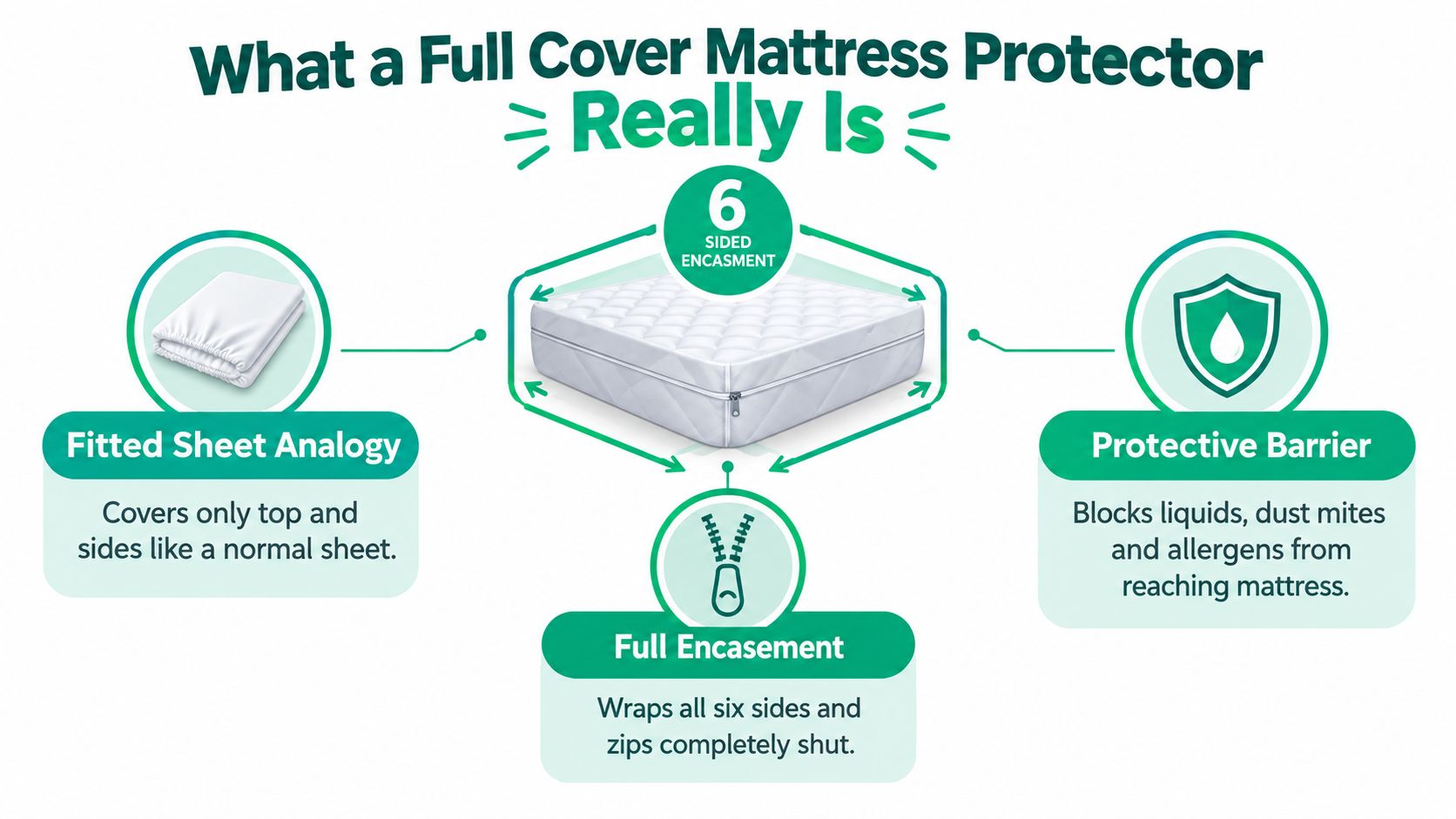
The key difference is six-sided coverage
That phrase matters because many shoppers assume “full cover” means a protector with deep sides. It doesn't always.
A true encasement covers:
- The top
- Both long sides
- Both short sides
- The underside
Then a zip closes the opening. That complete enclosure is what changes the product from surface protection into barrier protection.
UK buying guidance increasingly separates standard fitted protectors from six-sided encasements for this reason. A fitted protector helps with surface hygiene and spills. A zippered full encasement is the safer choice when sealed-barrier protection is needed for allergens or bed-bug-specific use.
Why the zip matters
The zip isn't a small feature. It's part of the protection system.
If a product leaves one side open, it isn't fully enclosing the mattress. For everyday spills, that may be fine. For dust-mite control or bed-bug containment, it changes the outcome. The barrier only works properly when the mattress is enclosed.
Simple test: If you can lift the mattress and see exposed mattress fabric underneath, you're not dealing with a true full encasement.
Waterproof doesn't have to mean plastic-feeling
Many people hear “waterproof” and imagine noisy, sweaty vinyl. Modern protectors don't have to work like that.
UK product guidance explains that waterproof performance is typically created by a polyurethane (PU) membrane, not by the top fabric itself. That membrane blocks liquid while still allowing air and water vapour to pass through. The same guidance notes that PU membrane designs are usually quieter and less heat-trapping than PVC or vinyl, and they're commonly suitable for regular 40°C washing, with everyday lifespan often cited as 3 to 5 years.
If you want a broader plain-English explanation of everyday benefits of mattress protectors, that resource helps with the basics. The main distinction to keep in mind is this: a standard protector protects a sleep surface, while an encasement protects the entire mattress shell.
Full Cover Encasement Versus Standard Protector Compared
The fastest way to clear the confusion is to compare the two products by what they do, not by how they're advertised.
A standard protector is often enough for a family bed that mainly needs spill protection and fresher day-to-day use. A full-cover encasement is the stronger choice when you need a sealed barrier around the mattress itself.
Standard Protector Versus Full Cover Encasement
| Feature | Standard Protector | Full Cover Encasement |
|---|---|---|
| Coverage | Usually top and sides | All six sides including underside |
| Closure | Elastic skirt or fitted-sheet style | Zip closure that seals the mattress inside |
| Main job | Surface spill defence and general hygiene | Sealed barrier for more complete mattress protection |
| Mattress underside | Exposed | Enclosed |
| Allergy-focused use | Helpful, but less complete | Better suited when full enclosure matters |
| Bed-bug-specific use | Not usually suitable on its own | Designed for this use when properly sealed |
| Best for | Everyday family use, guest rooms, light spill risk | Allergy-sensitive homes, rentals, hospitality, higher-risk settings |
When a standard protector is enough
If your main concern is tea, sweat, occasional accidents, or keeping the sleep surface cleaner, a fitted protector often does the job without much fuss. It's usually easier to remove and refit, and many people like the familiar feel.
This type works well when the goal is practical upkeep rather than a sealed barrier.
When a full encasement is the safer option
Bed-bug advice in the UK draws a clear line here. Ordinary protectors usually cover the top like a fitted sheet and leave parts of the mattress exposed, so they are not bed-bug control products. A proper encasement must enclose all six sides and use a secure zip closure. It can help trap bugs already in the mattress, but it does not solve infestation elsewhere in the room (bed-bug mattress encasement guidance).
That matters for anyone in a flat, rental, hotel setting, or multi-occupancy property. It also matters for households where one person assumes “waterproof” automatically means “bed bug proof”. It doesn't.
A full cover can create false confidence if the room itself hasn't been checked. Mattress protection helps. It doesn't inspect skirting boards, bed frames, or nearby soft furnishings for you.
The practical buying question
Don't ask, “Which one is better?” Ask, “What problem am I trying to solve?”
If the answer is everyday spills and keeping the mattress fresher, choose simple. If the answer is a sealed barrier for allergy control or bed-bug-specific protection, choose an encasement.
That one change in thinking makes shopping much easier.
Benefits That Matter and What They Cannot Do Alone
A full-cover encasement has real value, but only if you expect the right things from it.
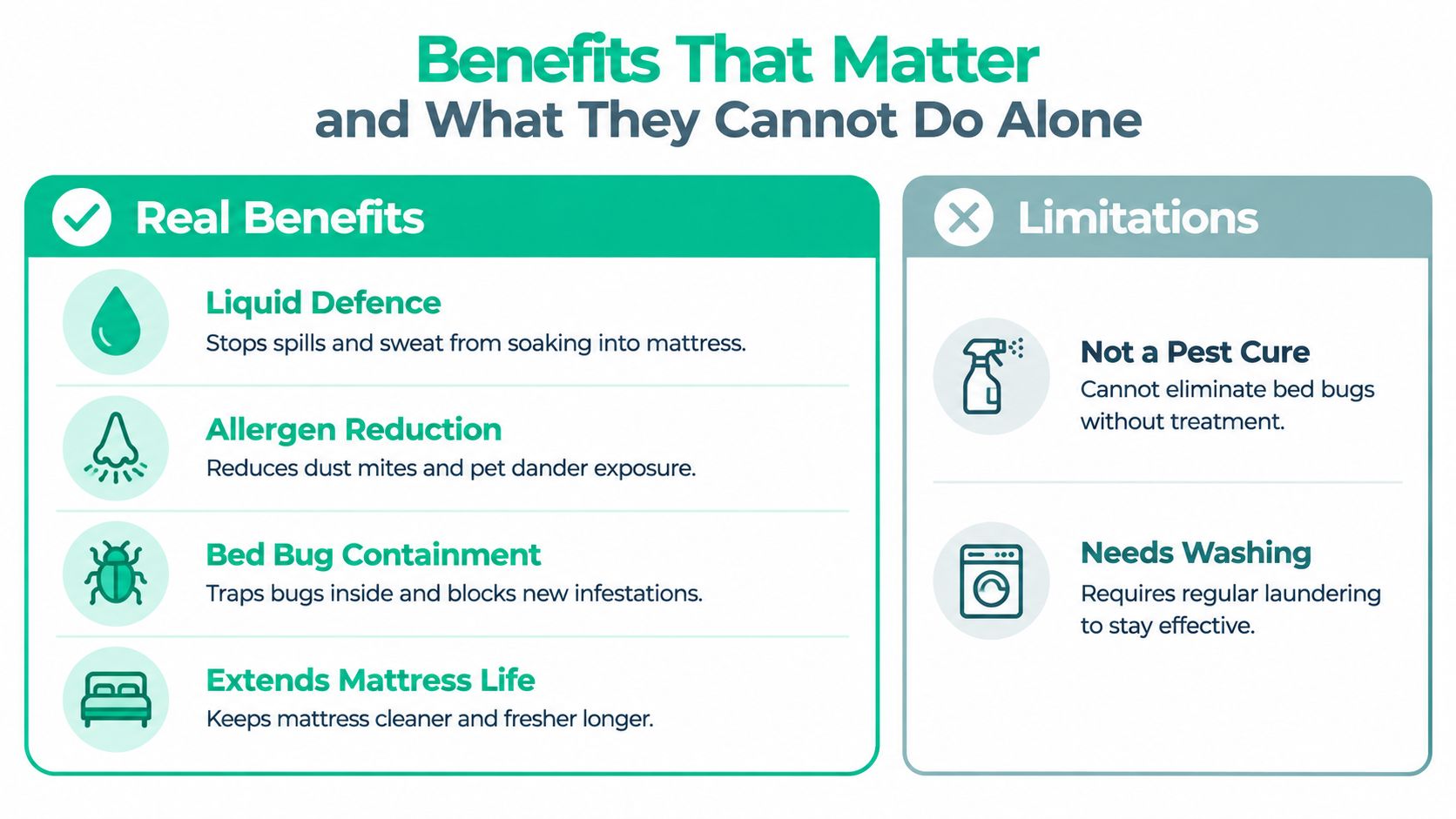
It can help keep liquids away from the mattress. It can reduce exposure to allergens when used properly. It can play a role in bed-bug containment. It can also help preserve the mattress by limiting staining and general wear. What it cannot do is replace washing, room care, or pest treatment.
What you can reasonably expect
For allergy control, UK guidance notes that allergen-impermeable mattress covers can materially reduce dust-mite allergen measured in mattress dust samples, but symptom improvement is strongest when those covers are paired with regular hot washing and broader bedroom controls (allergy guidance on mattress protectors).
That's a useful way to think about benefits in real life.
- Liquid defence keeps spills, sweat, and accidents from soaking into the mattress core.
- Allergen reduction helps limit what reaches or escapes from the mattress environment.
- Mattress preservation supports longer usable life by reducing stains and moisture ingress.
- Containment value matters when a sealed mattress barrier is needed for bed-bug management.
If you want a non-technical overview of everyday mattress protector advantages, that can be helpful background. The practical point is that the strongest results usually come from using a protector as part of a routine, not as a substitute for one.
What it cannot do by itself
People often overestimate the product.
Reality check: An encasement can reduce exposure. It can't replace cleaning the rest of the sleep space.
A full cover won't wash your bedding. It won't remove dust from the room. It won't solve bed bugs living in the bed frame, headboard, carpet edges, or nearby furniture.
UK guidance also highlights a point that shoppers regularly miss. Washing suitable bedding at 60°C or above kills mites, while lower-temperature washing mainly removes allergen temporarily. So if someone asks whether they can stop laundering or vacuuming once an encasement is on the mattress, the sensible answer is no (UK guidance on dust-mite covers and laundering).
Comfort still depends on design
Not every full cover feels the same.
A well-made encasement should stay breathable enough for everyday sleep. The membrane, face fabric, and fit all affect whether the bed feels crisp and normal or hot and awkward. Some households are happy to trade a bit of extra structure for sealed protection. Others want the lightest feel possible and may prefer a standard protector unless they have a specific risk to manage.
That isn't a flaw. It's the trade-off between convenience and full enclosure.
How to Choose Materials Fit and Seal Quality
Once you know you need an encasement, the buying job becomes much more practical. You're no longer shopping by buzzwords. You're checking whether the materials, fit, and closure will perform in your home.
Start with the waterproof layer
The face fabric often gets the attention because it's what you touch, but the membrane usually does the waterproof work.
A breathable waterproof membrane matters because it can block liquid without turning the bed into something stiff or noisy. If you want a plain-language explanation of how that works, this note on a breathable waterproof membrane is a useful reference.
When comparing materials, keep it simple:
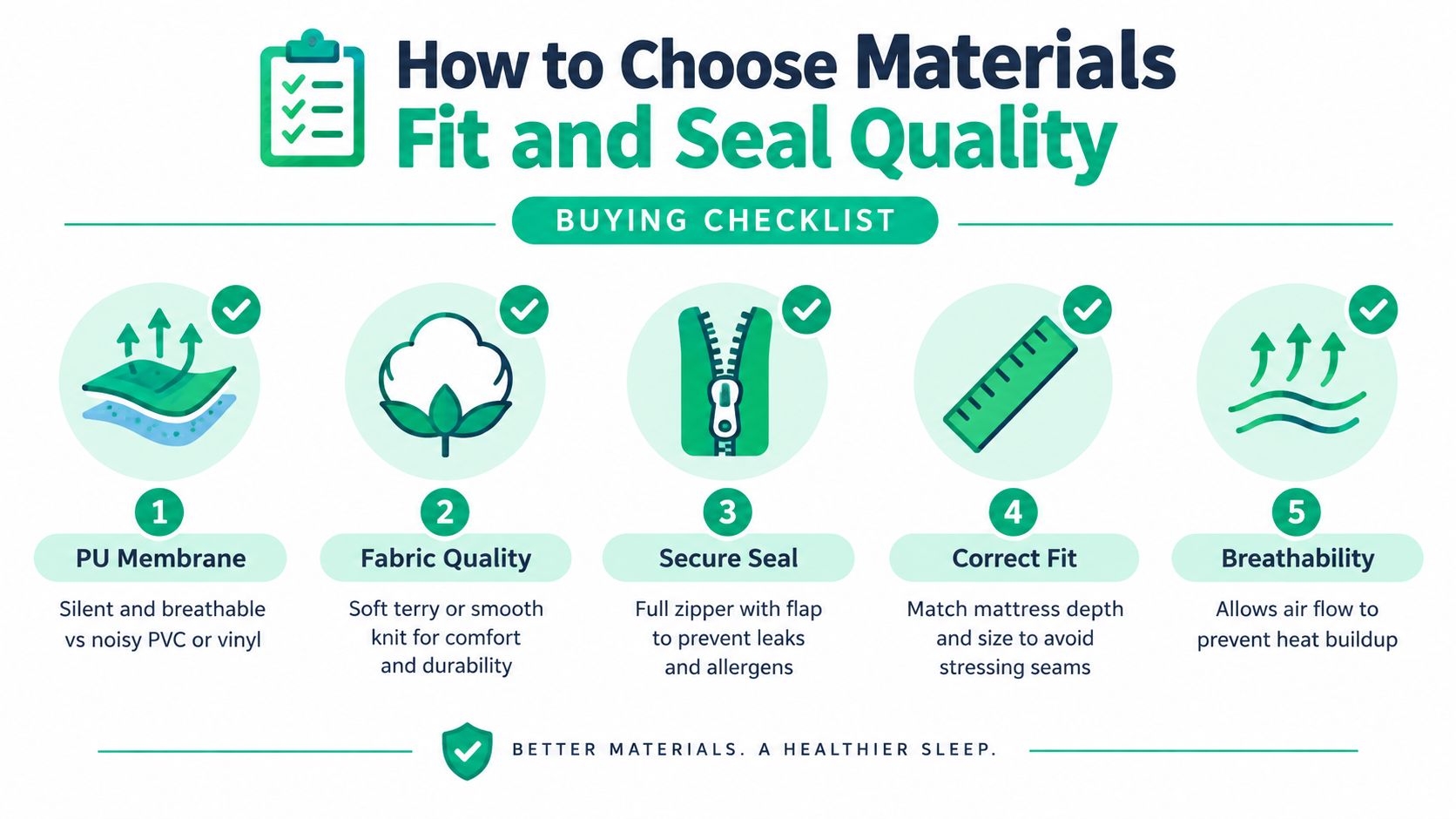
- PU membrane is generally the better everyday choice for quietness, flexibility, and breathability.
- PVC or vinyl-style feel tends to worry sleepers who dislike rustling or extra heat.
- Face fabric affects comfort. Soft terry, smooth knit, or cooling-feel fabrics all change how the bed feels under the sheet.
Fit is not a minor detail
A full cover only works well when it fits the mattress properly. Too tight, and you stress the seams and zip. Too loose, and the protector can bunch, shift, or leave awkward empty space.
Check all three mattress dimensions before ordering:
- Width so the encasement isn't pulled sideways under strain.
- Length so the corners sit correctly.
- Depth because this is the measurement people skip most often.
Buy to the mattress you own, not the mattress size you assume you own. Pillow tops, toppers, and deeper modern builds can change the fit more than shoppers expect.
Look closely at the zip and seal
On a true encasement, the zip is part of the barrier. Don't treat it like a side feature.
What to look for:
- Full run zip so the mattress can be enclosed without forcing it in.
- Neat closure area that doesn't gape once shut.
- Construction that feels secure around the opening and corners.
- A depth match that lets the zip close without strain.
This is the point where one factual mention of a brand can be useful. For example, Protect-A-Bed offers mattress and encasement products in the UK built around a breathable waterproof membrane, which is the kind of feature shoppers often look for when they want liquid protection without a plasticky feel. That doesn't remove the need to check sizing and closure details on the specific product you choose.
A short buying checklist
Before you click buy, pause and confirm these points:
- Material choice: Is the waterproofing membrane breathable and suitable for regular home use?
- Sleep feel: Will the top fabric suit the person sleeping on it?
- Correct depth: Have you measured the mattress rather than guessed?
- Seal quality: Does the closure support genuine full enclosure?
- Care routine: Can you wash it in a way that fits your household habits?
Most buying mistakes happen before the protector reaches the bed. They start with the wrong depth, the wrong expectation, or the wrong product type.
Fitting Your Encasement and Keeping It Effective
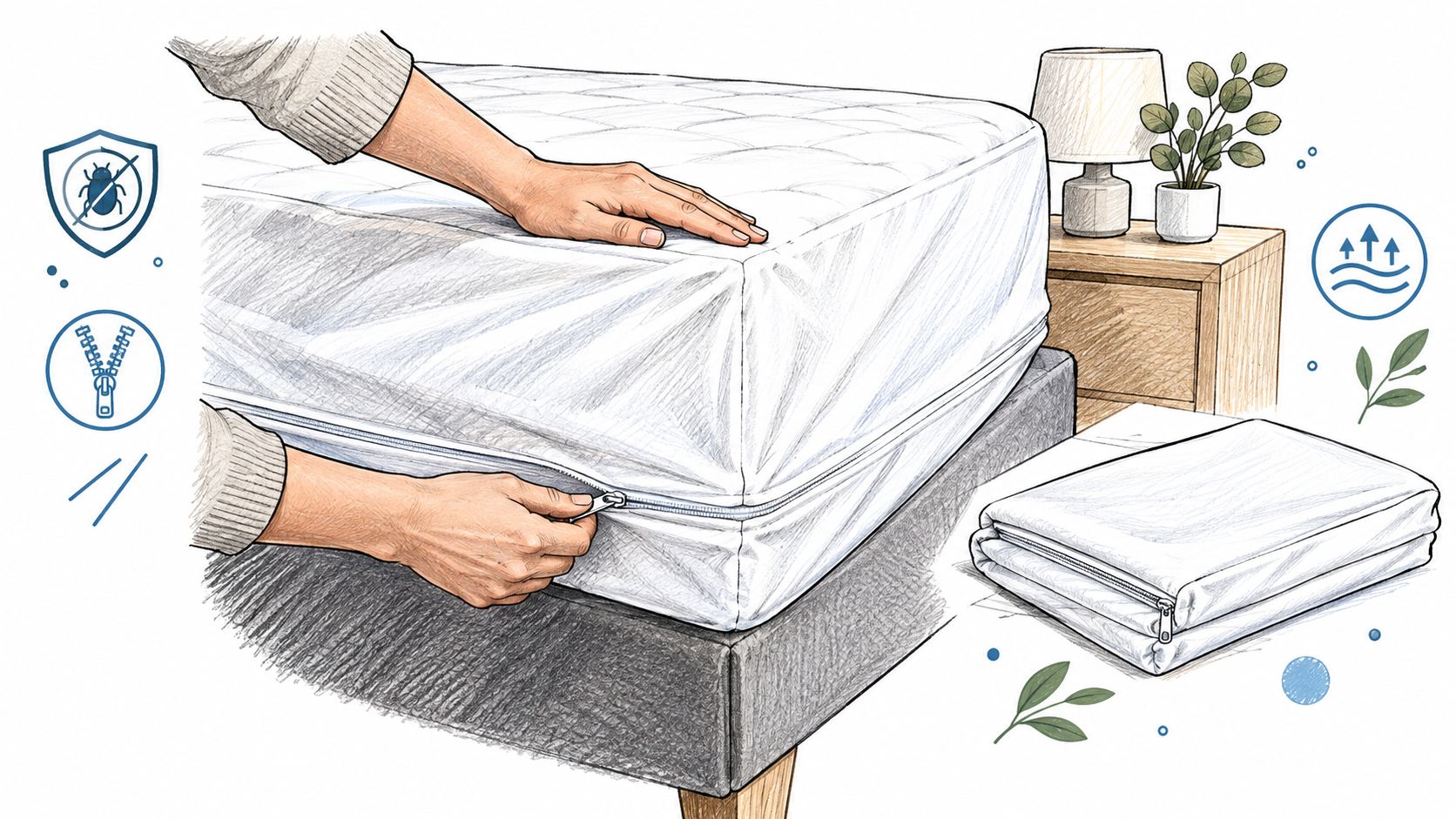
A full-cover protector usually works best when two people fit it together, especially on a heavier mattress. One person can do it, but the risk is that you pull too hard on one corner, stress the zip, or twist the mattress inside the cover.
How to fit it without fighting the mattress
Lay the encasement out first and identify the zip opening. Stand the mattress slightly on its side if needed, then guide one end in and work the corners into place gradually. Don't yank the fabric over a final corner as if you're forcing a fitted sheet.
If you're unsure whether the size is right, measure before fitting. This guide on how to measure mattress depth is useful because depth is the measurement most likely to cause trouble.
Check the closure before making the bed
Once the mattress is inside:
- Smooth the panels so there's no twisted fabric near the zip.
- Close the zip steadily rather than dragging it at an angle.
- Check the end point to make sure the opening is fully sealed.
- Add your sheet over the top only after the encasement sits flat.
A full cover should feel secure, not stretched and not baggy.
If the zip feels under pressure when closing, stop and check the depth and alignment. Forcing it usually shortens the life of the cover.
Keep the barrier working
Care matters as much as fitting. Wash according to the product instructions and avoid rough handling that can stress seams or damage the waterproof layer. Let the protector dry fully before putting it back on the bed.
For allergy-sensitive homes, remember that the encasement supports your hygiene routine. It doesn't replace it. Bedding still needs regular laundering, and the room still needs normal cleaning.
That's often the biggest misconception. People think the sealed cover means they can do less. In practice, the cover works best when it helps a good routine work better.
Making the Right Choice for Your Home
The right product depends less on marketing language and more on what's happening in your bedroom.
If you want everyday spill protection, easier cleaning, and a fresher mattress surface, a standard protector is often enough. It's simple, familiar, and practical for many homes. If you need a sealed barrier because of dust-mite concerns, stronger allergy protection, or bed-bug-specific use, a true six-sided encasement is the more sensible choice.
A quick way to decide
- For families with young children: prioritise waterproofing, washability, and ease of refitting.
- For allergy-sensitive sleepers: focus on true full enclosure and a routine that includes laundering suitable bedding properly.
- For landlords, hosts, and care settings: check coverage type, zip closure, and exact mattress fit rather than relying on broad “full cover” wording.
- For guest rooms with low risk: keep it simple unless there's a clear reason to step up to an encasement.
The biggest mistake isn't buying too much protection. It's buying the wrong kind and assuming all protectors do the same job.
A good buying decision usually comes down to three checks. Does it cover all six sides if you need that level of protection? Does the closure create a proper seal? Does the fit match your actual mattress depth and shape? If the answer is yes, you're far more likely to get the result you expected when you started searching.
Protect-A-Bed offers waterproof mattress protectors, pillow protection, and bed-bug encasements for UK homes and commercial settings, with breathable membrane designs aimed at practical sleep-surface protection. If you want to compare standard protectors with full encasements and check the options for your mattress size, visit Protect-A-Bed.