

Do Dust Mite Covers Work? an Honest UK Evidence Guide

Dust mite covers can reduce allergen exposure from bedding, and UK evidence suggests they may help some people with eczema, but they aren't a reliable stand-alone treatment for adult asthma. That's why the honest answer isn't yes or no.
The wrong version of the question is often asked. A mattress or pillow cover is bought, fitted carefully, and then judged by one thing only: “Do I feel better?” That sounds sensible, but it hides an important distinction. A cover can do its physical job very well and still fail to produce obvious symptom relief if the main trigger sits elsewhere in the room, or if the condition in question doesn't respond much to bedding changes alone.
That's where the confusion comes from. Some studies show covers reduce allergen in the bed. Some studies show little change in asthma control. Neither side is necessarily wrong. They're often measuring different outcomes.
Table of Contents
- What UK Shoppers Actually Want to Know
- How Dust Mite Covers Block Allergen
- What the UK Evidence Really Shows
- Choosing the Right Cover for Each Sleep Surface
- Standards and Specs Worth Checking Before You Buy
- Washing Covers and Keeping Them Effective
- Common Myths That Lead to Wrong Purchases
- When Covers Help and When to Move On
What UK Shoppers Actually Want to Know
do dust mite covers work, they usually mean two separate things.
The first question is practical. Do covers block dust mite allergen in the mattress or pillow?
The second is personal. Will I sneeze less, wheeze less, or wake with calmer skin if I use one?
Those questions don't have the same answer.
Two questions, two different answers
A proper barrier cover is designed to reduce exposure from one major reservoir: the bedding core. That matters because house dust mite allergy is common in the UK. One NHS-affiliated allergy resource states that one in 20 children and one in five adults will test positive for house dust mite allergy, and it also notes that house dust mite is a common perennial trigger in people with asthma, eczema, or rhinitis. NICE also notes that allergic rhinitis affects 26% of adults and 10 to 15% of children in the UK, with house dust mite being a major perennial trigger in this group, as summarised in the NHS house dust mite allergy guidance.
That tells you why these products became mainstream. It doesn't tell you they'll fix every symptom.
Practical rule: Ask whether you want lower allergen exposure, symptom improvement, or both. A cover is more reliable for the first than the second.
What a sensible expectation looks like
If you're hoping a cover alone will transform adult asthma, the evidence doesn't support that expectation. If you're trying to lower the allergen load in the bed as one part of a wider routine, that's a much more realistic use.
Keep these points in mind:
- Covers are a barrier product: They don't treat allergy directly. They reduce contact with allergen coming from the mattress, pillow, or duvet.
- Symptoms have multiple causes: A person may react to pollen, mould, pet dander, cold air, viral illness, or poor asthma control, not just mites.
- Condition matters: Skin symptoms and airway symptoms don't respond in the same way.
People also get stuck on the wrong buying decision. They spend ages comparing fabrics, but never decide which sleep surface matters most, or whether they need a full encasement rather than a top-only protector. That's often where difference lies.
How Dust Mite Covers Block Allergen
Dust mites don't need to be crawling on the sheet surface to cause trouble. They live deeper inside mattresses, pillows, and duvets, where warmth, moisture, and shed skin collect over time.
What many react to isn't the mite itself. It's the allergen in the material mites leave behind. A cover works by putting a physical barrier between you and that reservoir.
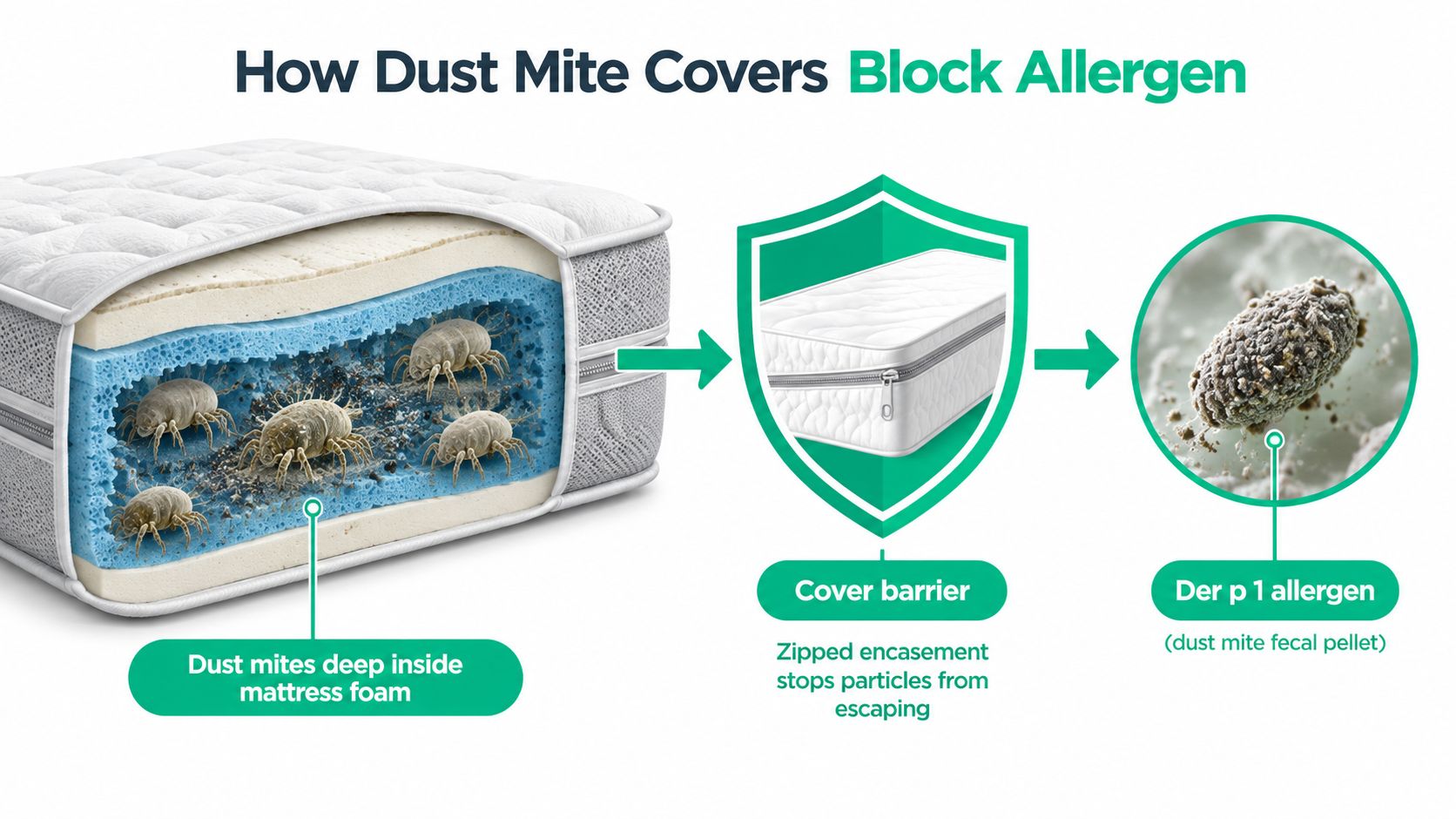
Think of it as a sealed filter layer
A mattress can look clean on the outside and still hold allergen inside. Vacuuming the top helps a little, but it doesn't remove what's embedded in the core. A zippered encasement changes the exposure path. Instead of allergen moving out toward the sleeper, the cover traps it inside and limits fresh build-up.
That's why wiping the mattress surface isn't the same as enclosing it. The barrier matters more than the appearance.
If you also want a plain-language explanation of how mites differ from other bedding pests, this Sunset Shine Home Cleaning guide is a useful primer.
The two main construction types
Most functioning allergen covers fall into one of these groups:
- Tightly woven fabric covers: These use a very dense weave to reduce the gaps through which allergen can pass.
- Membrane-backed covers: These pair a fabric surface with a very thin barrier layer that blocks particles while aiming to stay breathable.
Neither design has to feel plasticky if it's made well. What matters is not whether it says cotton, polyester, or microfibre on the packet. What matters is whether it forms a proper barrier and fully encloses the item.
A common shopping mistake is to assume 100% cotton or high thread count automatically means allergen-proof. It doesn't. Fibre content tells you what the yarn is made from. It does not, by itself, tell you how large the gaps are in the finished fabric.
Why full enclosure matters
A fitted protector that only covers the top and sides leaves part of the reservoir open. For spill protection, that may be acceptable. For allergen containment, it's weaker.
A useful way to compare styles is to look at examples of allergy mattress protectors and note the difference between top-only protectors and full zippered encasements. For allergy control, the six-sided enclosed style is the one that matches the barrier principle.
The cover doesn't need to kill mites to be useful. It needs to stop allergen moving freely from the bedding core to your breathing zone.
What the UK Evidence Really Shows
The UK evidence becomes much easier to understand when you stop looking for a single verdict.
Some trials ask whether covers reduce measured exposure. Others ask whether people feel better. Others still ask whether medication use or severe flare-ups change. Those are related questions, but they're not interchangeable.
Asthma evidence is cautious
NICE's evidence review found moderate-quality evidence from a randomised controlled trial of 48 adults and children with atopic dermatitis over 6 months, where impermeable mattress and pillow covers combined with other measures reduced eczema severity by a mean difference of -4.2 points (95% CI -6.7 to -1.7). In contrast, NICE also reports that a UK randomised asthma trial found mite-impermeable bed covers did not improve inhaled steroid use, asthma control, peak flow, dyspnoea, wheeze, or cough compared with self-management alone, and a major trial found no reduction in mite sensitisation, with prevalence 65.4% in the intervention group versus 65.1% in controls. NICE's full evidence summary is in this indoor air quality evidence review.
A separate UK asthma paper reaches a similar practical conclusion. In a large UK trial of more than 1,000 adults with asthma, mite-impermeable bed covers did not improve morning peak expiratory flow, did not increase the proportion able to stop inhaled corticosteroids, and did not improve secondary outcomes such as symptoms or quality of life, as discussed in the Manchester dust mite and asthma review.
Not all outcomes point the same way
That doesn't mean covers are useless. It means asthma control is harder to shift with bedding changes alone.
There's also a more nuanced body of UK-relevant evidence showing that single-intervention use often disappoints, while some children with more severe disease may still see benefit in specific settings. A UK and European review reported that covers alone were clinically ineffective in adults with asthma, and a primary-care trial in children found no improvement in peak flow, symptoms, medication use, or consultations over six months. Yet a later Manchester trial reported fewer severe asthma exacerbations in children using mite-proof covers, with 29.3% versus 41.5% hospital or A&E admissions with systemic steroids over a year, as summarised in the UKHSA publication on mite exposure control.
That mix of findings is exactly why blanket statements mislead.
Exposure reduction and symptom relief are different endpoints
One review found significant reductions in Der p 1 levels in bedrooms but no improvement in airway hyperresponsiveness or clinical asthma outcomes. That's a good reminder that lowering allergen counts doesn't automatically translate into how a person feels or functions, as discussed in this UK-relevant review of home environmental interventions.
| Outcome Measured | Typical UK Trial Finding | Strength of Evidence |
|---|---|---|
| Measured allergen in bedding or bedroom | Often reduced with impermeable covers | Fairly consistent for environmental effect |
| Adult asthma control | Often unchanged when covers are used alone | Strong caution against stand-alone use |
| Eczema severity | Some benefit when covers are combined with other measures | More encouraging, but not universal |
| Severe childhood asthma exacerbations | Mixed overall, with some later evidence of benefit in selected children | Nuanced and context-dependent |
| Rhinitis symptoms | Less convincing with bedding barriers alone | Weak to mixed |
Covers seem better at changing the bedroom environment than at delivering a predictable clinical result on their own.
Choosing the Right Cover for Each Sleep Surface
Not every part of the bed deserves equal priority. If you're buying strategically, start with the surfaces that hold the most allergen or sit closest to your face.
Mattress first, pillows second
The mattress is usually the biggest reservoir. It's bulky, hard to wash, and holds years of accumulated material inside. If your budget only stretches to one item, the mattress encasement is the logical first purchase.
Pillows matter for a different reason. They sit directly under your nose, mouth, and eyes for hours each night. Even when they contain less total material than a mattress, their proximity can make them highly relevant.
The duvet can also contribute, but it tends to be a secondary priority because it's easier to launder and replace.
| Surface | Allergen Reservoir | Priority | Best For |
|---|---|---|---|
| Mattress | Large and long-standing | High | First purchase in most rooms |
| Pillow | Smaller but very close to the airways and skin | High | Morning sneezing, eye symptoms, facial contact |
| Duvet | Variable and easier to wash | Medium | Extra barrier if symptoms persist |
Avoid the half-measure version
Top-only or fitted-sheet-style covers often sound similar to encasements in product listings, but they do a different job. They protect the sleep surface from wear and spills. They don't seal the item completely.
If you're comparing options and prices, it helps to understand the construction differences before you focus on cost. This guide to affordable mattress covers is useful for thinking through budget trade-offs, but for mite allergy the key question remains whether the product is a full encasement.
For that reason, many allergy-focused shoppers look specifically at zipper mattress covers rather than standard protectors.
A practical buying order
If I were advising a household trying to keep this simple, I'd suggest:
- Start with the mattress encasement: It tackles the largest hard-to-clean reservoir.
- Add pillow encasements next: Especially if symptoms are worst overnight or on waking.
- Consider the duvet last: Useful if symptoms continue or if skin flare-ups are prominent.
That order usually matches both biology and budget.
Standards and Specs Worth Checking Before You Buy
Marketing terms aren't very helpful here. “Anti-allergy”, “hypoallergenic”, and “hotel quality” don't tell you much about barrier performance.
You need to look at construction details.
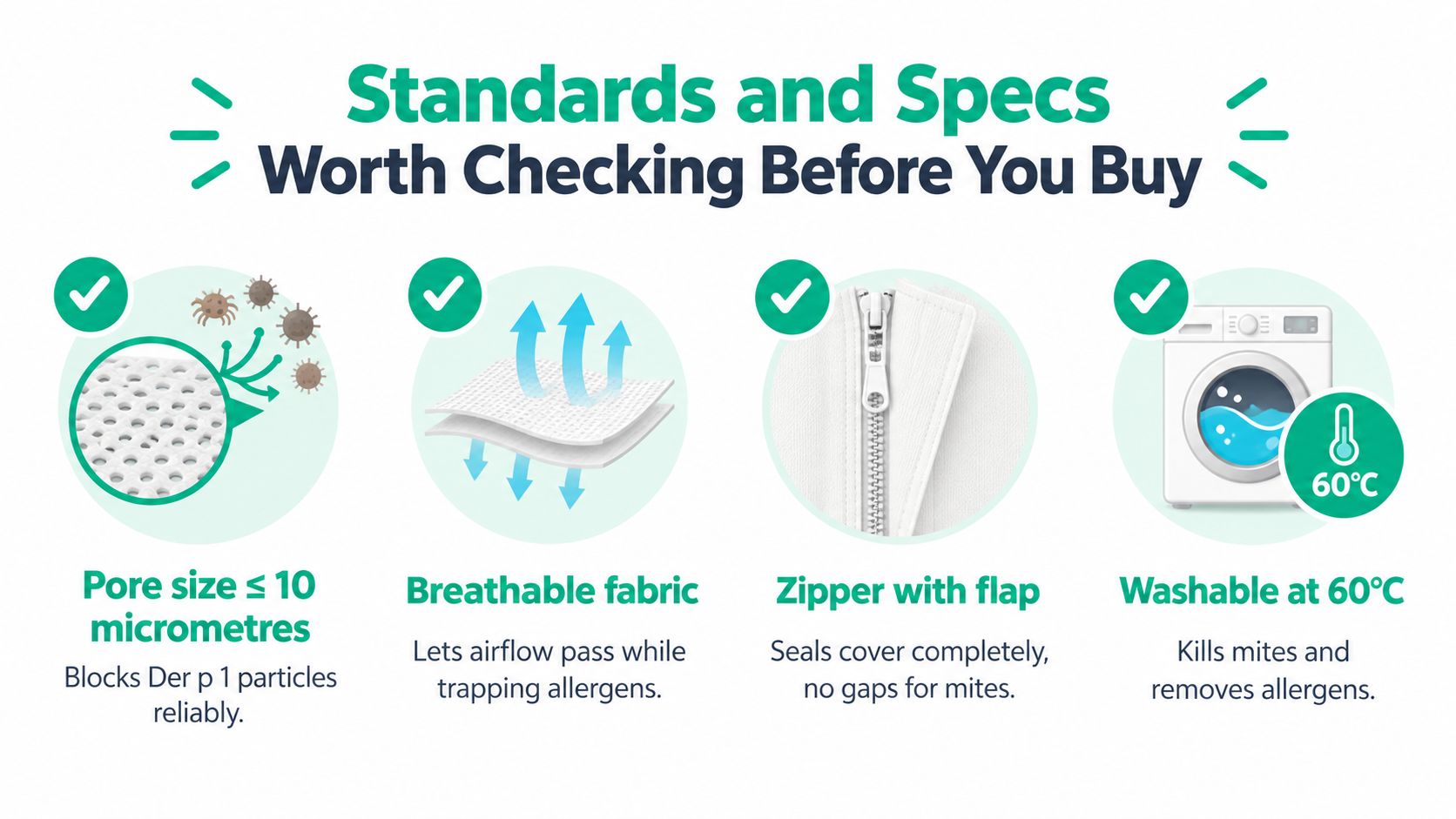
The shortlist that matters
When checking a product page or packaging, focus on these points:
- Full encasement: It should enclose all sides, not just the top.
- Secure zip closure: The zip should close fully and sit neatly without obvious gaps.
- Breathable feel: If the fabric feels clammy in the hand, sleep comfort may suffer.
- Washability: You need to be able to launder it regularly without awkward care rules.
A woven cover and a membrane-backed cover can both work if the barrier is sound. The difference often comes down to feel. Some people prefer the softer hand-feel of tightly woven fabric. Others want the added liquid protection of a thin membrane.
What to ignore
Don't put too much weight on these features alone:
- High thread count
- Natural fibre claims
- Luxury finish
- Quilted loft
Those features may affect comfort. They do not confirm allergen containment.
Comfort still matters
A cover that blocks allergen but makes you hot, noisy, or sweaty won't get used consistently. That makes it a poor real-world choice.
Vinyl-style covers are the classic example. They may create a barrier, but they often trap heat and moisture and can make people abandon them after a few nights. In practice, a breathable product used properly is better than an uncomfortable one left folded in a cupboard.
One factual example from the UK market is that Protect-A-Bed describes its Miracle Membrane products as breathable and designed to block allergens while also providing waterproofing. That sort of combined barrier can make sense for homes dealing with both spills and allergy concerns, provided the fit and comfort suit the sleeper.
If a cover feels unpleasant enough that you won't keep it on the bed, the technical spec stops mattering.
Washing Covers and Keeping Them Effective
A cover isn't fit-and-forget. It needs cleaning, and it works best as part of a routine rather than as a substitute for one.
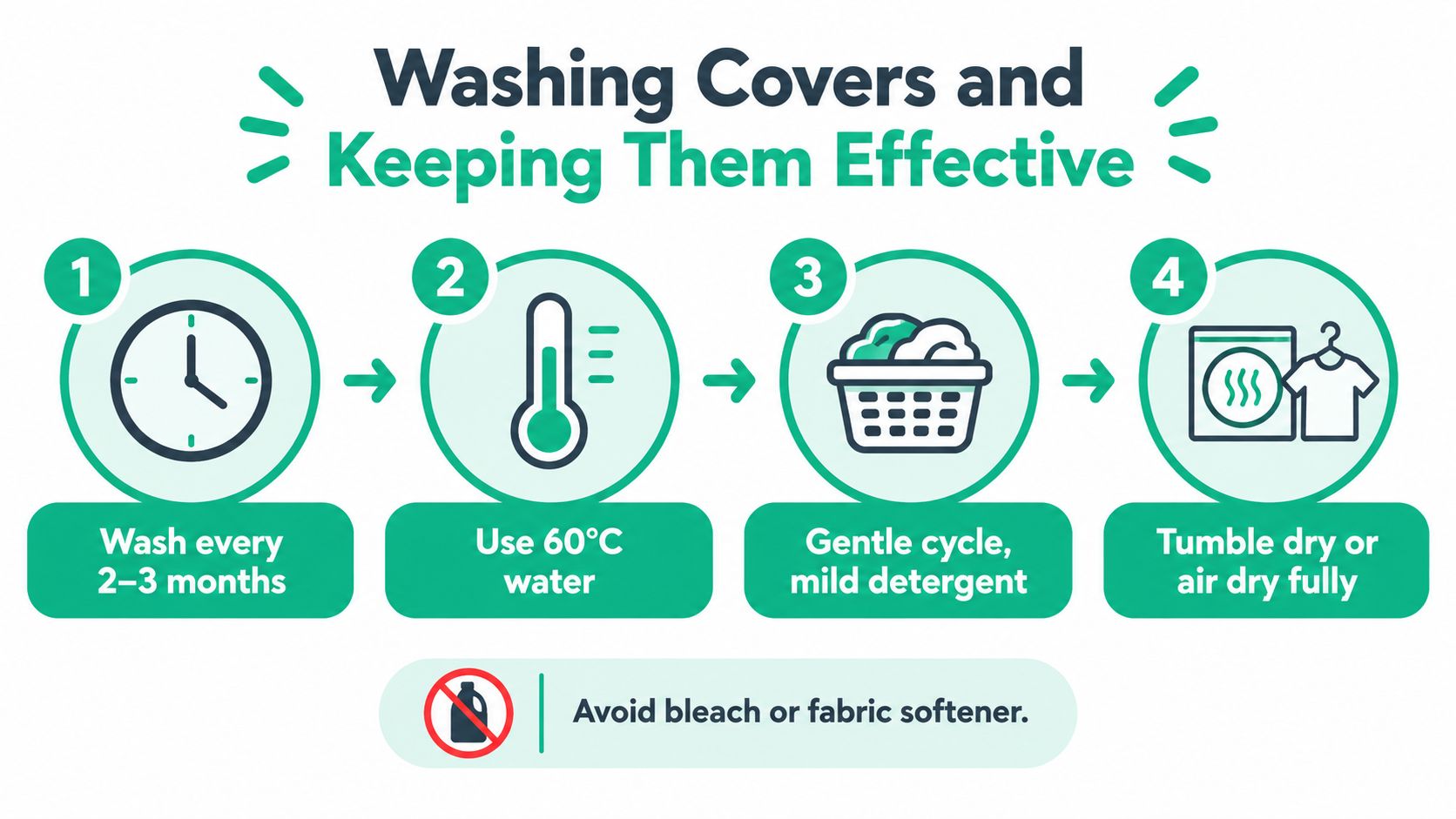
What to wash and how often
The usual pattern is straightforward:
- Wash the bedding you sleep on weekly: Sheets and pillowcases do most of the day-to-day collecting.
- Wash the encasement less often but regularly: Every few months is a common practical rhythm, or sooner if visibly soiled.
- Follow the care label: Especially for membrane-backed designs.
If you want a practical reference point for protector care, this article on how often to wash a mattress protector gives a helpful product-care overview.
Keep the rest of the room in view
People over-credit the cover. The cover reduces exposure from one reservoir, but the bedroom still contains dust-holding surfaces, soft furnishings, and airborne particles disturbed by movement and cleaning.
A sensible routine often includes:
- Regular hot washing of bedding where the care label allows
- Good ventilation and moisture control
- Routine cleaning of nearby soft surfaces
- Attention to pillows and duvets, not just the mattress
NHS guidance takes this broader view. Barrier covers on mattresses, duvets, and pillows are still recommended as part of a wider dust-mite reduction strategy, but clinicians advise stopping them if they make no difference to symptoms, as explained in the Norfolk and Norwich dust mite advice leaflet.
When washing goes wrong
The common errors are predictable. People wash the top sheet every week but never clean the encasement. Or they buy a cover and then stop bothering with the rest of the bedding routine.
That misses the point. The cover contains allergen. It doesn't replace ordinary laundering and cleaning.
Common Myths That Lead to Wrong Purchases
A lot of wasted money in this area comes from myths that sound plausible.
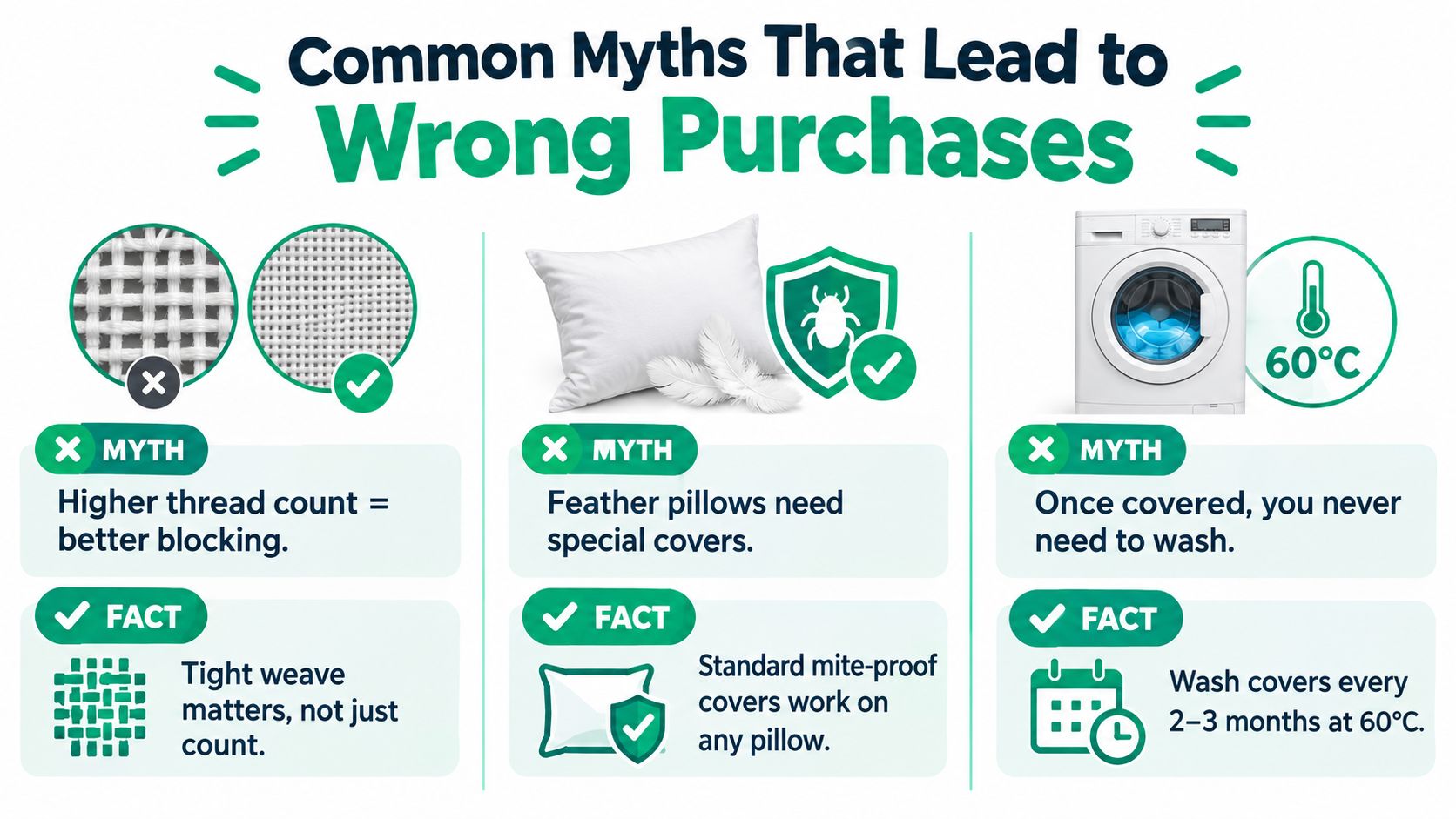
Myth one and myth two
-
Higher thread count always means better blocking
Not necessarily. A well-designed barrier fabric can outperform a loose high-thread-count fabric if the weave and overall construction are tighter. -
Only the mattress matters
Pillows can matter a great deal because they sit so close to the face. A person who wakes with sneezing, blocked nose, or itchy eyes may need to think about pillow encasement, not just the mattress.
Myth three and myth four
-
Covers alone will cure asthma
The UK evidence doesn't support that. They may reduce exposure, but adult asthma outcomes often don't shift much when covers are used as the only intervention. -
If it feels like plastic, it must be allergen-proof
Not always. Some cheap covers feel substantial but fit badly, tear, or are so uncomfortable that people stop using them.
Good buying decisions come from fit, barrier design, and comfort together, not from one dramatic-sounding feature.
Myth five and beyond
Two more myths cause trouble. One is the belief that a cover replaces washing. It doesn't. The other is that once fitted, a cover lasts forever. Seams, zips, and fabric performance can deteriorate with time and laundering, so ongoing inspection matters.
The sensible rule is simple: buy by specification and useability, not by folklore.
When Covers Help and When to Move On
The best use of a dust mite cover is targeted, not automatic.
People most likely to benefit
In practice, covers make the most sense for:
- Children or adults with confirmed dust mite sensitisation
- People whose symptoms are clearly worse in bed or on waking
- Families managing eczema where bedding contact seems relevant
- Households willing to combine covers with broader bedroom measures
For these groups, success may look like fewer morning sneezes, less overnight facial irritation, or calmer skin. It may be modest. It may also be worth it.
When they're less likely to change much
Covers are less convincing as a stand-alone fix for:
- Adults with asthma expecting major breathing improvement from bedding alone
- People whose main trigger is probably something else, such as pets, mould, or outdoor pollen
- Households that won't change anything beyond fitting the cover
That doesn't mean the cover has failed technically. It may mean it addressed the wrong part of the problem.
A sensible point to reassess
If you use the covers consistently and notice no meaningful symptom change after a fair trial, it's reasonable to step back and reconsider. NHS advice reflects exactly that practical stance: use them as part of a broader strategy, and stop if they make no difference.
Signs to move on include:
- No noticeable benefit after consistent use
- Symptoms occur well beyond the bedroom
- Another trigger becomes more obvious
- Comfort has become poor enough to disturb sleep
The cleanest answer to do dust mite covers work is this: they often work as environmental barriers, sometimes help clinically, and rarely deserve to be treated as a cure. Used in the right person, for the right reason, they're sensible. Used as a magic fix, they usually disappoint.
If you're looking for practical bedding protection rather than vague “anti-allergy” claims, Protect-A-Bed offers mattress and pillow protection products designed around breathable barrier construction. That can be useful if you want to combine spill protection with a more controlled sleep surface. It's worth browsing the specifications carefully and matching the cover style to the symptom pattern you're trying to address.