

Allergy Mattress Protectors How They Work and What to Buy

You wake with a blocked nose, itchy eyes or a tight chest, then feel better after leaving the bedroom. The mattress may not look dirty, but it can still hold dust-mite allergen close to your breathing zone night after night. For many UK households, the search for allergy mattress protectors starts with that frustrating pattern, not with a desire for another layer of bedding.
A protector can create a cleaner sleep surface, but it isn't a cure for allergy or asthma. The most useful way to judge one is to look beyond labels such as “hypoallergenic” and ask practical questions: does it form a reliable barrier, does it cover the whole mattress, and can you wash it properly? Guidance on dust mites in bedding can help you understand why the bed becomes such an important part of the bedroom environment.
The key is to treat the mattress as one part of a small sleep micro-environment. A suitable cover can limit contact with allergen stored in the mattress, while hot washing and sensible bedroom care deal with bedding around it. The sections below explain the barrier science in plain English, compare fitted protectors with full encasements, and give you a buying and care routine that works for homes, children's beds, rented properties and shared accommodation.
Table of Contents
- Introduction Why Allergy Sufferers Notice the Bed First
- How Allergy Mattress Protectors Actually Work
- What to Look For in a Dust Mite Proof Protector
- Fitted Protectors Versus Full Encasements Compared
- Why Protectors Work Best as Part of a Wider Plan
- Caring for Your Protector Washing Fit and Replacement
- Choosing Your Allergy Mattress Protector With Confidence
Introduction Why Allergy Sufferers Notice the Bed First
You go to bed breathing comfortably, then wake with a blocked nose, itchy eyes or a tight chest. A child may rub their eyes before breakfast, while someone with asthma may find nighttime breathing harder than it is elsewhere. The bed is often the first place to investigate because your face stays close to its fabrics for hours.
These symptoms do not prove that the mattress is the only trigger. Dust, pet dander, mould and pollen can also contribute, and persistent or severe symptoms need proper medical advice. Mattresses, pillows and duvets nevertheless create a warm, enclosed environment where allergens can remain near the sleeper.
Dust mites are too small to see. The practical concern is their allergen, which becomes part of household dust and can be disturbed when bedding moves. A mattress works like a deep filter: it collects material gradually, while ordinary surface cleaning cannot reach everything held within its layers. Guidance on dust mites in bedding explains why this hidden reservoir matters.
A barrier protector changes the contact point. It places a washable, tightly constructed layer between the mattress and the sleeper, rather than trying to clean inside an old mattress. The benefit depends on complete coverage, a dependable seal and correct care. A loose fitted layer may leave gaps at seams, corners or the underside, allowing allergen to remain accessible.
Practical rule: Judge a protector as part of a bedroom routine, not as a stand-alone treatment for allergy or asthma.
Washing also matters. A protector that can be laundered at 60°C helps remove allergen from the washable layer, while full encasement prevents the mattress contents from reaching the sleep surface. Marketing terms such as “hypoallergenic” say less than clear information about construction, coverage and washing instructions.
Expectations should remain realistic. A major adult asthma trial found that impermeable covers lowered mattress allergen concentrations, but concluded that covers alone were clinically ineffective for routine asthma management in primary care according to the study record and published trial. Lowering exposure at the mattress interface can still be useful, but symptoms may have several causes and may require a broader plan.
Ask three questions: does the barrier seal the whole mattress, can it withstand 60°C washing, and will the household maintain the surrounding bedding? This framework is more reliable than choosing a label alone.
How Allergy Mattress Protectors Actually Work
Think of a genuine allergen barrier as a breathable raincoat for the mattress. A raincoat keeps liquid on the outside while allowing some air and moisture vapour to move away from the body. A mattress protector uses a tightly formed fabric or membrane to interrupt the movement of liquids, dust and allergen particles, while aiming to avoid the clammy feeling associated with an ordinary plastic sheet.
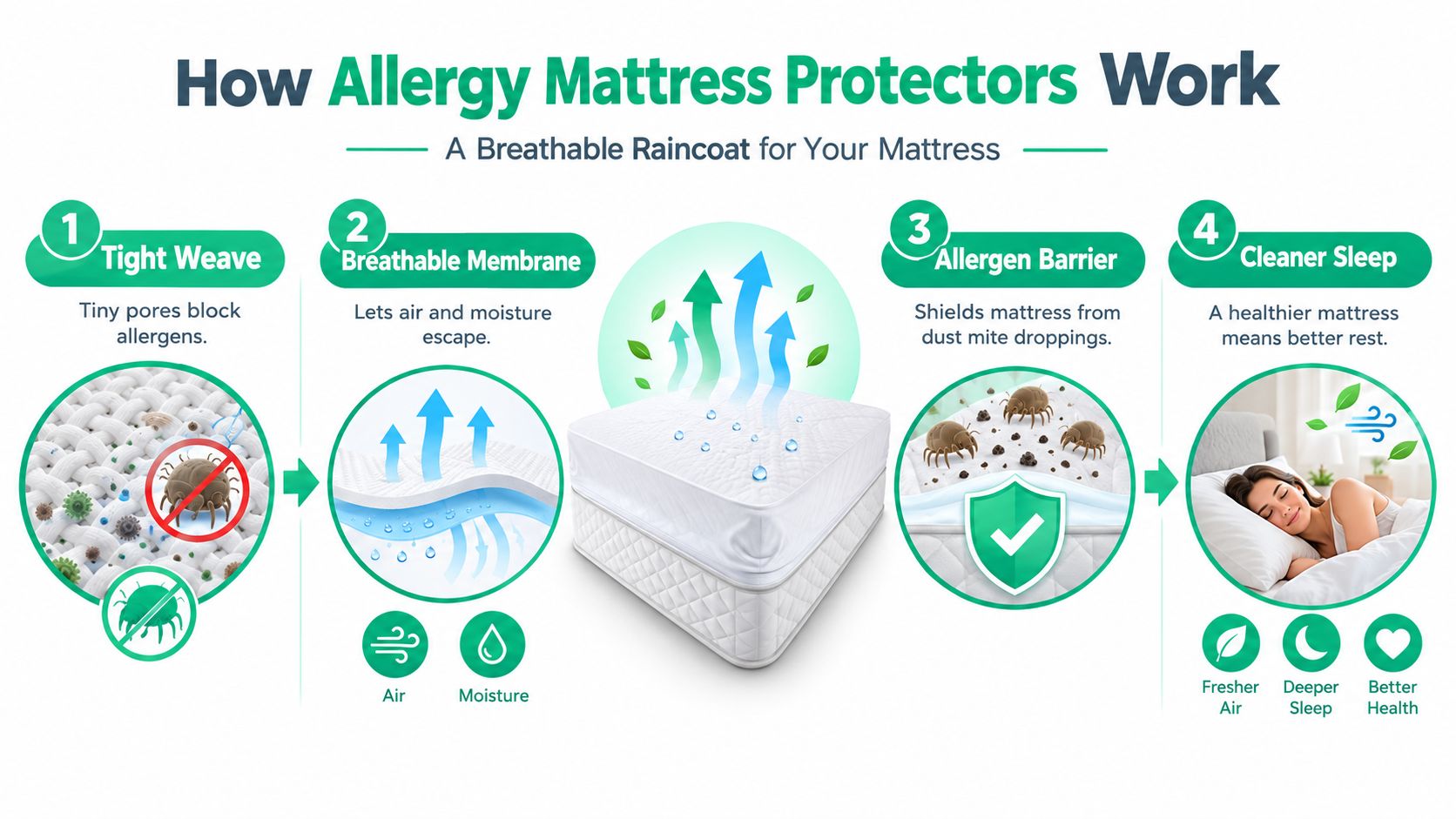
The barrier starts with the material structure
At microscopic level, the fabric's openings and the membrane's construction determine what can pass through. A tightly woven or laminated surface can stop dust-mite allergen from travelling out of the mattress towards the sleeper. The exact performance depends on the product's tested design, so a vague “anti-allergy” phrase tells you less than evidence of impermeability.
This is why water resistant and allergen impermeable aren't interchangeable terms. Water resistance may mean that a small spill beads on the surface for a while. It doesn't automatically show that the material blocks allergen particles or remains sealed around its edges.
Breathability affects whether you keep using it
A barrier that feels hot, noisy or stiff may end up folded in a cupboard. That defeats its purpose. Thin, flexible and quiet membranes make it easier to leave the protector on the bed, while breathable outer fabrics can improve comfort for people who sleep warm.
The membrane doesn't need to allow dust through in order to allow air and moisture vapour to move. A well-designed waterproof barrier can therefore protect against liquid while still supporting a more comfortable sleep surface. Product information from Suburban Furniture's mattress protector resource is useful when comparing the difference between everyday mattress protection and a specialist barrier.
Coverage closes the escape routes
A top-only layer protects the area beneath your sheet, but the mattress still has sides, seams and an underside. If allergen can move through an uncovered edge, the barrier isn't complete. Full encasements address this by enclosing all sides and closing the opening with a zip.
The same principle applies to the wider sleep system. A mattress cover can't seal allergen stored in a pillow or duvet. It creates a controlled mattress interface, which is valuable, but the surrounding bedding still needs its own washing and protection routine.
The result isn't a sterile bedroom. It's a more manageable one. The mattress becomes a contained source rather than an exposed reservoir, and the washable surface above it can be cleaned without repeatedly disturbing the mattress interior.
What to Look For in a Dust Mite Proof Protector
A child wakes with a blocked nose, or an adult starts sneezing after getting into bed. The mattress may not look dirty, yet its fibres can hold particles that are difficult to see. A useful protector should create a dependable physical barrier, fit the mattress properly, and remain practical to wash.
Verify the barrier, not just the label
Look for a clear statement that the material has been tested as an allergen-impermeable barrier. “Hypoallergenic” describes an intended outcome, not necessarily a tested construction. Product information should explain the fabric or membrane and identify what it is designed to block.
Pore size matters because particles need to be stopped physically. An isolated micron figure, however, does not prove that the finished protector performs as claimed. Check whether testing considers the whole item, including seams, closures and any opening used during fitting.
For allergy or asthma sufferers, full coverage and a reliable closure usually matter more than a prominent marketing label. A barrier is only useful where it remains continuous.
Check comfort for regular use
The protector lies beneath the sheet, so its feel affects whether it stays on the bed. Cotton can suit someone who prefers a familiar surface. Cooling, Tencel-style fabrics may appeal to people who sleep hot, while other finishes offer different textures and temperature characteristics.
Assess the layers together. The outer fabric should work with the membrane beneath it, make little noise as you turn, and suit the household's washing routine. A technically well-designed cover that disturbs sleep may be left unused.
Separate liquid protection from allergen protection
Waterproofing can help with children, night sweats, spills or incontinence. Check whether the waterproof layer is described as breathable or air permeable, then read how it should be washed and dried.
A waterproof protector limits liquid reaching the mattress. That feature alone does not confirm dust-mite protection. Look for both functions to be stated clearly, with barrier testing supporting the allergen claim.
Measure before ordering
Record the mattress width, length and depth, including any built-in padding or topper that will remain underneath. A cover that is too shallow may pull from the corners. One that is too large can shift and wrinkle, leaving the sleeping surface uncomfortable.
For a zippered encasement, accurate depth is especially important. The zip should close without force, and the fabric should not be stretched so tightly that seams become weak points.
Inspect closure, washing and evidence
A complete barrier needs a dependable closure. Look for a smooth-running zip, enclosed seams where possible, and a flap or construction that reduces the chance of an open gap. Confirm whether the protector covers all six sides or only the top and sides.
Washing instructions can determine whether the barrier remains useful. UK guidance recommends washing suitable bedding at 60°C or above to kill mites, while lower temperatures may remove some allergen without providing the same mite-control effect as outlined in this UK buying guide. Confirm that the protector tolerates this temperature and check drying instructions, since excessive heat may damage the membrane.
Finally, review textile or safety certifications, warranty terms and the replacement process. These details do not replace performance evidence, but they can show that the maker has considered material safety, durability and support after purchase.
Fitted Protectors Versus Full Encasements Compared
The easiest way to understand the difference is to compare a fitted protector with a zipped cover around a suitcase. A fitted protector lies over the mattress like a deep fitted sheet. A six-sided encasement surrounds the mattress completely and closes around it.
Neither format is automatically right for every household. A fitted design may be easier to remove and wash, while a full encasement gives stronger control over the mattress itself. The decision depends on whether you want surface protection, containment of an existing mattress, or a combination of both.
| Feature | Fitted Mattress Protector | Six-Sided Encasement |
|---|---|---|
| Main coverage | Usually covers the sleeping surface and sides | Encloses the top, sides and underside |
| Closure | Elasticated corners or fitted edges | Zippered closure around the mattress |
| Barrier continuity | Depends on fit and uncovered areas | Designed to seal the entire mattress |
| Everyday removal | Generally simpler | Takes more care to fit and remove |
| Best suited to | Surface hygiene, spills and easier laundering | Stronger mattress containment and shared-use settings |
| Key check | Correct depth and secure corners | Correct depth, zip quality and sealed construction |
A fitted protector can be a sensible choice when the mattress is new, the main aim is washable surface protection, or removal needs to be quick. It may also work as a practical outer layer over a fully enclosed mattress, taking the daily wear while the encasement stays in place.
A six-sided design is the stronger option when dust-mite allergy is a central concern, when the existing mattress may already hold allergen, or when a bed is used by different people. It also suits situations where landlords, care providers or hospitality teams need a consistent containment approach rather than a cover that can shift at the edges.
For a plain-language explanation of the fitted format, see this guide to a fitted mattress protector. The important distinction is not the word used on the packaging. It's whether the mattress is enclosed and whether the closure remains secure after fitting.
A fitted protector protects the surface. A full encasement controls the mattress as a contained object.
Remember that neither format replaces clean sheets, washed pillows or a washable duvet cover. The encasement solves one specific problem, exposure from the mattress. It doesn't turn every part of the bed into a sealed system.
Why Protectors Work Best as Part of a Wider Plan
You may wake with a sealed mattress but still breathe allergens from an uncovered pillow, duvet or nearby upholstered chair. These fabrics act like small reservoirs, holding dust and allergen close to the bed. A protector therefore manages one route of exposure, not the whole sleeping environment.
UK patient guidance recommends treating the bedroom as a connected system. That can include encasing mattresses, duvets and pillows, washing bedding at an appropriate hot temperature, and managing room conditions, as described by Cambridge University Hospitals. Another NHS resource states that mattress covers alone are insufficient, so other bedding also needs attention in its guidance on house dust and dust mites.
Use three controls together
Barrier protection blocks contact with allergen already held inside the mattress. A full encasement is useful because it surrounds the mattress, rather than leaving the sides and underside exposed. The zip, seams and fabric must remain closed and intact for that barrier to work.
Washing routines remove collected material from sheets and other washable bedding. Where the textile allows it, washing at 60°C or above matters because it addresses mites and allergen more directly than a cool cycle. Bedding should be fully dry before it returns to the bed.
Air management involves ventilation and sensible control of humidity. Regular airing, reasonable heating and prompt attention to damp conditions can make the room less supportive of dust-mite build-up. There is no need to treat the bedroom like a laboratory. Consistent habits are more useful than occasional intensive cleaning.
Research provides a helpful caution. In an adult UK trial, impermeable covers reduced mattress dust concentrations from 1.71 µg/g in the control group to 0.58 µg/g after 6 months, yet the researchers concluded that covers alone were clinically ineffective for routine asthma management. A lower allergen reading does not guarantee symptom relief. The barrier still has a purpose, but it needs to sit within a wider plan.
Evidence from children also supports careful containment. In the PAXAMA study, mattress dust allergen fell by 84% in the active group, while the placebo group showed no change in the University of Manchester study report. This supports a properly sealed mattress interface and regular laundering, while diagnosis and treatment remain matters for healthcare professionals.
For household-level guidance, minimize home allergens in Tucson offers a useful reminder that allergen control involves the wider home. The climate differs from the UK, but the practical principle remains: choose full encasement when mattress containment matters, wash compatible bedding hot, and address the surrounding textiles as well.
Caring for Your Protector Washing Fit and Replacement
A protector is only useful while its barrier remains intact. Washing clears collected allergen from the surface, while inspection finds small faults before they create an unprotected route to the mattress.
Begin with the care label. If the material permits, wash the protector at 60°C or above, a temperature used in UK guidance for killing dust mites. The higher-temperature cycle matters because a cooler wash may not achieve the same result. Do not exceed the manufacturer's instructions, since excess heat can damage a waterproof membrane or weaken its fit.
A simple care checklist
- Wash consistently: Follow the care instructions, particularly after spills, illness or heavy perspiration.
- Dry it completely: Damp fabric should not go back onto the mattress. Use the recommended drying method so the membrane is not overstressed.
- Check the zip: Close it from end to end. Look for snagging, separation or any section that fails to seal.
- Inspect seams and corners: After several washes, check for thinning fabric, tears and stretched elastic.
- Keep the fit secure: Smooth the protector over the mattress so it does not bunch, twist or pull at the corners.
A loose cover can leave gaps in the same way that a poorly closed door lets air through. Refit it whenever bedding is changed and check that the surface remains flat enough for comfortable sleep.
Pillow protectors and duvet covers need their own washing routine. Cleaning the mattress protector does not remove allergen from uncovered bedding, and a sealed mattress cannot compensate for an exposed pillow or unwashed duvet cover.
Replacement depends on condition rather than one universal date. Change the protector when the membrane cracks, fabric tears, the zip no longer seals, or the fit becomes unreliable. Warranty terms explain what the manufacturer may cover, but everyday wear and washing still require your own checks.
For practical instructions, see this guide on how to wash a mattress protector. The working goal is straightforward: keep the barrier clean, dry, sealed and comfortable enough to remain on the bed.
Choosing Your Allergy Mattress Protector With Confidence
The decision becomes much easier when you reduce it to three questions.
First, is the barrier verified? Choose a protector with clear information about allergen impermeability, construction and care. “Hypoallergenic” alone isn't enough.
Second, do you need fitted or full coverage? A fitted protector offers convenient surface protection. A six-sided encasement is more appropriate when containing the mattress is the priority, particularly for dust-mite allergy, asthma-related concerns, children's beds, rentals or shared accommodation.
Third, can you maintain it? Check the 60°C washing instruction, drying method, zip access and replacement support before buying. A cover that can't fit your mattress or tolerate your household routine won't provide dependable long-term protection.
People who sleep hot may prioritise breathable cotton or cooling fabric options. Families may place greater value on waterproofing and easy laundering. Landlords, care settings and hospitality managers may prefer a consistent encasement process that staff can inspect and repeat.
Protect-A-Bed offers UK mattress and pillow protection using its Miracle Membrane technology, with waterproof, air-permeable options and encasement designs intended to block liquids, dust mites and allergens. Product details, fabric choices and warranty information should still be checked against your mattress size and care needs. For another general buying perspective, this mattress protector guide from Woodstock Furniture & Mattress Outlet can help you compare the practical features to review before ordering.
Measure the mattress today, decide whether the exposed underside matters for your situation, and write down a washing routine that you can keep. If symptoms continue, worsen or include breathing difficulty, speak with your GP or an appropriate healthcare professional rather than relying on bedding changes alone.
Protect-A-Bed offers waterproof, breathable mattress protectors, pillow protectors and full encasements for UK homes and shared-use settings, including options built with Miracle Membrane technology. Visit Protect-A-Bed to measure your mattress, choose the coverage and fabric that fit your needs, and start a consistent allergen-control routine.