

Dust Mite Mattress Protection: What Works and What Doesn't

Only a fully enclosing, tested allergen-barrier cover meaningfully reduces mite allergen exposure from the mattress, while a standard waterproof protector mainly guards against liquids and gives only partial mite protection. In a UK housing study of 68 volunteers with asthma, 78% of sampled beds held Der p 1 above 2 micrograms per gram of dust.
That figure reframes the bed. The University of Warwick housing paper also found that 56% of those beds exceeded 10 micrograms per gram, a level tied to substantial exposure. Mattress age, bedroom condensation and how the bed was made all tracked with higher allergen. A south-east London trial discussed in that work found covers could cut Der p 1 in some circumstances, without a clear improvement in asthma from bedding changes alone. A cover is one part of a plan, not a cure, and it does not kill the mites already living in the mattress.
Table of Contents
- Why Dust Mites Settle in Your Mattress
- Encasements Versus Standard Protectors Compared
- Fabrics and Membranes That Actually Block Mites
- How to Fit a Full Encasement Correctly
- Washing and Care Routine That Keeps Covers Working
- Other Allergy Measures Worth Adding and When to Stop
- Confirm Your Protection Plan Before You Buy
Why Dust Mites Settle in Your Mattress
A mattress can hold dust, shed skin and moisture, giving house-dust mites a place to feed and live. The allergen that can trigger symptoms is found mainly in mite droppings and fragments of their bodies. As you move in bed, particles may escape into the air around you. A cover can help block that route, but it does not kill mites already inside.
The North West Allergy Network reports that about 1 in 20 young children and 1 in 5 adults test positive for house-dust-mite allergy. A positive test alone does not establish that mites are causing symptoms. The guidance describes mattresses and pillows as places where mites can thrive and recommends mite-proof covers to limit the build-up of mites and their faeces in bedding.
What is worth noticing
Night-time sneezing, a blocked nose, itchy eyes, wheeze or poor sleep that worsens in bed or on waking can fit an allergy pattern. Symptoms that reliably ease when you sleep elsewhere may also make the bedroom worth examining. A warm room, late meal or one-off cold, by itself, is less likely to follow that pattern.
Practical rule: If sensitisation is confirmed or symptoms clearly improve away from your bed, a barrier cover may be worth considering as part of a symptom-led plan. If neither applies, compare cover types before spending on extra measures.
Dust mites and their allergens are separate targets. A barrier limits allergen escaping from the mattress; cleaning and washing address dust and bedding you can reach. Older mattresses, damp bedrooms and bedding left unwashed can provide more food or moisture. A room-by-room clean can help with surfaces beyond the bed. The guide on how to tackle hidden bedroom dust covers skirting, shelves and soft furnishings, which a mattress cover does not protect.
Start with the measures that match the symptoms and the likely source. If a change makes no noticeable difference, avoid adding more steps without a clear reason. A cover is one part of reducing exposure, not a treatment for every cause of bedroom symptoms.
Encasements Versus Standard Protectors Compared
A fully enclosing cover limits the routes through which mite allergen can escape from a mattress. A standard protector is mainly designed to shield the bed from liquids, and its open underside leaves a different kind of gap.
A full encasement covers all six sides and closes with a zip or sealed flap. A standard protector covers the top and sides, with an elastic skirt underneath. That skirt does not seal the base, so movement on the bed can stir mattress dust through the gaps and into the room.
In a Manchester study of 564 homes, mattress dust had the highest geometric-mean Der p 1 concentration, at 1.19 micrograms per gram. The study also found 40.3% of homes had Der p 1 above 10 micrograms per gram in at least one dust reservoir, a level linked with higher sensitisation risk. Older mattresses, dampness, condensation and older housing were associated with heavier burdens. UK NHS guidance recommends breathable, fully enclosing, tested allergen-barrier covers for mattresses, duvets and pillows. A waterproof film can stop sweat and spills, but waterproofing alone does not show that allergen is contained.
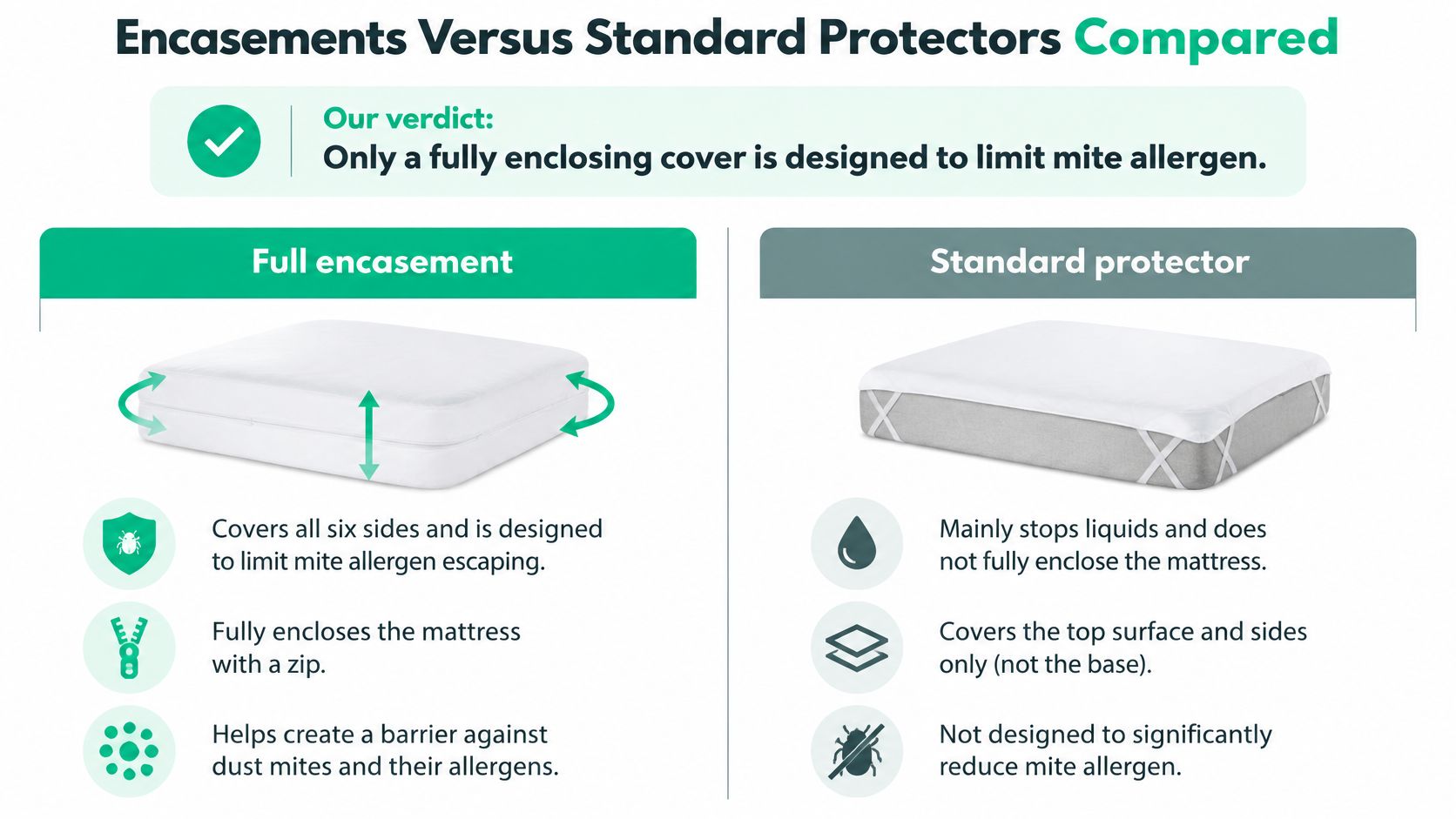
Side by side
| Criterion | Full encasement | Standard protector |
|---|---|---|
| Coverage | All six sides, sealed or zipped | Top and sides, elastic skirt underneath |
| Gaps where allergen can escape | Few, if seams and closure are sealed | Likely at the base, edges and skirt |
| Mite allergen containment | Strong when independently tested | Partial; waterproofing alone does not prove containment |
| Liquid and sweat protection | Usually, if a membrane is included | Usually |
| Breathability and heat | Check the moisture-vapour rating | Often lighter and more breathable |
| Washing | Check the care label; wipe weekly if not washable | Usually machine washable |
| Typical price | Usually higher than a fitted protector of the same size | Protect-A-Bed's Cotton Mattress Protector is sold from £24.98 on sale |
A skirt may look secure when the bed is made, then shift at the corners as the mattress is used. The resulting openings leave a route for dust to escape, even though the top is covered.
Confirmed sensitisation or asthma that flares in bed points toward a full encasement. For spills and sweat alone, a standard waterproof protector may be enough. If you need both kinds of protection, choose a fully enclosing cover with a waterproof membrane, and look for test evidence that allergen does not pass through the finished cover. A cover blocks allergen from escaping; it does not kill mites, so add measures only when they address a symptom or gap in protection.
Fabrics and Membranes That Actually Block Mites
A mite is large next to its waste. Droppings and fragments are the particles that matter, so the cover has to work like a fine sieve, not a net for insects. A weave or film that stops a spilled drink is not automatically tight enough for allergen. Liquid beads on the surface. Fine protein dust can still pass a looser pore.
What to check on the label
Weave density matters on cotton. A tight weave holds more back than an open one, and you cannot judge that by the word cotton alone. A continuous membrane should run across the sleeping surface without uncoated patches. Seams and zips need a finish that does not leave a channel around the barrier. Breathability is moisture-vapour transfer, not a marketing line about feeling cool.
Lyocell, including Tencel, and other cooling blends can feel fresher in a warm bedroom. A cool hand-feel does not confirm a barrier claim. Hypoallergenic is a marketing word unless the finished cover has independent testing that allergen does not escape.
| Material | Mite barrier | Breathability | Practical note |
|---|---|---|---|
| Tightly woven cotton | Moderate; depends on weave density | High | Good for washing; confirm the barrier claim, not just the fibre |
| Laminated or continuous membrane | High when continuous and sealed | Moderate; check the moisture-vapour rating | Strong against liquids; allergen containment still needs testing |
| Lyocell (Tencel) or cooling blend | Not proven by the fibre alone; needs a tested barrier | High | Cooler feel; check whether the barrier is independently tested |
| Standard polyester top layer | Low to moderate | Often lighter, sometimes less stable after many washes | Often used on protectors; less likely to contain fine allergen |
Heat is the trade-off people feel first. A heavier membrane can sleep warmer if vapour cannot leave. If you run hot, read how a breathable mattress protector is specified before you assume any waterproof layer will trap sweat.
Ask any seller three things. Is the cover fully enclosing? Has the finished cover, not just a fabric swatch, been tested for allergen escape? What moisture-vapour figure do they publish? If those answers are vague, the product is a liquid guard, not dust mite mattress protection.
How to Fit a Full Encasement Correctly
A good barrier fails at the zip more often than in the fabric. Fit it once, slowly, and the weekly routine stays simple.
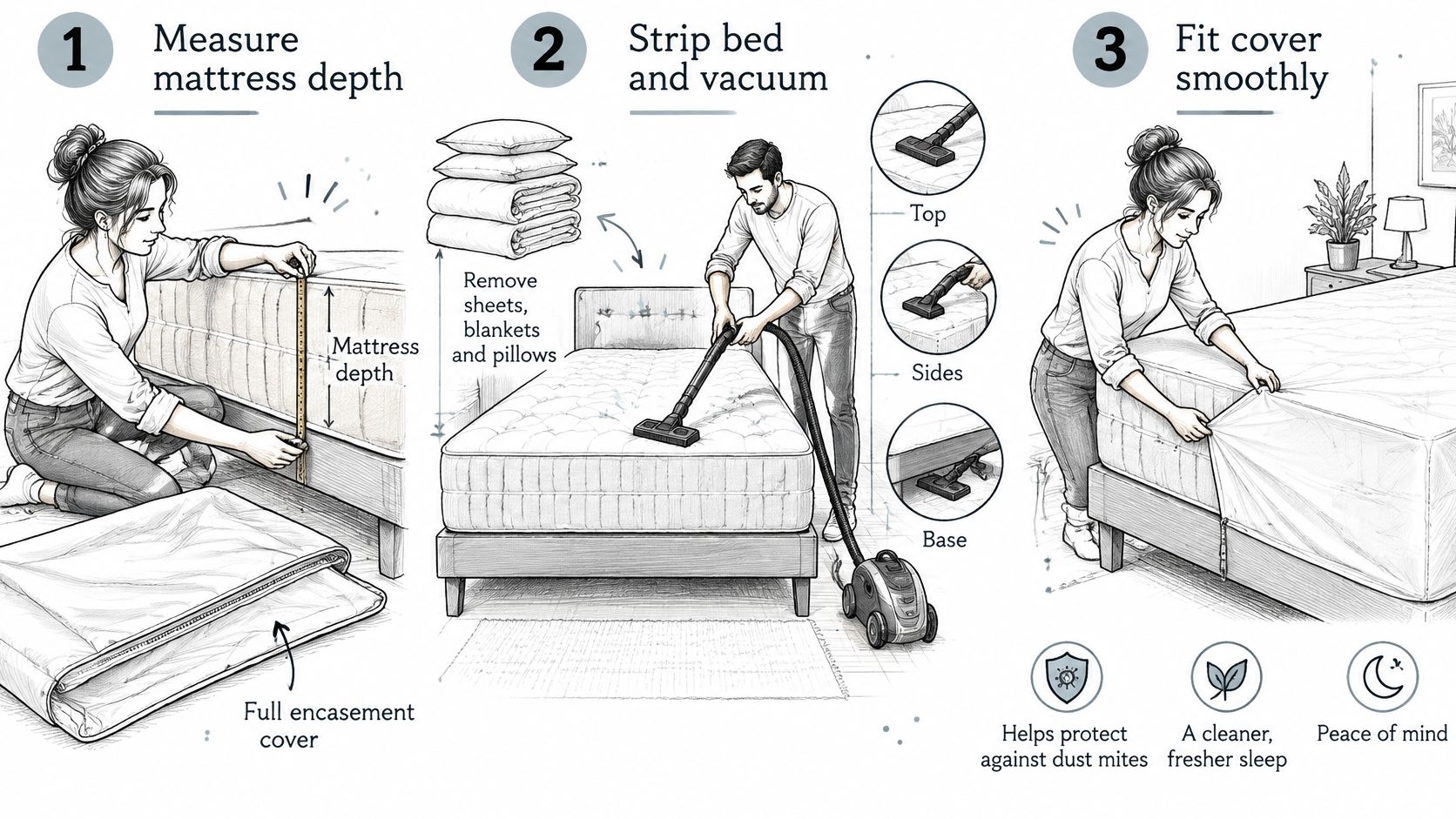
- Measure the mattress depth, including any pillow top, and match it to the cover's listed depth range. A cover that is too tight strains seams. One that is too deep bunches and leaves folds where dust collects.
- Strip the bed. Vacuum the top, sides and base with a vacuum that has a HEPA filter. You are lifting loose dust before you seal it, not trying to empty the mattress core.
- If the mattress feels damp, leave it uncovered until it is dry. Check the wall behind the bed for condensation. Sealing a wet mattress traps moisture against the mites' food supply.
- Open the zip fully and slide the mattress in so the cover lies flat. The common slip is a fold trapped under a corner. That fold becomes a wear point.
- Close the zip or sealed flap all the way. Run a hand along it. A half-closed zip is the failure that undoes the whole cover, because the gap works like an open bin lid.
- Put the mattress back on the frame and check the base panel is still enclosed. Slatted bases can pinch fabric. Smooth any pinch before you sleep on it.
- Encase the pillows to the same standard. An open pillow sits next to your nose and bypasses a perfect mattress seal.
- Remake the bed with your usual sheets and duvet cover. Once a month, check seams, zips and corners. A closure that stays shut when you shift the bed is what a good fit looks like: a smooth surface, no bulging seams, no gap you can slide a finger into.
Washing and Care Routine That Keeps Covers Working
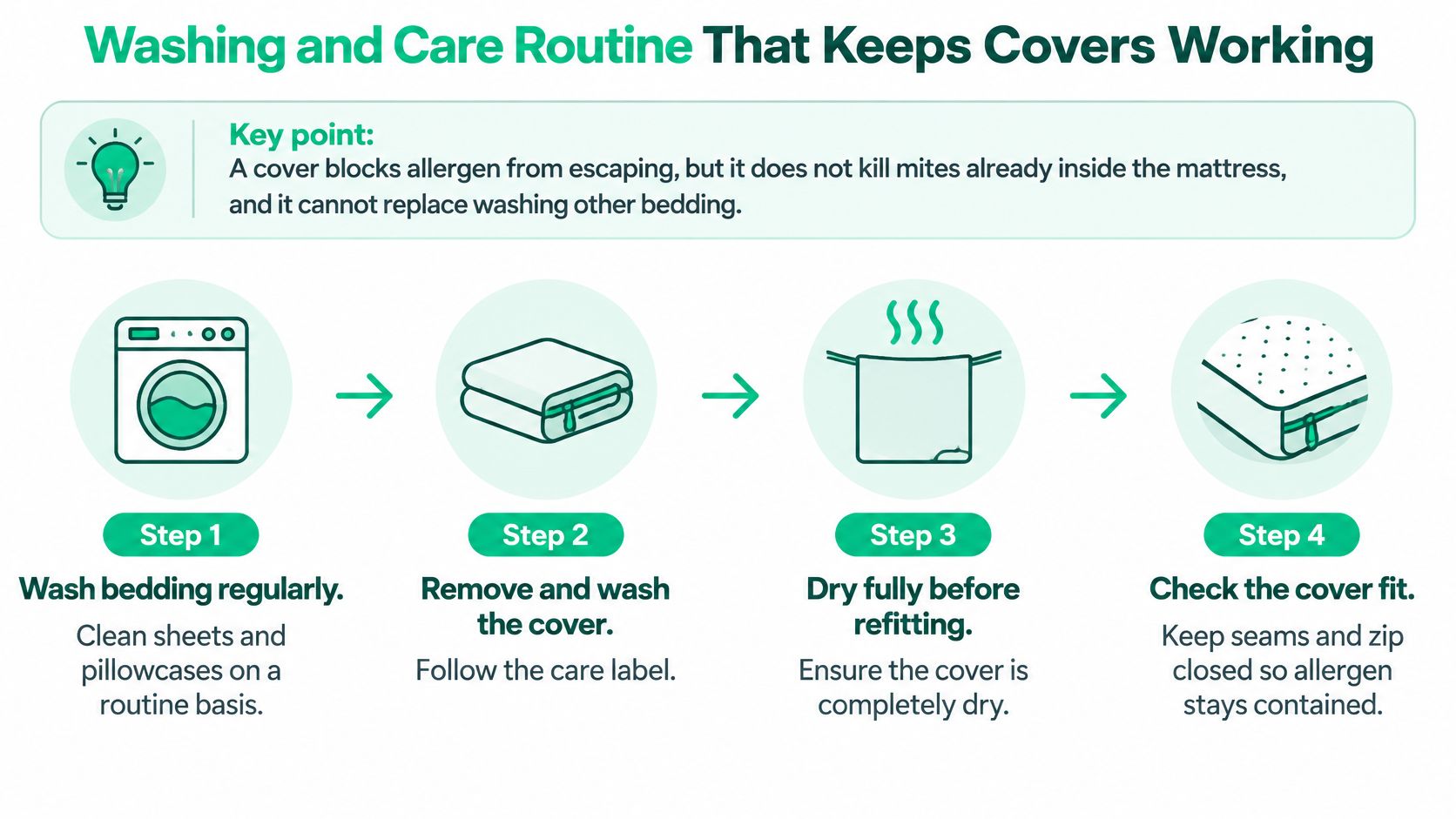
Dust-mite allergen can move from bedding into room dust as sheets and covers are disturbed. A barrier cover contains allergen at the mattress; washing and wiping remove material from the surfaces you touch. Keeping those jobs separate helps explain why washing sheets but leaving the barrier cover unwiped is a common gap.
University Hospitals Birmingham guidance recommends allergen-barrier covers for mattresses, pillows and duvets, and advises washing uncovered sheets and bedding weekly at 60°C or above. The same guidance recommends wiping barrier covers weekly with a damp cloth and letting them dry completely. For someone with asthma or a diagnosed dust-mite allergy, these steps can form part of a wider symptom-led plan. They keep allergen contained and bedding clean, rather than acting as a way to kill mites inside the mattress.
| Item | Wash or wipe | How often | Key care point |
|---|---|---|---|
| Non-encased sheets and duvet covers | Wash at 60°C or hotter | Weekly | Hot washing kills mites on bedding that is not encased |
| Outer barrier cover | Wipe with a damp cloth; dry fully | Weekly | Avoid soaking unless the label allows it |
| New mattress protector | Wash before first use | Once, before first use | Fabric is starched for cutting during production |
| Pillow encasements | Wash to the label | Weekly | Check closures and seams during washing |
| Torn or failed cover | Repair or replace | Straight away | A damaged barrier gives little protection |
A week that finishes properly
Strip the bed and wash non-encased linen at 60°C, then dry it fully before remaking the bed. Wipe the barrier cover with a damp cloth and let it dry until no damp patches remain. A dry surface matters: moisture left on the cover can create conditions that suit mites. Check the seams and closure as part of the same routine.
Follow the care label for any washable cover. Long soaks, harsh chemicals and excessive tumble-dryer heat can damage materials, so avoid them unless the label permits them. For guidance on setting a suitable cleaning rhythm, see how often to wash a mattress protector.
Keep a dedicated cloth and mild cleaning product with your other household essentials with J&M Cleaning Team. That makes it easier to wipe the cover without reaching for a harsh bathroom cleaner that could damage its surface.
If the cover tears or its closure fails, repair or replace it promptly. A damaged barrier cannot contain allergen as intended, even when the rest of the routine is followed.
Other Allergy Measures Worth Adding and When to Stop
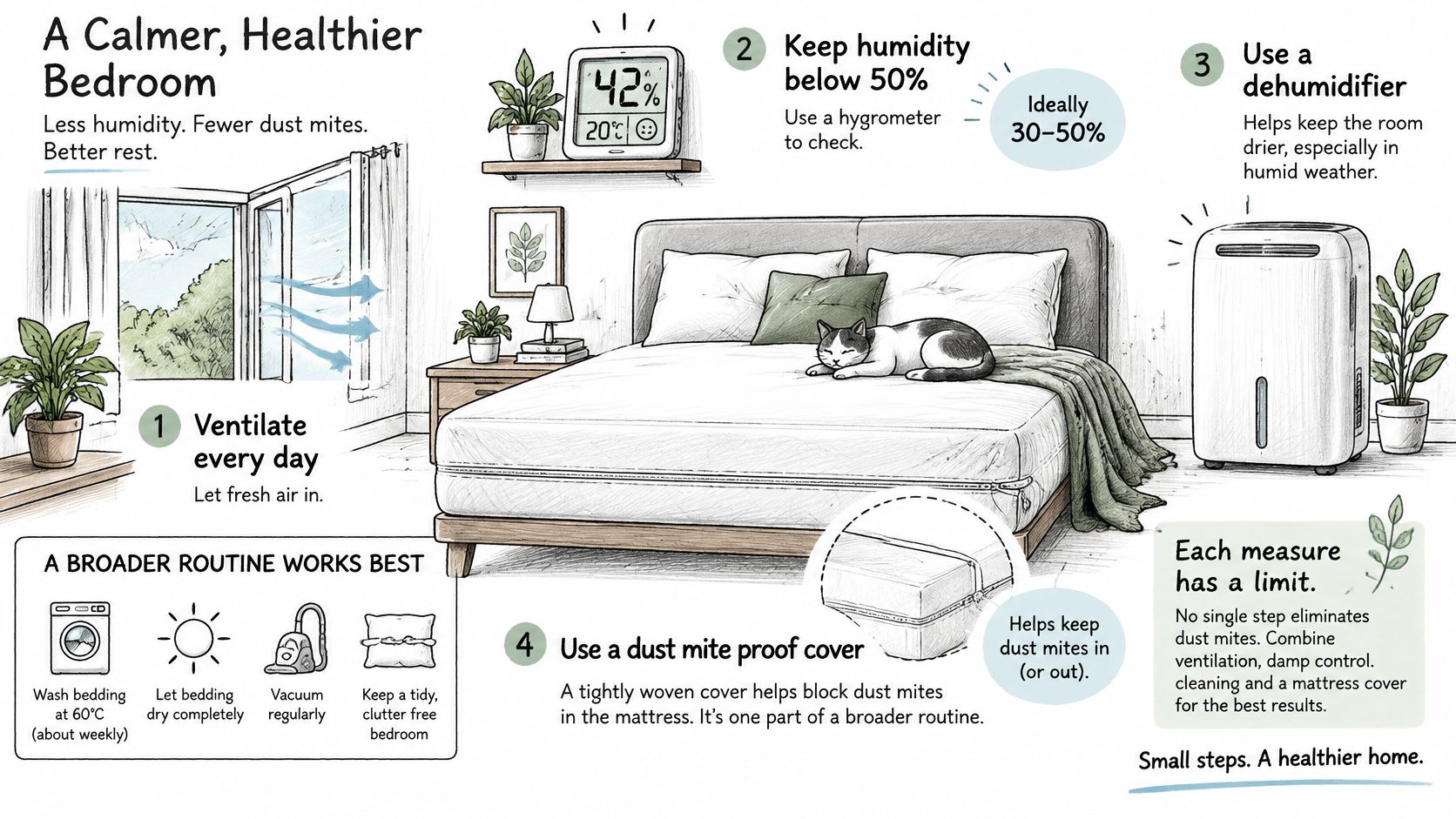
A mattress cover can block allergen from escaping into the room, but it does not remove mites already living in bedding or other furnishings. That distinction matters: a barrier is one part of a symptom-led plan, not a mite-killing treatment. Cambridge University Hospitals describes a breathable, fully enclosing mattress cover as the most effective bedroom measure, while also advising that it is not enough on its own. A review of bedding interventions found that mite-impermeable covers could reduce mite levels, although changing bedding alone was unlikely to produce a clear improvement in symptoms.
Choose other measures according to the conditions in the room and what seems to affect symptoms. If a change makes no noticeable difference, there may be little reason to keep adding more.
| Measure | What it targets | Caveat |
|---|---|---|
| Dehumidification | Indoor humidity that allows mites to survive | Look for persistent condensation on walls or windows rather than relying on a promised percentage |
| Ventilation | Moisture and stale air in the bedroom | Consider outdoor air quality and the cost of reheating the room |
| HEPA vacuuming | Surface dust on mattresses, floors and furniture | It does not remove allergen deep inside a mattress |
| Freezing soft toys | Mites living in soft toys | Check the care label first; the measure has a limited scope |
Moisture first, extras later
Address damp and ventilation before buying more gadgets. Open windows when outdoor air is reasonably clean and reheating the room is manageable. If the street air is polluted or heating costs are a concern, focus instead on persistent condensation and consider whether dehumidification suits the room.
HEPA vacuuming can reduce dust on exposed surfaces, but it cannot reach allergen held deep in a mattress. A cover helps by separating that reservoir from the room; vacuuming and blocking allergen therefore do different jobs. Freezing a soft toy may help with mites in that toy, but check its label and do not expect the step to treat the whole bedroom.
If the measures you try do not change symptoms, you do not need to continue them indefinitely. Consider a sealed mattress and pillow cover when symptoms are clearly worse in bed or sensitisation has been confirmed, then assess whether the overall plan is helping. Avoid making several costly changes at once: replacing carpets, buying new pillows or treating every toy may add effort without showing which measure, if any, made a difference.
For practical room-by-room ideas, see these allergen reduction tips for your bedroom and this guide on how to allergy-proof your bedroom. Use them to choose relevant steps, then stop adding measures that do not help.
Confirm Your Protection Plan Before You Buy
Before ordering, check the warranty terms and measure your mattress depth. Protect-A-Bed's warranty covers the mattress's sleeping surface, not its sides. Proof of purchase is required, and warranty protectors must be returned to Protect-A-Bed. A cover that is too tight can strain at the seams, so match the mattress depth to the listed range.
Choose the type of barrier to match the problem. A full encasement encloses the mattress; a standard protector covers its surface. Protect-A-Bed's patented BugLock Mattress Encasement has a three-sided zipper and AllerZip seal (US Patent 7,552,489) and protects against dust mites, allergens and bed bugs. Its Mattress Protector uses the Miracle Membrane, which prevents dust mite faeces from penetrating. A cover can block allergen from reaching the room without killing mites, so it is one part of a symptom-led plan.
- If you are unsure whether symptoms are allergy-related, ask a GP or pharmacist before buying several products.
- Measure mattress depth and check the cover's listed range to avoid straining seams.
- Choose a full enclosure if you need to seal the mattress, and protect pillows too. Use the testing checklist from the fabrics section to assess allergen containment.
- Follow the care instructions. Wash sheets weekly at 60°C, wipe the barrier with a damp cloth, and wash protectors before first use to remove factory starch.
- Reassess symptoms after a few weeks. Keep measures that help; stop adding steps that make no difference.
Protect-A-Bed offers mattress protectors, pillow protectors and bed bug encasements. If you choose one of its products, select it for the barrier you need and follow its care and warranty terms. A fitted cover and a manageable routine are more useful than accumulating extra measures without a clear benefit.