

Best Dust Mite Mattress Cover Choices for Allergy Sufferers

Waterproof doesn't mean allergen proof. That's the assumption behind a lot of disappointing purchases, and it's worth setting aside before you compare fabrics or prices. A cover can stop a spilt drink and still leave seams, sides and the underside open to allergens already inside your mattress. If you're choosing a best dust mite mattress cover for allergy control, the useful question isn't whether the label sounds protective. It's whether the product creates a continuous, breathable barrier you can keep clean over time.
Table of Contents
- Dust Mite Mattress Covers Buyer Guide
- Why Dust Mite Control Matters
- Encasement or Protector
- Materials Pore Size and Comfort
- Check Labels Tests and Fit
- Cleaning and Allergen Control
- Which Cover Fits Your Situation
- Final Dust Mite Cover Checklist
Dust Mite Mattress Covers Buyer Guide
Most shopping lists start with waterproof, anti-allergy or bed bug proof. Those words describe different jobs, and treating them as interchangeable is where buyers go wrong. Waterproofing addresses liquids. Bed bug wording concerns entry, escape and harbourage. Dust mite control depends on whether mite allergens inside the mattress can pass through the cover or escape around its closure.
A fitted sheet-style product may protect the sleeping surface well, but it doesn't enclose the mattress. If allergen containment is your main reason for buying, that's a fundamental gap, not a minor design difference. Start with construction, then assess comfort and care.
What to Judge First
- Full enclosure: Does the cover surround the top, sides and underside without gaps?
- Barrier evidence: Has that specific model been tested to prevent house dust mite allergen escaping?
- Breathability: Can air and water vapour move through it well enough for comfortable, regular use?
- Fit and closure: Do the zip, seams and stated depth match your mattress and stay secure?
- Washability: Can you clean and fully dry it according to its label without damaging the barrier?
- Whole-bed fit: Will it work alongside separate pillow and duvet protection where needed?
Selection principle: Buy the barrier you can verify and maintain, not the boldest health claim on the packet.
No cover fixes damp, mould, poor ventilation or allergens elsewhere in the bedroom. It also shouldn't be sold as a guaranteed symptom treatment. A sensible best dust mite mattress cover is one component of a wider routine involving laundering, cleaning and humidity control.
Your final choice will depend on your circumstances. A child prone to night-time accidents needs liquid protection and easy washing. A hot sleeper may place more weight on airflow and low noise. A landlord or hotel needs repeatable sizing and durable maintenance. Use the same evidence checks, then rank comfort and practical features for the person who'll sleep on it.
Why Dust Mite Control Matters
Dust mites live where warmth, retained moisture and shed skin flakes collect. Mattresses, bedding, upholstered furniture and carpets hold those materials for long periods, which is why the bed matters so much in a control plan. You can't wash a mattress as you would a sheet, so allergens can remain inside it even when the visible bedding looks clean.
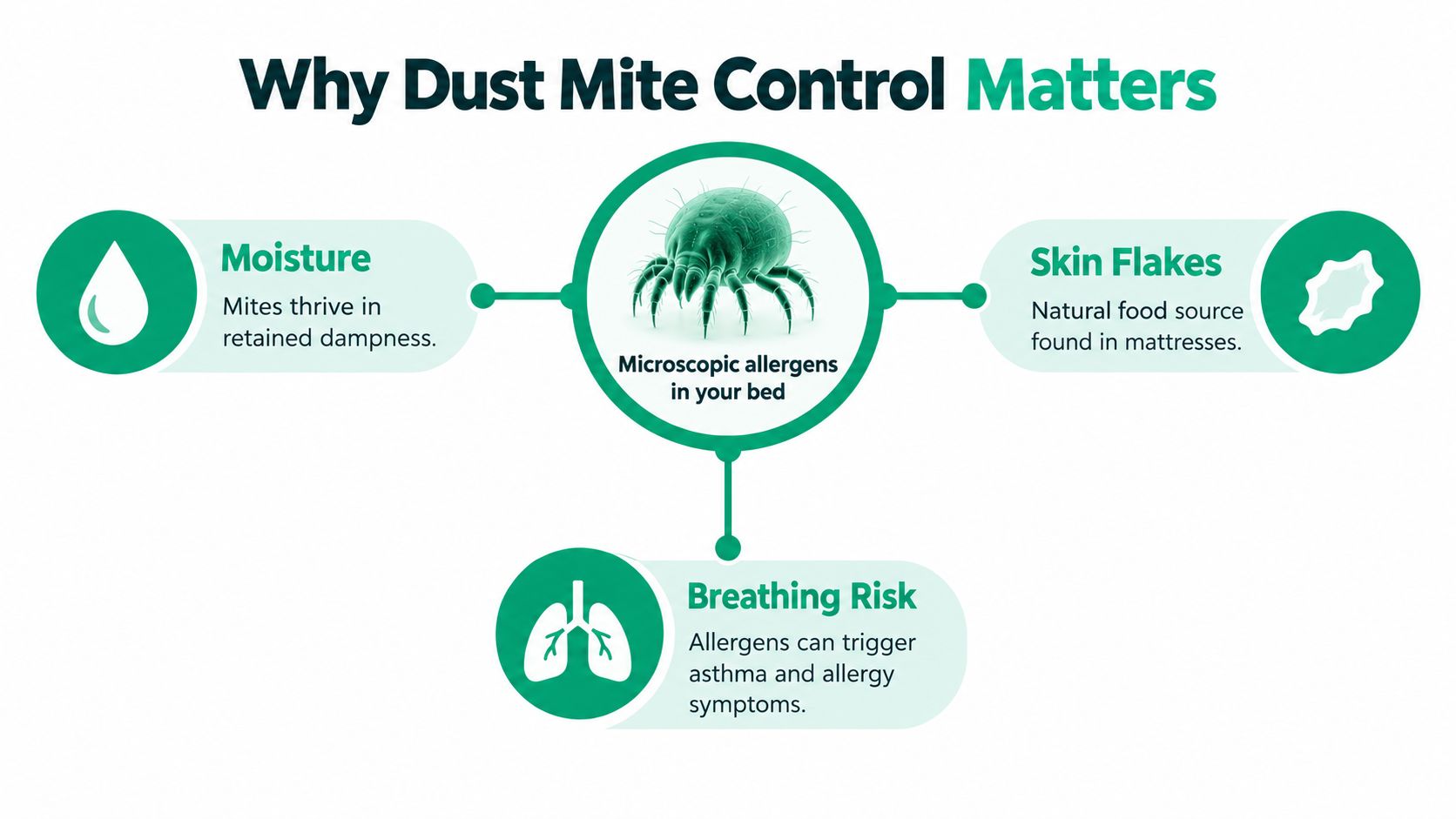
The issue isn't contact with a visible insect. It's the immune response to proteins derived from mites. Sensitisation means the immune system reacts to those proteins. It isn't the same as a diagnosis, and sensitised people don't all experience identical symptoms.
How Big Is the UK Concern
A UK-focused source reports that approximately 20% of the UK population is sensitised to house dust mite allergens, and identifies that sensitisation as a leading contributor to perennial allergic rhinitis and an important driver of asthma, atopic dermatitis and childhood respiratory problems, according to UK pest evidence on house dust mites. Treat that figure as a population indicator, not proof that every sensitised person has diagnosed allergy or asthma.
A fully enclosing cover works by separation. It places a washable physical layer between you and the allergen reservoir inside the mattress. That can reduce exposure from that one source, but it doesn't clean the room or guarantee fewer symptoms.
Think Beyond the Mattress
Pillows and duvets sit close to your face and need their own attention. Carpets can also retain allergen, so a bedroom plan may include cleaning soft furnishings, and some households explore professional rug cleaning for dust mite allergies when ordinary vacuuming isn't enough for a large rug. Practical steps for the wider room are set out in this guide to allergy proofing your bedroom.
That wider view matters because allergen reduction and symptom improvement aren't the same claim. A cover may be shown to contain allergen without clinical proof that it improves every user's asthma, rhinitis or eczema. Keeping those claims separate will help you judge products calmly.
Encasement or Protector
People often use encasement and protector as if they're two names for one product. They aren't. The difference is coverage. A protector usually fits over the top and sides, much like a fitted sheet. An encasement surrounds the whole mattress and closes with a zip or another sealed fastening.
Imagine two buyers. The first wants protection from sweat, drinks and everyday wear on a new mattress. A fitted waterproof protector may suit that job and it's easy to remove for washing. The second is concerned about allergens already retained inside an older mattress. Covering only the upper surface leaves other routes open, so a verified encasement is the more relevant category.
Mattress Encasement and Protector Compared
| Criterion | Allergen-focused encasement | Fitted protector |
|---|---|---|
| Coverage | Encloses the top, sides and underside | Covers mainly the top and sides |
| Allergen control | Designed to contain allergens inside when fully sealed and tested | May reduce surface contact, but doesn't seal the mattress |
| Liquid protection | Depends on the fabric or membrane used | Often designed primarily for spills and sweat |
| Cleaning | Usually less convenient to remove because it fully encloses the mattress | Typically quicker to remove and refit |
| Fit requirements | Needs accurate length, width and depth, plus a secure closure | Needs suitable depth and corner grip |
| Use with other bedding | Sits under a normal sheet and can pair with pillow and duvet encasements | Also sits under a sheet, but shouldn't be mistaken for a full barrier system |
| Bed bug relevance | A specifically designed sealed model can form part of prevention or remediation | An open underside limits containment |
| Main trade-off | More effort to fit and remove | Easier routine care, but incomplete enclosure |
UK NHS guidance supports this distinction. It advises that allergy covers should completely enclose the mattress, be breathable, and have been tested to prevent house dust mite allergen escaping, as explained in NHS guidance on house dust mite allergy covers. That wording gives you a clear test. If a product doesn't fully enclose the mattress, don't judge it as though it does.
There can still be a place for both types. Some households put a washable fitted protector over an encasement to handle frequent spills and reduce how often the encasement must be removed. That's a layering decision, not evidence that the fitted layer alone provides equivalent containment. If you're unsure when to buy a mattress encasement, compare the construction you already own with the job you need it to do. Further category detail is available in this overview of mattress encasements in the UK.
A protector guards the surface. An encasement seals the reservoir. Those are different promises.
Start by naming your priority. For stains, choose liquid resistance and easy laundering. For dust mite allergen, choose verified full enclosure first. For both, confirm that one product delivers both, or consider a deliberate two-layer setup.
Materials Pore Size and Comfort
Barrier fabrics work in different ways. A tightly woven textile restricts particle passage through very small spaces between fibres. A coated or membrane-based fabric adds a continuous layer that can block liquids and particles. Neither route is automatically more comfortable, and a material name alone doesn't prove allergen retention.
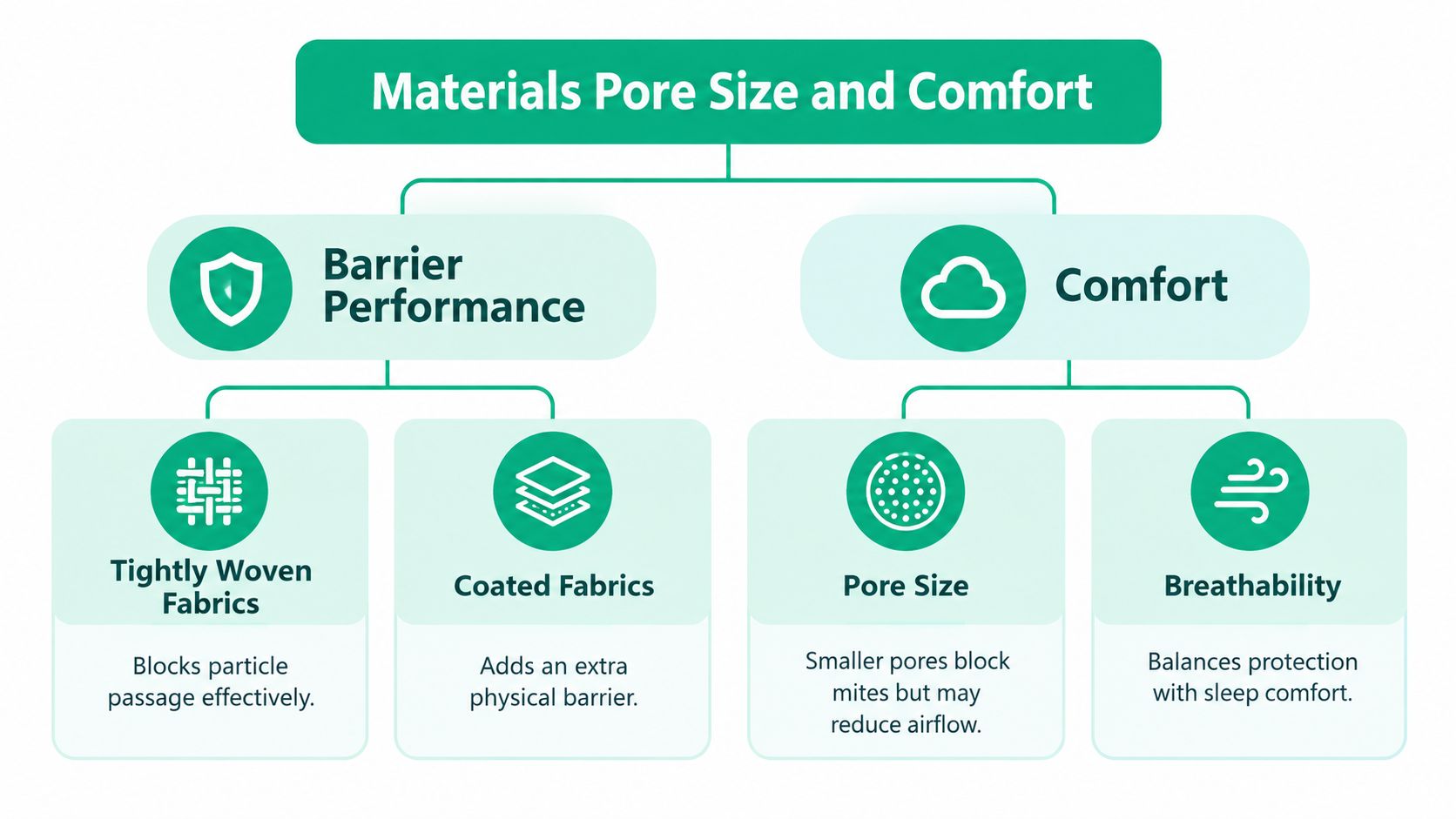
Pore size matters, but it isn't the whole story. Seams, zips, stretch and damage can create weaknesses even when the main fabric performs well. A cover that fits too tightly may strain its closure. A loose cover can bunch, feel noisy and leave fabric folds under the sheet.
Breathability Needs Evidence
Breathable is easy to print and harder to compare. Look for performance information rather than relying on the adjective. The National Eczema Society gives a practical benchmark of a breathable, tested cover carrying a British Standard mark for water permeability and breathability, with an index above 75%, in its guidance on choosing dust mite covers. Use that as a prompt to ask what was measured, not as a reason to ignore fit or enclosure.
Comfort involves more than softness because the cover sits beneath your sheet. Consider these trade-offs:
- Noise: Stiffer coatings may rustle when you turn, especially if the fit is loose.
- Temperature feel: Less vapour movement can feel warm to some sleepers, while a more permeable fabric may feel neutral.
- Stretch and flexibility: Flexible materials follow the mattress surface more closely and can make fitting easier.
- Surface texture: Smooth fabrics may feel less noticeable under a sheet. Textured fabrics can feel more substantial but may alter the mattress feel.
- Seam placement: Bulky seams near the sleeping surface can be distracting for light sleepers.
Waterproof construction has clear value. It can protect against perspiration and spills, which helps mattress hygiene. Still, liquid resistance is not evidence of allergen retention. A membrane might stop water because of its surface properties while the product remains open underneath or untested for allergen escape.
Don't choose by thickness. A thick cover can feel protective yet fit badly or sleep hot. A thin, flexible cover can maintain a continuous barrier if its material, seams and closure are properly designed. The practical balance is documented barrier performance, enough airflow for the sleeper and a fit that stays smooth.
Check Labels Tests and Fit
Read a product page as an inspection, not as advertising. Your task is to identify what the seller has demonstrated. Start with one question. Does this exact model completely enclose the mattress?
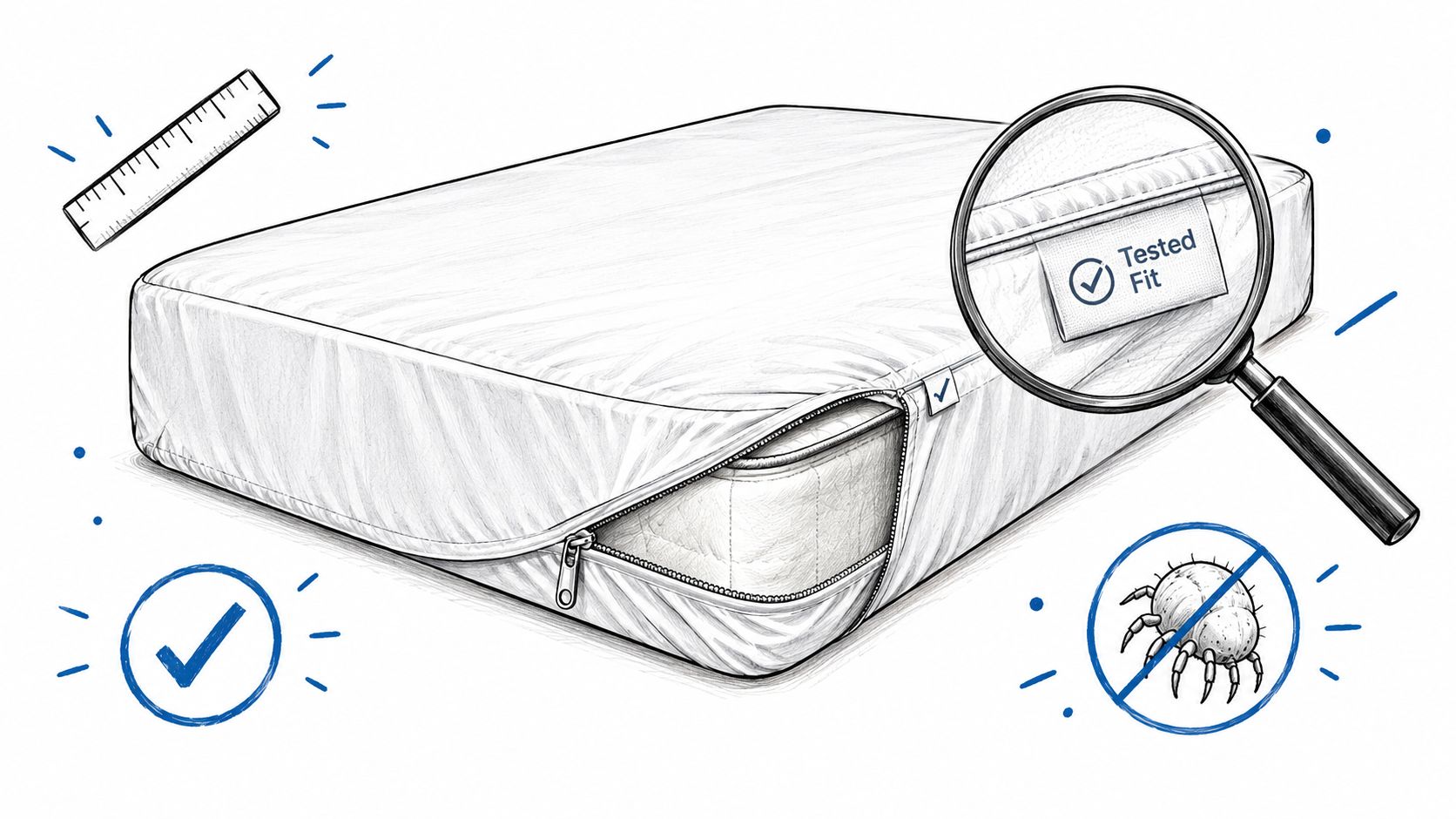
Then work through the claim language carefully.
A Five Minute Label Check
- Find the object of the test. Does it mention allergen retention, mite penetration, water permeability, breathability or liquid resistance? These aren't interchangeable.
- Check full enclosure. Look for a zip or sealed construction covering all sides, not elastic corners alone.
- Inspect closure details. The zip should close fully and stay fastened. Seams should support a continuous barrier.
- Measure depth. Measure the mattress itself, including any fixed topper that'll remain inside, and compare all dimensions with the size chart.
- Read care instructions. Confirm wash temperature, detergents, drying method and any products to avoid.
- Review warranty exclusions. Check whether seams, zips, membrane failure and incorrect washing are covered.
Words such as anti-allergy, hypoallergenic and non-allergenic don't replace those checks. A filling described as non-allergenic may still allow mites to live in bedding. The important point is whether the item is enclosed and tested to prevent allergen escape.
Evidence also needs careful reading. In a trial involving 1,122 adults with asthma, allergen-impermeable covers produced a mattress dust Der p 1 concentration of 0.58 micrograms per gram versus 1.71 with non-impermeable covers at six months, but the difference wasn't statistically significant at 12 months, and covers alone appeared clinically ineffective, according to the UKHSA record of the allergen impermeable bed cover study. That doesn't make barrier performance irrelevant. It means you shouldn't convert a short-term allergen measurement into a guaranteed clinical outcome.
Use named technologies the same way. For example, Protect-A-Bed models based on Miracle Membrane are described as flexible, silent and thin while blocking dust mites, allergens, liquids and sweat. Assess the individual product against the criteria above. Confirm that the specific UK model fully encloses your mattress, identify its stated test or standard and check that its depth and care instructions suit your intended use.
Cleaning and Allergen Control
A barrier only works while it remains intact and correctly fitted. Cleaning isn't an afterthought. It's part of the product's performance, because damaged seams, a partly open zip or a misshapen cover can undermine the enclosure.
Follow the manufacturer's instructions for the encasement rather than copying a routine from ordinary bedding. Some membranes and coatings have limits on temperature or drying. Wash compatible sheets and pillowcases separately, clean the encasement as directed, dry it fully and check the zip and seams before refitting it.
Build a Sustainable Routine
- Fit it once, properly: Smooth the cover, close it completely and make sure the closure isn't strained.
- Protect pillows and duvet: Cover them separately where allergen control is the goal.
- Wash non-encased bedding: Use the temperature and method the fabric allows, following care labels.
- Dry before refitting: Trapped dampness works against bedding hygiene.
- Inspect wear: Look for seam gaps, damaged coating, broken zip teeth and thinning fabric.
- Clean the room: Address carpets, upholstered items and other reservoirs as part of the same plan.
Cambridge University Hospitals describes a breathable, fully enclosing barrier cover as the single most effective bedroom measure, but says it isn't sufficient alone and advises washing non-encased bedding at 60°C while also addressing pillows and duvets, a point already linked in the materials discussion above. That qualification is useful. It tells you to judge the system, not just the mattress layer.
For day-to-day timing, this advice on how often to wash a mattress protector can help you distinguish a frequently washed surface protector from a fully enclosing cover that needs more careful handling. Large settings may also need specialist processes, so operators comparing external services can find mattress cleaning for resorts as part of a broader room hygiene programme.
An encasement used for bed bugs has a different purpose. A specifically designed sealed model can help contain insects and support a wider treatment plan, but it isn't a stand-alone remediation method. Likewise, no mattress cover repairs leaking pipework, condensation or poor ventilation.
Housing context explains why that boundary matters. The English Housing Survey reported that in 2023, 5% of dwellings, approximately 1.3 million homes, had a damp problem, while 29% of households reported condensation, damp or mould, according to English Housing Survey findings on housing quality. Private renters reported higher rates than owner occupiers. A washable barrier can support bedding hygiene, but building defects and humidity still need separate action.
Which Cover Fits Your Situation
There's no universal winner because the cost of a wrong compromise differs by household. Match the construction to the exposure source, the sleeper and the care routine that'll realistically happen.
Adults Managing Asthma or Rhinitis
Prioritise verified full enclosure, breathable construction, a secure closure and care instructions you can follow consistently. Don't let waterproof wording distract from allergen testing. Also plan for pillows and duvet, because sealing only the mattress leaves nearby reservoirs unchanged.
Set expectations carefully. A separate UK study in mite-sensitive asthmatic children found vapour-permeable waterproof encasement contributed to a 53% median mattress allergen reduction in the comparison group and a 100% reduction when combined with active treatment by six weeks, as summarised in the UKHSA-linked study record cited earlier. Those figures concern mattress allergen, not a promise that any individual will become symptom free. They support a combined approach rather than a one product cure.
Children and Caregivers
A child's bed often needs allergen control and liquid protection at the same time. Choose a correctly sized encasement that doesn't bunch, add separate protection for the pillow and duvet where appropriate and consider a washable surface layer for frequent accidents. Ease of change matters, especially at night.
For eczema, breathability deserves particular attention. A cover that's technically impressive but feels hot or noisy may be removed, and an unused barrier provides no separation. Comfort is therefore part of effectiveness, not a cosmetic extra.
Hotels Care Homes and Rental Properties
Multi-occupancy settings need consistency. Managers should compare size standardisation, installation time, staff training, washing durability, inspection routines and replacement procedures. A slightly easier fitting process can matter when the same task is repeated across many rooms.
Operational rule: Specify the cover, the inspection interval and the replacement trigger together. A barrier without a maintenance owner will drift out of use.
For landlords, document mattress depth and condition before fitting. For care settings, align laundering with infection control procedures and the manufacturer's limits. For hospitality, keep spare sizes available so staff don't substitute an ill-fitting protector and call it equivalent.
Final Dust Mite Cover Checklist
Use this sequence while shopping. Stop at any point where the answer is unclear and ask the seller for specifics before you compare prices.
- Confirm full enclosure: The cover surrounds the whole mattress, not just the sleeping surface.
- Identify the test: The claim states whether it concerns allergen retention, mite penetration, breathability, water permeability or liquids.
- Check breathability evidence: Performance information supports the word breathable.
- Measure accurately: Length, width and depth leave enough room without straining the closure.
- Examine seams and zip: Construction maintains a continuous barrier and stays closed during use.
- Match the care routine: Washing and drying instructions fit your home or organisation.
- Judge comfort: Noise, stretch, flexibility and temperature feel suit the sleeper.
- Read the warranty: Terms cover relevant defects and explain exclusions clearly.
- Decide the system: You know whether you need mattress protection only or coordinated pillow and duvet covers too.
The strongest choice isn't necessarily the thickest fabric or highest price. For allergy-focused buying, the best dust mite mattress cover is the one that maintains a verifiable, breathable and washable barrier around the entire mattress. It should fit properly, remain comfortable enough for nightly use and sit within a sustained routine of bedding care, cleaning and humidity control.
Keep the three claims separate in your mind. Waterproof describes liquid behaviour. Allergen impermeable describes containment. Clinically effective requires outcome evidence. When a product page respects those boundaries, you can compare it with confidence. When it blends them into one broad promise, slow down and inspect the construction and test wording.
If you're ready to compare fully enclosing mattress protection, pillow protectors and waterproof options for home or multi-occupancy use, visit Protect-A-Bed to check sizes, membrane details, care instructions and warranty terms against the checklist above.