

Anti Dust Mite Mattress Protector UK: What Actually Helps

The most popular advice you'll hear is simple. Buy a hypoallergenic cover, zip it on, and your dust mite problem is solved. That advice is too simple, and it's why so many people feel let down a month later when they still wake blocked up, itchy, or coughing. A cover can help, but only if it's the right kind of cover, fitted properly, washed properly, and used as part of a wider bedroom routine. A loose waterproof sheet with a friendly allergy claim on the packet isn't the same thing as a tested barrier that encloses the whole mattress.
The scale of the issue explains why people look for help in the bedroom first. UK government guidance on asthma and airborne allergens estimates that about 1 to 2% of people are sensitive to dust mites in the general population, but the proportion rises to approximately 20 to 70% among people with respiratory conditions, and around 7.2 million people in the UK have asthma. Those figures don't prove that any one product prevents attacks or cures symptoms. They do show why an anti dust mite mattress protector UK shoppers can wash, fit, and keep closed is worth understanding properly before you spend money.
Table of Contents
- How an Anti Dust Mite Protector Works and Whether It Helps
- Protector, Encasement or Allergen Barrier Compared
- Fabric and Membrane Choices Compared
- Buying Checklist and Fitting Steps
- Washing and Caring for the Barrier
- What a Protector Cannot Fix and Who Needs More
How an Anti Dust Mite Protector Works and Whether It Helps
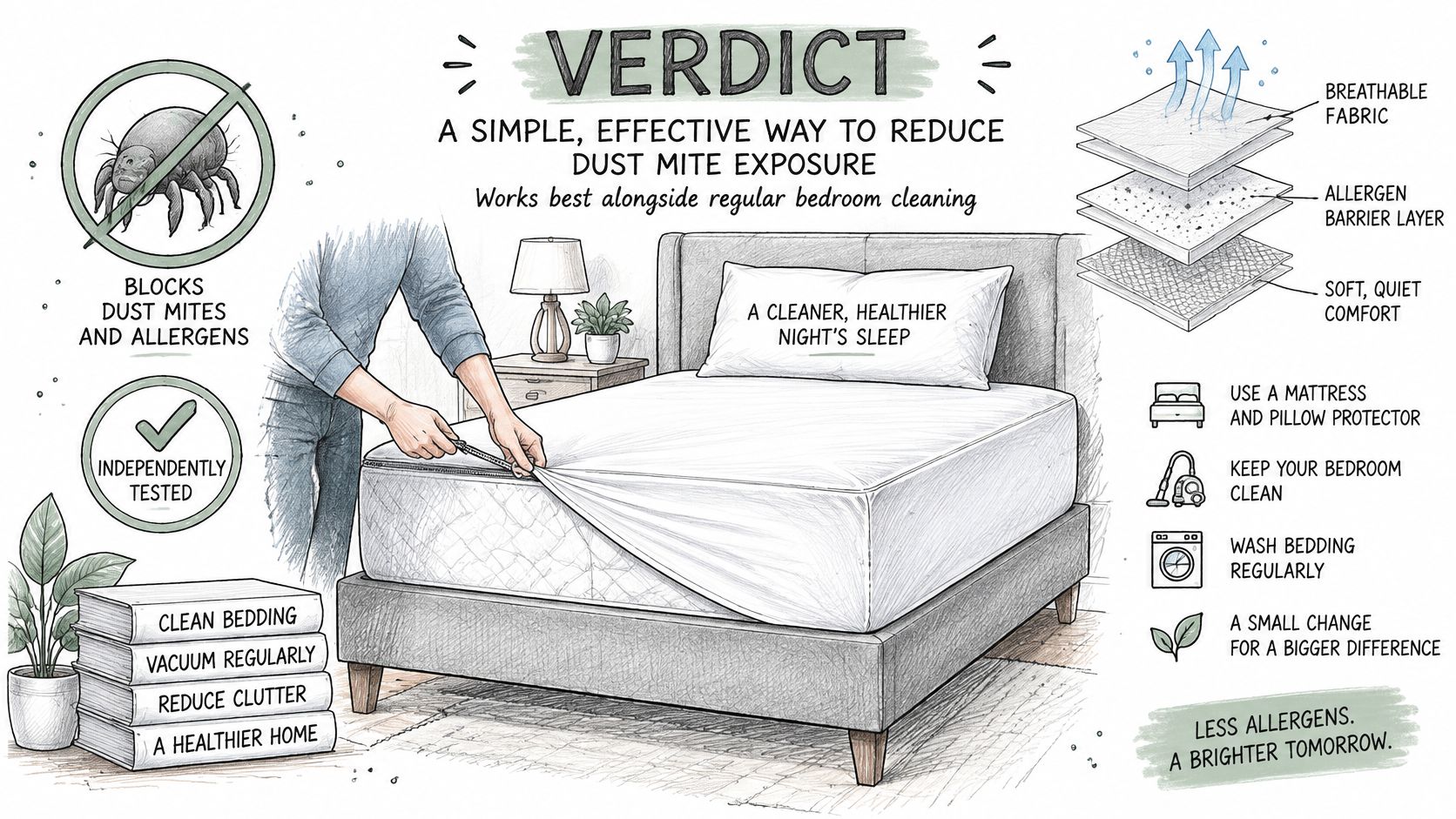
A fully enclosing, breathable, tested allergen barrier is the most useful single cover you can put on a mattress, but it won't work on its own. That's the plain verdict, and everything else follows from it. Cambridge University Hospitals NHS guidance on dust mites in your home identifies a fully enclosing, allergen-barrier mattress cover as the single most effective individual measure for reducing house dust mite exposure in the bedroom, while also stating that it's insufficient on its own.
Why the mattress matters so much
Dust mites live where people rest for hours at a time. They feed on tiny flakes of skin that settle into mattresses, pillows, and bedding, and they thrive in the warmth and moisture a sleeper leaves behind each night. The mites themselves don't bite you. The problem for sensitive people is the allergen in their droppings and body fragments, which builds up inside soft materials and can become airborne when you turn over, shake a duvet, or strip the bed.
Your face sits close to that material for a long, unbroken stretch. That's why symptoms often feel worst during the night or first thing in the morning, and why the mattress is a sensible first target rather than a minor detail. A clean looking bed can still hold allergen deep inside it, because ordinary sheet changes don't reach what's already settled into the mattress core.
What the barrier actually does
Think of a genuine barrier as a very fine, closed filter wrapped around the mattress. The fabric or membrane has to stop mites and allergen particles passing through, and the cover has to enclose the mattress completely so material inside can't escape at the sides or underneath while you sleep. Containment is the mechanism. You're separating the sleeper from an existing reservoir, and you're also slowing fresh skin flakes and dust from working their way in.
A cover that only sits on top can protect the surface. It can't claim the same job as a cover that closes around the whole mattress.
Breathability is the part buyers often misunderstand. Breathable doesn't mean leaky, and waterproof doesn't have to mean sweaty. Body moisture needs to pass through the cover as vapour rather than pooling inside it. If moisture gets trapped, the inside of the cover can become humid, uncomfortable, and more favourable to microbial growth, which works against the reason you bought it.
As a concrete construction example, our Miracle Membrane blocks dust mites, allergens, liquids and sweat from penetrating the bed, and our Mattress Protector protects against dust mites because that membrane does not let dust mite feces penetrate it. The buying test is the same whoever makes the cover. Look for complete enclosure, a construction described as breathable, and test evidence that it prevents dust mite allergen escape, then keep it closed under your ordinary bedding and keep washing the outer sheets. For an allergy or asthma household, that combination is worth buying. A generic sheet that merely sounds protective is a different purchase.
Protector, Encasement or Allergen Barrier Compared
A protector, an encasement and an allergen barrier do different jobs. The right choice depends on whether you need to guard the sleeping surface, enclose the whole mattress or block allergens from passing through the cover.
| Cover type | Fully encloses mattress | Liquid protection | Mite and allergen barrier | Best for |
|---|---|---|---|---|
| Waterproof top protector | No, sits on top and leaves sides open | Yes | Partial, membrane dependent | Spills, sweat, everyday cover |
| Full zip encasement | Yes, closes on all sides | Yes | Yes, when sealed and tested | Allergy, asthma, bed bugs |
| Tested anti-dust-mite barrier cover | Yes, when fully enclosing | Check label | Yes, with test evidence | Allergy households wanting a tested seal |
Reading each row in practice
A waterproof top protector is a fitted cover for the sleeping surface. It helps guard against drinks, children's accidents and sweat, and is usually straightforward to remove for washing. Since the sides and underside remain open, it cannot fully contain material already inside the mattress. For dust mite concerns, treat it as surface protection, not as a complete barrier.
A full zip encasement surrounds the mattress on every side. Its closure matters because a barrier fabric cannot prevent escape through an open gap. Protect-A-Bed's Mattress Encasement uses patented BugLock (US Patent 7,552,489) with a three-sided zipper and AllerZip seal, and protects against dust mites, allergens and bed bugs. The guide to choosing a mattress encasement in the UK explains the fitting and closure considerations for this type of cover.
A tested anti-dust-mite barrier cover is identified by evidence as well as shape. A full enclosure helps contain the mattress, while test evidence indicates whether allergens can pass through the fabric, seams and closure in normal use. Waterproofing is a separate feature: some barrier covers resist liquids, while others do not. Check the product details, since the word hypoallergenic alone does not establish either claim.
Bed bugs and dust mites also call for different decisions. A standard Mattress Protector does not prevent bed bugs, even when its membrane provides useful waterproof protection. A sealed encasement is designed for that separate purpose, with a closure intended to keep insects from entering or escaping.
Care after fitting
Once you have chosen a cover, follow its care instructions and inspect the seams and zip after washing. A split seam or damaged closure can reopen a route through the barrier, so check that the cover remains intact before putting it back on the mattress.
Choose an encasement or tested barrier when dust mite allergy or asthma is the reason for buying. Choose a waterproof top protector when spills and sweat are the main concern, and match the product's stated features to the job you need it to do.
Fabric and Membrane Choices Compared
A protector does two jobs with two different layers, and confusing those layers causes most disappointing purchases. The top fabric governs feel, drape, and how cool the surface seems against your skin. The membrane underneath governs liquid resistance and, in a barrier product, whether particles can pass through. A lovely soft top can't compensate for a membrane that traps vapour, and a strong membrane won't feel comfortable if the surface fabric is noisy or clammy.
| Fabric | Feel and breathability | Cooling | Care | Best for |
|---|---|---|---|---|
| Cotton | Soft and familiar, breathable but can hold warmth | Moderate, warmer than smooth lyocell | Hot wash, check label | Everyday use and first-time buyers |
| Tencel (lyocell) | Smooth, moisture-absorbing and breathable | Often cooler, construction dependent | Check label | Hot sleepers |
| Bamboo blend | Soft and drapes well | Moderate, similar to cotton blends | Check label | Buyers wanting a soft drape |
| Polyester membrane with washable top | Thin, quiet waterproof layer, breathability varies by build | Low to moderate, membrane dependent | Machine washable | Spills and children's beds |
The trade-off hidden in the table
Cotton feels familiar because many sleepers already use cotton sheets. It breathes reasonably well and tolerates straightforward washing, though it can hold warmth and dry more slowly than smoother technical fibres. For a first purchase in a spare room or a child's bed, that familiarity is a sensible, low risk starting point.
Tencel, which is a lyocell fibre, usually feels smoother and absorbs moisture away from the surface efficiently. Hot sleepers often prefer that cooler first touch. Bamboo blends also feel soft and drape closely over the mattress, which some people find less stiff, but the word bamboo describes the surface fibre rather than the barrier performance underneath it.
Vapour test: A good construction blocks liquid coming down while letting water vapour escape upward. If vapour can't escape, you feel the result as heat and clamminess, whatever the surface fabric promises.
That test explains the plasticky reputation older protectors earned. A thin membrane can be quiet and flexible, yet still sleep warm if it's dense and the top layer can't move vapour away quickly enough. The opposite mistake also happens. A soft, airy top fabric feels breathable in your hand in a shop, but once it's laminated to a heavy waterproof layer, the finished product can hold heat through the night. Judge the whole construction, not the top layer alone.
Cooling claims deserve the same caution. A Tencel type surface may well suit a warm sleeper better than cotton, but no fabric cancels out a hot room, a thick winter duvet, or a bedroom that never gets aired. If you regularly wake sweating, prioritise a membrane clearly described as breathable and pair it with lighter bedding before blaming the protector alone.
For families dealing with night time drinks, illness, or toilet training, practicality wins. A waterproof membrane with a washable top you can clean and dry quickly will serve you better than a delicate premium surface you're afraid to wash often. Choose the fabric for how you sleep, whether that's hot, cold, sensitive skinned, or spill prone, then confirm the membrane is breathable before you pay. Comfort isn't a luxury extra here. A cover you dislike gets removed, and a removed barrier protects nobody.
Buying Checklist and Fitting Steps
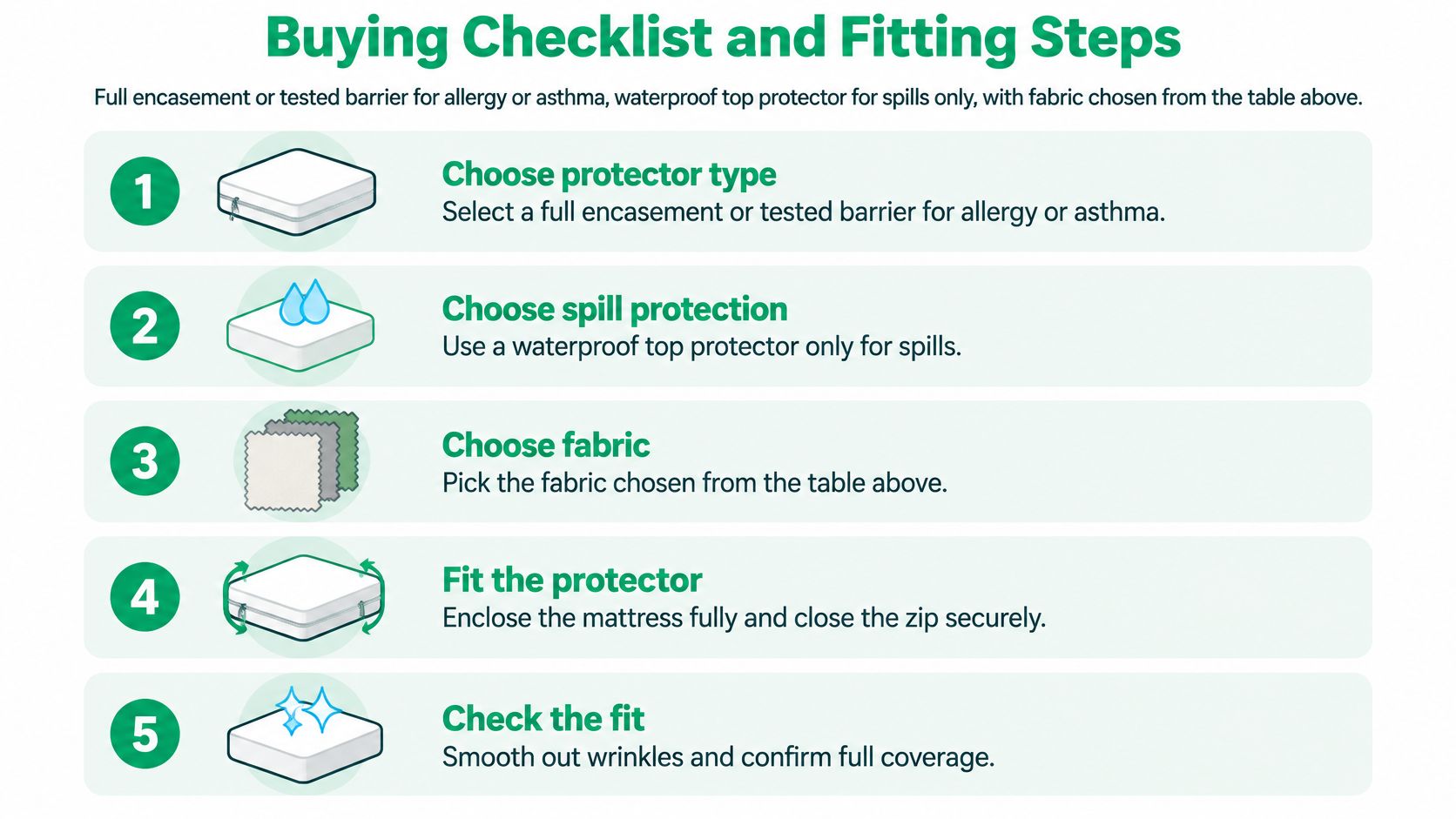
A waterproof sheet and an allergen barrier are not interchangeable. Before choosing a fabric or colour, decide what the protector needs to do: contain allergens around the mattress, shield the top surface from spills, or provide both kinds of protection. Then check the size, practical details and care terms. The checklist below focuses on fit and use, leaving barrier construction and test evidence to the earlier comparison.
The buyer checklist in order
- Measure depth, length and width: Use a tape measure across the mattress, including any topper that will sit inside the cover. Check the depth at the centre and near a corner. A cover that is too shallow may not close around a deep mattress, while forcing it can strain the zip.
- Check the fit for your mattress: Compare your measurements with the product's stated size and depth range. This matters particularly for deep mattresses, toppers and non-standard beds. If you are between sizes or buying for a split bed, check the exchange terms before ordering.
- Consider day-to-day use: Check whether the fabric and construction suit how you sleep and how often you expect to wash the cover. A protector that is awkward to fit or uncomfortable to sleep on is less likely to stay in use. Keep the care label available so you can follow its instructions.
- Read the warranty and guarantee terms: Check the stated period, what kinds of fault are covered, and whether proof of purchase is required. These terms can differ between a product warranty and an anti-stain guarantee, so read the wording for the specific item rather than assuming one applies to every protector.
- Check delivery and returns: If the bed is in nightly use, a size exchange may leave it without a cover while the replacement is arranged. Confirm the returns process before ordering, especially for a split or non-standard bed.
The National Bed Federation summary of its 2024 Censuswide survey of 1,000 adults reports a mean price of £595 paid for a new mattress or bed in the UK, with 76% of buyers spending up to £799. A protector is a smaller purchase beside that outlay, but it only serves its purpose if it fits the mattress you own, not merely the size on an old label.
Fitting it so the seal can work
- Strip and vacuum: Remove the bedding, then vacuum the mattress top and sides with an upholstery attachment. This clears loose dust from the surface before the cover goes on. It is not a deep clean of the mattress core.
- Place it on the bare mattress: Lay or slide the protector over the mattress, with no sheet or other bedding underneath. Line up the corners before closing it. A second person can make the job easier on a larger mattress.
- Close it fully: Zip the cover to its end stop, or check that each edge is closed as designed. Run a finger along the closure to feel for a trapped sheet, label or fold. Even a small fold can stop the cover sitting flat.
- Dress the bed over the top: Put the sheet, duvet and pillowcases outside the protector. Anything tucked underneath it sits on the mattress side of the barrier, rather than above it.
- Inspect after fitting: Check the corners, seams and closure for strain, splits or thinning. If damage means the cover no longer closes properly, it may no longer provide the intended separation.
A cover that is too large can bunch and crease beneath the sheet. One that is too small pulls at the closure as you move.
For a deep or heavy mattress, fit the cover while the mattress is on the bed base rather than dragging it across the floor, where grit may damage the fabric. Smooth out folds as you close the final section. Once the cover is fitted, keep it closed during ordinary use. Open it for washing, inspection or replacement, rather than repeatedly lifting it to check underneath.
Washing and Caring for the Barrier
Temperature is the detail that turns laundry from freshening up into actual mite control. The table below separates the barrier itself from the bedding outside it, because they need different rhythms.
| Item | Wash | How often | Drying |
|---|---|---|---|
| Mattress protector | First wash before use, then follow label | Per label, usually every few months | Air dry or low tumble until fully dry |
| Pillow protector | Follow label | Every few months | Fully dry before use |
| Sheets and duvet cover | 60°C | Weekly | Tumble or air dry until fully dry |
Why 60°C matters for the outer layers
Asthma and Lung UK guidance on indoor air at home advises washing bedding at 60°C, a temperature stated to kill dust mites, alongside lowering household humidity through ventilation and using allergen proof barriers on mattresses and pillows. A cooler wash can rinse away some allergen and leave bedding smelling clean, but it may leave mites alive to keep producing more. Clean smelling and mite controlled aren't the same outcome.
Our protectors follow a specific first step. Mattress protectors and pillow protectors should be washed before first use because the fabric is starched for cutting during production, and that first wash also removes the stiffness new fabric carries. After that, the care label governs temperature and drying for the membrane, and our detailed guide to how often you should wash a mattress protector walks through the intervals for different households. Don't improvise a boil wash on a membrane product to chase extra hygiene. You'll shorten the barrier's life while the sheets above it were the layer that needed the heat.
Moisture habits that support the wash routine
- Air the bed on waking: Pull the duvet back for a while instead of making the bed straight away, so night time moisture can leave the bedding.
- Ventilate daily: Open a bedroom window or use trickle vents, even briefly in winter, to stop humid air sitting around the bed.
- Keep laundry out: Avoid drying washing on radiators in the bedroom where you can, since it loads the air with moisture mites favour.
- Dry fully before refitting: A protector put back on even slightly damp traps that moisture against the mattress.
Set two reminders and the system mostly runs itself. A weekly reminder covers the hot wash for sheets and duvet covers. A monthly reminder covers a quick check of zip, seams, and fit while you're changing the bed anyway, so a small split gets caught before it becomes an open route for allergen.
What a Protector Cannot Fix and Who Needs More
Say a parent fits a good encasement because their child wakes coughing. The mattress is now sealed, but the child's pillow has no protector, the carpet beside the bed holds dust, and a row of soft toys sits against the pillow all night. The cover has done its job on one surface. Exposure continues from everything around it, and that gap, not a faulty product, explains the unchanged mornings.
A renter with damp walls faces a different limit. The English Housing Survey 2023 to 2024 on drivers and impacts of housing quality recorded damp problems in 1.3 million dwellings, 5% of all dwellings surveyed. A breathable, liquid resistant cover can keep sweat and spills out of a mattress, but it can't correct structural damp, failed ventilation, or mould on a wall. Persistent condensation or visible mould needs action from a landlord or local housing team, not another bedding purchase.
An adult with allergic rhinitis can miss the same point in a smaller way. Sealing the mattress while sleeping on an unprotected pillow, under an unwashed duvet, leaves the breathing zone exposed where it matters most. Pillows and duvets need their own covers, carpets and upholstery need regular vacuuming, and dust mites cannot be avoided completely however thorough you are. Our overview of dust mite allergy prevention across the whole bedroom covers how those layers fit together beyond the mattress itself.
Prescribed treatment comes before bedding decisions. If breathlessness or wheezing is worsening, or symptoms persist despite a sensible routine, seek medical advice promptly rather than upgrading covers and hoping. A protector is one layer alongside pillow protection, hot washing, ventilation, and the treatment you already use.
Two practical checks close the remaining gaps. In winter, lift a corner of the cover after a week and look for a damp patch or musty smell. If you find one, air the mattress, ventilate the room, use an extractor fan where one's fitted, keep washing off radiators, and run heating steadily instead of hard overnight. For overheating, choose a breathable membrane with a lighter top fabric, and don't stack a thick duvet on a plastic feeling cover and blame the cover alone.
If you're ready to put a tested, breathable barrier on your own bed, we offer fully enclosing encasements with sealed zips alongside washable waterproof protectors for spill prone households, so you can match the cover to the job rather than guessing. Measure your mattress depth, choose the enclosure and fabric that fit how you sleep, and visit Protect-A-Bed to compare sizes and order the right cover for your bedroom routine.