

Waterproof Mattress Protector Terry Towelling: A Guide

You strip the sheets after a child's accident, a sweaty night, or a spilled drink and find the mattress beneath has escaped the worst of it. The protector feels soft and slightly textured, yet the question remains: is a waterproof mattress protector with terry towelling actually protecting the mattress, or merely making the bed feel more comfortable?
The answer depends on construction. Terry towelling provides the absorbent surface your body touches, while a separate waterproof membrane stops liquid moving through to the mattress. Those jobs work together, but they aren't the same job. A protector can be excellent at handling spills and still fall short of the fully enclosed, tested barrier required for serious dust-mite management.
Table of Contents
- Understanding Waterproof Mattress Protector Terry Towelling
- Terry Towelling Versus Modern Fabric Alternatives
- Evaluating Breathability And Heat Management
- The Allergen Barrier Reality Check
- Care Requirements And Long-Term Durability
- Choosing The Right Protector For Your Household
Understanding Waterproof Mattress Protector Terry Towelling
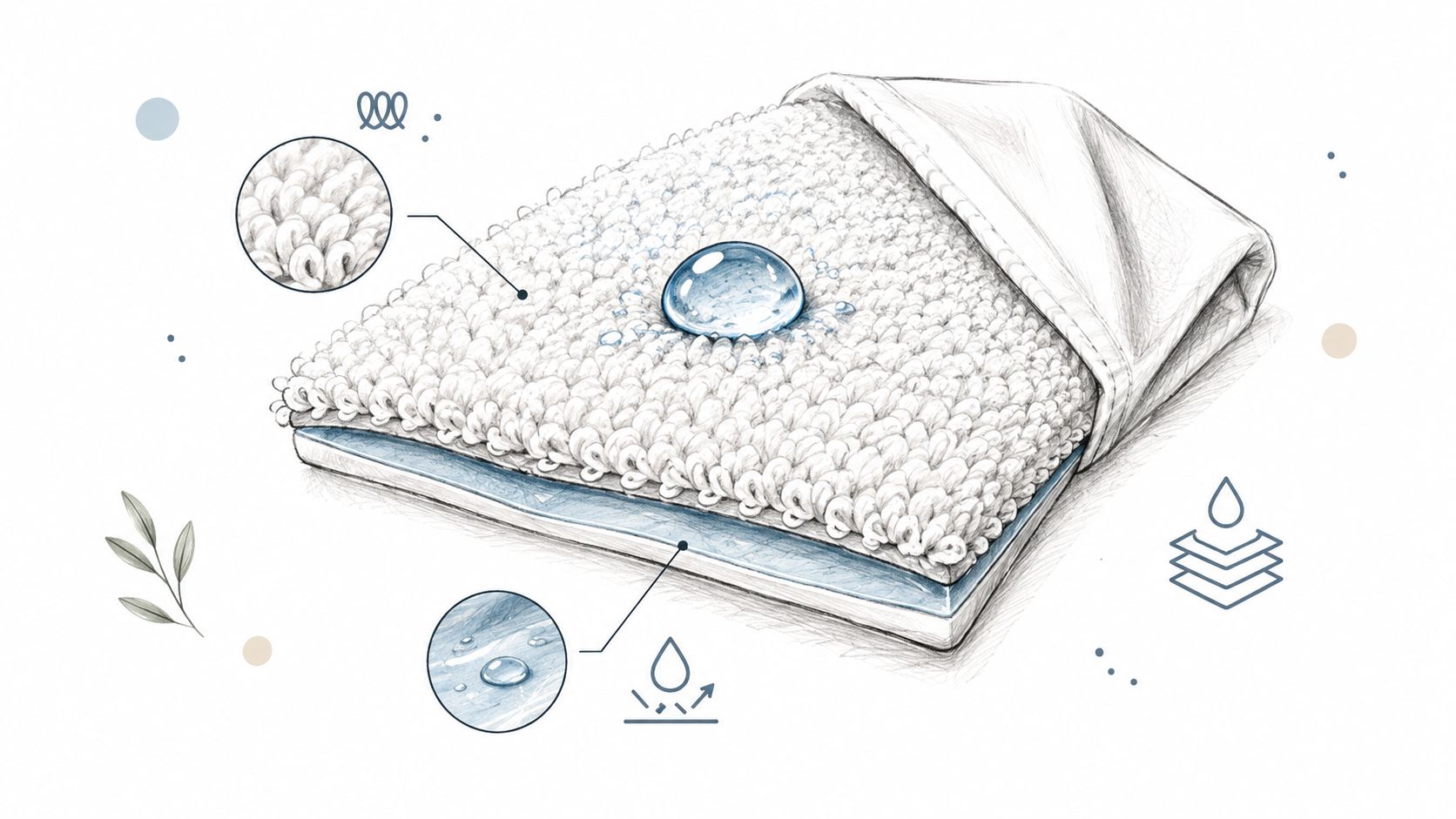
A waterproof terry-towelling mattress protector is best understood as a layered system rather than a single fabric. The upper surface uses looped yarns, often a cotton-rich or polycotton terry, to create a soft, absorbent contact layer. Beneath it sits a continuous waterproof backing, commonly polyurethane or another polymer film, which provides the liquid barrier.
That distinction matters during an ordinary night. Perspiration or a small spill first meets the terry loops, which can take up moisture and reduce the clammy feel of a smooth plastic-like surface. The backing then prevents that moisture from reaching the mattress. Terry towelling doesn't make the protector waterproof by itself. The membrane does the waterproofing; the terry surface manages contact, comfort and initial absorption.
What the layers need to achieve
A useful protector has to solve several household problems at once:
- Liquid control: The backing should cover the mattress-facing area continuously, with construction that limits leakage at edges and seams.
- Contact comfort: Looped terry gives the surface more texture and softness than a bare film.
- Secure fit: Elasticated edges or a suitable fitted depth stop the protector from shifting and exposing the mattress.
- Repeatable care: The fabric and membrane must tolerate the washing routine stated on the care label.
A documented UK retail specification illustrates the engineering principle. It uses a 70/30 polycotton terry surface at 135 GSM with 100% polyurethane backing, combining looped fibres with a continuous polymer barrier, as shown in this UK terry-towelling protector specification. A different listing uses a 50/50 polyester-cotton terry with 100% PEVA backing, so the word “terry” doesn't identify one universal construction.
That's why a product description should tell you more than “waterproof”. Check the fibre blend, backing polymer, fitted depth, coverage and washing instructions. For a broader explanation of how liquid protection works, see this guide to waterproof mattress protector construction.
Practical rule: Treat terry towelling as the comfort and absorbency layer. Judge waterproof performance by the membrane, seams, coverage and how those features survive laundering.
The right choice also depends on what you're trying to protect against. For children's accidents and everyday perspiration, a fitted terry protector can be convenient and comfortable. For a diagnosed dust-mite allergy, however, a conventional fitted protector may not enclose the mattress sufficiently. Liquid resistance and allergen containment need separate checks.
Terry Towelling Versus Modern Fabric Alternatives
Fabric choice changes the feel of the bed, but it also changes how moisture moves across the surface and how the protector behaves after repeated handling. A looped terry construction has raised yarns that create extra surface area and a degree of cushioning. Smooth fibres and knitted structures behave differently under the same pressure.
How the constructions differ
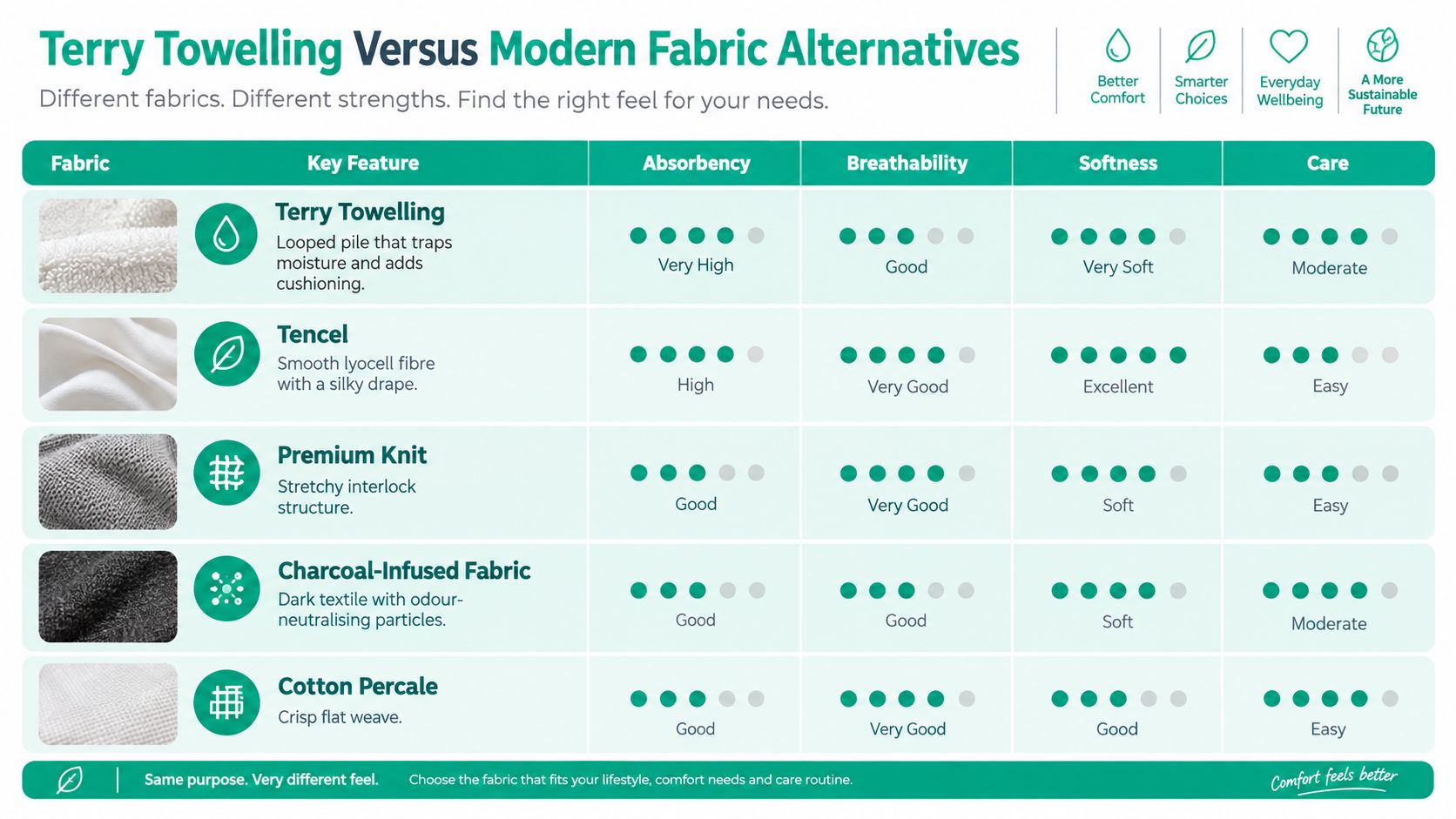
Terry towelling uses loops that can hold minor moisture before it meets the membrane. That makes it practical for perspiration and small accidents, and the pile gives the surface a familiar towel-like softness. The trade-off is bulk and a greater risk of feeling warm if the backing doesn't allow adequate air and vapour movement.
Tencel, usually referring to lyocell fibre, has a smooth surface and a softer drape. It can feel less textured than terry and may suit sleepers who dislike a towel-like hand. Its performance still depends on the waterproof layer beneath it, so a smooth, moisture-managing face doesn't automatically make the whole protector breathable.
Premium knit constructions stretch and conform around the mattress more readily than a stable woven surface. That can improve fit and reduce movement, particularly on mattresses with rounded corners or deeper profiles. The same flexibility can make dimensional stability and edge construction more important, because a protector that stretches excessively may shift during use.
Charcoal-infused fabrics add particles or treatment to the textile rather than changing the basic function of the waterproof membrane. They may appeal to households concerned about odour management, but the surface treatment shouldn't be confused with liquid protection or verified allergen containment.
Cotton percale has a crisp, flat woven structure. It feels cooler and less plush than terry to many sleepers, but it absorbs and cushions differently because it lacks the raised loops. Where softness and initial moisture uptake matter most, terry has an advantage. Where a flatter, drier hand is preferred, percale may feel more comfortable.
| Surface option | Construction effect | Main strength | Main trade-off |
|---|---|---|---|
| Terry towelling | Raised loops with a larger effective surface area | Absorbency and cushioning | Can feel warmer or bulkier |
| Tencel | Smooth lyocell-style fibre surface | Soft drape and low-texture feel | Depends heavily on membrane performance |
| Premium knit | Stretchable interlock-style structure | Flexible fit and tactile softness | Needs stable sizing and strong edging |
| Charcoal-infused | Textile combined with odour-focused particles | Different surface treatment for odour concerns | Doesn't replace a liquid barrier |
| Cotton percale | Crisp, flat weave | Light, smooth contact feel | Less cushioning and surface moisture holding |
What performs under pressure
The membrane remains the controlling component when a sleeper lies on the protector or when a wet area is compressed. Terry loops can hold fluid temporarily, but pressure can push that fluid towards weak seams or an incomplete backing. This is why a higher-quality comparison should ask for liquid-penetration or hydrostatic-pressure results after repeated laundering, rather than relying on a “100% waterproof” label.
Fibre choice also affects noise and tactile response. A flexible PU layer can feel quieter than a stiff plastic film, while the textile face masks some of the membrane's sensation. A terry surface can soften the experience, but it won't correct a membrane that traps heat or a fitted skirt that rides up.
For a more detailed look at smooth fibres and protector construction, this Tencel mattress protector guide is useful. The practical conclusion is simple: choose the surface for contact comfort and moisture handling, then inspect the barrier as its own engineering component.
Evaluating Breathability And Heat Management
A protector can feel cool when you first lie down and still become uncomfortable later in the night. Initial touch reflects the textile surface. Overnight heat depends more on the membrane, the bedding above it, room conditions, sleeper behaviour and whether moisture vapour can move away from the body.
Terry towelling has a useful role because its loops create space for small amounts of moisture. That can reduce the immediate wet sensation after perspiration. It also adds material between the sleeper and the membrane, which may feel warmer than a thin, smooth surface if the construction is dense or the bedding is already heavy.
Compare the whole system, not just the face fabric
A practical comparison looks like this:
- Terry towelling: Good for absorbency and a softly cushioned hand. It's a sensible choice where spills and perspiration are the priority, provided the membrane remains air-permeable and the protector isn't excessively bulky.
- Smooth cooling fibres: These can feel less clingy and may help moisture spread across the surface. They don't guarantee a cool bed, because the waterproof backing still controls vapour movement.
- Stretch knits: A close fit can reduce bunching, which helps comfort. However, a tight, dense knit combined with an impermeable backing can still feel warm.
- Flat cotton surfaces: These tend to offer a crisp, familiar feel with less pile. They may suit hot sleepers who dislike plushness, but the membrane and bedding layers remain decisive.
The word “breathable” needs a practical interpretation. Look for information about air or vapour permeability, membrane type, surface weight and care restrictions. If a supplier provides only a waterproof claim and no information about testing, you can't tell how the protector behaves under pressure, heat or ageing.
This guide to whether waterproof mattress protectors make you sweat helps separate membrane behaviour from the surface fabric's feel. For the wider bedding system, a best comforter for hot sleepers guide can also help you assess insulation above the protector, since a breathable protector won't compensate for an overly warm comforter.
A sensible choice for warm sleepers
Hot sleepers should favour a thin, flexible protector with a breathable membrane and a surface that doesn't feel plasticky. Terry can still work, particularly if you value absorbency, but a low-bulk construction and reliable fit matter more than the label alone. The product should also be quiet when you turn, because stiffness often signals that comfort has been sacrificed for barrier simplicity.
The Allergen Barrier Reality Check
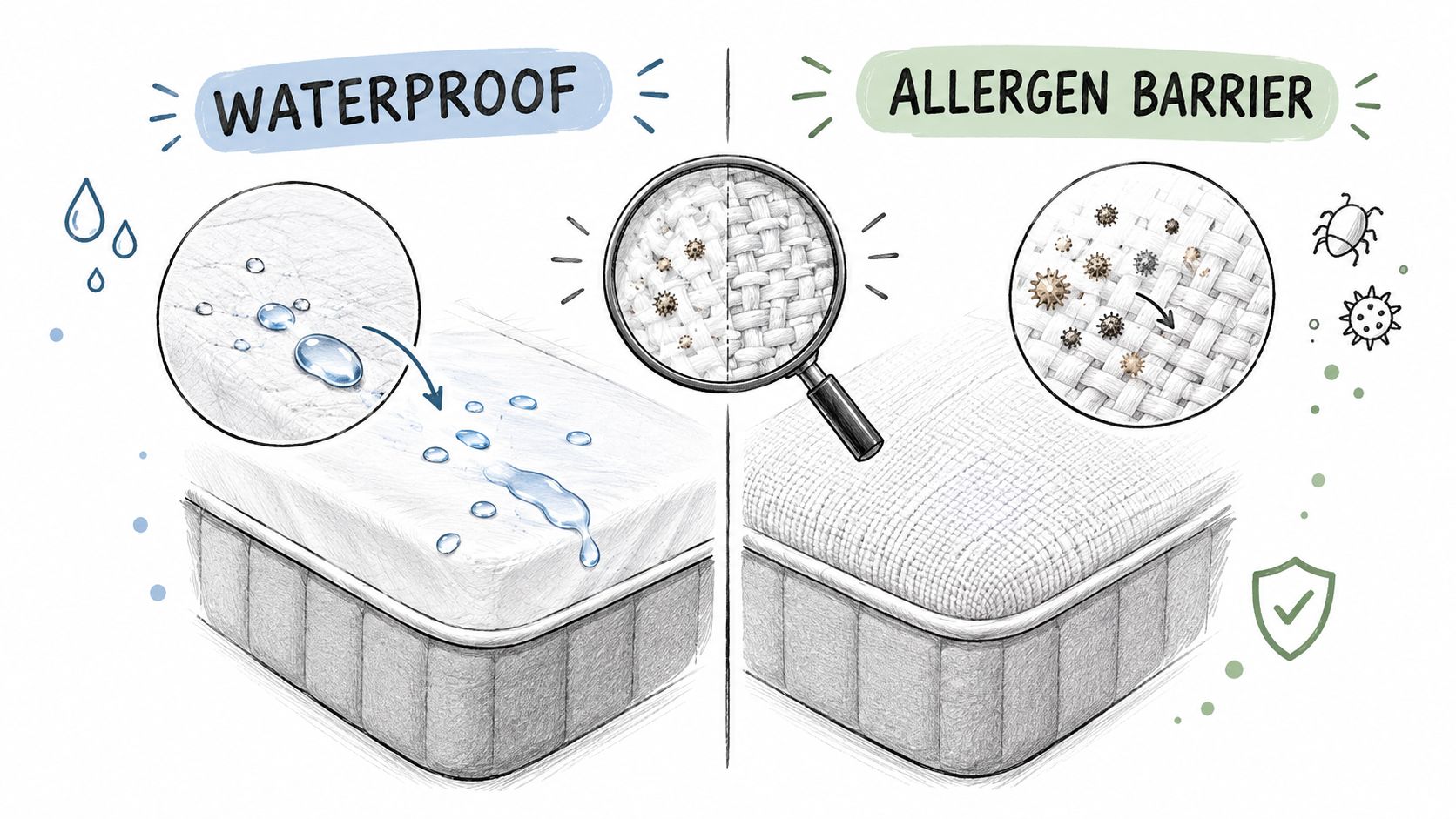
“Waterproof” and “allergen-proof” aren't interchangeable terms. Waterproofing describes resistance to liquid penetration. Dust-mite protection asks a different question: can mites, faeces and associated allergens pass through or escape around the protector?
NHS guidance states that house-dust mites are found in all UK homes, and reports that one in 20 young children and one in five adults test positive for dust-mite allergy, while also stressing that a positive test doesn't always produce symptoms. The same guidance identifies the mattress and pillow area as an ideal breeding environment and explains that mite-proof covers can help stop mites and their faeces reaching bedding. See the NHS guidance on house-dust mites for the clinical context.
Why a fitted protector may not be enough
A fitted terry protector usually covers the top and wraps around the mattress edges. That can be effective for spills, but the construction may leave areas that aren't fully enclosed. Openings, seams and exposed underside sections matter when the aim is to contain allergens rather than just stop a drink reaching the mattress.
Clinical guidance distinguishes a complete, breathable and tested barrier from a conventional protector. A fully enclosed encasement can therefore be more appropriate for a diagnosed dust-mite allergy, particularly when the mattress itself may already contain accumulated allergen. A fitted waterproof protector may still protect the mattress from moisture, but it shouldn't be sold as a complete allergy solution without evidence of containment.
Washing also matters. NHS advice recommends washing bedding and covers regularly at 60°C, because that temperature kills dust mites. It also explains that washing below 60°C may remove allergen temporarily while allowing mites to survive and produce more allergen later. The protector's care label must therefore be checked before purchase, because a membrane that can't tolerate the required temperature may not suit an allergy-focused routine.
Waterproofing protects the mattress from liquid. A verified allergen barrier protects the sleep environment through enclosure, testing and suitable laundering.
Barrier covers aren't sufficient on their own. Uncovered bedding still needs regular washing, and households managing eczema, asthma or respiratory allergy should follow appropriate clinical advice. Terry towelling remains useful as an absorbent, washable surface, but it shouldn't carry claims that belong to the membrane, seams or enclosure design.
Care Requirements And Long-Term Durability
The protector's care label is part of its performance specification. A membrane may block liquid when new, yet lose flexibility, develop damage or shrink out of shape if it's washed and dried outside the manufacturer's instructions. Terry towelling adds another maintenance consideration because loops can retain more moisture and take longer to dry than a flat woven face.
UK households already put bedding through regular domestic laundry. A UK home-textile longevity study found that 92% of respondents regularly wash bed sheets in a washing machine at home, while 91% regularly wash duvet covers. It also recorded an average bed-sheet washing frequency of 4.2 times per month, showing why a mattress protector needs to survive repeated washing rather than occasional emergency cleaning. These figures come from the UK home-textile longevity study.
Build a care routine around the actual label
Use the following process rather than guessing:
- Read the temperature limit before buying. If allergy management requires a 60°C wash, confirm that the protector is designed for that cycle. Don't assume every waterproof membrane can tolerate it.
- Wash after contamination. Accidents, heavy perspiration and visible staining justify prompt laundering. Leaving moisture against a textile surface gives odours and stains more opportunity to develop.
- Use a suitable cycle and detergent. Avoid harsh treatments or additives unless the manufacturer permits them. Oils, solvents and excessive heat can affect textile finishes and polymer films.
- Dry thoroughly without unnecessary heat. A damp terry protector should not be returned to the bed. If tumble drying is allowed, follow the stated setting rather than choosing the hottest programme.
- Inspect before refitting. Check the membrane-facing side, elastic, seams and corners for cracking, delamination, stretching or pinholes.
The study also notes that more than 90% of UK citizens regularly wash several major home textiles in a domestic washing machine, while tumble drying is used by around one in five people, depending on the item. That variation makes drying performance a genuine selection issue. A protector that takes too long to dry can become impractical in a busy household, rental property or care setting.
What repeated washing reveals
A product that fits well when new can become troublesome if the terry surface shrinks or the elastic loses recovery. Poor fit creates exposed areas, bunching and extra stress at the corners. It can also make the mattress harder to remake, encouraging users to skip laundering.
Ask suppliers for liquid-penetration or hydrostatic-pressure testing after repeated washing. That evidence is more useful than a nominal waterproof claim because it addresses the barrier under pressure and after ageing. Also check whether testing covers seams, not just the centre of the fabric.
A terry protector earns its place when the surface remains comfortable, the membrane remains intact and the fit stays secure through normal household care. If any of those three elements fails, the product may still look clean while no longer performing as intended.
Choosing The Right Protector For Your Household
Start with the risk, not the fabric name. Terry towelling is a strong fit for households that need a soft surface and practical absorbency, but allergy-focused buyers should look for verified enclosure and suitable laundering rather than assuming waterproofing is enough.
| Household need | Recommended fabric | Key consideration |
|---|---|---|
| Children's accidents | Terry towelling with a waterproof membrane | Check full top coverage, fitted depth and wash compatibility |
| Adult night perspiration | Low-bulk terry, smooth fibre or knit surface | Prioritise vapour permeability, quietness and reliable fit |
| Diagnosed dust-mite allergy | Fully enclosed, tested allergen barrier | Confirm enclosure, testing and whether 60°C care is permitted |
| General mattress protection | Terry, cotton or smooth modern surface | Balance touch comfort, drying time and membrane durability |
| Rental or care use | Durable, washable fitted construction | Verify seam quality, replacement checks and clear care instructions |
For a neutral way to compare waterproof protector options, use the same checklist each time: surface fibre, backing material, fitted depth, enclosure, washing temperature, drying method and evidence of barrier performance.
Protect-A-Bed offers waterproof mattress protectors in terry and other surface constructions, using a membrane intended to block liquids while allowing air permeability. Choose the option that matches your household's actual exposure, then inspect it after regular washing rather than treating the purchase as permanent.
Protect-A-Bed can help you choose between terry, cotton, cooling and other waterproof mattress-protector constructions for UK household needs. Visit Protect-A-Bed to review the available options, check care details and select a protector built around the spills, perspiration or allergy concerns you need to manage.