

Waterproof Mattress Protector for Cot: A Parent Guide

It's 2am. A nappy has leaked, a cup has tipped, or your child has been sick, and you're trying to change the sheet without fully waking them. The immediate problem is laundry, but the more important question is whether the mattress underneath has stayed dry, firm, flat and safely fitted.
A waterproof mattress protector for cot use should do more than stop stains. It needs to sit securely between the mattress and fitted sheet, block liquid without creating a soft or raised area, and remain reliable after repeated washing. The right choice protects the mattress while preserving the sleep surface your child uses every night.
Table of Contents
- Why a Cot Protector Is a Safer-Sleep Choice, Not Just a Laundry Fix
- Understanding the Safer-Sleep Basics Behind Cot Mattresses
- Sizing and Fit for UK Cot and Cot-Bed Mattresses
- How Waterproof Barriers Work and Why Miracle Membrane Matters
- Fabric Options and What They Mean for Comfort and Care
- Fitting the Protector and Building a Care Routine That Protects the Barrier
- When to Replace a Cot Protector and Why Softer Is Not Safer
- A Simple Cot Protector Checklist for Parents
Why a Cot Protector Is a Safer-Sleep Choice, Not Just a Laundry Fix
A cot protector is easy to classify as a convenience. It catches urine, milk and vomit, so the sheet can be changed quickly and the mattress stays cleaner. That matters, particularly because bedwetting can continue beyond infancy. NHS guidance reports that up to 1 in 5 five-year-olds wet the bed, and estimates that around half a million children aged 5 to 16 in the UK do so. NHS guidance on bedwetting also explains that bedwetting is generally normal before the age of five.
The safety question begins after you open the packet. A thick, loose or poorly sized protector may bunch beneath the sheet. A raised seam can create an uneven patch, while excess material around the edges can affect how the mattress sits in the cot. You've solved the leak problem but introduced a fit problem.
Protect the mattress without changing the sleep surface
UK safer-sleep advice treats the mattress as part of the sleep environment, not a soft furnishing. NHS guidance recommends a mattress that's firm, flat, clean, dry, waterproof, undamaged and correctly fitted, with a waterproof cover used for protection. The Lullaby Trust similarly emphasises a firm, flat mattress with no soft areas, raised edges or cushioned sides.
That makes a protector a safety-relevant layer. Its job is to shield the mattress, not to make the cot softer or more padded. The same principle applies to other nursery sleep products. If you're reviewing surrounding bedding, guidance on how to find a safe swaddle blanket can help you keep the wider sleep setup focused on secure, age-appropriate use.
Practical rule: If the protector changes the mattress from firm and flat to padded, folded or unstable, it isn't doing its job properly.
A dry mattress is only useful if it stays intact
Liquid can enter through a pinhole, worn corner or failed seam even when the surface still looks clean. Once fluid reaches absorbent mattress filling, it becomes much harder to clean reliably. That's why choosing a protector involves more than comparing absorbency descriptions or fabric softness.
A useful overview of baby mattress protector considerations can help you compare the protection layer, fit and everyday care routine. For a cot, the best result is simple: the mattress remains dry, the protector lies flat, and the fitted sheet stays secure.
Understanding the Safer-Sleep Basics Behind Cot Mattresses
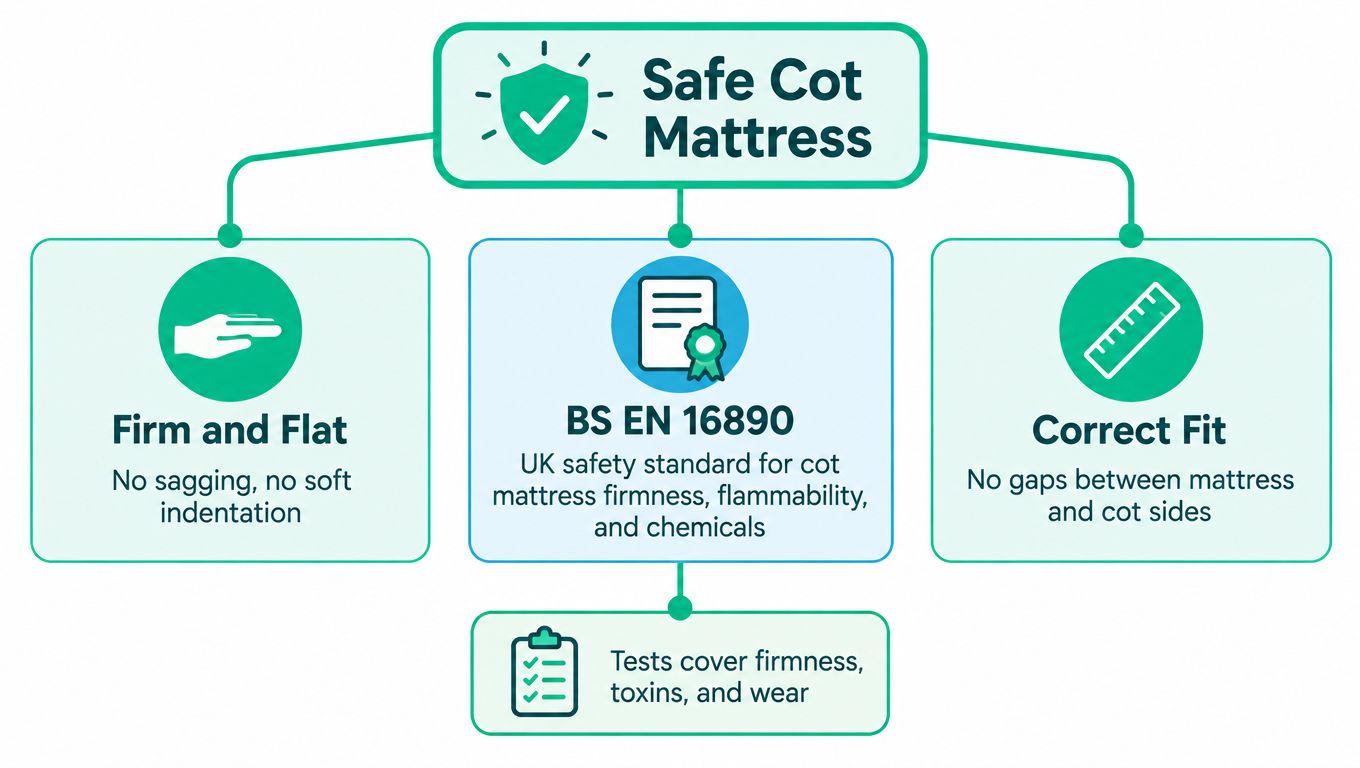
Start with the mattress, not the protector. A cot mattress should provide a firm, flat sleeping surface and fit snugly inside the cot. It shouldn't sag, contain a soft indentation or leave a noticeable gap around its perimeter.
The UK implementation of BS EN 16890:2017+A1:2021 covers safety requirements and test methods for mattresses used in cots, cribs, travel cots and suspended baby beds. A protector doesn't make a non-compliant or damaged mattress safe. It also doesn't replace the mattress manufacturer's instructions, safety information or fire-resistance labelling.
What waterproof means in safer-sleep guidance
In this context, waterproof means the mattress and its protective cover resist liquid reaching the filling. The protector should form a continuous barrier across the sleeping area and remain flat beneath the sheet. It shouldn't act like an additional comfort layer.
Think of the cot mattress as a carefully measured tray. The protector is a thin liner that sits inside it. A liner that folds, rides up or creates a raised rim no longer supports the tray's intended shape.
The cot should also remain clear of bumpers, toys and loose bedding. A waterproof protector belongs beneath a properly fitted sheet, not above it as a loose layer. If you're choosing a separate sleep layer for warmth, information about wearable blankets for babies may help you distinguish a wearable garment from loose items placed in the cot.
The three checks that come first
Before considering fabric feel or cooling claims, check:
- Firmness: The mattress still feels firm and lies flat after the protector is fitted.
- Compatibility: The protector matches the mattress dimensions and thickness, rather than relying on a broad “cot” label.
- Condition: The mattress and protector are clean, dry, intact and free from tears, exposed filling or damaged waterproof layers.
Comfort still matters, but cot comfort shouldn't mean softness. A quiet, flexible protector can feel more pleasant to use than a stiff one, provided it preserves the underlying geometry.
Sizing and Fit for UK Cot and Cot-Bed Mattresses
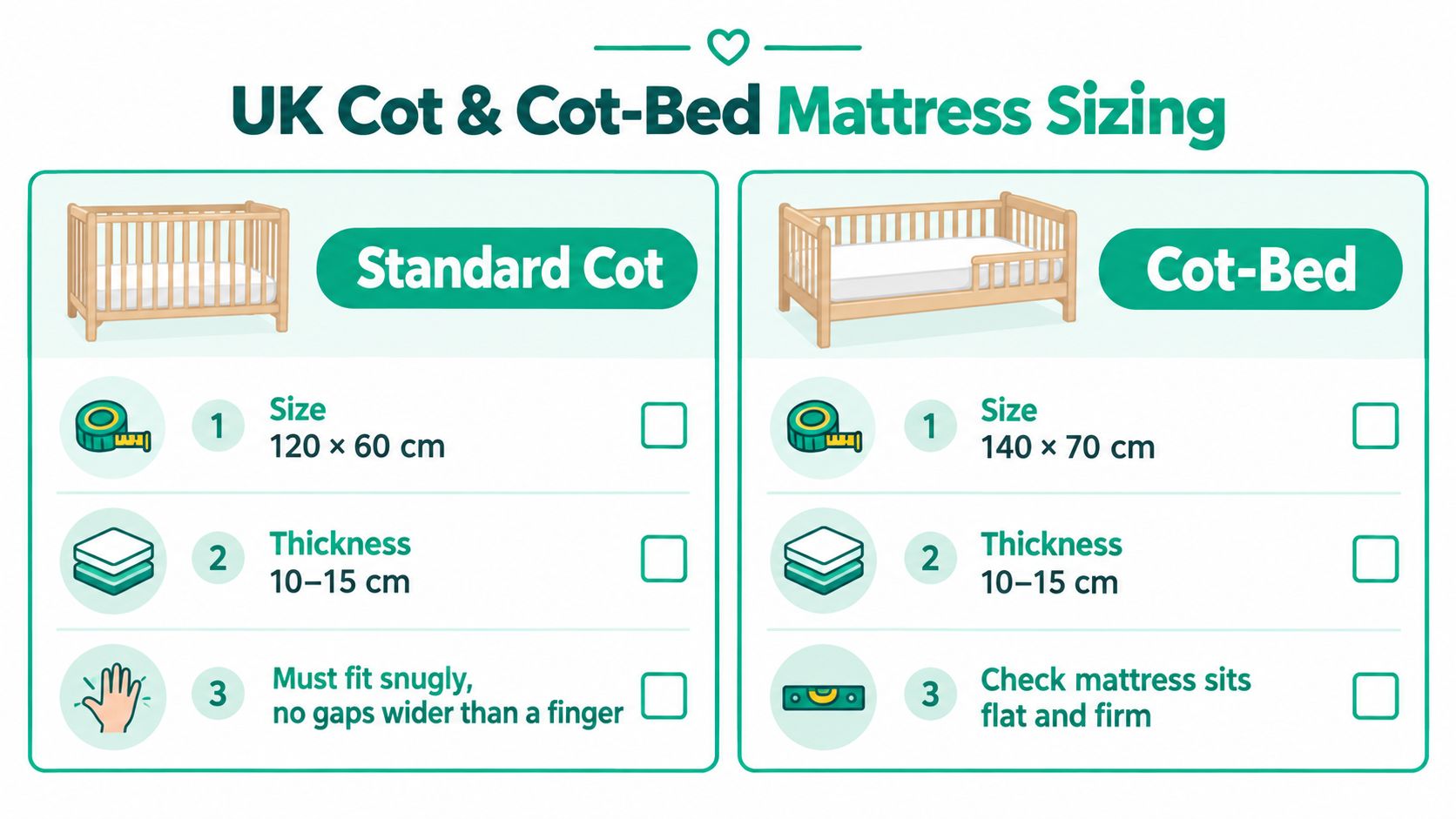
A protector can only fit correctly when you know the mattress dimensions. A common UK cot mattress size is 120 × 60 cm, while cot-bed mattresses commonly measure 140 × 70 cm. Typical cot-mattress thickness is approximately 10 to 13 cm, and UK retail guidance advises avoiding mattresses below 10 cm or above 15 cm in thickness. UK cot-mattress sizing guidance also notes that the mattress should fit without gaps and remain at least 50 cm below the top of the cot rails.
Measure the mattress, not the cot frame
Measure the mattress length, width and thickness on its own. Don't assume that every cot labelled “standard” uses exactly the same mattress, and don't choose a protector by age range alone.
Write down:
- Length and width, measured from the mattress edges.
- Thickness, measured without compressing the filling.
- Corner shape, especially if the mattress has rounded corners.
- Manufacturer guidance, including any specified cover dimensions.
Then compare those measurements with the protector's stated dimensions. A fitted protector needs enough depth to hold the mattress securely, but not so much excess fabric that it folds underneath.
Fit test: Put the protector on the bare mattress, smooth every corner, then run your hand across the surface. You shouldn't find folds, ridges, loose pockets or a section that pulls away when you press near the edge.
Why gaps and bulk matter
A gap between the mattress and cot sides gives the mattress room to move. Extra protector material can make that problem worse if it gathers underneath or lifts an edge. UK guidance cited by retailers and manufacturers places the maximum gap at around 20 mm, while The Lullaby Trust's practical advice is stricter, with no gaps being the ideal.
A thicker protector isn't automatically a better protector. In a cot, low bulk and a secure fit matter more than plush padding. Check the mattress again after fitting, because a protector can alter how easily it sits into the cot base.
For a cot-bed, confirm that the cover is made for the larger mattress rather than stretching a smaller product across it. A dedicated guide to a waterproof mattress protector 140 x 70 can help when that is the mattress size you have.
How Waterproof Barriers Work and Why Miracle Membrane Matters
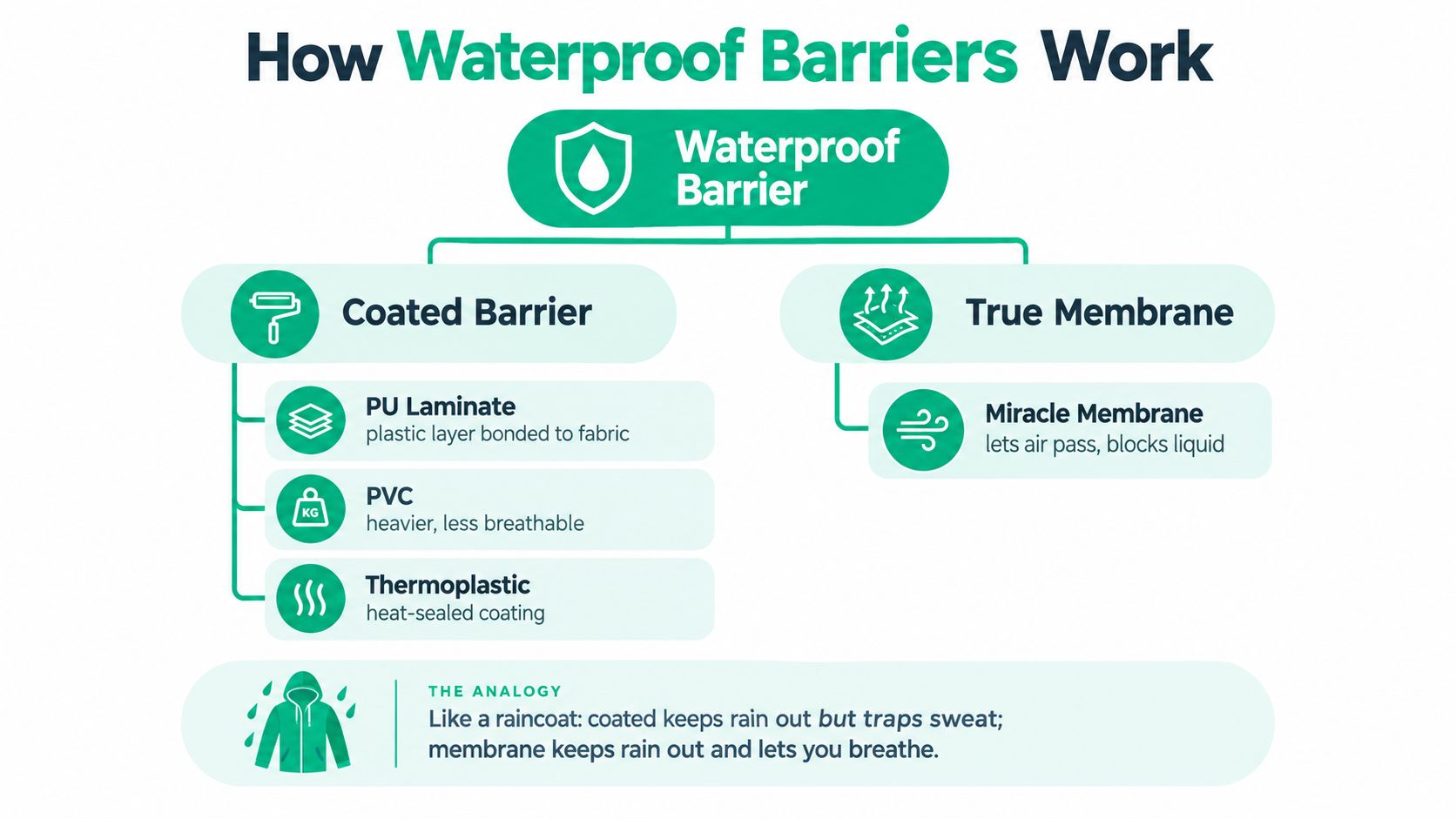
Waterproofing usually comes from a layer placed beneath the fabric surface. Some products use a coated barrier, such as a PU laminate, PVC or another thermoplastic layer. The coating blocks liquid, but its feel, flexibility and breathability depend on how it's made and bonded to the fabric.
A simple analogy is a raincoat. It keeps rain out, but a heavy or poorly ventilated raincoat can trap heat and moisture inside. A breathable membrane aims to block liquid while allowing air and water vapour to pass through more readily.
The barrier is only one part of the experience
Protect-A-Bed's Miracle Membrane is described as a thin, flexible and silent waterproof layer designed to block liquids while remaining air permeable. In practical terms, parents are looking for a protector that doesn't feel like a sheet of plastic, make a loud crinkling noise or add a noticeable cushion beneath the child.
The face fabric still affects the result. A soft textile can make the protector feel more familiar, while the membrane performs the liquid-blocking function underneath. The two layers need to work together. A breathable fabric cannot compensate for a barrier that has cracked, peeled or separated.
A breathable waterproof membrane can therefore be a useful feature to investigate, but don't treat the word “breathable” as a substitute for checking fit, construction and care instructions.
Match the protection to real routines
A cot used at home may face nappies, milk and occasional sickness. A cot in childcare or hospitality may need more frequent laundering and inspection. In both settings, a continuous barrier and sturdy seams matter because a small failure can allow fluid to reach the mattress filling.
The same organising principle applies to nursery accessories. A water-resistant pouch for essentials can keep small items together, but it isn't a substitute for waterproof protection beneath a child. Use each product for its intended purpose.
Fabric Options and What They Mean for Comfort and Care
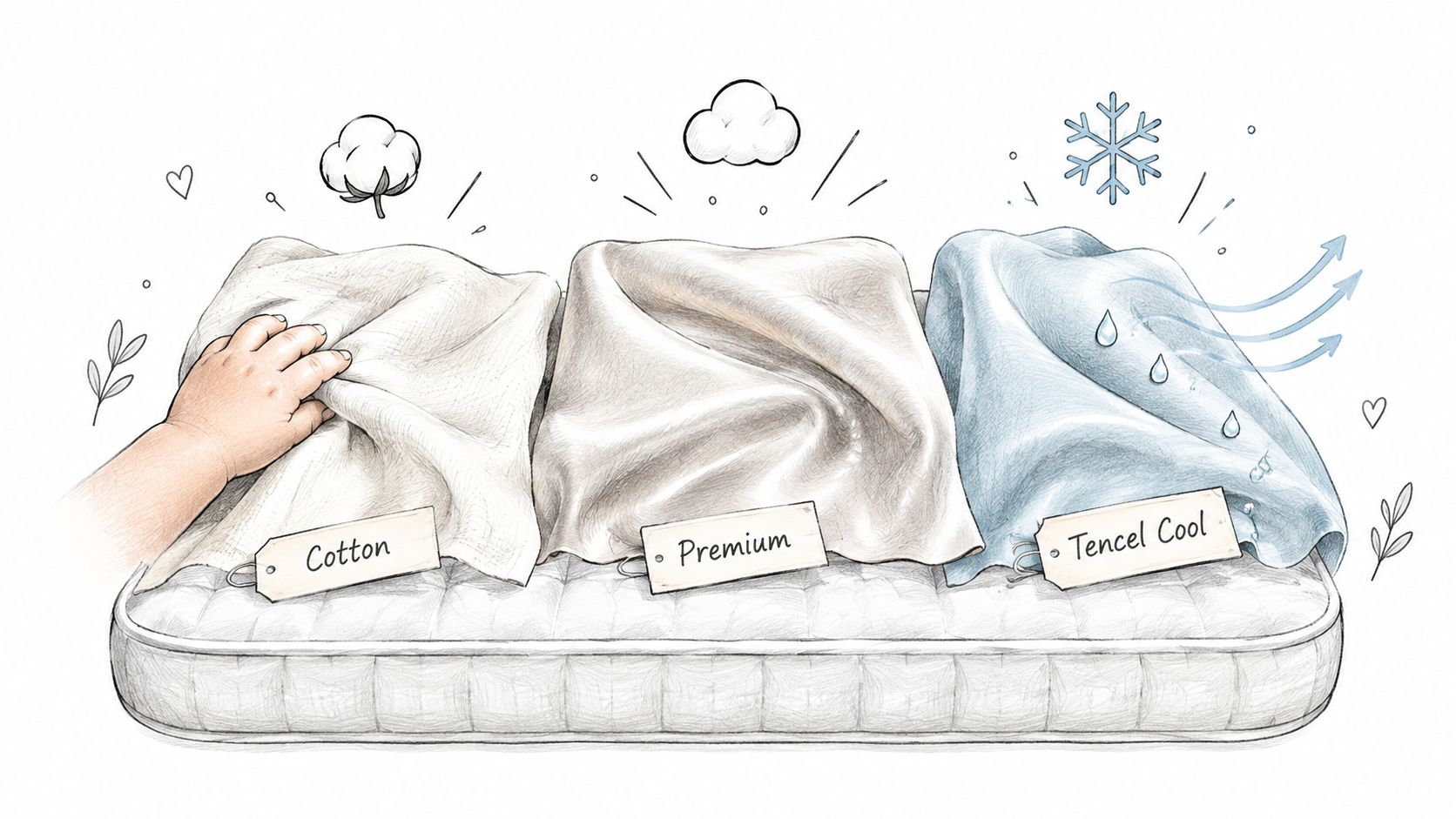
The fabric touching the sheet changes how the protector feels, dries and fits into your routine. There isn't one face fabric that suits every child or household. Choose according to your priorities, then confirm that the underlying waterproof layer and fitted shape meet the same standard.
Cotton for a familiar feel
Cotton is an intuitive choice for parents who want a recognisable textile surface. It can feel natural against the fitted sheet and may suit households that already wash cotton nursery bedding regularly.
The important question is how the cotton face is bonded to the membrane. A soft top fabric doesn't make the protector suitable if the backing is noisy, bulky or prone to separation. Check the finished product rather than judging the face fabric alone.
Tencel Cool for warmer sleepers
A cooling-oriented fabric may appeal when a child tends to feel warm or sweat during sleep. Tencel Cool is positioned around a smoother, cooler-feeling surface, but the protector still needs to remain thin and securely fitted beneath the sheet.
Temperature comfort is individual. If your child sleeps comfortably in ordinary cotton bedding, a specialist cooling face may not be necessary. If night-time heat is a recurring issue, fabric feel and air permeability become more relevant.
Premium for everyday balance
A premium face fabric usually aims to balance softness, finish and practical protection. It can suit parents who want a more refined hand feel without choosing a strongly cooling or odour-focused surface.
Look beyond the label. Ask whether the product can be washed according to your routine, whether its elastic remains secure and whether the surface stays smooth after repeated use.
Charcoal for practical households
Charcoal fabric can make marks less visually obvious, which may appeal in a frequently used cot or a setting where the protector needs to look presentable between washes. That doesn't mean stains or contamination can be ignored. Inspect and launder it in the same way as any other protector.
The sensible choice is the one your household can maintain consistently. Softness, temperature and washability matter, but none outranks a secure fit and an intact membrane.
Fitting the Protector and Building a Care Routine That Protects the Barrier
A good protector can fail through poor fitting or harsh care. Treat installation as a short safety check, not a one-time task.
Fit it in a fixed order
- Confirm the measurements. Check that the protector matches the mattress length, width and depth.
- Place it evenly. Position the fitted corners without pulling one side tighter than the other.
- Smooth the top. Remove wrinkles from the centre towards the edges.
- Check underneath. Make sure excess fabric isn't folded into a thick ridge beneath the mattress.
- Add the sheet. Use a properly fitted cot sheet over the protector.
- Inspect again. Run your hand across the surface and check each corner before sleep.
The final check matters after washing. Elastic can relax, fabric can shrink, and a protector that fitted neatly at first may develop loose sections over time.
Wash for the barrier, not just the fabric
Follow the product's care label and avoid assuming that a hotter or harsher wash is better. Chlorine-heavy products, aggressive chemicals and some disinfectants can weaken waterproof coatings or encourage delamination. Clinical NHS decontamination guidance warns that alcohol wipes, sprays and chlorhexidine can break down waterproof covers through delamination, so household cleaning should be equally cautious about unsuitable products.
Use a compatible detergent, skip fabric softener unless the manufacturer specifically permits it, and dry the protector according to its instructions. Gentle tumble drying or line drying may be appropriate, but excessive heat can stress laminated layers.
Inspect after laundering
Hold the protector up to a bright light and look for pinholes, peeling, cracks or areas where the layers appear to separate. Check the elastic, corners and seams by hand. If the sheet has been wet beneath the protector, investigate immediately rather than assuming the mattress caused the problem.
A protector's safety value depends on the barrier remaining continuous. Clean appearance isn't proof that the membrane still works.
When to Replace a Cot Protector and Why Softer Is Not Safer
A protector needs replacing when its liquid barrier no longer works. NHS clinical decontamination guidance states that mattresses with fluid ingress must be replaced immediately in clinical settings and tells staff to inspect covers for holes, tears and body-fluid penetration. Although that guidance concerns clinical mattresses, the underlying lesson applies at home: once liquid reaches absorbent filling, cleaning becomes much less reliable.
Replace it when you find
- Strike-through: Liquid has reached the underside or mattress.
- Delamination: The waterproof layer is peeling, bubbling or separating.
- Surface damage: You can see pinholes, cracks or torn fabric.
- Seam failure: A corner or stitched edge no longer closes securely.
- Persistent odour: Washing doesn't remove a smell associated with contamination.
- Loss of fit: Elastic has stretched enough for the protector to bunch or move.
Don't try to rescue a damaged barrier with tape, extra fabric or a second loose layer. Those fixes can create new folds and won't restore a continuous waterproof surface.
A thicker protector may feel more luxurious in an adult bed, but cot safety depends on different priorities. Low bulk, secure fit and preserved firmness matter more than padding. The quietest and softest product isn't automatically the safest, but a thin protector that remains flat and intact supports the sleep environment you already have.
A Simple Cot Protector Checklist for Parents
Use this quick check before buying and whenever you change the bedding:
- Start with the mattress: Confirm that it's firm, flat, clean, dry and undamaged.
- Measure accurately: Check whether you need the common cot size of 120 × 60 cm or a cot-bed size of 140 × 70 cm.
- Choose low bulk: Look for a thin protector that doesn't add cushioning or raise the mattress edges.
- Check the barrier: Prefer a continuous waterproof layer with secure seams and no loose sections.
- Fit it smoothly: The protector should stay wrinkle-free beneath the fitted sheet.
- Keep the cot clear: Don't add bumpers, toys or loose bedding around the mattress.
- Wash carefully: Follow the care label and avoid products that may damage the waterproof layer.
- Inspect regularly: Check corners, elastic, seams and the underside after laundering.
- Replace early: Don't wait for repeated leaks once you see peeling, cracking, pinholes or strike-through.
The aim isn't to create a complicated sleep system. It's a quiet, dry and firmly fitted cot where the protector handles everyday liquid while the mattress keeps its intended safer-sleep characteristics.
Protect-A-Bed offers waterproof cot and cot-bed mattress protectors using its Miracle Membrane, with fabric options intended for different comfort and care preferences. Visit Protect-A-Bed to check the available sizes and choose a protector that fits your mattress without compromising its firm, flat surface.