

Pillow Protector Waterproof

You've just changed the bedding, but the pillow still feels like the weak point. A child spills juice, a guest arrives with a damp coat, or you wake after a hot night and notice the pillow has absorbed more than the pillowcase can handle. A waterproof pillow protector sits between the pillow and its ordinary pillowcase, creating a washable maintenance layer for those everyday problems.
That layer can also matter in a UK bedroom where dust mites are a concern. NHS-linked guidance identifies the bed, including the mattress and pillowcase, as a suitable environment for mites and recommends allergen-proof covers for pillows and mattresses. North West Allergy Network reports that one in five adults and one in 20 young children test positive for house dust mite allergy, while 59% of indoor allergy sufferers say their symptoms are worse in the bedroom (NHS-linked house dust mite guidance).
Table of Contents
- Why a Waterproof Pillow Protector Matters in a Real UK Bedroom
- How Waterproof Pillow Protectors Are Built and What Goes Inside
- Benefits a Waterproof Pillow Protector Delivers
- The Breathability Trade-Off Nobody Talks About
- Matching a Waterproof Pillow Protector to Your Household
- Washing, Care and UK Hygiene Best Practice
- Choosing the Right Waterproof Pillow Protector with Confidence
Why a Waterproof Pillow Protector Matters in a Real UK Bedroom
A child spills juice, a guest arrives with a damp coat, or you wake after a warm night and realise the pillow has absorbed more than the pillowcase can manage. A waterproof pillow protector adds a washable maintenance layer between the pillow and its ordinary pillowcase.
The protector is usually a fitted zip or envelope cover that wraps around the pillow before the normal case goes on. It helps keep sweat, saliva, drinks, skin oils and other everyday contamination away from the filling. The pillowcase remains the layer you feel and see, while the protector takes responsibility for mess that would otherwise settle inside the pillow.
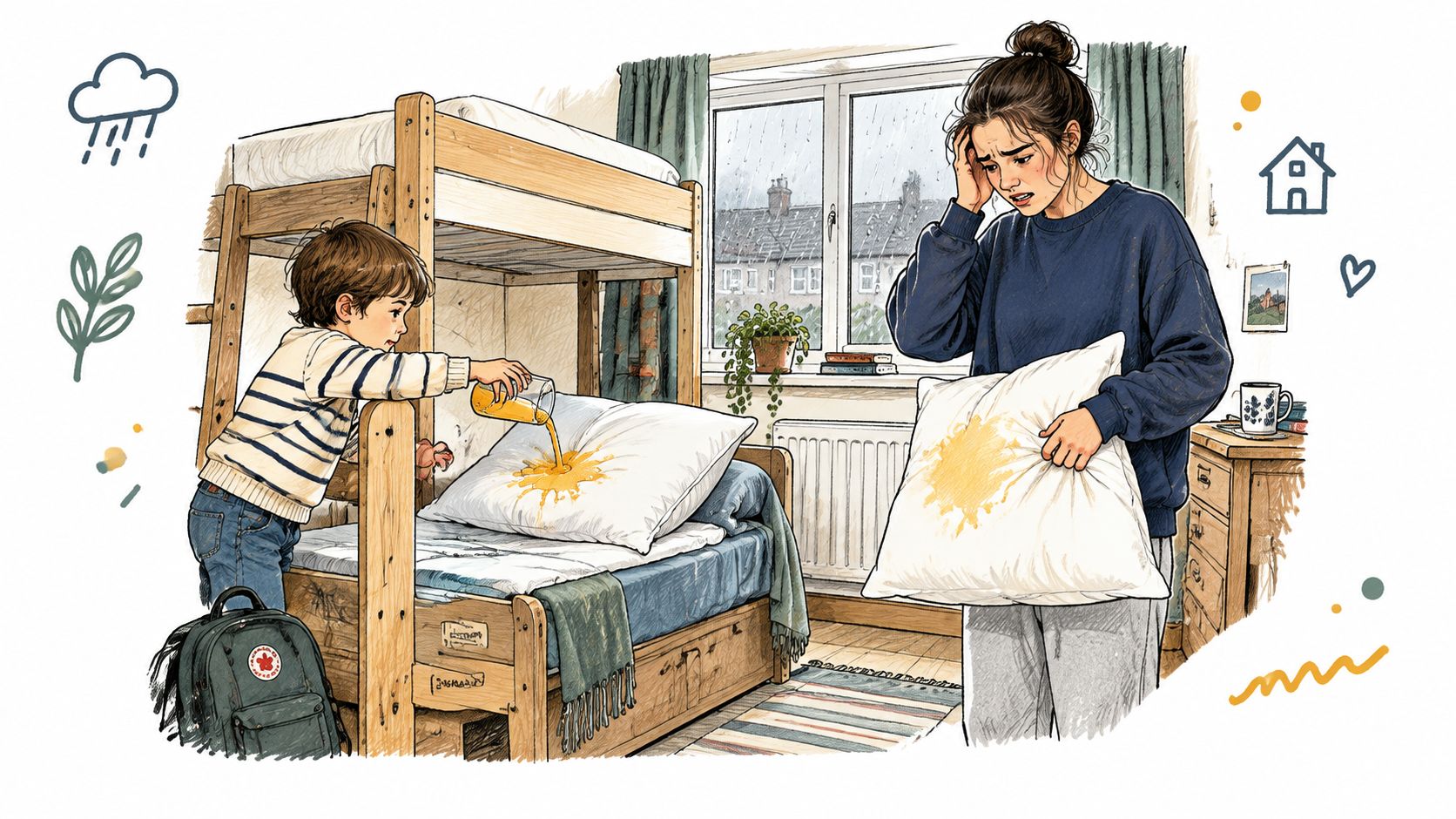
The bedroom problems it helps manage
UK bedrooms differ widely. Some have limited ventilation, some become warm with winter heating, and others are used by children, pets or overnight guests. A protector cannot prevent every hygiene problem, but it gives you a removable surface to wash when moisture or accidental spills are common.
It can also form part of an allergy-conscious bedding routine. NHS-linked guidance recommends allergen-proof covers for pillows and mattresses, alongside regular washing of bedding at 60°C or above to kill mites (NHS-linked house dust mite guidance). The cover is therefore a practical barrier, not a cure for an allergy. Wash it according to its care label and keep the wider bedding routine consistent.
Hot sleepers should consider the comfort cost. A waterproof layer may feel warmer or less airy, especially beneath a pillowcase, so fabric feel, membrane design and washing instructions matter as much as liquid resistance. In a guest room, the trade-off can be worthwhile because a washable cover makes an unexpected spill easier to handle.
What it does not do
Waterproofing does not automatically provide bed-bug protection. If bed bugs are suspected, use an encasement specifically designed and labelled for pest containment, then follow an appropriate treatment plan. A liquid barrier is only suitable for that purpose when its seams, zip and coverage have been designed for it.
For a clearer explanation of the difference between a pillowcase and a protector, read this guide to why use pillow protectors.
How Waterproof Pillow Protectors Are Built and What Goes Inside
A waterproof pillow protector is usually built in layers. The upper face fabric is the part you feel through the pillowcase, while a concealed membrane sits underneath it and stops liquid reaching the pillow filling. Together, they work like a washable raincoat: the outer textile remains comfortable, while the inner layer provides the barrier.
The face may use cotton, polyester, Tencel, lyocell or a blended textile. Cotton offers a familiar feel, polyester is often durable and economical, and Tencel or lyocell can provide a smooth surface with moisture-management properties. Bamboo blends are another common fibre choice, but the name alone says little about performance. Check the finished construction, care label and feel instead.
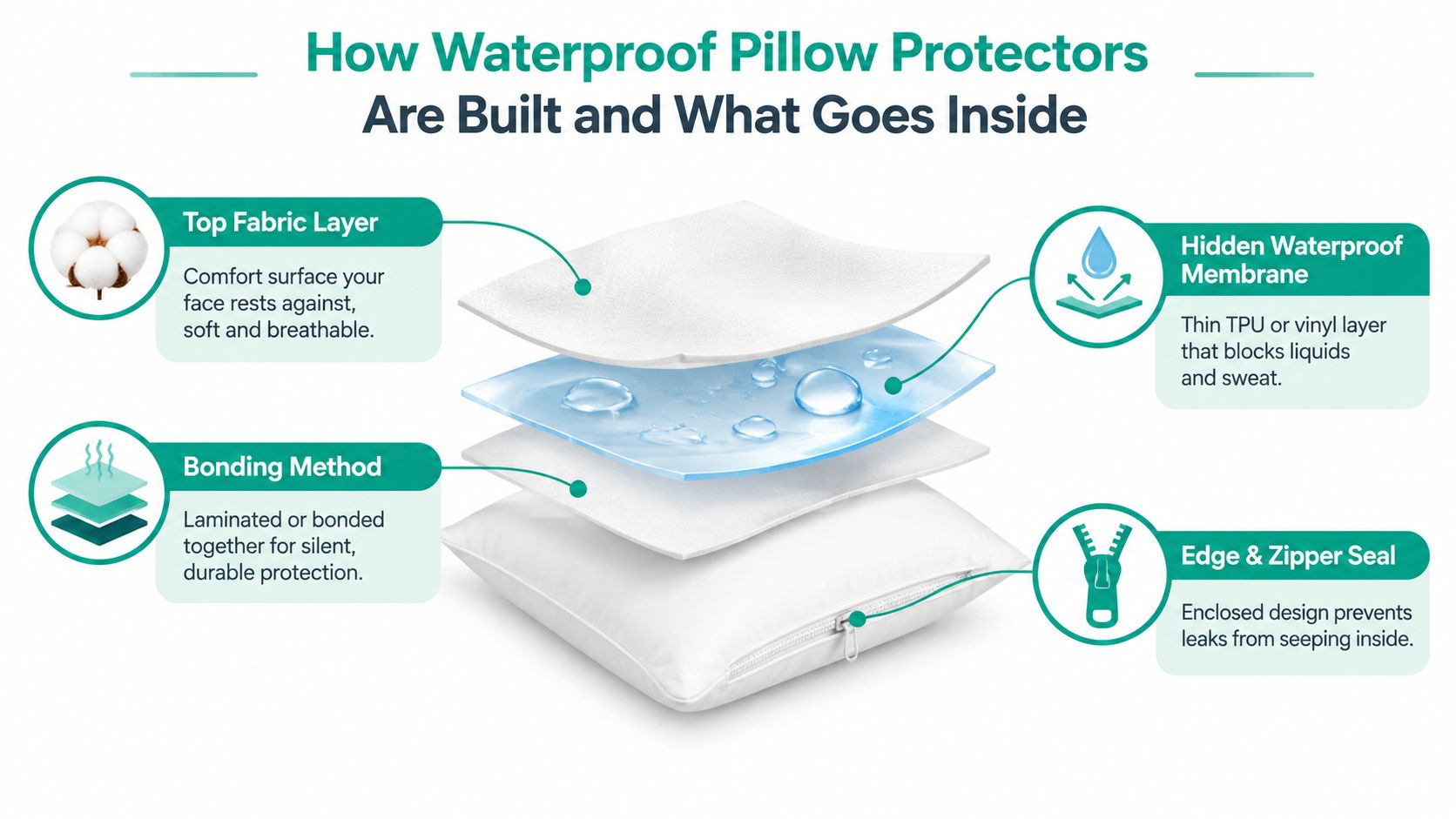
The hidden barrier
The membrane may be made from flexible polyurethane, TPU or another proprietary waterproof material. Its job involves a careful compromise. It needs to stay continuous enough to block liquid, while allowing some air and moisture vapour exchange. Without that balance, the protector can feel more like a plastic sheet than bedding.
A breathable construction generally pairs a soft face fabric with a thin waterproof membrane. Product specifications may also show OEKO-TEX Standard 100, which indicates that the textile components have been tested for harmful substances and assessed for direct skin contact. Treat this as information about the materials, not as a guarantee that the protector will feel cool or suit every sleeper.
Closures and seams matter
A zipped design can enclose the whole pillow. An envelope style leaves an opening covered by overlapping fabric. Full enclosure gives broader barrier coverage, which can make sense for allergy-conscious care or situations where spills are likely. Taped or welded seams reduce the weak points through which liquid could otherwise pass.
Fit affects comfort as well as protection. A loose cover may bunch beneath the pillowcase, while an undersized one can strain the zip or membrane and alter the pillow's shape. Choose a close fit without compressing the filling.
The same construction principle applies to larger sleep surfaces when you protect your futon mattress.
Benefits a Waterproof Pillow Protector Delivers
A child spills a drink at bedtime, a guest arrives with little warning, or a hot sleeper leaves the pillow damp by morning. In each case, a waterproof protector acts as a maintenance layer, giving moisture a place to stop before it reaches the pillow filling.
Sweat, saliva, tea, juice, night-time perspiration and other moisture can soil a pillow quickly. The cover is especially useful for children, people who perspire heavily, anyone recovering from illness, and households managing incontinence.
A pillow is difficult to clean thoroughly once liquid reaches its interior. A removable protector is easier to remove, inspect and wash. It does not make the pillow maintenance-free. Instead, it places the layer most likely to become soiled where routine laundering is practical.
A barrier for allergens
Dust-mite control is another reason UK households use a protector. Guidance from the NHS recommends allergen-proof covers for pillows and mattresses because they help stop mites and their faeces reaching the bedding. A zipped, well-fitting protector can therefore support an allergy-conscious cleaning routine, provided its surface is washed as directed.
A protector is not an allergy treatment by itself. It works more like a washable boundary around the pillow: useful, but dependent on regular cleaning and suitable bedding care.
Allergy guidance also highlights widespread allergies in the UK and differences in how often people wash bedding and at what temperature. Follow the protector's care label, and use the highest suitable wash temperature where the fabric and filling allow it (UK household allergy and bedding hygiene summary).
Practical rule: A protector supports allergy management only when you keep the outer surface clean and follow its care label.
Comparing everyday threats
| Threat | Without Protector | With Protector |
|---|---|---|
| Sweat and saliva | Can reach the pillow filling and create odour or dampness | Stops at a washable outer layer |
| Drink spills | May permanently mark or saturate the pillow | Can usually be contained by removing the protector promptly |
| Dust-mite allergens | The pillow remains directly exposed to the bedroom environment | A suitable barrier can reduce contact with the pillow surface |
| Pet dander and pollen | Can settle directly into the pillow fabric | The protector creates an additional washable layer |
| Guest use | The pillow itself receives the full burden of unfamiliar use | The protector can be changed between guests |
| Illness or accidents | Cleaning the pillow may be difficult or unsuitable | The removable cover can be washed or replaced |
The Breathability Trade-Off Nobody Talks About
Some waterproof protectors feel warm, clammy or faintly crinkly. That complaint isn't imaginary. The same membrane that blocks liquid can also slow the movement of air and moisture vapour, particularly when the cover uses a thick coating or a stiff backing.
Basic vinyl-style covers tend to produce the most obvious plastic feel and rustling. Thin polyurethane or TPU-style membranes can be quieter and more flexible, but quality varies with the face fabric, bonding method and overall construction. A description such as “breathable” is useful, but it doesn't tell you exactly how the cover will feel in your bedroom or for your sleeping pattern.
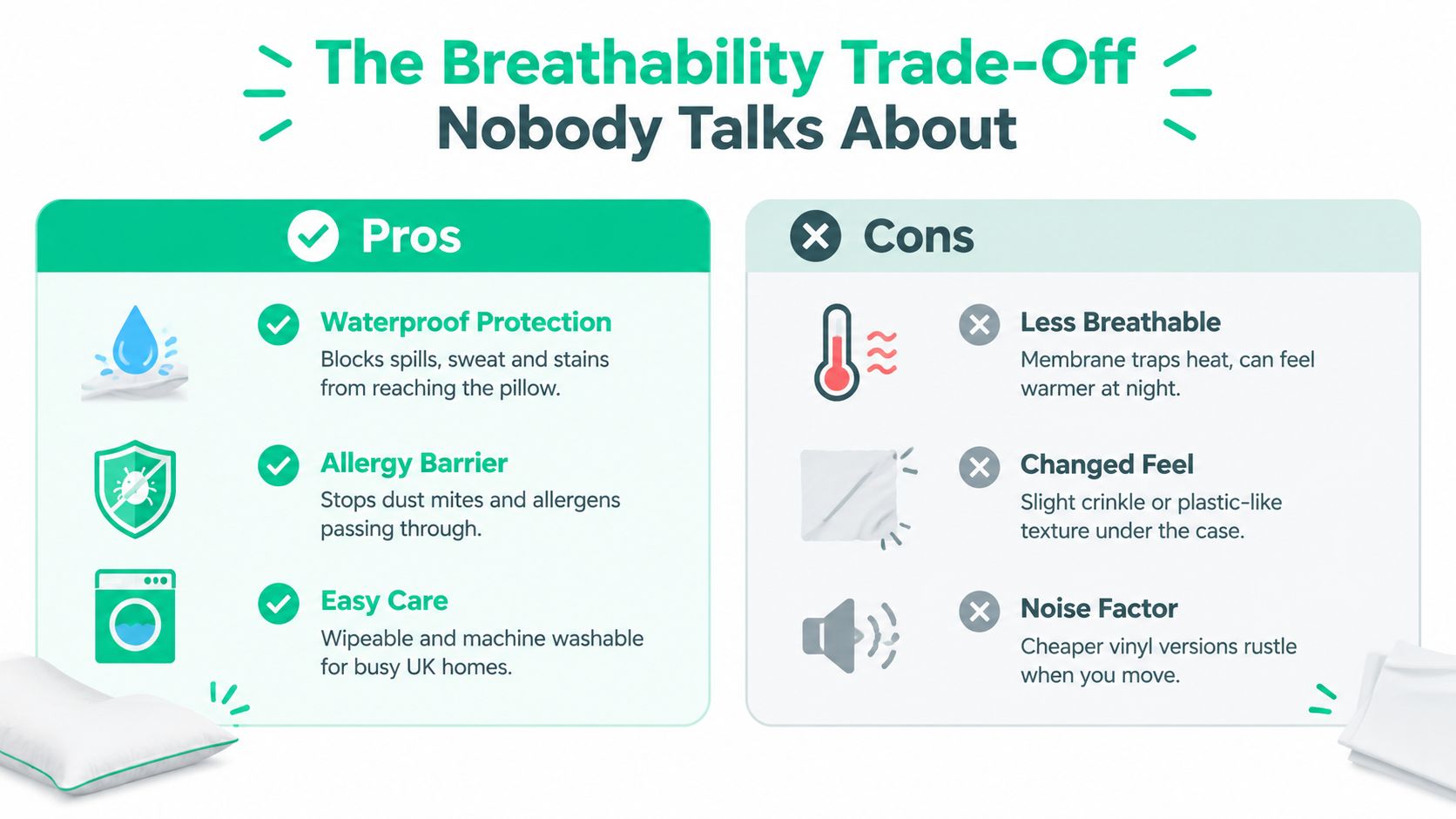
Where comfort can win
If your bedroom is cool and your main concern is an occasional drink spill, you may not need the most heavily sealed design available. A soft face fabric and a thin membrane can provide practical protection without making the pillow feel noticeably different. Cotton can feel familiar and relatively cool, while Tencel or lyocell may suit shoppers who prefer a smooth surface with moisture-management properties.
Hot sleepers need to examine the fabric as well as the waterproof claim. A cover that feels damp against the pillowcase, traps warmth around the face or produces a persistent odour suggests that its construction isn't working well for your needs.
When waterproofing is worth the compromise
For children, recurrent night sweating, vomiting, incontinence care, or a pillow exposed to frequent spills, liquid protection is more than a cosmetic preference. In those situations, a washable barrier can prevent repeated damage and reduce the need to deal with a contaminated pillow directly.
Waterproofing also shouldn't be treated as a substitute for pest control. UK public-health guidance recommends hot washing contaminated bedding at 60°C and hot drying for at least 30 minutes in bed-bug workflows, with additional steps such as bagging, freezing or professional treatment sometimes required (bed-bug treatment guidance). A protector is a maintenance layer, not an infestation treatment.
For more detail on balancing liquid resistance and sleep comfort, read this explanation of a breathable waterproof pillow protector.
Matching a Waterproof Pillow Protector to Your Household
The right specification depends on the problem you're trying to solve. An allergy sufferer, a hot sleeper and a holiday-let host may all search for a waterproof pillow protector, but they won't necessarily need the same construction.
For allergies, prioritise a fully enclosed design with a secure zip and a barrier fabric intended to limit allergen passage. The cover still needs regular laundering, because allergens can remain on the outer textile even when the membrane blocks the pillow interior.
Families with young children should look for quiet construction, durable stitching and a wash routine that fits frequent accidents. A protector that can tolerate the care temperature stated on its label is more useful than one that offers impressive liquid claims but becomes difficult to maintain.
Hot sleepers should put breathability first. A cotton or Tencel-faced cover paired with a thin, flexible membrane is generally a more comfortable direction than a stiff, heavily coated cover. For guest rooms, easy removal and quick inspection may matter more than advanced allergen features, especially when the cover is changed between visitors.
Care homes and incontinence settings need a fully enclosed product with reliable seams and a closure that staff can check quickly. Don't confuse a general waterproof protector with a clinical or pest-control encasement unless the specification explicitly supports that application.
| Scenario | Priority Feature | Best Material | Closure Cue |
|---|---|---|---|
| Allergy or asthma concerns | Allergen barrier and washable outer surface | Membrane-backed, tightly woven face fabric | Full zip around the pillow |
| Young children | Quiet, durable and easy to launder | Soft polyester, cotton or blended face fabric | Secure zip with reinforced construction |
| Hot sleepers | Moisture management and low bulk | Cotton or Tencel face with a thin membrane | Close-fitting zip or smooth envelope |
| Guest rooms and holiday lets | Fast changes and spill resistance | Durable, easy-care textile | Simple fitted cover that removes cleanly |
| Care or incontinence use | Strong liquid barrier and enclosed coverage | Robust waterproof laminate | Secure closure with protected seams |
A useful rule is to buy for the most frequent risk, not the most dramatic one. If spills happen weekly, prioritise washable waterproofing. If the pillow is mainly exposed to allergy concerns, an allergen-focused barrier may be sufficient, provided the product's wash instructions match your routine.
Washing, Care and UK Hygiene Best Practice
A protector only works as a maintenance layer if it is washed and checked regularly. After a child's spill, an illness or a sweaty night, remove it promptly so moisture and residue do not sit against the pillow. Start with the care label, because waterproof membranes, seams and zips vary in how much heat, detergent and drying they can handle.
For dust-mite management, UK guidance commonly recommends washing unencased bedding at 60°C or above. Barrier covers can reduce what reaches the pillow, while bedding outside those covers still needs regular washing. A 30°C or 40°C cycle can refresh fabric, but it should not be described as equivalent to the higher temperature used for mite control.
A sensible care routine
- Remove contamination promptly. Take the protector off after a spill, illness or heavy soiling. Leaving it in place can keep moisture against the pillow.
- Check the care label. Confirm the maximum temperature, drying method and whether the zip should be closed before washing.
- Use a suitable detergent. Avoid chlorine bleach and fabric softener unless the maker permits them. Residue can affect the face fabric, while unsuitable chemicals may weaken the membrane.
- Dry gently. Line drying puts less stress on the waterproof layer. If tumble drying is allowed, use the stated low setting and keep it away from high heat.
- Inspect before refitting. Check for tears, separated seams, a distorted membrane or a damaged zip.
Keep a spare protector for a pillow used every night. It gives the first cover time to dry and means a soiled one can be removed immediately, which is especially useful in family bedrooms and guest rooms.
A damp-feeling protector may have detergent build-up, a faulty zip or a damaged seam. It may also have reached the end of its useful life. Stop treating it as a reliable barrier until you have found the cause. For wider household routines, this allergy cleaning plan from Top Cleaners can help organise cleaning around bedding, dust and other common triggers.
Choosing the Right Waterproof Pillow Protector with Confidence
Start by naming the main reason you're buying. Is it childhood spills, perspiration, allergy management, guest turnover, care use or a concern about protecting an expensive pillow? Once that priority is clear, the product description becomes easier to judge.
The buying checklist
- Confirm genuine waterproof construction. Look for a named membrane or clearly described liquid barrier, not a fabric advertised as stain resistant.
- Inspect the face fabric. Cotton, cotton terry and Tencel-style fabrics can provide a softer surface than a bare coated backing.
- Check the closure. A full zip gives more complete enclosure than a cover with a permanently open end.
- Match the size. UK pillow dimensions vary, so measure the pillow and compare those measurements with the product listing.
- Read the wash instructions. Allergy-focused households should confirm whether the protector can be laundered at the temperature required by their hygiene routine.
- Look for comfort clues. “Quiet”, “thin” and “air-permeable” are useful descriptions, but also check whether the fabric feels stiff, plasticky or heavily coated.
- Examine the seams. A strong membrane is less useful if the zip area or stitching creates an obvious weak point.
The best choice for a family with young children is usually a washable, quiet protector with dependable liquid resistance. An allergy sufferer should prioritise full enclosure and an appropriate barrier. A hot sleeper should choose the lightest breathable construction that still addresses the actual moisture risk. A rental host needs easy changeover and durability, while a care setting needs a stronger, fully enclosed specification.
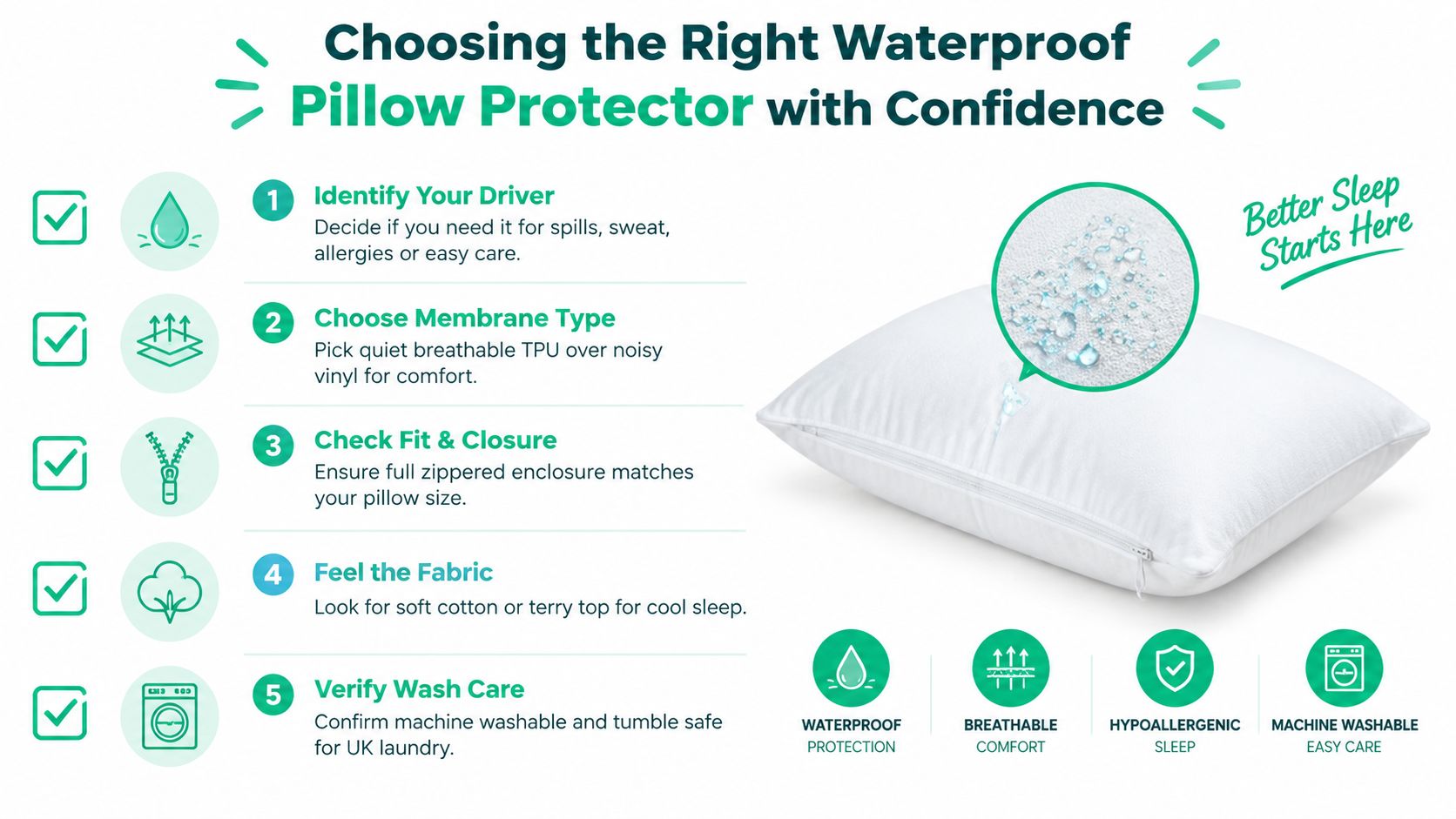
Make the decision practical
Don't buy two poorly fitted covers because they cost less individually. Choose one that matches your pillow size, your washing routine and your tolerance for warmth or noise, then keep a spare if regular laundering makes that useful.
Protect-A-Bed offers UK pillow protectors using its Miracle Membrane approach, including breathable waterproof options and fabric choices aimed at different comfort preferences. You can also review its wider guidance on pillow protectors in the UK. If airborne dust is another bedroom concern, a quiet purifier for bedroom may be considered as part of a wider cleaning routine, alongside laundering and ventilation.
A waterproof pillow protector should feel like sensible housekeeping, not a compromise you notice all night. Match the barrier to the risk, the fabric to your sleeping temperature, and the care instructions to what you can realistically maintain.
Protect-A-Bed offers waterproof, breathable pillow protection designed to help manage spills, sweat and everyday bedding hygiene, with UK options in fabrics such as cotton and Tencel Cool. Visit Protect-A-Bed to compare pillow protectors and choose a cover that fits your household's real maintenance needs.