

Mattress with Cooling: Types, Protectors and What to Buy

A national study of 553 homes estimated that 18.6% of main bedrooms in England, about 4.45 million homes, overheated in summer, and about 7.4 million people were exposed to those rooms, as set out in the Buildings and Cities analysis. The same work noted that the result sat in line with an earlier estimate of about 19%. Overheating is a normal summer problem in English bedrooms, not a freak year.
A mattress with cooling only changes the surface under your body. It does not empty heat from a closed room, a heavy duvet, or a top-floor flat that has stored sun all afternoon. I would ignore a cool-touch hang tag until the room, the bedding stack, and a week of real nights have been checked.
Surface temperature regulation is heat and moisture at the sleep surface. Whole-room heat is the air around the bed. Those are different jobs, and only one of them is a mattress job.
Table of Contents
- Why a Cool Label Cannot Fix a Hot Bedroom
- Cooling Options at a Glance
- Materials, Gel, Phase-Change and Breathable Builds Compared
- Cooling Protectors Compared With Built-In Cooling
- UK Buying Considerations Before You Pay
- Measure the Room and Choose Your Setup
Why a Cool Label Cannot Fix a Hot Bedroom
A cooling label assumes the problem starts in the foam. In many UK bedrooms it starts in the air, and the mattress is only where you notice it.
In 2024, UK Sleep Charity experts identified 24°C or higher as the bedroom temperature at which many people may experience restless nights. The charity recommends an ideal bedroom temperature of 16-18°C. Nothing in a comfort layer drags a room from the mid-20s into that band. The surface can only change how fast heat pools under your hips, shoulders, and lower back.
Before I accept a cooling claim, I run three checks.
- The room. Take the reading at bed height overnight, not from a hallway thermostat in the evening.
- The bed stack. Air and moisture have to leave the surface. A film that blocks both will undo an open mattress.
- The sleeper. A chill that lasts for the first minute is not the same as staying dry at 3am.
Practical rule: If the room is already above the restless threshold, fix airflow and bedding weight before you pay for a premium surface.
Warm nights also depend on what you wear and how the room is ventilated, which is why tips for sleeping in warmer weather belong in the same decision as the mattress. Treat cooling as a system of room, bedding, and bed.
Cooling Options at a Glance
Six routes promise a cooler night, but they work through two different mechanisms. Five slow heat build-up at the surface. One moves heat away with power. Sorting them that way makes buying decisions clearer than comparing brand names.
| Option | How it cools | Works best when | Main limitation |
|---|---|---|---|
| Breathable foam or latex mattress | Open structure moves air and reduces trapped heat | Room holds near the ideal sleeping range and the sleeper runs warm | Cannot fix a hot room |
| Gel-infused foam | Gel adds a cool first touch on contact | Light sleepers who want an immediate cool feel | Cool feel fades under sustained body heat |
| Phase-change material (PCM) cover | Absorbs heat as it changes phase, then releases it | Moderate night-time heat spikes | Limited capacity, saturates over long periods |
| Cooling fabrics (Tencel, linen, bamboo, cotton) | Wick moisture and let air pass through the cover | Night sweats and humid bedrooms | Feel and performance vary by fibre and weave |
| Cooling mattress protector | Breathable membrane or cooling fabric over the mattress | Adding liquid protection without losing airflow | Adds a layer, cannot change the core mattress |
| Active cooling (fan or cooling pad) | Moves air or circulates cool water | Heatwave nights when the room itself stays hot | Running cost and noise |
Passive moderation versus moving heat
Read the table down the mechanism column, not the marketing name. The first five rows are passive. They slow heat build-up, move a little air, or take up moisture. They stop helping once air paths close under body weight, covers seal the surface, or a heat store fills.
Only the last row is active. A fan moves room air across the body. A cooling pad circulates water and needs power. That difference decides summer performance. A breathable stack improves comfort in a room that already sits close to the range covered in the opening section. Sustained room heat needs airflow, lighter bedding, and control of the window first.
Which combination fits which room
Few sleepers need every row. A warm sleeper in a bedroom that already holds steady through the night usually does well with an open mattress, a natural-fibre cover, and a protector that still lets air through. That stack keeps moisture moving instead of pooling around hips and shoulders.
Check compatibility before paying. Gel without airflow fades within the first part of the night. A waterproof sheet that seals the mattress cancels an open core. A fan pointed at a heavy winter duvet mostly cools the outside of the cover while heat stays trapped underneath. I recommend judging any product by whether it keeps the moisture path open from skin to room air, because a single sealed layer can undo three breathable ones.
Materials, Gel, Phase-Change and Breathable Builds Compared
UK sleep guidance cited by the BBC identifies approximately 16-19°C as a bedroom range conducive to sleep, and reports that natural fibres such as linen, cotton, and bamboo generally support thermoregulation better than man-made fibres. The same commentary warns that memory foam and polyester can retain moisture, so the bed can feel warmer even when the first touch seems fine.
Judge a cooling mattress as a stack: cover fibre, moisture path, ventilation through the comfort layers, and how much heat stays trapped once your weight closes the surface. A waterproof layer has to stay air permeable, or it undoes that stack. Passive moderation slows heat build-up and helps with humidity for a time, within the limits of room temperature and airflow.
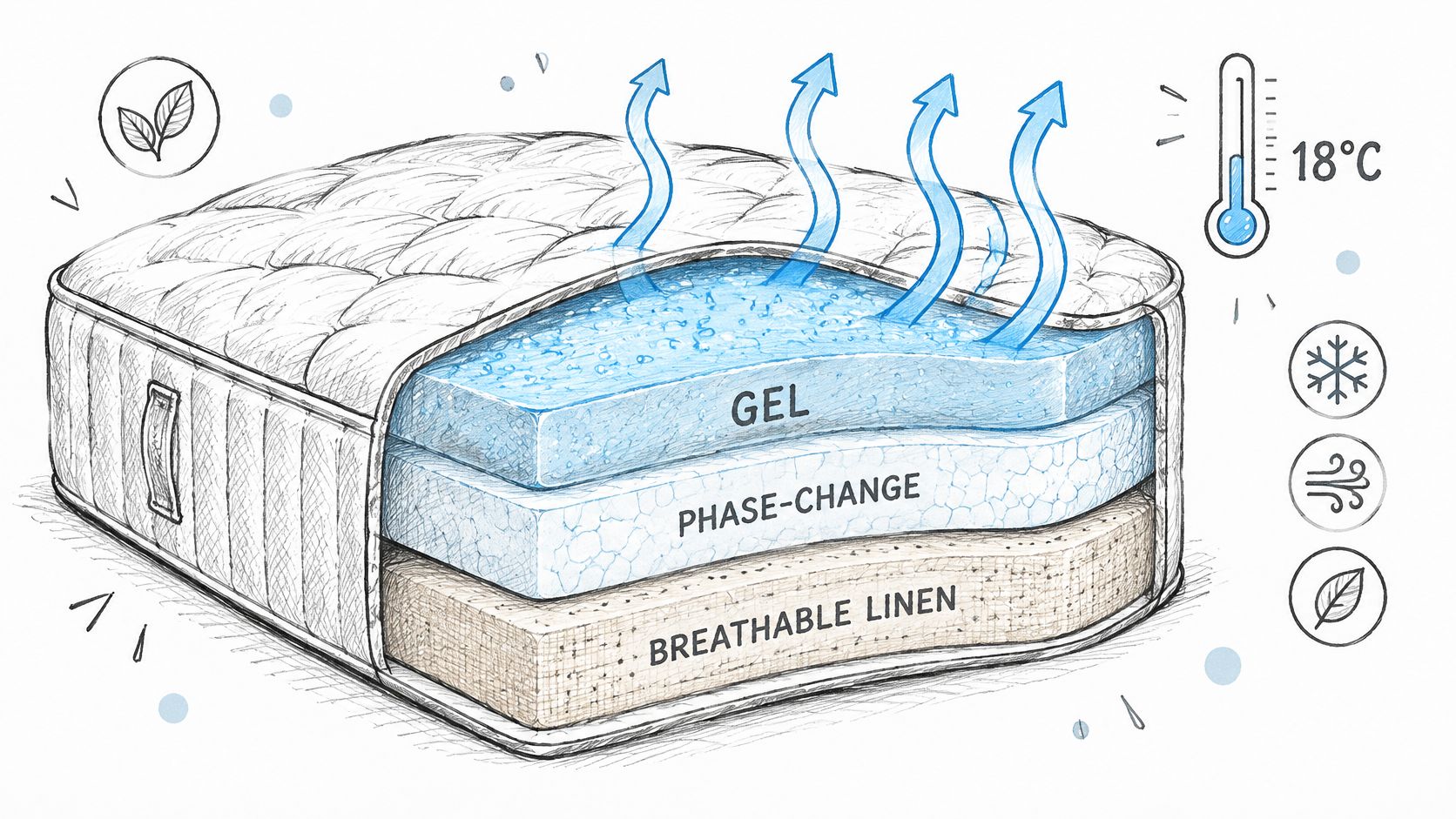
| Criterion | Gel-infused foam | Phase-change layer | Breathable open-cell build |
|---|---|---|---|
| First-contact feel | Strong cool touch | Moderate cool feel | Mild; relies on air movement |
| Sustained heat handling | Cool feel fades under body heat | Absorbs heat until capacity is reached | Moves heat through the structure over time |
| Moisture handling | Poor; dense foam holds sweat | Low; the layer stores heat and does not wick | Strong with linen, cotton, or bamboo and open ventilation |
| Typical limitation | Short-lived cool feel | Finite heat capacity | Does not cool a hot room on its own |
First touch is not an all-night result
Gel feels cold because it conducts heat away from skin for a short time. Once that gel sits at skin temperature, the feel goes. Dense viscoelastic foam then hugs the body and holds humid air in the imprint.
That is why a showroom lie-down of thirty seconds flatters gel and tells you almost nothing about 4am. An open-cell foam, latex, or pocket-spring core keeps channels for air after you settle. Springs and latex tend to let you lie on the surface rather than sink into a sealed pocket. The cover still matters. A polyester knit over an open core can hold dampness even when the inside of the bed is well built. If you want the material logic set out before you compare builds, you can find a temperature regulating mattress and then test those claims against your own room, not against a shop floor.
Phase-change layers have a full point
You wake at 3am damp and too warm, kick the duvet off, then feel chilled ten minutes later. That short spike is where phase-change material earns its place. A phase-change material cover absorbs heat while it shifts state, then gives that heat back later. Useful for the first hour after you get into a slightly warm bed. It works as a buffer for falling asleep, not as an all-night battery. Once the material is saturated, you are back to whatever sits underneath it. I would not pay a large premium for PCM in a bedroom that stays hot until dawn. I would consider it where nights are mostly comfortable and you only overheat as you fall asleep.
Ask for a hot-room comparison
A controlled bedroom test at 30°C is a better benchmark than a cool showroom. Among 17 adults, a cooling mattress topper improved reported thermal comfort and sleep quality versus standard bedding, with actigraphy showing an average increase of 19 minutes in total sleep time and a 10-minute cut in sleep-onset latency, with comfort effect sizes of r = 0.71-0.93, as described by Loughborough University. The sample is small, so treat it as promising, not a guarantee for every sleeper.
Ask the seller for the test room temperature, how long people lay on the product, sleeper weight, humidity, and whether the result includes protector and sheets. A gel photo is not that test.
Look past the labels and examine how gel foams are really built, including the limits covered in this note on gel foam mattresses. If the only evidence is cool-touch technology with no hot-room method, assume you are buying a first impression.
Cooling Protectors Compared With Built-In Cooling
Built-in cooling lives in the mattress core. A protector sits on top of it. The protector cannot redesign foam density, spring gauge or latex openness, but it decides whether the airflow you paid for reaches your skin or stops on night one.
| Protector type | Liquid protection | Airflow | Cooling feel | Best for |
|---|---|---|---|---|
| Standard plastic-backed waterproof protector | Full | Low | Can feel warm underneath | Budget spill protection |
| Breathable membrane protector (Miracle Membrane type) | Full, air permeable | Good | Neutral | Daily use where waterproofing and airflow both matter |
| Tencel Cool protector | Full when a waterproof membrane is included | High at the fibre face | Cool-to-touch fibre | Hot sleepers who want a fibre-based cooling feel |
| Charcoal-fabric protector | Full when sold as a waterproof protector | Good if the backing is an air-permeable membrane | Neutral fabric surface | Buyers comparing fabric options on odour and airflow |
| Unwaterproofed cotton protector | None | High | Neutral | Light dust and dirt barrier only |
The layer that decides the mattress
A plastic-backed sheet handles spills well and handles heat poorly. Sweat vapour has nowhere to go, so the surface turns clammy and the cooling core underneath loses the air movement it was designed for. Put an open latex hybrid under a shiny waterproof sheet and the bed sleeps warmer than the specification suggests.
A breathable membrane is the compromise that works for most UK homes. Liquid stays out. Air still crosses the film. The hand feel stays neutral rather than cold, which suits sleepers who want steady temperature control through the night instead of a cold touch in the first minute. Protect-A-Bed sells this style across Charcoal, Premium, Tencel Cool, and Cotton, in the usual UK sizes, with a thin membrane that stays air permeable.
That distinction matters because surface cooling and room heat are different problems. A membrane protector preserves ventilation around the body. It does not lower a hot bedroom. Close the window on a still August night and no cover corrects the trapped air.
Fibre cooling still needs a match
Tencel Cool is a fibre property. It wicks at the face of the protector, yet a dense foam core below still limits how fast that vapour and warmth can disperse, and the finish suffers if the wash label is ignored and the fibres are washed too hot. Charcoal fabric gives a neutral surface that some buyers choose when comparing odour and airflow options, and it only stays breathable when paired with a membrane backing rather than a solid film. Plain cotton gives a light dust and dirt barrier. It leaves the mattress exposed to drinks, a child's accident, or heavy night sweats.
Score any cover on four practical points. Airflow, liquid hold-out, noise, and wash life. A silent, thin membrane keeps its place through July. A crinkly plastic sheet often ends up folded in a cupboard. If you want the wider case for covering a mattress at all, discover the benefits of mattress protectors before you compare fabrics. For a UK-focused look at membranes that keep air moving, see this guide to a breathable mattress protector.
Match the stack in order. Ventilating core first, breathable protector second, low-tog summer cover third. Change one layer and the whole result shifts.
UK Buying Considerations Before You Pay
Size, tog, and the heat you add yourself
UK mattresses are sold as single, small double, double, king, and super king, and depths differ by model. A protector or topper has to match width and depth. A short cover bunches at the corners, leaves a ridge under the sheet, and traps a pocket of warm air exactly where you sleep.
Duvet tog is the other silent heater. A 13.5 tog winter duvet in a warm bedroom adds heat no mattress can remove. Pair summer nights with a lighter tog, or with a sheet and a thin blanket you can kick off. I would change the duvet before I changed the mattress.
Trial, warranty, and what small print excludes
A cooling claim is almost impossible to judge under shop lighting for five minutes. Look for a home trial of at least one month and a return route that is written down, including who pays collection. Sleep on the full stack, protector included, before you decide.
Read the mattress warranty and the protector warranty side by side. Stains, pet damage, and misuse are often excluded. Heat-related softening of foam is easy to argue about later, so keep the delivery note and a photo of the labels. A long warranty that excludes the comfort layer is thinner than it looks.
Power, permission, and the wash
- Fans and pads. A fan on heatwave nights adds electricity use and a hum. A water pad needs a socket, a reservoir, and a safe lead route so you are not stepping over it at night.
- Renters. Confirm landlord consent before you fix anything to walls, windows, or the frame. A freestanding fan and lighter bedding need no consent.
- Washing. Read the label before you buy. Repeated hot washes can stiffen membranes and flatten fibre finishes that were sold as cooling.
A cheap protector that you can wash on the cycle you already use will beat a delicate cooling cover that has to be replaced after one boil wash.
Measure the Room and Choose Your Setup
A cool label means little if the bedroom itself holds heat through the night. Start with three nights of readings taken at bed height, with the usual duvet on the bed. Note the nightly low and the nightly high. A single evening reading from the landing misses the 2am peak when sleep is lightest.
Separate a warm sleeper from a hot room before you spend. If the room stays uncomfortable all night, sort airflow, curtains and bedding weight first. If the room sits in a comfortable band and you still wake warm and damp, the sleep surface and the layers directly above it deserve attention.
Government monitoring of homes found UK bedrooms exceeded 26°C for an average of 54 minutes per day in summer 2025, compared with 23 minutes in 2024, and Government monitoring of homes found bedrooms exceeded 26°C for an average of 4.7 hours after heatwave days. In a 2025 UK experiment, Loughborough University researchers found that mean night-time bedroom temperatures above 29°C degraded sleep quality and thermal comfort among 22 participants. Past that point, I would not expect a new surface to carry the night on its own.
Use a logged week to make the decision concrete:
Night 1 to Night 3, lighter tog and window cracked open. Record bedtime temperature, 2am temperature, wake ups, and whether sheets felt damp. Night 4 to Night 7, add a breathable waterproof protector under the same sheet. Keep the duvet, the room, and the bedtime the same.
Compare the two blocks. Fewer wake ups and drier sheets in the second block point to sweat and liquid vapour trapped at the surface. No change across the week points to room heat, a duvet tog that is too high, or poor airflow. That distinction tells you whether to change the bedding stack or the ventilation.
Match the setup to the home
| Situation | Best setup | Why it fits | Watch for |
|---|---|---|---|
| Bedroom under 19°C, sleeper runs warm | Breathable mattress with cotton or linen cover | Airflow and natural fibre do the work | Tog rating of duvet too high for the room |
| Heatwave nights above 26°C | Breathable setup plus active airflow | Surface cooling cannot offset room heat | Running cost and noise of fans |
| Spills, children or pets | Breathable waterproof protector | Liquid barrier without sealing in heat | Membrane airflow and wash instructions |
| Dust mite allergy | Protector with a fine-weave membrane | Blocks dust mite allergens | Washing temperature set by the label |
| Renter or top-floor flat | Protector plus fan and lighter bedding | Mattress change does less than reducing heat | Landlord consent for fixed equipment |
If the room is already in a comfortable band and you still wake warm, choose open construction and a breathable waterproof protector, then test that pair through the same week log. If the room itself is hot, add airflow first and only then decide whether a premium surface is worth the money.
Protect-A-Bed makes waterproof mattress protectors with an air-permeable membrane, including Tencel Cool and other fabric options, so you can keep spills and sweat off the mattress without sealing in heat. A protector that stays breathable after washing keeps the whole bedding stack working as intended. Visit Protect-A-Bed to match a breathable protector to your mattress size before the next warm spell.