

Mattress Protector Small Double Cotton Fit Guide

You've found a protector labelled small double, chosen cotton because you want a comfortable sleep surface, and assumed the fit would take care of itself. Then a corner lifts, the skirt won't reach underneath the mattress, or the fabric description leaves you wondering whether it's waterproof at all. The way to avoid that disappointment is to check the footprint, fitted depth and fabric construction separately.
Table of Contents
- Why Small Double Cotton Protectors Confuse Buyers
- UK Small Double Sizes and Related Names
- Cotton Fabric Qualities on a Mattress Protector
- Standard Fit and Deep Fit Compared
- Choosing Cotton with Miracle Membrane
- Allergy Protection Versus Everyday Comfort
- Washing Care and Mattress Longevity
- Small Double Size-Check Before You Buy
Why Small Double Cotton Protectors Confuse Buyers
Three separate checks decide whether a small double cotton protector works on your bed: the footprint it was cut for, the depth it can stretch over, and the layers hidden behind the word cotton. Shoppers regularly check the first, occasionally check the second, and almost never check the third.
That order is understandable, because the footprint feels like the obvious part. A mattress labelled 120 × 190 cm seems to answer the size question on its own. It doesn't. A fitted protector still needs pocket depth to cover the mattress plus any topper, and it needs a construction that matches the job you bought it for.
Separate the jobs before choosing the cover
A protector can serve different purposes, and the product needs to match the job you're asking it to do.
- Liquid protection: You want a barrier against spills, accidents or perspiration reaching the mattress.
- Surface comfort: You want a fabric that feels suitable beneath your fitted sheet, without assuming that a fibre name guarantees a particular sleeping temperature.
- Mattress coverage: You want to reduce what reaches the sleep surface during everyday use, with coverage that stays in place.
Those needs overlap, but they aren't interchangeable specifications. An absorbent textile isn't necessarily a liquid barrier, and a comfortable surface isn't proof of allergen protection. The distinction between the textile face and any backing is an important part of the complete mattress-protector specification.
Buying rule: Choose the protection you need, then check how the complete cover delivers it. Don't let the word cotton answer every question.
A cotton face can sit above a separate waterproof membrane, the way a lined jacket pairs a soft inner fabric with a weatherproof outer layer. A product described as cotton may still contain other materials, each doing a different task. Read the description of the whole protector rather than stopping at the first fabric word.
Start with the problem you're trying to solve
If a cover keeps riding up or pinging off the corners, depth is the suspect. Measure the mattress with the topper in place before blaming the size label. If liquid protection matters, look for a named membrane or barrier layer rather than assuming cotton alone can block a spill.
Parents protecting a child's small double will usually want to settle liquid protection and washability together. Landlords and small hospitality operators should distinguish an everyday fitted protector from an encasement built for a sealed-barrier job.
For households managing asthma or rhinitis, a reassuring fabric label says little about allergen control. Comfort, reduced exposure and symptom improvement are three different claims, and each needs its own evidence. A cotton face can make a protector nicer to sleep on without making it better for allergies.
UK Small Double Sizes and Related Names
Small double, 4 ft, three-quarter and 3/4 are closely related UK shopping terms. The conventional small-double mattress footprint is 120 × 190 cm, equivalent to 4 ft × 6 ft 3 in; it is 30 cm wider than a UK single and 15 cm narrower than a standard double, while sharing their length.
Treat those names as signposts pointing you toward the measurements. A listing can use a familiar bed name prominently while leaving the actual fitted dimensions further down the page. A size label works like a clothing size: useful as a starting point, meaningless until you check the tape-measure figures behind it.
UK mattress footprints next to a small double
The table shows the width relationships in practical terms, so you can see exactly what each neighbouring size would do to your cover.
| Size name | Width | Length | What a wrong protector does |
|---|---|---|---|
| UK single | Small-double width minus 30 cm | Same as small double | A single protector won't provide full lateral coverage |
| UK small double, 4 ft or three-quarter | 120 cm | 190 cm | The intended footprint, provided the fitted depth also matches |
| UK standard double | 135 cm | 190 cm | A double protector can leave excess fabric around a narrower mattress |
The distinction is easy to miss because the lengths match. A cover can look correct when you lay it along the bed, yet still be wrong across the sleeping surface. Pulling harder at the corners won't turn it into the right size.
A larger protector isn't automatically a safer choice either. Excess fabric can make corner seating less precise, while a smaller cover may leave parts of the mattress uncovered. Choose the intended footprint rather than trying to compensate with stretching or tucking.
What the label doesn't tell you
For a clearer explanation of the bed category itself, use the small-double mattress size guide. It's useful when you're checking a mattress description against the bedding you already own.
Depth is a separate measurement, and it varies widely by construction. A pillow-top mattress sits taller than a basic foam one, and a topper adds further height the skirt has to wrap around. Measure your own mattress rather than assuming a standard-depth protector will grip it.
Before shopping, write down the mattress's width and length from a direct measurement or its specification. Keep that note separate from the depth figure, particularly if you use a topper.
Trust the printed centimetres over the search name. Once the footprint is confirmed, the standard-versus-deep decision should depend on the full height the protector must cover, whatever the mattress happens to be called.
Cotton Fabric Qualities on a Mattress Protector
You pick up two small double protectors. Both labels say cotton. One feels like a towel, the other like a bedsheet, and only one claims to stop liquid. The word cotton alone cannot explain that difference, because it names a fibre, not a finished product.
A raincoat works the same way. The outer layer might be cotton canvas and still keep you dry, but only because a coating underneath does the waterproofing. On a protector, the cotton face and the liquid barrier are two separate checks, and the label wording tells you where to start asking.
| Label wording | What it describes | What it will not tell you |
|---|---|---|
| Cotton terry | A looped, towel-like sleep surface | Whether anything beneath it stops liquid |
| Woven cotton | A flat, sheet-like construction | The waterproofing, if any exists |
| Cotton-rich | A blend with other fibres | Which fibres, or in what proportion |
None of these phrases is a quality ranking. Each is a prompt to look closer.
If a listing says only cotton, ask which part of the protector that describes: the sleep surface, the entire textile construction or a blend. A useful answer identifies the face fabric separately from the skirt and the backing, because each can be made from something different.
The membrane earns its own questions. The seller should explain its role, its composition and the area it covers. Sleeping-surface protection and side protection are not automatically the same thing, so check whether the liquid barrier extends down the sides or covers only the top panel. A fitted skirt holds the protector in place, which is a different job from carrying a barrier.
One more confusion is worth clearing up. A natural fibre face does not mean a healthier bed. Cotton's softness and breathability are real comfort traits, but comfort and allergen control are handled by different parts of the construction. Prefer the feel of cotton if you like it. Just read the barrier specification as its own decision, because that is what you are buying.
Standard Fit and Deep Fit Compared
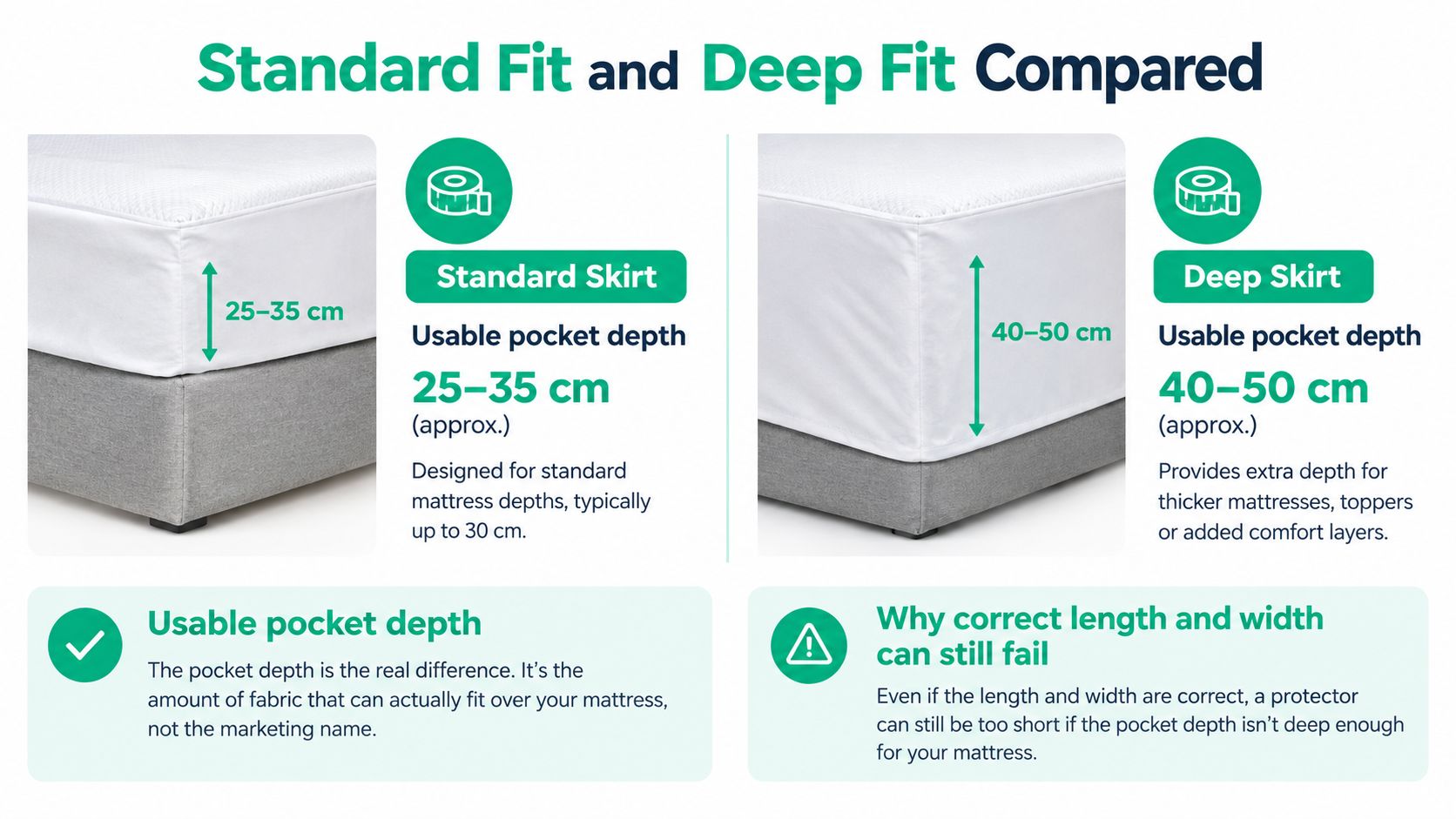
A small double can fit across the top and still be too deep for the protector's skirt. Check the mattress footprint, then check the full height the fitted cover needs to accommodate.
Measure the mattress and topper
Stand a tape measure vertically against the mattress side. Measure from its base to the top of the sleeping surface, keeping the tape straight rather than following a rounded edge.
If you use a separate topper, measure its depth and add it to the mattress depth. Or measure the assembled bed from the mattress base to the top of the topper. Do not add the topper twice if it is already included in that total.
Compare your measurement with the protector's stated fitting range. A reliable choice needs a declared range that accommodates the mattress depth and any topper, rather than relying on width and length alone.
| Fit description | What to establish | When to choose it |
|---|---|---|
| Standard skirt | Its usable fitted-depth range | Your measured total falls within that range |
| Deep skirt | Its stated capacity and intended fit | Your mattress and topper need the additional depth |
| Unspecified skirt | Whether the seller can confirm compatibility | Only after the missing measurement is clarified |
A skirt that is too shallow may pull upwards, expose the mattress sides or lift at the corners when you make the bed. Forcing it down can strain seams and a laminated barrier. The elastic cannot make an unsuitable depth range fit.
Check the fit in use
If you can inspect the fitted cover, check the corners, edges and underside, not just the top panel:
- Seat every corner: Each should sit around the mattress without being pulled tight over its upper edge.
- Make the bed normally: Check whether the protector shifts as you arrange the sheet.
- Apply ordinary edge pressure: Sit on the bed and look for corners lifting or seams straining.
- Check the underside: Confirm the skirt reaches as far as the design intends.
For more detail on choosing a protector for a deeper mattress, read the guide to protectors for deep mattresses. Ask for the usable pocket-depth range if the product is labelled “deep fit” but gives no measurement.
Check the care instructions and return conditions before washing or testing the protector beyond the seller's permitted inspection. A fit that works before laundering also needs to remain usable afterwards.
Choosing Cotton with Miracle Membrane
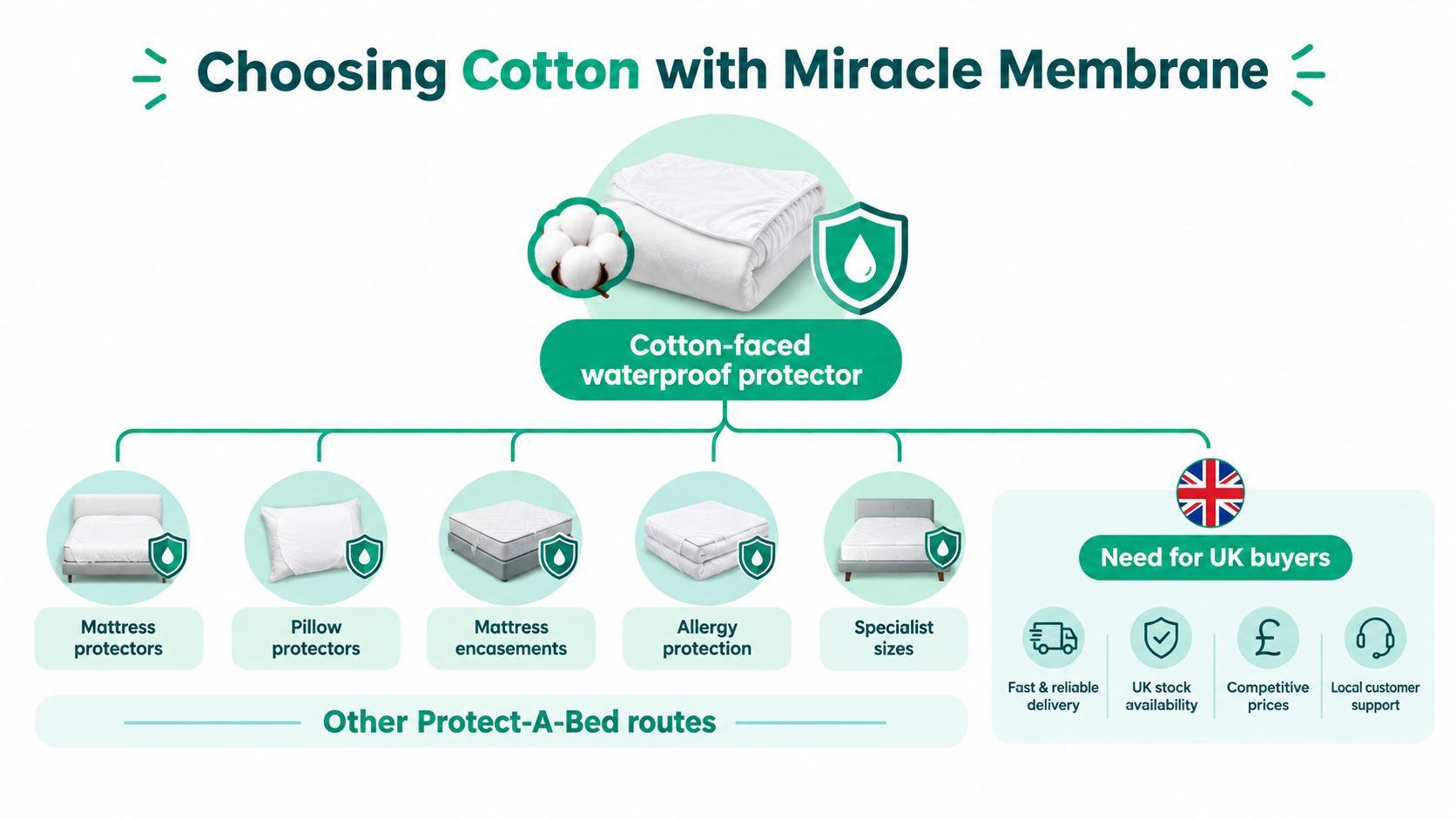
Choose a cotton-faced waterproof protector when you want a familiar textile surface and a separate liquid barrier. Compare other fabrics when surface feel is your main concern, and an encasement when you need a product designed to surround and seal the mattress.
Protect-A-Bed offers cotton-faced protection alongside Premium, Charcoal and Tencel Cool options, plus separate bed-bug encasements. Its product descriptions present Miracle Membrane as a flexible, silent, thin layer that remains air permeable while blocking liquids, sweat, dust mites and allergens. Treat that as a description of the barrier's intended performance, not as evidence that the cover will improve a medical condition.
Match the route to the household
Cotton is a sensible option to investigate if your priority is a familiar sleep surface combined with protection against everyday spills and perspiration. A parent choosing bedding for a small double, for example, may value a washable fitted design without wanting a noticeably different surface beneath the sheet.
A hot sleeper has a different decision to make. Compare the stated construction and intended feel of the available fabrics, including cooling-oriented options, rather than assuming cotton must be the coolest choice. Air permeability and a promise of comfortable sleep aren't the same claim.
The choice can be organised by need:
| Your main concern | Product route to investigate | Detail to verify |
|---|---|---|
| Spills and perspiration | Cotton-faced waterproof protector | Barrier coverage and care instructions |
| A different surface feel | Alternative protector fabrics | Full fabric composition and construction |
| Sleeping hot | Cooling-oriented fabric options | Specific, bounded cooling claims |
| Bed-bug protection | Purpose-designed encasement | Enclosure design and stated barrier performance |
Don't ask a fitted protector to become an encasement
For a landlord or host concerned about bed-bug harbourage, the product's enclosure design matters more than the appeal of the top fabric. A daily fitted cover and an encasement are different purchasing routes. Check that the specific encasement is intended for the problem you need to address.
The same principle applies to allergen sealing. A statement about a membrane doesn't, by itself, tell you how completely a finished cover encloses the mattress. Examine the entire product, not just the barrier material.
Before ordering, check current UK stock, delivery information and the warranty terms applicable to the particular product. Look at what the warranty covers, what care conditions apply and what information you should retain.
Return to your depth note before making the final choice. Membrane technology can address barrier performance, but it can't compensate for an incompatible fitted skirt.
Allergy Protection Versus Everyday Comfort
A parent buys a small double cotton protector because their daughter wheezes at night, and the word "allergy" on the packaging feels like an answer. Slow down here, because three different jobs tend to get bundled into one purchase.
The first job is keeping drinks and perspiration off the mattress. The second is reducing exposure to dust-mite allergens. The third, the one the parent actually wants, is fewer symptoms. A protector can perform the first job reliably. The second depends on the barrier and on how completely the cover encloses the mattress. The third is a medical outcome, and bedding marketing cannot promise it.
That gap shows up clearly in the research. UK-focused literature discusses allergen-impermeable mattress encasings and washing bedding above 55°C, because those temperatures can kill dust mites and semi-permeable covers can reduce mite-allergen levels. Yet the largest reported randomised trial of mite-impermeable covers, involving more than 1,000 adults with asthma, found no improvement in primary or secondary clinical outcomes, and a separate allergic-rhinitis trial found no benefit either, as summarised in this clinical review of house-dust-mite avoidance. Lower allergen exposure measured in a study does not automatically become a better night's breathing.
Match the claim to the job
Worried about spills and sweat? Judge the liquid barrier on its stated waterproofing and on how it launders.
Worried about mite allergens? Look for evidence about the specific barrier and the finished cover, because a washable fitted top and a fully sealed encasement are different designs.
Worried about asthma or rhinitis symptoms? Take that question to a clinician rather than a product page.
A lower allergen count and a better night's breathing are different outcomes. Don't accept one as proof of the other.
The encasement route covered above is worth investigating when enclosure is part of the requirement, although a bed-bug claim and an allergen-barrier claim answer different questions and should be evidenced separately. Temperature guidance needs the same care: the washing levels cited in clinical literature are not permission to run every protector that hot, since the membrane, elastic and seams all live under the sewn-in care label.
The settled position for an allergy-aware household is modest and honest. Choose a tested barrier if reducing exposure is the goal, keep expectations realistic about what that can deliver, and handle symptoms as a separate conversation. A cotton face can still earn its place on the bed for comfort alone, which is reason enough to buy one.
Washing Care and Mattress Longevity
A protector can come out of the wash looking cleaner and still fail at the corners. The elastic may have tightened, the skirt may have shrunk, or the backing may have started to peel away from the cotton face. Clean and serviceable are separate checks.
Use the sewn-in care label as the recipe for the whole item. A small double protector is one finished product made from fabric, elastic, dyes, stitching and often a waterproof membrane, so the wash routine has to suit the weakest layer in that stack. A hotter cycle or stronger detergent is not automatically kinder to every part, even when the top feels like ordinary cotton.
Before the first wash, read the label and any leaflet in the packaging. Confirm the wash temperature, drying method, spin guidance, bleach restrictions and whether tumble heat is allowed. If the instructions are vague, ask the seller before using a routine copied from sheets.
For method detail, use the mattress-protector washing guide beside your own label, with your product instructions taking priority.
After drying, give the protector a short once-over before it goes back on the bed. Seat each corner and compare the tension with the fit it had before laundering. Run a hand along the seams for pulling or gaps, look at the backing where the construction lets you inspect it, and check that the surface still lies flat without loose ripples or exposed edges. The cotton face and the membrane deserve separate judgement: one can feel soft while the other has lost the barrier you paid for.
If the fit has changed, measure again instead of forcing the skirt over the mattress and topper. If the backing looks cracked, bubbled or separated, treat the protection claim as unfinished until the seller confirms the next step.
Longevity claims need the same calm reading. WRAP estimates that about 169,000 tonnes of mattresses enter the UK waste stream each year and that only 14.7% are reused, recycled or recovered for energy, while a bulky-waste study found more than 25% of mattresses assessed at household waste and recycling centres were very clean, as recorded in WRAP's guidance on items for re-use. Those figures show disposal pressure, not a guaranteed number of extra years for any one mattress.
The useful aim is simpler: limit preventable surface damage from perspiration, spills, stains and routine wear. A protector supports that aim when laundering follows the label, the fit stays secure and the barrier remains intact.
Small Double Size-Check Before You Buy
Use your measurements and the product specification together. A familiar size name, attractive fabric description or reassuring waterproof claim shouldn't replace a missing compatibility detail. If something important isn't stated, ask before ordering.
The following lookup keeps the decisions in the order you can verify them. Refer back to the named guidance when you need the reasoning, rather than trying to make every decision from a product photograph.
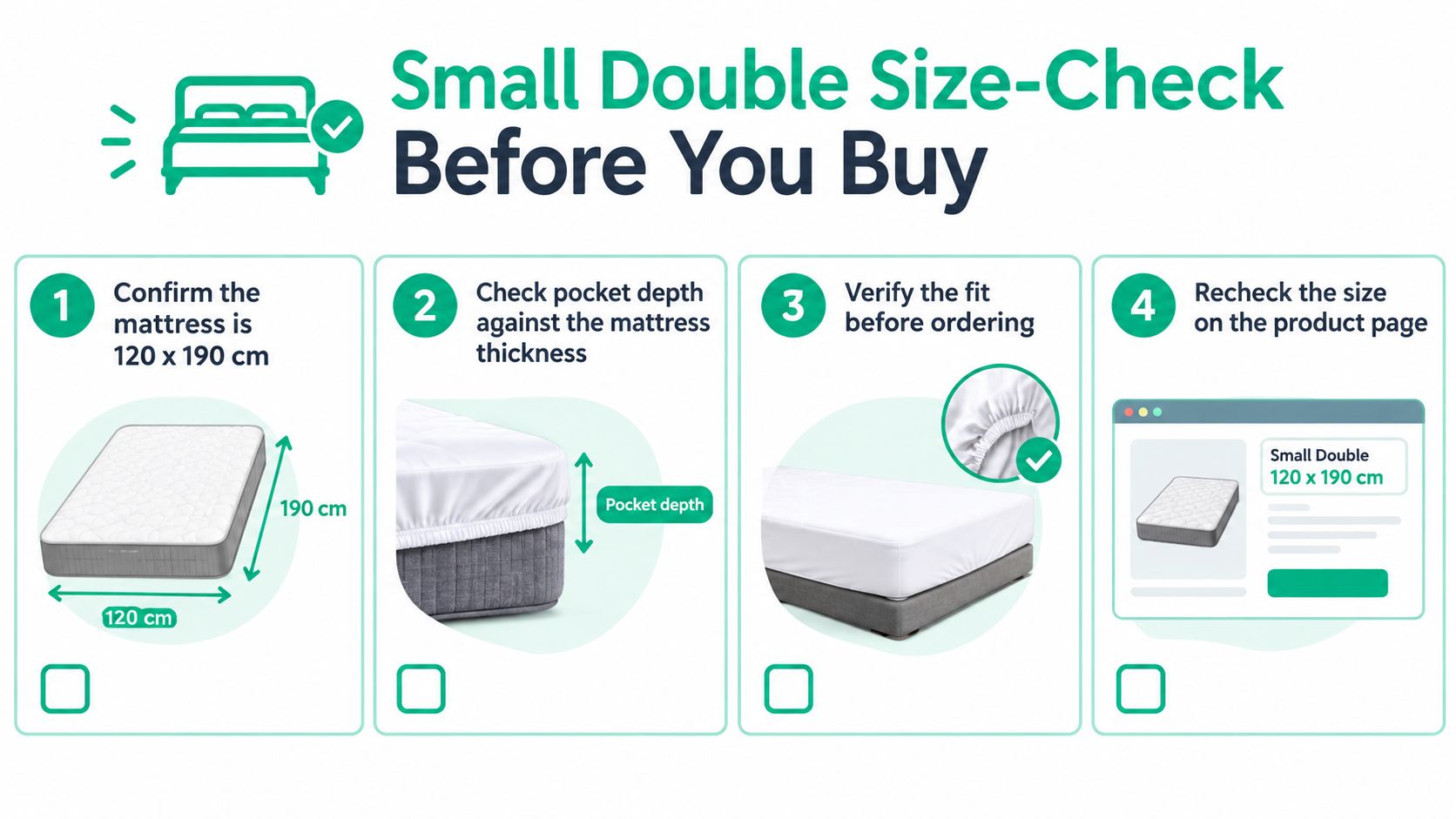
Run the purchase checks in order
- Confirm the footprint. Compare your mattress measurements with the nominal small-double dimensions established in UK Small Double Sizes and Related Names. Don't substitute a single or standard double because the length looks right.
- Include the topper in the depth. Use Standard Fit and Deep Fit Compared to check the full height being covered. Match that measurement to a declared usable range, not merely the word deep.
- Identify the sleep surface. Use Cotton Fabric Qualities on a Mattress Protector to distinguish terry, woven and cotton-rich descriptions. Read the full composition where it's provided.
- Find the liquid-barrier specification. Use Choosing Cotton with Miracle Membrane to distinguish the textile face from the backing. Confirm which areas of the finished cover receive barrier protection.
- Choose the correct product type. Decide whether you need an everyday fitted protector or an encasement. For allergy-related goals, use Allergy Protection Versus Everyday Comfort to keep exposure claims separate from symptom expectations.
- Read the care instructions before buying. Check Washing Care and Mattress Longevity against your household's laundry arrangements. Don't assume that a preferred hot cycle is permitted.
Resolve missing details before checkout
A search for mattress protector small double cotton is a useful way to find the category. It isn't a complete specification. Keep a written note of the footprint, total depth and protection you need beside you while comparing product information.
If a page lists package dimensions, a nominal skirt size and a maximum fitting depth, don't assume they mean the same thing. Ask which measurement describes usable mattress compatibility and whether it includes a topper.
For a shared household or guest property, keep the care instructions accessible to whoever washes the bedding. A carefully chosen cover still needs consistent handling after it arrives.
Buy only when the footprint and pocket depth both match. If allergen sealing or bed-bug protection is the priority, investigate the relevant encasement specification instead of asking a cotton fitted protector to perform an unverified job.
Protect-A-Bed offers cotton-faced waterproof mattress protection and separate encasement options for different household needs. Measure your mattress and topper, then visit Protect-A-Bed to check the small-double option's fitted-depth range, care instructions and applicable delivery and warranty support before ordering.