

Small Double Bed Mattress: UK Sizing and Buying Guide

You've measured the box room, allowed for the wardrobe, and discovered that a standard double leaves barely enough space to walk past. A small double bed mattress looks like the sensible answer. It gives a solo sleeper more freedom than a single and appears to preserve the option of occasional guests.
That logic is sound, but only if you understand what you're giving up. A UK small double isn't a compact double. It has its own dimensions, bedding requirements and long-term comfort compromises, particularly when two adults share it every night.
Table of Contents
- Why Small Double Beds Are Tricky to Get Right
- Exact UK Dimensions and How They Compare
- Choosing the Right Mattress Type and Firmness
- Sizing Sheets Duvets and Protectors Correctly
- When a Small Double Works and When It Does Not
- Protecting a Smaller Sleep Surface from Wear and Allergens
- Your Small Double Buying Checklist
Why Small Double Beds Are Tricky to Get Right
A small double often enters the conversation after a familiar bedroom calculation. The bed has to fit beneath a sloping loft ceiling, between two walls in a Victorian terrace, or inside a box room where every piece of furniture competes for floor space. A standard double seems too wide, while a single feels limiting, so the small double looks like the neat middle ground.
For one adult, it often is. The extra width makes turning, reading and stretching out more comfortable than on a single. The problem starts when two people treat it as a full-time couple's bed rather than a compact occasional solution.
A UK small double measures 120 cm wide, while a standard double measures 135 cm wide, and both are 190 cm long according to this UK bed and mattress size guide. That missing 15 cm comes entirely from the width. There's no extra legroom to compensate for the narrower sleeping surface.
The practical reality: two adults sharing a small double have less personal room, so shoulder contact, partner movement and edge pressure become more noticeable.
Bedding creates a second problem. Standard double fitted sheets can be loose across the mattress, while single bedding is too narrow. A protector that fits the width but ignores mattress depth can ride up at the corners, especially on a deep foam or hybrid model. Measure the mattress from the base to the highest sleeping surface before ordering, using this guide on how to measure mattress depth.
The smaller surface also concentrates use. Two sleepers repeatedly occupy similar central zones, leaving less spare area for movement and rotation. That doesn't make a small double automatically poor value, but it does make construction, edge support and protection more important than they are on a casually used guest bed.
Exact UK Dimensions and How They Compare
The first rule is simple. Buy by centimetres, not by the word “double”. UK, European and overseas sizing names don't reliably match, and a frame, mattress and sheet set must share the same standard.
A UK small double mattress is 120 cm by 190 cm, or 4 ft by 6 ft 3 in, as listed in this UK mattress size guide. The mattress footprint is therefore 2.28 square metres, calculated from its stated width and length. The frame may occupy more room because of side rails, upholstery, a headboard, a footboard or storage mechanisms.
The width difference you'll feel
A standard single is 90 cm wide and 190 cm long. A small double gives you 30 cm more width than a single, which is a meaningful improvement for one person who changes position or likes to spread out.
A standard double is 135 cm wide and 190 cm long. The small double is 15 cm narrower, but it doesn't lose any length. That makes it a good upgrade from a single for one sleeper, but a compromise for a couple who needs more shoulder and elbow room.
A UK king measures 150 cm by 200 cm. It adds width and length, but it also requires a materially larger bedroom footprint and a suitable frame. Don't assume that a room which accepts a small double will comfortably accept a king once walking routes, drawers and wardrobe doors are considered.
UK mattress size comparison
| Mattress Size | Width | Length | Total Area | Best For |
|---|---|---|---|---|
| Single | 90 cm / 3 ft | 190 cm / 6 ft 3 in | 1.71 m² | One child, teenager or adult |
| Small double | 120 cm / 4 ft | 190 cm / 6 ft 3 in | 2.28 m² | One adult, teenager or guest room |
| Double | 135 cm / 4 ft 6 in | 190 cm / 6 ft 3 in | 2.57 m² | Two adults where space is limited |
| King | 150 cm / 5 ft | 200 cm / 6 ft 6 in | 3.00 m² | Couples wanting more room |
These areas are calculated from the published width and length for each UK size. The small double is also described as a “queen” size in parts of the UK market, so check the measurements rather than relying on the label. A listing that says “queen” without a metric footprint deserves caution.
Length causes a separate issue. The 190 cm mattress length suits many sleepers, but taller adults may find the usable space restrictive, particularly if they sleep close to the edge or use a substantial pillow. If you're buying online, check whether the product is UK small double rather than a 120 cm by 200 cm international variant.
Choosing the Right Mattress Type and Firmness
A narrow bed exposes weak mattress design quickly. If the edges collapse, the sleepers roll towards the centre. If the surface transfers movement, a partner turning over can disturb the other person. If the comfort layers are too deep and soft, the mattress can feel like a narrow ledge rather than a stable sleep surface.
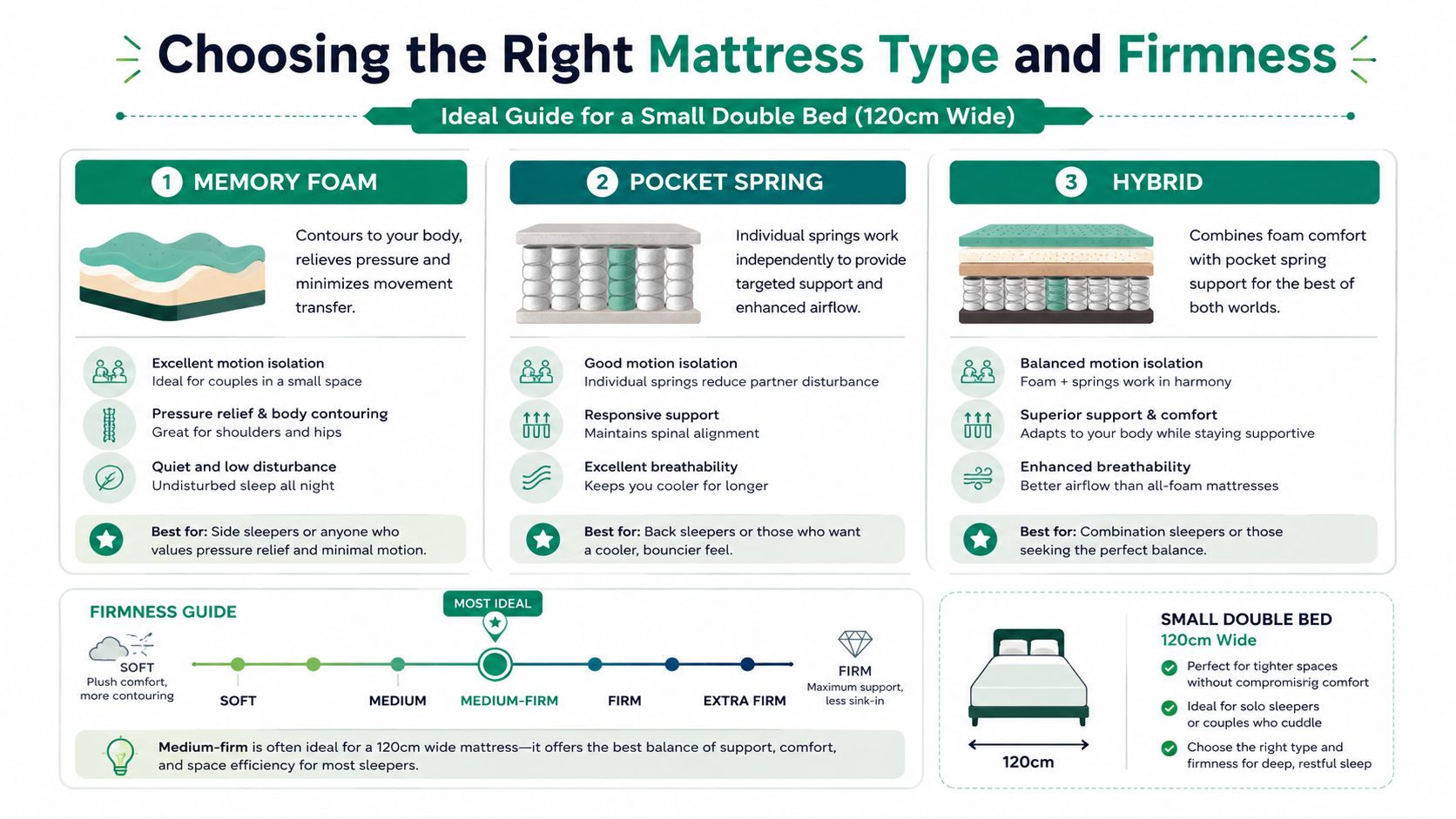
Compare the main constructions
Memory foam is a strong choice for couples who are sensitive to movement. It absorbs motion rather than passing it across a connected spring network, and it can cushion shoulders and hips on a firm base. The drawback is heat retention on some designs, so look for breathable covers and sensible layering rather than an excessively deep soft top.
Pocket sprung mattresses use individually contained springs, allowing more localised support than basic connected spring systems. On a small double, strong edge reinforcement matters because each sleeper has less room to move away from the perimeter. A well-built pocket spring model can feel steadier when sitting near the side and can support different body weights across the same mattress.
Open coil mattresses are usually straightforward and economical, but they're not my first recommendation for two adults on a small double. Connected coils can transmit movement, and weak perimeter support makes the centre feel like the only dependable sleeping zone.
Hybrids combine springs with foam comfort layers. They can offer a useful balance of airflow, support and pressure relief, provided the upper layers don't allow excessive sink. A medium-firm hybrid is often the safest couple-friendly starting point for this size.
Latex offers responsive cushioning rather than the slower sink of memory foam. It can suit sleepers who change position often, although the feel is more buoyant and won't appeal to everyone.
Match firmness to how the bed is used
A solo sleeper can usually choose medium-soft to medium if pressure relief is the priority. Side sleepers often prefer enough cushioning around the shoulder and hip, while back and front sleepers normally need a more stable surface.
Couples should generally begin with medium-firm, particularly when they have different body weights or sleeping positions. Excessively soft comfort layers allow both sleepers to drift towards the middle, worsening the confined feeling. Excessively firm surfaces can create pressure points, so don't confuse firmness with support.
Before adding a topper, check what a mattress topper does. A topper can alter surface comfort, but it can't repair poor edge support or turn an unsuitable small double into a spacious couple's bed.
Sizing Sheets Duvets and Protectors Correctly
Small double bedding is where many otherwise sensible purchases go wrong. The mattress is wider than a single but narrower than a double, so generic bedding often leaves you choosing between excess fabric and inadequate coverage.
Start with the fitted sheet. Buy one labelled small double, 4 ft, or 120 cm by 190 cm, and check its maximum mattress depth. Width and length alone aren't enough. A fitted sheet designed for a shallow mattress may pull off a deeper model, while a very generous pocket can leave loose fabric beneath the sleeper.
Bedding choices at a glance
| Bedding Item | Recommended Size | Common Fit Issue |
|---|---|---|
| Fitted sheet | Small double, 120 cm by 190 cm | Incorrect depth causes lifting or wrinkles |
| Flat sheet | Small double where available | Double size can create excess side fabric |
| Duvet cover | Small double if available | Single can leave poor side coverage |
| Mattress protector | Small double, matched to depth | Wrong width creates slack or corner tension |
| Encasement | 120 cm by 190 cm, matched to depth | A loose seal can reduce retention and coverage |
A single duvet can look tidy on a small double, but it may leave less coverage at the sides when two people share the bed. A standard double duvet offers more overhang, though it can feel bulky and may drag towards the floor on a low frame. Choose based on whether the bed is primarily for one person or regular sharing, then use duvet clips if the filling shifts inside the cover.
Protectors need exact measurements
A mattress protector should follow the mattress profile rather than merely approximate the bed category. The guide to protectors for deep mattresses is useful when a thick comfort system makes ordinary fitted protection unreliable.
Look for a breathable waterproof membrane if spills, perspiration or allergy control are concerns. An encasement needs enough depth to close around the mattress without forcing the zip or leaving loose corners. Measure the mattress with its cover on, including the highest quilted section, and keep the retailer's return policy available in case the stated depth doesn't match the product.
Order by the mattress, not the frame. The frame tells you the category. The mattress measurements determine whether the bedding will stay in place.
When a Small Double Works and When It Does Not
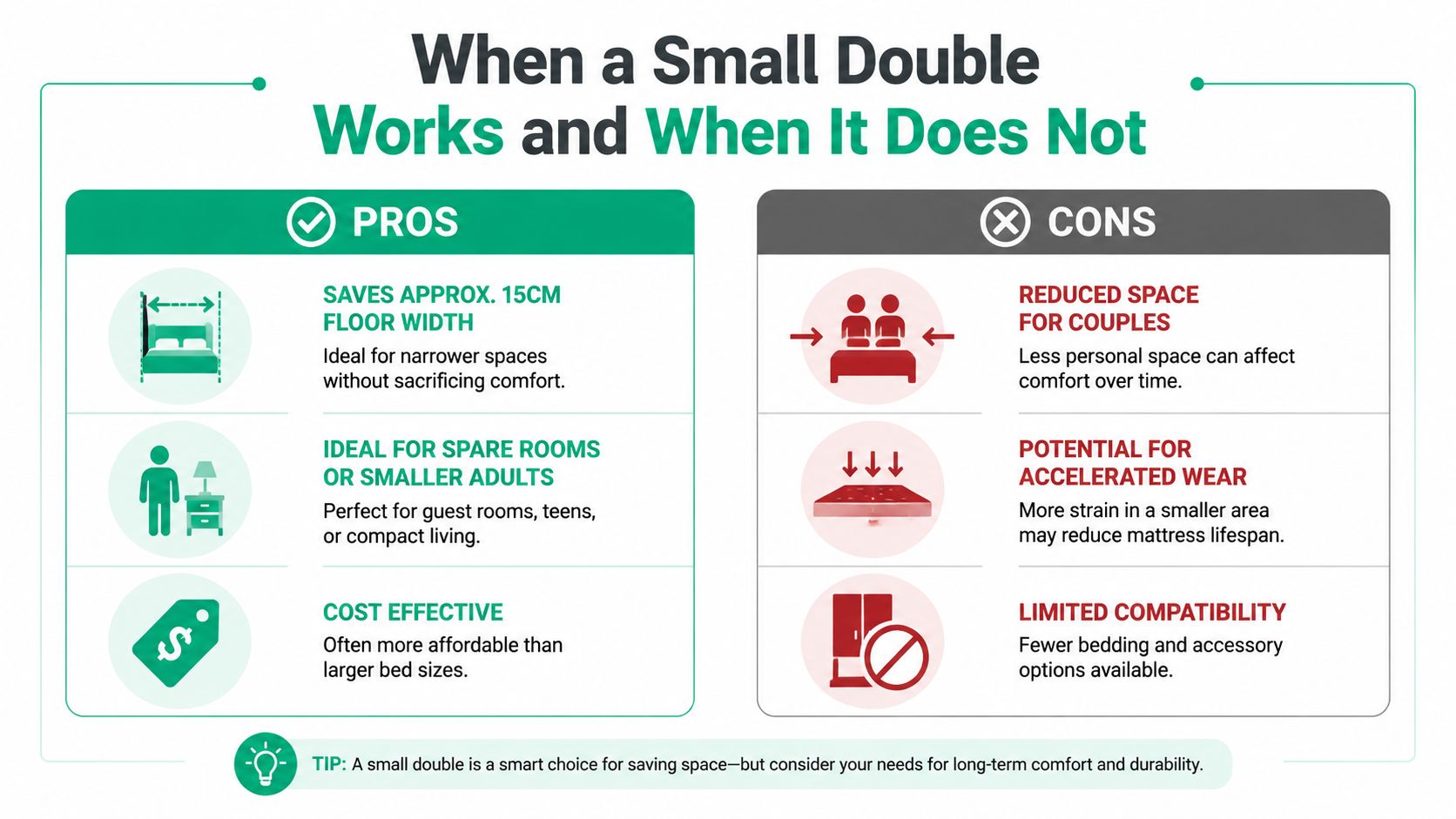
The small double makes sense when floor space is the limiting factor and one person will use the bed most of the time. It gives a solo adult a more forgiving sleep surface than a single without demanding the room required by a standard double.
It also suits a teenager moving on from a single, a spare bedroom in a compact terrace, or a guest room where two people may stay occasionally rather than nightly. In those situations, the reduced footprint can preserve useful space for storage, a desk or a clear route around the room.
The couple test
For two adults, the arithmetic is unforgiving. A 120 cm mattress gives approximately 60 cm per person, before either sleeper moves towards the other or avoids the edge. That's less personal width than a standard double provides, and the loss is felt most by restless sleepers, broad-shouldered adults and couples with different schedules.
Partner disturbance also becomes more consequential on a narrower surface. A movement near the centre can reach the other sleeper more easily, while a person trying to avoid disturbance may end up sleeping close to the edge. Good motion isolation helps, but it can't create additional room.
My recommendation: choose a small double for regular solo use, occasional couple use, or a room where a standard double genuinely cannot work. If two adults will share it every night, buy the widest size the room can accommodate.
Measure the whole room
Don't measure only the mattress recess. Measure the external bed frame, then mark that footprint on the floor with tape. Open wardrobe doors, account for storage drawers and check whether you can walk comfortably around the occupied space.
If a standard double appears close to fitting, test it with furniture in its real positions. A saving of 15 cm of mattress width can matter in a tight room, but it shouldn't automatically outweigh nightly sleep quality. Taller adults should also treat the 190 cm length as a deciding factor rather than an afterthought.
Protecting a Smaller Sleep Surface from Wear and Allergens
Protection matters more on a small double because the same sleeping zones receive repeated pressure. Two people can occupy much of the available width every night, concentrating body weight, perspiration and skin debris across a limited surface. A protector won't prevent every type of wear, but it creates a washable barrier between the sleeper and the mattress.
For allergy control, choose a genuine dust-mite barrier rather than a thin decorative cover. The North West Allergy Network guidance on house-dust-mite avoidance explains that proof covers on mattresses and pillow cases prevent mites and their faeces from reaching bedding. That makes sealed protection especially relevant when two occupants share a compact sleep surface.
Use a practical protection routine
- Choose breathable waterproof protection: A membrane should block liquids while allowing air movement, so the bed doesn't become clammy.
- Use an encasement for barrier control: A six-sided cover provides more complete separation from the mattress than a fitted top-only protector.
- Rotate when the manufacturer permits it: Turning the mattress end to end helps vary the areas receiving repeated pressure. Follow the care instructions because some mattresses shouldn't be flipped.
- Wash the removable layer regularly: The right interval depends on sleepers, pets, sweating and allergies. Follow the protector's washing instructions and increase attention when the bed has heavy use.
- Clean the surrounding bed area: Vacuuming the mattress surface, frame and floor removes loose debris, but it won't replace a properly fitted barrier.
For a heavily used guest room, rental property or bed affected by staining, professional help may be sensible. Use a local service to find local mattress cleaners, but don't treat cleaning as a substitute for ongoing protection.
Protect-A-Bed offers small double protectors and encasements designed around the 4 ft by 6 ft 3 in, or 120 cm by 190 cm, UK footprint. Its range includes waterproof, breathable protector options and bed-bug protection encasements, so check the product depth before ordering.
Your Small Double Buying Checklist
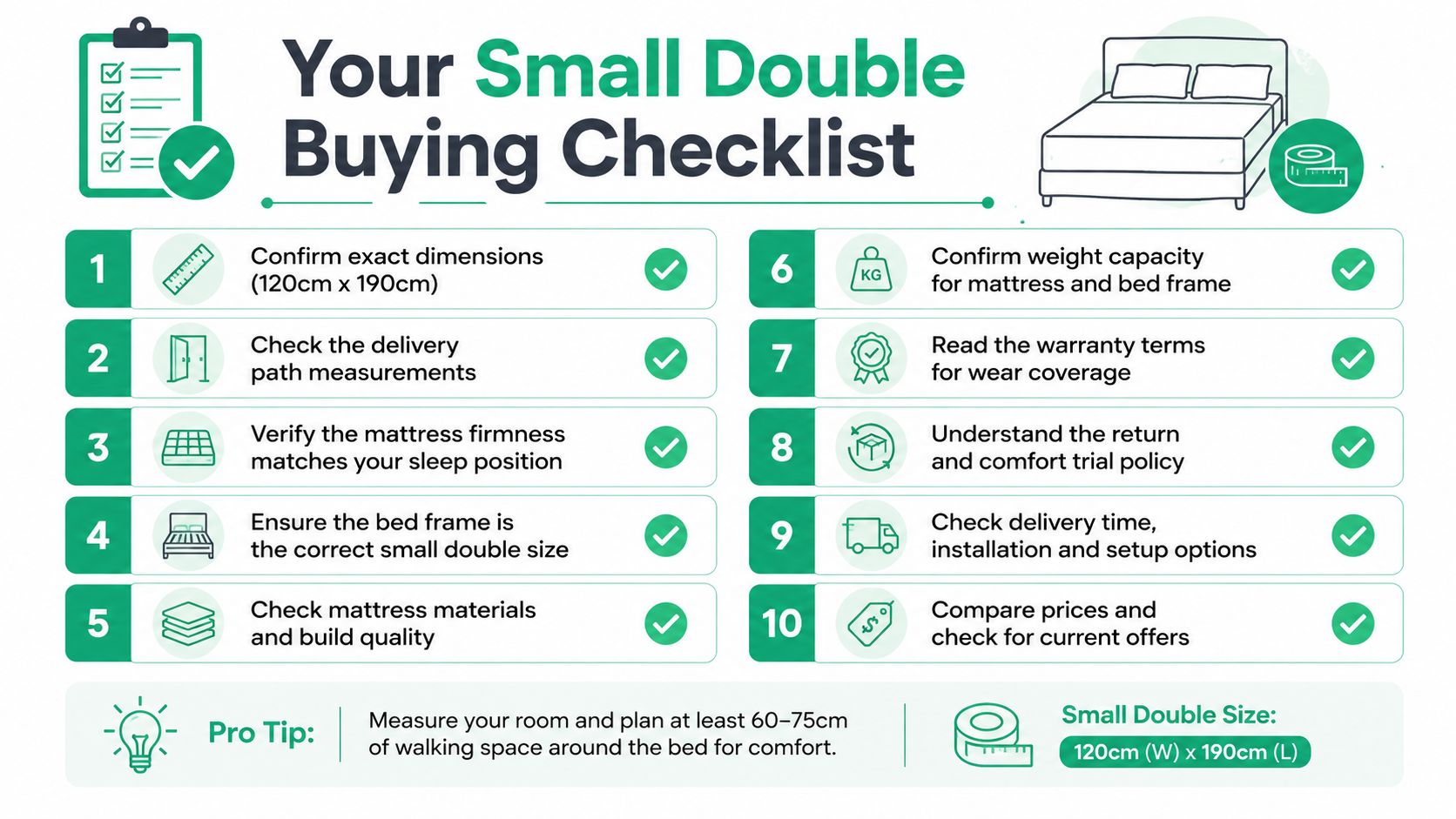
Use this sequence before paying for a small double bed mattress:
- Confirm the footprint: Check that the mattress is 120 cm by 190 cm, not an international 120 cm by 200 cm version.
- Measure the frame: Include rails, headboard, footboard and storage components.
- Test the room: Mark the full frame area and check wardrobe doors, drawers and walking routes.
- Decide who'll use it: Solo use and occasional sharing suit the size better than nightly couple use.
- Choose construction carefully: Prioritise motion isolation and edge support if two people will share it.
- Match firmness: Start around medium for solo sleepers and medium-firm for regular sharing.
- Measure mattress depth: Include the upper comfort layers before buying fitted bedding.
- Buy dedicated protection: Choose a small double protector with the correct depth and barrier properties.
- Check delivery access: Measure doorways, staircases, landings and lift interiors before ordering.
- Read the care and warranty terms: Confirm rotation, washing and coverage instructions.
Protect-A-Bed offers UK small double mattress protectors and encasements with waterproof, breathable protection for the exact compact footprint discussed here. Visit Protect-A-Bed to check the available small double sizes, mattress-depth options and protection styles before your new bed arrives.