

Mattress Protector Reviews You Can Actually Trust

You've just pulled a protector off a mattress after a wet night, a child's accident, or a sweaty spell in a stuffy room. The packet said waterproof, the fabric felt fine on night one, and the question now is simple: did it still do the job after months of washes, tugs, spills, and refitting?
| What matters after months | Why it matters in real homes |
|---|---|
| Waterproofing after laundering | A protector that fails after repeated washing is a false economy. |
| Fit on your mattress depth | Slipping corners and loose fabric ruin protection and sleep. |
| Noise and feel under movement | Rustle shows up fast when people turn over at night. |
| Allergen barrier quality | Dust-mite control matters in a lot of UK homes, not just spill protection. |
| Wash temperature and drying | If the care label doesn't match your household routine, you won't keep using it. |
Table of Contents
- What Most Mattress Protector Reviews Miss
- The Six Criteria That Actually Predict Satisfaction
- Standard Protectors Versus Full Encasements
- How to Read Waterproof Claims Properly
- Allergen Claims Versus Allergy Outcomes
- Breathability, Cooling, and the Real Comfort Trade-off
- What Survives the Washing Machine
- Matching the Right Protector to Your Household
What Most Mattress Protector Reviews Miss
A child wets the bed at 2 a.m., the washing machine is already running, and you're lifting the protector off to see what soaked through. That is the moment most reviews never reach. They praise the first-night feel, then ignore what happens after the third wash, the tenth wash, or the month when the elastic relaxes and the seams start to look tired.
The test that matters is whether a protector still blocks liquid in month six, not whether it felt soft in a showroom. A decent review also checks whether it still stays in place and whether it starts sounding like crisp paper when someone rolls over. In UK homes, that matters because mattress protection does more than guard against spills. It also supports household hygiene and allergen control, especially where dust mites are a problem in bedding, upholstered furniture, and carpets (house dust mite evidence).
Practical rule: judge a protector by month six, not minute one.
A good review answers four blunt questions. Does it still waterproof after repeated washing? Does it still fit the mattress properly? Does it still stay quiet under movement? Does the warranty mean anything once the cover has been laundered hard? If a review cannot answer those, it is mostly advertising with better punctuation.
The Six Criteria That Actually Predict Satisfaction
If you want to read mattress protector reviews properly, forget the fluff about thread count and “luxury feel” until the basics are clear. Those things can be nice, but they don't predict whether the cover still works after six months in a busy household.
Waterproofing depth
This is about whether liquid stops at the surface or finds its way through seams, edges, or weakened fabric. For spills, accidents, and sweat, a protector only matters if it blocks liquid reliably after washing, not just when it's new.
Breathability and heat behaviour
A protector can be waterproof and still feel stifling. The key question is whether it traps heat and moisture against the sleeper, especially in summer, or whether it stays comfortable enough to keep in use.
Allergen and dust-mite barrier quality
This is separate from waterproofing. UK households with asthma, rhinitis, or eczema need a proper barrier against allergens, not a vague “hypoallergenic” label that doesn't say how the fabric or closure performs (dust-mite cover evidence).
Noise under movement
Some covers are technically protective but make too much rustle to ignore. If the surface crackles loudly every time you turn over, the protector becomes a sleep problem of its own.
Fit on the specific mattress depth
A protector that slides, rides up, or barely reaches the corners won't stay effective. Mattress depth matters more than most shoppers think, especially with thicker foam and hybrid beds.
Warranty terms
A warranty only means something if the care instructions are realistic for your household. A long warranty looks generous on paper, but it's less useful if normal washing habits put you outside the terms.
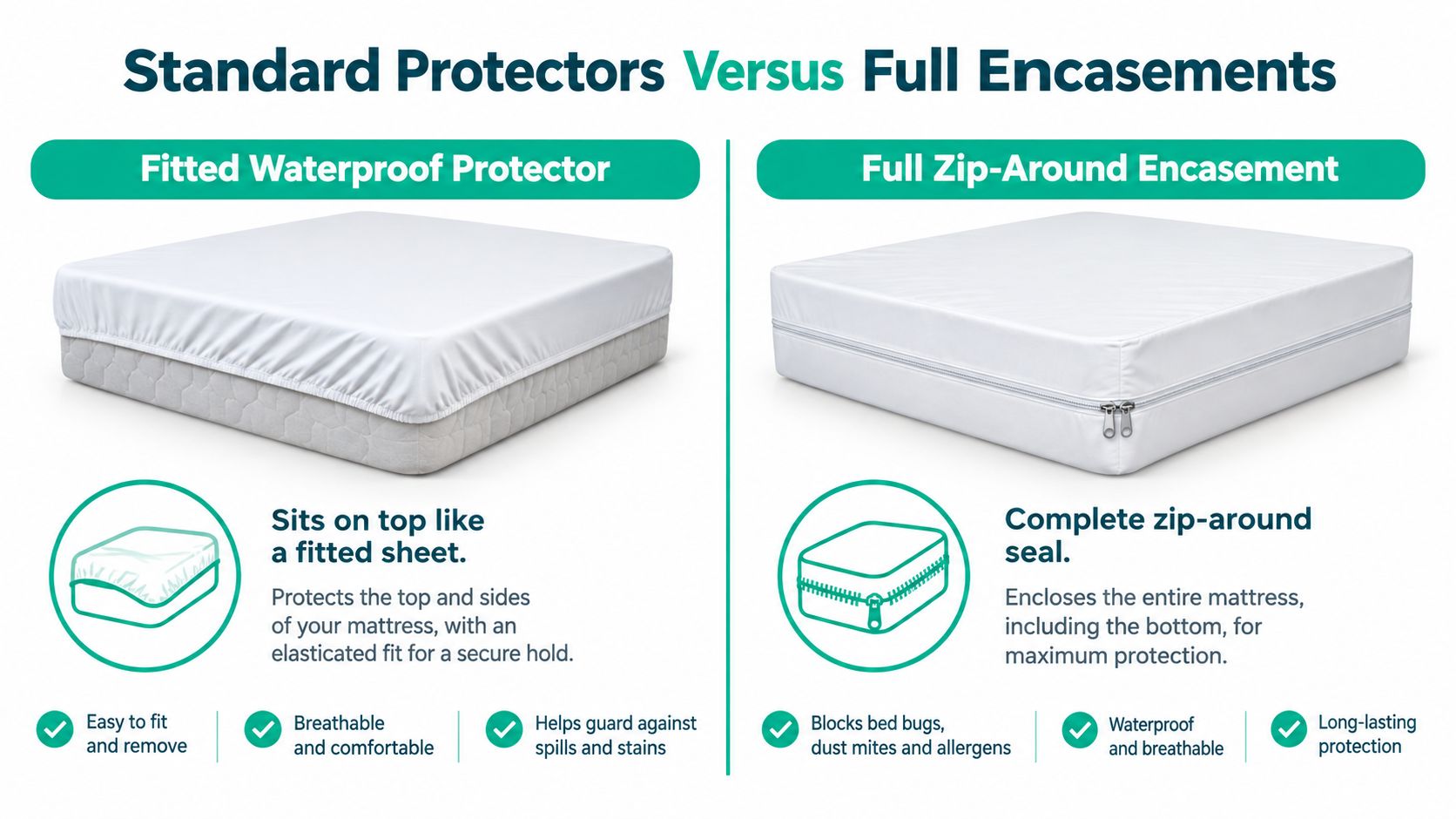
Standard Protectors Versus Full Encasements
A fitted protector and a full zip-around encasement solve different problems, and reviews lose value when they score them the same way. A fitted protector sits over the mattress like a sheet and handles everyday spills well. A full encasement seals the mattress inside a cover, which matters when you want to stop both spills and harbourage.
That difference matters in bed-bug situations. UK pest history is part of the picture, because bed bugs have long been a household issue, and professional callouts rose again in 2023 after travel recovered (bed-bug callout data). A top-sheet-style protector can help with stains, but it is not a sealed barrier.
| Criterion | Fitted Protector | Full Encasement |
|---|---|---|
| Everyday spill protection | Strong fit for normal household use | Also strong, but often more coverage than needed |
| Bed-bug containment | Not equivalent to a sealed solution | Designed for complete enclosure |
| Ease of fitting | Quicker to put on and remove | More fiddly, especially on deeper mattresses |
| Washability | Often easier to launder frequently | Depends on zip quality and whether seams hold after repeated hot washes |
| Noise and feel | Usually simpler and less bulky | Can feel more enclosed depending on construction |
Choose a fitted protector if you want a washable barrier for spills and daily hygiene. Choose a full encasement if you need complete containment, and check the zip, seams, and closure quality, not just the marketing copy. For a fuller breakdown of the format choice, see the practical guidance on full-cover mattress protection.
How to Read Waterproof Claims Properly
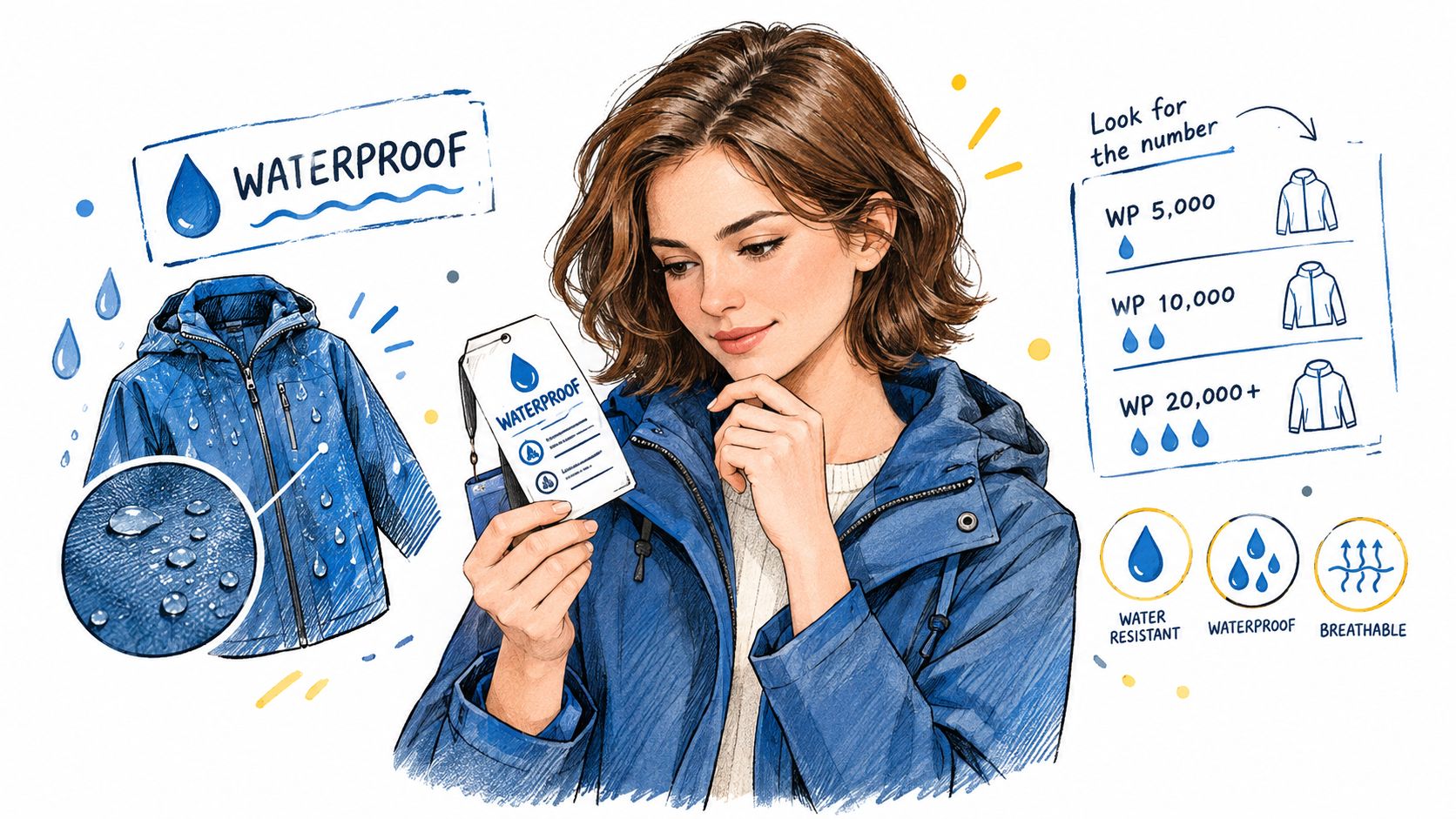
A waterproof claim only means something if the test is repeatable. A sensible review should sandwich the protector between cotton sheets, apply a coffee-and-water mix, wait five minutes, then check the lower sheet for staining before stepping up the liquid in 25 ml increments. That turns the claim into something you can measure, not just marketing copy.
The question is where leakage starts. Good review language states how much liquid the protector held back before failure, whether it broke through the middle, the seams, or the elastic edge, and whether it still worked after washing. If a protector is only water-resistant, treat that as a weaker promise. It may slow a small spill, but it does not guarantee full liquid blocking, as explained in waterproof versus water-resistant guidance.
Good review language names the failure point, not just the fabric.
Post-wash performance matters just as much. A protector that holds up on day one but fails after laundering is a poor buy, especially if you expect repeated use in a real home. Care claims belong in the verdict, not the footnote, and the first thing to check is whether the waterproof layer still works after washing.
Allergen Claims Versus Allergy Outcomes
A protector can cut allergen exposure without changing whether someone is sensitised, and that distinction matters. In a 1,122-adult double-blind randomised study, allergen-impermeable bed covers reduced mattress dust Der p 1 to a geometric mean of 0.58 µg/g after six months, compared with 1.71 µg/g with non-impermeable covers, roughly a 66% lower measured concentration (study PDF). Sensitisation stayed unchanged, so reviews should not mix up barrier performance with symptom relief.
That is why “hypoallergenic” says too little. The construction has to do the work, and the closure has to hold. A loose weave with a pleasant finish does not stop allergens, and a zip that looks firm but leaves gaps at the seam is still a weak barrier.
| What to look for | Why it matters |
|---|---|
| Full enclosure | Limits entry through exposed edges and openings |
| Documented barrier spec | Gives you something concrete instead of marketing language |
| Secure zip or seam design | Reduces weak points where allergens can pass |
| Washability that preserves closure | Keeps the barrier useful after routine laundering |
If your household is dealing with asthma, eczema, or allergic rhinitis, ask whether the protector is built to reduce exposure, not whether it promises to “cure” anything. The key buying question is whether the barrier stays intact after repeated washing, because that is what keeps the cover useful. For a closer look at dust-mite containment claims, see whether dust-mite covers work.
Breathability, Cooling, and the Real Comfort Trade-off
Hot sleepers don't need another vague promise about “cooling”. They need a protector that doesn't trap sweat, doesn't stay damp, and doesn't make the bed feel sticky by midnight. Membrane-backed cotton, cooling cellulosic fabrics, and quilted constructions all solve this differently, and each one gives up something in return.
Membrane-backed protectors are usually the safest choice when spill control matters most, because they protect the mattress without relying on bulky padding. Cooling cellulosic fabrics can feel nicer against the skin, but comfort depends on the whole sleep setup, not just the surface layer. Quilted designs may feel softer, yet that extra loft can work against fast drying and can make repeated washing more of a chore.
If you want a sharper discussion of temperature regulation in bedding, Bedhead Marketing on cooling claims is worth reading as a companion perspective. The key point here is that airflow through a fabric doesn't automatically mean the sleeper feels cooler. Air-permeable and cooling are not the same thing.
A slightly warmer protector is often the better buy if it blocks sweat, dries quickly, and stays wearable after washing.
That's the trade-off people miss. A protector that feels a bit less airy on night one may still be the better household choice if it keeps urine, spills, and sweat off the mattress and can be back on the bed quickly after laundering. For families, pet owners, and anyone dealing with night sweats, fast recovery after washing matters more than marketing language.
What Survives the Washing Machine
A protector that can't handle the wash routine your home uses is a poor protector, no matter how nice it feels in the packet. UK guidance often pushes more frequent bedding changes for allergy households and stresses complete drying before reuse, so the care label is part of the product, not an afterthought. If the washing instructions don't match the hygiene routine, the cover won't stay in service.
The issue is repeated laundering at the temperatures people really use. A product that survives a gentle first wash but starts to lose seam integrity, stretch, or waterproof performance after later cycles is failing the job. That's why a buyer should care about drying time, shrinkage risk, and whether the waterproof layer survives the kind of washing that comes with real family life.
A breathable or eco-friendly label doesn't help if the protector can't be washed hot enough for the household's needs. A family dealing with accidents or allergies needs practical durability, not a soft story. The question that matters is whether it still protects the mattress in month nine, not whether it felt pleasant on the first night.
Matching the Right Protector to Your Household
Different homes need different answers, and pretending otherwise is how people end up buying the wrong cover. A family with potty-training toddlers or teenage night sweats needs a protector that can take frequent washing, dry fast, and keep its fit. An allergy or asthma household should prioritise a genuine barrier, secure closure, and washability that doesn't wreck the seal. A hot sleeper in a poorly ventilated bedroom should care more about comfort under summer conditions than about a luxurious hand feel.
Rental properties are a separate case. Landlords and tenants usually need something durable, easy to launder, and simple to replace if a mattress is being protected for turnover or long occupancy. For a small hospitality or care setting, the priority is consistency, because the product has to withstand repeated use without turning noisy or misshapen.
If bed bugs are part of the risk, use a full encasement. If the problem is spills or day-to-day hygiene, a fitted protector is usually enough. For mattress depth, measure from the base to the top edge and don't guess, because the wrong depth leaves you with lifted corners and weak coverage. Memory foam, pocket-sprung, and hybrid mattresses can all work with protectors, but thicker profiles need a better fit and a more secure edge.
Bottom line: choose by household use, not by one universal “best” label.
A warranty deserves the same practical reading. Up to 10 years sounds reassuring, but only if you've checked what counts as normal use, what laundering is allowed, and what failure mode the warranty covers. And yes, one option in this space is Protect-A-Bed, which makes waterproof protectors and full encasements for different household uses, but the right choice still comes down to fit, washability, and the type of protection you need.
If you're comparing protectors for your own home, use these checks before you buy: measure mattress depth properly, match the format to the risk, and read the care label as carefully as the product description. Then choose the cover that fits your routine, not the one that sounds nicest on the shelf. Visit Protect-A-Bed to review the range and compare the protector types against the way your household washes, sleeps, and protects a mattress.