

Dust Mite Mattress Protector Reviews for UK Buyers

A high star average is the advice most UK shoppers follow when they open dust mite mattress protector reviews. Buy the waterproof cover with the best score, the thinking goes, and the mattress is sorted. That shortcut fails. A loved fitted sheet can keep a spilled drink off the foam and still leave the underside, a loose zip and the pillows open to allergen. Softness and a dry surface matter for comfort and stains. They do not show whether the cover is a complete, wash-durable barrier, or how it sits inside hot washing and covers for the pillow and duvet. This guide reads reviews the other way. How someone felt stays separate from construction you can check: enclosure, closure, breathability, fit and care.
Table of Contents
- Why Dust Mite Mattress Protector Reviews Matter
- What UK Buyers Should Check Before Trusting a Score
- Comparing Barrier Fit Washability and Warranty
- Matching Protectors to Real UK Sleep Situations
- How to Read Allergy and Comfort Review Signals
- Building a Whole Bed Dust Mite Routine
- Choosing a Protect-A-Bed Cover and Next Step
Why Dust Mite Mattress Protector Reviews Matter
A shopper filtering for waterproof covers may assume that the same product also blocks dust mites. The two jobs are different: waterproofing stops liquid, while an allergen barrier must limit the escape of particles. A cover over only the sleeping surface can leave routes open around the mattress. Comments about a quiet fabric or a dry sheet after a spill describe comfort and liquid protection, not allergy performance.
UK pest guidance places the highest house-dust mite concentrations in mattresses, bedding, upholstered furniture and carpets. A heavily infested mattress can contain more than 10,000 mites per gram of mattress dust, and a typical double mattress may harbour hundreds of thousands of mites, according to UK pest and allergen guidance on house-dust mites. The same guidance cites an NHS estimate that approximately 20% of the UK population is sensitised to house-dust-mite allergens.
These figures describe separate things. Mite counts measure contamination in dust; the 20% estimate concerns people sensitised to the allergen. One household may have a mattress with substantial mite contamination but no one with symptoms. In another, a sensitised adult may react to allergens from pillows or a duvet, even with a newer mattress. That is why a review needs to distinguish a personal symptom account from evidence about the cover's construction.
What belongs in the review
Because contamination and sensitivity are not the same, useful dust mite mattress protector reviews answer practical questions alongside comfort questions.
- Barrier evidence: The write-up should describe a fully enclosed design or a stated allergen-blocking construction, such as a zip that closes on all four sides of the mattress.
- Washing: Care instructions should be clear. Later reviews can say whether the cover still performs after repeated washes.
- Fit: The protector's depth should suit the mattress, with the sides lying flat rather than gaping.
- Breathability: Reviews can indicate whether someone can sleep comfortably on the cover in a warm bedroom, or finds it uncomfortable enough to remove.
A personal story of easier breathing does not verify how a cover is made. Congestion can ease for many reasons. A buyer can check whether a zip closes around every side.
Star averages can still blur these differences. A cover may feel pleasant and protect against spills while offering incomplete allergen coverage. Read comfort reports as accounts of one person's experience, and judge barrier claims by the construction and care details the review provides.
What UK Buyers Should Check Before Trusting a Score
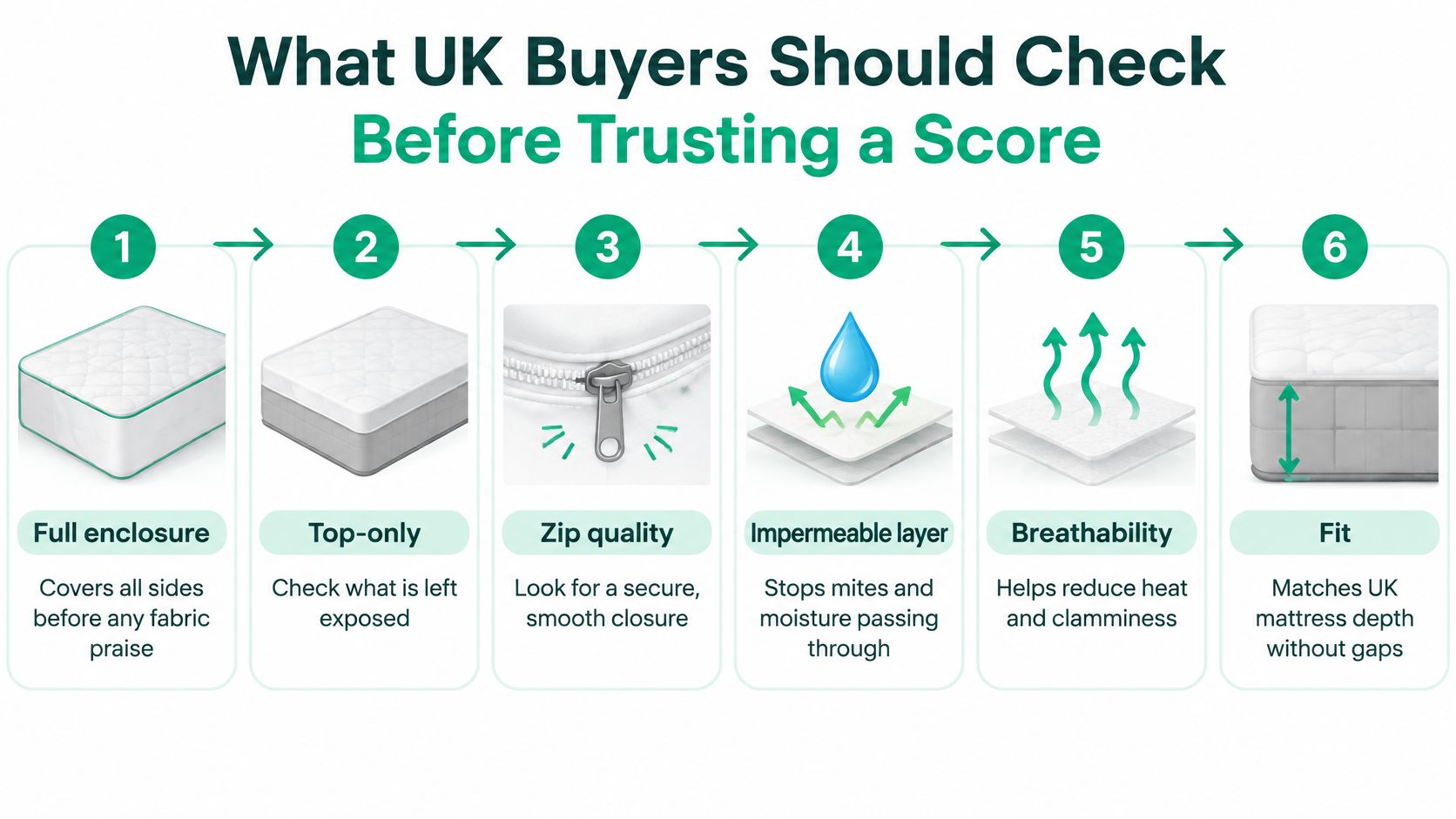
Before any fabric is praised, read a review in a fixed order. Praise for softness comes last. Coverage comes first.
The reading order
- Full enclosure versus a surface cover. A zip-around encasement closes the top, sides and base. A fitted protector covers the sleeping surface and usually the sides, like a sheet. Ask what is still open. Allergen already inside a mattress can leave through a gap underneath.
- Stated allergen-blocking construction. Look for a described barrier layer, not a marketing phrase. A thin, flexible, quiet membrane is relevant when it is meant to block liquids, sweat, dust mites and allergens while staying air permeable. The name of that layer is not proof on its own.
- Vapour-permeable waterproofing. The cover should stop a drink and still let moisture vapour move. A clammy sheet is why many people abandon an otherwise sound barrier.
- Depth and fit. UK mattresses vary a lot in height. A skirt that rides up, or elastic that will not reach the corners of a deep bed, leaves a channel at the edge.
- Wash temperature. Note the highest temperature the label allows, and whether reviewers say the barrier still sheds liquid after months of laundering.
- Noise, heat and warranty against defects. Rustle, overheating and a short or missing defect warranty show up in real use long before a star average moves.
What a useful comment looks like
A useful line is specific. "The zip stays closed at the foot." "The skirt stopped riding up on a 30 cm mattress." "After six months of washing it still beads water." Those sentences describe coverage, closure, care and performance after repeated use.
Vague lines do not. "Mite-proof and so soft" tells you almost nothing you can verify. If you want more examples of how shoppers talk about real covers, the mattress protector reviews on a specialist UK bedding site show the kind of detail worth hunting for: fit, washing and whether liquid still stays out.
Ignore a mite-proof badge until the review has walked that order. Construction you can picture beats a slogan you cannot test.
Comparing Barrier Fit Washability and Warranty
Apply the same checklist to two different jobs. A fitted surface protector is built for spills, sweat and the top of the bed. A zip-around encasement is built to close the mattress on every face. Bed-bug-proof encasements and dust-mite barriers overlap, but they are not the same product. A sealed, tough encasement is about stopping insects finding harbour in the mattress. An allergen barrier is about limiting what already lives in the dust from reaching the sleeper. Some covers try to do both. A review should say which job was tested.
The allergen benchmark
A UK double-blind, placebo-controlled trial of 1,122 adults with asthma found allergen-impermeable bed covers reduced mattress Der p 1 at six months. The geometric mean was 0.58 micrograms per gram of dust versus 1.71 micrograms per gram with non-impermeable covers, a reduction of about 66%, as reported in the UK trial of allergen-impermeable bed covers. At 12 months the difference was no longer statistically significant: 1.05 versus 1.64 micrograms per gram. Asthma outcomes did not improve significantly either.
That result is a benchmark for dust load, not a promise of symptom relief. Seams, zip closures and wash durability decide whether a six-month drop survives a year of real beds. A lab-style reduction is not the same as waking less congested.
What to compare in dust mite mattress protector reviews
| Criterion | Stronger review evidence | Weaker review evidence |
|---|---|---|
| Enclosure | Zip-around cover, seams described as closed | Fitted top only, base left open |
| Closure | Zip stays shut with no end gap | Zip slips or has no lock |
| Wash durability | Still sheds liquid after months of washing | No mention of laundering |
| Breathability | Named fabric plus comments on heat | "Hypoallergenic" with no feel notes |
| Fit | Depth stated and matched to the mattress | Skirt rides up, one depth for every bed |
| Warranty | A stated term against material defects | No defect cover mentioned |
Fabric, fit and how long cover lasts
Hot sleepers should compare cotton, charcoal and Tencel Cool style faces, not only the membrane underneath. Cotton tends to feel familiar. Charcoal and cooling weaves are chosen when night sweats make people strip the cover off. None of those faces replaces a secure fit. Measure mattress depth before you trust a "universal" elastic.
Warranty is a separate signal from allergy performance. Protect-A-Bed, for example, offers warranty cover of up to 10 years against material or manufacturing defects, with a stated replacement policy. That tells you about defects, not about Der p 1 in your dust. Read it as one concrete warranty marker beside seam quality and wash notes, not as a winner on every criterion.
Care instructions belong in the same comparison. If you are unsure how often a cover should go through the machine without wrecking the barrier, start with guidance on how often to wash a mattress protector and then check that the product label agrees.
Matching Protectors to Real UK Sleep Situations
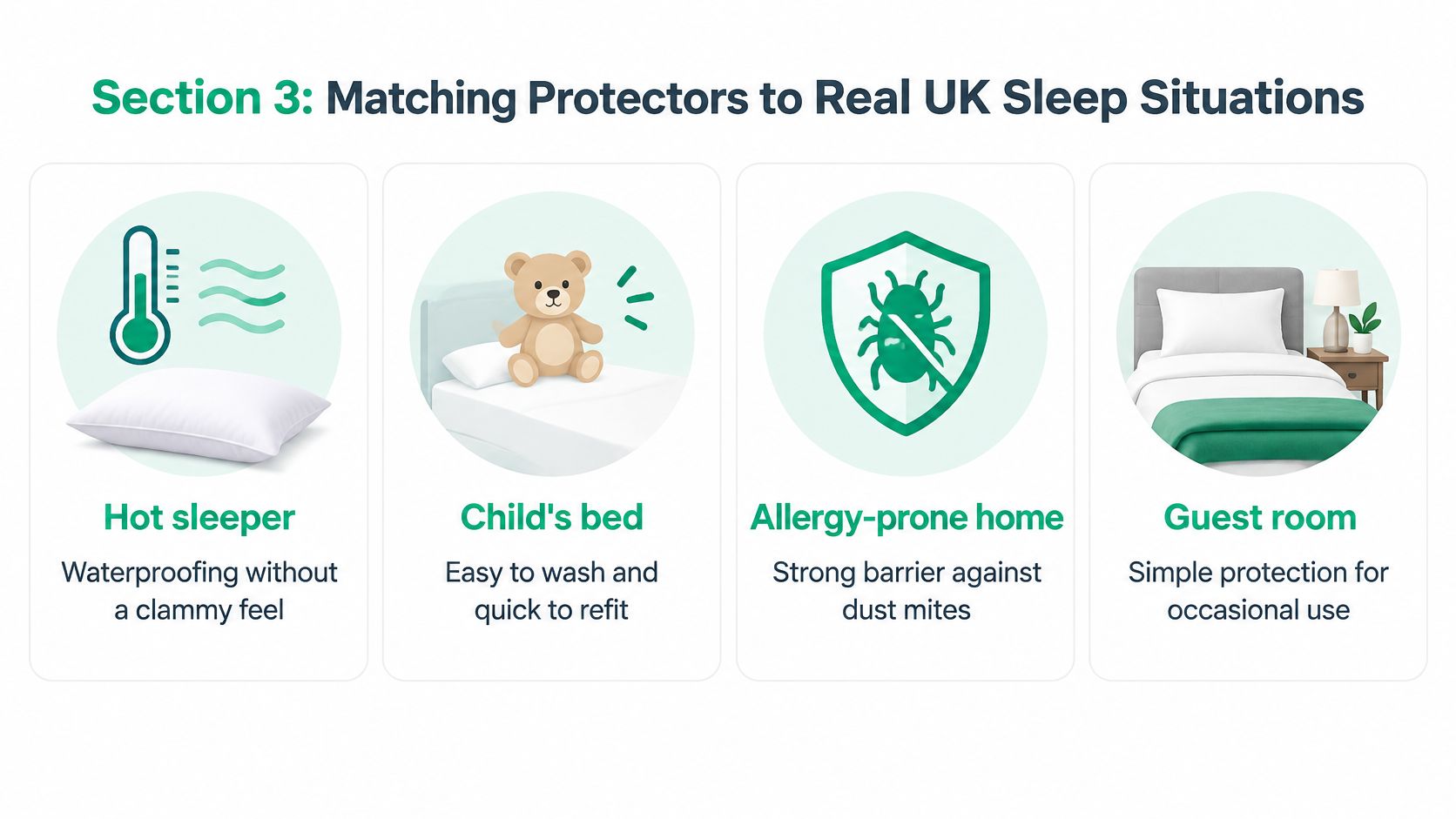
Cover choice follows the people in the bed. A hot sleeper, an allergic household, a child and a rented room each need a different design, so a useful review considers the job the cover must do as well as its construction.
Four households, four jobs
A hot sleeper in a small UK bedroom needs waterproof protection that does not feel clammy. Heat and sweat can make someone take a cover off, so reviews should describe comfort overnight, not just the result of a daytime spill test. A breathable membrane beneath a cooling face, such as Tencel Cool, Snow or Charcoal, may suit this situation. The trade-off is practical: a cooler-feeling surface still needs a secure fit.
Someone with allergies or asthma should look at the whole sleeping setup. The face rests on a pillow, while the duvet lies over the sheet, so leaving those items uncovered can leave other reservoirs in place. For this household, reviews focused only on the mattress skirt offer an incomplete picture. Pillow and duvet barriers belong in the scenario too.
Parents protecting a child's bed often need a cover that is straightforward to wash and refit. A protector that is awkward to put back on a single mattress may end up unused after an accident.
A UK study followed 56 mite-sensitive asthmatic children using vapour-permeable waterproof bedding encasements for 24 weeks. At six weeks, the active group had a median 480-nanogram, or 100%, reduction in mattress mite allergen, compared with a 215-nanogram, or 53%, reduction in the placebo group. Allergen levels in the active group remained lower during the study, according to the Bristol combined bedroom mite-allergen study. The study combined the cover with acaricide treatment and other bedroom measures. An encasement can be one part of that system, but it is not a medical treatment on its own.
Landlords, hotels and care settings may need protection against spills and bed bugs as well as everyday sweat. A standard protector can suit a guest room used only occasionally, where drinks and sweat are the main concerns. A full encasement is a closer match when hygiene or pest control calls for a sealed mattress barrier. Staff also need a closure that is quick to check and fabric that withstands frequent changes without splitting at the corners.
Match the cover to the likely failure: heat, a child's wash day, allergy concerns or the demands of a guest or rental bed. Cooling fabric addresses comfort; full enclosure provides a sealed mattress barrier; a straightforward protector can handle spills and sweat. This situation-based approach gives more useful guidance than a single overall score.
How to Read Allergy and Comfort Review Signals
Trustpilot's 2019 survey of 1,000 consumers found that ratings and reviews mattered most for home and garden buying. The survey included 500 UK and 500 US respondents. Across the combined sample, 69% said ratings and reviews were "very important" or "important" when buying home and garden products, compared with 25% who gave social media that weight, according to Trustpilot's home and garden trust research.
Past the average
A high score can indicate buyer confidence, but it cannot prove clinical allergen reduction in every household. Protect-A-Bed's on-site Trustpilot display of 4.6 from 201 reviews is an example of a product's review score and volume, not a clinical result. Check how recent the reviews are and whether the site identifies verified purchases. These details help you judge the sample, but they do not establish that a cover blocks allergens after repeated washing.
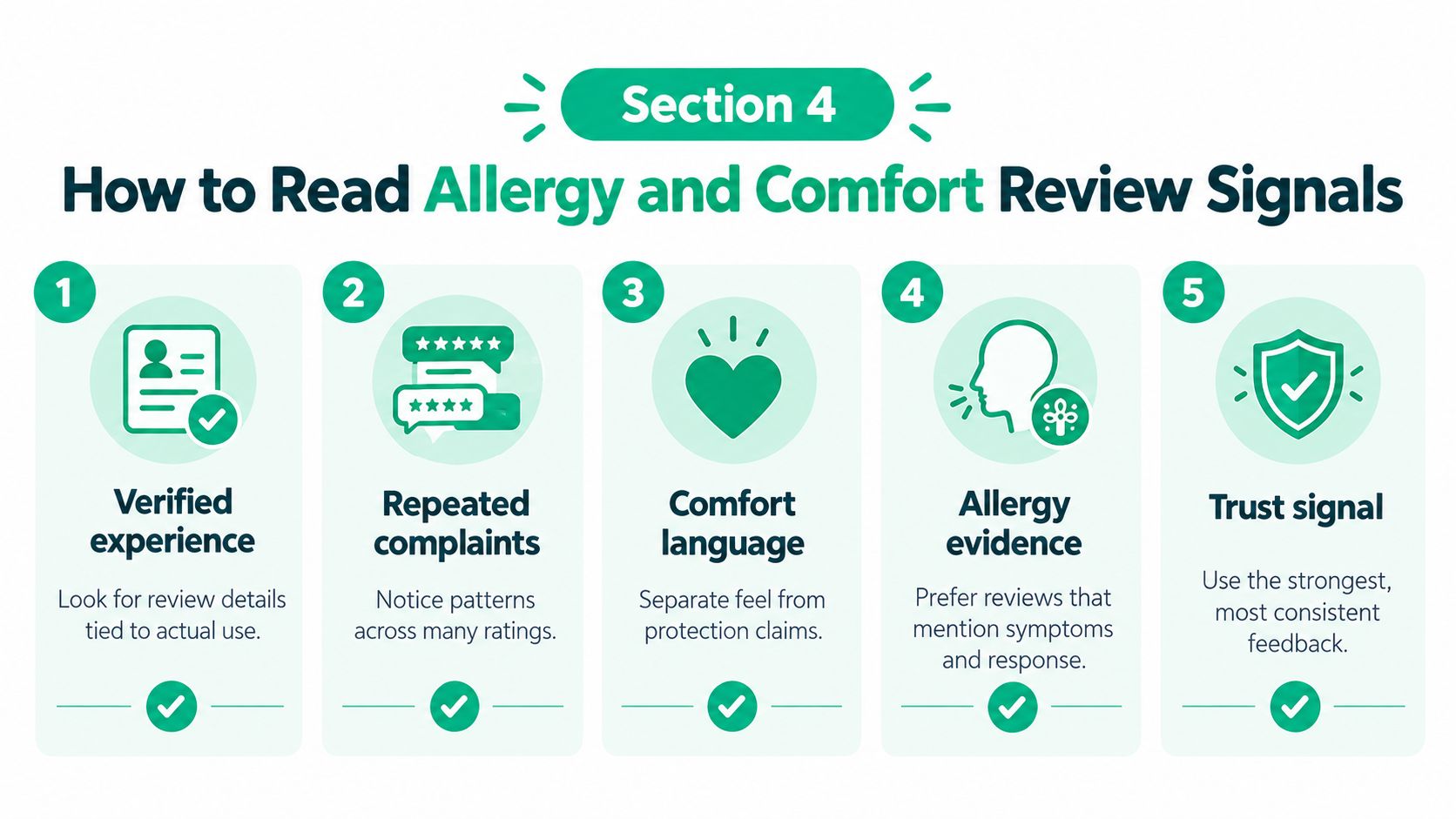
Look for repeated reports rather than relying on one glowing paragraph.
- Dates: Reviews spread across seasons offer a broader view than a cluster posted in one month, particularly for comments about warmth.
- Verified purchase: Treat this as a useful check where it is shown. It does not verify a medical claim.
- Recurring themes: Look for repeated comments on allergy use, laundering, leaks, noise, heat and fit before deciding a pattern is emerging.
- One-off extremes: “Ruined my asthma” and “cured my nights” are personal accounts, not controlled trials.
Separate the two kinds of sentence: “I feel less congested” describes a symptom experience. “The zip fully encloses the mattress and still repels liquid after washing” describes construction that you can check.
That distinction matters because trial results and review stories answer different questions. A trial can show a change in mattress dust without finding a clear improvement in asthma symptoms. Comfort reports help you weigh heat, noise and feel; they do not establish barrier performance. Construction claims are more useful when reviewers describe details you can verify, such as full enclosure, fit after laundering and whether the cover remains intact. Read both kinds of evidence, but do not treat either as proof of the other.
Building a Whole Bed Dust Mite Routine
A mattress cover handles one part of the bed, while allergens can also collect in other bedding and bedroom fabrics. NHS guidance describes mattress covers as useful but not a standalone solution, according to the NHS house dust mite allergy leaflet.
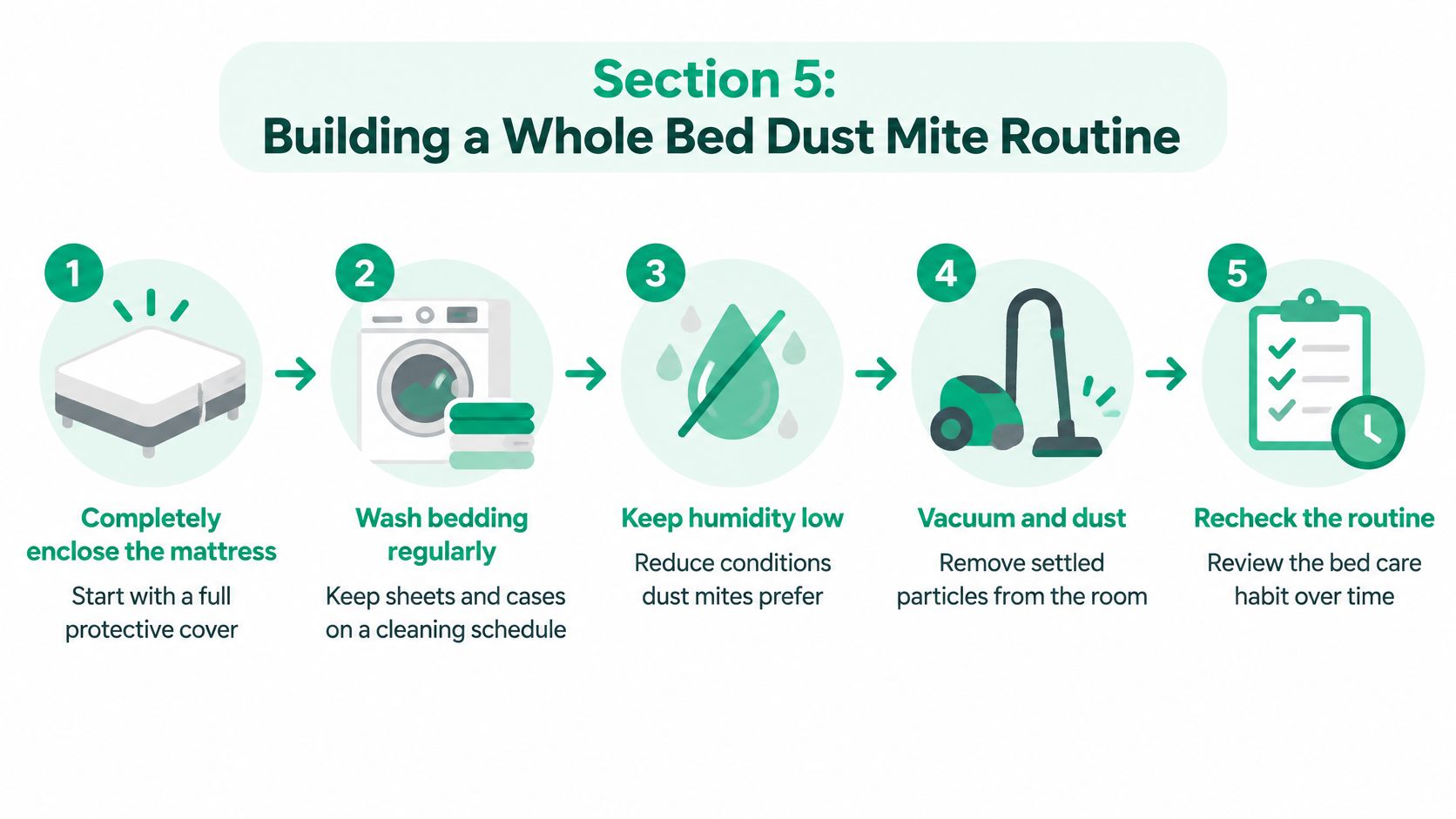
The leaflet recommends fully enclosing the mattress, duvet and pillows with breathable, tested allergen barriers, then washing uncovered bedding weekly at 60°C or above. Washing below 60°C lowers surface allergen but does not kill mites, which can survive and reproduce, so the weekly hot wash is the step the NHS leaflet recommends. It reports dust-mite sensitivity at around 1–2% in the general population and 20–70% among people with respiratory conditions. These figures underline why a cover alone cannot control exposure across the whole bed.
Checks reviews often skip
Once the cover arrives, check the setup in order. A well-made barrier can still fail if it does not fit or gets damaged.
- Depth before you order. Measure the mattress, including any topper you plan to keep. A cover that falls short leaves a gap in the barrier.
- A secure closure. Zip it fully, then sit on a corner and check that the zip end stays closed.
- Pillow and duvet coverage. Enclose the pillows and duvet as well, as explained in the sleep situations section.
- Weekly hot washing. Wash uncovered bedding at 60°C or above. Cooler washing does not kill mites.
- Protect the barrier. Pet claws, an overloaded wash or forcing a zip over a deep corner can damage the seal. Keep bedroom humidity below about 50% and check it with an inexpensive hygrometer. Vacuum carpets and upholstery regularly, as mites can collect in them.
The protector is the mattress wall inside a wider bedroom routine. A star rating cannot show whether the whole setup stays intact through fitting and washing.
If symptoms remain troublesome, speak to a GP or allergy clinic. This routine helps manage exposure at home; it does not provide a diagnosis.
Choosing a Protect-A-Bed Cover and Next Step
Choose a cover by the problem it needs to address, then check whether its construction and care instructions suit your bed. Breathable waterproof mattress protectors can help keep spills and sweat from reaching the mattress. Cooling fabrics such as Tencel Cool or Charcoal may suit people who find covers too warm. A bed-bug-proof encasement encloses the mattress, while pillow protectors cover the area closest to your face. These options serve different purposes, so a high score for softness alone cannot show whether a cover forms a complete allergen barrier or will be practical to wash and refit.
The UK range includes protectors, encasements and pillow covers, so you can match the product to the situation described above. Its Miracle Membrane is described as air permeable while blocking liquids, sweat, dust mites and allergens. Check the product details and care instructions to understand how the barrier is constructed and maintained. The defect warranty covered in the comparison section applies to materials and manufacturing, not to allergen performance.
The practical next step
Start with size and mattress depth, including any topper that will stay on the bed. Then compare fabric and closure, and read recent comments for washing, fit, noise and heat. Leave the headline score until you know how the cover is likely to work in your household. A cool fabric may feel more comfortable, but a poor fit can leave gaps; an encasement may close the mattress, but it still needs to be manageable to remove and refit after washing.
Protect-A-Bed offers waterproof and breathable protectors, pillow covers and bed-bug encasements for UK homes and accommodation settings. Use the product details to check which features apply to the cover you are considering, then weigh them against review comments and your care routine. Visit Protect-A-Bed to check sizes and product information before ordering.