

Do Mattress Covers Prevent Dust Mites? the Truth

Yes, mattress covers can prevent dust-mite exposure when they're fully sealed, breathable encasements, but they reduce allergens rather than eradicate mites or guarantee allergy or asthma relief. In a UK-linked trial, mattress allergen levels after 6 months were 0.58 micrograms per gram with impermeable covers versus 1.71 with control covers.
If a cover protects your mattress from spills, does that mean it also protects you from what's already inside it? That's the gap behind the question, do mattress covers prevent dust mites? The answer depends on what the cover encloses, what its fabric has been tested to block, and whether you're measuring allergen exposure or improvements in health.
Table of Contents
- Why This Question Matters for UK Households
- How Dust Mites and Allergens Build Up in a Mattress
- Protector vs Encasement - What Actually Blocks Mites
- What the UK Clinical Evidence Actually Shows
- How to Maintain Your Cover for Maximum Protection
- What This Means for Allergy and Asthma Sufferers
- Common Misconceptions About Mattress Covers
- Frequently Asked Questions
Why This Question Matters for UK Households
You wake with a blocked nose, rub your eyes and wonder whether the bedroom needs cleaning. Perhaps you've already washed the sheets and fitted a waterproof protector. It's reasonable to ask whether the mattress underneath could still matter, but morning discomfort alone doesn't establish what's causing it.
For a household investigating dust-mite sensitivity, buying bedding involves more than choosing something washable. Protecting a mattress from everyday wear and separating a sleeper from mattress allergens are different jobs. A product might perform the former without providing the complete enclosure required for the latter.
The terminology doesn't help. Retail descriptions can use cover, protector and encasement loosely, leaving shoppers to assume they're interchangeable. They aren't reliable descriptions of protection unless the construction and supporting evidence are clear.
Start with the purpose of the purchase
Before comparing fabrics or prices, decide what you need the product to do:
- Manage spills and perspiration: Look at waterproofing and care requirements.
- Create an allergen barrier: Examine complete enclosure and evidence of allergen containment.
- Support a household health plan: Keep the purchase separate from decisions about prescribed treatment.
UK government guidance estimates dust-mite sensitivity at 1–2% of people, rising to 20–70% among people with respiratory conditions, illustrating why the question deserves particular attention in affected households (government guidance on asthma and airborne allergens).
A useful starting point: Ask what a cover has been shown to block, not simply what its name suggests.
For landlords or accommodation managers, household allergen control may sit alongside broader property responsibilities. Facility Management Insights' guide to protect your facility from pests offers a separate facility-management perspective, rather than evidence about bedding or asthma treatment.
The practical aim is a proportionate decision. You don't need to regard your bed as unsafe, and you shouldn't have to interpret reassuring packaging as a medical promise.
How Dust Mites and Allergens Build Up in a Mattress
Think of a mattress as a reservoir, rather than just a surface. Ordinary bedding sits above material that can contain mites, skin scales, moisture and allergen-containing particles. Changing the sheet deals with the removable layer, not everything beneath it.
The important distinction is between a mite and an allergen. Mite allergens include material associated with faecal particles and body fragments. Keeping that material away from the sleeper is a different task from proving that every living mite has disappeared.
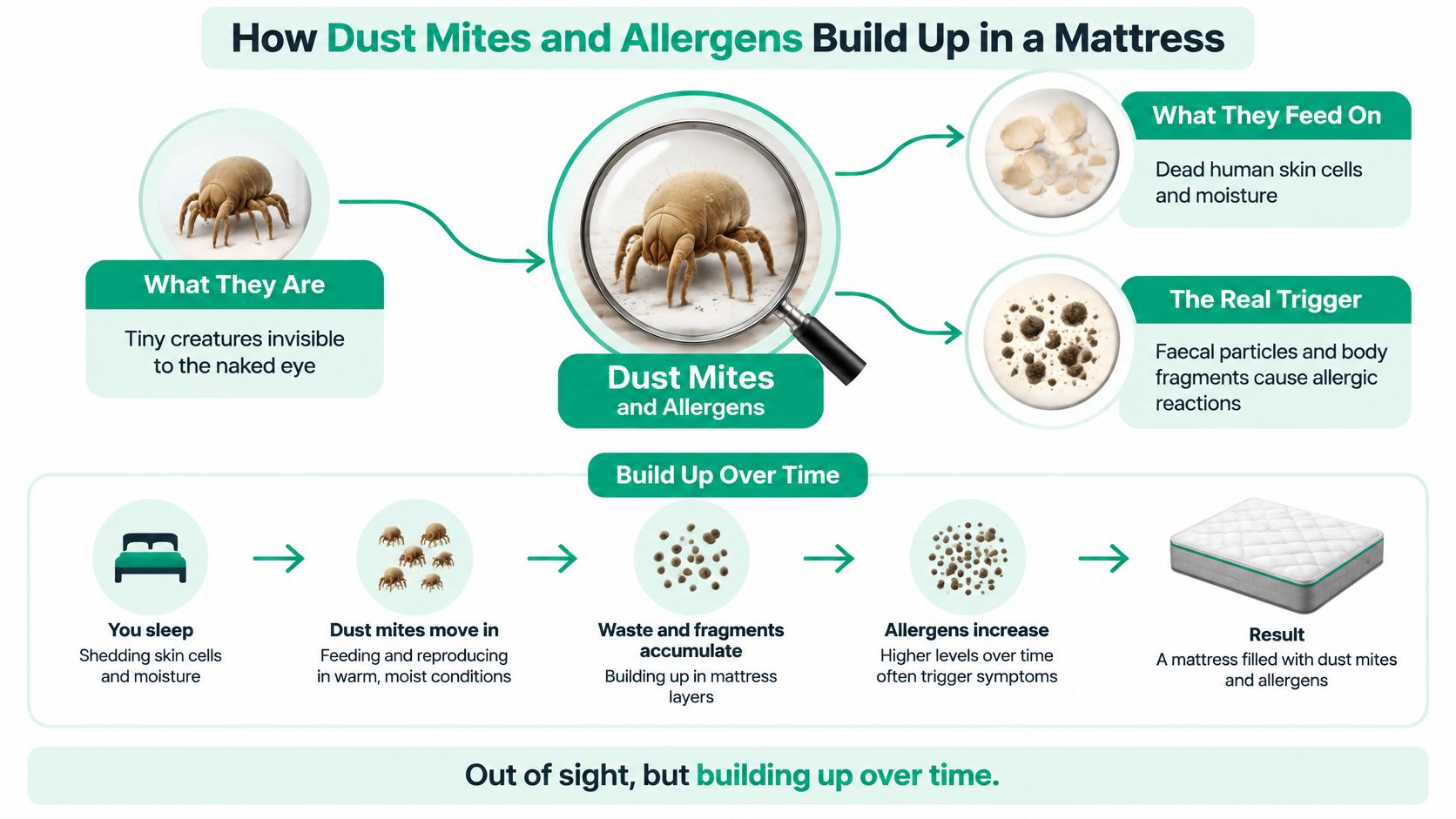
Follow the route from mattress to sleeper
The barrier approach makes sense when you separate the process into its parts:
- Material enters the mattress: Skin scales and body-derived moisture contribute to the conditions within bedding.
- Allergen-containing material remains: The mattress can hold a reservoir that isn't removed by changing a pillowcase or sheet.
- A barrier interrupts exposure: An intact encasement separates the sleeper's breathing area from that reservoir.
NHS advice on house-dust-mite sensitivity explains that mites are difficult to eliminate completely and describes barrier covers as a way to separate the nose and mouth from mattress contents. Its practical message is containment within a wider control programme, not instant sterilisation.
An easy analogy is a sealed container holding dusty material. Closing the container doesn't make its contents disappear, but it changes the route by which those contents can reach you. That's why the integrity of the enclosure matters as much as the presence of protective fabric.
For more bedding-specific context, the guide to dust mites in bedding provides a useful companion explanation. For general housekeeping beyond the bed, J.G. Carpet Cleaning LLC's advice on how to keep your home dust-free addresses a different part of the cleaning routine.
Neither general dust removal nor a freshly made bed should be treated as proof that the mattress reservoir has been eliminated. The realistic objective is to manage the routes of exposure you can control.
Protector vs Encasement - What Actually Blocks Mites
A standard fitted protector usually sits over the sleeping surface and around the mattress edges. A fully sealed encasement surrounds the whole mattress and closes around it. The difference is structural, not just a matter of thicker fabric or a more reassuring product name.
If your aim is mattress allergen containment, ask whether there's a continuous barrier around the entire mattress. A fitted layer can leave routes around its edges and underneath, even when the covered surface performs well.
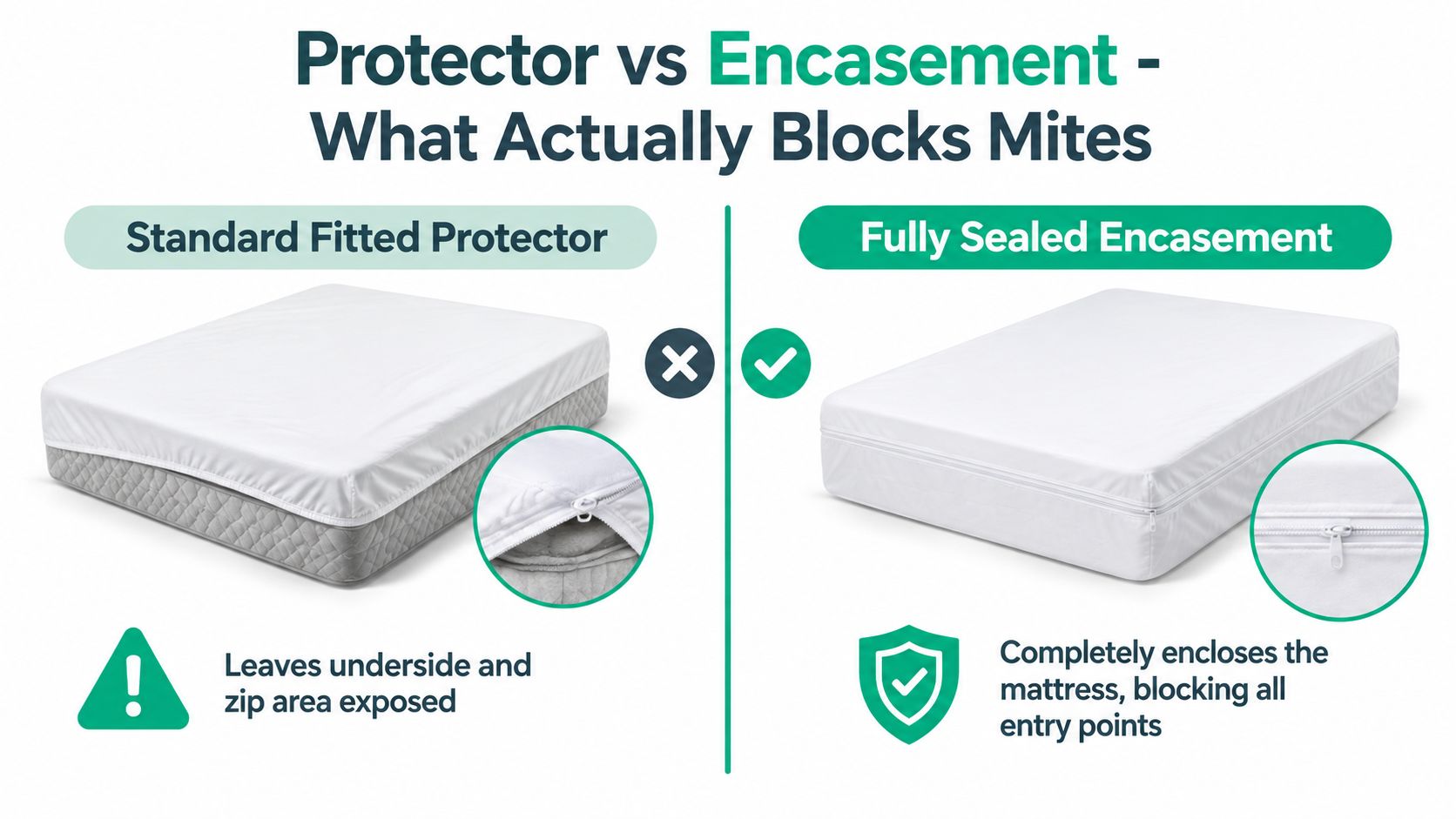
Protector vs Encasement at a Glance
| Feature | Standard Protector | Encasement |
|---|---|---|
| Mattress coverage | Usually the top and sides | Completely surrounds the mattress |
| Underside | Not fully enclosed | Included within the barrier |
| Closure | Commonly an elasticated fitted edge | A closing system that needs to remain sealed |
| Allergen containment | Shouldn't be assumed from the product type | Requires suitable fabric and evidence of allergen containment |
| Waterproofing | May be waterproof | May be waterproof |
| Buying priority | Match protection to everyday use | Check enclosure, testing, breathability and care |
Cambridge University Hospitals' dust-mite guidance recommends breathable bedding covers that completely enclose the mattress and have evidence that they prevent house-dust-mite allergen escape. It also advises covering pillows and duvets, rather than treating the mattress as the only relevant bedding item.
Judge the construction, not just the fabric
Fabric pore size and construction are relevant to whether particles can pass through, but a technical-sounding fabric description isn't enough on its own. Seams, stitching and the closure must belong to the same effective barrier. Ask whether the evidence applies to the finished product, rather than assuming a fabric claim covers every opening.
Breathability deserves equal attention. The aim isn't merely to put an impermeable layer somewhere in the bed, but to choose a barrier that's suitable for sleeping on and compatible with moisture management.
A waterproof claim answers a question about liquids. It doesn't, by itself, answer the question about allergen escape.
For example, a household choosing between a washable fitted protector and a zip-around cover shouldn't compare them only by fabric feel. If allergen containment is the priority, the decisive question is whether the finished encasement provides a complete, tested barrier.
What the UK Clinical Evidence Actually Shows
Research can show a cover reducing mattress allergens without showing it improving asthma. Those findings aren't contradictory: an environmental measurement and a clinical outcome answer different questions.
The large UK-linked randomised, double-blind, placebo-controlled trial involved 1,122 adults with asthma. At 6 months, geometric mean Der p 1 concentrations were 0.58 versus 1.71 micrograms per gram of mattress dust in the impermeable-cover and control groups respectively, a statistically significant difference (P=0.01); at 12 months, concentrations were 1.05 versus 1.64, and the difference was no longer statistically significant (P=0.74), according to the adult trial of allergen-impermeable bed covers.
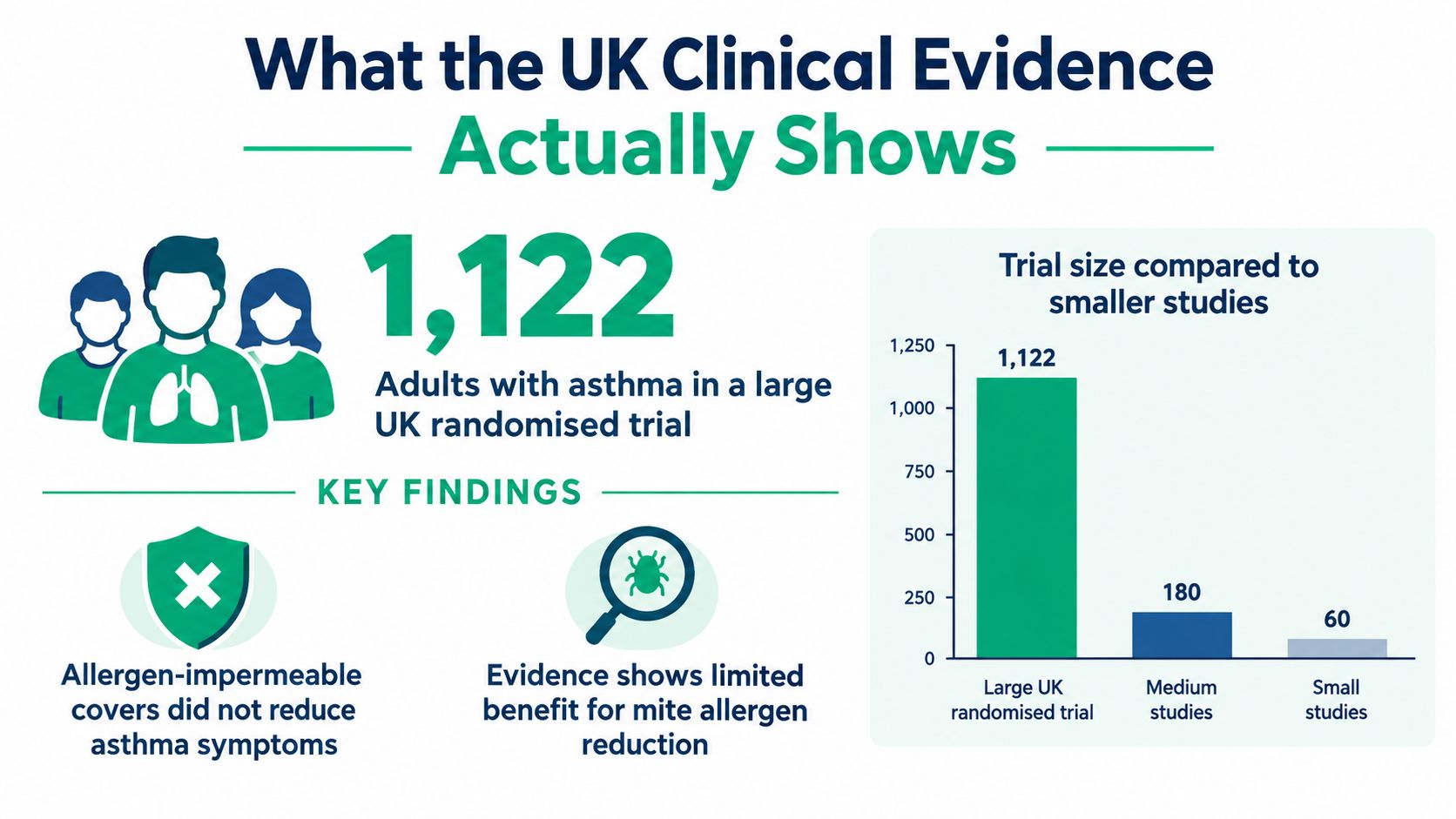
What the adult result means
The investigators concluded that covers alone appeared clinically ineffective for adults with asthma, despite the temporary reduction in allergen exposure. That rules out presenting a mattress cover as a guaranteed asthma treatment.
It doesn't mean that the barrier did nothing. It means the measured environmental change didn't establish the hoped-for clinical benefit in that trial. Equally, it would be inaccurate to turn the early allergen reduction into a promise of lasting symptom relief.
What the children's study adds
A separate trial studied 56 mite-sensitive asthmatic children over 24 weeks. After 6 weeks, the active-treatment group had a median mattress-allergen reduction of 480 nanograms, or 100%, compared with 215 nanograms, or 53%, in the placebo group; the intervention included bedroom treatment and encasements for the mattress, duvet and pillows, as described in the UK review of bedroom interventions and mite-control evidence.
That result needs its context. It wasn't a test of an ordinary fitted protector used alone, and a reduction in sampled mattress allergen wasn't proof that all mites throughout the bedroom had been eradicated.
- Environmental conclusion: Encasement can reduce exposure to mattress allergens.
- Clinical conclusion: That reduction doesn't guarantee improved asthma outcomes.
- Guidance implication: The reviewed British asthma guidance advises against routinely recommending physical or chemical mite-reduction measures as asthma-management interventions.
The honest recommendation is narrower than a cure claim, but still useful: choose a barrier for the exposure-control job it can do.
How to Maintain Your Cover for Maximum Protection
A suitable cover needs a care routine that preserves its barrier. Treat installation and maintenance as part of the purchase, not an afterthought once the packaging has been discarded.
Before fitting it, read the instructions for the closure and check how the encasement should sit around your mattress. Keep those instructions somewhere accessible, particularly if different people change the bedding.
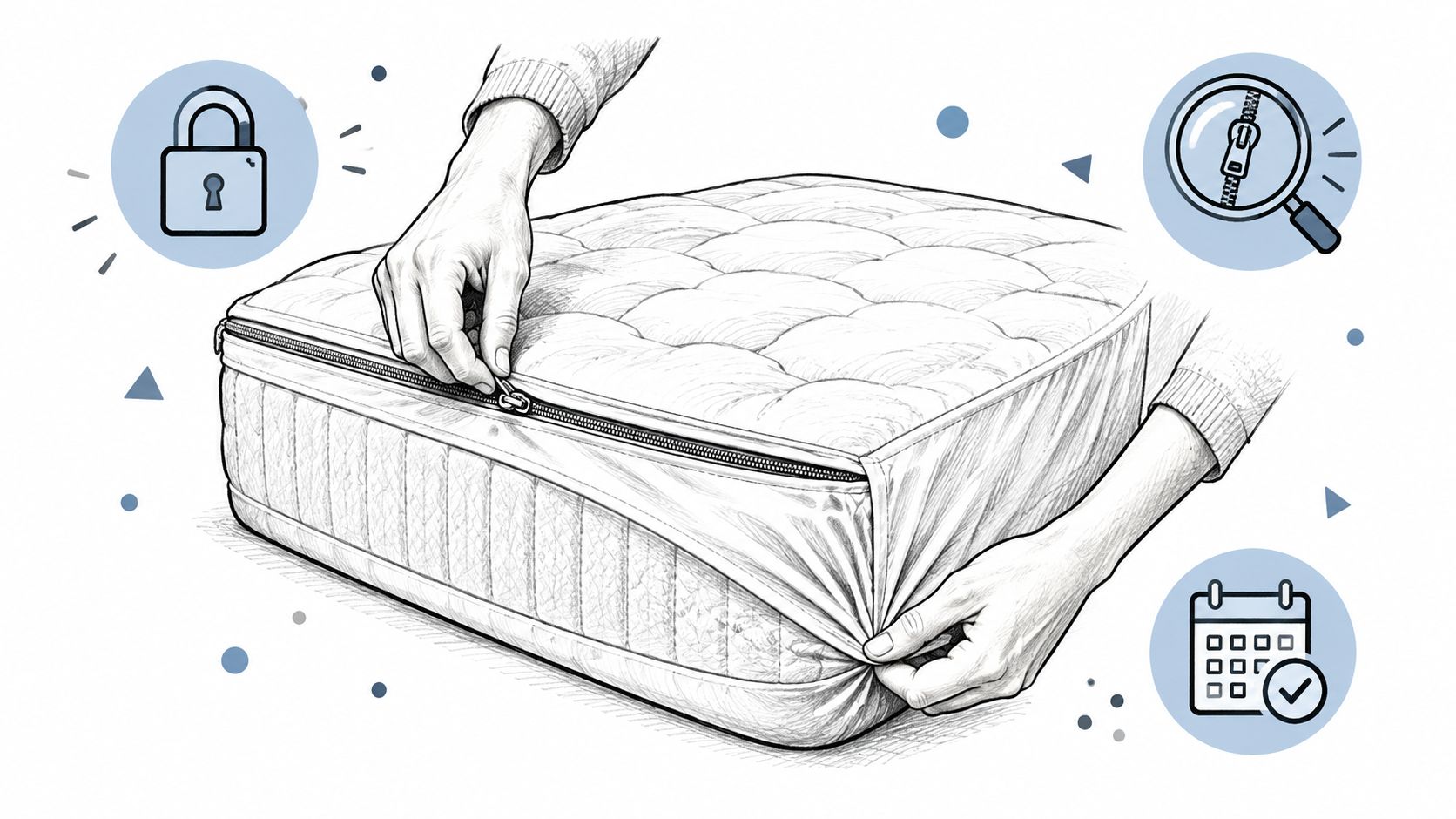
Separate the permanent barrier from the washable layers
The NHS guidance discussed earlier recommends weekly bedding changes or washing, with washable outer bedding laundered at the recommended hot setting. Its recommendation of 60°C or above is for killing mites in suitable washable items, not permission to ignore an individual product's care label.
Keep the encasement fitted continuously, subject to its manufacturer's care instructions. Don't assume it needs removing whenever you change the sheets, or that every encasement tolerates the same washing and drying process.
- Inspect the closure: Check that the zip closes completely and stays secured.
- Look along the seams: Pay attention to loose stitching, tears or worn fabric.
- Read the care label: Confirm washing, drying and handling requirements before laundering.
- Maintain the room: Include ventilation and humidity reduction in the household routine.
For help distinguishing routine protector care from care of a sealed barrier, consult the guide on how often to wash a mattress protector.
Make the routine easy to repeat
For a family bed, it may help to keep suitable spare outer bedding ready so that laundry doesn't require removing the encasement. In shared accommodation, make sure whoever changes the bed knows which layer should remain fitted.
Maintenance priority: Preserve the enclosure while cleaning the bedding outside it.
Don't compensate for damage by adding another fitted sheet. If the fabric or closure no longer forms an intact barrier, ask the supplier about repair or replacement under the product's instructions.
Ventilation and moisture control remain relevant because the cover is only part of the bedroom environment. You're maintaining a system of practical measures, not relying on a single purchase to do every job.
What This Means for Allergy and Asthma Sufferers
For someone with confirmed dust-mite sensitivity, the most useful expectation is better control of a potential exposure source, not certainty about how they'll feel the next morning. For someone without a confirmed trigger, buying a cover shouldn't substitute for understanding persistent symptoms.
The clinical distinction matters particularly if you have asthma. Keep environmental purchases separate from treatment decisions, and don't interpret a new cover as a reason to reduce or stop prescribed medication. If symptoms remain troublesome, discuss them with your clinician rather than repeatedly buying bedding in search of a guaranteed fix.
Decide what counts as success
There are different questions a household can ask:
| Question | What it helps you judge |
|---|---|
| Does the product fully enclose the mattress? | Whether it has the required physical design |
| Is allergen-containment evidence available? | Whether the claim goes beyond a reassuring label |
| Can we use and care for it consistently? | Whether the barrier is practical for this household |
| Have symptoms changed? | A separate health observation, not proof of product performance |
A comfortable night doesn't verify allergen-impermeability, just as a difficult night doesn't automatically prove a cover has failed. Symptoms and mattress containment aren't interchangeable measurements.
Make the buying conversation specific
Ask the retailer for the finished-product specification, the nature of allergen-escape testing, and the care instructions. If the answer only repeats words from the packaging, you still need the underlying information.
A useful request is: explain what was tested, which parts of the product the evidence covers, and how the barrier should be maintained. You don't need specialist laboratory knowledge to ask for a clear answer.
The broader guide to how to allergy-proof your bedroom can help organise household measures beyond the mattress. Keep that wider perspective when judging value: other bedding and soft furnishings remain relevant, and sensitivity differs between people.
A sensible decision can therefore be worthwhile without carrying a promise of symptom relief. Choose on the strength of the barrier evidence, practical suitability and realistic expectations, while keeping medical care focused on your individual needs.
Common Misconceptions About Mattress Covers
Marketing language can collapse several different benefits into a single impression of protection. The safest response isn't to dismiss all claims, but to separate them and ask what each one means.
The label isn't the evidence
Waterproof means allergen-proof. These are different properties. As the earlier comparison explains, evidence about liquid protection doesn't establish that an entire mattress has been enclosed against allergen escape.
Hypoallergenic guarantees protection. Treat the word as a prompt for questions, not the end of the buying process. The useful information is the product's construction, testing and instructions.
| Marketing impression | Better buying question |
|---|---|
| Protective bedding | Protection against what? |
| Allergy-friendly | What evidence supports the intended use? |
| Sealed design | How does the closure maintain the barrier? |
Containment isn't eradication
Once the cover is fitted, the mites are gone. A barrier isn't evidence that the contents of an existing mattress have been eliminated. Its role is containment, which is why continued use matters.
A greater barrier always means a better sleeping product. Breathability and care compatibility also deserve attention. Don't choose solely on a general impression of impermeability while ignoring whether the product suits everyday use.
No immediate symptom improvement means the cover is useless. This confuses the clinical and environmental questions discussed earlier. Conversely, feeling better doesn't establish that the mattress was the only trigger.
Evaluate the claim the manufacturer can support, not the outcome you understandably hope for.
The most costly misunderstanding is expecting a bedding purchase to replace every other household measure or medical intervention. A carefully chosen cover can have a defined role without becoming the answer to every symptom.
Frequently Asked Questions
Can I use an encasement on a mattress that's already been used?
Yes. The barrier approach isn't restricted to a newly purchased mattress. The important practical questions are whether the encasement fits properly, remains intact and can stay continuously closed according to its instructions.
Should I wash the encasement whenever I wash the sheets?
Not automatically. Keep the distinction between outer bedding and the underlying enclosure described in the maintenance guidance. Follow the encasement's own care instructions rather than transferring a sheet-washing routine to a different product.
Do pillows and duvets need attention too?
Yes. The NHS barrier-bedding guidance discussed earlier includes both. When planning a purchase, check which bedding items you need to cover rather than assuming a mattress product addresses the whole sleeping environment.
What should I ask before ordering online?
Use a short purchasing checklist:
- Fit: Does the stated size accommodate your mattress dimensions and depth?
- Evidence: Can the supplier explain the allergen-containment claim?
- Closure: Are fitting and sealing instructions available before purchase?
- Care: Can your household follow the required washing and drying instructions?
Can I tell whether it works by looking at the mattress?
Appearance can help you identify visible damage, but it can't establish allergen-barrier performance. Product evidence and correct use are more informative than whether the bed looks clean.
What if I still wake with symptoms?
Don't assume you need a stronger cover or that dust mites must be the cause. Review the household routine and seek clinical advice about persistent symptoms, particularly where asthma is involved. The appropriate next step may be understanding the trigger rather than buying another bedding layer.
Protect-A-Bed offers mattress protectors, pillow protectors and mattress encasements for household bedding protection. Visit Protect-A-Bed to compare product construction and care requirements, and ask which options provide complete enclosure and documented allergen-barrier performance before choosing for your bed.