

Waterproof Bed Bug Proof Mattress Cover UK Guide

A waterproof bed bug proof mattress cover is a fully zippered six-sided encasement with a sealed membrane, not a fitted sheet-style protector, and combining both is the standard UK approach for full protection; UK local authorities recorded 16,569 bed bug control treatments in 2013–14. That figure represented 3.3% of all local-authority pest control treatments, and it was 21% higher than in 2011.
The most popular advice is also the most misleading: buy a waterproof mattress protector and assume you've bought bed bug protection. You haven't. A fitted protector can stop a drink, sweat, or a child's accident reaching the mattress, but its open underside, elastic edges, seams, and exposed corners leave routes for insects.
A proper encasement does a different job. It surrounds the mattress on all six sides, closes with a secured zip, and removes the mattress interior as an easy hiding place. It won't replace professional treatment during an active infestation, but it can support containment and protect the mattress after treatment.
The buying rule: waterproofing protects the mattress from liquid. A sealed encasement protects the mattress from pest entry, escape, and harbourage. If you need both outcomes, buy both layers.
This guide covers the practical decision UK households often miss: which layer earns its keep, how the two products work together, how to fit and inspect an encasement, and what landlords, hotels, guesthouses, and short-let operators should document.
Table of Contents
- The Two Products Most UK Shoppers Confuse
- How Waterproof and Bed Bug Proof Covers Actually Work
- Mattress Protector vs Full Encasement
- Installing and Sealing an Encasement Properly
- Why UK Bed Bug Trends Make Encasements Worth Owning
- Real Use Cases for UK Households and Property Managers
- Buying Criteria That Actually Matter in the UK
- Which Setup Is Right for Your Bed
The Two Products Most UK Shoppers Confuse
A quilted terry protector and a bed bug encasement may sit beside each other in a shopping search, but they aren't interchangeable. The protector is designed to sit over the sleeping surface. The encasement is designed to seal the mattress itself.
A fitted waterproof protector normally has elasticated edges. It covers the top and may extend down the sides, but the underside remains open. That design makes the protector quick to remove and wash, which is useful for spills and perspiration. It also creates an obvious weakness for bed bug control, because insects can travel beneath the mattress or enter through an uncovered base.
A six-sided encasement works less like bedding and more like a sealed protective shell. It must fit around the entire mattress, with a closure that leaves no open gap at the zip ends. The fabric, seams, and closure all have to work together. Calling a product “bed bug proof” doesn't make it suitable if it only covers five sides.
What each product is for
Use a waterproof fitted protector when your main concern is liquid damage, sweat, bedwetting, staining, or everyday wash convenience. Use a full encasement when you need to reduce mattress harbourage, contain a treated mattress, or prevent insects from entering the mattress core.
UK consumer guidance makes the distinction clearly. Which?’s mattress protector guidance explains that a protector can create a barrier against bed bugs reaching the mattress, but also warns that a protector alone is unlikely to eradicate an infestation.
The common mistake is buying a thick, comfortable protector for pest defence, then assuming it remains effective because it still looks intact after washing. Bed bugs don't need a large tear in the middle of the fabric. An open base, loose seam, or unprotected zip can be enough to undermine the intended barrier.
For a straightforward explanation of the distinction, see this guide to bed bug mattress protectors versus encasements. The decision is simple once the use case is clear: a protector is a surface shield, while an encasement is a mattress barrier.
How Waterproof and Bed Bug Proof Covers Actually Work
A good waterproof bed bug proof mattress cover uses several layers, and each layer has a specific responsibility. Think of the construction as a sandwich. The soft top layer is the bread you sleep against, the waterproof membrane is the filling that stops liquid, and the backing supports the structure from underneath.
The surface may use a breathable knit, terry fabric, cotton, or a cooling textile. That layer controls how the cover feels against the sheet and helps manage warmth and condensation. Underneath sits a thin membrane, commonly a polyurethane-type film in this product category. It blocks liquid migration while allowing the cover to remain flexible and quieter than cheap plastic-based alternatives.
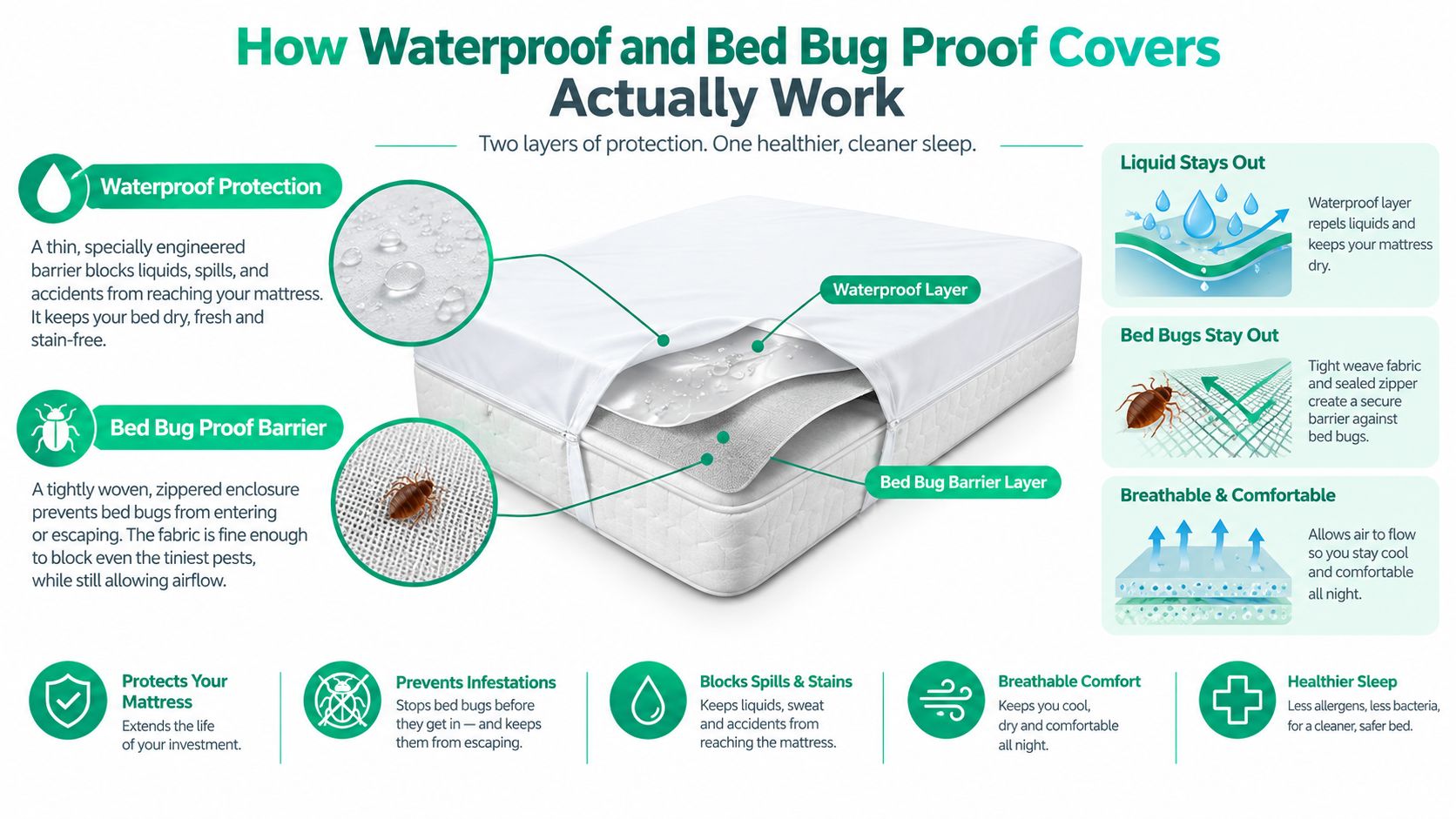
The waterproof layer
A membrane has to block more than an obvious spill. It also needs to resist sweat and repeated moisture exposure without becoming stiff, noisy, or uncomfortable. UK expert testing has found that the more comfortable waterproof protectors pair a membrane barrier with a breathable face fabric, rather than relying on a single plastic-like layer. Independent testing and reviews of waterproof mattress protectors discuss this layered construction and the importance of breathability.
That matters in a child's bed, guest room, care setting, or hotel room. A cover that prevents liquid but traps heat can encourage people to remove it, defeating the protection. Look for a soft face fabric and a membrane described specifically, rather than a vague promise of “water resistance”.
The sealed closure
The zip is the most important detail in the encasement. It should travel around the mattress edge and meet a protective flap or guard at the ends. A small-toothed zip, reinforced stitching, and a flap that shields the slider reduce the chance of an exposed route.
The cover's fabric and seams matter just as much. Bed bugs can move through very small gaps, so the barrier must remain closed after fitting, laundering, and ordinary bed movement. Waterproofing at the centre of the panel is useless if the seams or zip ends allow access.
Choose a construction that feels flexible rather than brittle. You want a cover that stays quiet beneath the sheet, bends around corners without stressing the seams, and can remain fitted during inspection and treatment. Breathability isn't a luxury here. It affects whether the encasement stays on the bed long enough to do its job.
Mattress Protector vs Full Encasement
The quickest way to choose correctly is to identify where the risk sits. If the problem is on the sleeping surface, a fitted protector may be enough. If the concern includes the mattress edges, underside, seams, or existing harbourage, choose a full encasement.
| Feature | Fitted Protector | Full Zip Encasement |
|---|---|---|
| Coverage | Top and part of the sides | All six sides |
| Closure | Elasticated edge | Full zip with a secured closure |
| Main purpose | Spills, sweat, bedwetting, and surface allergens | Mattress containment and bed bug barrier support |
| Bed bug entry points | Open underside and exposed edges remain | Entry points are reduced when correctly sealed |
| Waterproofing | Often available | Available in models with a sealed membrane |
| Everyday washing | Usually simpler to remove | Requires more careful removal and refitting |
| Comfort layer | Designed to sit beneath a sheet | Usually needs a sheet or protector over it |
| Best use | Routine household protection | Suspected, confirmed, or higher-risk pest situations |
A fitted protector solves a real problem. It can stop liquids from reaching the mattress and make routine cleaning less disruptive. It shouldn't be sold to yourself as a complete pest-control measure.
A full encasement earns its place when the mattress itself needs isolating. It can reduce the mattress as a harbourage site and help trap insects that may already be inside, but it isn't a standalone cure. Room treatment, inspection, cleaning, and professional advice still matter during an infestation.
Why the layered setup works
For full protection, fit the encasement first. Add a separate waterproof protector over it, then place the normal fitted sheet on top. The encasement provides the sealed barrier, while the upper protector takes the daily wear, sweat, and spills that would otherwise make the encasement harder to remove.
This arrangement also makes housekeeping more practical. A landlord or hotel operator can inspect the encasement at changeover while staff wash the upper protector between occupants. A household gets the same benefit with less disruption to ordinary laundry.
Don't buy based on a product title alone. Check whether “waterproof” refers to the whole six-sided shell, whether the zip has a guard, and whether the bottom is enclosed.
Installing and Sealing an Encasement Properly
A correctly designed cover can still fail if it isn't fitted carefully. Treat installation as a sealing procedure, not as a routine change of bed linen.
- Strip the bed completely. Remove sheets, blankets, toppers, pillows, and any loose bedding. Keep potentially affected items separate until you've decided how they'll be laundered or treated.
- Vacuum the mattress seams. Use a crevice tool around piping, tufts, corners, handles, and the underside edge. Vacuuming isn't a cure, but it removes loose debris and makes inspection easier.
- Inspect before enclosing. Look for live insects, faecal spotting, shed skins, or other signs around the seams and bed base. If you suspect an active infestation, arrange professional treatment rather than sealing the problem away and assuming it has gone.
- Slide the cover over from the foot. Keep the mattress upright or supported where practical. Work each corner into place instead of pulling hard on one edge, particularly on a deep UK double, king, or superking mattress.
- Align the zip and guard. The zip head should meet the protective flap at the start and finish. Close it slowly, checking that fabric isn't caught in the teeth and that the perimeter sits flat.
- Inspect the finished seal. Run your hand along the closure from outside the zip teeth. Confirm that the flap covers the slider in both directions and that no daylight appears at either end.
The fitting method and the purpose of zipped covers are also covered in this guide to zipped mattress covers.
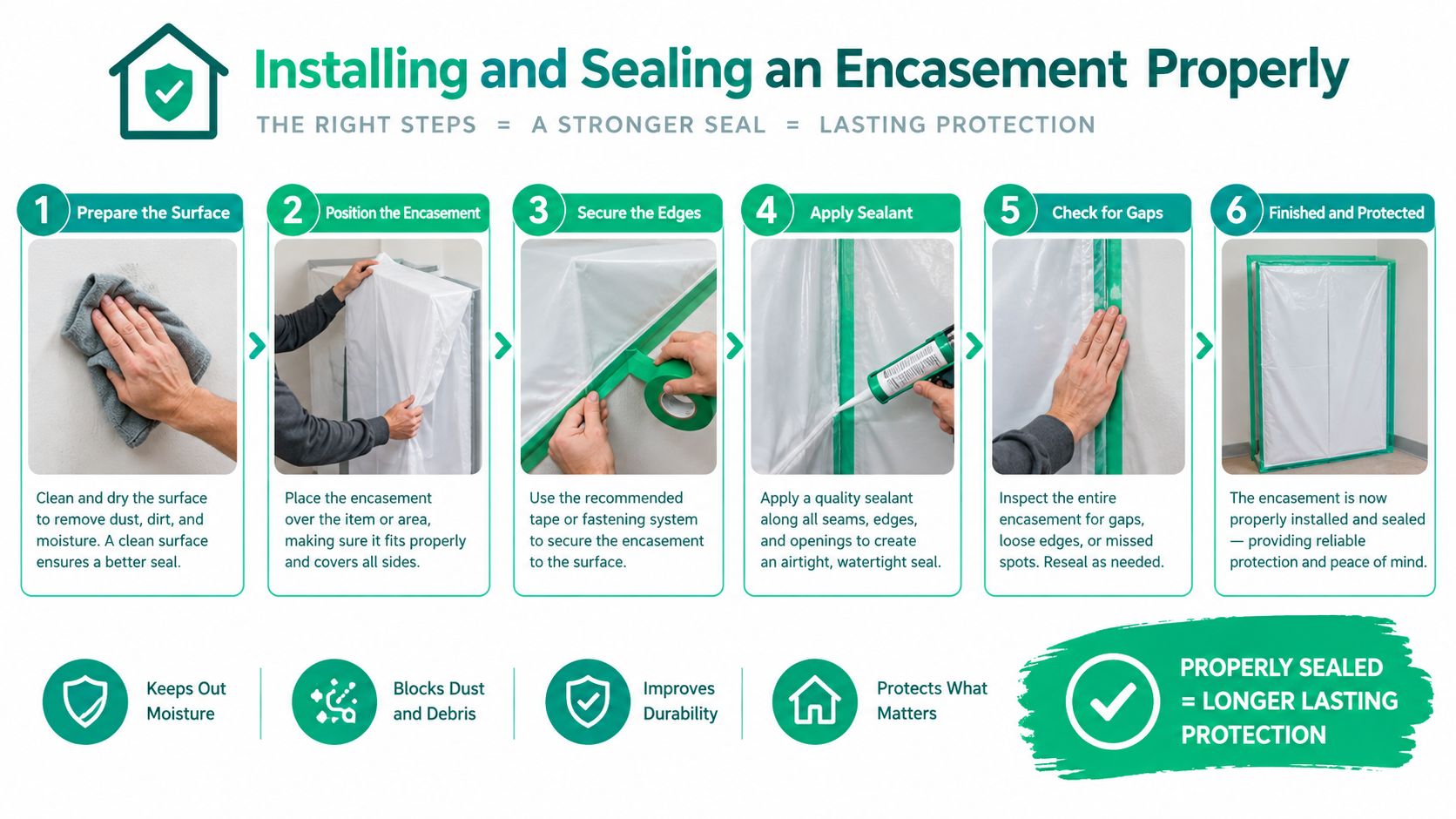
Write the installation date on the underside with a permanent marker. Keep the date visible for your maintenance records, and inspect the fabric, seams, and closure whenever the bed is rotated, moved, or replaced. Don't force a damaged zip, and don't put a cover back on after laundering until it's fully dry and free from tears.
Why UK Bed Bug Trends Make Encasements Worth Owning
Bed bugs are not a rare theoretical risk in UK accommodation. The British Pest Control Association recorded 16,569 bed bug control treatments by UK local authorities during 2013–14, accounting for 3.3% of all local-authority pest control treatments. The figure was 21% higher than in 2011, and more recent industry reporting cited a 44% average year-on-year increase in confirmed UK bed bug activity between 2023 and 2025. These figures are reported in the British Pest Control Association national survey summary.
That context changes the purchase decision. An encasement isn't just a comfort accessory. It gives the mattress a defined physical barrier, supports inspection, and can help contain a mattress during a wider integrated pest-management programme.
It still won't kill an infestation by itself. Bed bugs can hide in bed bases, frames, skirting, furniture, and wall-adjacent areas, so a sealed mattress must sit alongside inspection and appropriate treatment. The cover's value is control of one important harbourage location, not a promise that the whole room is pest-free.
Where the encasement fits
| Method | Reaches Mattress Seams | Kills Eggs | Starve-Out Effect | Post-Treatment Prevention |
|---|---|---|---|---|
| Professional inspection | Yes | No | No | Helps identify early activity |
| Vacuuming | Partly | No | No | Removes loose insects and debris |
| Heat or targeted treatment | Depends on method and access | May do so when correctly applied | No | Requires follow-up controls |
| Sealed mattress encasement | Isolates the seams inside | No | Yes, by containing pests inside | Yes, by denying new entry to the mattress |
| Room monitoring | No | No | No | Helps detect renewed activity |
A sealed cover is therefore a physical control measure, not an insecticide. It can make later inspections more meaningful because the mattress surface is easier to check, and it prevents the mattress core from becoming an unobserved refuge.
For landlords and accommodation operators, the sensible approach is to pair the encasement with a written inspection routine and a documented response process. A resource listing UK pest control providers for 2026 can help property managers identify appropriate professional support when signs go beyond routine prevention.
Real Use Cases for UK Households and Property Managers
A London tenant has just had a bedroom treated. The mattress looks clean, but the letting agent's reinstatement note requires the bed to remain protected while the wider room is monitored. A six-sided encasement gives the tenant a visible, inspectable barrier. The tenant can then use a normal protector and sheet above it without disturbing the sealed layer.
The documentation matters as much as the fabric in a rental. Record the product, installation date, mattress condition, and any treatment paperwork. That record doesn't prove the room is pest-free, but it shows that the tenant or manager took a defined containment step and kept the bed under observation.
Short-let and hospitality rooms
A guesthouse or serviced apartment faces a different pressure. Guests change frequently, and housekeeping staff need a repeatable process rather than a product that depends on individual judgement. The encasement stays on the mattress, while the upper protector and bedding are changed, inspected, and laundered according to the property's procedure.
A room checklist should direct staff to inspect seams, bed bases, headboards, and nearby furniture. It should also state who receives a report when staff see spotting, shed skins, or live insects. A practical Airbnb cleaning service playbook can help operators build a wider turnover routine around bedding, inspection, and record keeping.
For accommodation operators: the encasement is not permission to skip inspection. It is a standardised layer that makes the mattress easier to manage when several people share responsibility for the room.
Landlords and family homes
A buy-to-let landlord refurbishing a void can fit an encasement to each retained mattress and inspect it at the next changeover. Pairing the mattress cover with protection for the bed base creates a clearer preventative system, particularly where furniture remains between tenancies.
A family moving into a flat may face a similar concern after inheriting furniture from a previous occupant. Fitting the barrier before the first sheet goes on is more sensible than waiting for bites or visible signs. The same principle applies to student housing, shared homes, and care settings, where one overlooked room can affect other occupants.
In every example, the cover is a documented preventative layer and an IPM adjunct. It can support conversations with tenants, insurers, agents, or environmental health officers, but it doesn't replace a professional diagnosis or treatment plan.
Buying Criteria That Actually Matter in the UK
Ignore the product title until you've checked the construction. A listing that says “waterproof” may describe a top-surface protector. A listing that says “bed bug proof” may fail to explain whether the bottom is enclosed or whether the zip has a protective closure.
Use these questions before buying:
| Criterion | What to look for | Red flag |
|---|---|---|
| Mattress coverage | Six-sided, full-mattress encasement | “Full protection” with an open underside |
| Waterproof layer | A named membrane and clear liquid barrier description | “Water resistant” without a waterproof claim |
| Surface fabric | Breathable knit, cotton, terry, or cooling textile | Thin, noisy plastic-like surface |
| Zip construction | Secured zip with an end flap or guard | Exposed zip ends or vague closure wording |
| Fit | Mattress dimensions and usable depth | One-size wording with no depth guidance |
| Seams | Reinforced construction and clear care instructions | No information about stitching or durability |
| Washing | Specific machine-washing instructions | Care label unavailable before purchase |
| Testing and warranty | Verifiable product documentation and written warranty | Unspecified certification or unsupported claims |
| Delivery and returns | UK returns address and clear delivery terms | Overseas seller with unclear returns process |
Ask what the membrane actually is
A breathable waterproof membrane should be identified clearly. A generic phrase such as “advanced waterproof technology” tells you very little. The breathable waterproof membrane guide gives shoppers useful context for judging why a thin, air-permeable layer can feel different from a rigid plastic coating.
Check the closure before the colour
Fabric choice affects comfort, but the zip determines whether an encasement can perform its pest-barrier role. Look for wording that explains how the slider, ends, seams, and flap are protected. If the listing shows only the top of the product, ask for a photograph of the underside and the zip termination.
Don't accept “bed bug proof” as a complete specification. Ask whether the product covers all six sides, whether testing is documented, how the warranty treats zip or seam failure, and whether the seller offers a genuine UK returns route. Delivery speed matters for a changeover or treatment, but it shouldn't distract from the barrier details.
Which Setup Is Right for Your Bed
Choose a waterproof fitted protector alone if your priority is spills, sweat, bedwetting, or routine surface protection and there's no known bed bug concern. It suits a standard household mattress when you want easy washing and don't need to isolate the mattress core.
Choose a full six-sided zip-around encasement when bed bugs are suspected, confirmed, or a realistic risk during a house move, hotel stay, rental changeover, or second-hand furniture move. Measure the mattress length, width, and depth before ordering. A loose cover creates folds and stress points, while an undersized cover can strain the zip and seams.
For most UK households, the strongest arrangement is layered:
- Encasement first. Fit the waterproof, sealed mattress shell and inspect the closure.
- Protector second. Add a separate waterproof or breathable fitted protector to handle everyday wear.
- Sheet on top. Keep the normal sleeping surface easy to remove and wash.
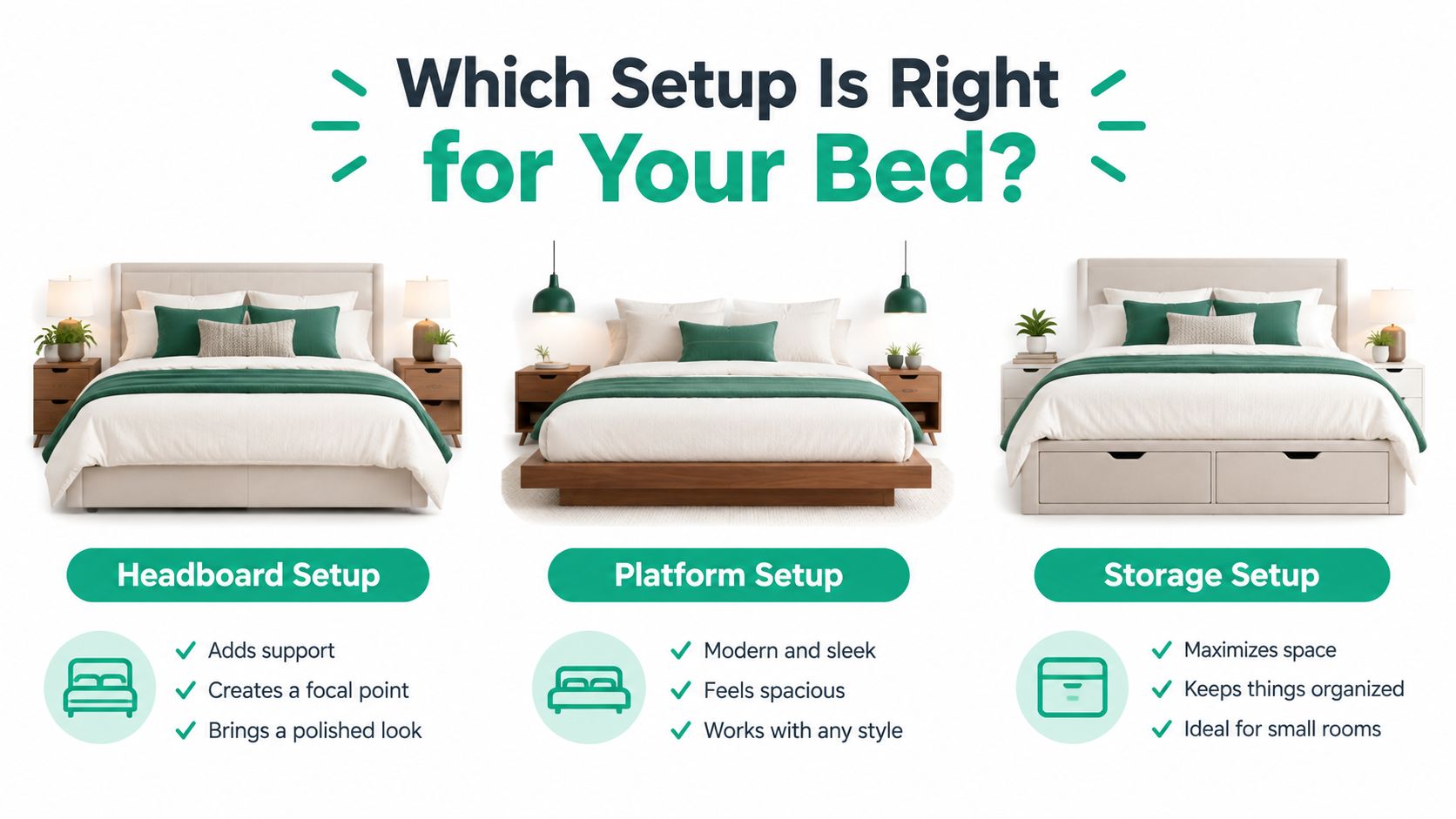
My recommendations are direct. Owner-occupiers should buy both layers if they want liquid and pest protection. Landlords should use a sealed encasement wherever mattresses remain between tenants and keep installation records. B&B and short-let operators should standardise encasements with inspection checklists and washable upper protectors. Student households should prioritise a full encasement when moving into furnished accommodation or sharing a building with frequent room turnover.
A waterproof bed bug proof mattress cover earns its price through the combination, not the label. Buy the fitted protector for convenience, the encasement for containment, and use both when the mattress needs protection from the two risks at the same time.
Protect-A-Bed offers UK mattress protectors and bed bug encasements using waterproof, breathable protection designed for household and commercial beds. Visit Protect-A-Bed to choose the correct layer for your mattress, check the fit, and build a setup that combines everyday liquid protection with a sealed pest barrier.