

Zipped Mattress Covers: A Practical UK Guide

You've bought a new mattress, or you've spotted a suspicious mark near the seam of the old one. The obvious question is whether to add a simple waterproof protector or invest in a zipped mattress cover that surrounds the entire mattress. Those products look similar in search results, but they solve different problems.
The practical choice is layered protection. A fitted protector handles routine spills, perspiration and everyday mess. A full zip-around encasement is the serious option for bed bug containment, dust-mite barriers and higher-risk properties. Buying the wrong type usually means paying for coverage you don't need, or discovering too late that a top-only protector leaves the mattress core exposed.
Table of Contents
- What a Zipped Mattress Cover Actually Is
- How a Zipped Cover Is Built and How the Zip Works
- Everyday Waterproofing Versus Full Encasement
- Sizing Your Mattress and Installing the Cover Properly
- Real-World Pros and Cons of Zipped Mattress Covers
- Looking After the Cover So It Keeps Working
- Why a Zipped Cover Alone Will Not Solve Everything
- Choosing the Right Zipped Mattress Cover for Your Home
What a Zipped Mattress Cover Actually Is
In UK bedding shops, a zipped mattress cover usually means a full mattress encasement. It surrounds the mattress on all six sides, including the underside, and closes with a zip. That makes it different from a fitted waterproof protector, which stretches over the sleep surface and usually grips the mattress with elastic around its edges.
The wording on product pages can be confusing, so start with the construction rather than the name.
- Encasement: a cover that encloses the complete mattress.
- Six-sided enclosure: protection across the top, bottom and four sides.
- Zip closure: the opening used to fit and remove the cover.
- Bug-proof or allergen-proof seal: a closure and fabric system designed to minimise pathways through seams, gaps and the zip end.
A cover can be waterproof without being a proper encasement. It can also be marketed as anti-allergy without isolating the whole mattress. Those claims describe materials or intended uses, not necessarily the level of physical coverage.
Practical rule: If you can see the mattress underside after fitting, you haven't created a complete encasement.
This distinction matters most with bed bugs. A six-sided cover interrupts access to mattress seams and internal cavities, where bed bugs can hide and lay eggs. Field observations have reported fewer bed bugs in encased mattresses and box springs than in unencased ones, while fabric encasements appeared less protective than vinyl alternatives, which underlines the importance of closure integrity and material performance. UK product information on full bed bug encasements reflects the same practical principle.
For many households, a full encasement is overkill. A child's occasional spill doesn't automatically justify wrestling a heavy mattress into a sealed shell. For a rental property, a returning traveller, a hotel room or a household managing serious dust-mite sensitivity, the extra coverage can be the only sensible choice.
The rest of the decision comes down to one question: are you protecting the surface from daily accidents, or isolating the mattress from a specific risk?
How a Zipped Cover Is Built and How the Zip Works
A quality encasement is a small barrier system, not just a large piece of fabric. The outer layer provides the hand feel and durability. Beneath it, a waterproof membrane, often made from polyurethane or TPU, blocks liquid while allowing some air movement. Seams then need binding, stitching or welding that prevents the membrane from becoming the weak point.
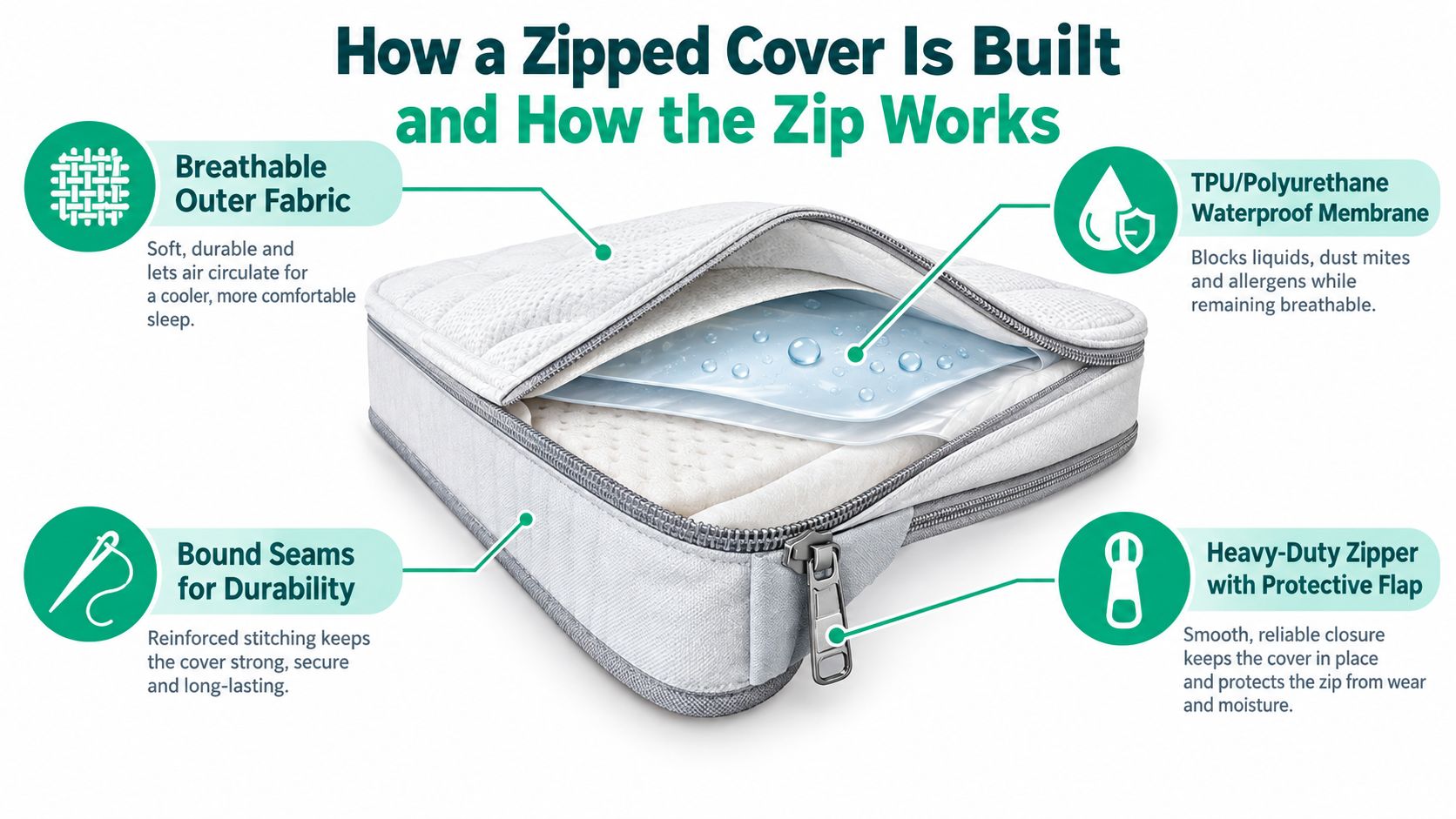
The zip is the critical engineering detail. A loose, ordinary zip may keep the cover closed but still leave a small opening at the termination point. A bed bug-focused design needs a protected zip end, a guard flap or another mechanism that closes that final gap. The closure must also remain aligned under tension, because a cover that's too shallow will pull the teeth apart whenever someone sits on the edge.
Two common zip layouts
The first style uses an L-shaped or U-shaped zip. It runs along the top edge and down one or two sides, allowing the upper panel to open widely. This design is common because it's relatively straightforward to manufacture and can be fitted without exposing every part of the mattress at once.
A wraparound zip travels farther around the mattress. It can make fitting easier, particularly when the mattress is bulky, but the longer closure creates more stitching and more zip surface to inspect. Neither layout is automatically superior. The seal at the end, the quality of the teeth and the fit around all six sides matter more.
The depth example is easy to visualise. A memory foam mattress around 20cm deep needs a different cover shape from a pocket-sprung mattress around 30cm deep, especially if the latter has a pillowtop. A shallow cover strains the zip and lifts at the corners. An oversized cover may sag, bunch under the sheet and leave the closure sitting awkwardly.
Construction details worth checking
Look for a soft outer textile rather than exposed plastic, a membrane described clearly rather than vaguely, and seams that are bound or reinforced. A protective zip flap can reduce snagging against sheets and pyjamas, while a bug-proof closure should have a defined stop or guard rather than just a standard zip pull.
The important point is simple: the cover is only as secure as its weakest seam, corner or zip ending. A six-sided shape provides the right architecture, but poor fitting or a damaged closure defeats it.
Everyday Waterproofing Versus Full Encasement
A fitted waterproof protector is usually the right answer for ordinary household protection. It sits between the sheet and mattress, catches a child's accident, protects against perspiration and makes routine laundering manageable. It also comes off more easily when you're changing bedding in a narrow UK bedroom.
A full encasement earns its keep when the mattress itself is part of the risk. That includes concern after travel, a rental property between occupants, accommodation with frequent guest turnover, or a household where dust-mite exposure is a serious consideration. UK bed bug outbreaks increased by nearly two-thirds in the twelve months reported by the Chartered Institute of Environmental Health in 2023, a rebound after the pandemic slowdown that helped move sealed mattress protection into mainstream pest-control and property-management conversations. UK waterproof mattress protection listings and market context provide the relevant retail context.
| Feature | Fitted Waterproof Protector | Full Zip Encasement |
|---|---|---|
| Coverage | Usually the sleep surface and mattress sides | All six sides of the mattress |
| Best use | Spills, sweat, children's beds and guest rooms | Bed bug containment and stronger allergen barriers |
| Fitting | Quick to stretch over the mattress | More involved, often requiring the mattress to be lifted |
| Daily convenience | Easy to remove and wash | Bulkier to remove and refit |
| Pest protection | Doesn't isolate the mattress core | Can interrupt access when fully sealed |
| Comfort strategy | Usually feels closer to ordinary bedding | May need a separate protector above it |
The material matters too. A breathable waterproof membrane can block liquid without producing the harsh plastic feel shoppers associate with old-fashioned mattress covers. Guidance on breathable waterproof membrane construction is useful when you're comparing a daily protector with a sealed encasement.
Choose the fitted protector if your main problem is mess. Choose the encasement if your main problem is containment. If you need both, use the encasement as the long-term barrier and place a washable fitted protector above it. That layered setup protects the sealed cover from everyday soil and avoids unzipping the entire mattress whenever the top layer needs washing.
Current UK retail listings show a broad market, from about £10.99 for some waterproof protectors to £20 to £35 at larger retailers and around £44.80 for premium independent coverage. UK waterproof bedding listings show why shoppers can start with a basic surface protector or move towards a higher-spec encasement with specialist construction.
Sizing Your Mattress and Installing the Cover Properly
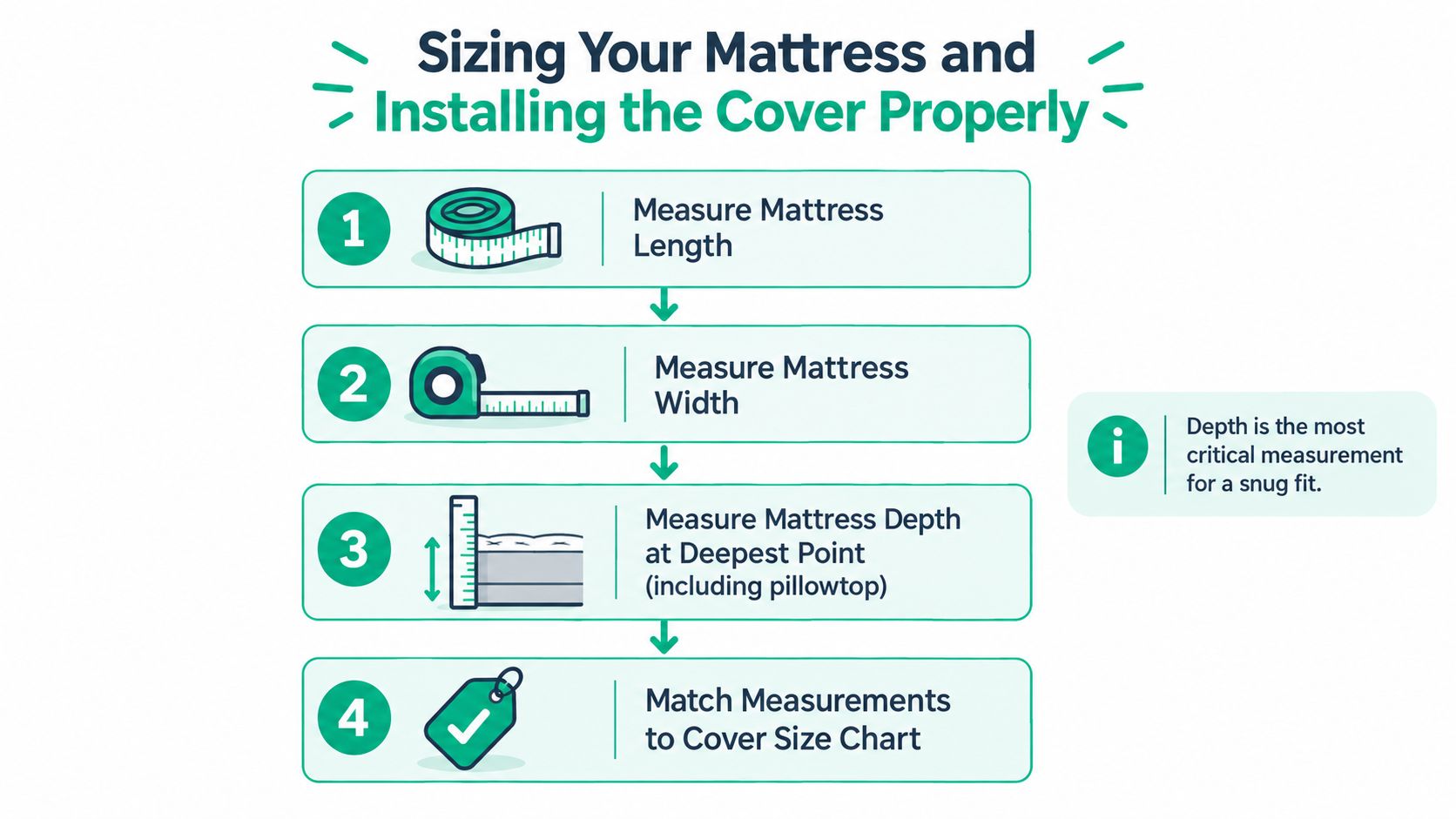
Measure the mattress before you shop. The label “double” or “king” isn't enough, because two mattresses with the same length and width can have very different depths.
Record:
- Length, from head to foot.
- Width, from side to side.
- Depth, from the base to the highest point, including a pillowtop or topper that will remain underneath the cover.
Depth is the measurement most likely to cause trouble. A mattress around 18cm deep won't need the same encasement as one around 38cm deep. A cover that's too shallow strains the zip and pulls the corners upwards. One that's too deep leaves loose fabric beneath the sheet, with folds that can feel uncomfortable and put uneven pressure on the closure.
Use the manufacturer's size chart and match the complete measurement range, not just the familiar bed-size name. This guide to measuring mattress depth is useful if the mattress has a substantial top layer.
Fit it without damaging the seal
Clear the bed and remove the sheets, topper and loose bedding. Lift the mattress onto a clean floor if you can, preferably with another person, then lay the unzipped encasement flat with its zip start point accessible.
Work the cover over the top first. Pull each side down gradually, seat the corners fully and keep the fabric flat rather than dragging one corner into place. If the mattress is folded, twisted or only partly inside, the zip will carry too much tension.
Zip slowly along the seam. Stop if the teeth separate, the pull catches or the fabric begins feeding into the mechanism. Never force a tight closure. Reposition the mattress and corners, then try again.
Finish with a physical inspection:
- Flat zip: the teeth should run evenly without a bowed section.
- Covered termination: the internal flap or bug seal should sit over the zip end.
- Settled corners: no corner should be folded inside the enclosure.
- Complete coverage: the underside should remain enclosed after the mattress returns to the bed base.
Real-World Pros and Cons of Zipped Mattress Covers
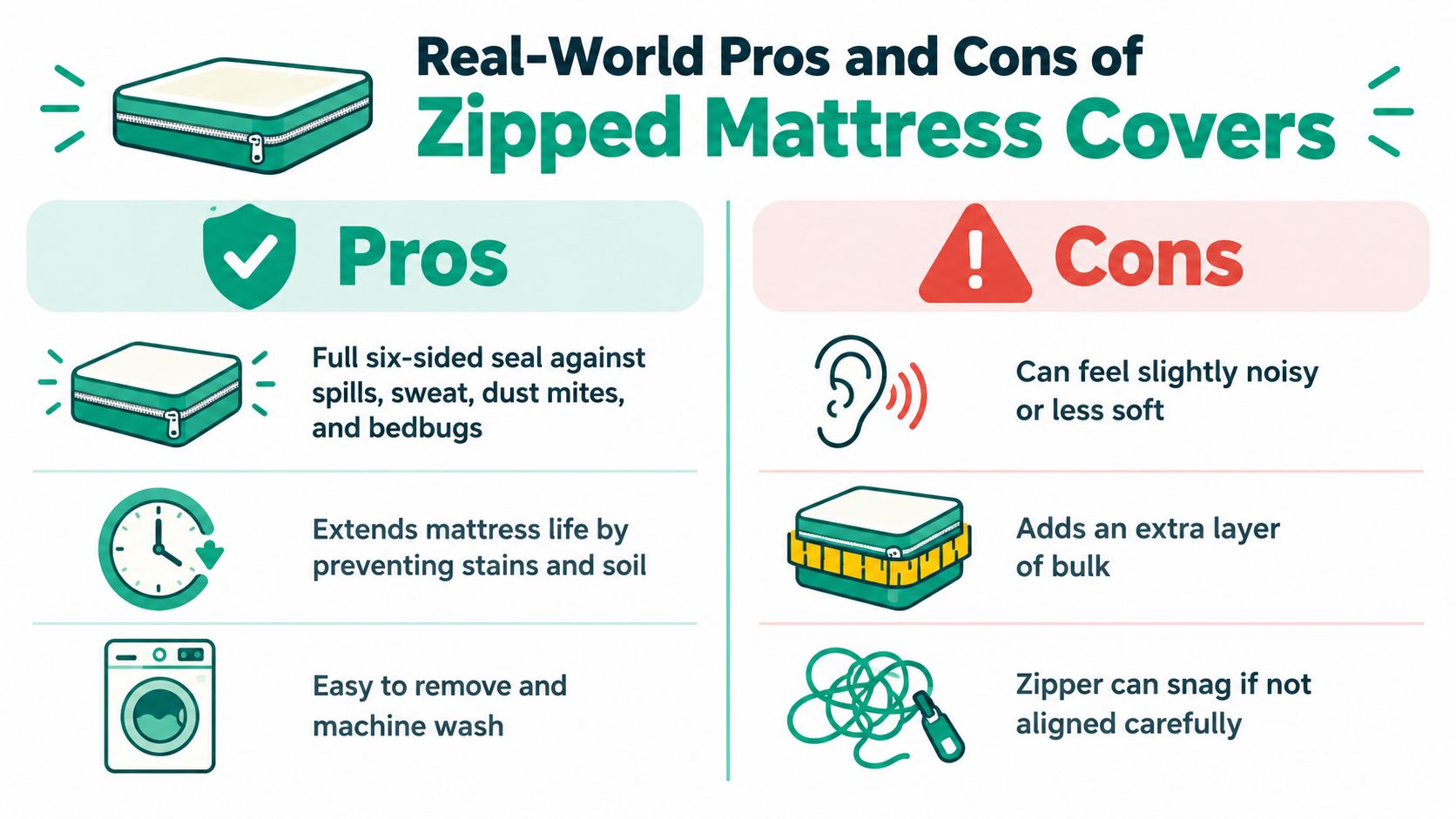
The strongest benefit is physical coverage. A properly fitted encasement protects the mattress top, sides and underside from liquid, perspiration, dust and pest access, while a separate sheet still provides the familiar sleep surface. You can usually leave the encasement in place while changing sheets, which means the mattress stays protected without becoming part of every laundry load.
What you'll notice in a normal bedroom
A breathable membrane can feel much less crinkly than thin plastic, but no encasement is completely invisible. On a memory foam mattress, the extra layer may make the bed feel warmer, particularly for someone who already sleeps hot. A soft sheet and a washable protector above the encasement usually make the surface more comfortable.
The bulk is real. A deep mattress becomes harder to lift, turn and dress, and the zip panel can add resistance when you're pulling a fitted sheet over the corners. That inconvenience matters in a small room or a care setting where staff change beds repeatedly.
Bedroom test: If the cover protects against a serious risk but makes the sleep surface unpleasant, add a separate breathable protector above it rather than abandoning the barrier.
Where cheaper construction shows itself
Low-grade materials can rustle, retain odours or lose their waterproof performance after repeated washing. The zip is often the first component to fail, especially when the cover is too tight or the teeth repeatedly catch fabric. A damaged seam or peeling membrane isn't a cosmetic fault. It breaks the protection you bought.
An encasement can help keep a mattress cleaner for longer, which supports its usable life and protects the condition of the bed. It won't transform an unsuitable mattress, improve its firmness or compensate for a poor base.
The right verdict depends on the room. For a child's bed, the protection against accidents may outweigh the extra handling. For a hot sleeper, a fitted protector on top can preserve comfort. For a landlord, hotel or care provider, the heavier construction and complete coverage may be justified because inspection and containment matter more than quick fitting.
Looking After the Cover So It Keeps Working
Start with the care label. Many zipped covers are designed for machine washing at 60°C, a temperature relevant to dust-mite control and reducing allergen load, but the fabric and membrane still need gentle handling. Use a mild detergent and the cycle specified by the manufacturer.
Avoid fabric softener and bleach. Both can damage or weaken waterproof membrane materials, particularly polyurethane-based layers. Don't overload the drum, because a compressed encasement may not rinse properly and the zip can become stressed.
Dry the cover completely before refitting it. Low tumble drying may be suitable where the care label permits it, while line drying is gentler. Never put a damp encasement back around the mattress. Trapped moisture can create stale smells and contribute to mould inside the mattress environment.
For routine use, wash according to the household's exposure rather than following a rigid calendar. A cover beneath a clean fitted protector may need less frequent washing than one directly exposed to children, pets or allergy-related laundering. Wash it promptly after a spill that reaches the encasement.
Inspect the cover every time you remove it. Replace it when the zip skips, the teeth no longer meet, the membrane starts separating or the surface feels damp after an ordinary night. Rewashing won't restore a failed barrier.
Care priority: A perfectly clean cover with a broken zip is no longer a protective cover.
Why a Zipped Cover Alone Will Not Solve Everything
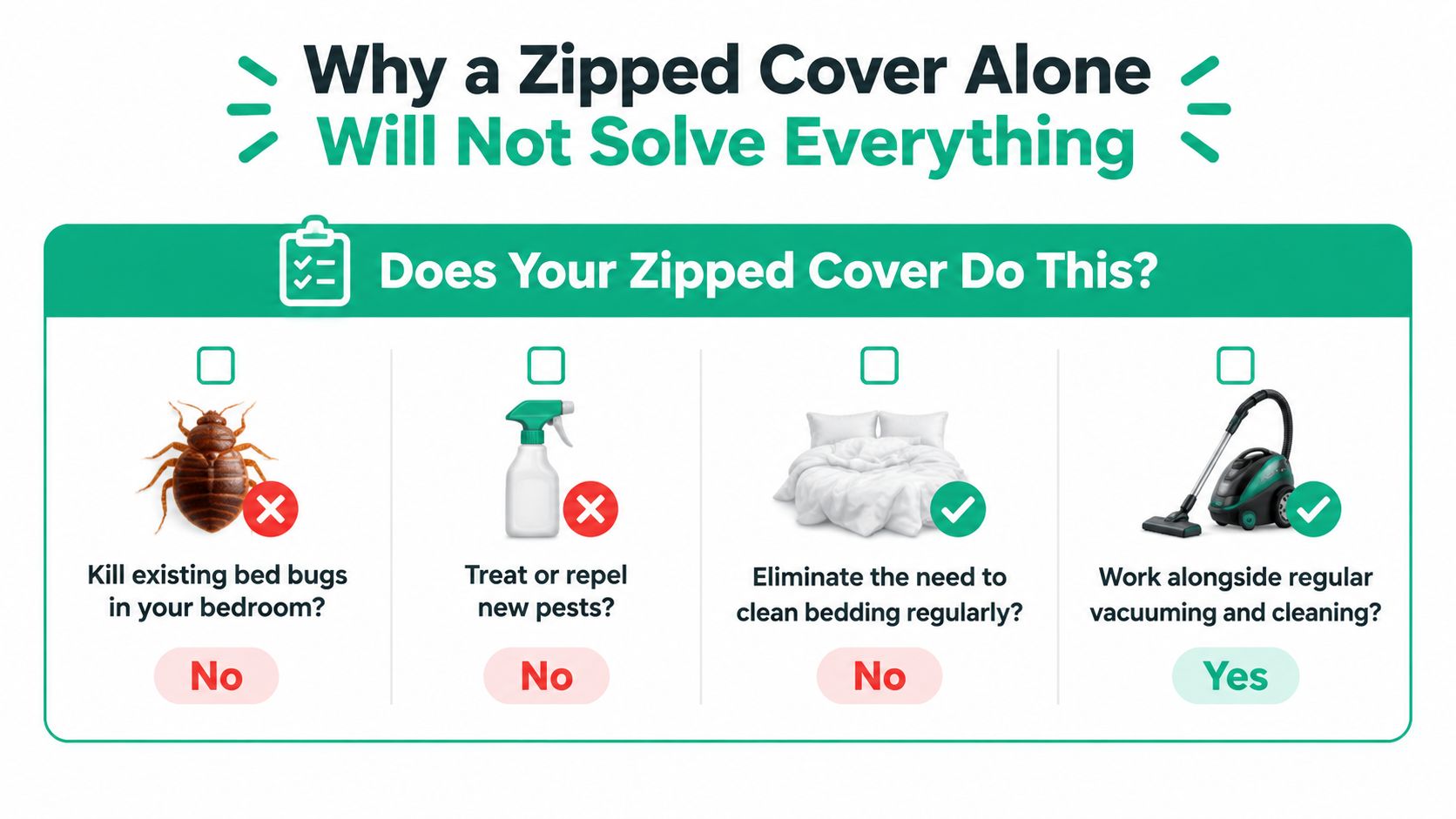
A mattress encasement is a containment tool, not an eradication treatment. It can seal the mattress surface and make the perimeter easier to inspect, but it doesn't kill bed bugs already hiding in the bed frame, headboard, skirting, furniture or bedroom clutter.
After professional treatment, a sealed encasement can trap surviving insects inside the mattress, where they eventually die without feeding. It must remain in place continuously, and it should be combined with follow-up inspection and monitoring such as interceptors. UK pest-control guidance on using encasements after treatment explains why the cover belongs within a wider control plan.
The bedroom still needs attention
If you suspect bed bugs, inspect the mattress seams, base, frame and headboard. Vacuum the bed structure and surrounding floor carefully, wash bedding at 60°C where the care label permits, and arrange professional pest-control advice for a serious or persistent infestation. A cover won't treat a new arrival from luggage or stop insects travelling through other hiding places.
For allergies, the limitation is different. Dust mites and their allergens can remain in pillows, duvets, carpets and upholstered furniture. A sealed mattress cover may reduce exposure from the mattress, but it won't make the entire bedroom allergen-free.
Regular laundering remains part of the plan. So does cleaning the surrounding room and choosing covers for pillows and duvets where appropriate. Anti-allergy wording on a product page shouldn't persuade you that one mattress cover solves every source of irritation.
For a clear explanation of the mattress-specific part of bed bug control, use this Pestless Inc. mattress bed bug guide alongside professional advice. The useful mindset is straightforward: seal the mattress, inspect the room and deal with the wider source.
Choosing the Right Zipped Mattress Cover for Your Home
Match the cover to the problem, not to the most dramatic product claim. A family dealing with spills needs a comfortable waterproof layer that can survive routine washing. A renter concerned about a previous occupant needs a genuine six-sided encasement with a secure closure. An allergy sufferer needs the encasement plus a wider laundering routine.
| Household Profile | Best Cover Type | Key Feature to Check |
|---|---|---|
| Family with young children | Breathable waterproof protector or encasement | Soft surface, waterproof membrane and practical wash care |
| Renter concerned about bed bugs | Full six-sided zip encasement | Bug-proof zip architecture and complete underside coverage |
| Allergy or asthma household | Mite-resistant encasement with regular bedding care | Washable construction, suitable depth and clear care instructions |
| Rental or hospitality property | Durable full encasement, often with a washable top protector | Robust seams, reliable closure and repeatable fitting |
| Guest room with occasional use | Fitted waterproof protector | Easy removal and simple storage |
Check the mattress depth in centimetres, including any permanent pillowtop. For bed bug claims, look for a clearly stated closure design rather than relying on the word “protective”. If a manufacturer specifies a zip-tooth size below 0.5mm, treat that as a technical buying detail to verify against the product information, not as a guarantee that the entire bedroom is protected.
Read the warranty and care label before buying. A long warranty is useful only if the cover can be washed and fitted without overstretching the zip. If the encasement is difficult to install, you're more likely to leave it damaged, poorly sealed or unused.
Protect-A-Bed offers UK mattress protectors and bed bug encasements using waterproof, breathable barrier construction, with options intended for residential and commercial bedding. Visit Protect-A-Bed to compare the available protection level with your mattress measurements and household needs.