

Temperature Control Mattress Guide for Cooler UK Sleep

At 3am, you wake clammy, push the duvet towards the foot of the bed and turn your pillow over to find its cooler side. A few minutes later, you're too cold, so you pull the covers back up, only to repeat the same routine when your body warms again.
The difficult part isn't recognising that you're uncomfortable. It's identifying what's causing the heat. Your mattress, protector, sheets, duvet, pillow, bed base and bedroom can all affect the small pocket of air around your body. A temperature control mattress may help, but it can't cool an entire room on its own. This guide separates those problems so you can choose the right layer, rather than replacing an otherwise suitable bed unnecessarily.
Table of Contents
- Why Your Bed Feels Too Hot at Night
- What a Temperature Control Mattress Actually Is
- How Mattress Materials Regulate Heat
- Pros and Cons of Temperature Control Mattresses
- How Breathable Mattress Protectors Improve Thermal Comfort
- Who Benefits Most and Which Solution Fits
- Buying Tips and Maintenance for Long-Term Comfort
Why Your Bed Feels Too Hot at Night
A warm bed doesn't always mean the room is too warm. Your body creates a thin layer of heated, humid air between your skin, clothing, bedding and mattress. This is your sleep microclimate, and it can become uncomfortable even when the rest of the bedroom feels reasonable.
The materials above and beneath you determine whether that heat and moisture can escape. A dense mattress with a heat-retaining cover, a non-breathable waterproof protector and a heavy duvet can work together like an insulated coat. A breathable mattress, airy bedding and a ventilated base give warmth and moisture more routes out.
The distinction matters because UK evidence points to room temperature as a serious part of the problem. A nationally representative UK survey identified bedroom heat as the country's number one sleep disruptor, affecting over half of adults, while Loughborough research found that 4.6 million main bedrooms in England overheated during the hot summer of 2018. Those findings are reported in the UK sleep report from Argos, which also notes that just over a quarter of adults never change bedding between seasons.
Start with the source of the discomfort
Try to notice what happens before buying anything.
- Your skin feels damp, which points towards moisture management and the protector, sheets or duvet.
- The whole room feels stuffy, which points towards ventilation, shading or room-level cooling.
- Your back feels hot where it touches the mattress, which suggests the mattress surface or its cover is restricting heat transfer.
- Your partner is comfortable while you're overheating, which suggests different personal preferences rather than one universally unsuitable bedroom.
- You feel cold after removing the covers, which suggests that a stronger cooling solution could overcorrect.
Sweating at night can have many causes, including health and hormonal factors. Practical ideas such as lighter layers, breathable bedding and other proven sleep tips from Sleep All Nite may help, but persistent or unexplained night sweats deserve medical advice.
A useful next step is to inspect the protector. Some waterproof layers feel warm because their coating holds moisture close to the skin. Guidance on night sweat bedding can help you think about sweat, fabric and mattress protection together.
Practical rule: If the room is hot, improve the room. If your body feels hot only where it touches the bed, investigate the sleep surface first.
What a Temperature Control Mattress Actually Is
A temperature control mattress is a mattress designed to moderate the sleep microclimate, not just cushion your body. It may help air move through the bed, reduce heat retention at the surface, draw warmth away from your skin or manage moisture more effectively.
Think of an ordinary heat-retaining mattress as a thick winter coat. It may feel comfortable and supportive, but it can hold body heat close to you. A temperature-regulating design works more like a breathable clothing layer. It doesn't make your body cold by magic. Instead, it gives heat and humidity a better path away from you.
The phrase covers two broad approaches.
Passive temperature regulation
Passive systems use the mattress's materials and construction. They don't need a plug, a control unit or an app.
Common features include:
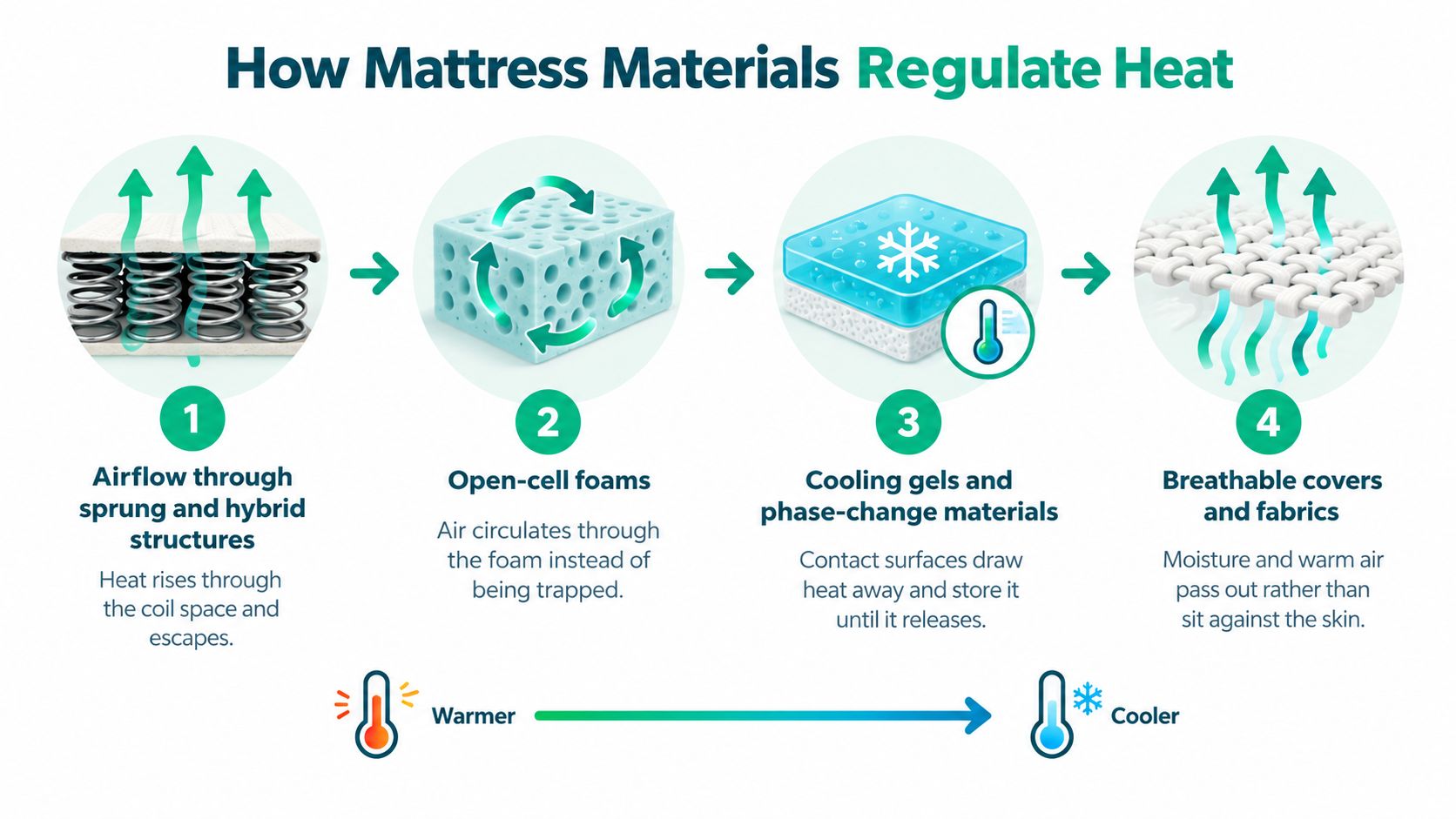
- Sprung and hybrid structures, where the space around the coils can support airflow.
- Open-structure foams, which allow air to circulate more readily than a completely dense block.
- Heat-dissipating covers, which can feel less clammy at the point of contact.
- Moisture-managing fabrics, which help move sweat away from the skin and into areas where it can evaporate.
Independent UK mattress guidance identifies breathability as the main technical lever for temperature regulation. It also highlights sprung and hybrid interiors, open-structure foam and ventilated bases as important parts of the overall design. You can explore the same general buying context in this guide to the best cooling mattress for hot sleepers.
Active temperature control
Active systems use powered components to heat or cool a topper or mattress surface. They may offer more direct adjustment, but they also bring extra equipment, setup and maintenance. They're a different category from a passive mattress and should be assessed according to your tolerance for technology, noise, cleaning and ongoing care.
A product claiming to be “cooling” may therefore mean several different things. It could refer to a cool-feeling cover, improved airflow, a material that stores heat, or a powered system that actively changes the surface temperature.
What the label can't tell you
“Cooling” doesn't necessarily mean the bed will feel cold all night. It may just mean that the surface warms more slowly, air escapes more easily or moisture doesn't remain against your skin.
Ask what the product does:
- Does air move through the internal structure?
- Can the cover release warm, damp air?
- Does the base allow ventilation underneath?
- Is the effect passive or powered?
- Could the surface feel too cool for someone who usually runs cold?
This mental model keeps you focused on behaviour rather than marketing language. The most useful temperature control mattress is the one whose construction matches your specific source of discomfort.
How Mattress Materials Regulate Heat
A warm night often begins at the contact surface. Your body heats the bedding beneath you, and the mattress determines how readily that warmth spreads or stays concentrated. A mattress cannot remove all body heat, but its materials can help heat travel away from you, much like vents give warm air a route out of a room.
Sprung and hybrid designs create open spaces around their coils. These spaces are not an air-conditioning system, yet they can provide more room for air movement than a solid, dense structure. Turning in bed may move some air through the mattress, while warmth can rise through the internal coil space.
Open-structure foam takes a different route. Its air pockets can reduce the sensation of heat sitting in one continuous mass. The result depends on the foam formulation, its thickness, the cover and everything placed above it. “Open cell” therefore describes one feature, not a guarantee of a cool night.
Surface temperature changes quickly
A UK heat-pad review recorded a mattress surface falling from 30°C to 22°C in 10 minutes during testing. That result shows how material choice and airflow can change surface temperature quickly, although a heat-pad test does not recreate sleeping in a real bedroom. The example appears in this UK cooling mattress review.
For a closer look at how a gel-based layer can change contact temperature, see this guide to a cooling gel pad. A cooler first touch may help, but it does not control the temperature of the whole bedroom.
The cover is the first layer touching your sleepwear and skin. Fabric that lets warm air and moisture pass through may feel drier than a surface that holds perspiration against you. Cooling fibres or finishes can change that first sensation, while lasting comfort still depends on the complete combination of mattress, protector, sheets and duvet.
Look for behaviours, not slogans: airflow, moisture release and a cover that does not feel plasticky are more useful questions than asking whether a mattress is labelled “cooling”.
Don't ignore the base
A mattress with breathable internal layers can still perform poorly if its base blocks ventilation. A solid or poorly ventilated support can restrict the route heat takes beneath the bed. UK cooling-mattress guidance therefore recommends ventilated bases or slatted supports when appropriate.
Check the base before blaming the mattress. It should allow air to move underneath, and the bed should not be pushed tightly against a wall if that blocks available airflow. Follow the mattress maker's support instructions, rather than placing a breathable mattress on an unsuitable surface.
Room heat remains a separate problem. Better airflow through the bed can improve the small climate around your body, but it cannot cool a bedroom that is already too hot. A room-level change, such as improving ventilation, may be needed when the whole space feels warm.
Moisture management matters just as much. Sweat helps the body cool itself, yet a humid patch trapped between skin and bedding can feel hotter and stickier. Check the construction for:
- Airflow: Sprung or hybrid space can help warmth disperse.
- Foam structure: Open pathways may reduce heat concentration.
- Cover design: Breathable, heat-dissipating fabric can improve contact comfort.
- Moisture handling: Wicking or absorbent layers can reduce clamminess.
- Base ventilation: Slats or other suitable supports can help heat escape below.
Be cautious when a product makes a strong cooling promise without explaining its internal construction, cover, base requirements or care instructions. A thick, noisy-feeling waterproof protector can also prevent moisture from leaving the mattress, even when the layers beneath it are designed for airflow.
Pros and Cons of Temperature Control Mattresses
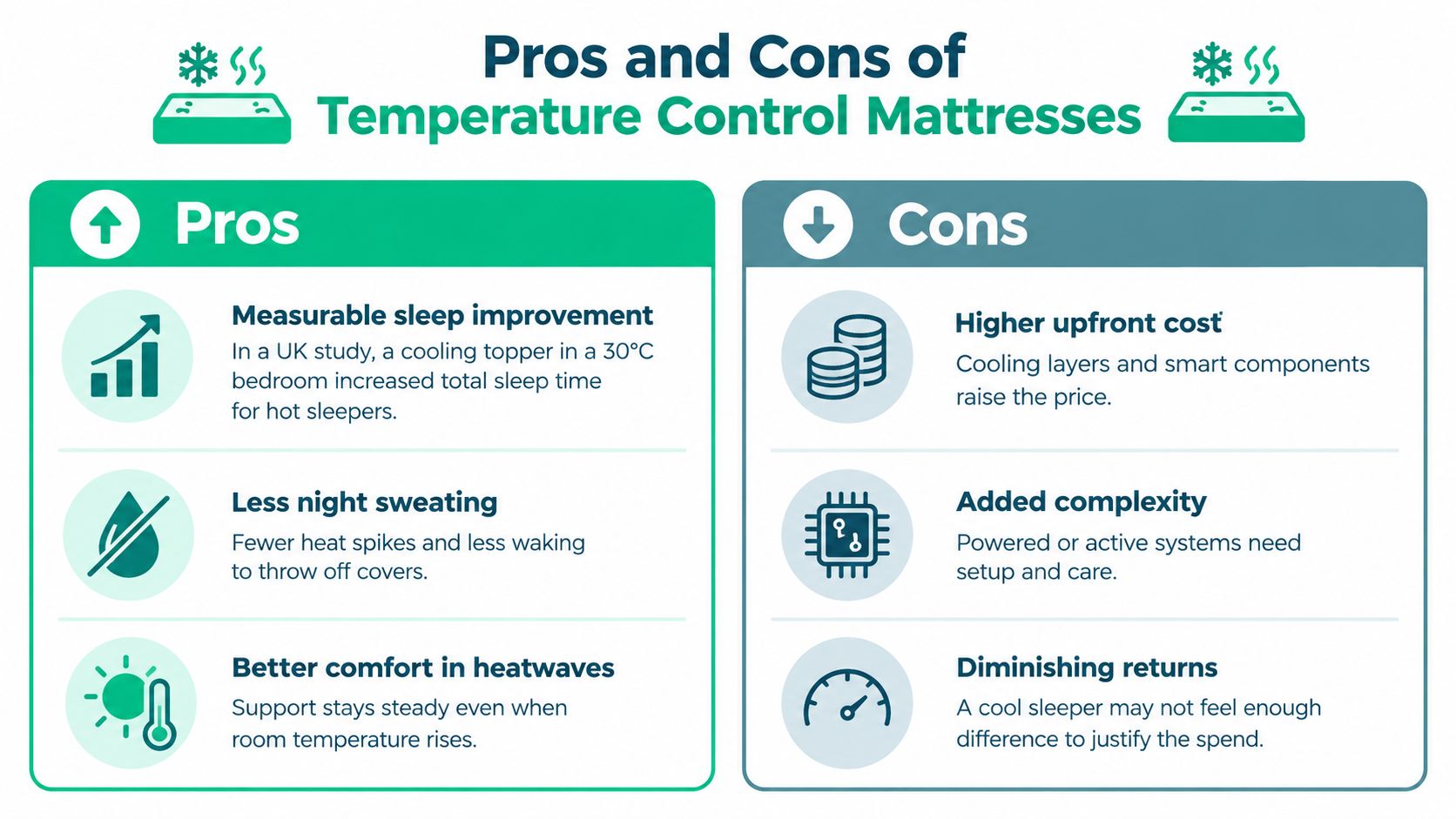
The strongest case for temperature control comes from people who regularly lose sleep because of heat. In a 2026 Loughborough University study, a cooling topper improved thermal comfort in an overheated 30°C bedroom, increased average total sleep time by 19 minutes and reduced the time taken to fall asleep by 10 minutes. The controlled study involved 17 adults, comparing typical summer home sleep with a 30°C test bedroom using regular bedding and then a cooling topper. The findings are described by Loughborough University's bed-cooling study.
That evidence is useful because it measures bed-level intervention under heat stress. It doesn't prove that every sleeper will experience the same result at home, particularly when the room is only mildly warm or when the main problem is a heavy duvet or non-breathable protector.
Where a cooling mattress can help
A passive temperature-regulating mattress or topper may suit you if:
- You feel hot at the contact surface, even when the room feels manageable.
- You wake sweaty or clammy, and your current mattress and protector hold moisture.
- Your bedroom becomes uncomfortable during hot weather, but you otherwise like your bed's support.
- You need a no-power solution, with no cables or controls at the bedside.
- Your current mattress is nearing replacement, so breathability can be part of the next purchase.
People experiencing night sweats may value a drier sleep surface, but a mattress won't address every underlying cause. It's also possible to spend heavily on a cooling mattress and remain uncomfortable because sunlight, poor ventilation or thick bedding keeps the whole room hot.
Where the drawbacks appear
A full mattress is a substantial purchase, and cooling construction can add complexity or cost. A topper or protector may offer a more proportionate response when the underlying mattress still provides the right support.
There's also a risk of overcooling. UK survey data shows that 24% of Brits identify being too hot as a main reason for poor sleep, while 12% identify being too cold. Another 2026 UK sleep survey reported “too hot” as a top sleep disruptor for 37% of respondents, as summarised by UK guidance on couples sleeping at different temperatures. The numbers point in one direction overall, but they don't mean every sleeper wants the same surface temperature.
One temperature-controlled mattress-cover study found that men sleeping below 26°C increased slow-wave sleep by 17 minutes and improved heart-rate variability. Women's sleep was largely unaffected when the mattress-cover control was active, while warmer mattress-cover temperatures above 27°C lowered heart rate in women. That makes “cooler is always better” an incomplete recommendation, especially for couples.
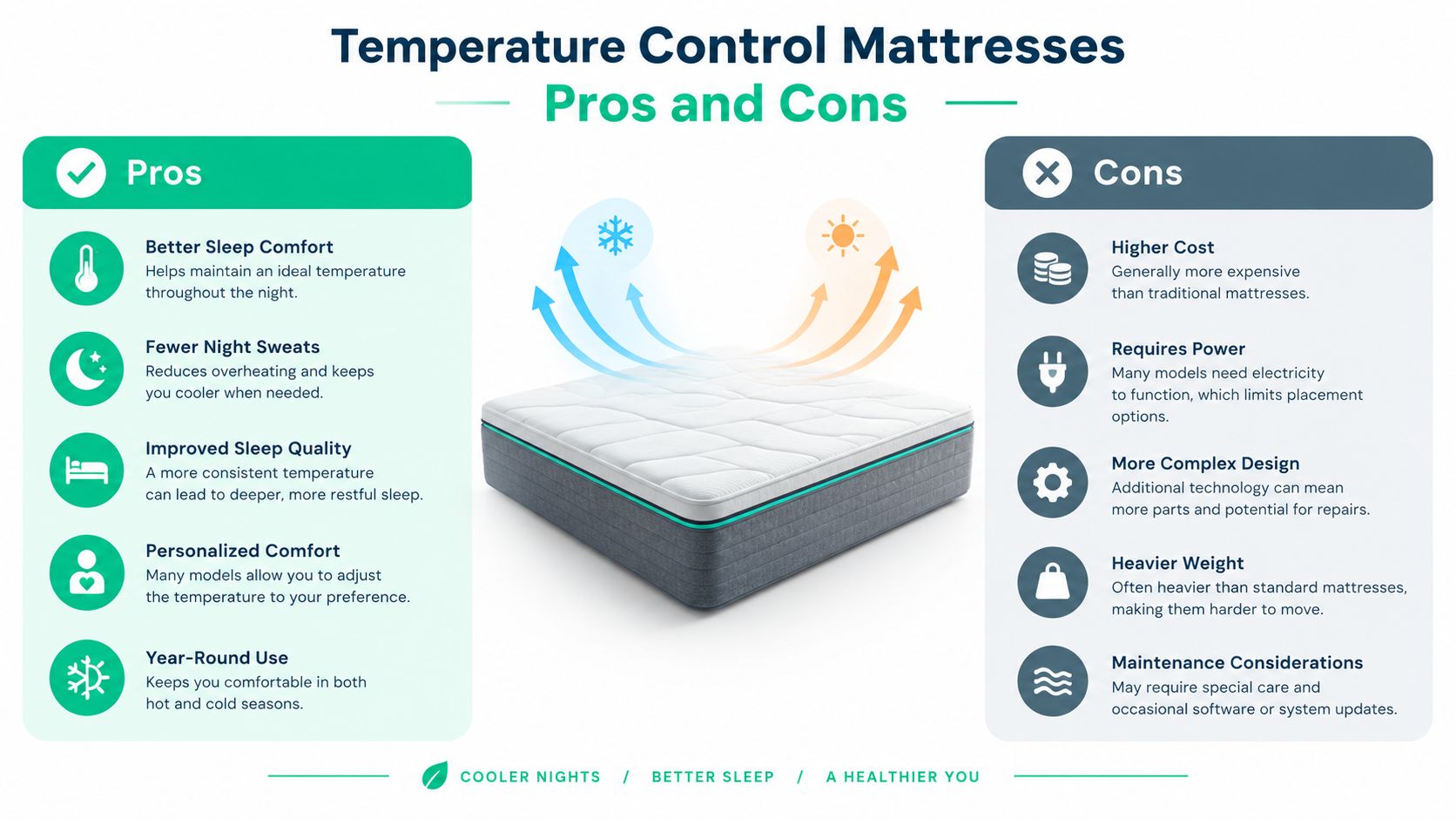
The honest value proposition is comfort control at the bed level. It isn't a replacement for ventilation, shading, sensible bedding or medical advice about persistent symptoms.
How Breathable Mattress Protectors Improve Thermal Comfort
You wake with a damp back, yet the bedroom itself feels reasonably cool. In that situation, the uncomfortable heat may be concentrated where your body meets the bed. Replacing the mattress is not always the right response. If the mattress still feels supportive, a breathable protector can change the surface without replacing the whole sleep system.
A suitable protective layer has two jobs. It should block spills, sweat and allergens from reaching the mattress, while allowing air and moisture to move away from the body. A waterproof layer that feels plasticky can act like a raincoat under your sheet, trapping warmth even when the mattress underneath has reasonable airflow.
Protect-A-Bed's Miracle Membrane is described as flexible, silent and thin, while blocking dust mites, allergens, liquids and sweat. Further product details are available in the Protect-A-Bed UK mattress protection range.
Why the membrane matters
A thin, air-permeable waterproof barrier works differently from a heavy coating. It helps keep moisture out of the mattress without making the sleep surface feel sealed. The distinction matters because waterproofing and breathability are not automatically opposites. The design and materials determine how much the layer affects airflow and moisture movement.
This approach suits a mattress that already provides good support and does not feel persistently hot throughout its structure. You keep its existing construction, then adjust the layer closest to your skin. It can therefore sit between two more disruptive choices: putting up with a clammy surface or buying a new mattress when the core problem is only at bed level.
Fabric choice changes the contact feel rather than cooling the entire room. Some materials feel drier, some feel cooler initially, and others offer a more familiar texture. Match the fabric to the problem you are trying to solve.
| Fabric option | Best for | Thermal comfort benefit |
|---|---|---|
| Tencel Cool | Hot sleepers who want a smoother, moisture-managing surface | Helps the sleep surface feel drier and less clammy |
| Snow | Sleepers seeking a cool-feeling top layer | Supports a fresher contact sensation |
| Charcoal | People who want moisture and odour-conscious bedding protection | Helps manage the feel of a damp sleep surface |
| Cotton | Sleepers who prefer a familiar natural-feeling fabric | Offers a comfortable layer above the waterproof membrane |
Treat these descriptions as a shortlist, not a substitute for checking the exact specification and care instructions. A protector can improve the microclimate between your body and the sheet, but it cannot cool a stuffy bedroom. It also cannot compensate for a duvet that is too warm for the season.
For a closer explanation of how waterproofing can coexist with airflow, read this guide to a breathable waterproof mattress protector.
A protector is a sensible first test when the mattress remains comfortable in other respects. Change the protective layer alongside seasonal bedding, then judge whether the damp or clammy feeling improves. If it does, you have identified a surface problem without paying for mattress technology that the room or bed did not require.
Who Benefits Most and Which Solution Fits
Different sleepers need different interventions. A hot sleeper with a stuffy bedroom has a different problem from a couple who disagree about the ideal surface temperature. The right choice starts with the person and the setting, not the product category.
Hot sleepers and night sweats
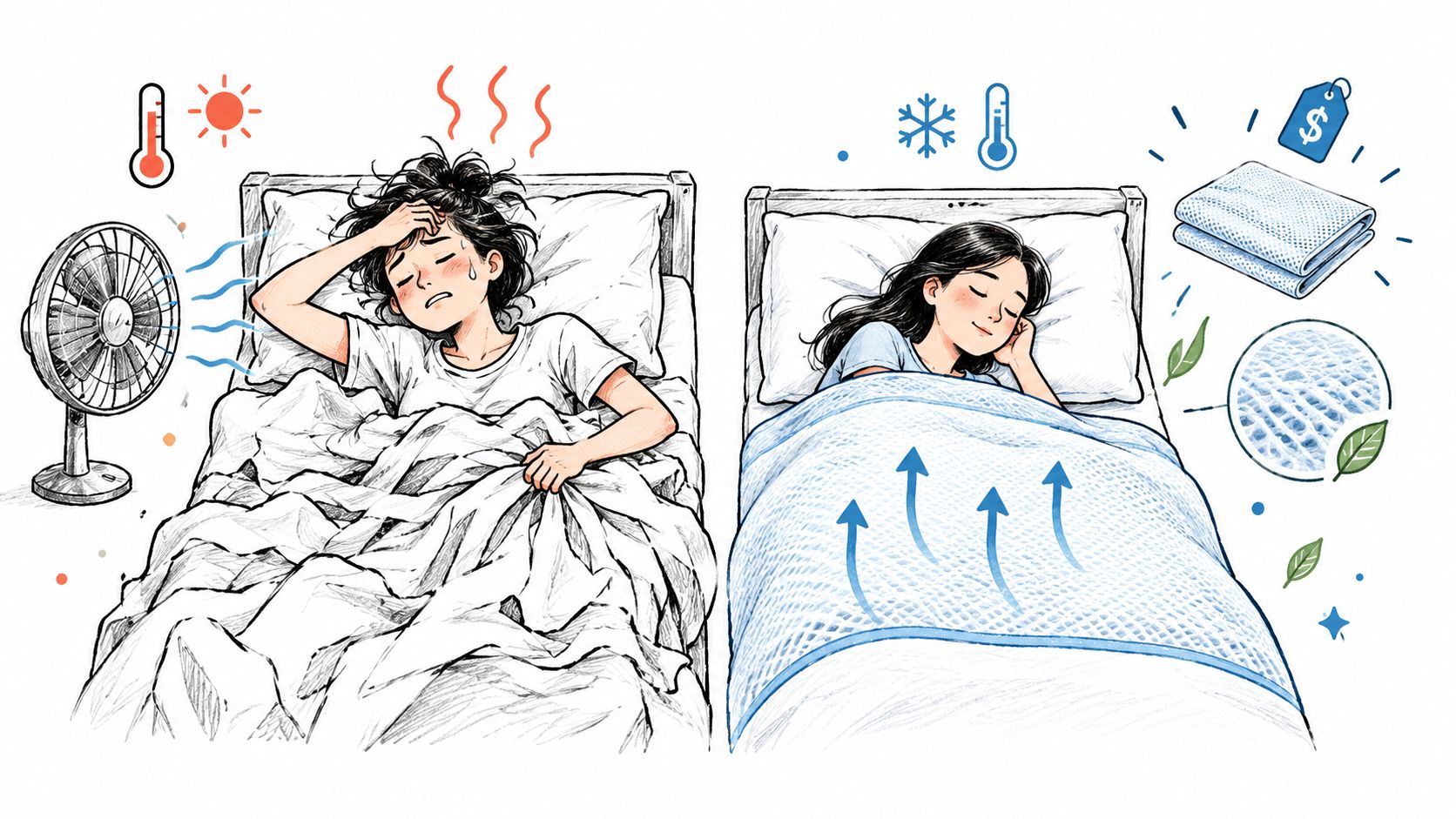
Start with the removable layers. Choose breathable sheets, review the duvet's seasonal suitability and consider a protector that manages moisture without trapping heat. A cooling fabric protector or topper may be enough if your mattress support remains good.
A temperature control mattress becomes more relevant when the mattress itself feels dense and warm, or when you're already using breathable bedding but still wake hot at the contact points. Choose passive construction first if you want simplicity and don't need adjustable settings.
Couples with different preferences
A shared bedroom doesn't require identical thermal comfort. One partner may want a lighter duvet and breathable protector, while the other needs an additional layer or warmer sleepwear. Side-specific bedding can reduce conflict without forcing both people to sleep on a surface that suits only one of them.
The UK survey split between people who sleep badly because they're too hot and those who are too cold shows why a universal “cooler is better” solution can fail. A breathable protector can provide a neutral base, then each sleeper can adjust their own duvet, clothing and side of the bed.
For couples: Solve the mismatch locally before changing the whole room. A shared mattress doesn't have to mean shared bedding weight.
Allergy sufferers and people with asthma
A protective barrier can reduce the amount of liquid, sweat, dust mites and allergens reaching the mattress. Breathability matters here because a sealed, sweaty surface can create a different comfort problem. Look for a protector that combines a protective membrane with a washable sleep surface, and follow its care instructions carefully.
Children's beds
Parents often need waterproof protection because spills and accidents can damage the mattress. Comfort still matters, particularly when a child dislikes crinkly or warm bedding. A thin, quiet layer can protect the mattress while keeping the sleep surface more natural to touch. Protect-A-Bed's product background includes a 2014 award for children's protectors, but check the current product details and sizing before buying.
Landlords, hotels and guest accommodation
For properties with several beds, protection has a practical hygiene role as well as a comfort role. Washable protectors can help standardise the sleep surface between occupants, while waterproof barriers reduce the risk of permanent mattress damage. Bed-level protection won't fix a poorly ventilated room, so property managers should assess curtains, window use, airflow and seasonal bedding too.
When the room needs attention
UK guidance cited by London Metropolitan University recommends limiting bedroom temperatures to 26°C or less to reduce overheating risk. The same guidance notes that bedroom temperatures above 26°C may be experienced as bad for sleep quality and discusses an immediate sleep space of about 30°C for comfort, while also explaining that a well-insulated mattress can lower the room temperature an occupant finds comfortable. Read the UK guidance on temperature and sleep for the wider context.
If your whole room feels hot, use ventilation when outdoor conditions allow, block direct sunlight and change bedding seasonally. A mattress, protector or topper is one layer of the solution, not a substitute for managing the room.
Buying Tips and Maintenance for Long-Term Comfort
Shop by construction rather than by the word “cooling”. Ask whether the mattress uses coil airflow, open-structure foam or a breathable cover, and check whether the recommended base allows ventilation beneath it. If you're choosing a protector, confirm that it's waterproof, air permeable, washable and quiet enough for your sleep habits.
A simple checklist can prevent an expensive mismatch:
- Match the intervention: Try a protector or topper before replacing a supportive mattress.
- Check the base: Make sure slats or ventilation routes aren't blocked.
- Read the warranty: Protect-A-Bed protectors have stated coverage of up to 10 years against material or manufacturing defects.
- Confirm delivery: Check UK delivery timelines and stock status before you remove your existing bedding.
- Plan for seasons: Review sheets, duvet weight and sleepwear as the weather changes.
Wash the protector according to its care instructions, air the bed when practical and avoid covering a damp sleep surface. UK survey data found that just over a quarter of adults never change bedding between seasons, so a seasonal review can be a useful comfort improvement in its own right.
Thermal comfort is a layered strategy. Combine a suitable mattress or topper, a breathable protective layer, appropriate bedding and a sensibly ventilated bedroom, because no single product can replace all four.
Protect-A-Bed offers UK mattress protectors in fabric options including Tencel Cool, Snow, Charcoal and Cotton, using a thin, flexible waterproof membrane designed to remain breathable. Visit Protect-A-Bed to compare protection options and choose a sleep surface that helps manage both moisture and temperature.