

Night Sweat Bedding: Stay Cool & Protect Your Mattress

You know the feeling. You fall asleep hoping the new sheets will finally fix the problem, then you wake up at 3 a.m. with a damp T-shirt, a clammy pillow, and a mattress that feels as if it's holding onto every drop of moisture you shed overnight. That's where night sweat bedding gets misunderstood, because shoppers often look for “cooling” and expect that to solve a problem that's partly about heat and partly about liquid sweat.
The difference matters. A bed can feel cooler at first touch and still fail miserably once sweating starts, because airflow, absorbency, and protection all play different roles. If you've ever been desperate enough to strip the bed, remake it, and still wake up uncomfortable, the issue isn't that you picked the wrong “cool” product, it's that the bed needs a layered system that handles both temperature and moisture.
Table of Contents
- Why You Wake Up Soaking Wet (And Why Cooling Sheets Aren't Enough)
- Understanding Night Sweats and Their Impact on Bedding
- The Three-Part Moisture Management System for Better Sleep
- Choosing the Right Bedding Materials and Construction
- Why Breathable Waterproof Protectors Are Essential
- Choosing the Right Protection for Different Needs
- Building Your Complete Night Sweat Bedding System
Why You Wake Up Soaking Wet (And Why Cooling Sheets Aren't Enough)
You can buy sheets that feel airy, light, and crisp, then still wake up damp. That's because cooling at the surface and managing sweat after it forms aren't the same job. A sheet can reduce trapped heat, but once sweat starts pooling, the bed needs somewhere to move that moisture instead of letting it sit against your skin or soak into the mattress.
The problem starts with what the bed is actually holding
Think of the bed as a series of layers, not a single product. The top layer might feel comfortable for the first ten minutes, but if the deeper layers trap warmth or moisture, the whole setup becomes clammy by the middle of the night. That's why a room that feels cool can still produce a wet duvet, a sticky pillow, and a mattress that slowly absorbs the evidence.
Practical rule: if the goal is comfort, chase breathability. If the goal is protection, you also need a barrier that keeps sweat out of the mattress.
Many bedding guides stop too early. They talk about fabric softness, thread count, or a cool hand-feel, but they don't separate heat reduction from liquid management. That gap matters because the answer to “How do I sleep cooler?” is not always the answer to “How do I stop sweat from getting through?”
For renters and anyone dealing with used mattresses or inherited bedding, the after-effects matter too. Odours and stains can linger long after the night itself. If you're also trying to deal with a bed that smells musty or tired, a practical guide such as how to remove rental smells can help you understand why moisture control matters beyond comfort.
A better approach is layered. The top layers should move heat away from the body, while the protective layer should stop sweat from penetrating the sleep surface. When those functions get confused, people keep replacing sheets that never had a chance to solve the problem.
Understanding Night Sweats and Their Impact on Bedding
Night sweats are more common than many people realise. A systematic review cited by the American Academy of Family Physicians found prevalence ranges of 10% to 41%, with the highest rates in people aged 41 to 55; the same source also notes that 12% of school-aged children reported weekly night sweats AAFP review. That does not explain why one person sweats at night, but it does show that bedding problems linked to night sweating are not rare or minor.
What the NHS means by night sweats
The NHS defines night sweats as sweating so heavily that night clothes and bedding are soaking wet, even when the room is cool NHS night sweats guidance. That definition matters because it shifts attention away from room temperature alone and towards where the moisture ends up.
The amount of moisture involved is easy to underestimate. UK bedding reporting has cited research suggesting that couples can generate nearly 300 pints, about 105 litres, of perspiration over a summer, and that warmer conditions can increase sweat production by about 15% UK bedding reporting. That same reporting also gives an estimate of around 500 ml per person per night, which is a useful reminder that a bed can collect a meaningful amount of liquid even when the room does not feel overheated.
Why bedding absorbs the problem over time
Sweat does not vanish just because the sheet feels dry by morning. Some of it moves into the layers below, where it can sit between wash cycles, contribute to odour, and slowly affect the mattress surface. That matters in homes, rentals, and hospitality settings, where bedding gets used repeatedly and laundering is not always immediate.
The bed is not just a comfort surface. It also holds moisture if the layers do not stop liquid from moving downward.
That is why night sweat bedding is about more than sleeping cooler. It is about keeping perspiration, skin cells, and humidity out of the mattress and pillow core so the bed stays cleaner, drier, and easier to maintain.
A related question some people raise is whether hormonal changes can play a part. A useful resource on that broader sleep issue is testosterone treatment for better sleep, which can help readers separate possible causes from bedding solutions. Bedding cannot fix every trigger, but it can make the sleep environment much more manageable when sweating is part of the picture.
A layered system works better than a single cooling sheet. The top layers should move heat away from the body, while the protective layer should stop sweat from penetrating the sleep surface. If those jobs get mixed up, people often keep replacing sheets that were never designed to solve the liquid problem. For a closer look at how a breathable barrier fits into that system, see Protect-A-Bed's guide to choosing a cooling mattress protector.
The Three-Part Moisture Management System for Better Sleep
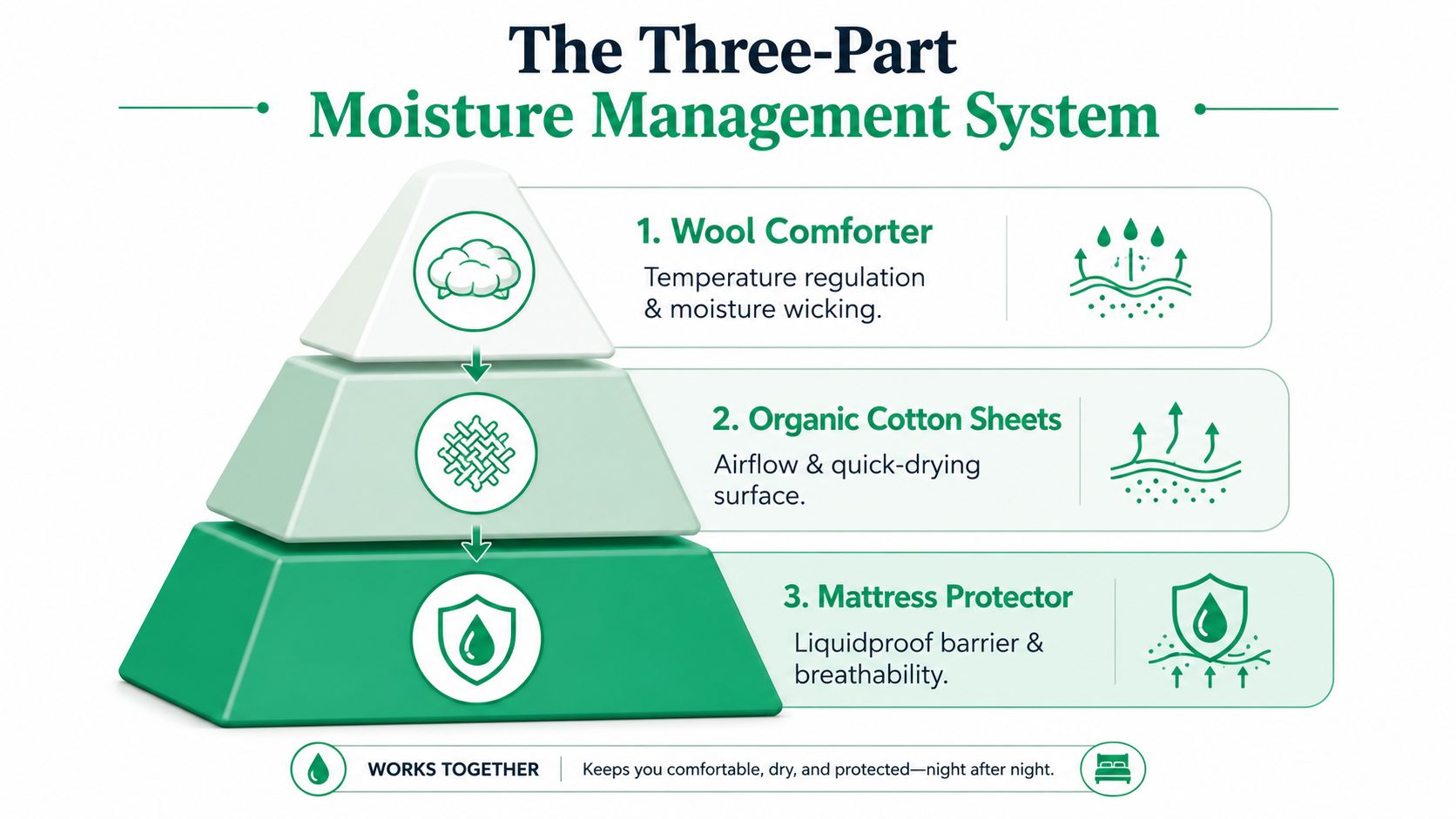
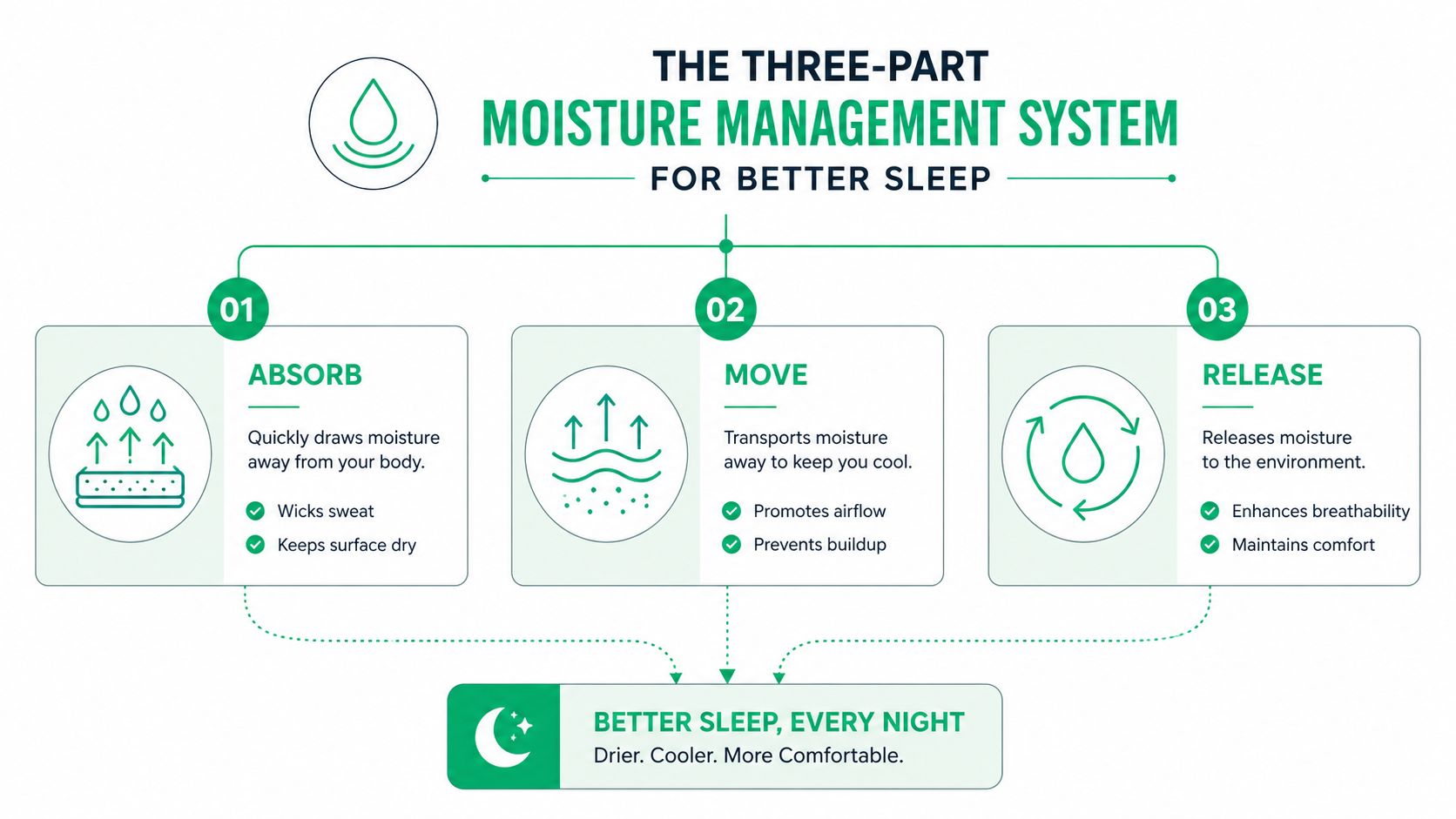
The simplest way to think about night sweat bedding is to treat it like a building envelope. You need one layer to control temperature, one to move moisture away from the body, and one to stop liquid from reaching the structure underneath. If any one of those layers fails, the whole bed feels hotter, wetter, and harder to recover from.
How each layer earns its place
Start with a wool comforter if you want a layer that balances warmth and moisture movement. Wool is useful because it doesn't behave like a heavy, sealed-up blanket that traps everything underneath it. It helps the bed feel more stable across the night, which is why comforter choice matters so much when people blame “the sheets” for a problem coming from above them.
Then use organic cotton sheets as the contact surface. Cotton with a breathable weave gives air somewhere to move, and that matters because sweat first hits the sheet, not the protector below. A sheet that dries quickly after contact feels less clammy and gives the top of the bed a better chance to recover.
Finally, add a breathable mattress surface rather than a foam-heavy or overly dense layer. The mattress is where liquid becomes a long-term problem, because once moisture gets there, it's much harder to remove completely. A protector that blocks liquid while still allowing air exchange keeps the bed from turning into a sealed pocket.
Useful analogy: a good system doesn't try to make sweat disappear. It gives sweat a path upward and blocks it from going downward.
Why skipping one layer creates friction
If you only buy breathable sheets, the bedding may still overheat from the comforter side. If you only buy a protector, but your top layers trap heat, the bed can still feel stifling. If you only focus on the duvet, moisture can still pass through to the mattress and create a lingering problem.
The strongest setups preserve airflow at the surface and protection at the base. That combination is what makes night sweat bedding work in practice, not just in product descriptions.
For a deeper product-specific look at how this layered approach is applied, the guide on best cooling mattress protector is a useful reference point for the mattress layer itself.
Choosing the Right Bedding Materials and Construction
Material choice matters, but construction shapes how that material behaves once you're asleep. A fabric can be natural and still feel hot if it is woven too tightly, while a lighter weave can move air and moisture more effectively overnight. UK bedding guidance recommends breathable low-to-mid weight fabrics around 90 to 130 GSM, and fabrics above 500 thread count or with a GSM over 130 are more likely to hold heat and moisture. For a more general bedding reference on this point, see the guidance on why bedding can trigger night sweats.
What to look for at the shop
Loose weaves leave small channels for air, which helps moisture leave the sleep surface instead of sitting there. Tighter sateen-like constructions feel smoother, but they usually reduce airflow and hold warmth more readily. That does not make them wrong in every situation; it means they are often a poor fit for people who wake up damp.
The simplest way to choose is to ask two questions at the same time. First, does the material breathe? Second, does the construction let moisture move away from the body? If only one answer is yes, the bed can still feel wrong after a few hours.
A quick comparison helps make the difference clearer.
| Bedding Material Comparison for Night Sweats | Material Type | GSM Range | Breathability | Best For |
|---|---|---|---|---|
| Cotton percale | Cotton | Low to mid weight | High | Hot sleepers who want a crisp, airy feel |
| Linen | Linen | Low to mid weight | High | People who want strong airflow and a dry hand-feel |
| Tencel-style fabrics | Lyocell-based blends | Low to mid weight | High | Sleepers who want a softer surface with good moisture movement |
| Dense sateen | Cotton sateen | Higher or tightly woven | Lower | People who prioritise smoothness over night-sweat control |
| Heavy synthetics | Synthetic blends | Often higher or tightly packed | Lower | Generally less suitable for night sweats |
Sheets, duvet covers, and pillowcases should work together
Sheets sit closest to the skin, so they need to dry quickly and avoid a sticky feel. Duvet covers need enough looseness in the weave to let the comforter breathe. Pillowcases matter more than many people expect, because a hot head can make the whole body feel warmer and less settled.
Buying shortcut: if you're choosing between two similar options, favour the lighter construction with more visible airflow through the weave.
That same logic applies across protectors and encasements. A night sweat bedding system works best when no single layer is forced to do everything. Each layer should handle the job it is suited for, while the full stack stays breathable enough that the bed never feels sealed in.
For a closer look at how protector construction fits into that system, the Tencel mattress protector guide is a useful companion to fabric shopping decisions.
Why Breathable Waterproof Protectors Are Essential
A protector matters as soon as night sweats become a regular pattern. It keeps liquid sweat from reaching the mattress, and that difference matters because mattresses are expensive to replace and difficult to clean once moisture sinks deep inside. Repeated hot nights also leave the bed absorbing moisture again and again, so the surface alone cannot handle the whole job.
The right barrier should block liquid, not airflow
Traditional waterproof layers often behave like plastic. They stop liquid, but they can also hold in heat and make the bed feel damp and closed in. Breathable protectors work differently because they are built to let air move through while still preventing liquid from passing into the mattress.
Protect-A-Bed describes its Miracle Membrane technology as waterproof while remaining air permeable, which is the key idea behind a protector that does not make the bed feel sealed up. For a deeper look at how breathable waterproof membranes work, see our guide on breathable waterproof membrane technology. In practical terms, sweat is kept away from the mattress, while the sleep surface still has room to breathe.
Plain truth: a protector should defend the mattress without turning the bed into a heat trap.
That is also why features such as Tencel Cool and Charcoal matter. They suit people who want protection without losing the cooler feel they are trying to keep. The goal is not to make the bed feel dramatically colder, it is to prevent it from becoming damp, stuffy, and harder to settle back into after a sweat episode.
Protection solves the part cooling can't
A cooling sheet can help with first contact. A breathable protector handles what happens after the sweating starts. That is the part many night sweat bedding guides leave out, because the advice often stops at choosing something that feels cooler without explaining how to keep moisture out of the mattress.
Once the mattress stays dry, the bed resets better by morning. If moisture is allowed to soak in, you are left dealing with odour, staining, and a surface that can feel less fresh over time. Breathable waterproof protection keeps the bed usable as well as comfortable.
Choosing the Right Protection for Different Needs
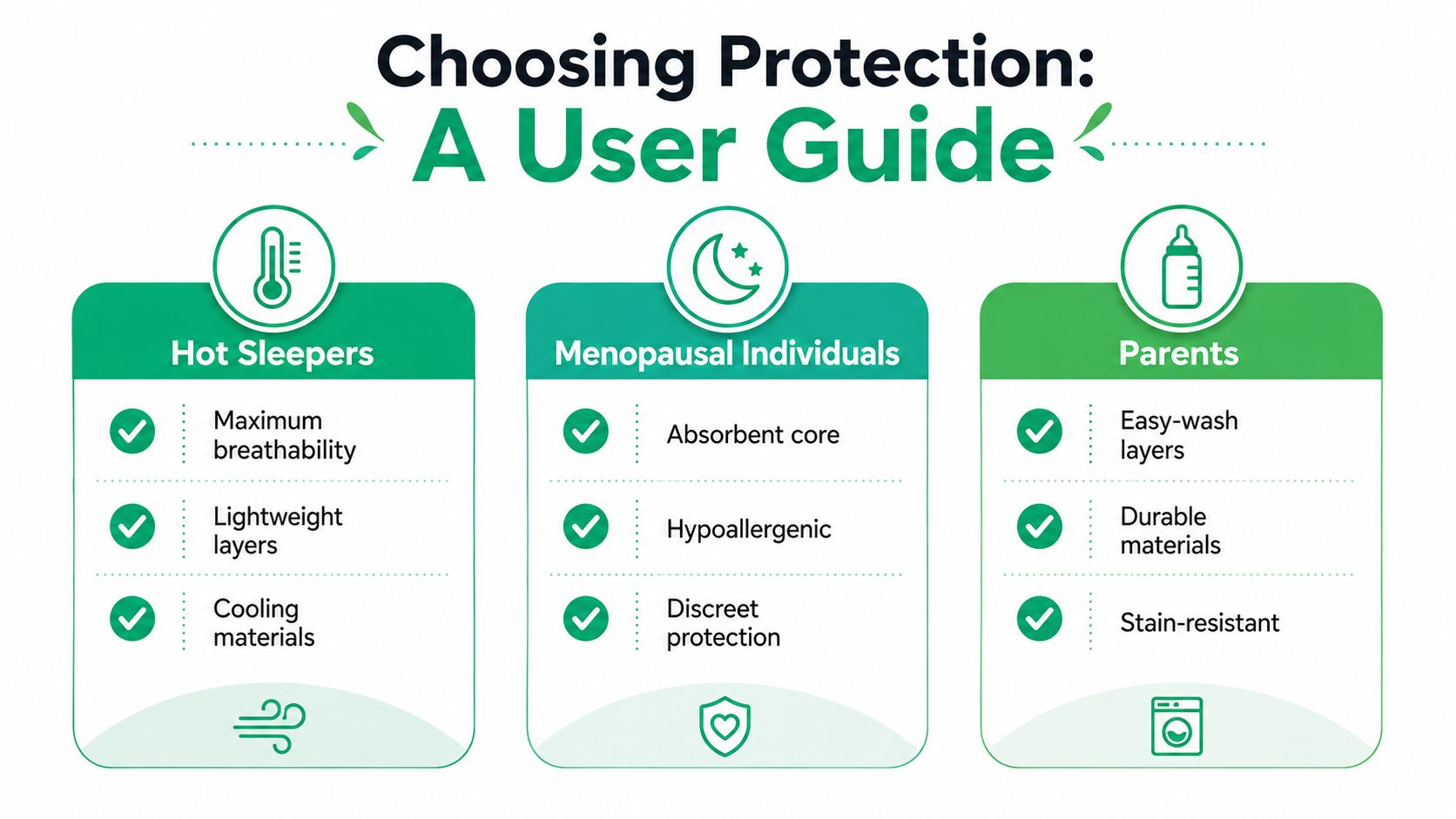
Different sleepers need different combinations of airflow, absorbency, and coverage. A hot sleeper wants the bed to feel as open as possible. Someone dealing with hormonal night sweats often wants discreet, reliable protection that doesn't change the feel of the bed too much. Parents usually want bedding that survives frequent washing. Care settings need protection that supports hygiene across many beds without making upkeep awkward.
Match the protector to the way the bed gets used
Hot sleepers usually need the most breathable option they can get without sacrificing the barrier. That means prioritising a thin, air-permeable surface and avoiding anything that makes the mattress feel enclosed. For people with menopause-related sweating, comfort and discretion often matter as much as protection, so the priority is a protector that stays quiet and low-profile under the sheets.
Parents are dealing with a different problem. Children's bedding gets washed often, so durability and easy care matter just as much as waterproofing. In care homes and similar settings, the bed has to support hygiene, quick turnarounds, and repeated use without becoming hard to manage.
Decision filter: buy for the situation, not just for the label. Two people can both sweat at night and still need different protector features.
What to check before you buy
Look at care instructions first, because a protector that's awkward to wash won't stay in use for long. Check whether the fit works for deep mattresses or full encasement needs. Then think about long-term support such as warranty coverage and delivery timing, especially if the bedding is replacing an older item that's already stained or worn.
For some households, a standard waterproof mattress protector is enough. For others, especially where allergies or full-coverage hygiene concerns matter, a more enclosed style makes sense. Protect-A-Bed offers waterproof mattress protectors, pillow protectors, and bed bug encasements, including options such as Tencel Cool and Charcoal fabrics, with UK delivery and warranty-backed support, so it's one route to consider when you need breathable protection rather than just a cooling feel.
Building Your Complete Night Sweat Bedding System
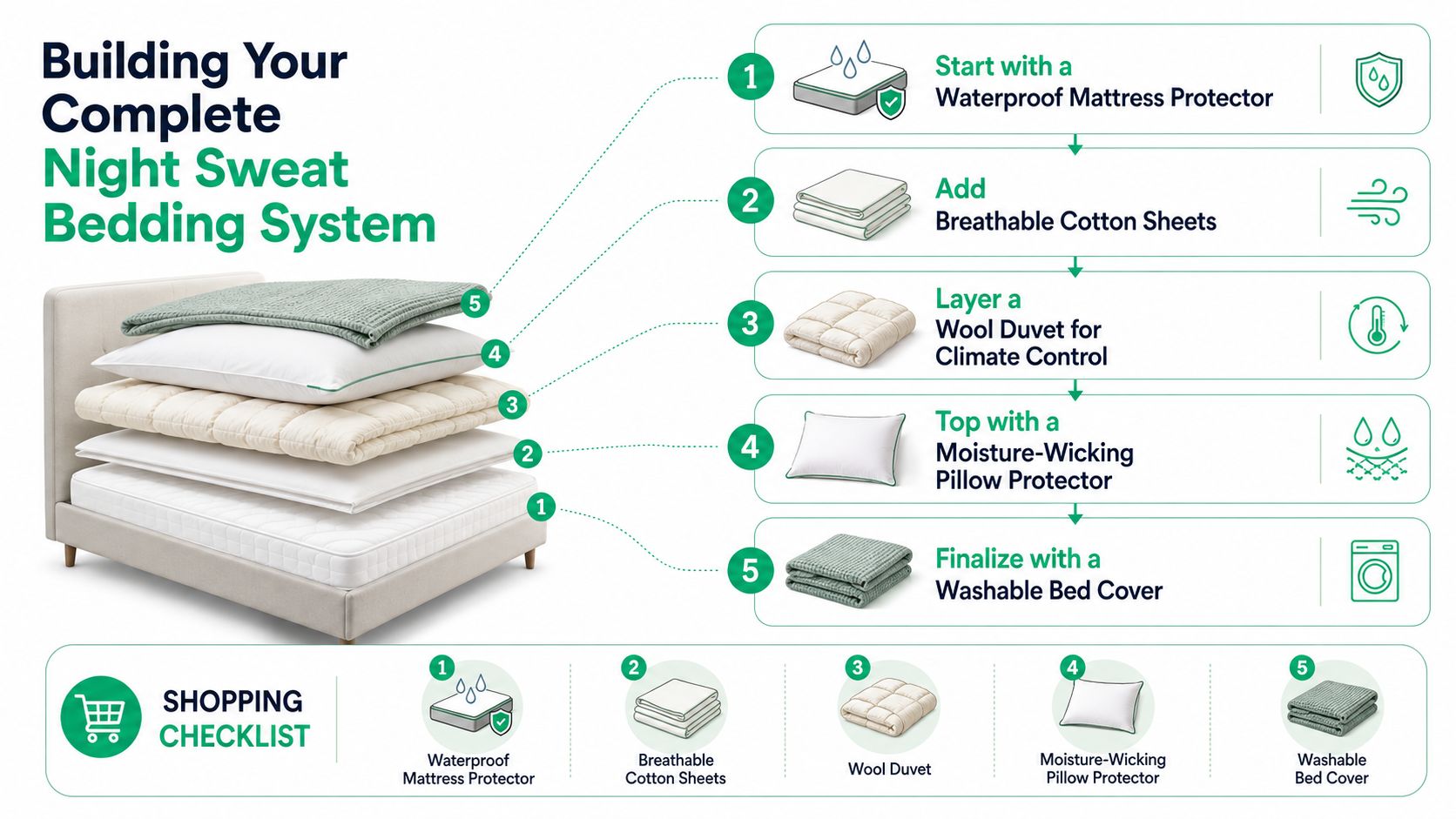
The cleanest setup is usually the simplest one that covers every layer. Start at the mattress, then move upward, because each layer should solve a different part of the problem. If you stack good sheets on top of a vulnerable mattress, you still end up with moisture sitting where you don't want it.
A practical shopping checklist
- Start with a breathable waterproof mattress protector. It should block liquid while still allowing air exchange, so sweat doesn't sit against the mattress.
- Choose sheets with a light, open construction. Cotton or linen-style weaves are easier to live with when you sleep hot.
- Use a comforter that balances warmth and moisture movement. A wool-based option is a strong example of that balance.
- Add pillow protection. If your head and neck stay damp, the whole bed feels less comfortable.
- Keep the final cover washable. That makes the system easier to maintain and helps prevent odour build-up.
Keep the system working after the first wash
Wash protectors and sheets according to their care labels, and don't assume hotter is always better. Overheating fabrics or using the wrong detergent can shorten the life of breathable layers and reduce how well they perform. The goal is to preserve airflow and barrier function, not just to make the bed look fresh on the surface.
A good night sweat bedding system won't stop a medical or hormonal cause of sweating, and it shouldn't pretend to. What it can do is keep the bed drier, more comfortable, and far easier to reset the next morning. That's often the difference between “getting through” a bad night and sleeping well enough to feel human the next day.
If you're ready to put a proper night sweat bedding system together, visit Protect-A-Bed to look at breathable mattress protectors, pillow protectors, and encasements designed to keep liquid out while helping the bed stay comfortable. It's a practical next step if you want protection that works with the bedding you already use, not against it.