

Mattress Protector Elastic Straps: A Practical UK Guide

For a mattress around 23–30 cm deep, elastic straps need enough reach to pull the protector underneath without excessive tension. Their real job is to keep the protector flat across the full sleep surface over time, and that depends on mattress depth as much as mattress size.
You fit the protector before bed, smooth the corners, and expect everything to stay in place. By morning, one corner has popped up, the fabric has rucked beneath the sheet, and a strap has either stretched loose or snapped back while you were fitting it. The problem may not be the protector alone. It may be the way its elastic retention system matches your mattress, topper and bedding layers.
Mattress protector elastic straps are small components with a significant responsibility. They connect the protector to the mattress, maintain downward tension at the corners and help preserve coverage while sleepers move. To work reliably, they must accommodate the mattress footprint, vertical depth, repeated stretching and washing.
Table of Contents
- Why Elastic Straps Matter More Than Shoppers Realise
- What Elastic Straps Actually Do on a Mattress Protector
- UK Mattress Sizes and Why Depth Changes Everything
- Strap Styles Compared Against Real UK Use Cases
- How to Measure and Fit Your Protector Properly
- Why Tighter Is Not Always Better
- Caring for Straps So They Outlast the Protector
- Choosing the Right Strap Configuration for Your Bed
Why Elastic Straps Matter More Than Shoppers Realise
Corner straps are often noticed only after something has gone wrong. A protector that looked perfectly positioned at bedtime can shift towards the foot of the mattress overnight. The sheet may hide the movement for a while, but a raised corner, exposed mattress edge or persistent wrinkle eventually reveals that the retention system isn't holding its position.
That makes the strap more than a fastening detail. It is the mechanical link between a flat protective layer and a mattress that flexes, compresses and receives movement from the sleeper. If the link is too loose, the protector can migrate. If it is too tight, the corner can distort and place unnecessary stress on the stitching or waterproof panel.
Practical rule: A protector hasn't fitted properly just because it looks flat immediately after installation. It should remain aligned after movement, laundering and refitting.
A UK shopper also needs to separate two different questions:
- Does the protector cover the correct mattress size?
- Can its retention system grip the mattress stack at the actual depth?
A protector can match the width and length perfectly while still struggling with a deep mattress or topper. Corner-only straps may also leave parts of the mattress sides exposed, unlike a fitted design that wraps further underneath.
A useful mattress protector buying guide can help with broader choices such as protection type and household needs. For strap performance, however, the decisive details are more physical: corner alignment, available stretch, under-mattress grip and recovery after repeated use.
What Elastic Straps Actually Do on a Mattress Protector
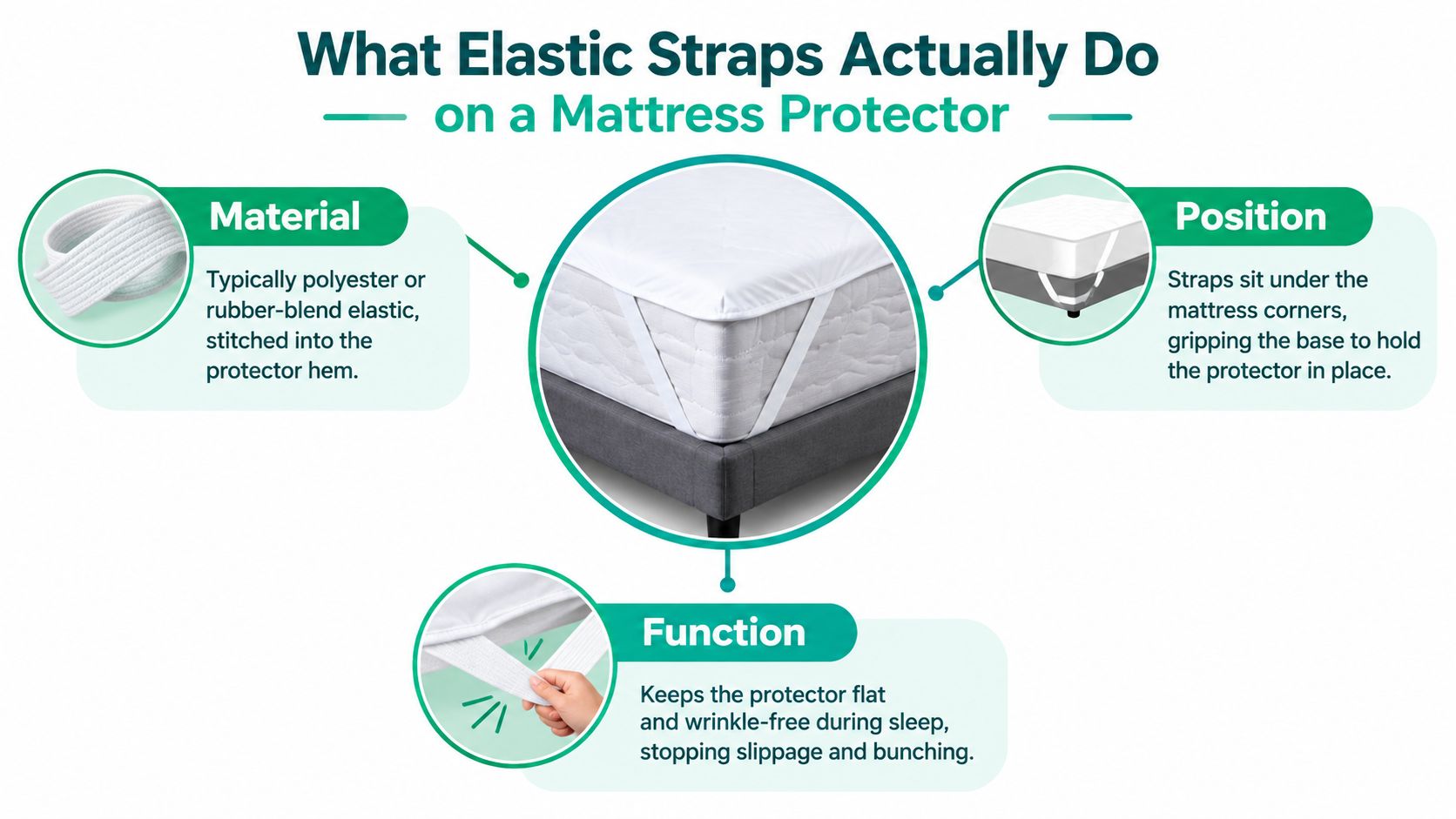
An elastic strap is a short band of flexible textile, usually stitched beneath or into the corner of a protector. You pull it under the mattress, where it applies downward and inward force to keep the corner in contact with the mattress base. Four-corner designs use one anchoring point at each corner, creating a simple system that holds the protector across the sleep surface.
The strap's position matters. A corner is where the protector is most likely to lift when the sleeper turns, sits on the edge or pulls the bedding during fitting. Anchoring all four corners helps distribute retention rather than relying on a single point.
Three designs that are easy to confuse
Corner straps secure a mostly flat pad at selected points. They're quick to remove and can suit beds where easy laundering matters, but the mattress sides may remain partly exposed.
An elasticated skirt wraps around the mattress sides and tucks underneath more continuously. It relies on a broader band of elastic rather than four separate attachment points, so it can offer more consistent edge retention on a deeper or more active bed.
A full zip-around encasement surrounds the entire mattress. Its purpose is complete enclosure rather than simple surface retention, making it relevant where side protection or a sealed barrier is a priority.
The elastic itself may be a knitted or braided textile band, often combined with polyester components. The important question isn't the label alone. It is whether the material, stitching and recovery characteristics maintain enough tension without pulling the protector out of shape.
UK Mattress Sizes and Why Depth Changes Everything
A mattress can be the right width and length, yet still fail at the edges if the straps cannot sit under the base properly. UK mattress categories give you the starting footprint, but depth decides whether the protector holds after the bed is made and slept on. The familiar footprints are Single at 90 × 190 cm, Double at 135 × 190 cm, King at 150 × 200 cm and Super King at 180 × 200 cm. These dimensions are outlined in UK mattress size standards.
| Size | Width × Length | Common depth range |
|---|---|---|
| Single | 90 × 190 cm | Usually suited to standard-depth mattresses, with deeper builds needing extra strap reach |
| Double | 135 × 190 cm | Usually suited to standard-depth mattresses, with deeper builds needing extra strap reach |
| King | 150 × 200 cm | Often used on thicker mattresses, where strap tension matters more |
| Super King | 180 × 200 cm | Often used on thicker mattresses, where strap tension matters more |
Width and length tell you whether the protector covers the plan dimensions. Depth determines whether the elastic can get underneath and stay there. UK guidance also recognises small double, Euro, emperor and other formats, so the frame size alone never tells the full story.
Most UK mattresses sit between 23 and 30 cm deep, and pillow-top or hybrid models can be deeper. That extra height changes the load on the straps. A protector that fits a shallow mattress may pull upward on a taller one, especially after washing when the elastic has lost a little recovery.
Measure the whole vertical stack
A topper changes the fitting calculation. So does a padded underlay or a protector that adds material beneath the sheet. If the combined stack is taller than the protector's usable depth, the strap must stretch further to reach the underside. That can increase upward corner force, leading to edge lift, wrinkling or strap disengagement.
Some protectors state compatibility up to 42 cm in height. Treat that as a product limit, not a universal target. Your measured mattress, topper and protector stack still needs to fall within the stated range.
For deeper bedding arrangements, see the guide to a mattress protector for deep mattresses, then check the protector's own maximum depth before buying.
Strap Styles Compared Against Real UK Use Cases
The right retention design depends on what the bed has to manage. A lightly used guest bed may prioritise quick removal, while a family bed with a topper needs more forgiving coverage and grip. A property manager may value repeatable fitting and straightforward washing above a minimal purchase price.
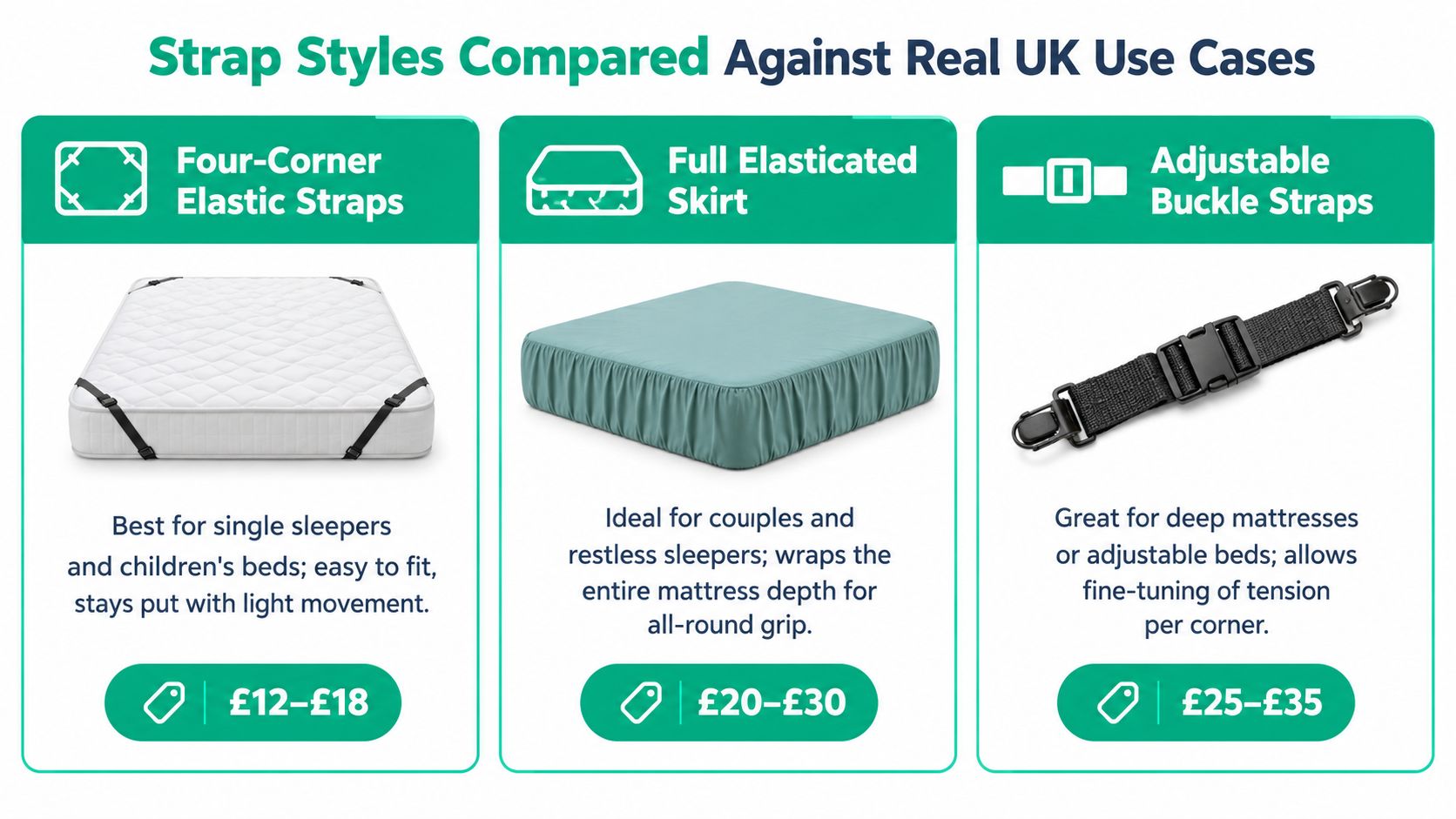
| Retention style | Suitable use case | Main strength | Main limitation |
|---|---|---|---|
| Four-corner elastic straps | Shallow to mid-depth mattresses, guest beds and easy-change bedding | Simple to fit and remove | Corner-only grip can allow movement or leave sides exposed |
| Elasticated skirt | Deeper mattresses, toppers and active sleepers | Wraparound retention across the mattress depth | Needs accurate depth and pocket compatibility |
| Full encasement | Allergy-focused protection or sealed mattress coverage | Encloses the mattress on all sides | More involved to fit and remove |
| Hybrid strap design | Layered bedding where flexible fitting matters | Combines corner anchoring with broader edge support | Can be harder to assess without clear depth specifications |
Match the design to the household
A student moving between rented rooms may prefer four-corner straps because they can be removed without wrestling with the whole mattress. A household adding a permanent topper may find an elasticated skirt more stable because it accommodates the complete depth rather than pulling from isolated corners.
For allergy control or bed bug management, a full encasement serves a different purpose from a surface protector. It addresses enclosure and side coverage, not the question of whether the top panel stays flat.
Adjustable buckle straps can offer fine tension control, but adjustment doesn't remove the need to measure. A strap that is adjustable yet forced across an unsuitable stack can still distort the protector or lose recovery. Choose the retention style according to coverage, depth, movement and laundering needs, in that order.
How to Measure and Fit Your Protector Properly
Start with the bed as it is used. Don't measure only the bare mattress if a topper remains in place every night.
- Measure the width. Run the tape across the centre of the mattress from side to side.
- Measure the length. Measure from the head end to the foot end.
- Measure the total depth. Include the mattress, permanent topper, protector thickness and any padded layer that the fitted sheet must contain.
- Check the product limit. The protector's stated maximum depth should exceed your measured stack, leaving the straps enough usable stretch to pass beneath the corners without excessive force.
- Centre the protector. Align the top panel before attaching any corner. An off-centre starting position makes one strap work harder than the others.
- Fit opposite corners progressively. Attach one corner, move diagonally to the opposite corner, then repeat across the other diagonal. This spreads the tension instead of locking one side down while the other side remains displaced.
- Inspect the surface. Smooth the panel from the centre towards the edges and check that no mattress area is exposed after the sheet goes on.
The fitted sheet is part of the same system. UK guidance generally distinguishes standard pockets for mattresses up to about 30 cm deep from deep pockets intended for roughly 30–40 cm; adding a topper or protector increases the total stack. A sheet that is too shallow can pull the protector out of position, making a strap appear faulty when the sheet is the source of the movement.
For a visual approach to the depth measurement itself, use this guide on how to measure mattress depth.
Why Tighter Is Not Always Better
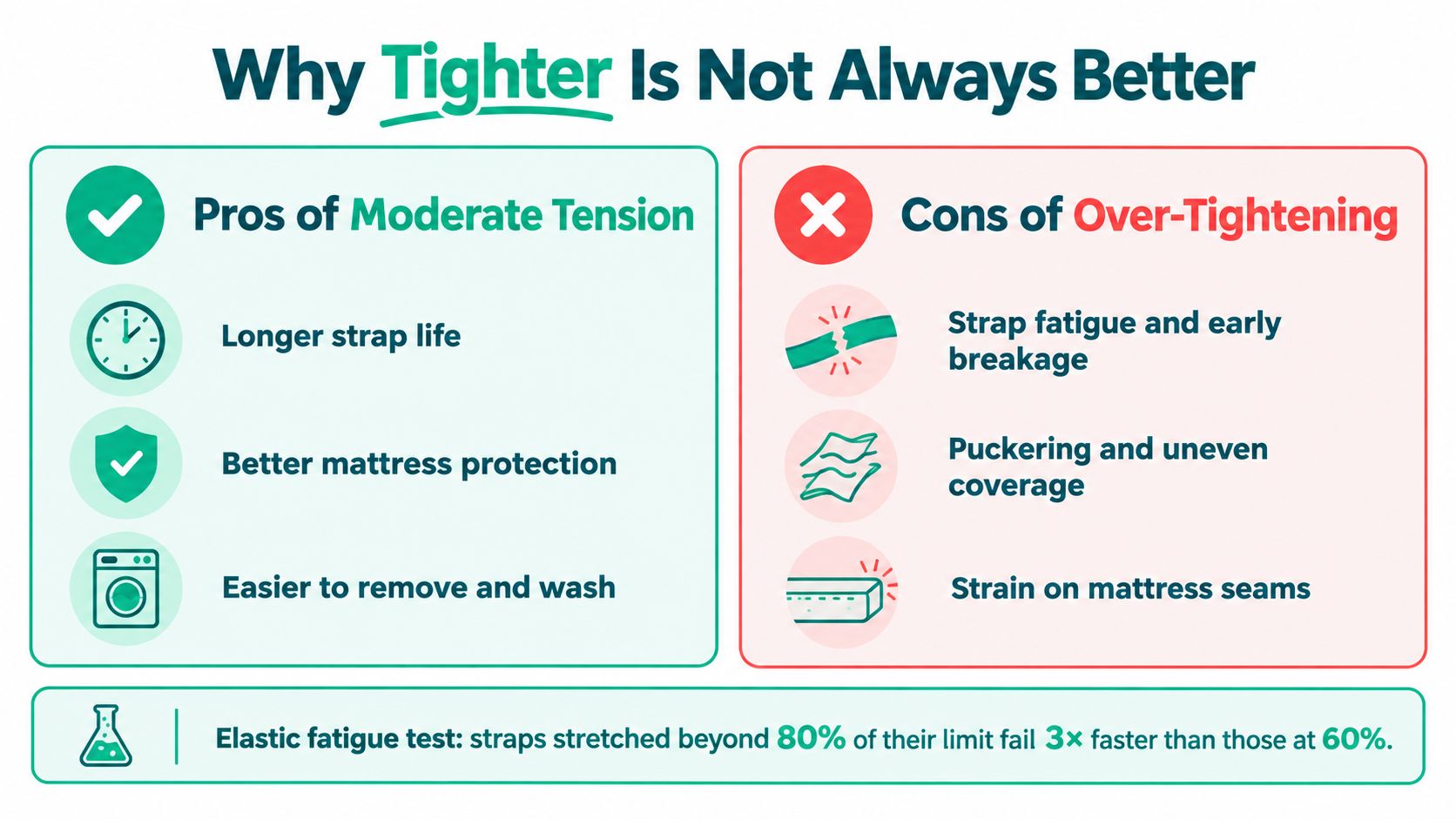
A strap that feels difficult to stretch isn't automatically performing better. Elastic is a fatigue-sensitive textile component. The UK-adopted BS EN 14704-1 framework assesses elasticity and recovery by stretching, holding, releasing and measuring residual deformation. That principle matters at home because repeated overextension can leave a strap permanently longer and less able to pull the corner down.
Over-tension also affects the protector around the strap. The corner may pucker, the stitching may carry a concentrated load, and a waterproof laminate can be pulled into an uneven shape. The result is often less reliable coverage, not better coverage.
Look for even, sustainable tension
The ideal strap holds the corner flat while allowing the protector to remain naturally shaped. During fitting, stop if the corner fabric begins to gather sharply or the band must be pulled aggressively to reach the underside.
Inspect the system after washing and refitting:
- Permanent elongation: The strap remains visibly longer when relaxed.
- Corner distortion: The protector pulls into a diagonal shape instead of lying squarely.
- Edge lift: A corner or side rises again despite correct centring.
- Stitching damage: Bar-tacks or seams show broken threads, fraying or separation.
If these signs appear, reducing tension won't restore lost recovery. The mattress stack may exceed the protector's usable depth, or the strap may have reached the end of its serviceable life. A more suitable depth rating or a different retention style is safer than continuing to force the existing band.
Caring for Straps So They Outlast the Protector
Follow the protector's care label rather than assuming a hotter wash provides better hygiene. One UK-market specification pairs corner straps with a 60°C wash capability and textile flammability testing, but that doesn't mean every protector has the same limit. Washing outside the declared instructions can accelerate fabric, seam or elastic deterioration.
After each wash, let the protector return to its normal shape before fitting it. Check the corners for fraying, broken bar-tacks, permanent strap elongation and any exposed waterproof layer. Don't remove the straps for washing unless the manufacturer specifically designed them to detach. They are part of the retention system and should be laundered with the protector.
Use this guide to washing a mattress protector alongside the product label. If a strap detaches, don't rely on a temporary knot or continue using the protector where the corner no longer stays covered. Replace or repair it through the appropriate manufacturer route, especially where liquid protection depends on an undistorted corner.
Choosing the Right Strap Configuration for Your Bed
Treat the strap as one part of a complete bedding system. Measure the mattress footprint and the full vertical stack, then choose a protector whose depth allowance exceeds that measurement. After fitting, use a sheet with enough pocket depth to contain the mattress, topper and protector without pulling the corners upwards.
For a shallow or moderately deep mattress where quick removal matters, four-corner straps can be practical. For a deeper mattress, permanent topper or restless sleeping arrangement, an elasticated skirt usually provides broader retention. Choose a full encasement when complete side coverage or a sealed barrier is the priority rather than simple surface stability.
Inspect the corners after washing, not just when buying. If the protector moves, first check whether the fitted sheet is too shallow, then examine strap recovery and corner alignment. A flat-looking bed isn't enough if the protector leaves the perimeter exposed during use.
Protect-A-Bed offers UK mattress protectors with fitted elasticated edges or skirts, alongside waterproof, breathable protection options and bed bug encasements. You can review the available configurations and match the depth and coverage to your bed at Protect-A-Bed.