

How Often Replace Mattress Protector: A UK Guide

Replace a mattress protector roughly every 1–2 years in a typical UK household, but replace it sooner if it shows visible wear, fails to block moisture, develops a persistent odour, or has a warranty-covered defect.
You'll usually notice the problem when the protector stops behaving like a protective layer. The corners ride up during the night, the fabric feels thinner, a spill reaches the mattress, or washing no longer removes a stale smell. At that point, the calendar matters less than the protector's actual condition.
Table of Contents
- How Often Should You Replace a Mattress Protector
- What a Mattress Protector Actually Protects
- Signs Your Mattress Protector Needs Replacing
- Replacement Intervals by Household Type
- Washing and Care Habits That Change the Timeline
- How Warranty and Defect Replacement Work
- Real Scenarios That Bring Replacement Forward
- A Quick Replacement Checklist for Your Bed
How Often Should You Replace a Mattress Protector
UK bedding guidance generally places replacement at roughly every 1–2 years under normal use. Treat that as a starting point, not an expiry date. A well-made protector used by one adult, washed carefully and kept dry, may remain serviceable beyond two years. A protector used by children, pets, allergy sufferers, or several sleepers can deteriorate much sooner.
Use two tests together:
- Calendar-based replacement: Consider the household, washing routine, and any applicable guarantee period.
- Condition-based replacement: Inspect the fabric, elastic, odour, fit, and waterproof barrier.
The second test is more important. A protector can look clean while its membrane has weakened through repeated washing, stretching, heat, or friction. Conversely, a lightly used cotton protector may still perform properly after the usual interval.
The practical starting point
For most adult households, plan to inspect the protector regularly and budget for replacement within the 1–2-year range. Families with young children, homes with pets, and rental properties should plan towards the shorter end because spills, accidents, body moisture, and repeated laundering place greater stress on the material. Allergy and asthma households also need a stricter routine because the cover forms part of the bed's dust-mite control system.
Practical rule: Replace by condition first, and use the calendar as a backstop.
A replacement becomes essential when the protector no longer fits snugly, smells unpleasant after washing, feels damaged, or allows moisture through. A warranty issue is another reason to act early. Protect-A-Bed's UK warranty information links replacement to materials or manufacturing defects during the guarantee period, while its care guidance stresses that improper laundering can damage the membrane (Protect-A-Bed UK warranty and care information).
What a Mattress Protector Actually Protects
A mattress protector has three separate jobs, and each one can fail at a different pace.
First, its waterproof or water-resistant barrier helps stop perspiration, drinks, spills, and accidents reaching the mattress core. Many protectors use a thin laminated membrane beneath the sleeping surface. That membrane must remain continuous and flexible. A fabric surface may still feel soft even after the barrier has developed weak points.
Second, the protector acts as an allergen and dust-mite barrier. It limits the movement of skin flakes, dander, and other particles into mattress fibres. NHS guidance on house-dust-mite allergy recommends frequent bedding washing at 60°C and the use of mattress covers or encasements as part of dust-mite reduction measures (NHS allergy guidance).
Third, it provides a hygiene and stain barrier. You can remove and launder the protector, whereas cleaning the inner structure of a mattress is far more difficult. Keeping the mattress free from liquid and heavy soiling also helps you follow the care conditions attached to its guarantee.
Different failures need different responses
Fabric can pill, thin, or fray from friction. Elastic can lose tension and allow the protector to move. The membrane can delaminate, crack, or develop tiny leaks without an obvious hole. Persistent odour may indicate that washing is no longer restoring a hygienic surface.
For storage or a house move, protective handling matters too. Advice on how to wrap furniture for storage is useful because mattresses and protectors need clean, dry wrapping rather than sealed dampness. Never pack a protector away while it's even slightly wet.
For a closer explanation of barrier performance, see this guide to whether waterproof mattress protectors work. The key point is simple: replace the protector when one of its protective functions has stopped working, not merely when the surface looks old.
Signs Your Mattress Protector Needs Replacing
Start with the fabric. Pilling, thinning, small holes, frayed edging, and permanent yellowing all show that the sleeping surface has experienced wear. A few marks alone don't always mean immediate failure, but thinning around the centre of the bed or exposed stitching deserves attention because those areas receive the most friction and pressure.
Check the elastic next. If the corners ride up overnight, the skirt no longer grips the mattress, or you have to pull the protector back into place every morning, it isn't protecting the full surface. A loose protector also creates bunching, which increases friction and can make sleep less comfortable.
Test the barrier, don't guess
Place a small amount of water on an undamaged-looking area and watch what happens. If the water beads briefly and remains contained, the surface may still be functioning. If it spreads rapidly or reaches the mattress beneath, the waterproof layer has failed. A tacky, peeling, cracked, or flaking underside is another clear reason to replace it.
Odour is equally important. A musty or sour smell that remains after washing, stains embedded in the membrane, or skin irritation that improves when you sleep elsewhere means the protector has become a hygiene problem. For help dealing with a contaminated mattress, use a practical urine smell removal guide, but don't mistake cleaning the mattress for repairing a failed protector.
| Sign | What It Looks Like | Why It Matters |
|---|---|---|
| Thinning fabric | Pilling, weak patches, holes, or visible wear | The surface may no longer resist friction or contain spills reliably |
| Lost elasticity | Corners lift, skirt sags, or the cover shifts | Areas of the mattress can become exposed during sleep |
| Waterproof failure | Dampness beneath the protector or water soaking through | The barrier no longer protects the mattress core |
| Persistent odour | Musty or sour smell after laundering | Washing is no longer restoring acceptable hygiene |
| Membrane damage | Peeling, cracking, or a sticky underside | The waterproof layer is breaking down |
One major failure is enough to justify replacement. Don't wait for several defects if liquid is already reaching the mattress.
Replacement Intervals by Household Type
The right interval depends on how hard the protector works. A single adult in a guest-used room creates a very different wear pattern from a child who has repeated accidents or an allergy sufferer whose bedding needs frequent hot washing.
| Household Type | Replace Every | Why This Interval |
|---|---|---|
| General adult household | 1–2 years | This is the standard UK starting range under ordinary use |
| Family with young children or pets | 12 months or sooner | Spills, accidents, sweat, claws, and repeated laundering increase wear |
| Allergy or asthma household | 6–12 months | The barrier has a hygiene role and must remain clean, well-fitted, and intact |
| Rental or hospitality property | At changeover, or annually | Fresh protection supports consistent hygiene checks and reduces disputes |
General adult use
A typical adult household can use the 1–2-year range as its planning window. Stretching beyond that only makes sense when the protector still fits tightly, has no odour, retains its barrier performance, and has been washed according to its care label.
Children and pets
For a toddler, young child, or pet, I'd plan for replacement around 12 months or sooner, even if the protector looks presentable. The issue isn't just the number of spills. Repeated laundering, scrubbing, body moisture, and pressure on the same sleeping area can weaken the membrane and elastic.
Allergy and asthma households
The shorter 6–12-month cycle is a sensible recommendation for households managing allergy or asthma concerns. NHS advice supports hot washing and mattress covers for dust-mite reduction, but a cover that has lost its fit or developed micro-damage can't provide the same dependable barrier. Wash according to the care label, use a 60°C cycle where the product permits it, and replace earlier if symptoms, odour, or damage raise concerns.
For specialist protection against incontinence, this waterproof incontinence mattress protector guide explains why heavier-use beds need a more substantial protection strategy.
Rentals and hospitality
In a rental, inspect the protector at every changeover. Replace it when staining, odour, damage, or uncertain hygiene makes its history unclear. A documented replacement routine is easier to defend than trying to prove that an old cover is still sanitary.
Washing and Care Habits That Change the Timeline
Care can extend a protector's useful life, but poor washing can destroy it. For ordinary households, UK guidance commonly recommends washing around every 1–2 months, with monthly or more frequent laundering for allergy- and child-heavy environments (UK bedding hygiene guidance). Wash after a spill or accident, even if the mark looks minor.
Follow the sewn-in care label before choosing a temperature. For everyday cleaning, use the permitted lower-temperature cycle. Hygiene-focused households may need a 60°C wash where the protector allows it, particularly when managing dust mites or contamination. Never assume a hotter cycle is safer. Excess heat can shorten the life of the membrane and elastic.
Avoid the common damage-makers
- Fabric softener: Skip it because residue can interfere with the surface and membrane.
- Chlorine bleach: Avoid it unless the manufacturer specifically permits it, as it can weaken fibres and elastic.
- Excess detergent: Measure carefully. Residue can trap odour and make rinsing harder.
- High heat: Tumble dry on low if allowed, or line dry away from direct sunlight.
- Ironing: Never iron the waterproof layer.
Don't wash a protector at very high temperatures as a routine habit, and don't leave it damp in the machine. Dry it fully before putting it back on the bed. Protect-A-Bed's guide on how often to wash a mattress protector is useful when you need to match cleaning frequency to spills, household use, and product instructions.
Good care can move a protector towards the upper end of its expected interval. It can't reverse cracking, delamination, permanent odour, or lost elasticity.
How Warranty and Defect Replacement Work
A warranty changes the financial decision, not the physical signs of wear. If a protector fails because of a manufacturing or material defect during its guarantee period, the manufacturer may replace it under the stated terms. Protect-A-Bed's UK-facing warranty says it will replace a protector affected by materials or manufacturing defects during the guarantee period, while its FAQ makes clear that laundering and care can affect membrane condition (Protect-A-Bed UK warranty information).
A valid claim usually depends on three practical details:
- Proof of purchase: Keep the receipt, order confirmation, or other purchase record.
- Correct care: Follow the washing and drying instructions on the label.
- A genuine defect: Seam failure, delamination, or unexplained membrane breakdown is different from ordinary staining, gradual wear, misuse, or odour caused by poor care.
Warranty is not a lifespan promise
A long guarantee doesn't mean you should keep using a protector that no longer works. It gives you a route to replacement when the product fails prematurely through a covered defect. If the cover has thinned after heavy use, lost its elastic, or become permanently stained, the warranty may not apply.
For landlords and property managers, keep purchase records and care instructions with the property file. That makes a defect claim easier to assess and separates normal tenant damage from a product fault. In every setting, inspect the actual protector rather than treating the warranty end date as permission to delay replacement.
Real Scenarios That Bring Replacement Forward
A family with a toddler may buy a new protector and expect it to last through the usual household interval. Toilet training changes that plan. Repeated accidents expose the surface to liquid, cleaning products, heat, and mechanical stress. A wipe-down may remove the visible mark, but it can't prove that the membrane remains intact or that odour hasn't entered damaged areas.
In that situation, inspect after each serious accident. If the protector has been repeatedly contaminated, no longer smells clean after laundering, or shows any barrier damage, replace it rather than waiting. For many families, the practical decision lands somewhere between six and twelve months, depending on the frequency of accidents and the protector's condition.
The landlord's changeover decision
A landlord inspecting between tenancies faces a different problem. The question isn't only whether the protector looks worn. It's whether the next tenant can reasonably receive a clean, dry, well-fitting protective layer with no uncertain history.
Check the seams, corners, underside, and smell. If there's permanent staining, a doubtful membrane, or any concern about hygiene, replace the protector between lets. A fresh cover also makes the condition report clearer and reduces arguments about whether a stained mattress was protected before the tenancy began.
The same principle applies to guest accommodation and care settings. High turnover and shared hygiene standards justify a shorter service life than a lightly used private bed.
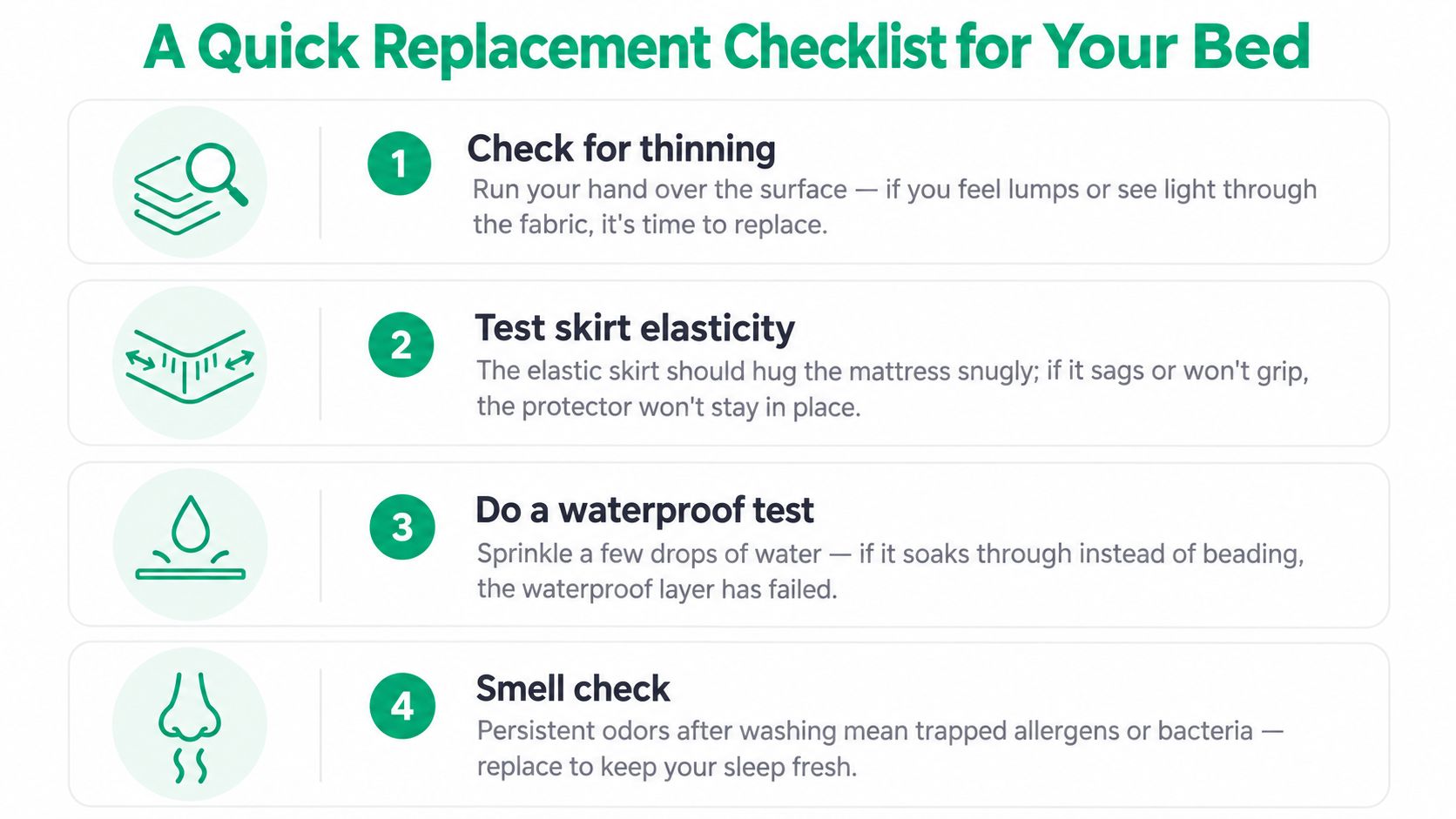
A Quick Replacement Checklist for Your Bed
Check the protector tonight if the mattress feels damp, the cover looks worn, or washing no longer restores freshness.
- Surface: Is the fabric thinning, pilling, holed, or permanently yellowed?
- Fit: Does the elastic still secure every corner?
- Barrier: Does a small water test show seepage?
- Hygiene: Does odour remain after proper laundering?
- Staining: Do marks remain after a permitted 60°C wash?
- Warranty: Could the fault be a covered manufacturing or material defect?
Two clear failures mean replace it now. For a general UK household, use 18–24 months as the outer planning limit, but let wear and membrane performance decide sooner. Families, allergy households, and rental properties should follow their shorter replacement intervals. A landlord can also use this landlord cost-saving maintenance list to add protector inspections to routine property checks.
Protect-A-Bed offers waterproof mattress protectors, pillow protectors, and bed-bug encasements for different household care routines. Visit Protect-A-Bed to choose a UK option.