

Hotel Collection Mattress Protector: A UK Buyer's Guide

You're standing in a room that needs to be sold again by mid afternoon, the previous guest has left a coffee ring on the bedding, and your housekeeper's already asking whether the mattress itself is marked. That's the moment a hotel collection mattress protector earns its keep, or doesn't. I judge protectors by what happens after repeated laundering, rushed bed making and a real spill, not by how soft the packaging promises they'll feel.
Table of Contents
- Hotel-Grade Specification Checklist at a Glance
- Why Hotels Treat a Protector as a Hygiene Layer
- Laundering Performance That Survives Turnover
- Waterproofing, Stain Control and Breathability Together
- Sizes and Fit for Each Bed Type
- Allergen Control Hotels Can Verify
- Bed Bug Limits and What Encasements Add
- Which Protector Spec Each Property Type Needs
- Order a Protector That Passes These Checks
Hotel-Grade Specification Checklist at a Glance
A hotel collection mattress protector is a removable, fitted barrier built to survive repeated commercial laundering and frequent guest turnover, not a single household spill cover. If you're buying for more than a handful of beds, score every sample against the same pass and fail points before price enters the conversation.
Hotel-Grade Protector Checklist
| Criterion | Good looks like | Red flag | Why it matters |
|---|---|---|---|
| Laundering tolerance | Care label allows the hotel's validated hot wash and tumble drying | Cold or hand wash only, temperature not stated | Daily turnover means repeated hot washes |
| Waterproof membrane | Liquid stays on the surface after repeated washes, with continuity tested | Coating cracks, peels or wets through after a few cycles | A failed membrane lets spills reach the mattress |
| Breathability | Air permeability claim backed by test data | Plastic feel with no supporting figures | Trapped heat and condensation disturb guests |
| Enclosure | Fitted top and sides for protectors, full zip encasement where allergy or bed bug control matters | Loose sheet that slides or gaps at the corners | Gaps defeat the barrier |
| Depth fit | Pocket depth stated for the mattress, not just width and length | Size given with no depth | Exposed edges and slipping |
| Noise and feel | Low rustle fabric guests do not notice | Crinkly fabric with no mention of feel | Guest complaints and disturbed sleep |
| Written warranty | Defect term, claim process and return route stated in writing | Verbal promise only | Unclear replacement cost for each failed unit |
Use the table in order. Pick one sample, score every row, then put it through your own wash cycle three times and score it again. Wash damage, shrinkage and a tired elastic rarely show on a brand new sample straight from a packet.
Check the corners under tension after those washes. Pull the sheet over the topper you'll use, smooth the top layers over it, and listen when you press and move across the surface. A protector that's quiet in your hands can still rustle once it's stretched tight.
Practical rule: Reject a sample that fails laundering or fit, even when it's cheap. You'll pay the saving back in replacements, remakes and stained mattresses.
Only order across the estate once the sample holds its size, keeps liquid on the surface and fits without housekeepers fighting the corners. A protector failing any laundering or fit row is a false economy, because the replacement cost recurs every time a bed is turned and a weak unit has to be swapped out.
Why Hotels Treat a Protector as a Hygiene Layer
A guest spills a drink at midnight. In the morning your housekeeper has several rooms to turn before check in, and the mattress underneath is the most expensive item in the room. She doesn't have time to deep clean foam or wait for a damp mattress to dry.
Think of the protector as the washable lining in a sealed envelope. It's the sacrificial layer that takes the stain, perspiration and spill so the mattress doesn't have to. You strip it, wash it and refit a clean one while the bed stays in service.
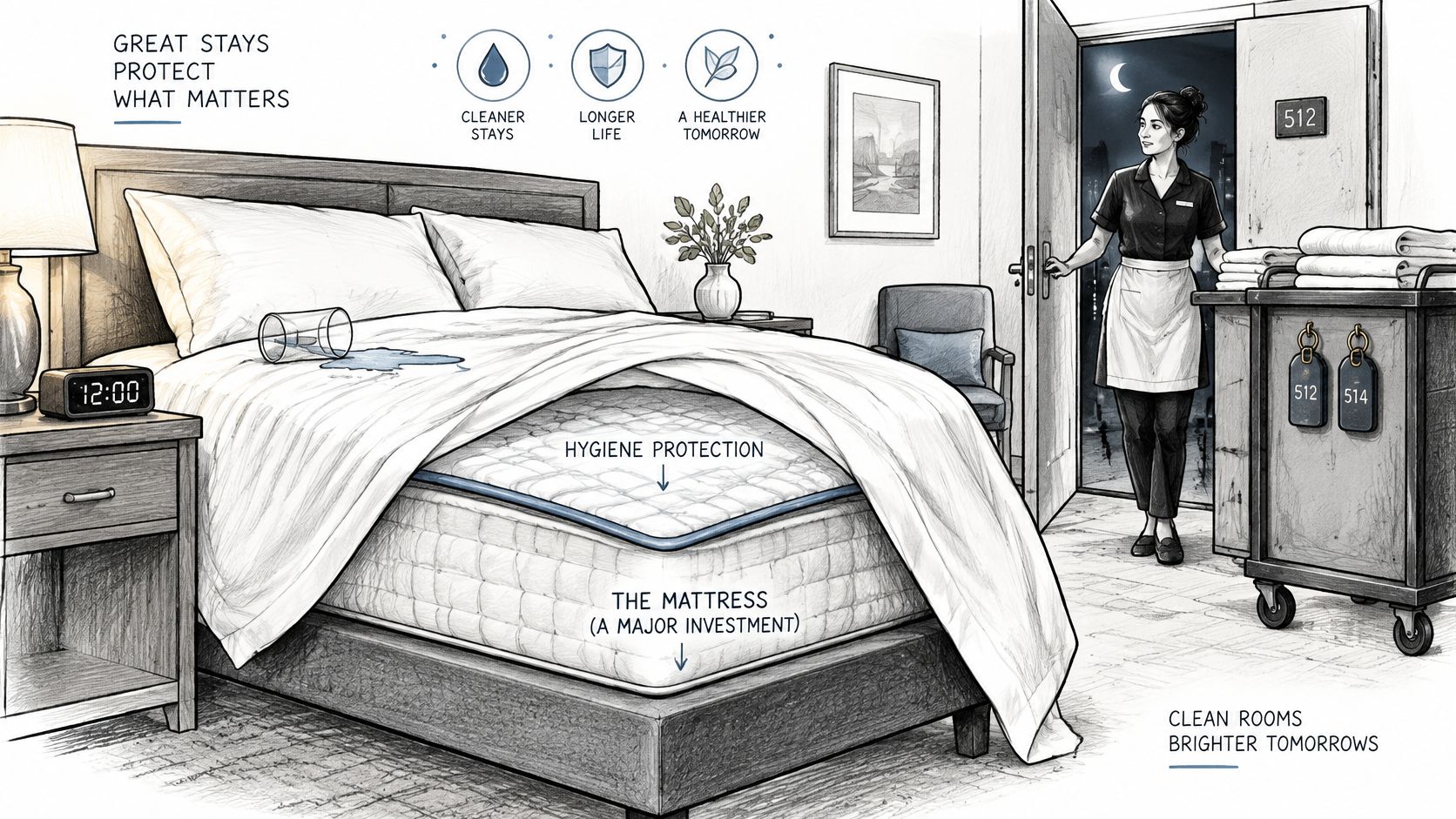
The workload behind that decision is sustained. Knight Frank's UK Hotels Trading Performance Review recorded 2024 average occupancy of 82% in London and 76% in regional UK hotels, which equates to roughly 299 nights per year in London and 277 nights in regional UK locations. That count comes before multiple guests and bedding changes between stays.
At that tempo, a waterproof, breathable protector is a housekeeping and asset decision, not a home comfort extra. It creates a replaceable hygiene layer between sleeper and mattress. The question worth answering is simple. Which specification survives that workload without failing in the laundry?
Laundering Performance That Survives Turnover
Laundering is the first real test because a hotel protector cycles through the wash far more often than a home one. Shrinkage, delamination and gaps at the edges show up in the laundry before guests notice anything. Buy the care label first and the fabric second.
Laundering Benchmarks for Hotel Protectors
| Goal | Benchmark | Hold time | Note |
|---|---|---|---|
| Dust mite control on non-encased bedding | 60°C or above, weekly | Full wash cycle | NHS guidance, lower temperatures may not kill mites |
| Thermal disinfection, health sector laundry | 65°C | At least 10 minutes | Mixing time needed for heat to reach the centre of the load |
| Thermal disinfection, health sector laundry | 71°C | At least 3 minutes | Alternative benchmark, the label must allow this temperature |
| Hotel protector wash | Temperature set by the care label and validated process | As set by the validated cycle | Confirm the maximum with the supplier |
| New protector before first use | One wash before use | One full cycle | Removes the production starch |
Those heat figures need context. NHS England's hotel space guidance sets out UK health sector thermal disinfection benchmarks of 65°C for at least 10 minutes or 71°C for at least 3 minutes, with additional mixing time required for heat penetration. They're a useful engineering benchmark, but your property still follows its own risk assessment and the manufacturer's instructions.
A Five Step Laundry Routine
- Check the label against the process: Confirm maximum wash and tumble dry temperatures before the protector enters your normal load.
- Wash at the validated temperature: Don't add bleach unless the label allows it, because the wrong chemical can damage the membrane.
- Tumble dry within label limits: Excess heat can distort fit just as surely as a hot wash can.
- Inspect under good light: Check seams, elastic, corners and membrane for rips, cracking or loss of continuity.
- Log and replace failures: Change a protector immediately after visible contamination and remove damaged units from stock.
For a practical walkthrough of temperatures and drying, follow our guide to washing a mattress protector correctly alongside the product label. Our Premium Mattress Protector can be washed at warm or hot temperature and should never be washed with bleach or bleach alternative.
Wash mattress protectors and pillow protectors once before first use, because the fabric is starched for cutting during production. I wouldn't judge any candidate on one cycle. Compare fit, feel and waterproofing across three wash cycles, because that's when early shrinkage and seam stress stop hiding.
Waterproofing, Stain Control and Breathability Together
A good waterproof protector works like a rain jacket. The outer surface sheds liquid while the construction lets vapour escape, so the sleeper isn't lying on trapped heat. A plastic bin bag does the opposite. It blocks a spill, but it also holds perspiration and warmth against the bed.
That difference sits in the barrier membrane. Liquid should stop at the surface, while air permeability lets sweat vapour move away from the body. Judge any cooling claim by the test data behind it, not by the word cooling on its own. I would ask what was measured, how the protector performed after washing, and whether the supplier will put the figures in writing.
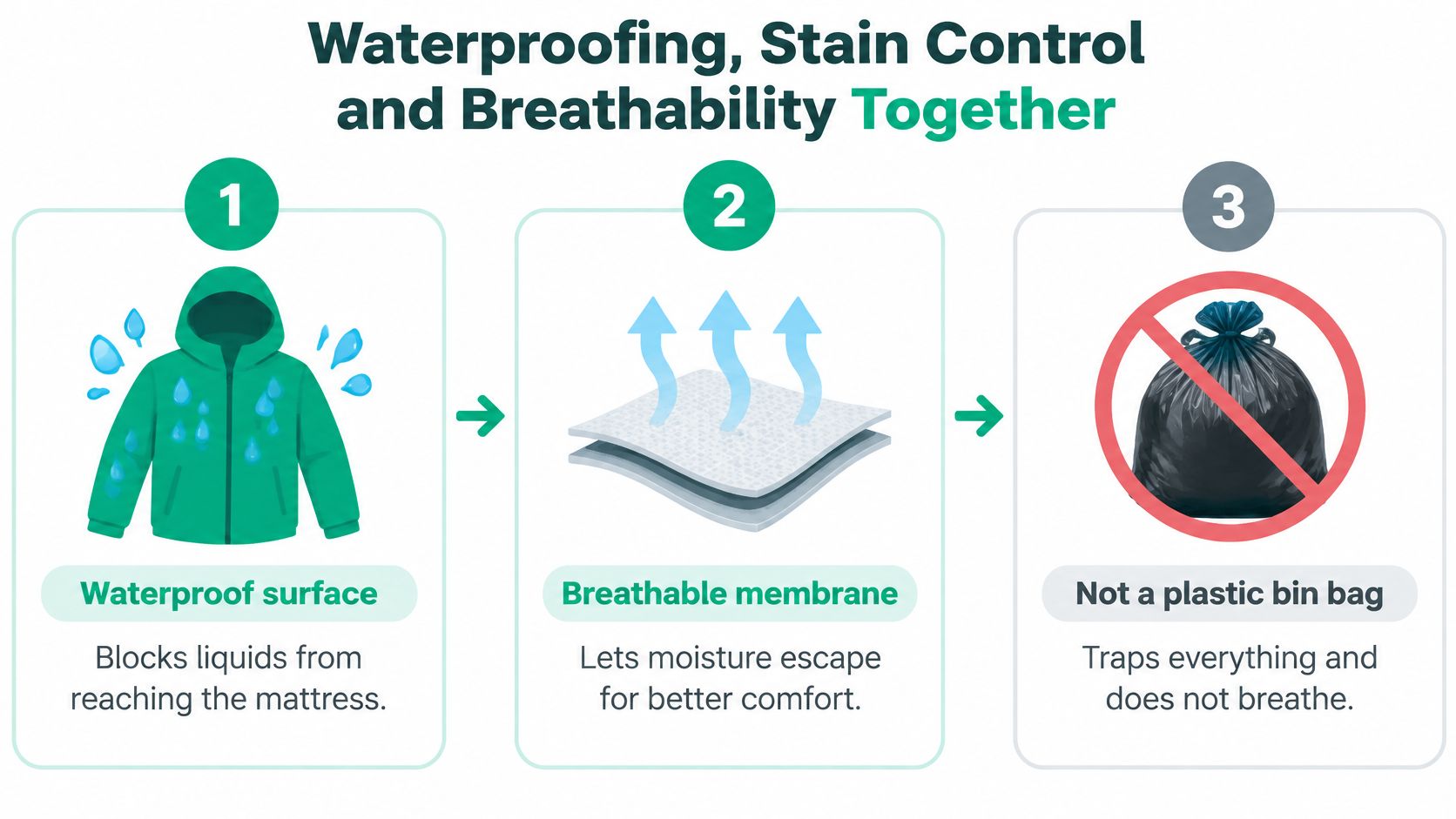
Breathability is also a comfort control. If vapour can't escape, guests feel clammy and may push the bedding aside, disturb the fit or complain that the bed sleeps hot. A quiet, flexible membrane matters just as much, because guests shouldn't hear the protective layer every time they turn over.
What to Do When a Spill Happens
- Strip and lift: Remove the top layers and lift the protector away from the mattress so pooled liquid doesn't run over an edge.
- Blot, don't rub: Press a dry cloth into the liquid. Rubbing pushes the spill into seams and spreads the stain.
- Match the water to the mark: Use cold water for blood and body fluids, since heat sets protein stains. Use warm water for oily marks, where cold water does less work.
- Rinse and dry fully: Don't refit a damp protector, because trapped moisture creates its own hygiene problem.
- Wash and inspect: Launder at the label temperature, then check whether the membrane still holds liquid across the affected area.
Rubbing feels helpful when you're rushing. It usually makes the clean up harder by driving liquid sideways into stitching.
Afterwards, a sound protector tells a clear story. Liquid beads on the surface, the mattress underneath stays dry, and there's no wet ring showing through the membrane. If you see damp patches where the coating has broken down, retire that unit rather than hoping the next spill lands somewhere else.
Sizes and Fit for Each Bed Type
Fit is set by mattress width, length and depth, not by the name on the bed frame. That rule changes most orders, because two beds sold as doubles can carry different mattresses and toppers. Measure the sleep surface you'll protect, then match the pocket to it.
UK Bed Sizes and Depth Allowance
| Bed type | Mattress size (W x L, cm) | Typical depth to allow for | Fit note |
|---|---|---|---|
| Small single | 75 x 190 | 20 to 30 cm | Bunk and staff rooms |
| Single | 90 x 190 | 20 to 30 cm | Standard single hotel room |
| Small double | 120 x 190 | 20 to 30 cm | Compact double rooms |
| Double | 135 x 190 | 20 to 30 cm | Most common double size |
| King | 150 x 200 | 20 to 30 cm | Common hotel double size |
| Super king | 180 x 200 | 20 to 30 cm | Two bed or family rooms |
| Deep platform or divan with topper | Mattress size plus topper | 30 cm or more | Check for an extra depth pocket |
| Care or profiling bed | Confirm width and length with the supplier | Confirm depth with the supplier | Confirm with the bed supplier |
Most domestic and hotel mattresses need a 20 to 30 cm pocket. Deep platform beds and mattresses with toppers need 30 cm or more, so check the corners rather than the centre. The centre can look smooth while a shallow pocket is already creeping up at one end.
For deeper beds, our guide to protectors for deep mattresses explains how pocket depth affects grip. Use it before you commit a whole floor to one size.
Measure Before You Order
- Start at one corner: Place the tape at the top edge of the mattress.
- Run down the side: Measure to the base without compressing the edge.
- Add the topper: Include its full depth if the protector will cover both layers.
- Record the top surface: Write down width and length for that exact mattress.
For care beds and profiling sections, confirm dimensions with the bed supplier before ordering. Adjustable sections and rails can change the usable area and the way a fitted corner moves. Check a multi room order against one sample room first, and keep the care bed row open until the supplier confirms its dimensions in writing. A protector that bunches on a profiling section isn't just untidy. It can pull free during repositioning and leave the edge exposed.
Allergen Control Hotels Can Verify
Guests with asthma or dust mite allergy notice quickly when a bed isn't properly enclosed. They may not use the word allergen at reception, but they'll tell you they slept badly, woke congested or needed their inhaler more than usual. For those rooms, waterproof isn't the whole specification.
The seal matters more than a broad fabric claim. An intact, closely fitted enclosure reduces mite allergen escape from the mattress core, while breathable construction limits heat and humidity build up. A loose cover with an open side can't do the same job, however strong the headline claim sounds.
NHS Lothian's house dust mite guidance recommends allergen proof covers that completely enclose mattresses, duvets and pillows, typically using a zip. That gives an operator something physical to verify instead of a promise to trust.
Three Checks Your Team Can Make
- Full perimeter coverage: Confirm the cover protects the top, sides and underside, not only the sleeping surface guests can see.
- Secure closure: Run the zip fully closed and check it doesn't gap at corners or pull apart along the seam.
- Tested permeability: Ask for vapour or air permeability results and documented resistance to repeated laundering, so comfort claims have evidence behind them.
Housekeeping should check seams, zips, corners and underside panels during each room turn. A small tear or incomplete closure defeats the barrier, and the underside is where damage can sit unnoticed for weeks. Build the check into the turn rather than relying on a periodic deep inspection.
The bedding around the enclosure still needs the right wash. The same NHS guidance advises washing non-encased bedding weekly at 60°C or above because this kills house dust mites. Lower temperature washing may remove allergen temporarily while allowing mites to survive.
Don't oversell what the enclosure does. It supports routine cleaning and ventilation, and it gives allergy sensitive guests a more controlled sleep surface. It doesn't replace vacuuming, linen changes or fresh air in the room. I would reserve your tightest inspection routine for rooms you market to guests who request allergen control, then apply the same basic seam check everywhere else.
Bed Bug Limits and What Encasements Add
A standard protector is not a bed bug defence. Our Mattress Protector does not prevent bed bugs, and treating a fitted waterproof sheet as pest control leaves the rest of the room exposed. That distinction protects guests and stops staff relying on the wrong tool.
Ordinary waterproof protection covers the top and sides against liquid. A fully sealed encasement encloses the whole mattress and closes with a secure zip, so it can support containment and make inspection cleaner. Those are different products with different jobs.
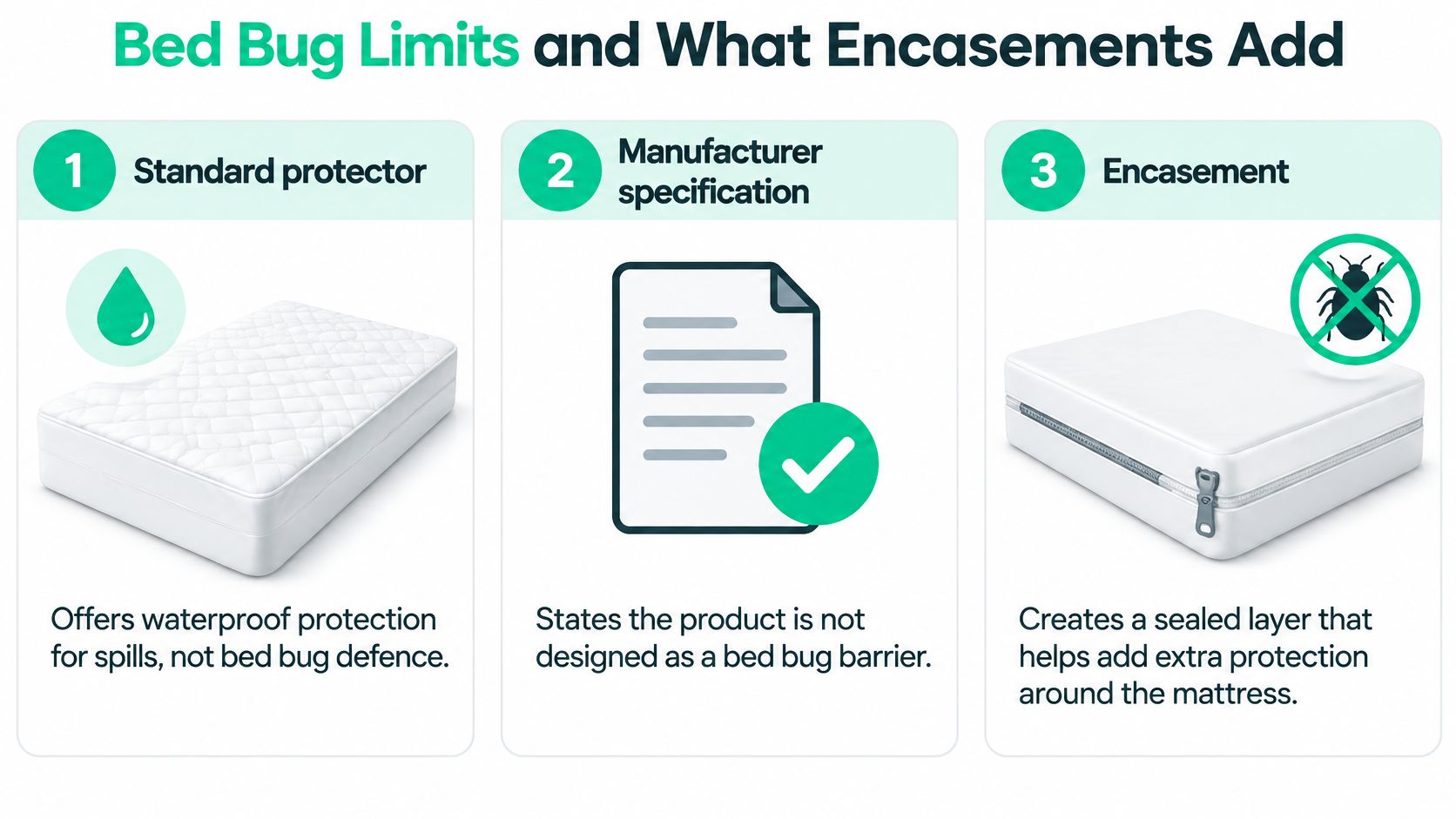
The British Pest Control Association's bed bug guidance does not present a protector as a stand alone prevention method. It frames encasements as part of broader integrated management, alongside heat, steam or chemical treatment and bed isolation. That wider view matters because infestations also involve bed frames, headboards, luggage and adjacent rooms.
A completely sealed encasement can trap bed bugs inside the mattress, but it must remain fitted for at least a year, and longer in colder conditions. Removing it early for a routine wash breaks the containment plan. Record the fitting date where the housekeeping lead can see it, not on a loose note in a cupboard.
Inspection and Escalation Checklist
- Check the mattress: Inspect edges, seams and corners before the guest settles.
- Check the furniture: Look along frame joints and behind the headboard.
- Bag suspect bedding: Seal it before carrying it through corridors, then treat it at 60°C or use high heat drying.
- Isolate and record: Take the room out of service and write down what was found, where and when.
- Call professional pest control: Don't let housekeeping attempt a chemical fix without the right controls.
An encasement supports integrated management. It never replaces professional treatment, room isolation or inspection of neighbouring rooms. I would also brief front desk staff on the same sequence, because a guest report handled slowly gives the problem time to move.
Which Protector Spec Each Property Type Needs
Hotels should weight laundering tolerance and depth fit first. High turnover gives a weak membrane nowhere to hide, and a shallow pocket slows every bed change. Check the sample against your validated hot wash at the label temperature.
Guesthouses often have smaller teams and less storage. A correct fit and a clear written warranty route carry more weight, because one awkward bed can eat into a short changeover window. Keep a spare set for each bed so a wash cycle doesn't leave a room waiting.
Care facilities face blood, body substances and incontinence. Membrane continuity and the health sector thermal benchmarks become the priority, alongside bed surfaces that are visibly free of spillages, dust and debris. The protector supports that standard. It doesn't replace cleaning or immediate changes after contamination.
Adjustable care beds need their own decision. Confirm dimensions with the supplier before ordering, because profiling movement changes what a corner has to tolerate.
Allergy sensitive rooms need a full enclosure with a secure zip. A fitted top only protector may handle spills well, but it leaves the underside open.
Landlords of furnished lets face fewer washes, yet the same fit and warranty checks still apply. Long gaps between tenancies make written records useful, and any bed bug concern follows the same inspection and escalation sequence you'd use in paid accommodation.
Order a Protector That Passes These Checks
Order in an order that stops mistakes reaching every room.
- Measure each bed type: Use the sizing table and record width, length and depth, including toppers.
- Shortlist by laundering: Keep only protectors whose care labels allow your validated process.
- Test one sample: Run the three cycle sample test before any bulk order.
- Confirm the warranty in writing: Check the defect term, claim process and return route. Warranty protectors must be returned only to us at Protect-A-Bed.
- Order by room type: Keep a spare set for each bed so laundering never leaves a mattress bare.
Our categories are Mattress Protectors, Bedbug Protection and Pillow Protectors, so you can match a fitted protector or a sealed encasement to the job. The published warranty term varies by product, so confirm it on the product page before purchase.
Apply one test before you buy in volume. Does the protector still pass the checklist after the laundry?
If you're specifying a hotel collection mattress protector for one bed or a full property, start with fit, laundering tolerance and the right barrier type so your team isn't fighting failures at every changeover. Visit Protect-A-Bed to compare mattress protectors, pillow protectors and bed bug encasements, check the warranty for the product you choose, and order a sample you can put through your own wash before you commit.