

Cooling Mattress Protector UK: A Buyer's Guide for 2026

Analysis of 553 English homes found that 18.6% of main bedrooms, about 4.45 million homes, overheated in summer, exposing an estimated 7.4 million people to excessive bedroom temperatures, in work published by Buildings & Cities. A cooling mattress protector UK shoppers choose sits inside that reality: the surface can reduce clamminess, but it cannot lower room temperature.
Choose in the order beds fail. Start with the fabric-by-sleeper table: a solo hot sleeper and a couple with different temperatures need different surfaces. Then use the size and pocket-depth checks once the breathability and bedroom-heat limits are clear. Judge each cooling claim against the whole household, not the hotter sleeper alone, and let washing plus the waterproof layer decide whether the cool feel lasts.
Table of Contents
- Matching Cooling Fabric to Your Sleep Type
- How Breathability and the Miracle Membrane Work Together
- Why UK Bedrooms Overheat and What a Protector Cannot Fix
- Sizing and Pocket Depth for UK Beds
- How to Wash and Care for Your Cooling Protector
- Delivery, Returns and Warranty Checks
- Compare the Two Cooling Options Before You Buy
Matching Cooling Fabric to Your Sleep Type
Fibre-based cooling fabrics such as Tencel Cool suit most solo hot sleepers, Charcoal suits odour-prone sleepers, and Snow suits a breathable surface for warm sleepers who don't need a slick, icy hand-feel.
| Sleeper situation | Suggested fabric | Main reason | Trade-off |
|---|---|---|---|
| Solo hot sleeper who wakes clammy | Tencel Cool | Lyocell fibre moves moisture away from the skin and feels cool on contact | Cool feel can fade after repeated washing |
| Couple with mismatched temperatures | Tencel Cool or Snow | Breathable surfaces suit a warm sleeper without chilling a partner who runs cold | Test both sides before committing |
| Odour-prone or frequent night sweats | Charcoal | Carbon-treated fabric is commonly chosen for odour control | Often feels less cool than fibre-based options |
| Children or heavy daily use | Premium or Charcoal, waterproof first | Durability and easy washing matter more than cool feel | Cooling is a secondary benefit |
| Dust mite or allergy sensitivity | Any protector with a membrane barrier | The membrane limits allergen transfer to the mattress | Fabric choice matters less than the barrier |
Solo and clammy. If you wake with a damp patch at the lower back, start with Tencel Cool. On the product page, look for a lyocell or Tencel sleep surface and a note on moisture movement, not only the word cooling. The trade-off is real: that first cool touch can soften after several washes, so read the care label before you commit.
Two temperatures in one bed. Say one of you kicks the duvet off and the other pulls it back by 2am. Tencel Cool or Snow gives the warmer sleeper a breathable surface without aiming to chill the colder one. Check whether you can feel a sample, or at least read a plain description of hand-feel. Lie on it, or picture both sides of the mattress, before you treat one fabric as the household answer. Our temperature control mattress guide is a useful next read if the argument is really about the whole bed, not only the cover.
Odour and heavy sweats. Charcoal is the practical pick when freshness matters more than a cool-to-the-touch marketing line. Confirm the page says carbon-treated or charcoal fabric, and accept that it often feels less cool than fibre-based options.
Children and daily use. Spills and washing come first. Choose Premium or Charcoal with waterproofing ahead of cool feel, and check that the care instructions match how often you'll wash it.
Dust mites and allergies. The fabric name matters less than a membrane barrier that limits what reaches the mattress. Confirm the listing describes a barrier, not only a soft top.
Practical rule: The table is a starting point. The trade-off column is what should decide the order.
How Breathability and the Miracle Membrane Work Together
A breathable raincoat and a plastic bag both keep rain out. Only the coat lets sweat vapour leave. A mattress protector has the same job in miniature. The liquid barrier must stop a spilled drink, yet water vapour and air still need a way out. If they don't, perspiration stays against the body and any cool feel collapses by midnight.
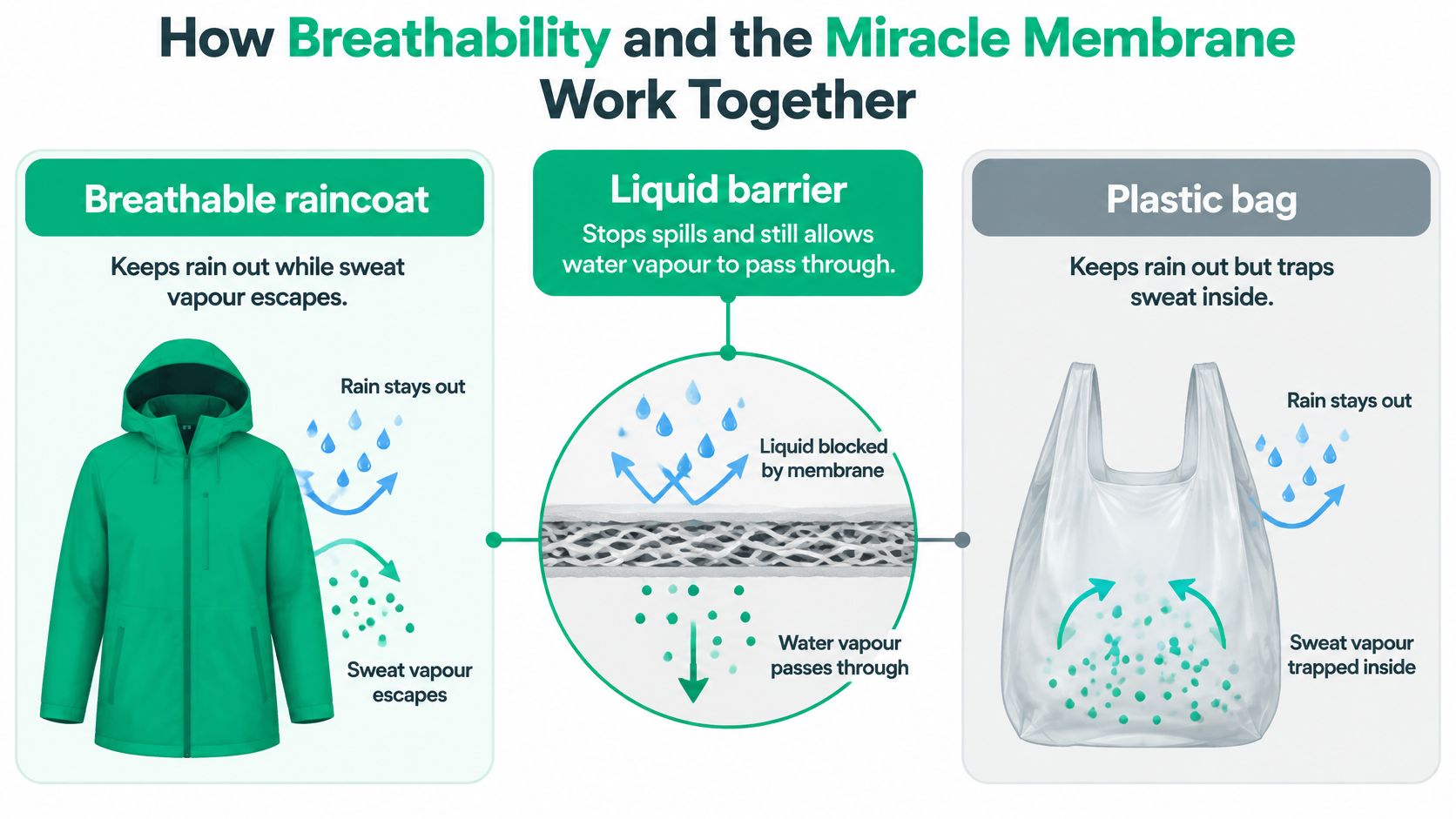
Our Miracle Membrane is that thin waterproof layer. It is flexible, silent and thin, and it gives top-surface waterproof protection. Liquids stay above it while air can still move. A stiff film does the sealing job too, but you feel it the moment you sit down, which is why membrane thickness matters as much as the waterproof claim itself.
Cool at first touch is not cool all night
A fabric can feel cold for ten seconds and still hold heat once your back has warmed the spot. Sustained comfort is about vapour leaving and the surface not acting like a lid. A hot sleeper on a foam mattress will notice the difference faster than someone who only feels warm under a heavy duvet.
Before you trust a cooling line, use three checks:
- Vapour, not only waterproof: The spec should describe water vapour or airflow, not just a liquid block.
- Quiet when you turn: A crinkly sheet usually means a stiffer film. The membrane should stay quiet as you roll over.
- Overnight, not first contact: The claim should describe how the surface behaves through the night, not a cool hand-feel in the shop.
What a measurable benefit looks like
In an experimental study of 22 healthy adults aged 25 to 50, people slept five nights at home in a typical English summer, then three nights in a bedroom held at 30°C ±0.5°C. Under that overheated condition, total sleep time fell by 24 minutes, and sleep quality and freshness were both poorer (p<0.001), in research archived by Loughborough University. A related trial in the same 30°C condition compared regular bedding with a cooling mattress topper and found sleep improved on the cooling surface, both in how long people slept and how quickly they drifted off.
Those trials used specific products and small groups, so treat them as direction rather than a promise for every cover. They show that the layer you lie on can change sleep when the room is hot, while a waterproof surface can still deal with spills and sweat.
Why UK Bedrooms Overheat and What a Protector Cannot Fix
Treat the bedroom as the problem, and the protector as one thin layer inside it. UK building-performance research found that 23% of main bedrooms in England, about 5.5 million rooms, were overheated in the hot summer of 2018 under proposed thresholds of 27°C for vulnerable households and 28°C for other households, as set out by Loughborough University. The same work notes that the current UK 26°C bedroom criterion rests on a small study more than 45 years old, and it proposes thresholds between 26°C and 29°C depending on the application.
A winter duvet commonly sits around 13.5 tog, while a summer one comes in nearer 4.5 tog. Swapping between them on a July night changes how much heat your body keeps far more than any layer under the sheet can. The protector's job is narrower: less clammy contact, better moisture handling and a surface that avoids the plastic-sheet feel. That is passive comfort, the same kind a decent cotton shirt gives, and it stays a long way from powered cooling.
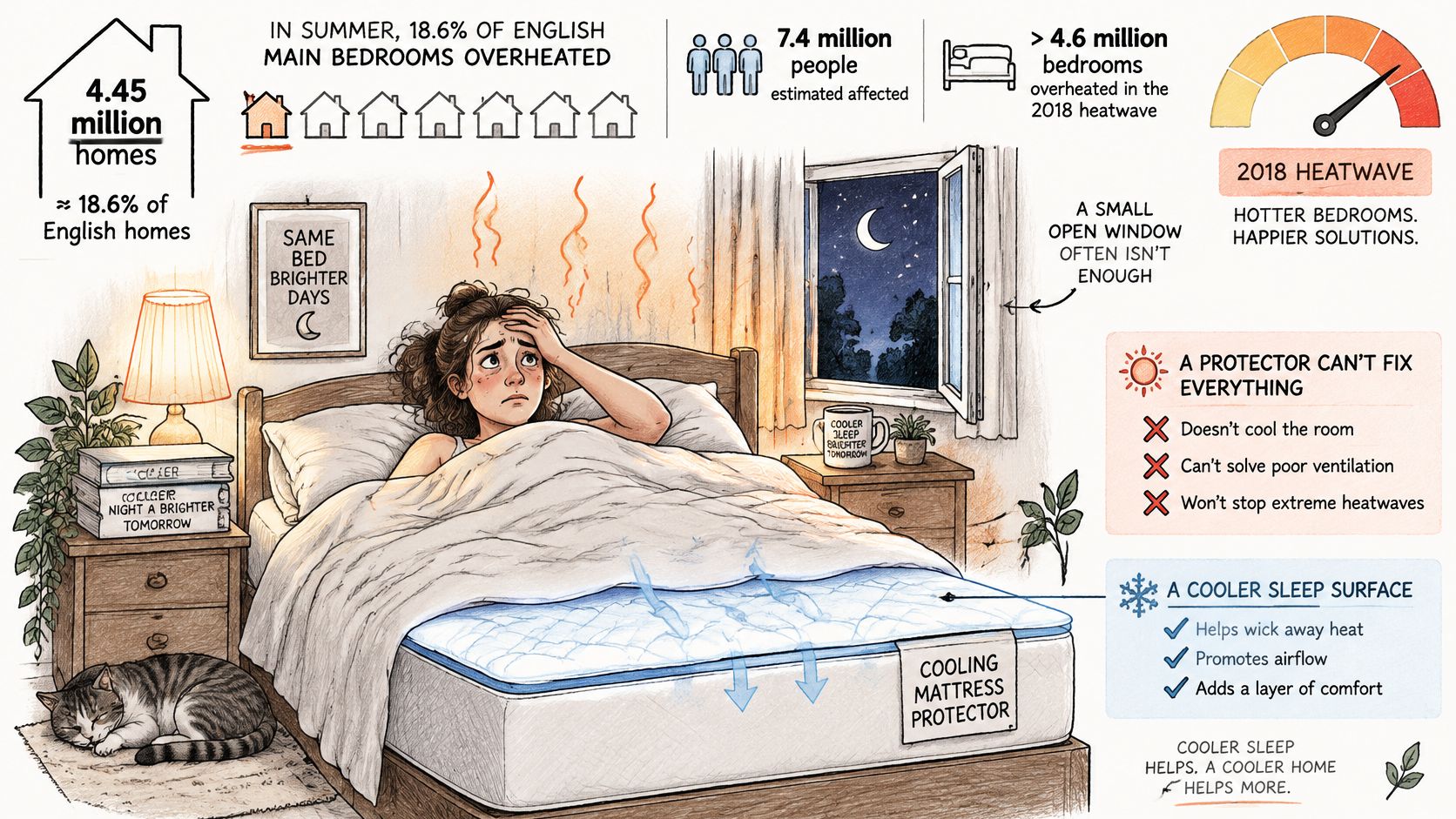
Monitoring work in English homes during a record-hot summer tells the same story from the sleeper's side. Many main bedrooms stayed warm well into the night, and most of the rooms studied failed the building-services overheating criterion. Even moving sleepers into the coolest bedroom available left most households without a cool room to retreat to. Official comfort guidance treats rising mean night-time bedroom temperatures as progressively harder on sleep, and rooms that hold very warm air through the night make restful sleep difficult for everyone in the bed.
A protector changes the sleeping surface, while the room temperature stays the room's problem. British homes rarely have air conditioning, so the closest real-world comparison sits abroad, where cooling a whole room is a routine purchase. The trade-offs between central and room units are laid out in cooling choices for Southwest Florida homes from Heatwave Air Conditioning, Plumbing, & Electric, and the same logic applies here: when the air itself is hot, only moving or cooling that air fixes it. Ventilation, shading and a lighter duvet still do the heavy lifting. Our tips for sleeping in warmer weather cover the room side of that job.
Three ideas that don't hold up
Cotton is not automatically a cooling membrane. The British Red Cross recommends a thin cotton sheet in a heatwave because cotton absorbs sweat. Absorbing moisture and blocking liquid are different jobs: a cotton sheet soaks sweat up, while a waterproof membrane keeps it off the mattress.
A cooling protector does not drop the bedroom temperature. If you feel hot around the torso while the mattress feels only slightly warm, look at the duvet tog, sleepwear and airflow before you blame the cover.
You may not want maximum cooling all night. Body temperature falls later on, so the Red Cross also warns that you may need a cover again. The better protector balances sweat management, waterproofing and comfort across the night, rather than feeling coldest at bedtime.
Test it at home against bedroom temperature, duvet rating, sleepwear, a partner's heat, and whether the warmth sits at the mattress or around your torso. One limit is easy to miss: a mattress protector does not prevent bed bugs. A fitted protector is a long way from a sealed encasement.
Sizing and Pocket Depth for UK Beds
Match the protector to the mattress width and length, not the name on the bed frame. A "double" frame can hide a small double mattress, and a super king label can hide two singles pushed together.
| Bed size | Fit check |
|---|---|
| Small single | Confirm the pocket depth on narrow frames |
| Single | Standard single, widely stocked |
| Small double | Common in guest rooms, often mistaken for a double |
| Double | Standard double, check for a topper |
| King | Most common UK king size |
| Super king | Check whether the bed is a single split pair |
Pocket depth is the measurement people skip
The elasticated edge has to cover the full depth of the mattress. A deep mattress, or a mattress with a topper on it, needs a deeper pocket. A cover cut for a standard depth will slide or bunch on a thicker or pillow-top mattress. Loose fabric then sits in ridges under the sheet, which feels warmer and noisier than a snug fit.
Split super king. If the bed is two singles zipped or strapped together, order two separate protectors, one for each mattress. One super king cover will not sit properly across a split.
Topper on top. Measure depth with the topper in place if the protector has to go over both. If the protector sits under the topper, measure the mattress alone, and remember the topper, not the protector, is what your skin meets.
Take three measurements before you order, and compare them with the product dimensions. Our guide on how to measure mattress depth walks through that check.
- Width: Edge to edge across the sleeping surface, not the frame.
- Length: Head to foot on the mattress itself.
- Depth: Top surface to the base, including any pillow-top, and including a topper only if the cover must wrap it.
If the pocket is shorter than that depth, don't order it and hope the elastic will stretch.
How to Wash and Care for Your Cooling Protector
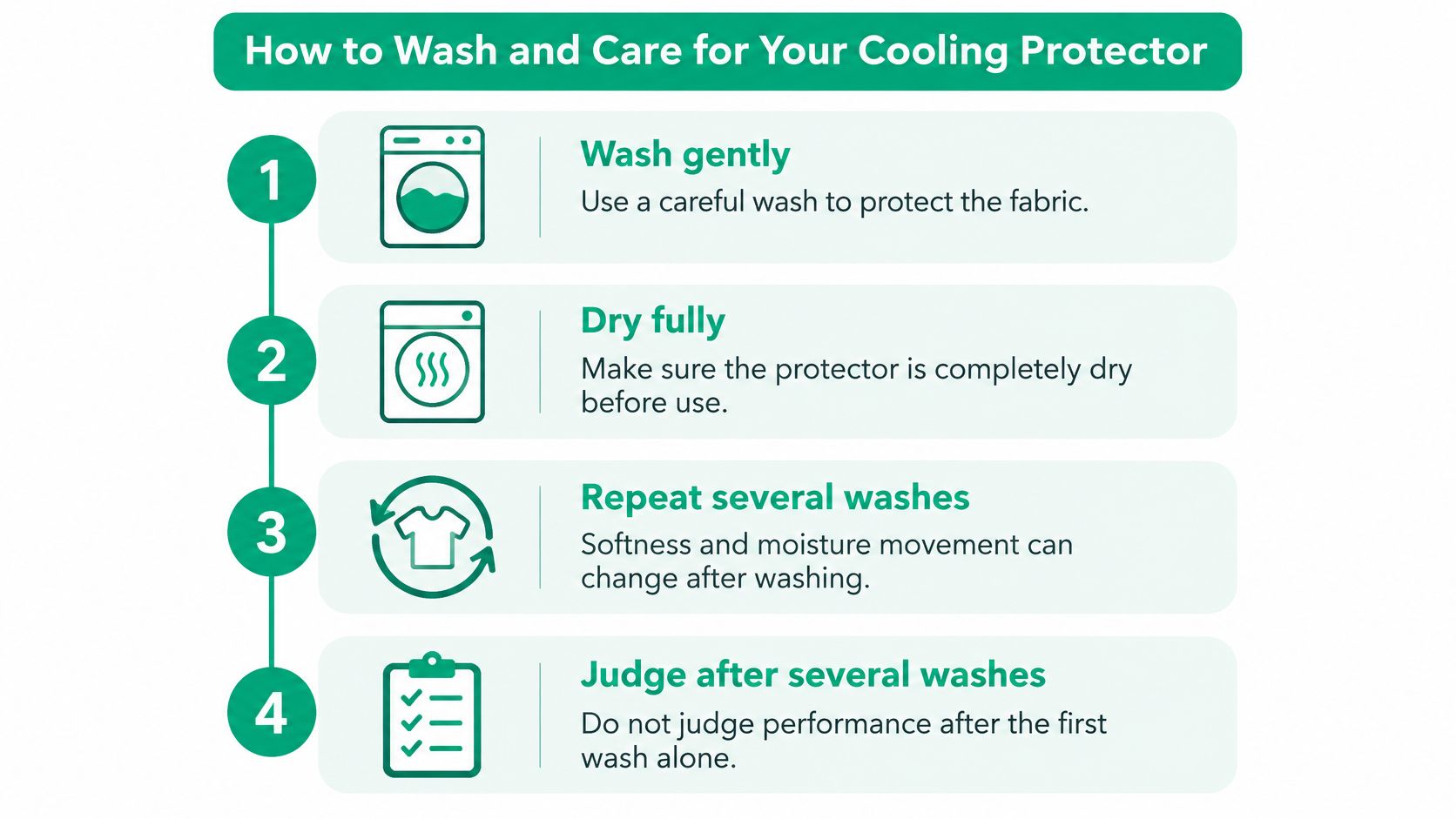
A cooling protector works like a non-stick pan: the layer doing the useful work is thin, and harsh cleaning wears it faster than sleeping on it ever will. Repeated washing also changes softness and how moisture moves through the cloth, so judge the cover after several washes, not after the first night out of the packet.
Good Housekeeping's 2025 UK sleep survey, based on more than 1,400 respondents, found that 25% struggled with overheating beside a sweaty partner and 32% had lowered bedroom temperature to sleep more comfortably, as reported by Floks. The British Red Cross recommends a thin cotton sheet because it absorbs sweat, and notes that overheating can disrupt both falling and staying asleep. Sweat and moisture are the part a protector can help with, but only while the cooling face and waterproof barrier survive the wash. What counts as too warm also varies from household to household, and from one side of the bed to the other, so no cover can promise to regulate the whole night for two different sleepers.
A routine that keeps the barrier intact
- Check the care label. Different fabrics in the range are not washed the same way, and the label beats a general habit.
- Wash at the temperature the label allows. The Premium Mattress Protector can be washed at a warm or hot temperature. Hotter than the label is how membranes and elastic age early.
- Skip bleach and bleach alternatives. The Premium protector should never be washed with bleach or a bleach alternative. Those products can attack the barrier and the colour.
- Dry fully before fitting. A damp cover feels heavier and less comfortable, and it can leave a musty patch on the mattress.
- Sterilise only when you need to. Mattress and pillow protectors can be wet sterilised at 120°C. Chemicals must not be used to sterilise them.
Two signs the surface is tired
Retire the cover from "cooling" duty when the surface feels warmer on contact than it did after the early washes, and when the fit loosens so the skirt rides up. New rustling noise and fabric that no longer sits flat are telling you the same thing. Judge on a pattern of nights, not one: a partner who runs hot can still overheat on an otherwise good cover while the other sleeper is comfortable.
Delivery, Returns and Warranty Checks
These checks come after fabric, size and care, because they don't change how the bed feels.
Delivery. Confirm the delivery estimate and the cost at checkout, since both are shown there rather than as one fixed offer. If you live in a flat or on an upper floor, check the parcel will fit the stairs and hallway. A king protector is a soft parcel, but a tight turn on a landing still matters.
Returns. Read the returns window and any hygiene condition on the returns page before you order. A washed or used protector may not qualify. Don't wash it "just to try the feel" if you might send it back.
Warranty. We replace mattress protectors that fail because of materials or manufacturing defects for up to 15 years from the date of purchase. You need proof of purchase. A claim covers a fault in materials or making. It is not a promise against ordinary wear, a loosened fit after years of washing, or a cool feel that has softened. Read how the terms separate a fault from wear before you assume a change of hand-feel is covered.
Keep the order confirmation with the care label. If you need a claim, both should be in the same place.
Delivery and warranty are one-time checks. They do not make a poor fabric match sleep cooler.
Compare the Two Cooling Options Before You Buy
| Product | Price | Role | Trade-off | Warranty |
|---|---|---|---|---|
| Tencel Cool Mattress Protector | from £34.98 | Fibre-based cooling | Higher price for a cooler-touch surface | Up to 15 years from purchase |
| Charcoal Mattress Protector | from £24.98 | Odour-focused | Lower price, freshness ahead of cool feel | Up to 15 years from purchase |
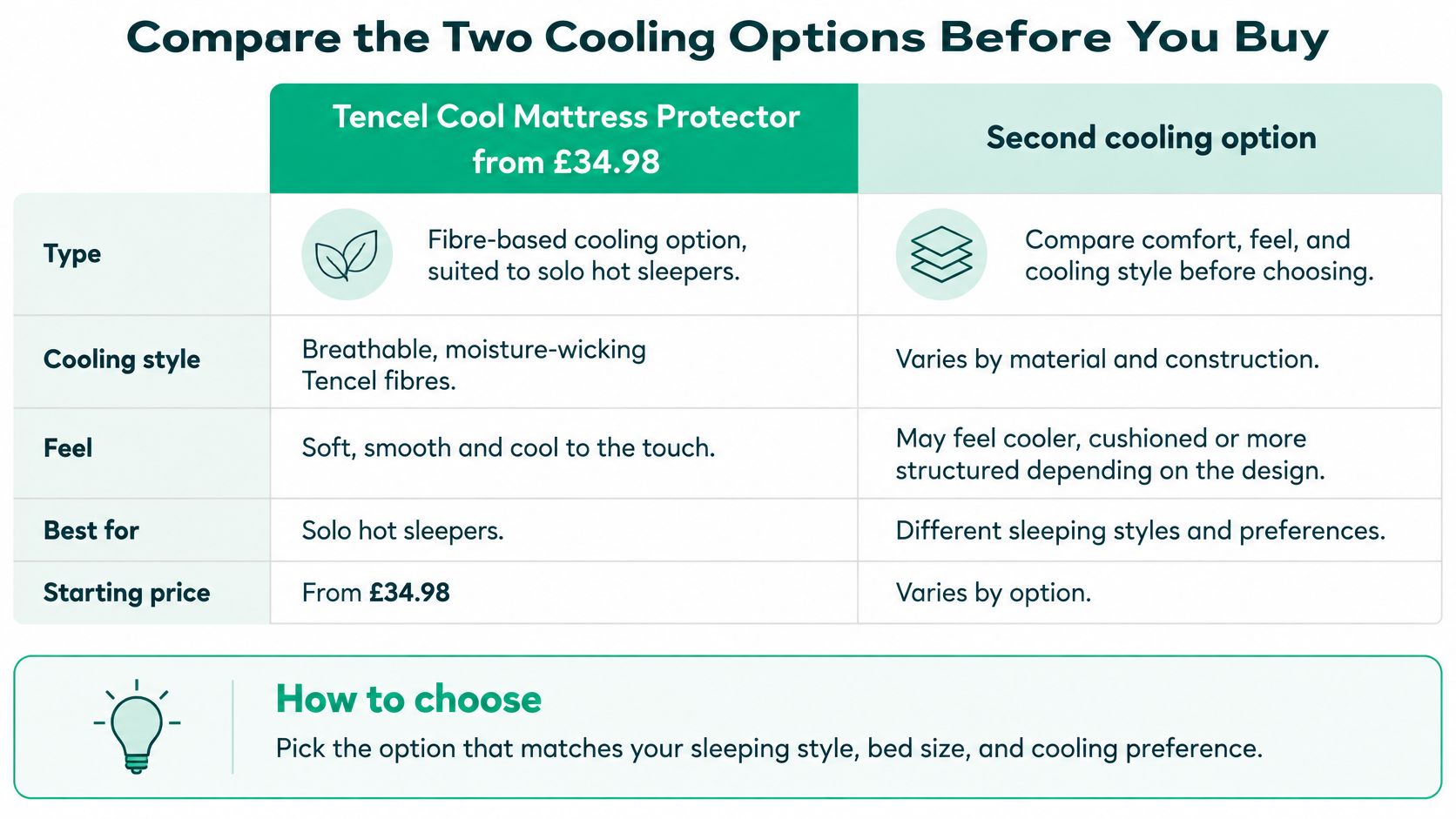
You already have a fabric match. What remains is the money question, because £10 separates the two at entry level and that gap pays for a different job.
The Tencel Cool Mattress Protector, from £34.98, puts its cooling in the fibre itself. You pay more for a surface that feels cool to the touch. The Charcoal Mattress Protector, from £24.98, spends its budget on odour control, handling what perspiration leaves behind after the night. Where freshness outranks a cool hand-feel, the lower price wins. Where the touch of the fabric is the whole point, the extra spend is doing the work.
On a shared bed the decision belongs to the household. A protector covers the full mattress, so both sleepers get the same surface. If your partner sleeps cold, a cool-feel top can bother them all night, and neither option lets you treat one half of the bed. Agree the priority together before you pay for it.
Warranty does not separate the pair. Both are covered for materials or manufacturing defects for up to 15 years from the date of purchase, proof of purchase required, so price and role do all the deciding. If spills or dust mites sit in your brief, confirm the waterproof membrane barrier is part of the build before checkout, since hygiene matters more than any cooling word on the packaging.
Cooling is one benefit beside waterproofing and hygiene. Match the cover to the job, measure the bed, and order the one that fits both.
Protect-A-Bed makes waterproof, breathable mattress protectors for UK beds, including cooling surfaces for hot sleepers and simpler covers where spills and washing come first. If a clammy mattress is the part of a warm bedroom you can change, compare Tencel Cool and Charcoal against your sleeper, your size and your wash routine. Visit Protect-A-Bed to check the fit and order the one that matches the bed you have.