

Best Waterproof Mattress Protector for Bedwetting UK Guide

You're standing beside a wet bed in the middle of the night, trying to remove the sheet without waking everyone else. The spare bedding isn't where you thought it was, and you're wondering whether the mattress underneath is wet too. You don't need a more luxurious cover. You need a bed that's easier to put right.
My recommendation for the best waterproof mattress protector for bedwetting is a properly fitted, washable waterproof protector, with a separate absorbent layer when accidents are frequent or quick changes matter. Choose the barrier and fit first, then decide how much absorbency you need. Treat the whole setup as part of a calm bedside routine, not as a cure.
Table of Contents
- What Bedwetting Really Looks Like in a UK Bedroom
- Evaluation Criteria That Actually Matter for Bedwetting
- Protector Types Side by Side and When Each One Wins
- How Protect-A-Bed Protectors Match These Scenarios
- Care, Washing, and Rotating Protectors Through Repeat Accidents
- Best Picks by Setting Parents, Eldercare, and Shared Homes
- Red Flags NHS Guidance and Building a Bedwetting Routine That Works
What Bedwetting Really Looks Like in a UK Bedroom
A wet night creates several jobs at once: help the sleeper get comfortable, remove damp bedding, check the mattress, and find somewhere for the laundry. For a parent, there's also the challenge of keeping frustration out of your voice. For an adult or carer, privacy may matter just as much as the clean-up.
Bedwetting isn't confined to toilet-training toddlers. NHS information on nocturnal enuresis reports that approximately half a million UK children aged 5–16 wet the bed. That makes mattress protection an ordinary household provision, not evidence that someone has failed.
Set a practical benchmark
The age pattern helps put accidents into perspective. In the UK Avon Longitudinal Study, frequent bedwetting affected 8% of children at approximately 4½ years, falling to 1.5% at approximately 9 years 7 months, according to the NICE nocturnal enuresis scope. Those figures describe frequent wetting, not every occasional accident, so don't use them to judge an individual child's progress.
Start with what you need the bed to do, rather than which fabric sounds most appealing.
| Your immediate problem | Your buying benchmark |
|---|---|
| Moisture reaches the mattress | A waterproof barrier with dependable coverage |
| Bedding takes too long to change | Removable layers you can handle easily |
| The cover slips during sleep | Correct dimensions and secure corner grip |
| Washing leaves you without protection | A clean, dry spare ready to fit |
Practical rule: Buy for the next wet night, not just for the clean bed you're making today.
Prepare without making a fuss
I'd organise the bedroom around a repeatable response rather than an emergency clean-up. Keep the arrangement discreet, and avoid turning each accident into a discussion about whether the protector has “worked”.
- Pick your benchmark. The mattress underneath should stay dry, and the bedding should remain comfortable.
- Accept the laundry. Waterproofing doesn't remove the need to wash wet sheets and clothing.
- Plan the handover. Decide who helps, where used bedding goes, and how the sleeper gets back into bed.
Adults researching night-time urinary leakage may also find it useful to see Lake City Physical Therapy's advice as a separate reading resource. Keep the distinction clear: buying bedding protection and understanding why leakage happens are different tasks.
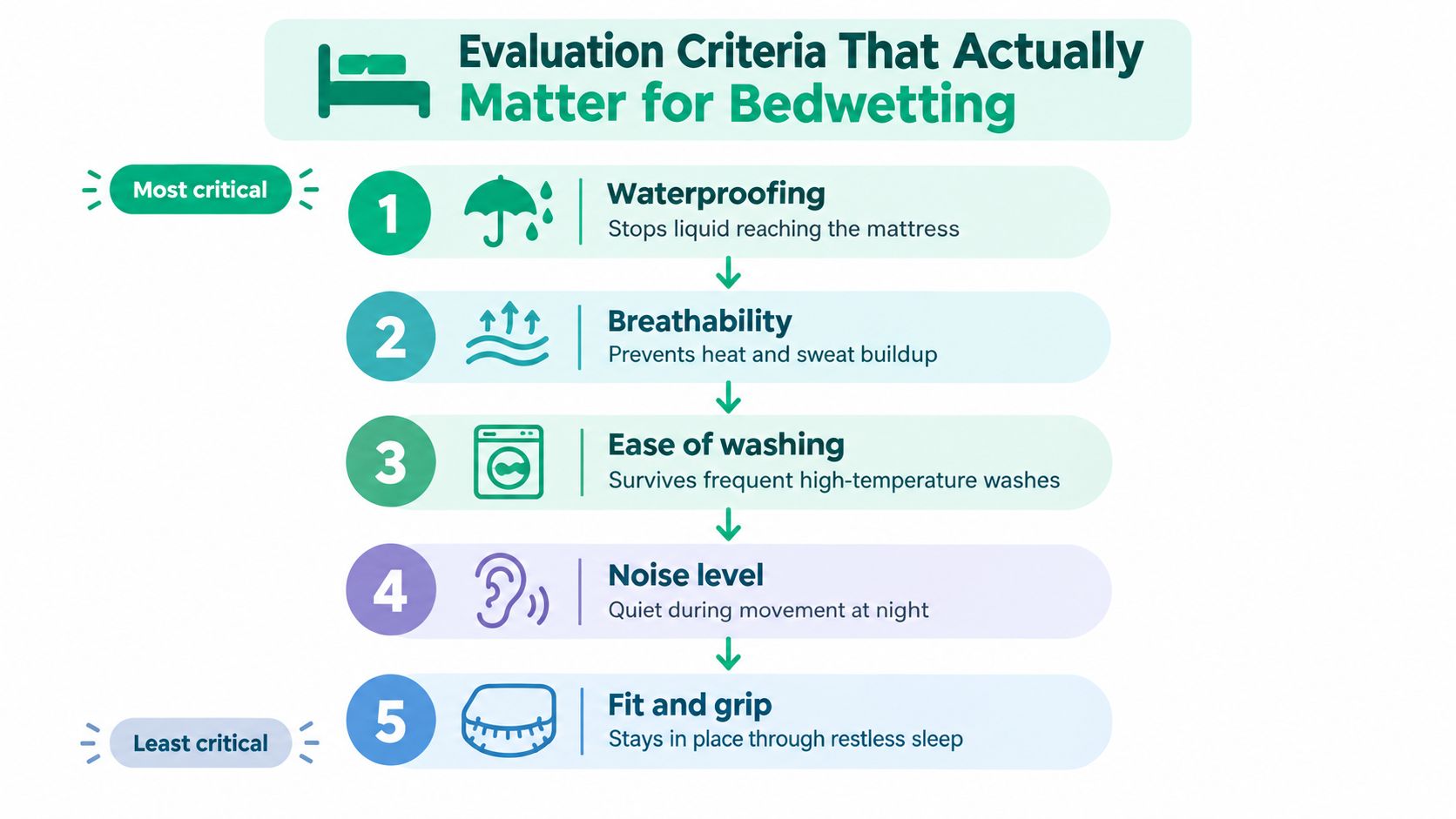
Evaluation Criteria That Actually Matter for Bedwetting
Waterproofing is the entry requirement. Fit is the condition that makes it useful. I wouldn't shortlist a protector that fails either test, however soft its surface feels.
The remaining criteria help you choose between covers that already meet those requirements. Breathability, straightforward laundering and low noise matter because someone has to sleep on this setup every night, not just during an accident.
Check the barrier before the fabric
A membrane-backed protector and a coated-fabric cover should both be judged by their stated liquid protection, not by how substantial they look. Don't assume a quilted surface is waterproof, or that an elasticated skirt has the same protection as the central panel. The difference between waterproof and water-resistant protection is a useful buying distinction when product descriptions sound similar.
Ask where the barrier extends. Pay particular attention to seams, corners and edges, because liquid can bypass a protected centre if the cover shifts or the surrounding fabric isn't protected.
NHS-linked bedwetting guidance recommends waterproof mattress covers. My buying interpretation is straightforward: prioritise full sleeping-surface coverage, a removable washable cover and a fit that stays secure, rather than fabric marketing alone.
Absorbency is a separate decision. The waterproof layer protects the mattress; an absorbent layer manages wetness above it. If your main difficulty is changing a soaked sleeping surface, adding a washable pad may be more useful than buying a thicker protector.
Judge comfort and maintenance together
Use a pass-or-fail shortlist before weighing optional features:
- Waterproof coverage. Reject vague descriptions that don't explain which areas block liquid.
- Fit and grip. Measure mattress length, width and depth, including any topper that sits beneath the protector. Check that the corners aren't stretched tight.
- Laundry compatibility. Read both washing and drying instructions before buying. A cover that doesn't suit your laundry routine is a poor match.
- Breathability and feel. Check the stated construction, then assess comfort beneath your normal sheet rather than directly against the bare protector.
- Noise. Turn over and move your legs during a dry fitting. A cover that rustles noticeably deserves scrutiny before you commit to using it nightly.
I'd give fit and laundering more weight than decorative quilting. A thin cover that stays smooth and can be cleaned correctly is a better practical choice than a plush one that bunches, pulls loose or creates a drying bottleneck.
Protector Types Side by Side and When Each One Wins
The most useful comparison isn't between fabric names. It's between a full-bed barrier, an enclosed mattress and a removable absorbent surface. Those products do different jobs, so comparing them as interchangeable alternatives leads to disappointing purchases.
Choosing Between Protector Patterns for Bedwetting
| Product pattern | Best for accident frequency | Overnight change speed | Suitability for self-changing |
|---|---|---|---|
| Fitted waterproof protector | Occasional or frequent accidents, with a spare available | Straightforward, but requires removing the sheet | Suitable if the sleeper can manage mattress corners |
| Full zip-around encasement | Ongoing protection where enclosing the mattress is useful | Less convenient if the whole cover needs removal | Better left in place beneath removable bedding |
| Quilted absorbent pad over a protector | Frequent accidents where localised changes help | Convenient if wetness stays within the pad | A practical option when the sleeper can remove and replace it |
| Disposable or reusable absorbent underlay | Occasional backup or a care-plan-led routine | Easy to exchange if accessible | Depends on placement, grip and the sleeper's mobility |
My default is the fitted protector. It gives households a straightforward removable barrier without making every wash a mattress-handling job. Frequent wetting doesn't automatically mean you need a zip-around encasement.
An encasement becomes more appealing when you want the mattress enclosed as a longer-term base layer. However, check its actual waterproof specification. A cover described as an encasement, including one designed for bed bug protection, shouldn't automatically be treated as a bedwetting barrier.
Choose absorbency for the change you want
For a child who wants to manage some of the clean-up independently, consider whether they can reach the corners of a fitted cover. Removing an accessible top pad may be easier than lifting the mattress edge and refitting the whole bed. Let them practise with clean, dry bedding before expecting them to manage it when tired.
For an adult with restricted movement, think about the carer's access. An underlay that's easy to replace on an empty bed may be awkward beneath someone who needs assistance turning. Choose the arrangement around the person, not around the fastest-looking product demonstration.
A pad can simplify a change, but it shouldn't be asked to protect areas it doesn't cover.
I wouldn't use a small absorbent pad as the only defence against recurring accidents. Pair it with a full sleeping-surface barrier, and check the surrounding bedding after wetting. If liquid regularly travels beyond the pad, change its size or placement rather than assuming more absorbency alone will solve the problem.
How Protect-A-Bed Protectors Match These Scenarios
Protect-A-Bed is one option within the fitted-protector approach, with waterproof mattress protectors offered in Premium, Cotton, Charcoal and Tencel Cool fabric variants. Its proprietary Miracle Membrane is described as a thin, flexible, silent waterproof layer that remains air permeable.
Those attributes fit the selection framework, but they don't establish a tested winner for every household. I wouldn't rank these variants by urine capacity, drying speed or suitability for clinical laundering without product-specific information.
Match the variant to the unanswered question
Use the fabric names to build a shortlist, not to skip the checks that matter.
| Option | Why I'd put it on a shortlist | What I'd verify before choosing |
|---|---|---|
| Premium | A starting point for a general-purpose bedwetting setup | Surface composition, mattress depth and care instructions |
| Cotton | An option for someone who prefers a cotton surface | The stated fabric composition and feel beneath their sheet |
| Tencel Cool | A comparison option when warmth is a particular concern | Comfort in the complete bedding setup and permitted drying method |
| Charcoal | An alternative surface option to assess alongside the others | The specific stated benefits, rather than assumptions based on its name |
For a child with substantial wetting, I'd choose the variant that meets the washing and fit requirements, then add absorbency separately if needed. There's no supplied basis for declaring one of these fabrics the “heavy-night” winner.
For a hot sleeper, Tencel Cool is a reasonable option to investigate, but don't treat a cooling-oriented name as a promise about how the entire bed will feel. Sheets, duvets and the mattress still form part of the comfort assessment.
Don't turn fabric preferences into medical claims
If someone has eczema-prone or sensitive skin, choose around their known preferences and the actual contact surface. I wouldn't describe Cotton, Charcoal or another variant as treating eczema. Keep the distinction between a comfortable bedding choice and a clinical benefit.
For a care-home bed, start with the required cleaning process instead. A pleasant surface and a breathable membrane don't establish compatibility with an institutional disinfection protocol.
Before ordering, make these checks:
- Confirm the exact size. Match the listed dimensions and depth allowance to the bed.
- Read the particular care label. Don't assume every fabric variant permits the same wash or drying conditions.
- Check support terms. Review the warranty's scope, exclusions and replacement process.
- Confirm availability. Use the current stock and delivery information, rather than relying on a general service promise.
Care, Washing, and Rotating Protectors Through Repeat Accidents
The care label belongs in the buying decision, not just beside the washing machine. If a protector can't be cleaned using the process your household or care setting needs, choose a different product.
For adult social care, UK government infection-control guidance advises washing laundry at the highest temperature permitted by the manufacturer. That instruction doesn't mean every waterproof cover can tolerate the same hot cycle.
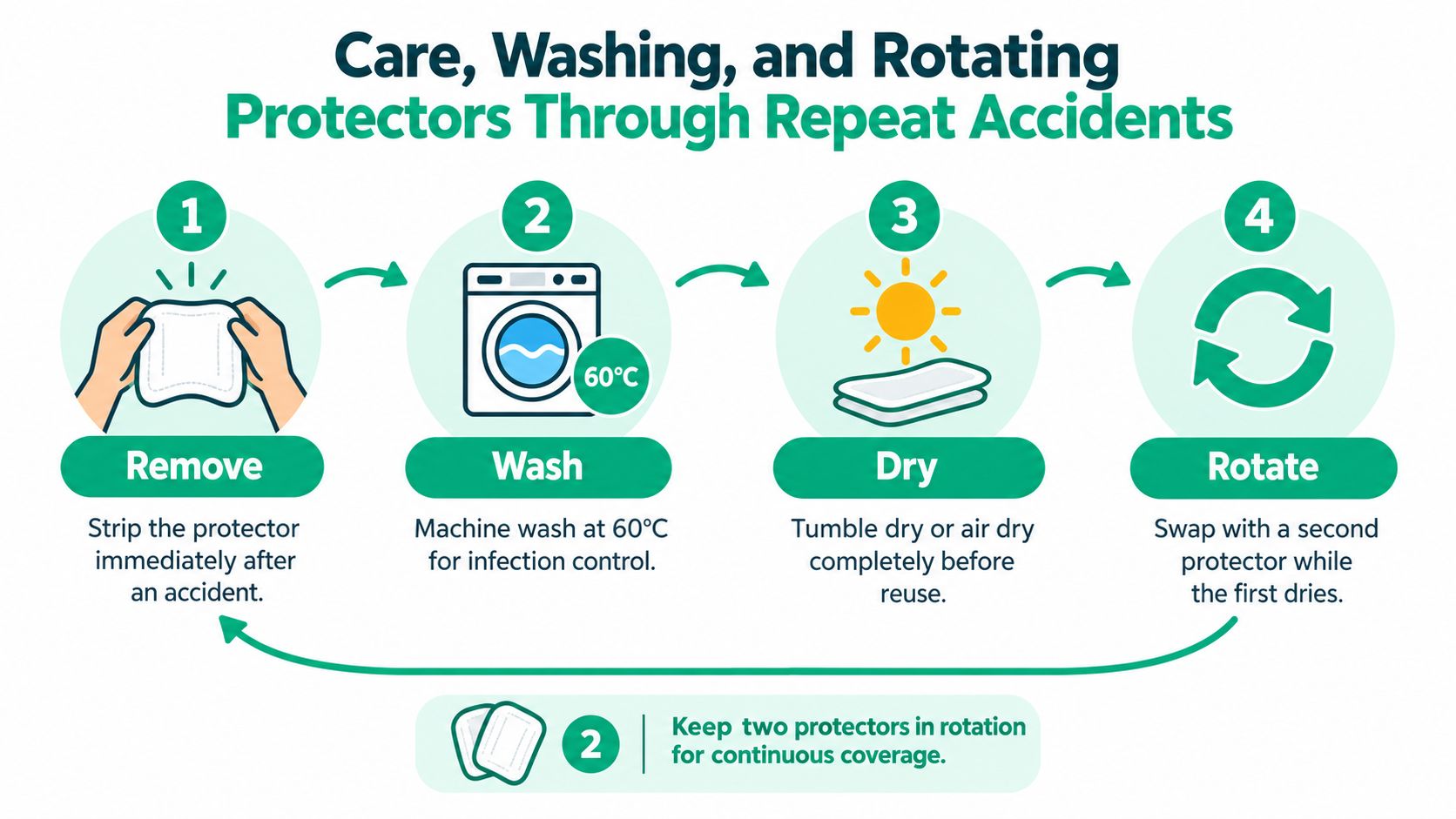
Treat the graphic as a rotation reminder, not a universal temperature prescription. Any wash temperature shown must be compatible with the product's label and, in a care setting, the applicable infection-control requirements. Likewise, tumble drying is only an option when the manufacturer permits it.
Make removal and replacement separate jobs
After an accident, I'd organise the work in this order:
- Remove carefully. Gather wet bedding inward and place it in the designated laundry container. Check whether wetness has travelled beyond the protected area.
- Remake with a dry spare. Keep the sleeper's return to bed separate from the time needed to process the laundry.
- Wash as labelled. Follow the specified programme, detergent guidance and any restrictions on stain treatments or additives.
- Dry completely. Use the permitted method, then check seams and folded areas before putting the cover away.
For product-specific preparation and care checks, use the guide to washing a mattress protector. If a stain remains, consult the care instructions rather than escalating to a stronger treatment on guesswork.
Keep the spare clean, dry and easy to reach. I'd store it neatly with the replacement sheet, so whoever responds can find a complete set without searching through unrelated bedding.
Inspect before putting it back into service
A washed protector still needs checking. Don't judge it solely by whether the surface looks clean.
Look for lifting seams, visible cracks or separation in the barrier, and elastic that no longer keeps the cover fitted. New rustling or a changed feel is a reason to inspect more closely, not proof by itself that waterproofing has failed.
Retirement test: If the barrier is visibly damaged or the cover won't stay secure, don't keep it in service simply because it still looks presentable.
In institutional use, resolve any mismatch between the required laundry process and the care label before the next use. Don't lower the required standard to accommodate the cover, and don't expose the cover to an unsuitable process hoping it will survive.
Best Picks by Setting Parents, Eldercare, and Shared Homes
The right setup depends on who changes the bed, how easily they can do it, and which cleaning process they must follow. I wouldn't prescribe an identical arrangement for a child's bedroom, an older relative's bed and a rental property.
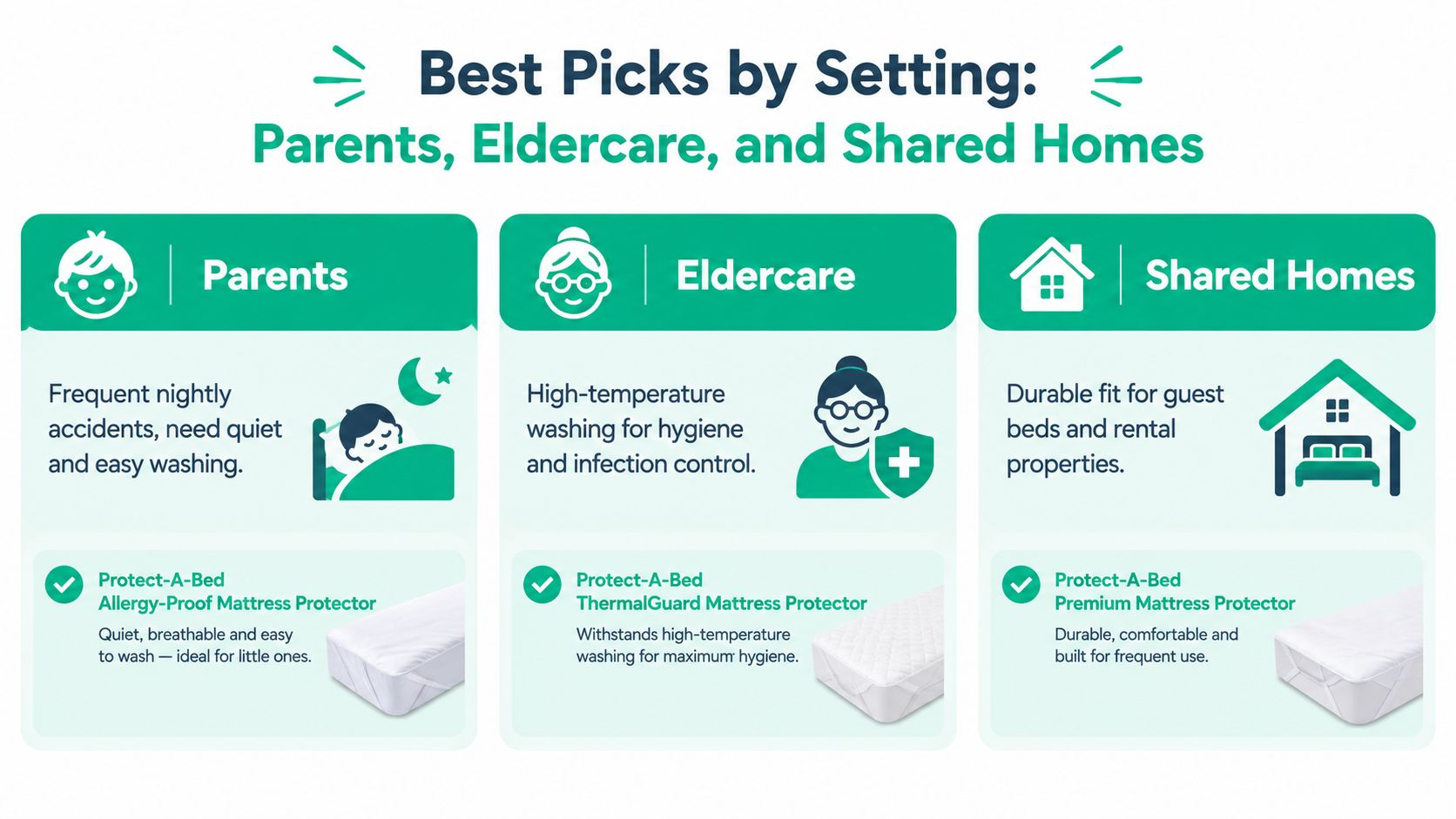
Use the setting-based recommendations as starting points. Fabric names and brand associations don't establish suitability for high-temperature washing or a particular care protocol; the individual product instructions must support the intended use.
Parents managing frequent accidents
Choose a fitted waterproof protector with an accessible absorbent pad, if localised changes would help. Keep a replacement protector and the necessary dry bedding together. From the fabric options discussed, I'd assess Cotton or Premium first for a straightforward family setup, subject to the same fit and laundry checks.
Give the child a role they can comfortably manage, such as fetching clean clothing or placing a dry pad. Don't make independence a test they can fail. The children's waterproof mattress protector guide can support the bedding-selection side of that decision.
For households also caring for a baby, a coordinate diaper changes app may be a separate resource to consider when organising caregiver handovers. Keep infant nappy tracking distinct from the approach to an older child's bedwetting.
Eldercare and adult incontinence
Start with the care plan, the person's mobility and the required laundering process. Choose a removable waterproof barrier, adding an underlay where the assessed routine calls for one. Consider a verified waterproof encasement beneath removable layers if enclosing the mattress serves an identified need.
Premium or Cotton can go on the comparison shortlist, but neither name establishes infection-control suitability. Where warmth is the main comfort concern, investigate Tencel Cool after confirming operational compatibility. If the label doesn't meet the setting's requirements, remove that option from consideration.
Shared homes and rental properties
Choose a setup that another person can inspect and remake correctly. A fitted waterproof protector is a practical default; add a suitable encasement only when the property has a separate reason to enclose the mattress. Keep replacement stock clearly matched to each bed.
I'd favour clear labelling and repeatable laundry instructions over a mixture of loosely documented covers. Premium or Cotton are options to assess, not automatic commercial-use recommendations.
- Parents. Prioritise an easy change and a child-appropriate response.
- Eldercare. Prioritise the care plan and verified cleaning compatibility.
- Shared homes. Prioritise consistent fitting, inspection and replacement stock.
Red Flags NHS Guidance and Building a Bedwetting Routine That Works
A better protector is the wrong response when symptoms need assessment. Painful urination, fever, increased daytime frequency, excessive thirst or constipation deserve medical attention rather than a bedding upgrade. Renewed wetting after six dry months is also a reason to seek GP advice, as set out in NHS hospital guidance on nocturnal enuresis.
Bring useful observations to that conversation: when the wetting began, whether it has changed, and whether daytime symptoms are present. Don't wait until you've tried a succession of covers before asking for help.
Keep the bedtime response consistent
The same NHS guidance supports keeping clean bedding and clothes nearby, avoiding routine night-time lifting, and generally avoiding a return to nappies or pull-ups once a child has stopped using them. Those are parts of a wider bedwetting approach, not extra product features.
Build the bedside routine around those principles:
- Agree on help. Tell the child how to get assistance without making an accident feel like an offence.
- Keep essentials accessible. Put clean clothes and replacement bedding where the person responding can find them.
- Avoid automatic lifting. Don't make routinely carrying a sleeping child to the toilet your default response.
- Follow the clinical plan. Use any recommended alarm or other treatment according to its instructions, rather than redesigning it around convenient bedding.
If an alarm is part of the plan, check its sensor-placement instructions before adding pads or changing the bedding arrangement. Don't assume every layer combination is compatible. The cover should support the treatment routine, not obscure the signal the equipment needs.
Judge success by the right outcome
For the protector, success means the mattress is protected and the cover remains usable after correct care. For the sleeper, progress is a separate question that belongs within the bedwetting or continence plan. Keeping those measures separate prevents a dry mattress from being mistaken for a resolved health issue.
My final recommendation is to choose the simplest setup that meets your actual needs, then rehearse the change while everyone is awake. Check the fit, place the spare where it belongs, and agree on a calm response. That preparation is more useful than buying increasingly elaborate bedding without fixing the routine around it.
Protect-A-Bed offers waterproof mattress protectors in different fabric options, alongside pillow protection and mattress encasements. Visit Protect-A-Bed to compare the current range, check the exact fit and care instructions, and choose a protector that works with your bedwetting routine.