

Waterproof Mattress Protector for Children: UK Guide

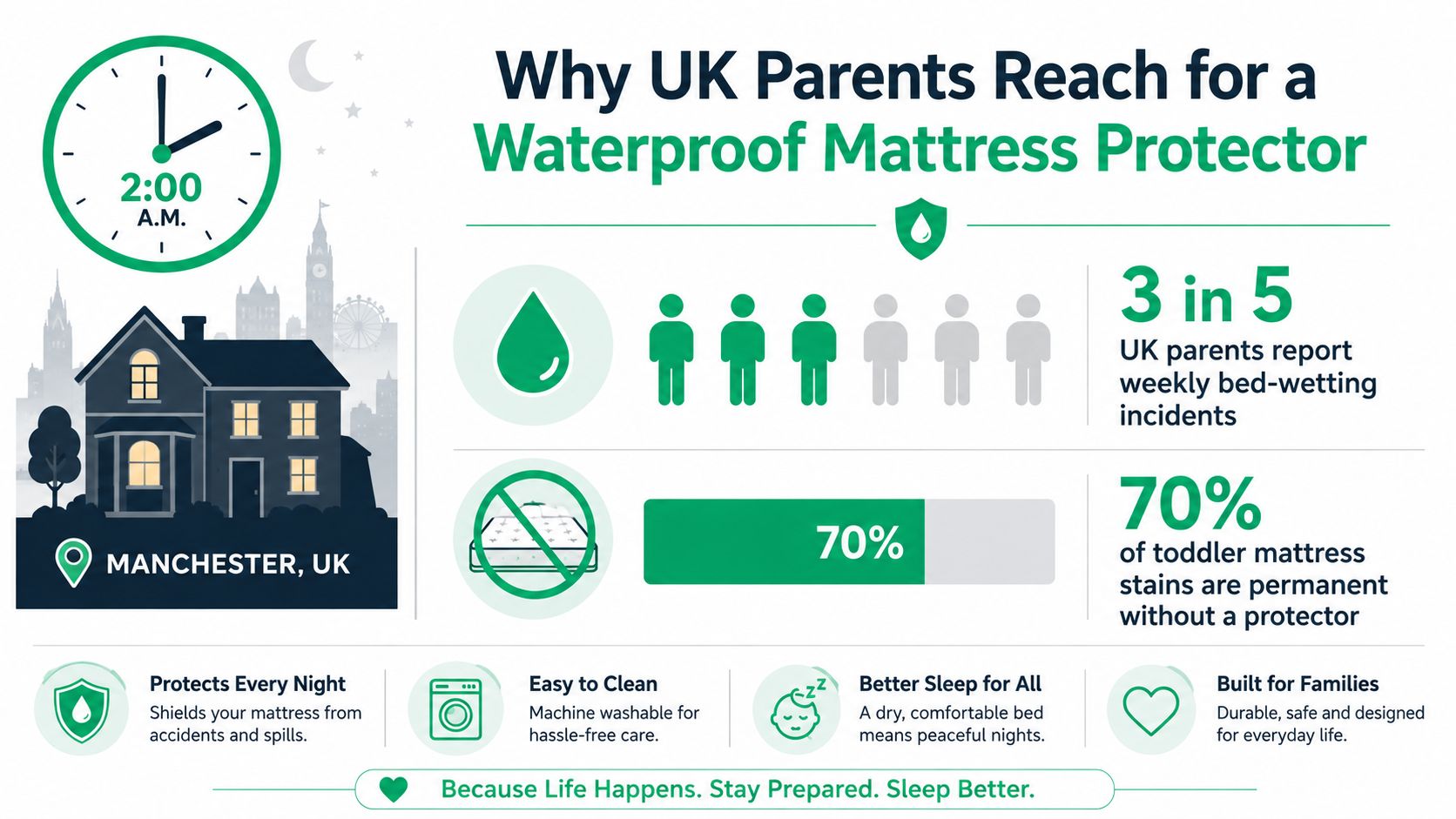
At 2 a.m. in a Manchester terraced house, the duvet is on the floor, the sheet is soaked and you're changing a toddler's bed without fully waking them. It's the third accident that week, and the mattress already smells faintly damp. A waterproof protector cannot prevent bedwetting, but it can stop repeated accidents turning into a damaged mattress and another expensive replacement.
Bedwetting is common in the early school years. UK clinical guidance reports around one in five 5-year-olds and one in ten 7-year-olds wet the bed. NICE-linked prevalence data records about 21% around age 4.5, falling to 8% around age 9.5 and roughly 2% to 3% between ages 12 and 14. UK prevalence guidance supports a practical decision: keep protection in place while accidents continue, rather than treating it as a short toddler-stage purchase.
Fit the protector directly over the mattress, beneath the fitted sheet. Choose a waterproof layer that covers the sleeping surface fully, stays flat and does not rustle loudly. Check the label before buying, because a protector that cannot withstand frequent washing will quickly become a nuisance.
There is a second benefit. NHS guidance identifies house dust mite as a common cause of indoor allergy, with mites living in mattresses, beds, pillows, carpets and other soft furnishings. UK allergy guidance recommends allergen-proof barrier covers. The right protector therefore supports both accident control and allergen management.
Table of Contents
- Why UK Parents Reach for a Waterproof Mattress Protector
- Understanding What Your Child Actually Needs
- Fabric, Membrane and Breathability Compared
- Getting the Fit Right on Cot, Toddler and Junior Beds
- Washing, Drying and Long-Term Care
- Common Myths About Kids Waterproof Protectors
- Your Quick-Reference Checklist Before You Buy
Why UK Parents Reach for a Waterproof Mattress Protector
A child's mattress has to cope with far more than ordinary sleeping. Milk, water, muddy clothes, sickness, sweat and night-time accidents can all reach the cover. Once liquid passes through the sheet, it can settle deep inside the mattress, where drying becomes difficult and odours linger.
That's why a protector should sit directly over the mattress, beneath the fitted sheet. It creates a removable barrier that you can wash, inspect and replace without disturbing the mattress itself.
Bedwetting needs practical protection
The useful question isn't whether your child is “too old” for a protector. It's how often the bed gets wet and how much disruption each incident causes. Bedwetting falls with age, but it remains relevant beyond the toddler stage. NICE-linked data records roughly 1% to 2% from age 15 onward, and a smaller group continues to wet more frequently at older ages. The clinical prevalence figures support keeping protection in place for as long as accidents remain part of family life.
The NHS explicitly recommends waterproof covers for the mattress and duvet as a practical measure for children who wet the bed. NHS bedwetting guidance places this alongside easier toilet access and a night light. That makes a protector standard bedding equipment, not a sign that anything is wrong with your child.
The allergy benefit is easy to miss
A waterproof layer isn't automatically an allergy barrier. For children with asthma, allergic rhinitis or eczema, look for a product that states it forms a dust-mite and allergen barrier, rather than relying on the word “waterproof” alone.
The best choice balances a sealed barrier with a breathable surface. It should also be washable in line with the care instructions, because an allergen-control routine depends on regular cleaning rather than a cover left untouched for months.
Practical rule: Buy for the problem you're managing most often. Occasional spills need simple liquid protection. Repeated wetting or dust-mite concerns justify broader coverage and a more durable construction.
Understanding What Your Child Actually Needs
Start by identifying the job. Parents often buy a protector based on mattress size alone, then discover that the fabric is noisy, the skirt rides up or the barrier doesn't cover the part of the bed that gets wet.
Four situations usually drive the purchase.
Age and mattress stage
A cot or toddler mattress needs a thin, close-fitting protector. Avoid anything that creates a loose fold or noticeably raises the sleep surface. Junior and single mattresses generally offer more room for a deeper fitted design, particularly if there's a topper beneath the sheet.
Frequency of accidents
For an occasional accident, a fitted-sheet-style protector is usually the sensible starting point. It comes off quickly and keeps routine washing manageable. If wetting is frequent, or liquid reaches the mattress edges, choose a construction with more complete coverage. A full encasement, including a protected zip, reduces exposed areas that a fitted layer leaves open.
Allergies and sensitive skin
Children with asthma or rhinitis need more than a spill shield. UK allergy guidance advises allergen-proof covers on mattresses, duvets and pillows, so check whether the product's barrier is documented for mite control and whether its care instructions support effective laundering. For eczema, prioritise a smooth, comfortable face fabric and avoid anything that traps heat or rubs against sensitive skin.
Sensory comfort
A child who notices every rustle won't sleep well on a crinkly protector, however strong its waterproofing. Children with autism or ADHD may also reject heat, stiffness or unfamiliar textures. Read more about creating a calming sleep space if your child's sleep environment needs broader sensory adjustments.
Write down which need is strongest: age and fit, accident frequency, allergy control or sensory comfort. Then compare materials against that priority instead of choosing by price or appearance alone.
Fabric, Membrane and Breathability Compared
The membrane does the waterproofing. The fabric bonded above it controls much of what your child feels, including softness, noise and heat. Product descriptions often blur these two parts together, so separate them when you're judging a protector.
Polyurethane, or PU, membranes are usually the strongest all-round option for children. They can block liquid while allowing water vapour to pass through, and they're generally quieter than plastic sheeting. Thermoplastic polyurethane, or TPU, blends can feel soft and flexible, although some constructions retain more heat. Traditional PVC or vinyl is fully waterproof but tends to feel noisier and less comfortable, so it's rarely my first recommendation for a child's main bed.
On the face fabric, brushed polyester offers softness and durability. Cotton or bamboo-jersey blends can feel cooler and absorb light perspiration, but they may take longer to dry. If you're comparing membrane performance in more detail, this explanation of the breathable waterproof membrane is a useful reference.
| Construction | Noise level | Breathability | Allergen barrier | Best for |
|---|---|---|---|---|
| Thin PU with brushed polyester | Low | Good | Can be strong, check product specification | Everyday children's beds |
| PU with cotton or jersey face | Low | Good | Depends on the barrier design | Children who run warm |
| TPU blend with soft face fabric | Low to moderate | Variable | Depends on the product | Softness and flexibility |
| PVC or vinyl sheet | Moderate to high | Low | Not automatically an allergen barrier | Basic short-term liquid control |
Match the surface to the child
If your child runs hot, prioritise a thin PU membrane with a cotton or Tencel-style face. If dust mites are the main concern, choose a tightly woven face with a clearly stated mite barrier and suitable washing instructions.
For cot purchases, material is only one part of safe sleep. Guidance on what to look for in a crib can help you assess the mattress and surrounding sleep surface together.
Perform the noise test before keeping the protector. Scrunch it in both hands and lie on it for a few minutes. If it crackles loudly in an empty room, it'll probably end up folded in a drawer after the first restless night.
Getting the Fit Right on Cot, Toddler and Junior Beds
A protector that doesn't fit is a failed protector. Liquid can escape at an exposed edge, elastic can pull the cover out of position and loose fabric can create uncomfortable ridges beneath the sheet.
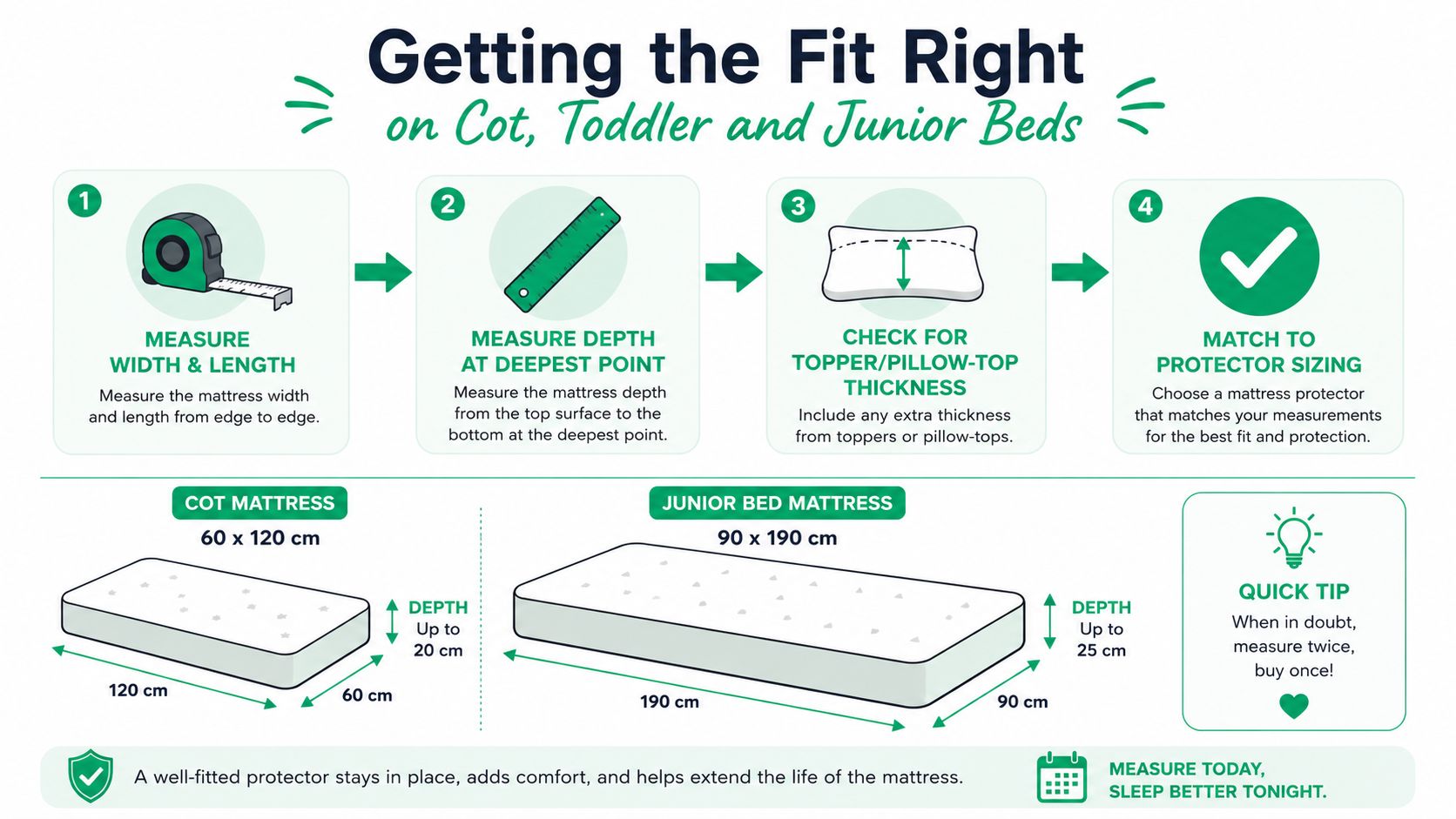
Measure the mattress itself, not the bed frame. Record the length, width and depth at the deepest point, then include any topper or pillow-top that will sit beneath the protector. A label such as “cot” or “single” isn't enough because mattresses with the same nominal size can have different depths.
Choose coverage, not just convenience
A fitted-sheet-style protector works well for ordinary spills and standard-depth mattresses. It's quick to remove, easy to wash and less frustrating during a middle-of-the-night change.
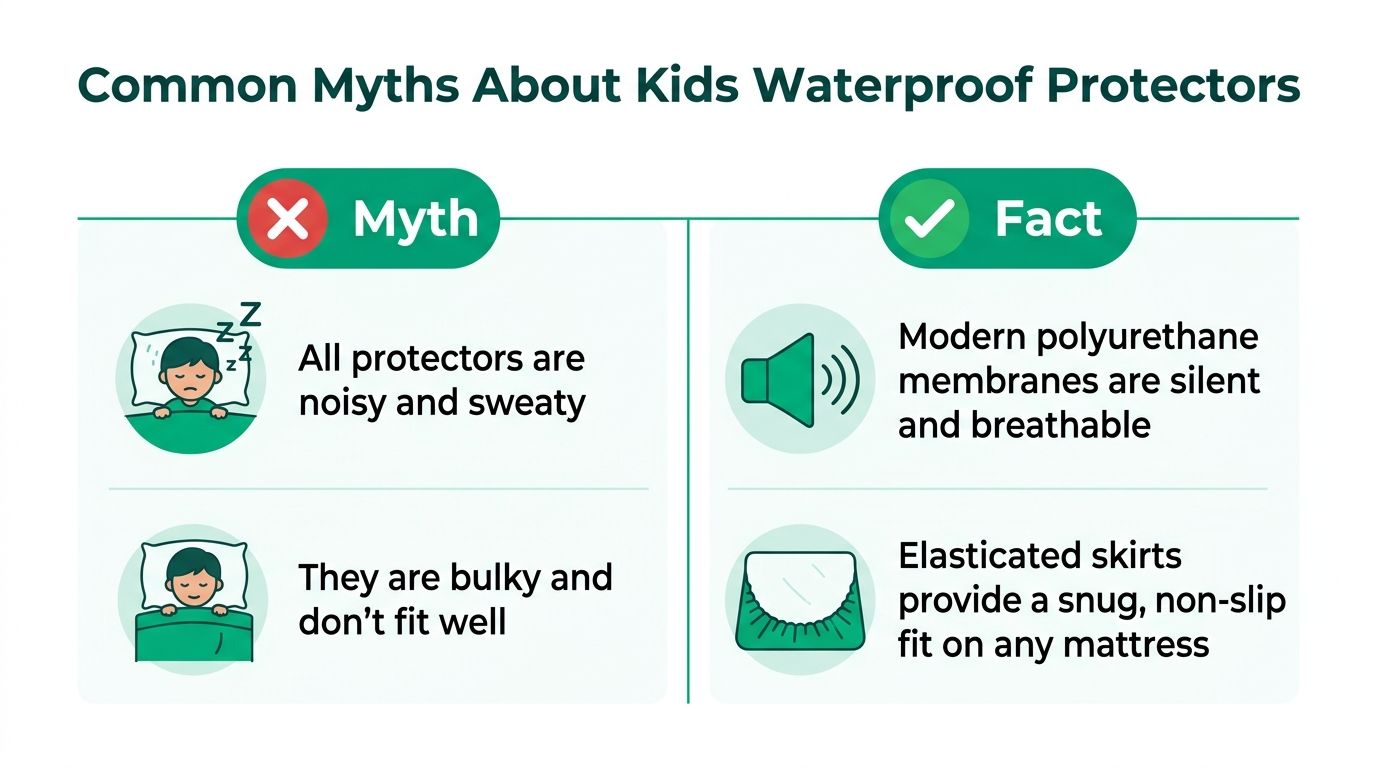
A full encasement takes longer to fit, but it protects the upper, lower and side surfaces more thoroughly. I'd choose it where a child regularly wets heavily or where dust-mite control matters. Check the skirt or pocket depth carefully. A protector with a 15 cm skirt won't reliably grip a much deeper mattress, while options reaching 30 cm can be unnecessary and loose on a shallow cot mattress.
Install it without stretching the seams
- Cot: Lift the mattress rather than dragging it across the protector. Pull each corner into place, then check that no fabric has folded beneath the sleep surface.
- Toddler bed: Secure the elastic beneath every corner and smooth out air pockets before replacing the fitted sheet.
- Junior single: Run your hand around the perimeter after fitting. Make sure the protector doesn't ride up beneath the duvet when your child moves.
For more detail on choosing a suitable waterproof mattress cover for a crib, pay particular attention to close fit and the relationship between protector thickness and the mattress.
Keep a spare protector with the spare fitted sheets. For travel, pack a lightweight folded protector in a separate washable bag. A dry swap saves far more sleep than trying to clean and dry one layer at an inconvenient hour.
Washing, Drying and Long-Term Care
Care instructions decide whether a protector remains useful or slowly loses its barrier. Start by checking the product label, because membranes differ and a high-temperature cycle that suits one product may damage another.
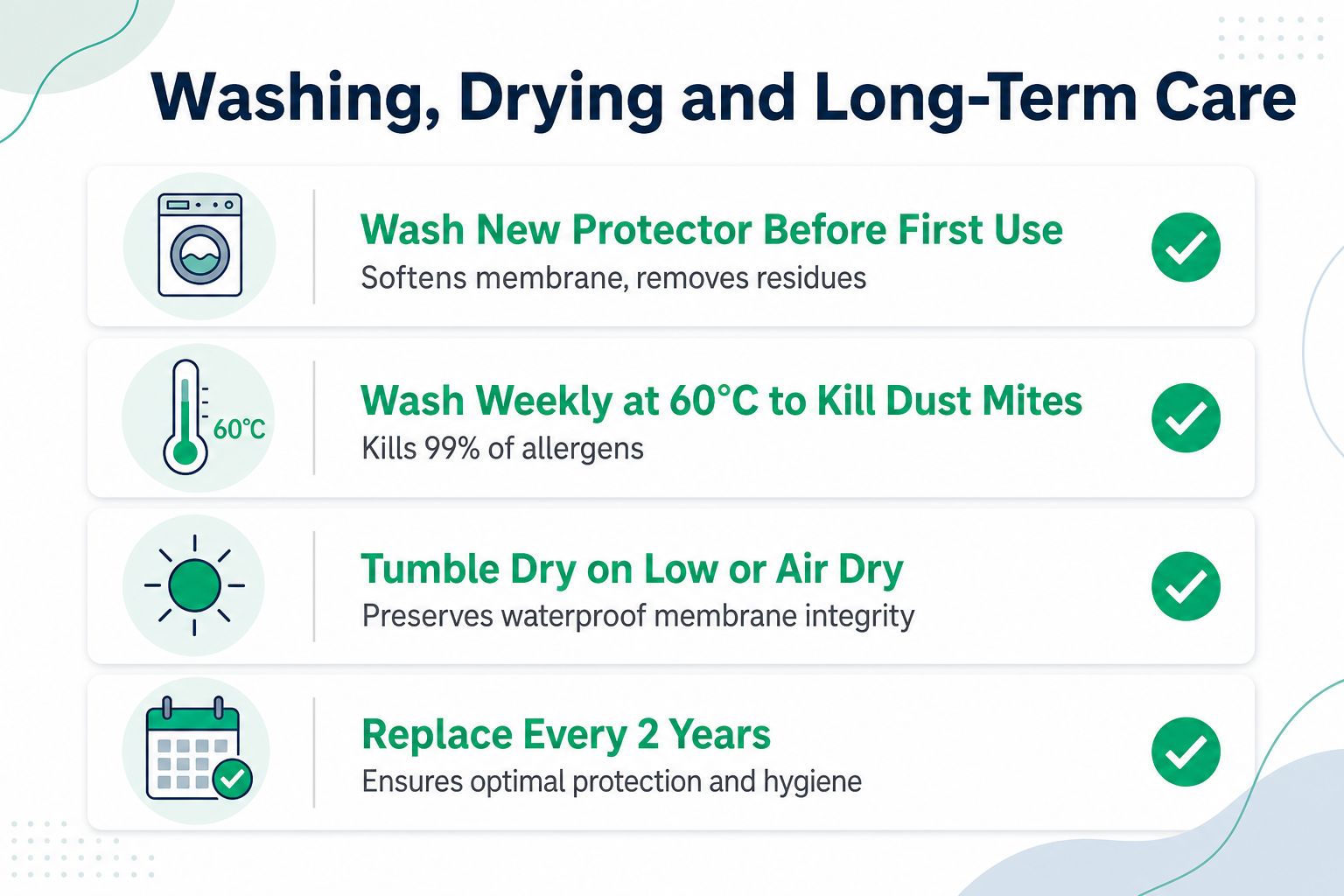
Wash a new protector before first use. This removes manufacturing residues and settles the face fabric. For allergy management, UK guidance supports regular washing, and one UK source recommends washing protectors monthly while advising 60°C washing for encasements. The detailed dust-mite guidance also stresses that washable bedding matters as much as an anti-allergy label.
A sensible home routine
Use this as a working routine, then follow the specific care label:
- Wash after an accident: Remove the protector promptly and rinse or wash according to its instructions.
- Wash regularly: Use a 60°C cycle where the product permits it, especially when allergen control is part of the reason for buying it.
- Avoid damaging additives: Skip bleach, fabric softener and harsh chemicals. They can weaken or coat the waterproof layer.
- Use low heat: Tumble dry on low or line-dry away from intense direct sunlight. Don't iron or dry-clean the protector.
- Keep two in rotation: One can cover the bed while the other is being washed and dried.
Don't treat the membrane like ordinary cotton. High heat, aggressive chemicals and repeated rough handling can cause cracking, thinning or seam failure. If you need a practical laundering walkthrough, use this guide to wash a mattress protector, then check your own care label before starting the machine.
Replace the protector when the surface has visibly thinned, odour remains after washing, elastic no longer grips or liquid reaches the mattress. For a child still having accidents, replacing it every two to three years at most is a sensible upper limit, sooner if performance declines.
Common Myths About Kids Waterproof Protectors
The old image of waterproof bedding is a sheet of noisy plastic that makes a child sweat. That description still fits some low-cost designs, but it doesn't describe every modern construction.
Myth one, all waterproof protectors are noisy
A thin PU membrane can be quiet and vapour-permeable, particularly when it's bonded to a soft brushed or jersey face. PVC and vinyl are more likely to produce the familiar rustle. If your child is a light sleeper, choose the membrane and surface together, then test the sound before washing and fitting it.
Myth two, waterproof means hot
Waterproofing and warmth aren't the same thing. A protector blocks liquid; breathability, fabric weight, bedding layers and room conditions influence how hot the bed feels. Cotton or Tencel-style faces can feel cooler than dense synthetic surfaces, but no material label replaces observing your child for sweating or discomfort.
Myth three, a protector can't help with allergies
A basic liquid barrier isn't necessarily an allergen barrier. However, UK allergy guidance recommends barrier covers for mattresses, duvets and pillows, and NHS guidance identifies mattresses as a common place for house dust mites. Choose a protector that explicitly addresses mite exposure, then maintain it properly.
Myth four, protection fixes bedwetting
It doesn't. A protector limits damage and makes changing the bed less distressing, but it won't change bladder development or remove an underlying medical issue. Keep bedtime routines calm, make the toilet easy to reach and speak to a GP if wetting is persistent, distressing or changes suddenly.
Treat the protector as ordinary bedding, not an embarrassing announcement about bedwetting. That attitude matters. Your child needs a clean, comfortable bed and a calm response, not shame attached to a washable layer.
Your Quick-Reference Checklist Before You Buy
Use this list before ordering:
- Name the main job: Decide whether you're containing occasional leaks, managing regular wetting or reducing dust-mite exposure.
- Measure properly: Record mattress length, width and depth, including any topper beneath the protector.
- Choose the coverage: Pick a fitted style for quick changes, or a full encasement for broader side and zip protection.
- Prioritise comfort: Look for a soft, breathable face and a quiet membrane, especially for sensory-sensitive sleepers.
- Check the barrier claim: Waterproofing alone doesn't prove allergen control. Look for clear information about mite protection.
- Read the care label: Confirm whether regular washing and a 60°C cycle are permitted for the construction you're buying.
- Inspect UK suitability: Check the manufacturer's safety information and material disclosures where available.
- Plan a rotation: Keep a spare protector and fitted sheet ready for wet nights.
- Test the fit: Smooth every corner, secure the elastic and check that the protector doesn't ride up.
- Replace when needed: Don't keep using a layer with leaking seams, weakened elastic, persistent odour or a failing membrane.
Protect-A-Bed offers UK waterproof protectors in several fabric options, including cotton and cooling-focused materials, using a breathable waterproof membrane designed to block liquids while allowing air movement. Visit Protect-A-Bed to compare the available children's bedding protection options, then choose the construction and fit that match your child's accidents, allergies and comfort needs.