

Best Waterproof Mattress Protector Buying Guide

A waterproof mattress protector often gets bought after a single unpleasant night. A child wets the bed, a guest spills a drink, or you wake with a damp patch from perspiration and start wondering whether the mattress underneath has been permanently marked. The sheet goes into the wash, but the mattress is much harder to clean properly.
The best waterproof mattress protector isn't merely the one with the thickest backing or the most reassuring product description. It needs to block liquid, manage vapour, stay quiet under the sheet, fit securely, and survive the washing routine your household will actually use. The right choice depends on the sleeper, the mattress, and the type of moisture you're managing.
| Household priority | Specification to prioritise | Trade-off to consider |
|---|---|---|
| Bedwetting or repeated accidents | Continuous waterproof barrier, secure fitted skirt, washable construction | Maximum liquid protection can feel warmer if vapour transfer is poor |
| Night sweats or heat sensitivity | Air-permeable membrane, moisture-managing surface, breathable textile | A cooler fabric can't compensate for a hot room or heavy duvet |
| Dust-mite allergy concerns | Close fit, sealed seams, washable surface, tested allergen impermeability | A protector isn't a standalone asthma treatment |
| Guest rooms and accommodation | Durable fit, straightforward care instructions, reliable liquid barrier | Frequent washing can accelerate wear if care guidance is ignored |
| Deep or pillow-top mattresses | Measured mattress depth and elastic with enough purchase | An oversized skirt can shift and leave exposed areas |
Table of Contents
- Why Most Waterproof Protectors Fail the Comfort Test
- The Science of Breathable Liquid Barriers
- Comparing Surface Fabrics for Thermal Regulation
- Matching Protector Specifications to Household Needs
- Washing Protocols and Membrane Longevity
- Why Miracle Membrane Leads the UK Market
- Answers to Common Mattress Protector Questions
Why Most Waterproof Protectors Fail the Comfort Test
You can spend generously on a mattress and breathable bed linen, then undermine both with a cheap protector. The first night often reveals the problem. The backing rustles when you turn, the surface feels slightly plasticky, and the bed becomes noticeably warmer by morning. Instead of feeling like a protective layer, it feels like you're sleeping on a sheet of packaging.
That experience has made many shoppers suspicious of waterproof bedding. The concern is reasonable, because a basic coated fabric can restrict the movement of heat and water vapour. It may stop a spill, but if it also holds perspiration close to the body, the sleeper notices the barrier long before they appreciate the protection.
Practical rule: Liquid resistance is only half the specification. Ask what happens to heat and perspiration after the barrier has done its job.
Modern waterproof construction doesn't have to create that plastic-sheet sensation. A flexible, air-permeable membrane can block liquid while allowing some air and vapour movement through the structure. The surface fabric then determines much of the tactile experience, from the crisp feel of cotton to the smoother hand of a temperature-managing textile.
This matters in ordinary UK bedrooms, where ventilation, room temperature, duvet weight and sleepwear all affect comfort. A protector can't cool an overheated room, but a poorly designed protector can make the microclimate worse. A 2025 UK sleep survey reported that 32% of respondents had lowered their bedroom temperature for comfort, so thermal comfort deserves more attention than a generic “breathable” label suggests. That figure is reported in UK guidance on hot sleepers and bedroom comfort.
If you're concerned that waterproofing automatically means sweating, the practical distinction is explained in this guide to whether waterproof mattress protectors make you sweat. Look beyond the word waterproof and examine the membrane, surface textile, seam construction and care instructions. Those details decide whether protection stays unobtrusive or becomes the most noticeable part of the bed.
The Science of Breathable Liquid Barriers
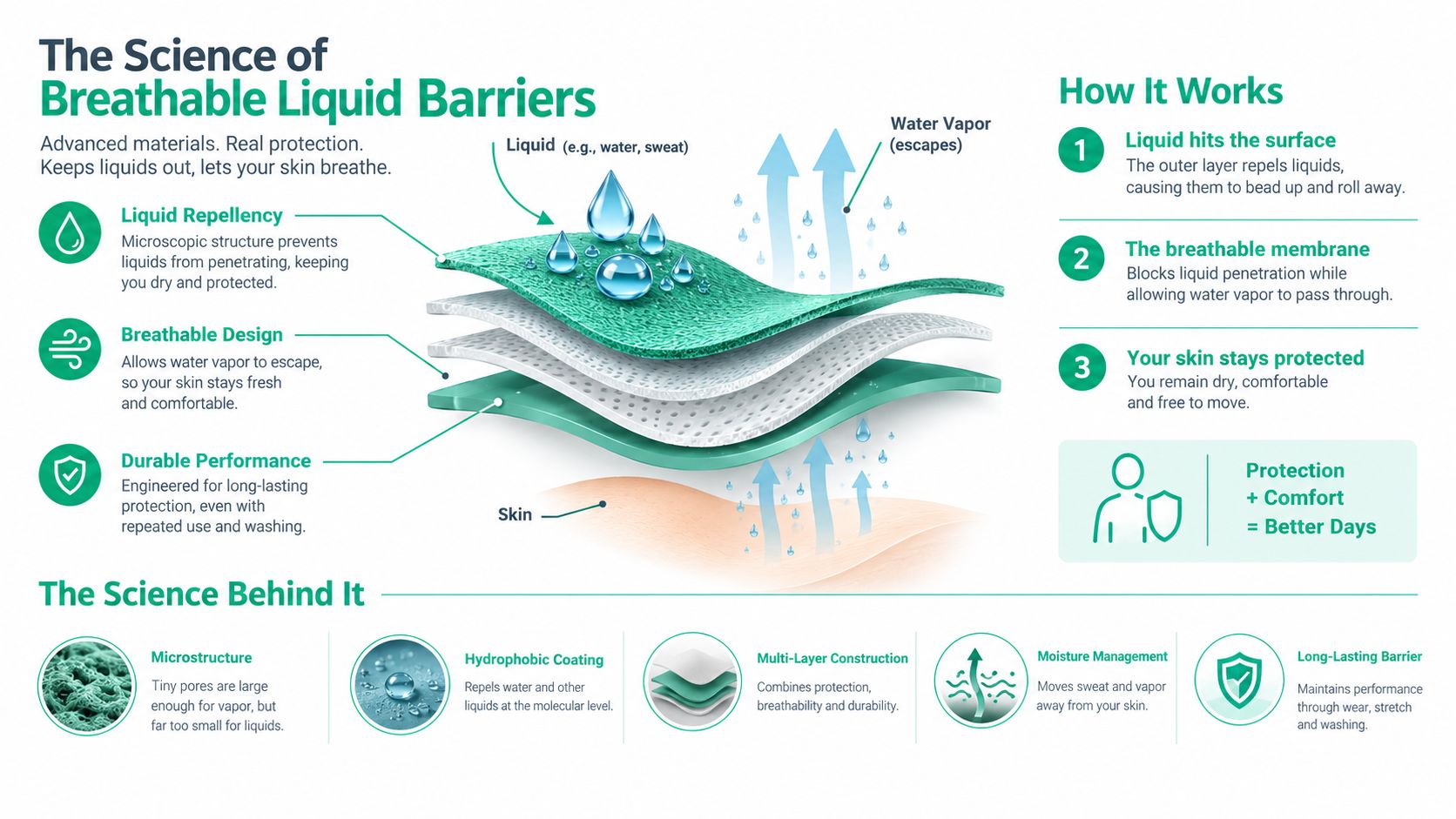
“Waterproof” describes the result, not the engineering. Two protectors may both resist liquid while feeling completely different because one uses a dense coating and the other uses a more flexible membrane designed to manage vapour transfer.
A basic barrier relies on a relatively impermeable layer. That construction can be effective against spills, but it may also limit air movement and create more noise when the sleeper changes position. A breathable membrane takes a different approach. Its structure is designed to prevent liquid penetration while permitting some movement of air or water vapour, helping reduce the clammy sensation associated with sealed plastic films.
The product sheet should tell you more than a broad comfort claim. Look for:
- Liquid-pressure performance, such as a hydrostatic-head or equivalent test result.
- Water-vapour transmission, which indicates how readily vapour can move through the construction.
- Air permeability, where the manufacturer provides a relevant test.
- Seam integrity, because a strong membrane is of limited value if liquid can pass through stitching or an unprotected edge.
- Wash-cycle durability, especially if the protector will be used nightly or in a high-turnover setting.
Why UK households need more than spill protection
Recurring moisture is a practical reason to take the barrier seriously. NHS-linked guidance estimates that approximately 500,000 children aged 5–16 in the UK wet the bed, with prevalence declining substantially as children get older. The same guidance reports that around 1 in 10 seven-year-olds wet the bed at least twice a week, while other NHS guidance cited there reports that up to 1 in 5 five-year-olds, about 1 in 20 ten-year-olds, and approximately 1 in 50 teenagers may wet the bed. These figures are detailed in NHS-linked guidance on bedwetting.
That isn't an occasional-spill problem for every family. Repeated exposure can lead to staining, odour and cleaning difficulties because a mattress isn't designed to be laundered like a removable cover. A suitable protector therefore needs a continuous barrier, dependable edge coverage and a surface that remains comfortable when used night after night.
Allergens add another reason to assess the construction. Separate allergy network data reports that around 1 in 5 adults and 1 in 20 young children test positive for house-dust-mite allergy, although a positive test doesn't always mean symptoms occur. The same NHS-linked material identifies house dust mites as a common perennial trigger and associates mite allergy with symptoms including sneezing, coughing, itchy eyes, asthma attacks and eczema. A physical barrier can limit exposure around the sleeping surface, but it shouldn't be presented as medical treatment.
For a clearer explanation of how membrane construction differs from a simple coated fabric, see this overview of breathable waterproof membrane technology. The useful question isn't whether a protector sounds advanced. It's whether the construction provides measurable liquid resistance, acceptable vapour movement and seams that remain secure after laundering.
Comparing Surface Fabrics for Thermal Regulation
The membrane does the blocking, but the surface is what your body touches. It affects noise, softness, moisture handling and the initial temperature of the bed, so choosing a fabric by name alone is too simplistic.
Cotton remains familiar because it has a natural, breathable hand and feels comfortable across a wide range of bedding systems. It can absorb moisture at the surface, but absorption isn't the same as rapid drying. If the membrane beneath restricts vapour movement, cotton may still feel damp or warm after a sweaty night.
Tencel Cool generally offers a smoother, cooler-feeling surface with useful moisture-management characteristics. It suits sleepers who dislike a dry, crisp cotton feel or who want the top layer to move perspiration away from the immediate contact zone. It still needs a membrane that can transport vapour. No surface fabric can overcome an impermeable backing.
Charcoal and other treated or blended surfaces are often selected for odour-management positioning and a particular tactile finish. They may appeal in guest rooms, family bedrooms or situations where freshness matters, but ask what has been tested. “Odour neutralising” is not a substitute for washing, ventilation or a liquid barrier.
Premium blends usually aim for balance. They can combine softness, durability and easy care, making them sensible where the protector will be washed regularly. Their performance depends on the exact fibre mix and membrane pairing, so a generic premium label tells you less than a construction specification.
| Fabric Type | Thermal Profile | Moisture Management | Best Suited For |
|---|---|---|---|
| Cotton | Familiar, breathable hand, temperature depends heavily on the backing | Absorbs surface moisture but may not dry quickly | General household use and sleepers who prefer natural-feeling bedding |
| Tencel Cool | Smooth and cool-feeling against the skin | Helps manage moisture at the surface when paired with a vapour-permeable membrane | Hot sleepers, night sweats and warmer bedrooms |
| Charcoal | Usually chosen for a soft or specialised surface feel | May support freshness claims, but washing remains necessary | Sleepers prioritising odour management and a distinctive finish |
| Premium blend | Balanced feel with construction-dependent warmth | Often designed for practical durability and regular laundering | Family, guest and rental use where comfort and upkeep both matter |
How to choose without being misled by “cooling”
A cooling label can describe touch sensation rather than a tested reduction in temperature or humidity. Check whether the manufacturer provides meaningful information about vapour transmission, air permeability or surface-temperature testing. If it doesn't, treat cooling as a comfort impression, not a measured performance guarantee.
Room conditions matter just as much. A heavy duvet, closed windows, warm sleepwear or a memory-foam mattress can create heat independently of the protector. Choose the lightest bedding system that suits the sleeper, then select a surface and membrane that won't add unnecessary restriction.
For shoppers considering a smoother plant-based surface, this guide to Tencel mattress protectors provides useful context. The sensible decision is not “natural versus synthetic”. It's whether the complete layered construction manages liquid, vapour, movement and washing in the environment where it will be used.
Matching Protector Specifications to Household Needs
Start with the problem, not the product name. A protector for a child who wets the bed has a different priority from one used in a guesthouse, even if both buyers want waterproofing.
Children and recurring bedwetting
Choose a barrier that covers the whole sleeping surface and stays anchored around the mattress. A fitted skirt with durable elastic is generally more dependable than a loose pad because it reduces movement and limits exposed edges. Check the mattress depth before ordering, especially if the bed has a pillow-top or topper.
The surface should be quiet and comfortable enough for nightly use. Washability matters just as much as the initial liquid rating because an accident requires prompt cleaning, and the protector may need to return to the bed without a long drying delay.
Night sweats and heat-sensitive sleepers
Prioritise a membrane with published vapour or air-permeability data, then choose a surface that feels comfortable against the skin. Tencel Cool may suit someone who dislikes heat, while a familiar cotton surface may be preferable for a sleeper who values a drier, more traditional hand.
Don't overspecify protection at the expense of comfort. If the main issue is perspiration rather than urine or spills, a thin waterproof layer with good vapour movement is usually more appropriate than a bulky, heavily padded construction.
Guest rooms, landlords and care settings
Turnover creates repeated wet-load events. Look for a protector that can be removed without wrestling it off the mattress, fits consistently across the specified depth, and has care instructions that match the available laundry facilities.
A plain, durable surface is often more useful than a delicate finish. Keep spare protectors available so a clean one can be fitted while another is being washed. For broader context on how mattress protection can support cleanliness and preserve the underlying bed, consult this practical resource on the hidden benefits of mattress protection.
Allergy-sensitive bedrooms
A tight fit and sealed construction deserve priority. UK-relevant research found that approximately one-quarter of beds had mattress-dust Der p1 concentrations above the commonly used sensitisation threshold, and bed allergen levels correlated with asthma activity in mite-sensitive patients. The finding is discussed in UK-relevant research on mattress dust allergens.
That evidence supports choosing a protector with a physical barrier, secure edges and a washable surface. It doesn't prove that any individual protector will improve asthma outcomes. Families should continue with clinical advice, ventilation, humidity management and prescribed treatment rather than relying on bedding protection alone.
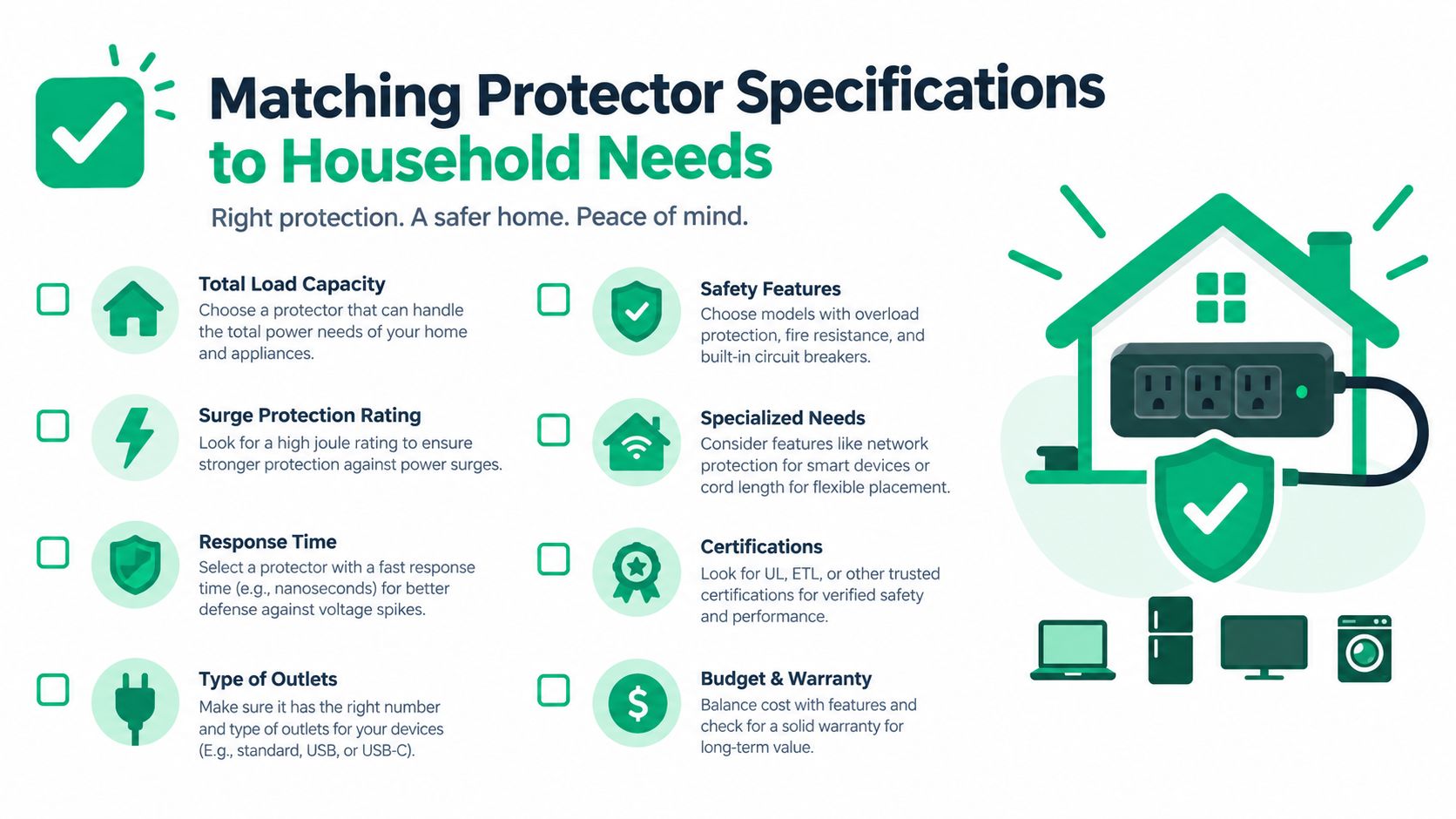
Buying decision: Match the barrier to the wet-load risk, the surface to the sleeper, and the fit to the mattress depth. Paying for features that don't address your household's actual problem rarely improves the result.
Washing Protocols and Membrane Longevity
“Machine washable” is not a complete care instruction. It tells you that laundering is possible under defined conditions, not that every temperature, detergent and drying method is safe for every waterproof construction.
Wash immediately after an accident, following the product label. For ordinary use, set a routine based on perspiration, allergies, pets, occupancy and odour rather than treating one universal interval as suitable for every home. A protector used by a child with repeated accidents has a very different laundry demand from one beneath a guest-room sheet.
Separate hygiene from durability
A 40°C wash may remove ordinary soil, but it isn't automatically equivalent to a 60°C cycle for hygiene management. UK practice commonly uses 60°C washing for removable bedding where the care label permits, while the correct temperature for a protector depends on its membrane, seam construction and surface textile.
Never assume that the highest available temperature is best. Heat can stress adhesives, elastic and membrane layers, while bleach and fabric softener may affect waterproof performance or leave residues that change the surface feel. Use the stated detergent and avoid improvising with treatments the manufacturer hasn't approved.
Household humidity also affects the sleeping environment. UK research and expert commentary identify humidity as sufficient for mite growth in many homes, which is why a protector should combine a physical barrier with measurable vapour permeability. The background is discussed in this UK report on humidity and dust-mite conditions.
A practical care matrix
- After a child accident: Remove and wash promptly. Inspect the underside and seams once dry, because a protector that looks clean on top may still have developed a weak point.
- For night sweats: Use a regular refresh routine suited to the care label, and allow the protector to dry fully before refitting it.
- For allergy management: Use the temperature specified for the product and household hygiene need. Don't assume a lower cycle provides the same allergen-control result.
- For guest accommodation: Keep a spare protector, record the care instructions, and check the barrier during room turnovers rather than waiting for a visible leak.
- For pets or heavy occupancy: Increase inspection frequency and treat odour, hair and moisture as separate cleaning problems.
Tumble drying can be convenient, but only use it if the label permits it. Excessive heat, overloading and fabric softener can shorten the useful life of a membrane even when the first few washes appear successful.
How to check for wear
Look for cracking, delamination, stiff patches, thinning, pinholes, stretched elastic and seam separation. A protector can remain visually acceptable while losing liquid resistance, so test it periodically in a controlled way according to the manufacturer's guidance rather than pouring large volumes of water onto the bed.
Durability should be supported by validated washing-cycle performance, not just a long warranty. If the barrier leaks, the surface has become brittle or the fit no longer holds, replacement is safer than continuing to trust it.
Why Miracle Membrane Leads the UK Market
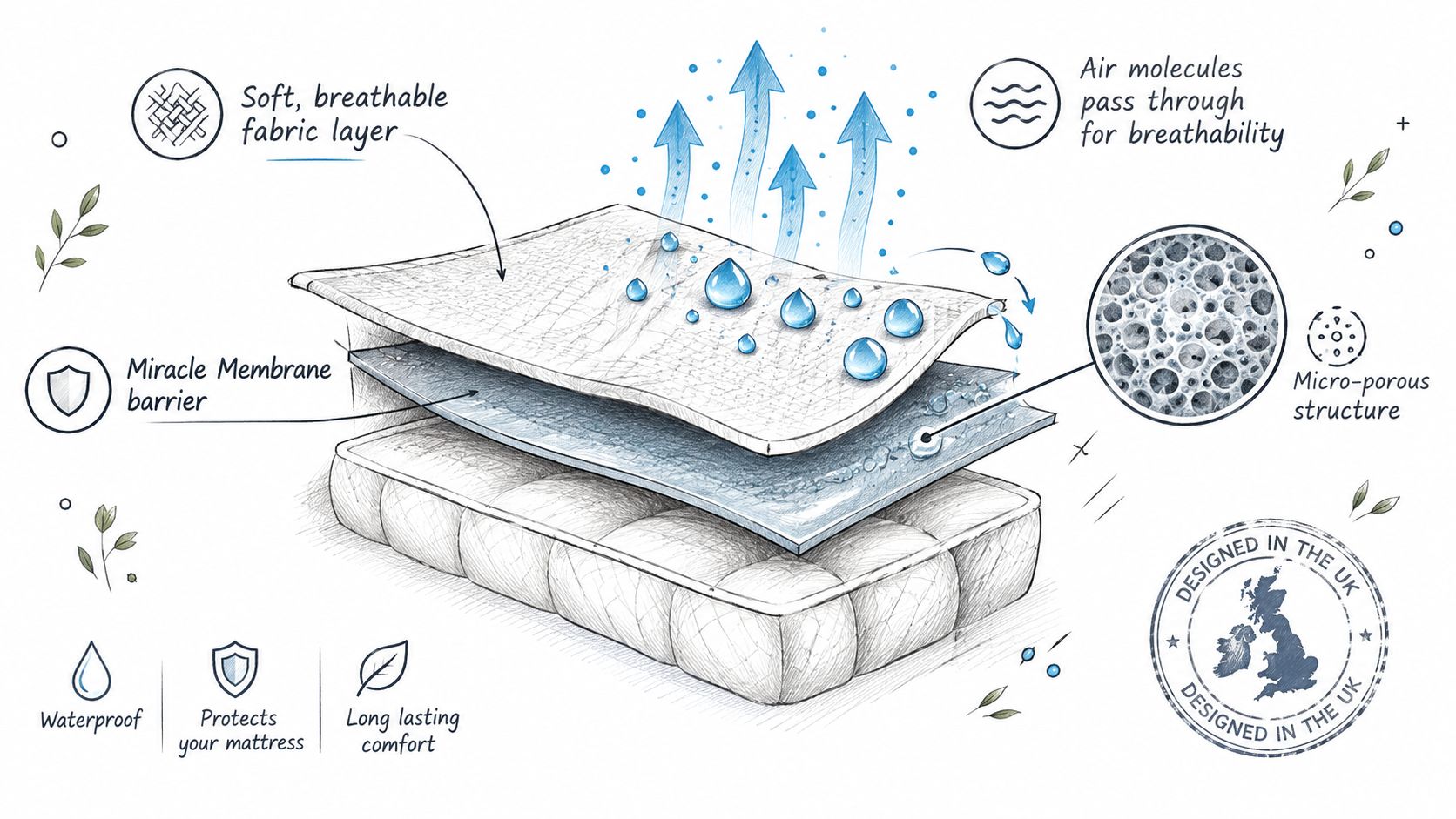
The strongest specification combines a continuous liquid barrier with quiet handling, vapour movement, secure fit and care instructions that suit regular laundering. Protect-A-Bed's Miracle Membrane range is designed around that combination, using a flexible, thin and silent membrane intended to block liquids, sweat, dust mites and allergens while remaining air permeable.
That matters because the membrane sits between two competing requirements. It must resist urine, spills and perspiration, but it shouldn't turn the sleeping surface into a noisy, heat-retaining film. The surface options, including Cotton, Premium, Tencel Cool and Charcoal, allow the shopper to adjust the tactile and thermal character without abandoning the underlying waterproof construction.
What makes the specification credible
A useful evaluation should focus on construction rather than slogans:
- Flexible and quiet: Less rustling is important for light sleepers and children who move frequently.
- Air-permeable design: Vapour movement supports comfort, although buyers should still look for measurable test information where available.
- Multiple surface choices: Fabric selection can be matched to the sleeper's preference for softness, smoothness or moisture management.
- Protection options beyond the top panel: Encasement designs are relevant where side and edge exposure matters.
- Warranty-backed support: A stated warranty gives the buyer a defined route to address manufacturing defects, subject to its terms.
The brand also offers bedbug-proof mattress encasement technology covered by a global patent, which is a separate use case from ordinary top-surface waterproofing. Landlords and accommodation providers should distinguish a fitted protector from a full encasement because they solve different coverage problems.
For UK buyers, fulfilment and after-sales support also affect the practical value of the purchase. Protect-A-Bed's UK storefront offers UK delivery, product-specific care information and warranty-backed support, so check current stock, delivery terms and the exact model specification before ordering. Public review signals can be useful context, but they shouldn't replace checking membrane data, mattress depth and care requirements.
The recommendation is straightforward. Choose the range or model whose barrier, surface, fit and maintenance instructions match your household. A premium protector is only a sound purchase if you can wash it correctly, keep it fitted and sleep comfortably on it.
Answers to Common Mattress Protector Questions
Will a waterproof protector make the bed noisy?
Older plastic-feeling constructions can rustle, especially when the sleeper turns. A thin, flexible membrane with a textile surface should be quieter, but noise also depends on the mattress, fitted sheet and how tightly the protector is installed. Fit it smoothly without trapped folds, then assess it under the sheet rather than judging the material in your hands.
How do I choose the right depth?
Measure the mattress from the top sleeping surface to the bottom edge, including any permanent pillow-top. Don't rely only on the nominal mattress size. The protector should pull securely below the corners without excessive tension, while a skirt that is too loose can shift and expose the side panels.
Can a protector prevent asthma?
No. A close-fitting barrier may limit the mattress's exposure to liquid and allergen-containing dust, but it isn't an asthma treatment. Research has not shown consistent improvement in asthma outcomes from mattress covers and other mite-avoidance measures, so follow clinical guidance alongside sensible washing, ventilation and humidity control.
Is “cooling” enough for a hot sleeper?
No. The surface may feel cooler, but the room, duvet, sleepwear and mattress all contribute to heat. The UK sleep survey cited earlier reported that 32% of respondents had lowered their bedroom temperature for comfort, reinforcing the point that a protector can support thermal comfort but can't correct an overheated sleep environment. A detailed mattress protector guide from Vinson Fine Furniture offers further general buying context.
What should I check before buying?
Confirm the barrier type, seam coverage, mattress depth, washing temperature, drying method and any independent testing. If the product only says “waterproof” and “breathable” without explaining how those claims were assessed, ask the seller for more precise information.
Protect-A-Bed offers UK waterproof mattress protectors built around the flexible Miracle Membrane, with fabric choices for different comfort preferences and protection options for household, allergy and accommodation needs. Check the current specifications, care instructions and fit guidance, then visit Protect-A-Bed to choose a protector that can protect your mattress without compromising the way you sleep.