

Zip Mattress Covers: How They Work and Why They Matter

A zip mattress cover is a fully enclosed sleeve that seals around the entire mattress with a zip closure. For bed bug containment, a trapped population may require 12–18 months to die off naturally, so the cover is a containment tool, not a fast-kill treatment.
You may be looking at your bed after a small disaster, a suspected allergy trigger, or a worrying report of bed bugs in a nearby flat, and wondering whether a “zip protector” is the right answer. The terminology makes that harder than it should be. Some products zip around the mattress on all six sides, while others are fitted protectors with an elastic edge and a zip detail that doesn't create a complete seal.
The practical distinction is simple. A true zip mattress encasement wraps the top, bottom, and all four sides, then closes around the mattress. A fitted mattress protector usually covers the sleeping surface and side panels, while its elasticated skirt leaves the underside open. The right choice depends on whether you're mainly managing spills, allergens, bed bug risk, or several of these problems at once.
Table of Contents
- What a Zip Mattress Cover Is
- How the Zip Closure and Full Encasement Work
- Zip Covers Versus Fitted Protectors
- Waterproofing, Allergen, and Bed Bug Benefits
- Choosing the Right Size, Depth, and Material
- Matching the Cover to Your Specific Problem
- Care, Cleaning, and Common Fit Mistakes
- Bringing It All Together Before You Buy
What a Zip Mattress Cover Is
At six in the morning, a cup of tea tips over and soaks into the bed. You remove the sheets, find a topper underneath, and wonder whether the cover already on the mattress could have stopped the liquid reaching it. The answer lies in the construction, not the product name.
A zip mattress cover is a fabric sleeve that holds the entire mattress. Once the mattress is inside, a zip closes the opening along one or more edges. A genuine six-sided encasement covers the top, bottom, and four sides, including the underside that a conventional fitted protector usually leaves exposed.
A fitted protector works more like a fitted sheet. Elastic holds it around the mattress, while its top layer may resist water or absorb moisture. It can suit everyday spills, perspiration, and routine washing. Because the underside remains open, however, it does not form a complete enclosure.
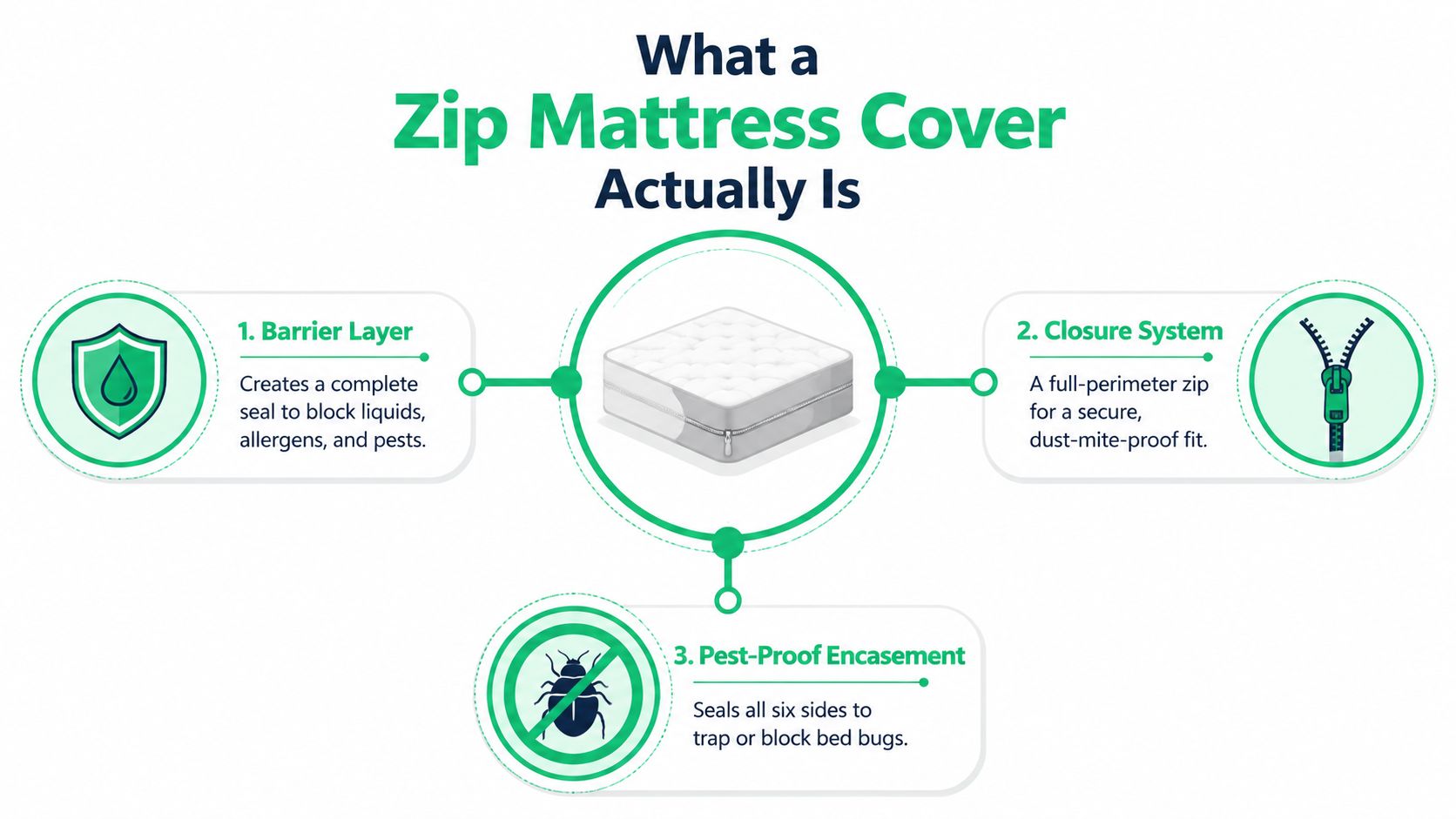
The terms to recognise
- Encasement: A cover designed to surround the entire mattress.
- Zippered cover: A general term for a cover using a zip. It does not prove that all six sides are sealed.
- Fitted protector: A top-and-side protector held in place by elastic, usually open underneath.
- Closure type: The design of the zip, flap, guard, or locking feature that closes the opening.
This vocabulary helps you assess a listing rather than rely on its title. Look for terms such as six-sided, fully enclosed, or sealed mattress encasement, along with a clear description of the underside. A product called a “zip mattress protector” may still need closer inspection.
For UK buyers, sizing is part of the protection decision. Match the cover to the mattress's length, width, and depth, including a built-in pillow-top or extra comfort layer. If the zip closes only when the fabric is stretched, pressure can separate the teeth and weaken the barrier. A properly fitted six-sided encasement therefore addresses a different problem from a zip-on protector, especially when spills, allergens, or bed bug containment all matter.
How the Zip Closure and Full Encasement Work
Think of the cover as an envelope large enough for the mattress. The mattress goes inside first, then the opening closes around it. Unlike an ordinary sheet, the cover doesn't rely on tension around the corners to stay in place.
The zip track forms the main closure. On a bed bug encasement, the track should travel around the opening in a way that leaves no obvious gap when closed. A zip flap or guard sits beneath or over the teeth, depending on the design, and helps shield the seam from small openings.
The parts that create the barrier
- Fabric membrane: This forms the six-sided shell. Depending on the specification, it may be designed to resist liquids while remaining relatively quiet and breathable.
- Bound or welded seams: These reduce the chance that liquid, dust, or insects can pass through the stitched perimeter.
- Zip guard: This covers the zip line and helps limit access around the closure.
- Bug flap or locking feature: This is intended to protect the end of the zip and prevent a small opening becoming a route in or out.
- Zip tie closure: Some products include a way to secure the closed zip, which can make routine inspection easier.
The important point is that the zip itself isn't the whole protection system. A strong fabric can still fail at an exposed seam. A well-made seam can still be compromised if the cover is too small and the teeth separate under pressure. The barrier works as a connected system, with fabric, seams, zip alignment, and end protection all performing different jobs.
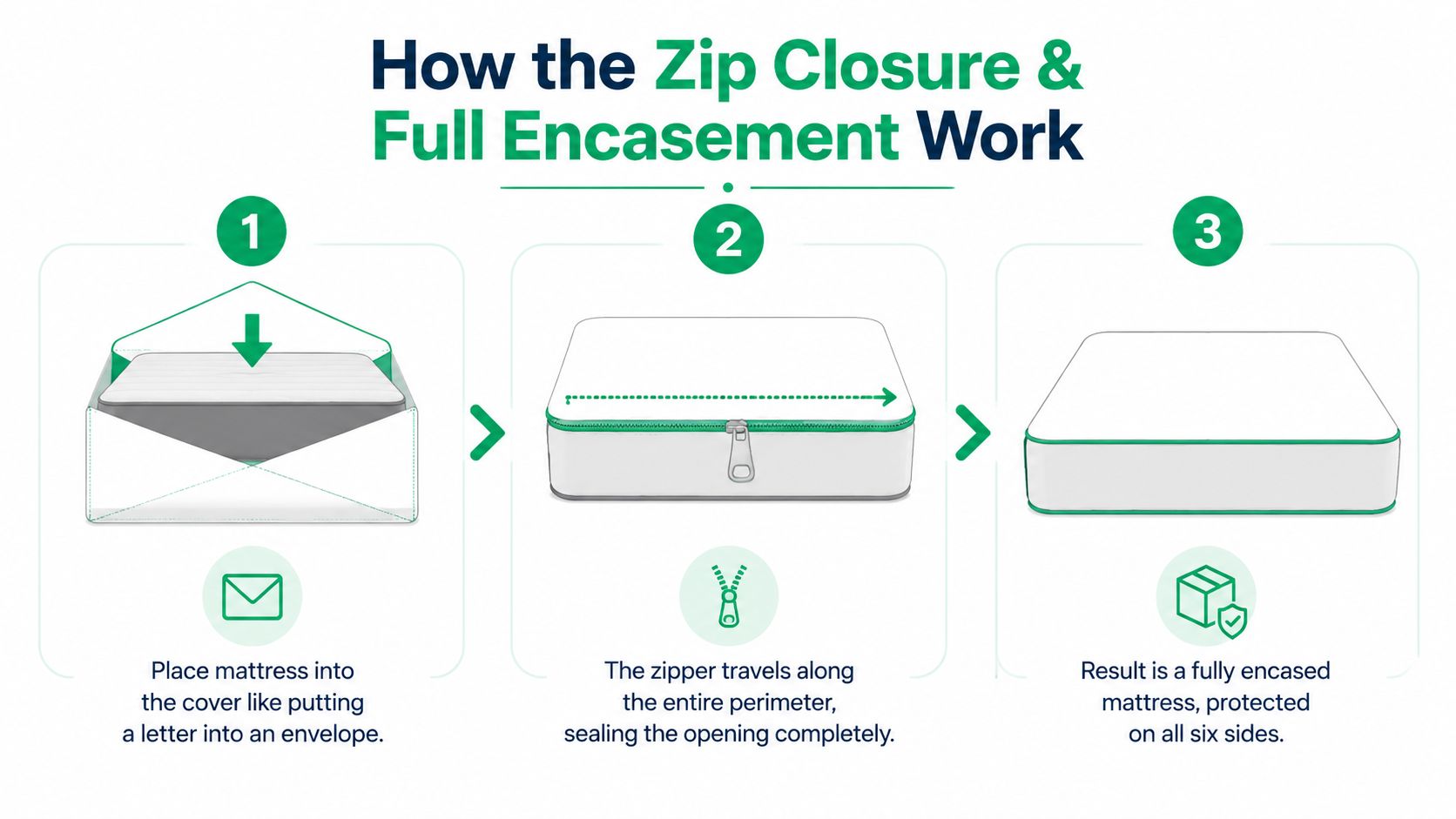
What the closure is meant to block
A waterproof perimeter helps stop a spill from reaching the mattress core through the open underside. An impermeable barrier also reduces the movement of dust-mite allergens into and out of the mattress. For bed bug control, a properly closed six-sided encasement is designed to prevent new insects entering the mattress and to contain insects already inside.
Practical rule: Treat “zip closure” as an invitation to inspect the engineering details, not as automatic proof of a pest-proof seal.
The cover also needs to remain intact during normal use. Check the teeth, the end stop, the flap, and the seams after fitting. If any part catches, opens, or pulls sharply, remove the strain before placing bedding over it.
Zip Covers Versus Fitted Protectors
The easiest way to choose is to match the construction to the problem. Neither format is universally superior. They solve different protection tasks.
| Criterion | Zip encasement | Fitted protector |
|---|---|---|
| Coverage | Surrounds the mattress on all six sides | Usually covers the top and sides, with the underside open |
| Closure method | Zip, often with a guard or locking feature | Elasticated skirt or fitted edge |
| Allergen control | Creates a complete mattress barrier when correctly sealed | Limits exposure on covered surfaces, but doesn't enclose the mattress |
| Bed bug use | Designed for containment and prevention when properly certified and sealed | Not a complete bed bug barrier because the underside remains accessible |
| Waterproofing scope | Can protect the top, sides, and underside | Usually protects the sleeping surface and may cover part of the sides |
| Fitting | Requires the mattress to be lifted or inserted into the sleeve | Usually faster to fit like a sheet |
| Sleep feel | May feel slightly more structured, depending on fabric and membrane | Often feels closer to a conventional fitted sheet |
A fitted protector suits a household that wants quick changes after an everyday spill or prefers a simple washable layer over the sleeping surface. It can also work well as a removable comfort layer placed over an encasement.
A zip encasement makes more sense when the underside matters. That includes suspected or confirmed bed bug activity, a desire to isolate the mattress from allergen reservoirs, or a need to protect the entire mattress from liquid damage.
If you're comparing ordinary protector formats and want to see how different sleep-surface options are presented, the shop icare protector range provides a useful reference point. Read the construction details carefully, because “protector” and “encasement” aren't interchangeable terms.
A fitted protector is a convenient cover. A six-sided encasement is a containment system.
Waterproofing, Allergen, and Bed Bug Benefits
A zip mattress cover can perform several jobs, but each benefit depends on a different part of its construction. Waterproofing depends on the membrane and perimeter. Allergen control depends on the barrier fabric and closure. Bed bug containment depends most heavily on complete coverage and an intact zip system.
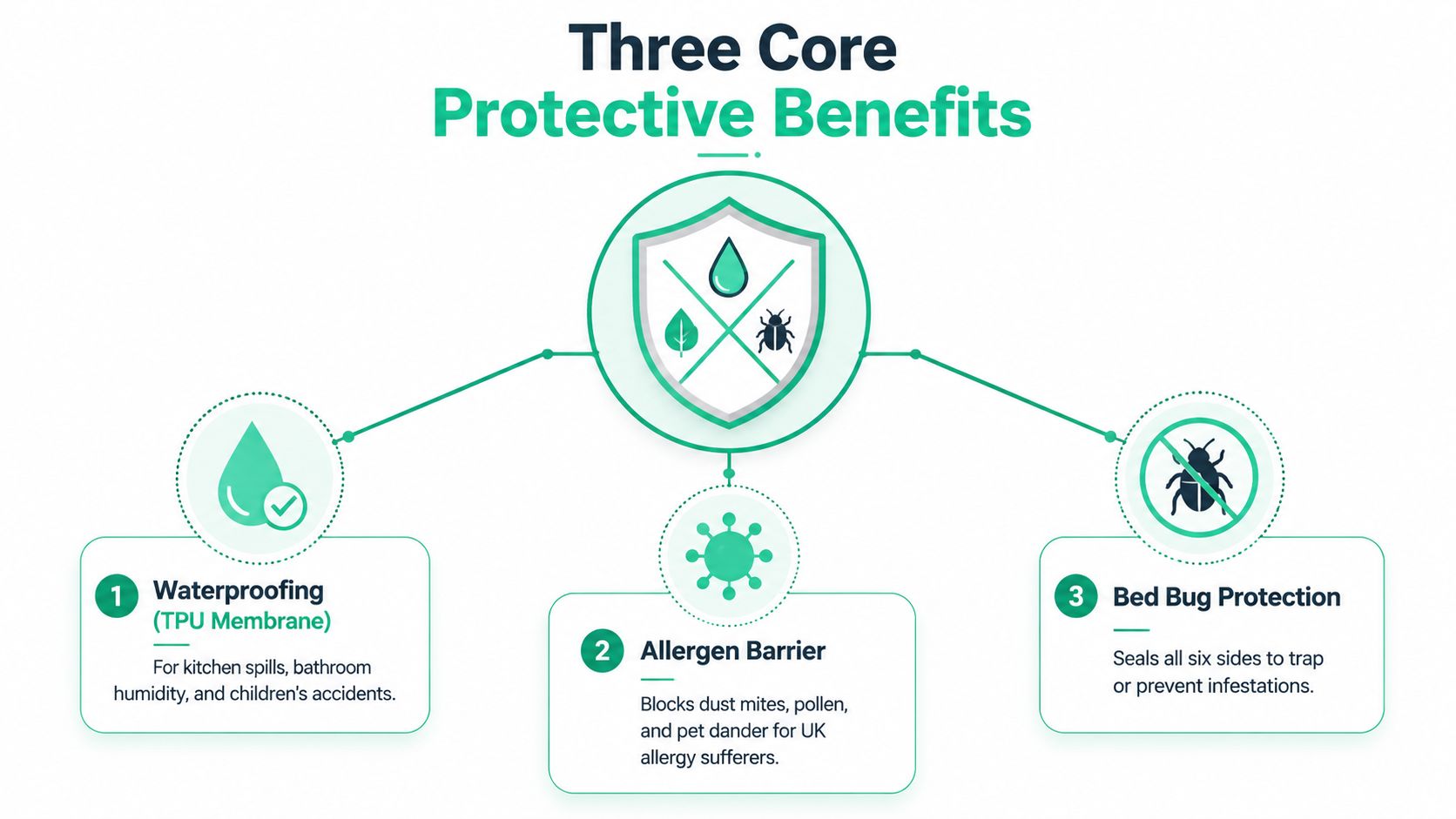
Waterproofing for real household accidents
A water-resistant fabric may make liquid bead on the surface, but that doesn't automatically protect the mattress from a larger spill. A waterproof membrane, such as a polyurethane or TPU-style layer, is intended to stop liquid passing through the fabric.
The perimeter still matters. If the top is waterproof but the mattress is exposed underneath, liquid can migrate around the edge or reach an uncovered side. A six-sided waterproof encasement closes that route, which is useful for children's accidents, incontinence care, heavy perspiration, or a drink knocked over beside the bed.
Allergen control needs a complete barrier
UK evidence shows that allergen-impermeable covers can reduce dust-mite allergen in mattress dust, although symptom improvement isn't guaranteed when a cover is used alone. In one randomised trial, Der p 1 concentration at six months was 0.58 µg/g in the active-intervention group compared with 1.71 µg/g in the control group, as reported in the UK-linked trial record and paper.
Another trial found Der p 1 levels in the active group fell from 19.2 to 7.2 µg/g of dust after bedding was encased, while a further study found active encasings reduced mattress Der p 1 concentration by a factor of 2.1 after twelve months. The same study reported a 2.5-fold reduction for combined Der p 1 and Der f 1 concentration.
Those findings support the barrier function, not a promise that every allergy or asthma symptom will disappear. A separate UK randomised trial found no improvement in peak flow or asthma symptoms when allergen-impermeable covers were used alone, despite a greater reduction in Der p 1 in the active group. The UK clinical evidence on mattress encasements and asthma outcomes therefore supports using the cover alongside the wider management plan.
Bed bug containment is a long process
Bed bug encasements aim to block access to the mattress and contain insects already inside. They don't replace inspection, professional treatment, or attention to the bed frame and surrounding room. Guidance on bed bug mattress protectors and full encasements stresses the difference between an open fitted protector and a sealed six-sided cover.
UK bed bug pressure has become more significant. The Chartered Institute of Environmental Health reported that outbreaks increased by nearly two-thirds over twelve months in 2023, while historical pest-control evidence records bed bugs as established in British cities much earlier. That context explains why landlords, hotels, shared houses, and care settings often treat a true encasement as part of a wider control plan.
Choosing the Right Size, Depth, and Material
A zip cover can look suitable on the bed yet fail at the corners if its depth is wrong. Start with the mattress label, then measure the mattress itself. UK sizes commonly used for zip encasements include 90x190 cm Single, 135x190 cm Double, 150x200 cm King, and 180x200 cm Super King. Depth allowances often sit around 20–30 cm, but the product specification takes priority.
Stand the mattress on its side and measure the width, length, and depth. Include any built-in topper or pillow-top. Keep the mattress fully expanded during the measurement. A cover that fits only under pressure can strain the zip, pull at the seams, and leave the closure difficult to operate.
Use these checks before ordering:
- Match the nominal size: Compare the cover with the mattress dimensions, not just the bed frame.
- Confirm usable depth: The pocket or sleeve must accommodate the mattress at its full thickness.
- Examine the closure: A true encasement should cover all six sides and describe a full seal, zip guard, and protection at the zip end.
- Review care instructions: A cover that is difficult to wash may be impractical for a child's bed or a frequently used guest room.
For a more detailed method, follow this guide to how to measure mattress depth before ordering.
| Material | Best for | Trade-off | Fit check |
|---|---|---|---|
| Terry cotton | A softer, familiar surface and everyday use | May provide less slick liquid resistance than a plastic-feel outer layer | Confirm the membrane remains present across the covered faces |
| Polyester microfibre | Value, softness, and straightforward maintenance | May feel warmer for some sleepers | Check the fabric weight and depth allowance |
| Vinyl or membrane-backed fabric | Strong liquid protection and demanding hygiene settings | Can feel less textile-like or make more noise | Check that the zip and seams are protected, not just the centre panel |
Material should match the problem being managed. A child's room may call for waterproofing and easy washing. An allergy-focused bedroom may need an impermeable, tightly constructed barrier. For bed bug exposure, verified six-sided containment and zip integrity take priority over surface softness. That distinction separates a genuine encasement from a zip-on protector that covers the top and sides but leaves the underside exposed.
Matching the Cover to Your Specific Problem
Start with the exposed area, then identify what must be blocked. A comfortable zip-on protector may cover the top and sides while leaving the underside open, so it cannot contain a problem that can reach below the mattress.
For light spills or everyday humidity, a fitted protector may be sufficient. Night-time accidents and incontinence call for a waterproof six-sided encasement when liquid could reach the sides or underside. The decision depends on the route of exposure, not on the cover's thickness.
Allergy concerns require a tightly made, allergen-impermeable encasement, supported by evidence that the product is designed to reduce mite allergen exposure. It should complement the household's wider asthma or eczema plan. Bed bug risk changes the priority again. Choose a certified, fully enclosed encasement with a protected zip, and follow the treatment provider's instructions. The cover supports containment, but does not replace a complete pest-management programme.
A true six-sided encasement can also serve as the sealed base layer for mixed needs. Place a washable fitted protector over it when routine cleaning matters, so surface spills do not require removing the encasement.
The setting affects the trade-off. An occasionally used guest bed may not need a bulky waterproof cover. A thin fitted layer may be inadequate for a tenant returning to a flat after a bed bug report.
Before buying, ask two questions: Does the problem require protection on all six sides? And which feature matters most, liquid resistance, allergen control, pest containment, or easy washing? If the mattress must be isolated, choose the true encasement first. Add comfort and convenience layers afterwards.
Care, Cleaning, and Common Fit Mistakes
A zip cover can look fitted while still sitting incorrectly. Before cleaning, note how the zip, seams, and corners rest on the mattress. A strained closure may indicate that the cover is too small, too shallow, or pulled off-centre.
Open the zip fully before removal. Follow the care label for temperature and detergent, and avoid bleach or fabric softener unless the manufacturer permits them. Use low heat or line drying where instructed. Wash the cover often enough to keep the surface fresh, but do not treat a sealed encasement like a loose sheet. Removing it takes more time, so planning the wash matters.
Never enclose the mattress while the cover is damp. Moisture trapped around the seam can encourage mould and leave a stale smell. Refit it only after the shell is completely dry.
Small fitting errors create larger protection gaps:
- Measure the full depth: Include the side panel, not only the raised sleeping surface.
- Include extra layers: A pillow-top or built-in topper increases the mattress depth.
- Align before closing: If the zip teeth resist, stop and reposition the cover. Force can damage the closure.
- Treat stretch as comfort, not sizing: Elastic fabric cannot reliably correct the wrong nominal size.
- Check the underside: Inspect lower seams and corners as carefully as the top.
After washing, run your fingers along the zip teeth, seam binding, and underside corners. Look for loose stitching, punctures, separation, or a flap that no longer lies flat. These defects can let liquid through, weaken allergen isolation, or affect bed bug containment.
For practical mattress protector washing guidance, follow the care label for your own product because membranes and fabrics vary.
Bringing It All Together Before You Buy
The first specification to confirm is complete enclosure with a working zip. Waterproofing, allergen reduction, and bed bug containment all depend on the cover remaining sealed across the top, sides, and underside.
A fitted protector suits spill-only households that value quick fitting. A zip encasement is the more appropriate format when the mattress itself needs isolating because of allergen exposure, liquid risk, or bed bug concerns. Measure the full depth including any topper, verify the zip runs around the intended perimeter, choose the material for your main problem, and check the wash instructions before ordering.
Protect-A-Bed offers waterproof mattress protectors and bed bug encasements designed to help protect the sleep surface from liquids, allergens, and pest-related risks. Visit Protect-A-Bed to compare UK sizes and choose a cover that matches your mattress dimensions and protection needs.