

Waterproof Mattress Protector Moses Basket: Size Guide

Buying the softest, most absorbent waterproof protector is the wrong starting point for a Moses basket. Fit, firmness and flatness come first. A protector should keep liquid out of a suitable mattress, not make an unsuitable mattress seem usable.
Choose a waterproof mattress protector for a Moses basket by checking the actual mattress, the assembled sleep surface and the washing instructions. A waterproof claim alone doesn't tell you whether a cover will pull the mattress edges upwards, wrinkle after washing or add unwanted cushioning.
Table of Contents
- Why Fit and Firmness Come Before Waterproofing
- Measure and Match Your Basket Before You Buy
- Waterproof, Breathable and Safety Specs Compared
- Fit Problems and How to Fix Them
- How to Wash, Dry and Replace the Protector Safely
- Confirm the Size and Safety Before You Buy
Why Fit and Firmness Come Before Waterproofing
Waterproof doesn't automatically mean suitable for infant sleep. A bulky cover can block spills while making the mattress softer or less even. That's a poor trade-off, however convenient the laundry routine might be.
The Lullaby Trust's safer-sleep guidance calls for a firm, flat mattress covered by a waterproof layer, with no soft or raised areas, and says a baby's head shouldn't sink more than a few millimetres into the surface. Waterproofing belongs within that complete setup, not above the other requirements.
What a protector must preserve
A separate protector goes over the mattress and underneath a correctly fitted sheet. It isn't an under-mattress pad, a topper or a replacement for the mattress supplied or specified by the basket manufacturer.
Judge it against these requirements:
- Firm support: The protector mustn't add a yielding, cushioned layer.
- An even surface: Seams, elastic and fabric must stay flat without ridges or gathered patches.
- An intact liquid barrier: The protective layer must prevent spills reaching the mattress beneath.
Extra absorbency isn't a reason to accept padding. Nor should you choose a cover because it promises to make the basket feel softer or cosier. For infant sleep, those are the wrong priorities.
Our baby mattress protector guidance provides further context for choosing a protection layer, but the basket and mattress instructions remain decisive. You need compatible dimensions, suitable construction and a cover you can clean without ruining its fit.
Practical rule: Compare the uncovered and covered mattress with a flat hand. If the protector introduces softness, ridges or distortion, it's the wrong product for that basket.
This hand check can reveal an obvious problem. It doesn't certify a mattress as safe or replace the manufacturer's instructions.
Measure and Match Your Basket Before You Buy
Measure the mattress itself. Woven sides, handles and decorative edging tell you nothing useful about protector size. Start with the mattress specified for your exact basket model.
Use a tape measure and record the dimensions without compressing the mattress. Compare your measurements with the basket maker's specification before shopping. If they disagree, resolve that mismatch rather than buying a cover around a potentially incorrect mattress.
Measurements to check before buying a Moses basket protector
| Measurement | Where to find it | Why it matters |
|---|---|---|
| Mattress length | Basket maker's specification, checked against the mattress | Protector must cover the full sleep surface without folding up at the ends |
| Mattress width | Basket maker's specification, checked against the mattress | A cover mustn't distort the mattress and create gaps at the sides |
| Mattress thickness | Measured in place with the basket base level | Added cover thickness can raise the surface and change how it feels |
| Corner and edge shape | Compared with the basket base outline | Corner fabric must follow the mattress outline without spare material |
| Basket model and standard | Label or instruction booklet, including the basket's standard reference | Identifies the exact sleep product for compatibility checks |
| Protector listed size | Product page dimensions | Must match the mattress measurements above |
Measure the length along the mattress's longest line and the width across its widest point. For thickness, leave the mattress resting flat on the level basket base and measure its edge without pressing it down. Leave any padded protector out of that figure.
Then check the outline. Many basket mattresses have rounded ends while plenty of covers are cut square, and equal length and width can still produce puckered fabric. Lay the cover on the mattress and check that each corner sits square without spare fabric. Check the stated depth as well: an elastic skirt sized for a thin mattress will creep off a deeper one.
Why a close match matters
The NHS newborn equipment guidance says an infant mattress should be firm, flat, clean, dry, waterproof, undamaged and fitted snugly so a baby cannot become trapped around its edges. A protector must preserve that fit. It is a hygiene layer over a compliant mattress, and its job is to leave the fit exactly as the manufacturer intended.
An undersized cover can pull the ends upwards or draw the mattress sides inward. An oversized one leaves fabric that can crease beneath the sheet. Pulling the sheet tighter fixes neither.
Keep the basket model and standard reference with your figures. On the product page, match the protector's stated length, width, depth and corner shape against them. A label reading Moses basket size proves nothing on its own.
If your mattress falls between two available sizes, resist sizing up by default. Choose only a manufacturer-confirmed compatible cover that lies flat without forced stretching or surplus fabric. If neither option fits, buy neither. Never fold an oversized universal cover beneath the mattress to make it work.
Waterproof, Breathable and Safety Specs Compared
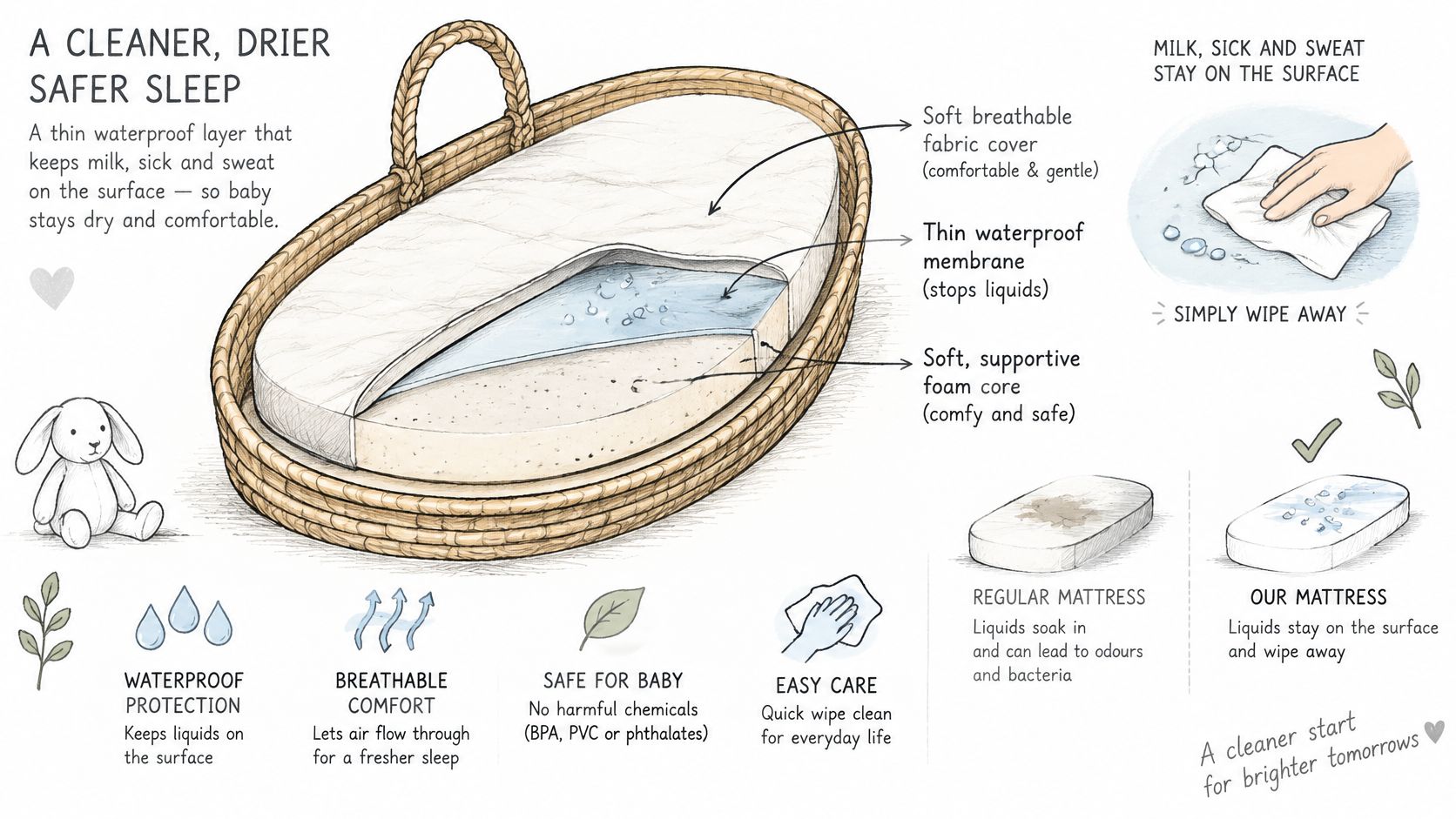
A waterproof membrane is a thin coating or laminated layer that stops liquid reaching the mattress. Its job is straightforward: contain milk, sick, perspiration and nappy leaks so you can strip the soiled bedding and clean the protected surface.
Check the wording before you buy. The product description and care label need to say "waterproof" or "fully waterproof". A fabric described only as water-resistant may shed a splash without containing sustained wet contact. Look for clear instructions on cleaning and inspecting the barrier, because a membrane you cannot examine is a membrane you cannot rely on.
How to read a breathability claim
The Lullaby Trust product guide prioritises a waterproof mattress or fitted waterproof cover over breathability because it helps prevent bacteria building up inside the mattress and makes cleaning easier; it also identifies BS EN 1466:2014 or BS EN 1466:2023 for Moses baskets and carrycots, alongside checking the mattress's fire-resistance label.
Breathability figures describe how the material performs in isolation. They say nothing about whether the assembled sleep space is suitable, and they never establish that a baby can breathe safely with their face pressed against a fabric. A breathable label does not make quilting, thick filling or loose material acceptable.
A useful protector has a straightforward job. It provides a waterproof barrier without contouring around the baby or changing the mattress's support. Cover it with a clean, tightly fitted sheet and leave the protector as the hygiene layer underneath.
Safety specifications, safe signs and warning signs
| Specification | Safe sign | Warning sign |
|---|---|---|
| Firmness | Thin and flat, preserving the mattress's firm support | Padded, quilted or cushioned layers |
| Fit | Fitted elastic that holds the cover flat under a sheet | Loose universal cover that bunches or lifts |
| Waterproof barrier | Fully waterproof and wipe-clean as instructed | Water-resistant only, or a coating that peels |
| Fabric and seams | Smooth, flat seams with no loose parts | Ruffles, bows, ties or thick seams that lift |
| Breathability claim | Read as material-performance information only | Used to justify extra padding or softness |
| Compliance | Basket meets its applicable standard; mattress has a fire-resistance label | Missing labels or unclear compliance information |
Use these as screening checks. The basket's standard does not independently approve an accessory you add later, so you still need to confirm compatibility with the mattress and follow the complete product instructions.
Does an already waterproof mattress need another cover?
Only if it earns its place. If the mattress already has an intact waterproof surface, a separate protector is an optional convenience that may make laundry easier after a spill.
That benefit disappears if the extra layer pulls, wrinkles or changes the surface. Where the manufacturer permits cleaning the existing waterproof mattress cover directly, the simpler setup is the better choice.
Say your basket's mattress has a fitted, wipe-clean waterproof casing. Adding a thick absorbent pad doesn't improve its basic suitability. A compatible thin cover can still be useful, but only if the manufacturer allows it and the finished surface remains unchanged.
The same distinction applies when choosing a waterproof mattress protector for a cot, although cot dimensions and product compatibility must be checked separately. Never assume a nursery label makes a cover interchangeable between sleep products.
Keep pillows, bumpers and extra padding out of the basket. If a cover doesn't fit, the answer is a different cover, never another accessory.
Fit Problems and How to Fix Them
A protector that misbehaves in use is not always the wrong size. Sometimes it is the wrong product, and sometimes the mattress underneath is at fault. Sort the difference before you reorder, because a new cover in the next size up will not correct a mattress that has already lost its shape.
Protector symptoms, likely causes and fixes
| Symptom | Likely cause | Fix |
|---|---|---|
| Raised or soft patches | Extra layers or a cushioned cover | Remove the extra layer and recheck the surface with a flat hand |
| Stains reaching the mattress | Torn or peeling waterproof barrier | Replace the protector and inspect the mattress beneath |
| Sour smell after a leak | Possible liquid penetration into the foam | Stop use, inspect and dry as instructed; replace an unsuitable mattress |
| Cover loosens overnight | Elastic losing tension, or ends shaped for a different mattress | Recheck after the first night's use; replace it if it will not stay seated |
Separate a fitting error from a product failure
For a cover that will not lie flat, remove it and refit with the mattress on a level surface. Seat the shaped ends properly and distribute the elastic evenly. If the fabric gathers again the moment you release it, the size or construction is wrong for that mattress.
For edge gaps, take the protector off and look at the bare mattress sitting in the basket. If the gap disappears, the cover was distorting it. If the gap remains, check the mattress itself against the basket specification.
Never fill a gap with towels, muslins or blankets. That hides the mismatch instead of correcting it, and a soft filler is its own hazard. The same goes for laying a sheet over a raised seam to make the surface feel even.
Refit the protector, then recheck it after the first night's use. Sleep movement exposes slack that a careful fitting can hide, so a cover that passes at bedtime but sits loose by morning has already failed. A peeling barrier or a contaminated mattress calls for a replacement decision, not more enthusiastic tucking.
Stop-use signal: If the proposed fix leaves the surface softer, uneven or distorted, do not use the basket until the cover, mattress and basket have all been checked.
A sour smell does not prove exactly where liquid has travelled. It does justify stripping the bedding and inspecting the mattress rather than masking the odour with fresh linen.
How to Wash, Dry and Replace the Protector Safely
Treat routine spills, damaged barriers and second-hand mattresses as different situations. A washable spill calls for cleaning. A torn waterproof layer calls for replacement, while a stained or worn mattress needs its own assessment.
The Kingston and Richmond NHS safe-sleeping guide supports keeping the waterproof cover clean and dry, checking the mattress for staining or damage, and using a new mattress for each baby where possible. A second-hand mattress needs an intact waterproof cover, sound condition and a secure fit without gaps.
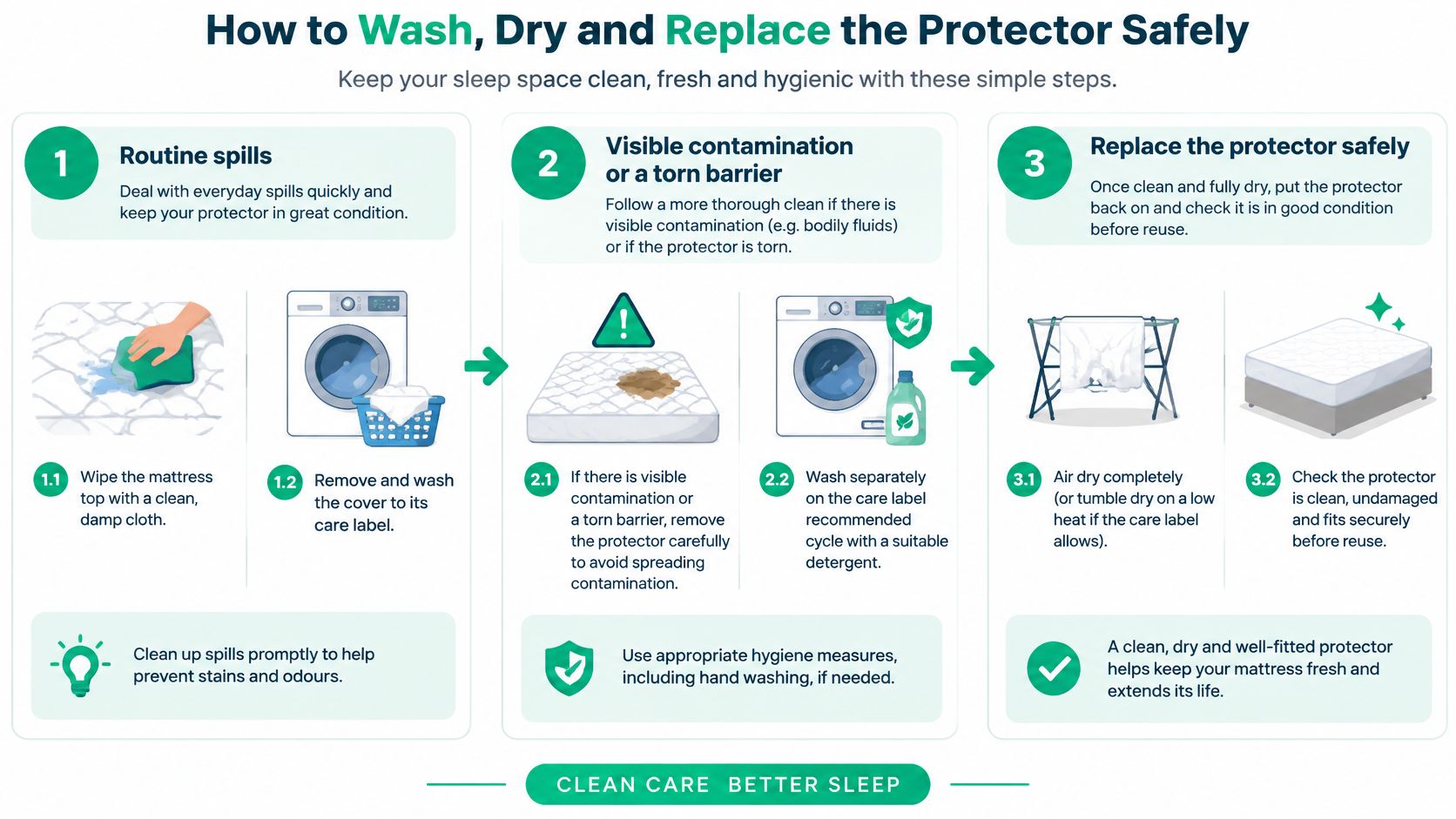
A spill-cleaning routine
- Strip and inspect. Remove the sheet and protector without spreading the spill onto the mattress. Wipe the mattress's waterproof top with a damp cloth if its instructions allow, then check for penetration.
- Wash to the actual label. Use the stated temperature and permitted laundry products. Don't assume another protector's instructions apply.
- Dry completely. Air dry flat where permitted and avoid tumble drying wherever the label forbids it. Don't refit a cover that still feels damp.
- Inspect the barrier. Look and feel for cracks, peeling, damaged seams and damp patches. A flat-hand check can reveal texture changes, but it cannot prove waterproof performance.
- Remake and check. Fit the dry protector beneath a clean, tightly fitted sheet. Inspect every corner and the mattress perimeter before reuse.
Our Premium Mattress Protector can be washed at a warm or hot temperature and must never be washed with bleach or a bleach alternative. That's a product-specific care instruction, not a universal temperature recommendation for Moses basket covers.
Our guide to washing a mattress protector provides broader care guidance. Always give the label on the item you own priority over general laundry advice.
For separate adult-bedding tasks, CleanOnline, North York's Premium Dry Cleaners, offers a resource to compare home and professional duvet cleaning. Those duvet-cleaning methods aren't instructions for a nursery waterproof membrane, and duvets don't belong in the Moses basket.
When cleaning isn't enough
- Torn, stained or fraying mattress: Replace it rather than concealing deterioration beneath a fresh protector.
- Second-hand mattress without an intact waterproof cover: Don't assume a new outer layer can undo earlier contamination.
- Mattress that no longer fits securely: Replace it with the specified compatible mattress; cleaning cannot correct its dimensions.
- Cracked or peeling protector: Replace the protector and inspect whatever was underneath it.
Visible soiling needs cleaning before reuse; damage needs replacement. A protector cannot reset an old mattress, restore lost support or make an unsuitable hand-me-down acceptable.
Confirm the Size and Safety Before You Buy
Run the buying checks in a fixed order. A protector that fails on fit or construction is out, whatever its fabric description says.
Apply these checks in order
- Use the recorded measurements. Apply the dimensions already taken for the basket mattress and reject any protector that does not state a matching end shape or supported depth.
- Reject unsuitable construction. Choose a thin, fitted cover with no padding, loose trims or bulky seams. Confirm the construction includes a fully waterproof barrier.
- Check waterproofing after fit. Verify the dedicated waterproof layer only once the dimensions and surface construction pass. Branding should not carry more weight than measured compatibility.
- Read care instructions and returns terms. Establish how the cover must be washed, dried and inspected. Check whether it can be returned if the stated compatibility fails in practice, including any hygiene-related restrictions.
The Miracle Membrane is flexible, silent and thin, and provides top surface waterproof mattress protection. Those properties describe the barrier; they do not prove every protector size is suitable for a Moses basket.
Missing information means no purchase yet
Before paying, the listing or accompanying documentation should provide:
- Exact dimensions: Including supported mattress depth and end shape.
- Construction details: Enough information to identify padding, seams and the waterproof layer.
- Care instructions: Full directions for washing, drying and inspecting the cover.
- Relevant compliance information: Clearly separating basket and mattress requirements from claims about the protector.
If any of that information is missing, pause the purchase. Ask the basket manufacturer whether an extra layer is compatible, especially before placing one over an already waterproof mattress.
When the baby later moves to a cot, keep accessory checks product-specific. Guidance on UK cot rail safety standards covers a cot accessory and does not establish that a Moses basket protector is compatible.
Compare every shortlisted cover using the same checks. Do not relax the requirements for a preferred fabric, a convenient bundle or a stronger marketing claim.
If the seller will not state the supported mattress depth in writing, do not buy the protector. The basket and mattress manufacturer's instructions still govern the finished setup.
Protect-A-Bed offers waterproof mattress protection using its thin, flexible Miracle Membrane technology. Visit Protect-A-Bed to review product construction, dimensions and care information, then confirm compatibility with your Moses basket's specified mattress before ordering.