

Waterproof Mattress Protector Extra Deep: Fitting Guide

You've probably had the same moment many UK shoppers have, you pull a new protector over a thick mattress, smooth the corners, then wake up to find one side has ridden up and the sheets feel rumpled. The waterproof layer may be doing its job, but the fit is wrong, and that's enough to make the whole purchase feel useless.
That frustration is exactly why extra-deep protection exists. Modern mattresses are often too tall for a standard pocket, especially once you add a topper or buy a pillow-top build, and a loose fit creates the hidden failures people don't spot until the first night.
Table of Contents
- Why Extra Deep Mattress Protectors Exist
- How to Measure Your Mattress Depth Accurately
- Choosing the Right Fabric and Enclosure Style
- Fitting Your Extra Deep Protector Without Corner Slip
- Washing and Caring for Waterproof Protectors
- Warranty Coverage and Common Troubleshooting Fixes
Why Extra Deep Mattress Protectors Exist
A protector can look right in the packet and still fail on a thick UK mattress. The corners ride up, the skirt loses its grip, and by the first sleep cycle you are left with a wrinkled layer under the fitted sheet. That failure is about depth compatibility, not waterproofing.
Why standard sizes fall short
UK mattress construction has changed. Pillow-tops, hybrids, and mattresses used with toppers sit deeper than the slimmer profiles many buyers still expect, so the old assumption that one protector fits every bed no longer holds. Retail guidance now treats extra deep as a practical fit category, not a luxury feature, especially once mattresses move beyond 30cm and into thicker builds.
Practical rule: if the protector pocket does not clear the deepest point of the mattress, the fit will work against you from the first night.
That is why the market has shifted toward deeper, better-contained protection. One independent report places the global bedding-protector mattress-protector market at USD 3.43 billion in 2024, with the waterproof segment accounting for about 45% of revenue, while another forecasts the UK bedding-protector market to grow at 4.2% CAGR from 2025 to 2035 (market overview). In the UK, that lines up with real-world risk management too, because the British Pest Control Association reported a 65% rise in bed bug treatments in 2023 compared with 2022, and a 42% increase from 2021 to 2022 (UK pest-control context).
The point is wider than stains. On thicker mattresses, a well-fitted waterproof mattress protector extra deep helps keep the surface sealed, reduces harbourage points, and stops the nightly tug-of-war that happens when the pocket is too shallow. UK retail depth benchmarks typically cluster around 38 cm for extra-deep protectors and 45 cm for deeper encased models, including zippered enclosure designs with TPU-backed waterproof construction. Once a bed includes a topper, the full sleep stack needs measuring, not just the mattress core. For a practical method, see how to measure mattress depth accurately.
How to Measure Your Mattress Depth Accurately
The wrong measurement is the most common reason an extra-deep protector still disappoints. People measure the visible top surface, forget the topper, or guess based on the mattress label, then wonder why the corners pop off after a few nights. The fix is simple, but it needs to be exact.
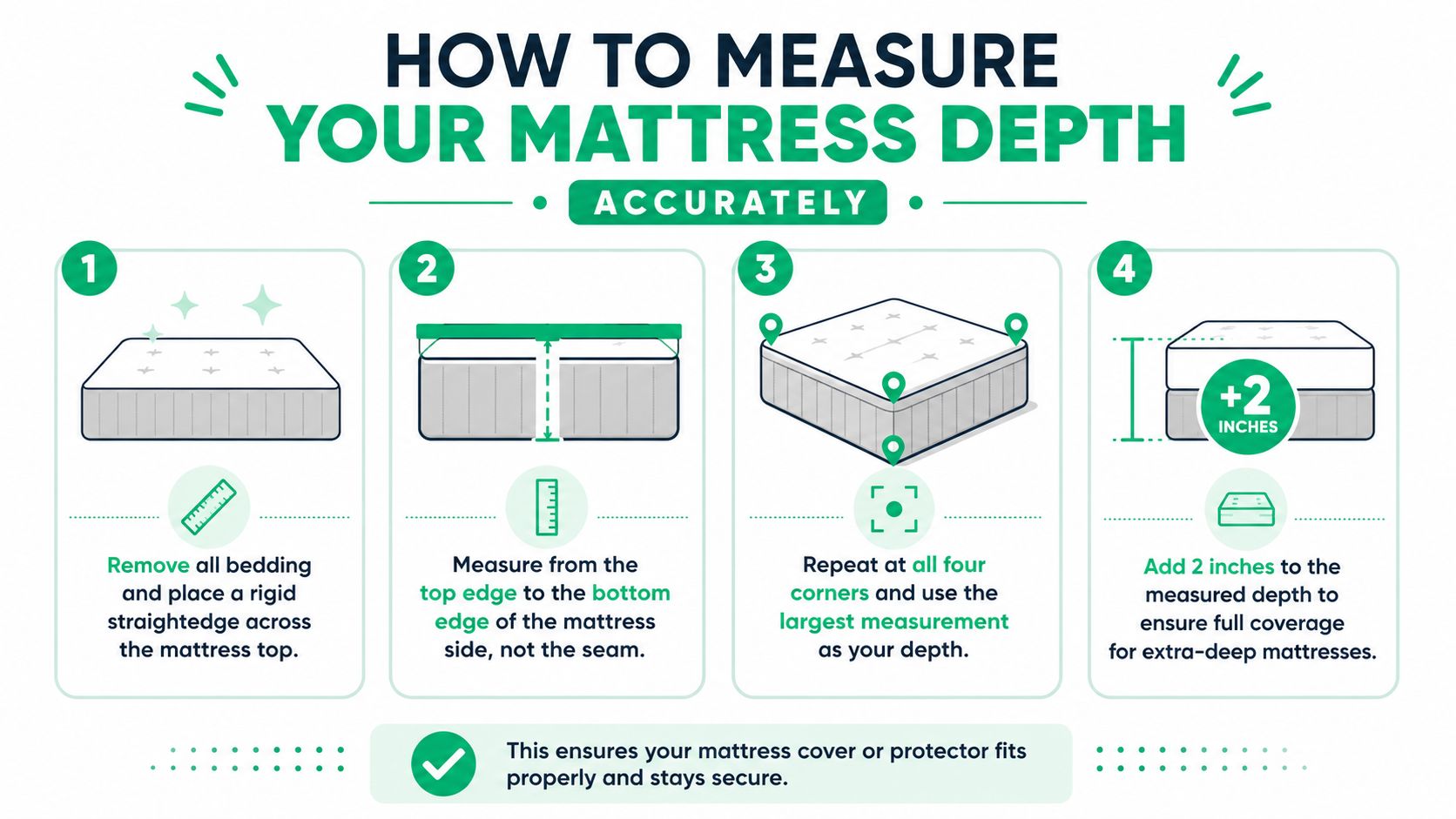
Measure the whole sleep stack, not just the mattress core
Start with all bedding removed. Place a rigid straightedge across the top so you're measuring from a true line, then measure from the top edge down to the bottom edge of the mattress side, not the stitched seam. Do that at all four corners, because thick mattresses often vary slightly from one side to the other, and use the largest measurement as your working depth.
That's the number that matters when you compare product specs. The fit benchmark in UK retail tends to cluster around 38 cm for extra-deep protectors and 45 cm for deeper encased models, including a zippered enclosure design with TPU-backed waterproof construction (UK retail depth example). If your bed has a topper, measure the full stack, not the mattress alone, because the protector has to cover what's there on sleep night, not what's underneath it.
Use a snug-fit allowance, not a loose guess
A useful sizing habit is to allow a little extra depth for full coverage and to keep the skirt under tension. Too little allowance creates corner lift. Too much creates slack, and slack is what lets the protector wrinkle, wander, and feel bulky under the sheet.
Measure the deepest corner first. If the deepest point already pushes close to the stated pocket depth, move up to the next size rather than hoping the elastic will compensate.
UK shoppers often ask whether a topper changes the rule. It does. If the topper stays on the bed permanently, treat it as part of the mattress height. If you remove it often, size for the mattress alone, but expect a looser fit on topper days unless you choose a deeper pocket. That trade-off matters more than brand names or fabric claims, because fit is what decides whether the waterproof barrier stays where it should.
For a simple reference point on depth checks, the measurement method used by Protect-A-Bed is explained in its own guide on how to measure mattress depth, and the basic principle matches what works in practice, measure the full profile, then match the protector to the deepest point.
Choosing the Right Fabric and Enclosure Style
Fabric changes how a protector feels, but enclosure style changes whether it stays in place. Those are separate decisions, and too many buyers mix them up. A soft top can still fail if the skirt is wrong, and a strong barrier can still feel awkward if the surface finish traps heat or makes noise.
Compare feel, airflow, and fit security
| Extra Deep Protector Fabric and Enclosure Comparison | Best For | Key Characteristics |
|---|---|---|
| Cotton quilted top | People who want a familiar, softer sleep feel | Quilted surface with a waterproof backing, usually feels more mattress-like |
| Brushed polyester | Buyers who want a smooth, practical surface | Often lighter-feeling, can work well where easy laundering matters |
| Tencel Cool | Hot sleepers who want a cooler touch | Usually chosen for a smoother, more breathable feel against the sheet layer |
| Charcoal-infused variants | Households focused on a fresher-feeling sleep surface | Often selected for a modern fabric feel and a slightly more technical finish |
| Fitted-sheet enclosure | Everyday domestic use | Elasticated skirt, faster to fit, depends on correct depth and tension |
| Full zip-around encasement | Allergy control, rentals, hospitality, bed bug risk settings | Fully enclosed barrier, more secure around the whole mattress, slower to install |
The big choice is whether you need a fitted-sheet style protector or a full encasement. Fitted-sheet styles are easier to live with in a normal bedroom, because they go on and off quickly. Full encasements make more sense where barrier security matters more, especially in rental properties or shared occupancy settings where the mattress needs sealed coverage.
Match the style to the household, not the marketing
The relevant technical detail is the waterproof membrane underneath the fabric. Protect-A-Bed's own materials describe a breathable Miracle Membrane used across its protectors, and the brand also publishes guidance on a breathable waterproof mattress protector, which is the right concept to keep in mind when you compare surface feel with barrier performance. A protector can feel quiet and still be fully waterproof, so don't assume thickness automatically means better performance.
If you sleep hot, prioritise a cooler-feeling top. If you're fitting out guest rooms or managing pest risk, prioritise a secure enclosure and a barrier that stays closed around the full mattress profile. Those goals don't always overlap, and forcing one style to do the other job is where many UK buyers end up dissatisfied.
Fitting Your Extra Deep Protector Without Corner Slip
A correct size can still fail if the fitting sequence is sloppy. Most corner slip problems come from pulling the skirt over one side too soon, stretching the elastic unevenly, or placing the protector off-centre before it's under tension. Thick mattresses expose those errors fast.
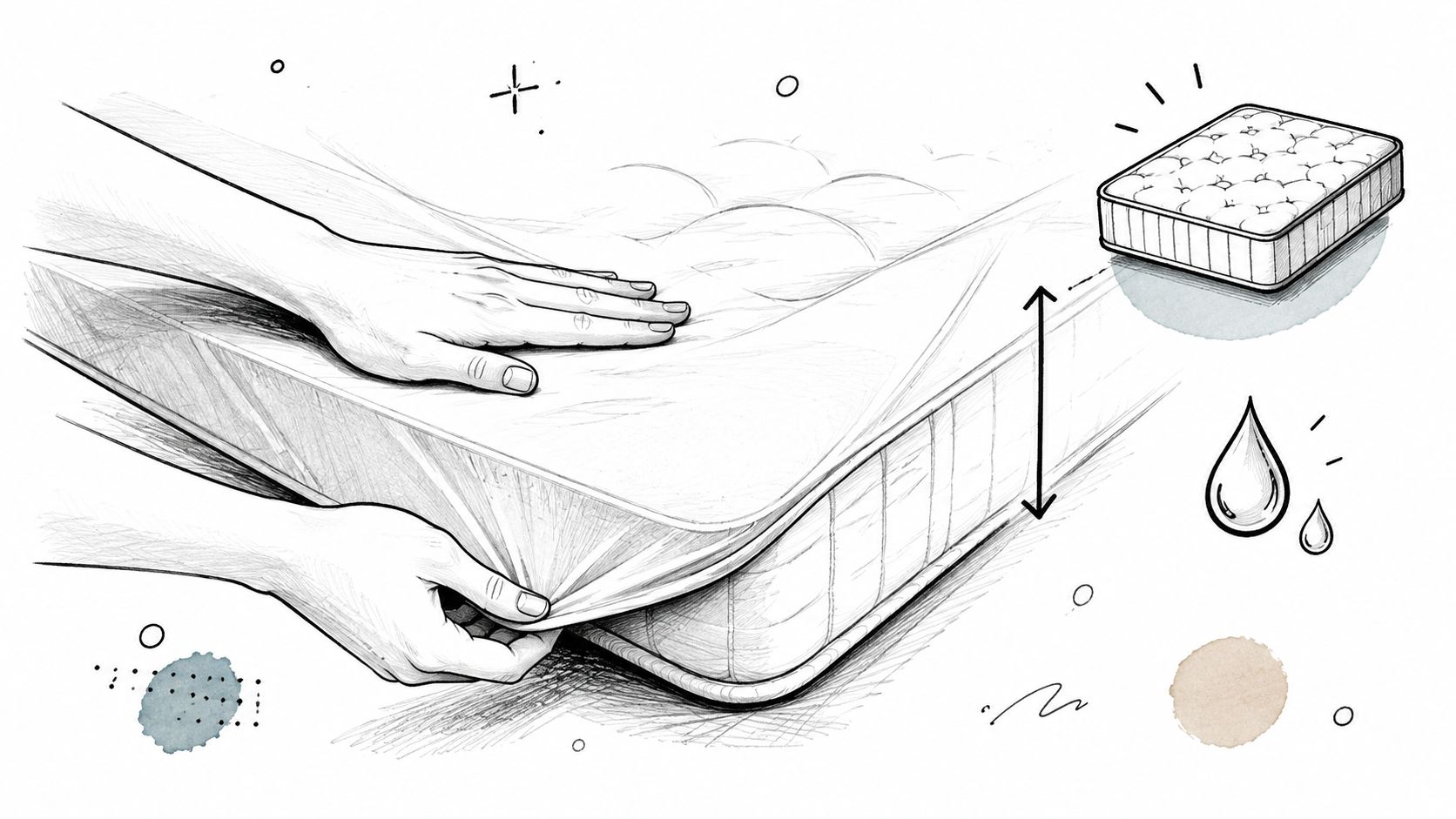
Fit the corners first, then check the side tension
Lay the protector over the mattress so the corners are aligned before you stretch anything. On a fitted-sheet style protector, seat one corner, then move diagonally across to the opposite corner, because that keeps the fabric centred instead of dragging it sideways. Once all four corners are on, run your hand down each side and check whether the skirt is gripping evenly.
If one corner feels loose, take it off and refit before you add the outer sheet. A protector that starts crooked usually stays crooked, and the wrinkle you ignore at bedtime is the one you feel at 3am. On a thick pillow-top bed, the extra height increases that risk, which is why a extra-deep pocket matters more than a vague “deep fit” label.
Treat encasements differently from fitted styles
With a zip-around encasement, the fitting order changes. The mattress has to sit fully inside the cover before you close the zip, and the zip line needs to be flat rather than pulled taut across one edge. If the protector has a waterproof zipper seam, check that the closing path isn't twisted, because a twisted zip can create stress points and make the enclosure harder to close cleanly.
If the elastic feels weak, don't over-stretch it to force a loose fit. That only speeds up corner slip and shortens the life of the skirt.
On encasements, the goal is a smooth, sealed profile. On fitted styles, the goal is tension without strain. Those are not the same thing, and using the wrong fitting habit for the style is a common reason buyers think the product is faulty when the problem is installation. If the mattress is unusually deep, or if you've added a topper, re-check the corner alignment after the first night, because the fabric often settles slightly once weight is applied.
Washing and Caring for Waterproof Protectors
A waterproof membrane can last a long time, but only if you treat it properly. Most damage comes from everyday laundry habits that seem harmless, like heavy heat, aggressive detergents, or softener. Those shortcuts can weaken the barrier, reduce breathability, and make the top layer feel less comfortable over time.
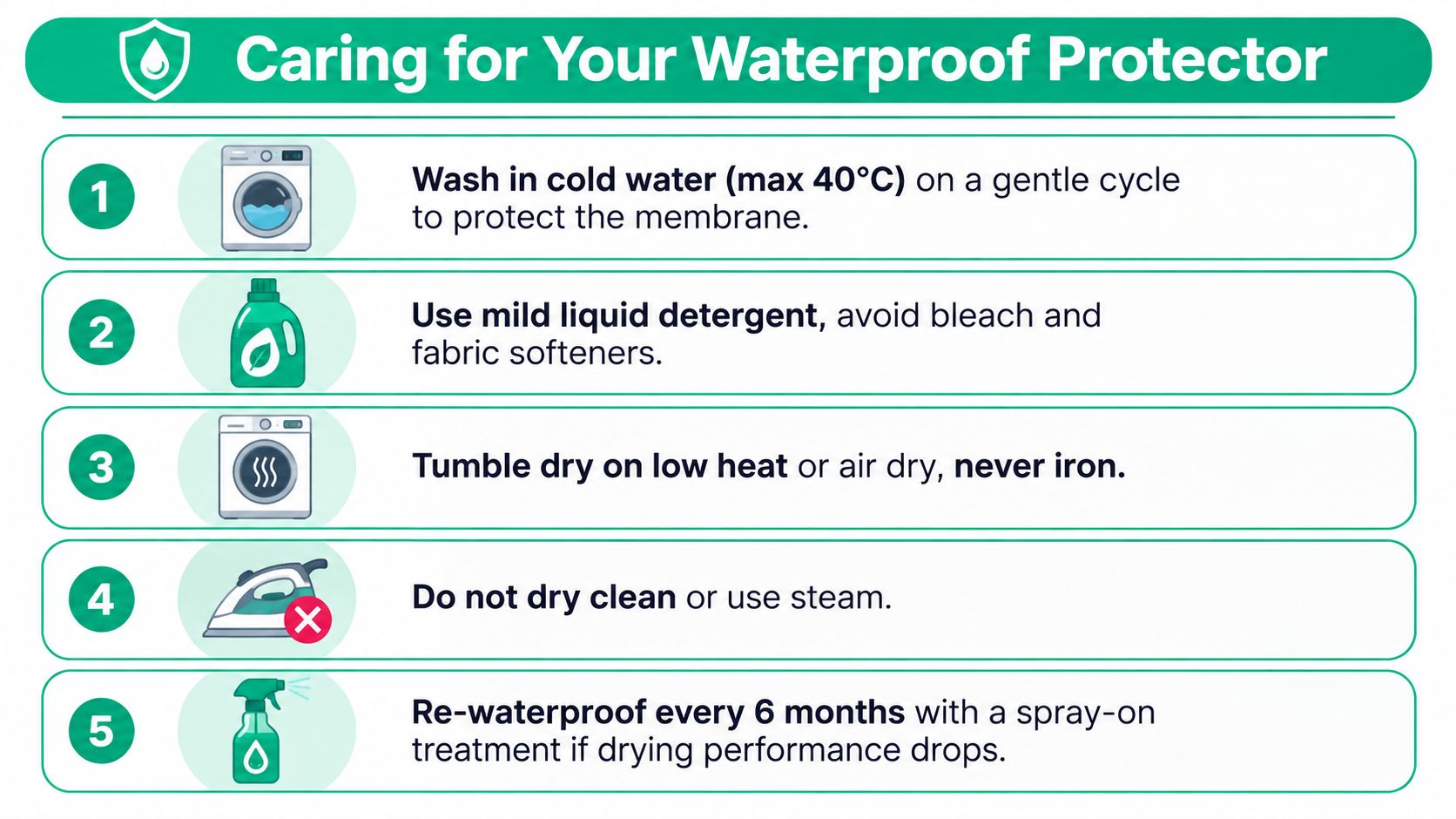
Keep the membrane intact in the wash
The safest routine is a gentle cycle with mild liquid detergent. Avoid fabric softener, because it leaves a coating that can interfere with how the fabric breathes, and don't use bleach unless the care label explicitly allows it. A practical care guide for mattress protectors is available in Protect-A-Bed's how to wash mattress protector advice, and the basic principle is straightforward, clean the fabric without hammering the barrier.
Drying matters just as much. Low heat is safer than high heat, and air drying is even gentler when you've got time. Don't iron a waterproof protector, and don't dry clean it or expose it to steam, because those methods work against the bonded layers that make the barrier effective in the first place.
Match the wash routine to the household
A family bed with sweat, spills, or nighttime accidents needs more frequent laundering than a spare room protector. A guest bed can go longer between washes if it's not being used regularly, but it still needs periodic cleaning so the fabric stays fresh and the membrane doesn't accumulate residue. If you're handling stored linen, bedding, or spare room protection, it helps to think in the same way as how to safeguard stored items, keep it clean, dry, and protected from avoidable damage while it isn't in use.
If the top layer starts to feel less breathable after washing, the culprit is often detergent residue or heat stress, not the waterproof layer itself.
Spot-clean small spills quickly, then let the protector dry properly before refitting it. If the surface begins to feel persistently damp or the waterproofing no longer seems consistent after washing, the protector may be reaching the end of its serviceable life. That's the point where replacement makes more sense than trying to rescue a worn membrane.
Warranty Coverage and Common Troubleshooting Fixes
Warranty matters because it tells you what the maker is willing to stand behind. Protect-A-Bed offers warranty coverage of up to 10 years against material or manufacturing defects, with UK fulfilment providing 1–3 working day delivery for in-stock items and free shipping on orders over £90. That's useful context when you're buying a protector for a thick mattress, because fit and durability are both part of the purchase decision (warranty and delivery details).
Diagnose the common annoyances before blaming the product
Noisy fabric usually means the protector is under too much tension, or the fitted sheet on top is too tight and rubs the surface. Slight condensation under the membrane can happen when the room is warm and the sleep stack holds heat, so a cooler top fabric or more breathable bedding layers can help. If the fit changes after the first wash, the most likely causes are heat, over-drying, or the wrong size allowance from the start.
A quick troubleshooting order works well.
- Noise first: Check whether the mattress protector is stretched too tightly across the corners, then smooth the outer sheet so it isn't pulling against the surface.
- Warmth second: Reduce layered heaviness above the protector if the bed feels stuffy, because the membrane can only do so much if the whole stack traps heat.
- Fit after washing: Re-measure the mattress if the corners have started to slip, because a protector that was marginal before washing usually becomes more obvious afterwards.
- Zip issues on encasements: Inspect the closure path for twists or fabric caught in the seal before you force the zip.
The decision framework is simple once the details are clear. Measure the full depth, choose the smallest pocket that still gives a snug fit, then pick the enclosure style that matches the room and the risk level. If you do those three things well, the protector tends to disappear into the bed, which is exactly what a good one should do.
If you're fitting a thick mattress, Protect-A-Bed offers waterproof protectors, extra-deep fit options, and encasement styles built for practical sleep-surface protection. Visit Protect-A-Bed to check the available depths, fabric finishes, and warranty-backed options before you buy.