

Toddler Mattress Protector Guide for UK Parents

At 2am, the smell tells you what happened before you switch on the light. The sheet is wet, your toddler is wide awake and cross, and the mattress underneath is now part of the problem. You strip the bed, search for a clean cover and discover that the protector you bought is either too small, too noisy, or still damp from yesterday's wash.
That's when a simple purchase becomes a practical question. Do you need a waterproof layer, a mite-proof encasement, or just a washable cover that fits properly? Does the protector work safely with a cot, cot-bed or toddler bed? Can it block accidents without turning the sleeping surface warm and crinkly?
This guide cuts through the sales language. You'll get clear advice on fit, breathability, waterproofing, allergy claims, washing and rotation, organised around the stage your child is in. There isn't one universal best buy. The right toddler mattress protector is the one that stays flat, feels comfortable, survives your laundry routine and solves the mess you're dealing with now.
Table of Contents
- The 2am Wake-Up That Starts the Search
- What a Toddler Mattress Protector Actually Does
- Fabrics, Membranes, and the Feel of the Bed
- Getting the Fit Right for Cot, Cot-Bed, and Toddler Bed
- Allergies, Dust Mites, and What the Evidence Really Shows
- Washing, Drying, and Keeping the Spare Ready
- Choosing Well, Warranty, and What to Expect After You Buy
The 2am Wake-Up That Starts the Search
The first night of potty training often exposes every weakness in a bedding setup. Your child wakes after an accident, the fitted sheet comes off, and the protector underneath has bunched into a ridge. You're trying to pull it away without fully waking them, but the elastic keeps snapping back over the mattress corner.
A protector should make this job faster, not add another fiddly layer. In the dark, you need to identify the wet section, remove the dirty cover, fit the spare without fighting the mattress and get your toddler settled again. If the cover takes ten minutes to install in daylight, it won't feel like a sensible product at midnight.
The same applies to the bed itself. A cot mattress, a cot-bed mattress and a toddler bed can have different dimensions or depths even when the retailer uses familiar size names. A cover that technically matches the length and width can still ride up, wrinkle or make the fitted sheet too tight.
Practical rule: If the protector moves under your hand, your toddler can move it too. The finished sleep surface should be flat, smooth and secure.
Safety matters more than convenience for younger children. UK government guidance records 273 deaths among children under five from unintentional injuries between 2012 and 2016, an average of 55 a year. Within that period, 41 deaths involved suffocation or strangulation in bed, while another 32 involved hanging or strangulation elsewhere. The same summary says these injuries primarily affect children under two, and estimates around 370,000 A&E visits and 40,000 emergency admissions annually in England for under-five injuries. Read the UK government guidance on unintentional injuries under-fives as a reason to treat the sleep surface as a safety-control point, not merely a hygiene accessory.
That doesn't mean every toddler needs an expensive technical protector. It means the product must fit the mattress, preserve a firm and flat surface, avoid loose material and support the way your family manages spills, sweat, illness and toilet training.
What a Toddler Mattress Protector Actually Does
A toddler mattress protector is a removable cover that sits between the mattress and the fitted sheet. Its job is to catch sweat, milk, water, urine, vomit and everyday grime before those substances reach the mattress core.
Most useful designs combine two layers. The upper fabric absorbs or spreads moisture across the surface, while a waterproof membrane below blocks liquid from passing through. Thin polyurethane, often called PU, or similar flexible membranes can stop liquid while allowing some water vapour to move through. That vapour exchange helps the bed feel less clammy than a heavy plastic sheet.
The protector also reduces cleaning work. You can wash the cover, but you can't normally put the foam or coil mattress in the washing machine. Keeping moisture out helps prevent staining and persistent smells, although a protector still needs prompt washing after an accident.
Protector, encasement or topper
These products solve different problems. Confusing them leads to buying too much, or buying the wrong layer.
| Cover type | What it covers | Best for |
|---|---|---|
| Protector | The sleeping surface and usually the sides, secured with elastic or a fitted skirt | Daily protection from moisture, stains and perspiration |
| Encasement | The entire mattress, including all six sides, usually closed with a zip | Targeted allergen control or bed-bug protection |
| Topper | Adds cushioning or changes the feel of the mattress | Comfort adjustment, not liquid protection |
A standard fitted protector is the sensible everyday option for most toddlers. It comes off quickly and doesn't require you to lift and zip around the whole mattress during a night-time accident.
A full encasement is more specialised. NHS-style allergy guidance recommends allergen-proof barrier covers on all mattresses, duvets and pillows, and says covers should be breathable and completely enclose the item. The NHS-style house dust mite avoidance leaflet also advises weekly washing of bedding that isn't encased. That's a different use case from ordinary spill protection.
A topper is not a substitute for either. It changes comfort and adds material to the bed. For babies and young toddlers, don't add softness or bulk casually. UK baby guidance focuses on a firm, flat, clean, dry and waterproof mattress that fits snugly, and warns against soft bedding, pillows and duvets for babies under one because of suffocation and overheating risks. Check the NHS advice on what you need for your baby before adding layers.
Fabrics, Membranes, and the Feel of the Bed
The fabric against your child matters, but the membrane underneath decides whether the product is waterproof. Retail descriptions often focus on cotton, bamboo or cooling fibres while giving less useful detail about the backing.
Brushed cotton and cotton-rich terry feel familiar and soft. Terry loops absorb surface moisture well, but these fabrics can feel warm in a centrally heated nursery, particularly beneath a thick fitted sheet. They're a comfortable choice for children who dislike slippery or synthetic bedding, provided the protector doesn't create too much loft.
Tencel or lyocell has a smoother, cooler feel and usually handles moisture comfortably. It suits toddlers who sweat at night or dislike a fuzzy surface. It can cost more, so prioritise it for a child who notices temperature and texture rather than paying for it automatically.
Polyester microfibre is the practical budget option. It dries quickly, resists shrinking and is easy to rotate through frequent washes. The compromise is feel. Lower-quality microfibre can feel less airy or slightly slick.
Bamboo blends sit between these choices. They may feel soft, but the blend and weave determine how breathable the finished protector is. Don't treat “bamboo” as proof of superior performance. If you're comparing fibres for children's bedding more broadly, this blanket fabric guide for families offers useful context on how texture, warmth and care requirements vary.
The membrane is the real decision
A thin PU laminate is usually the better design for a toddler's everyday bed. It can be quiet, flexible and more air-permeable than a thick plastic backing. Cheap construction may still feel slightly plasticky, especially when the membrane is loose or poorly bonded.
PVC-style membranes tend to provide a strong liquid barrier at a lower price, but they're more likely to rustle and feel less breathable. That noise matters if your toddler is a light sleeper, and the extra warmth matters in a heated bedroom.
Charcoal-infused fabrics are marketed for odour control. Treat that as a secondary feature. A protector that fits badly or stays damp will still be unpleasant, regardless of the fibre treatment.
| Material | Feel | Warmth | Noise | Washability |
|---|---|---|---|---|
| Cotton or cotton-rich terry | Soft, familiar, absorbent | Medium to warm | Usually quiet | Good, but drying can take longer |
| Tencel or lyocell | Smooth and cool | Cool to medium | Quiet | Good, care label decides drying |
| Polyester microfibre | Smooth and practical | Medium | Usually quiet | Quick-drying and easy to rotate |
| Bamboo blend | Soft, variable | Cool to medium | Usually quiet | Depends on blend and construction |
| Thin PU membrane | Flexible and discreet | Lower than thick plastic | Quiet | Needs controlled heat |
| Thicker PVC-style membrane | More plastic-like | Warmer | More likely to rustle | Waterproof, but less comfortable |
For most UK homes, choose the softest surface your child tolerates, then favour a thin PU membrane over a thick plastic sheet. Breathability, quietness and drying speed beat a dramatic material label.
Getting the Fit Right for Cot, Cot-Bed, and Toddler Bed
Measure the mattress, not just the bed frame. Manufacturers use familiar size categories, but mattress depth and corner construction vary. A protector must match the mattress length and width closely, then accommodate its depth without pulling the seams or leaving loose fabric.
Standard UK cot mattresses are commonly listed at 60 x 120 cm, while cot-bed mattresses are commonly 70 x 140 cm. Toddler beds may use 70 x 140 cm mattresses or move to a larger 90 x 190 cm format. Treat those as starting points, not permission to order without measuring.
Match the cover to the stage
For a cot, the protector should sit completely flat and stay below the mattress edge. A loose elasticated cover is unacceptable for an under-one. Check every corner after fitting, then press across the middle to make sure the cover hasn't created a padded ridge.
A cot-bed often carries a child through the toddler years, so its protector needs better long-term fit. A short skirt can pop off a deeper mattress, while an overly generous skirt may bunch beneath the sheet. Don't assume a standard depth will suit an extra-deep cot-bed.
A toddler bed creates more variation. Some use the same mattress as a cot-bed, while others take a larger single-style mattress. The protector should match the actual mattress rather than the age printed on the packaging.
| Bed type | Standard UK size (cm) | Typical age range | Recommended skirt depth |
|---|---|---|---|
| Standard cot | 60 x 120 | Baby stage, then transition | Measure mattress, choose a snug shallow fit |
| Cot-bed | 70 x 140 | Toddler years and beyond | Match the measured mattress depth, not a generic label |
| Toddler bed | 70 x 140 or 90 x 190 | Toddler to young child | Choose the exact length, width and depth |
Use this nursery essentials guide when you're checking the wider sleep setup, but keep the mattress measurement as the deciding detail.
The five-minute measuring routine
- Remove all bedding and measure the mattress length and width from edge to edge.
- Measure its depth without compressing the foam.
- Check the protector's stated dimensions and maximum mattress depth.
- Fit the protector, then run your palm across the full surface.
- Add the fitted sheet and check that its corners remain secure.
A protector that is too tight strains seams and may pull the mattress cover upward. One that is too loose creates folds. For further fitting detail, see this guide to a fitted mattress protector.
Allergies, Dust Mites, and What the Evidence Really Shows
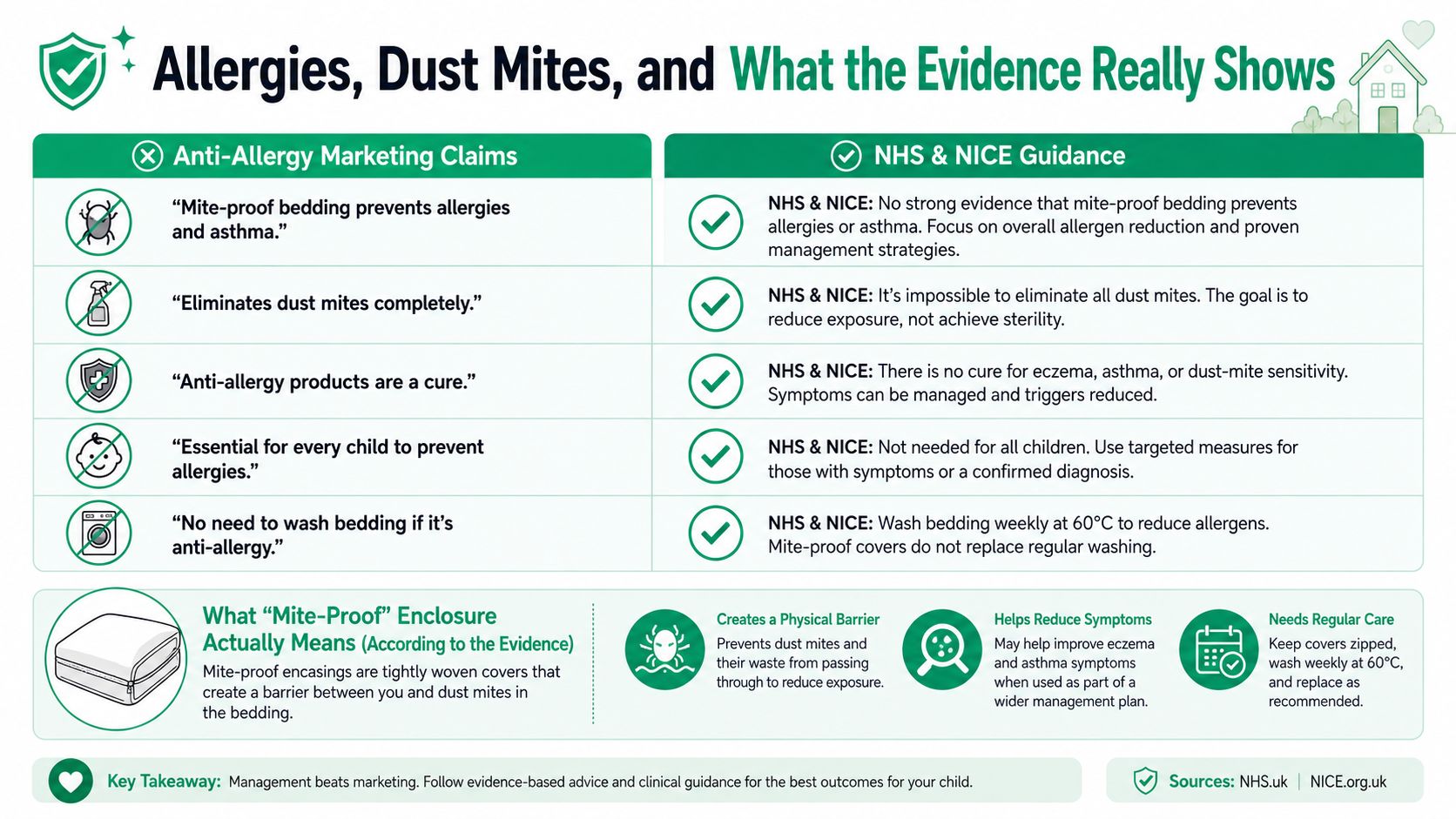
“Anti-allergy” is not a magic property. A printed claim doesn't prove that a protector encloses the mattress tightly enough to reduce mite allergen exposure, and it doesn't replace ventilation, humidity control or washable bedding.
NHS patient guidance supports a more specific approach. It recommends allergen-proof barrier covers that completely enclose mattresses, duvets and pillows, with breathable construction, alongside regular washing of bedding that isn't enclosed. That makes a true encasement relevant for a child with diagnosed mite sensitivity, asthma concerns or a clinician-led allergy plan. It doesn't make every waterproof protector an allergy treatment.
What the UK evidence supports
A randomised trial in North-West England found that mite-impermeable mattress and pillow encasings produced an 84% reduction in Der p 1 dust from the child's mattress. In the same intervention, emergency hospital attendance for severe asthma exacerbations fell by 45% among mite-sensitised children. Those figures come from the UK paediatric allergy trial, and they support source control for children with confirmed mite sensitisation, not a universal promise for every toddler.
The wider picture is less dramatic. A classic England-based primary-care trial found that barrier bedding didn't improve asthma outcomes in an unselected group, as recorded in the published trial summary. The practical conclusion is straightforward. Targeted barriers make sense when there's a diagnosed sensitivity or difficult symptoms. They're poor value as a general wellness upgrade for a symptom-free child.
A true mite-proof membrane must be sufficiently low-permeability and securely closed around the mattress. A loosely woven “anti-allergy” top fabric isn't the same thing. Look for independent testing or a recognised allergy-related certification, and check whether the claim applies to the complete encasement rather than only the surface fabric.
If your toddler sleeps well and has no diagnosed dust-mite sensitivity, choose a quiet waterproof protector with a breathable surface and easy washing. If they have confirmed mite sensitivity or persistent wheeze, discuss the wider strategy with a clinician and prioritise a tested encasement. For product-specific context, this guide to a mattress protector and dust mites is more useful than relying on the words “anti-allergy” alone.
Washing, Drying, and Keeping the Spare Ready
A protector fails most often in the laundry, not on the bed. Waterproof membranes can look fine while heat, bleach or fabric softener gradually weakens the bond between the top fabric and backing.
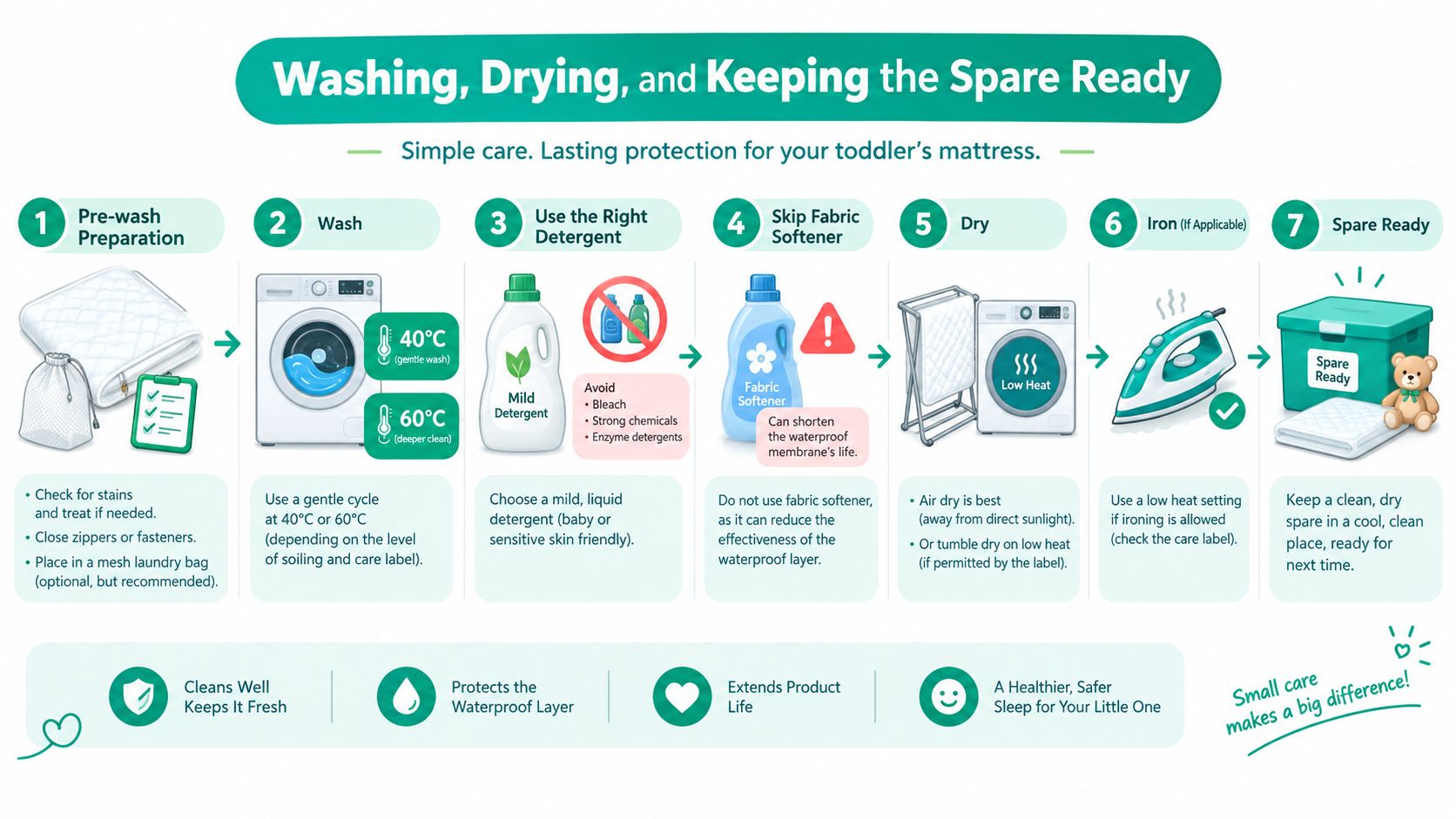
Start with the care label. A 40°C wash is a sensible routine for ordinary accidents, while a 60°C wash may be appropriate when the label permits it and the cover needs a more intensive clean. Use a mild detergent, avoid bleach and skip fabric softener. Softener can coat fibres and shorten the useful life of a waterproof membrane.
A routine that works on difficult nights
Pre-treat milk, juice or urine quickly with a small amount of mild detergent or a product approved for the fabric. Don't scrub aggressively across the membrane, and don't use strong chlorine products to chase a stain.
Wash the protector with similar lightweight bedding so it can move freely. Overloading the drum can leave detergent behind and prevent proper rinsing. After washing, check that the membrane isn't sticking to itself before drying.
Air-drying is the safest default. If you use a tumble dryer, select the lowest permitted heat. High heat can warp or delaminate PU layers even when the fabric still looks normal. Never iron the waterproof section unless the manufacturer explicitly allows it.
Build a rotation, not a rescue plan
Keep two protectors for an ordinary cot or toddler bed. One can be fitted while the other is washing or drying. During potty training, stomach bugs or repeated night-time accidents, three is more realistic. A spare only helps if it's clean, fully dry and stored where you can reach it without searching through drawers.
Check the cover after every demanding wash period:
- Peeling or bubbling: The membrane is separating from the fabric.
- Persistent odour: Moisture may be trapped or the barrier may have deteriorated.
- Leaks at seams: Waterproofing has failed, even if the centre still looks sound.
- Shrunken corners: The fitted shape may no longer hold the mattress securely.
Replace a protector when it no longer stays flat or keeps liquid out. Don't keep it in service because the surface fabric still looks acceptable. For a more detailed laundering routine, use this guide on how to wash a mattress protector properly.
Choosing Well, Warranty, and What to Expect After You Buy
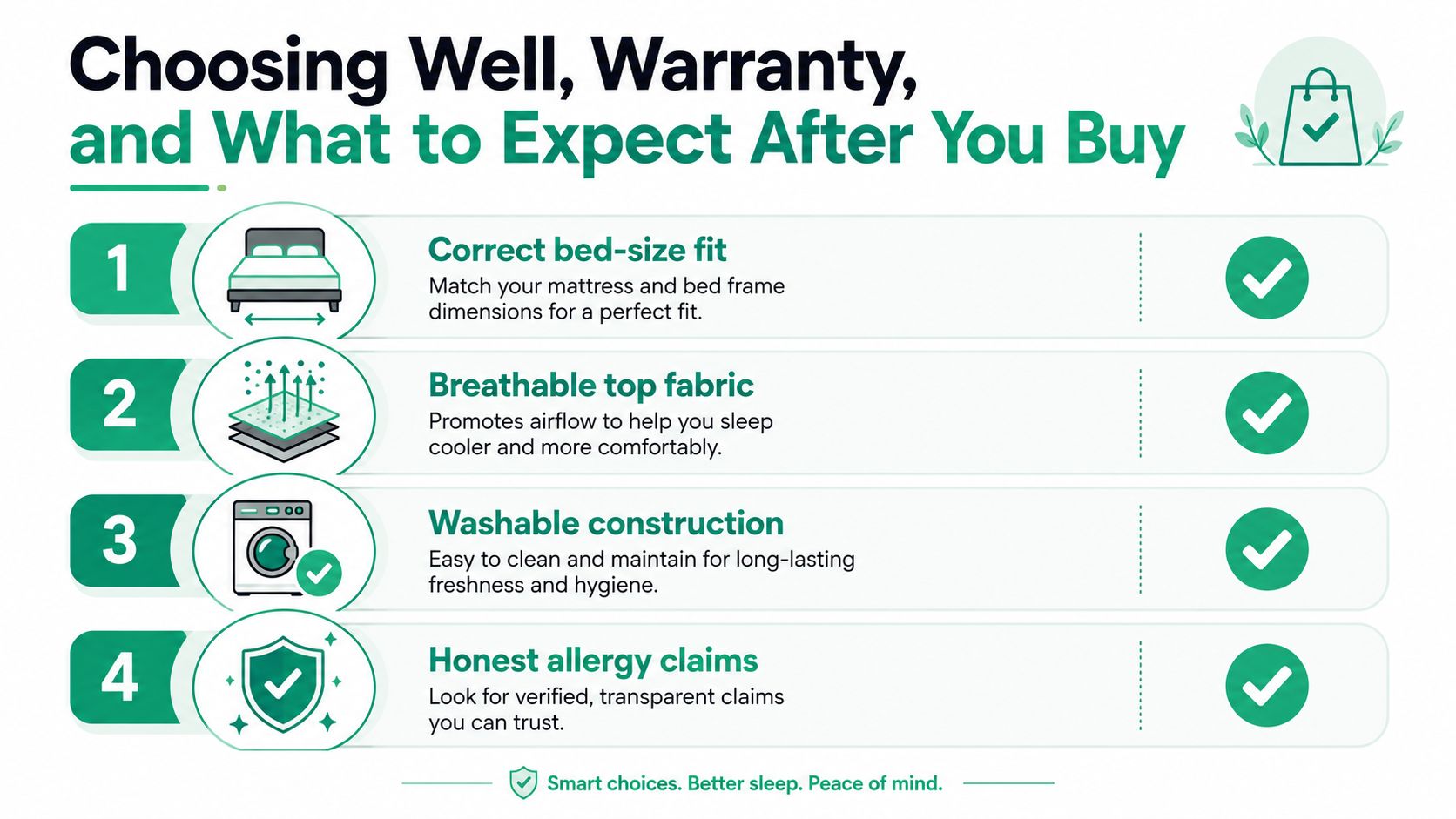
Forget the “premium” label until the basic checks pass. A toddler mattress protector earns its place through four things: correct fit, a comfortable top fabric, washable construction and honest allergy information.
Start with the bed size and depth. If the cover doesn't stay tight around the mattress, the rest is irrelevant. Next, inspect the surface fabric. Cotton terry suits children who like a familiar, soft feel, while Tencel or lyocell can suit hot sleepers. Polyester microfibre is sensible when quick drying and lower cost matter most.
The four-check shortlist
- Correct bed-size fit: Confirm length, width and mattress depth before ordering.
- Breathable top fabric: Choose a surface that won't leave your toddler hot or clammy.
- Washable construction: Check the permitted temperatures, drying method and membrane care.
- Honest allergy claims: Pay for tested mite protection only when your child's needs justify it.
Read the small print before checkout
Warranty terms usually distinguish manufacturing faults from ordinary wash wear. Bleach, excessive heat and care outside the label can weaken your position if the membrane fails, so save the care instructions and follow them.
Delivery matters when you're dealing with a leaking mattress. Stocked products often arrive quickly, while warehouse-dispatched items can take longer. Check the stated dispatch date, not only the delivery estimate, and keep one spare so a delayed parcel doesn't leave the bed uncovered.
If you're looking for material-focused options, browse a guide to non-toxic mattress covers, then return to the same practical questions: does the cover fit, breathe, wash and stay quiet?
Protect-A-Bed offers UK cot and mattress protectors with waterproof, air-permeable membrane construction, including terry, cotton and Tencel-style options for different comfort priorities. Visit Protect-A-Bed with your mattress measurements ready, compare the care instructions and choose the protector that matches your toddler's current stage rather than the loudest marketing claim.