

Superking Mattress Protector Waterproof Guide

You've bought the broadest mattress in the room, added a deep topper for comfort, and then discovered that the “superking waterproof protector” you ordered barely reaches the sides. By morning, a corner has pulled free, the skirt has ridden up, and the waterproof layer covers only the sleeping surface. That's a frustrating result, but it's also a common misunderstanding: waterproof doesn't automatically mean fully encasing, and superking beds expose every weakness in a protector's fit.
A reliable choice needs to match the mattress dimensions, depth, construction and intended use. Everyday spill protection calls for a different design from dust-mite control or bed bug remediation. The right membrane matters too, because a cover that keeps liquid out but makes the bed hot, noisy or difficult to wash won't work well in daily life.
Table of Contents
- Why Superking Beds Need Specialised Waterproof Protection
- Sizing and Depth Challenges for Superking Mattresses
- How Miracle Membrane Technology Balances Protection and Comfort
- Standard Protectors Versus Full Bed Bug Encasements
- Installing a Protector on a Heavy Superking Bed
- Washing Rules That Preserve the Waterproof Barrier
Why Superking Beds Need Specialised Waterproof Protection
A ruined superking mattress is rarely damaged by one dramatic accident. More often, protection fails gradually. A drink spills near the centre, perspiration reaches an exposed edge, or a child climbs into bed after an accident. On a smaller mattress, a protector may have enough spare fabric to stay in place. On a superking, a small sizing error can leave a long strip of mattress exposed.
The larger sleep surface also creates more opportunity for moisture and household debris to reach the mattress. A protector needs to cope with movement from two sleepers, a larger perimeter and potentially heavier bedding. A shallow fitted skirt may look secure when first installed, then loosen as the mattress flexes during the night.
Protection is about more than visible stains
Liquid damage is the obvious concern, but the mattress also collects material that's difficult to remove properly. A mattress protector creates a washable barrier between the sleeper and the mattress, helping keep perspiration, body oils, spills and everyday dust from working into the upholstery.
That barrier can be relevant to allergy management. UK allergy guidance recommends allergen-proof barrier covers on all mattresses, duvets and pillows, and says covers should be breathable and completely enclose the item. It also advises washing unencased bedding weekly, with washing at 60°C or above killing mites. You can read the full practical guidance in the House Dust Mite Allergy factsheet from Allergy UK.
The same guidance reports that one in five adults and one in 20 children test positive for house dust mite allergy, while one in three children with eczema and asthma test positive. Those figures don't mean every allergy sufferer needs the same product, but they do show why a large bed deserves more than a thin, decorative layer.
Practical rule: Choose the protector according to the problem you're trying to control. Spill protection, allergen reduction and bed bug remediation require different levels of enclosure.
A standard protector can still be the sensible choice
Not every household needs a six-sided zip cover. If your priority is protecting a clean mattress from drinks, sweat and occasional accidents, a well-fitted waterproof protector with a breathable surface may be adequate. It should sit flat, stay tensioned at the corners and have a skirt deep enough for the mattress profile.
A useful general explanation of how protectors, toppers and other bedding layers work is available in this bedding and mattress protector guide from Lucas Furniture & Mattress. The key point for a superking is practical rather than fashionable: the protector must remain in position after the bed has been slept in, not just look correct when it comes out of the packaging.
Sizing and Depth Challenges for Superking Mattresses
A UK superking mattress measures 180 x 200 cm, but those two measurements are only the starting point. The depth determines whether the protector's fitted skirt reaches beneath the mattress, whether the corners stay anchored and whether the sides receive any waterproof coverage.
Retail listings commonly describe superking as 180 x 200 cm while applying separate depth restrictions. One UK listing specifies a 30 cm depth limit and warns that its waterproof section covers the top surface, while the fitted skirt itself isn't waterproof. That distinction is easy to miss if you search only for the words “superking” and “waterproof”. The product may fit the mattress footprint while leaving the sides vulnerable.
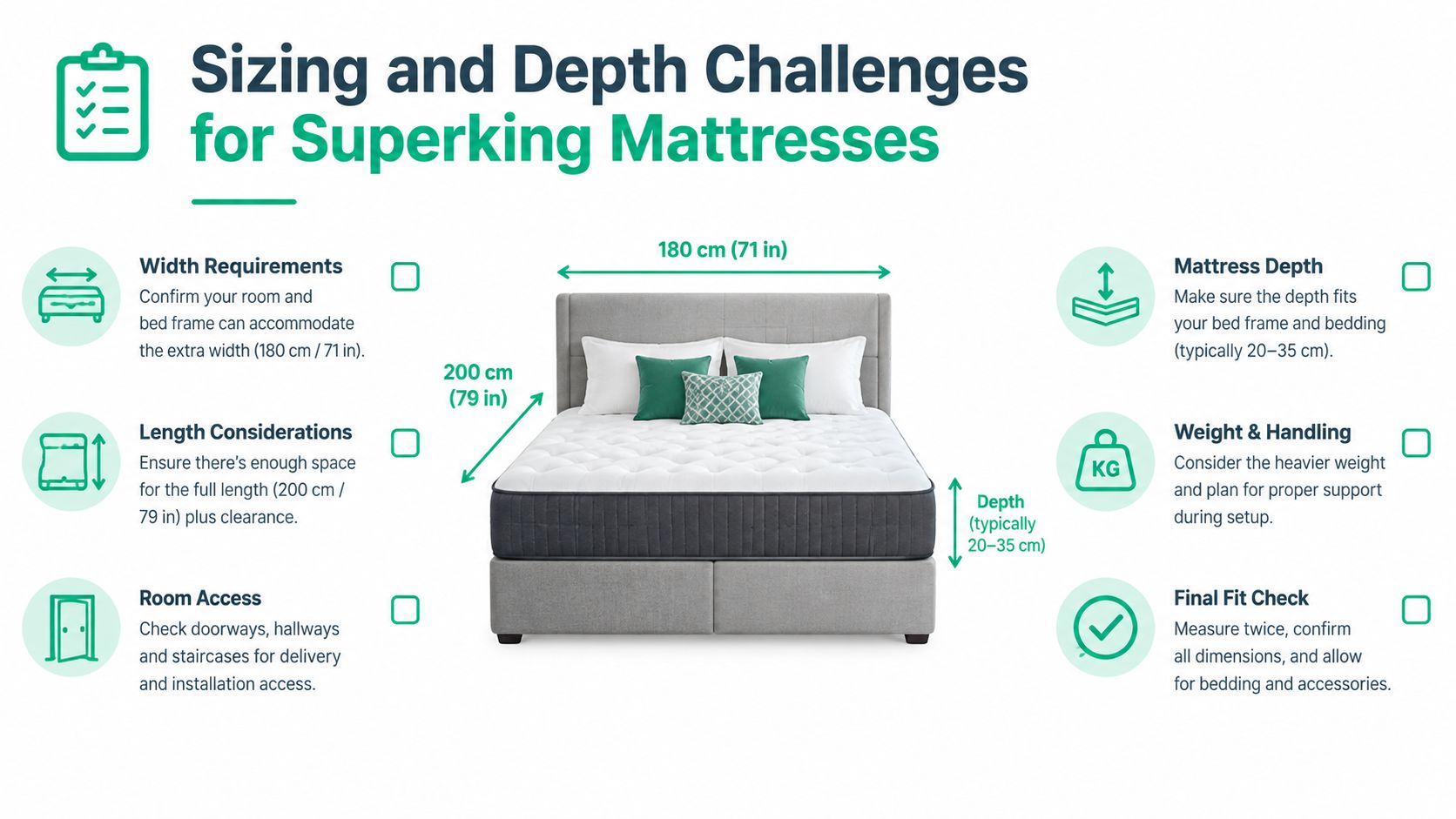
Measure the bed, not the label
Remove loose bedding and measure the mattress while it's resting on the bed base. Measure width from side to side, length from head to foot, and depth from the lowest point of the mattress base to the highest point of the sleeping surface.
Include any pillow-top or permanently attached comfort layer. If you use a separate topper, measure the combined height if the protector is expected to fit over both. A protector that fits the mattress alone may fail once the topper adds extra bulk.
Before ordering, check these details:
- Footprint: Confirm the protector is designed for 180 x 200 cm, rather than relying on a retailer's “superking” filter.
- Usable depth: Compare the stated depth range with the complete mattress and topper height.
- Side coverage: Check whether the waterproof membrane extends down the sides or stops at the top panel.
- Corner construction: Look for elastic that can hold tension around a deep profile without pulling the top fabric into folds.
- Return conditions: Keep packaging and avoid washing the protector until you've confirmed the fit.
For a more precise measuring method, use this guide to measuring mattress depth. It's particularly useful where the mattress has rounded edges, deep quilting or a topper that changes the overall profile.
Top-only and full-coverage designs are not interchangeable
A fitted protector usually places the waterproof barrier across the top and uses a fabric skirt to hold it in place. That can be perfectly functional for a spill that stays near the centre, but it isn't the same as a waterproof shell around the sides.
A fully enclosed design uses a zip or sealed construction to surround the mattress. It's the more appropriate format where side protection, dust-mite containment or bed bug control matters. Don't assume that “waterproof” describes every panel. Read the product specification for the membrane position, skirt material, depth allowance and zip sealing.
Check the fit with the bed made. A protector that works on an uncompressed mattress can shift when the topper, sheets and sleepers add pressure. The corners should stay anchored without forcing the zip or elastic to carry the mattress's weight.
How Miracle Membrane Technology Balances Protection and Comfort
Older waterproof bedding often earned its reputation for a reason. Plasticised covers could feel stiff, trap heat and produce a rustling sound whenever a sleeper moved. That discomfort is amplified across a superking surface, where the cover has more material to fold, stretch and rub against the sheet.
Modern waterproof-breathable protectors use a different approach. A polyurethane membrane can form a thin, flexible barrier that blocks liquid ingress while allowing water vapour to pass through. UK retail descriptions of this construction explain the central trade-off clearly: the membrane resists seepage without creating an entirely sealed plastic sleeping surface.
What the membrane does and doesn't solve
A breathable membrane doesn't make a protector weightless or guarantee a cool bed in every room. Heat retention also depends on the top fabric, sheet composition, mattress materials, duvet and the sleeper. However, membrane choice removes one common source of discomfort: a rigid, noisy waterproof sheet that sits directly beneath the bedding.
On a superking, edge and zip construction deserve equal attention. The membrane may perform well in the centre, but liquid can still reach the mattress through an unprotected side, an open zip path or a poorly fitted corner. Independent product descriptions of fully zippered encasements describe coverage on all six sides, which is materially different from a top panel with a non-waterproof skirt. The engineering only works as intended when the whole construction matches the use case.
For a plain-language overview of how a breathable waterproof layer works, see Protect-A-Bed's explanation of the breathable waterproof membrane. It helps separate the membrane itself from the surface fabric and the way those layers are joined.
Choose comfort as carefully as waterproofing
Look for a soft, quiet top fabric that won't create friction under the sheet. A terry or quilted surface can feel more familiar than a bare film, while a cooling-oriented textile may suit sleepers who dislike warmth. The membrane should flex with the mattress rather than crackle when the sleeper turns.
You'll also find useful general context in this guide to breathing easy with mattress protection. Treat “breathable” as a construction claim to investigate, not a substitute for checking depth, side coverage and care instructions.
A good superking mattress protector waterproof solution balances three requirements:
- Liquid resistance, so spills and perspiration don't reach the upholstery.
- Vapour management, so the layer doesn't feel unnecessarily hot or clammy.
- Mechanical durability, so movement, laundering and fitting don't compromise the membrane or seams.
Standard Protectors Versus Full Bed Bug Encasements
A standard fitted protector and a bed bug encasement serve different purposes. The first protects the sleeping surface from everyday moisture and staining. The second seals the mattress on every side, including the seams and harbourage areas where bed bugs can remain hidden.
That distinction matters for dust mites as well. Allergy guidance recommends breathable covers that completely enclose the item, while research linked to the London School of Hygiene & Tropical Medicine found that allergen-impermeable bed covers reduced Der p 1 mattress-dust levels from 1.71 µg/g in the control group to 0.58 µg/g in the intervention group at six months. The study is useful because it demonstrates the barrier effect, but it doesn't turn every fitted waterproof protector into an allergen-proof encasement. Seams, sides and closures still matter.
Compare the construction before buying
| Feature | Standard Fitted Protector | Zip-Around Encasement |
|---|---|---|
| Main purpose | Everyday spill and perspiration protection | Mattress enclosure for allergen and pest control |
| Coverage | Usually top surface, with a fitted skirt | Six-sided coverage around the mattress |
| Side waterproofing | Varies, and may be absent | Designed to enclose the sides |
| Closure | Elasticated corners or fitted edge | Zip or sealed closure |
| Dust-mite use | Limited unless the product specifically provides a complete barrier | More suitable when complete enclosure is required |
| Bed bug use | Not sufficient as a stand-alone control | Purpose-built designs can trap existing bugs and block new entry |
| Practicality | Easier to remove and wash | More involved to install and maintain |
UK pest-control guidance makes the bed bug distinction explicit. A mattress protector alone won't prevent an infestation, while a purpose-built encasement can trap existing bugs inside and stop new ones entering. One UK guide advises leaving an encasement in place for at least 12 months, reflecting how long bed bugs can survive without a blood meal. Read the detailed UK bed bug control guidance if you're dealing with an active problem.
Match the cover to the risk
For a family bedroom with occasional spills, a fitted waterproof protector is usually the more convenient option. For severe allergy concerns, choose a product explicitly designed as an allergen barrier and verify that it closes around the entire mattress.
For landlords, hotels, guest accommodation and care settings, a zip-around encasement is more defensible where bed bugs or cross-occupancy hygiene are concerns. Domestic bed bug work can involve inspections of £150 to £300, insecticide treatment of £150 to £300 per room, and heat treatment of £300 to £600 per room, according to the cited UK guidance. Those costs make prevention and durable protection worth considering, but an encasement doesn't replace inspection or professional treatment.
Further reading on the wider practical value of mattress protection is available in this guide to the hidden benefits of a mattress protector. The decision should still come down to the threat, the construction and how consistently the cover will be used.
Installing a Protector on a Heavy Superking Bed
A superking mattress is awkward to handle, especially on a low bed base or in a room with limited clearance. Pulling a tight protector over one corner at a time can strain elastic, distort seams and put unnecessary force on a zip. Installation is easier when you prepare the bed and use the mattress's own flexibility rather than fighting its weight.
Fit a fitted protector without overstretching it
- Clear the working area. Remove sheets, blankets and the topper if it's separate. Check the mattress for moisture or debris before covering it.
- Identify the orientation. Find the head and foot ends of the protector and locate the waterproof panel. Don't assume the label or seam indicates the correct direction.
- Place it on the mattress first. Position the protector over the top, aligning the central seams and corners before pulling the skirt down. This prevents you from stretching one side too far while the opposite side is misaligned.
- Work across the width. Ask another person to lift the mattress slightly from one side while you guide the skirt beneath it. Move around the bed rather than dragging the protector diagonally.
- Settle the corners gradually. Pull each corner over the mattress with your palm, not by yanking the elastic. If a corner requires excessive force, stop and check the depth specification.
- Smooth the surface. Run your hands across the protector and push any folds towards the edges. A flat surface reduces noise and helps the sheet sit securely.
- Replace the topper carefully. If the protector is designed to fit over the topper, confirm that the total depth remains within its stated range. Otherwise, place the topper above the protector only if the cover's construction allows it.
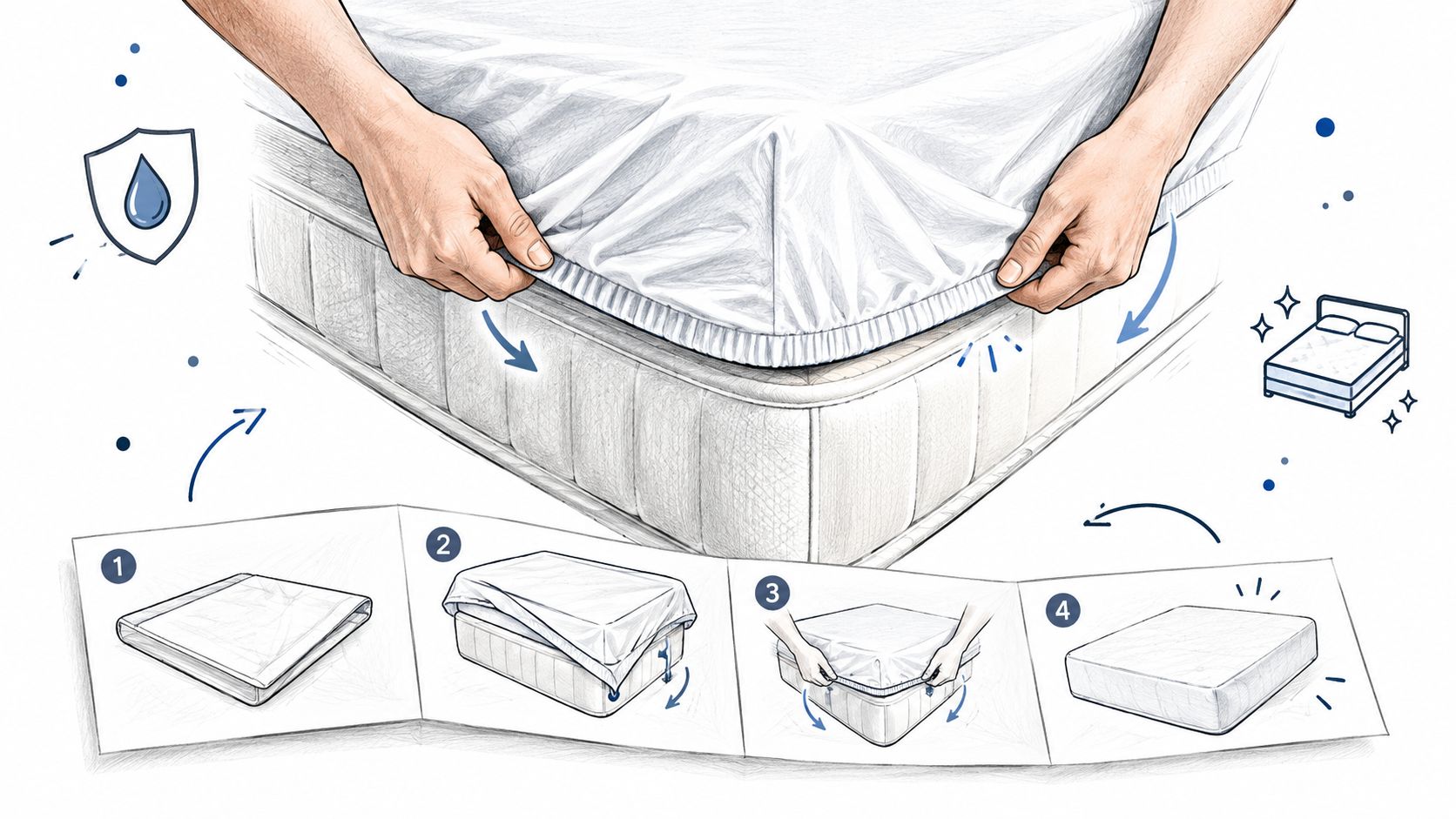
Install a zip-around encasement with patience
For an encasement, support the mattress on its side only as much as necessary. Slide the base section into position, keep the zip track straight and avoid catching the membrane in the closure. If the mattress is very heavy, use two people and protect the bed base from sharp contact points.
Once closed, inspect the zip path and all corners. The cover should be snug, but it shouldn't compress the mattress so aggressively that the zip teeth pull apart. Leave a small amount of natural allowance for the mattress to settle and expand within the enclosure.
Never use the zip as a lifting handle. Lift the mattress or cover by its fabric structure, not by the closure. A damaged zip can compromise the entire enclosure even when the membrane itself remains intact.
Washing Rules That Preserve the Waterproof Barrier
“Machine washable” doesn't mean indestructible. Waterproof membranes can lose effectiveness when they're exposed to unsuitable heat, harsh chemicals, rough handling or repeated overloading. The care label takes priority, because different protectors use different fabrics, membrane bonds and closure systems.
Independent UK guidance warns that incorrect washing can damage the membrane. Some buying guidance recommends washing a protector every one to two months under normal use, or monthly for allergies, asthma or pets, but the sensible frequency also depends on accidents, perspiration and whether the cover sits beneath another washable layer. The aim is to remove contamination without turning every laundry cycle into unnecessary mechanical stress.
Use a low-stress laundry routine
- Read the care label first. Follow the stated temperature, cycle and drying instructions rather than assuming that a waterproof cover can be treated like a towel.
- Close zips completely. A loose zip can snag fabric or damage the closure during washing.
- Avoid aggressive chemicals. Bleach, solvent-based stain removers and unsuitable fabric treatments can affect the membrane or its bond to the textile.
- Choose enough machine capacity. A tightly packed superking protector may not rinse properly and can suffer excessive creasing.
- Dry it thoroughly. Damp storage encourages odours and leaves the cover unready for use. Follow the permitted drying method, and don't apply high heat unless the care label specifically allows it.
- Inspect before refitting. Check seams, corners, elastic and the membrane area for cracking, lifting or pinholes.
The guide to washing a mattress protector gives a useful care reference, but your product label remains the final authority.
Judge durability by continued performance
A protector's real value appears after repeated use. The surface may still look clean while the membrane has weakened at a seam or the elastic has lost enough tension to expose the edge. Check for dampness reaching the mattress, unusual odours, noisy plastic-like movement or visible separation between layers.
For allergy households, washing the removable bedding doesn't replace a properly enclosed barrier. For bed bug concerns, don't remove a sealed encasement casually, since the containment period and treatment plan matter. For ordinary spill protection, refit the cover only when it's completely dry and correctly aligned.
A durable superking mattress protector waterproof product should make care straightforward, fit securely after washing and retain its barrier without becoming unpleasant to sleep on. Protect-A-Bed offers UK mattress protectors, waterproof-breathable options and bed bug encasements designed for different protection needs. Review the available formats and sizing on Protect-A-Bed, then measure your mattress depth before choosing the cover.