

Cot Bed Duvet Size: A UK Parent's Complete Guide

120 cm x 150 cm is the most commonly specified UK cot bed duvet size. It's larger than the typical 70 cm x 140 cm cot bed mattress, giving the duvet enough fabric to cover the child and hang safely over the sides of the longer toddler bed.
You may have arrived here with a duvet cover in one hand and a tape measure in the other, wondering whether “cot bed”, “toddler” and “junior” all mean the same thing. UK product listings don't always help. Some describe the mattress size, others describe the duvet or cover, and several guides give different measurements for what they call a cot bed.
That's why the number alone isn't enough. Your child's age, the bed's internal measurements, the duvet's tog rating, and the mattress protection underneath all need to work together. A duvet can be the right length and still be the wrong choice if the child is too young, the room is too warm, or the protector doesn't fit the mattress properly.
Table of Contents
- What Cot Bed Duvet Size Means in the UK
- Cot, Cot Bed, Toddler and Junior Bedding Explained
- How to Measure a Cot Bed Before You Buy
- Choosing the Right Tog for a Cot Bed
- How Protectors and Encasements Fit Under a Cot Bed Duvet
- Common Mistakes UK Parents Make With Cot Bed Duvets
- Putting the Cot Bed Sleep System Together
- Cot Bed Duvet Questions UK Parents Ask Most
What Cot Bed Duvet Size Means in the UK
The clearest starting point is 120 cm x 150 cm, the measurement most commonly given for a UK cot bed duvet. UK bedding guidance links this size with the larger cot bed format, rather than the smaller infant cot. The same guidance identifies the typical cot bed mattress as 70 cm x 140 cm, which explains why the duvet is noticeably bigger than the mattress beneath it. You can check the size relationship in this UK duvet and duvet cover size guide.
That extra fabric isn't an accident. A mattress sits inside the bed frame, while a duvet needs to cover the child's body and provide coverage beyond the mattress edges. Think of the mattress as the floor plan and the duvet as the roof. The roof has to extend beyond the walls, but it still needs to belong to the right-sized building.
Why the cot bed size causes confusion
An infant cot commonly uses a 60 cm x 120 cm mattress, whereas a cot bed generally uses the larger 70 cm x 140 cm format. The names sound similar, but they describe different stages of sleep and different bed footprints. A small infant cot duvet may look close enough on a product page, yet it can feel undersized once placed on a cot bed.
The phrase “cot bed duvet” also gets used inconsistently. Some guides list 120 cm x 140 cm, while others mention 80 cm x 120 cm, alongside the more widely cited 120 cm x 150 cm measurement. That disagreement reflects a muddle between mattress dimensions, duvet dimensions and duvet-cover dimensions, rather than a simple choice between equivalent products. The issue is discussed in this UK bedding size guide.
Practical rule: Treat the bed label as a starting point, not proof. Check the product's actual duvet dimensions and measure the mattress before buying the rest of the bedding.
The age decision comes first
A cot bed duvet is generally associated with the move into a toddler bed, around 18 months to 2 years, rather than with infant sleep. The same UK guidance says duvets shouldn't be used for babies under one year old. That means the child's age and sleep environment matter as much as the mattress size.
Once the duvet is appropriate for your child, choose the cover, tog rating and mattress protection as a joined-up set. You're not buying one loose rectangle of fabric. You're building a small sleep system that needs to fit the bed, suit the room and cope with real family life.
Cot, Cot Bed, Toddler and Junior Bedding Explained
UK children's bedding becomes easier to understand if you separate the bed size from the duvet size. The bed tells you how much sleeping surface your child has. The duvet is larger because it needs to cover the sleeper and extend over the mattress.
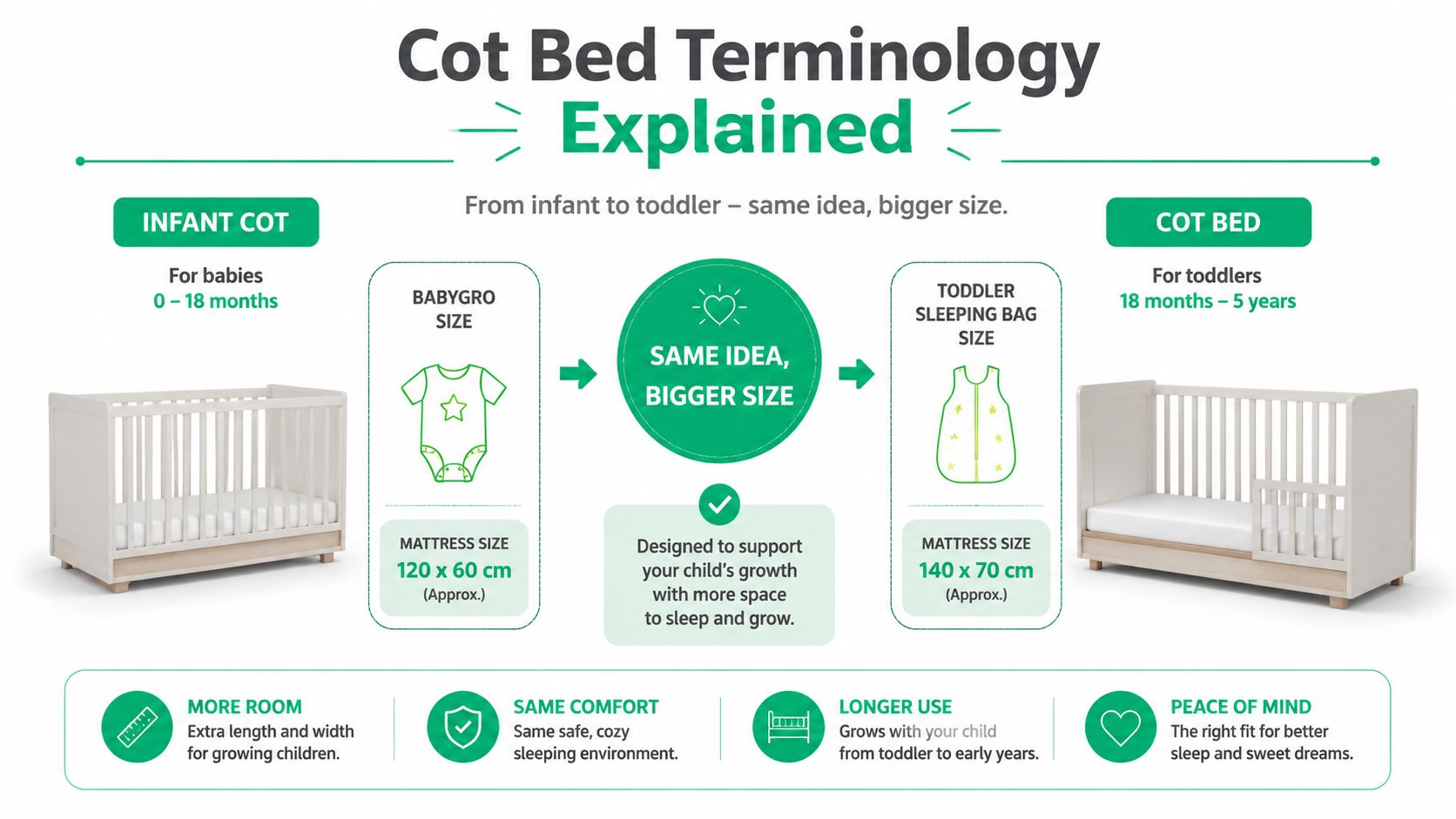
A useful comparison is the move from a babygro to a toddler sleeping bag. Both serve the same basic purpose, but the child, clothing and sleeping space have changed. Cot-to-cot-bed bedding follows a similar pattern. It's the same idea at a larger stage of childhood.
The main UK bed terms
- Infant cot: The commonly referenced mattress format is 60 cm x 120 cm. This is the smaller cot format used during infancy, when a duvet generally isn't the appropriate bedding choice.
- Cot bed: The typical mattress format is 70 cm x 140 cm. It's longer and wider than an infant cot, and it's designed to continue into the toddler stage.
- Toddler bed: This term often describes the lower, open-sided stage after the cot rails are removed. In many homes, it uses the same mattress and bedding footprint as the cot bed, so the product description matters more than the label.
- Junior bed: This can refer to a later children's bed, but the term isn't used consistently across retailers. Don't assume “junior” means a particular duvet measurement without checking the listing.
For a cot bed, the most commonly specified duvet is 120 cm x 150 cm. The duvet is not meant to match the mattress edge exactly. It needs room to cover the child as they move and to hang over the longer bed format without becoming an oversized adult-style duvet.
Why listings don't always agree
Some UK guides call 120 cm x 150 cm the cot bed standard, while other listings use 120 cm x 140 cm or 80 cm x 120 cm. One reason is that sellers sometimes use “cot bed” to describe the mattress, the duvet or the cover. Another is that the market hasn't settled on one universal naming system.
Read every listing in this order:
- Find the stated duvet dimensions.
- Check whether the cover is made for those exact dimensions.
- Confirm the child's bed uses the corresponding mattress format.
- Check the age guidance before placing a duvet in the bed.
If you're still preparing for newborn sleep, bedding terminology shouldn't push you towards a duvet too early. A separate guide to the best swaddle blanket for newborn sleep can help you think about early sleep layers independently from cot bed bedding.
The safest habit is simple. Measure the item, not just the name on the packaging.
How to Measure a Cot Bed Before You Buy
A product label is a bit like a child's clothing age label. It gives you a useful starting point, but it won't tell you exactly how that particular item will fit. Measuring your cot bed mattress takes only a few minutes and prevents the frustrating chain of buying a protector, sheet and cover that are all slightly wrong.
Follow the mattress, not the frame
Remove the sheet and measure the mattress itself. Place a soft tape measure across the width from one outside edge to the other, then measure the full length from head to foot. Write both measurements down in centimetres before you open a shopping page.
If the mattress has rounded corners, measure the longest straight-line width and length rather than following the curve. Also check the internal frame where the mattress sits. The mattress should fit snugly inside that space, but the frame measurement can help you spot a mismatch between what the bed is called and what it takes.
Measure the surface your child sleeps on first. Choose the duvet around the child's stage and the mattress protection around the mattress.
Your quick measuring checklist
- Clear the surface: Remove the sheet, protector and anything else covering the mattress.
- Measure width: Keep the tape straight across the widest point.
- Measure length: Run it from the head end to the foot end.
- Check depth: Mattress depth matters for fitted protectors and sheets, especially if you add a waterproof layer.
- Inspect the frame: Look inside the bed where the mattress rests and check for unusual lips, rails or curved ends.
- Record the result: Save the measurements in your phone with a note saying “mattress”, not “duvet”.
The last step is easy to overlook. A parent may measure a duvet cover, then use that number when shopping for a mattress protector. Those products don't fit the same part of the bed. For a useful explanation of measuring mattress depth, see this guide on how to measure mattress depth.
You can also use the same habit when comparing general bed formats and deciding how to find your ideal bed mattress size. The principle is consistent: start with the actual sleeping surface, then select the surrounding layers.
Choosing the Right Tog for a Cot Bed
The tog rating describes how much warmth a duvet is designed to provide. Size tells you whether the duvet fits the bed. Tog tells you how much insulation it adds to the sleep environment. Choosing one without considering the other is like buying a coat in the right size without checking whether it's a summer jacket or a winter one.
For many toddler bedrooms, parents compare 4.5 tog, 7.5 tog and 10.5 tog options. A 4.5 tog duvet is the lighter choice for warmer conditions. A 7.5 tog duvet is a practical middle option for many all-season settings. A 10.5 tog duvet is substantially warmer and may be unsuitable if the room already feels warm or the child sleeps in thick nightwear.
A simple seasonal guide
| Tog rating | Best season | Room temperature | Suggested sleepwear |
|---|---|---|---|
| 4.5 tog | Warmer months or warm bedrooms | A warmer room | Light, breathable sleepwear |
| 7.5 tog | Cooler months or mixed conditions | A moderate room | Standard cotton pyjamas |
| 10.5 tog | Colder conditions only | A cool room | Light sleepwear, checked carefully for overheating |
The table is a decision aid, not a substitute for checking your child. Children vary, and room temperature can change overnight. Feel the child's chest or back rather than relying on cold hands or feet, which can feel cool even when the body is comfortable.
A 7.5 tog duvet can be thought of as roughly comparable to two or three ordinary blankets in warmth, but that analogy isn't a reason to pile extra layers on top. It's a reminder that a single duvet can already provide substantial insulation.
Keep the layers predictable
Avoid combining a warm duvet with heavy sleepwear and additional blankets unless you have a clear reason and can monitor the child. The aim is a breathable, manageable layer that won't bunch up easily.
For a plain-language explanation of tog and how the rating relates to baby sleepwear, read the meaning of tog in baby sleepwear. If you're comparing warmer duvet options, this guide to a 10 tog duvet adds useful context, but the final choice still belongs to the room and the child, not the label alone.
How Protectors and Encasements Fit Under a Cot Bed Duvet
A cot bed duvet is the top layer of the sleep system. It doesn't protect the mattress from leaks, spills or perspiration, and it can't correct a badly fitting sheet. The foundation sits underneath: mattress, protector, fitted sheet, then duvet.
A waterproof mattress protector is usually shaped to fit over the mattress like a fitted layer. It creates a barrier beneath the sheet while keeping the child away from the waterproof surface itself. A full encasement wraps around the mattress and closes with a zip, creating a more complete outer barrier for households managing bed bug concerns or wanting sealed mattress protection.
Match each layer to the surface it covers
The cot bed mattress is the part that needs an exact fit. If your mattress follows the common 70 cm x 140 cm cot bed format, look for a protector specifically made for that mattress size and check its depth allowance. The duvet remains a separate decision, usually based on the 120 cm x 150 cm cot bed duvet measurement.
This distinction prevents a common shopping mistake. Parents see “cot bed” on both products and assume the measurements should match. They shouldn't. The protector follows the mattress, while the duvet is larger because it covers the child and extends beyond the mattress.

Build from the mattress upwards
Start with a clean, correctly fitted mattress. Add the protector without forcing elastic over the corners, then put the sheet over the top. The sheet should remain smooth, with no loose folds that could become uncomfortable or interfere with the fit.
Protect-A-Bed's Miracle Membrane protectors are designed as waterproof, air-permeable layers beneath the sheet. The relevant choice for a cot bed is the product's mattress dimensions and depth, not the duvet measurement. You can explore guidance on a waterproof mattress cover for a crib while checking which product format matches your child's actual bed.
An encasement is a different purchase from a fitted protector. It may be useful where bed bugs are a concern, but it shouldn't be treated as a replacement for checking the mattress, frame and wider sleep environment. If you use both, make sure the final protector and sheet still fit securely over the added layers.
The practical sequence is straightforward:
- Mattress: Confirm the measured length, width and depth.
- Protector: Choose the matching mattress format.
- Sheet: Check it accommodates the protected mattress.
- Duvet: Choose the age-appropriate cot bed size and tog.
Common Mistakes UK Parents Make With Cot Bed Duvets
Most cot bed duvet problems begin with a reasonable assumption. A parent sees “cot”, “cot bed” or “toddler” on a label and expects the products to be interchangeable. They aren't always, especially in a UK market where guides disagree about the exact measurement attached to the phrase “cot bed”.
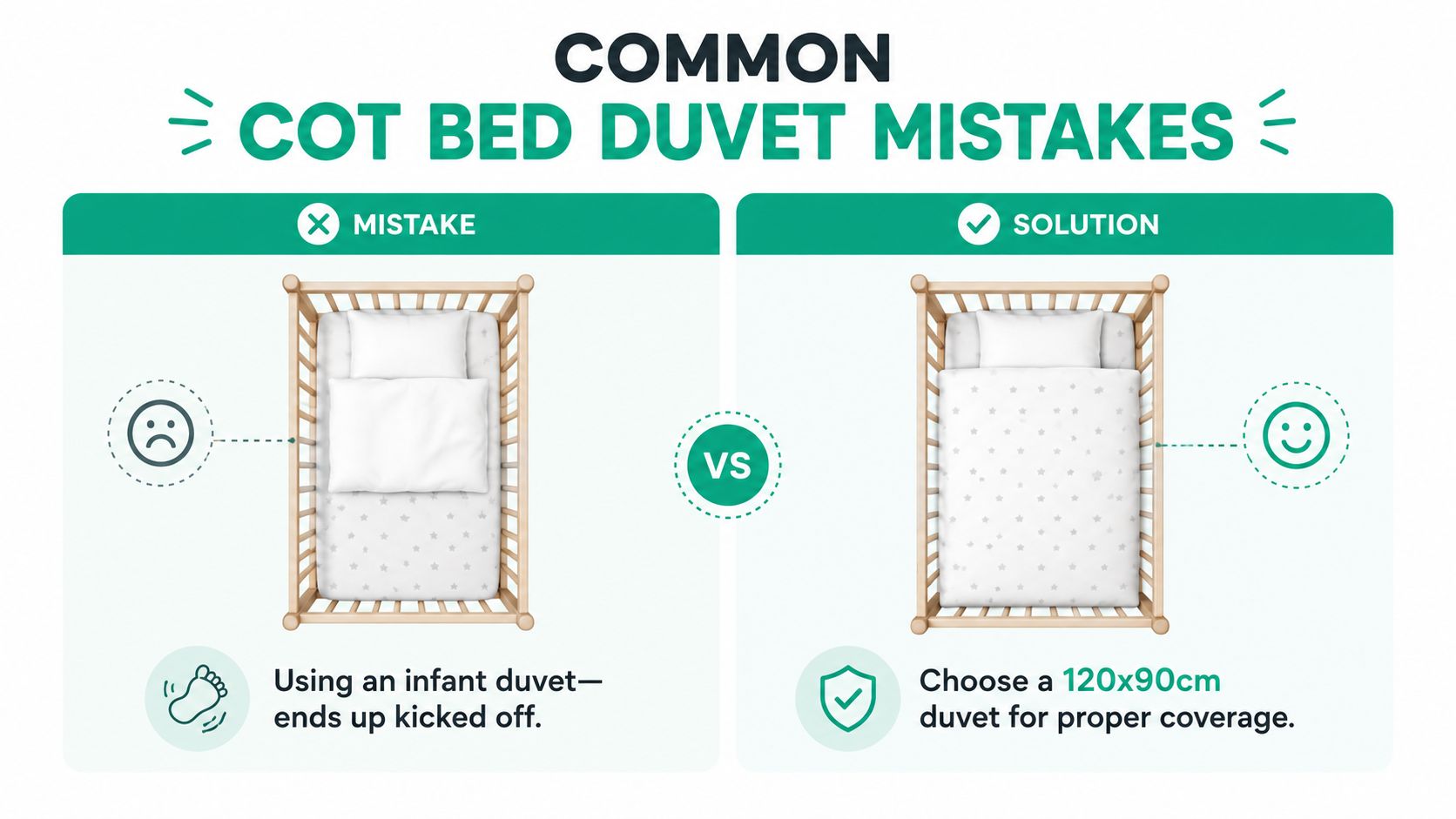
Mistake one using an infant duvet on a cot bed
A small infant duvet may appear tidy on a cot bed in the shop. Once the child moves around, it can leave too little coverage and become easy to kick away. The better approach is to check the cot bed listing, confirm the child is old enough for a duvet, and choose the commonly specified 120 cm x 150 cm format where it matches the product guidance.
Mistake two buying a single-bed duvet for convenience
A single-bed duvet is designed for a much larger sleeping surface. On a cot bed, excessive fabric can bunch, trail over the sides or make the bed harder for a young child to manage. A larger duvet isn't automatically safer or more comfortable. Choose the smallest suitable size that covers the child and fits the bed properly.
Mistake three treating age as irrelevant
A cot bed may be ready for its toddler configuration while the child still needs an age-appropriate sleep arrangement. The bed frame's ability to convert doesn't decide whether a duvet is suitable. Follow the relevant age guidance and consider the whole environment, including sleepwear, room warmth and loose bedding.
Mistake four choosing tog by habit
Some families use the same duvet rating all year because it's already in the cupboard. That can leave a child too warm in a warmer bedroom or insufficiently covered in a cooler one. Choose the tog according to the room and the clothing used underneath, then check the child rather than assuming the packaging has made the decision for you.
Mistake five skipping the protector
Toddlers may seem past the accident stage, but illness, drinks, night-time toilet learning and everyday spills can still reach the mattress. A protector is easier to remove and wash than a mattress, and it also keeps the bedding system easier to reset after an accident.
A duvet solves warmth. A protector solves mattress protection. Buying one shouldn't make you forget the other.
Putting the Cot Bed Sleep System Together
The easiest way to buy cot bed bedding is to treat it like a recipe. Each layer has a different job, and the recipe fails if you use the right ingredient in the wrong place.
Start with the measured bed
Write down the mattress length, width and depth. Use those measurements for the protector and fitted sheet. Use the child's stage and the bed format for the duvet decision, rather than expecting the duvet to have the same dimensions as the mattress.
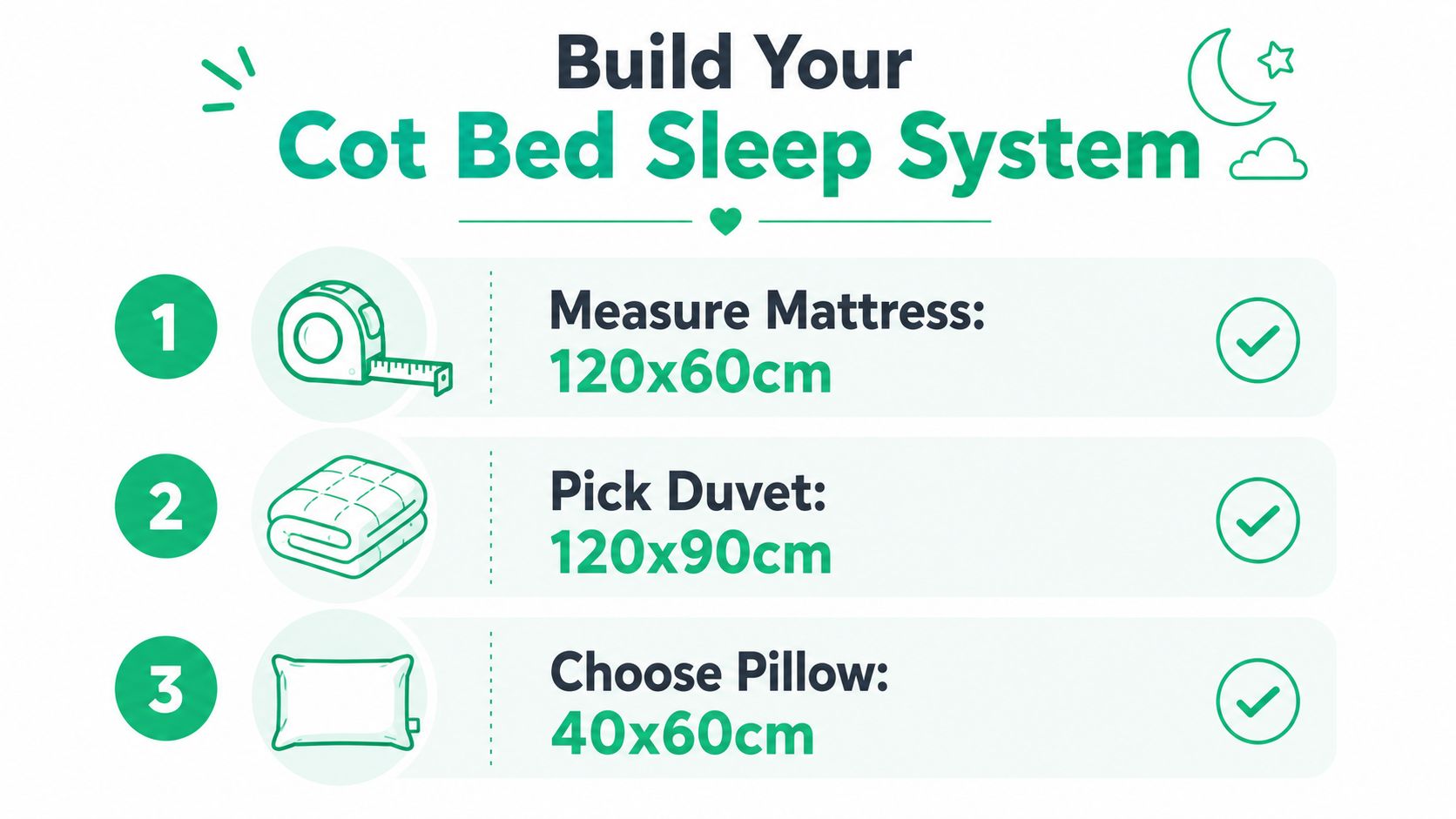
For a typical UK cot bed, that means checking the common 70 cm x 140 cm mattress format, then looking for the commonly specified 120 cm x 150 cm duvet where the product listing and age guidance suit your child. The duvet should be paired with a cover made for that same duvet measurement.
Add warmth with restraint
Pick the tog after considering the room and sleepwear. A lighter option may suit warmer conditions, while a middle rating can be more adaptable across changing seasons. A heavier rating needs more caution in a child's room because extra clothing and blankets can quickly make the sleep environment too warm.
The system can be written as a short buying checklist:
- Measure: Record the mattress width, length and depth.
- Protect: Choose a waterproof protector that matches the mattress, including its depth.
- Cover: Fit a sheet over the protector without stretching or bunching it.
- Warm: Select the duvet size and tog appropriate to the child and room.
- Review: Recheck the layers when the season, sleepwear or bed configuration changes.
An encasement can be added when you need a sealed mattress barrier, but it still follows the mattress dimensions rather than the duvet measurement. Keep the roles separate and shopping becomes much less error-prone.
The complete answer is therefore more useful than a single number. 120 cm x 150 cm is the common UK cot bed duvet size, but it only works well when the mattress, protector, sheet, tog and child's age all fit the same plan.
Cot Bed Duvet Questions UK Parents Ask Most
Can a cot bed duvet be used in a regular cot?
It depends on the cot's internal space and the child's age. A duvet intended for a cot bed may be too large for a smaller infant cot, so check the overhang and follow age-appropriate safe-sleep guidance rather than relying on the name of the duvet.
Will any cot bed duvet cover fit the duvet?
No. The cover needs to match the duvet's actual dimensions. If you've chosen the commonly specified 120 cm x 150 cm duvet, select a cover listed for that measurement, not one labelled “cot bed”.
How often should a cot bed duvet be washed?
Follow the care label and wash it when it's soiled, after illness or when it needs freshening. A washable cover reduces how often the duvet itself needs laundering, while a waterproof protector helps contain accidents before they reach the mattress.
What happens when my child moves to a single bed?
Re-measure the new mattress and treat the move as a fresh bedding decision. Don't place a single-bed duvet on the cot bed early just because you already own one. The larger bed may need a different duvet, cover, protector and tog combination.
Protect-A-Bed offers waterproof mattress protectors and bed bug encasements designed to sit beneath bedding, so you can match the protection layer to the measured cot bed mattress rather than the duvet. Visit Protect-A-Bed to check the available protection options before you buy your next cot bed duvet.