

Anti Dust Mite Bedding UK: A Practical Buyer's Guide

You wake with a blocked nose, itchy eyes or a tight chest, even though the bedroom looks clean. The duvet is still warm from the night, the mattress has held moisture, and your pillow sits close to your face for hours. For many UK households, the useful question isn't whether bedding matters, but how to choose anti dust mite bedding in the UK without mistaking a soft, waterproof cover for a tested allergen barrier.
The answer is practical rather than dramatic. A properly fitted protector can reduce exposure at the sleep surface, but it won't make a bedroom completely mite-free. The strongest approach combines a complete barrier system with hot washing, humidity control and sensible cleaning. UK guidance recommends breathable covers that fully enclose mattresses, duvets and pillows, alongside weekly washing of unenclosed bedding at 60°C or above, a temperature that kills mites, as explained in UK asthma and indoor-air guidance.
Table of Contents
- Why Bedding Is the Front Line Against Dust Mites
- What Dust Mites Are and How Bedding Protectors Actually Work
- Materials and Construction Options Compared
- How to Verify Real Barrier Performance
- UK Buying Considerations from Sizes to Warranty
- Why a Protector Is Only One Piece of the Bedroom Routine
- Common Misconceptions That Lead to Wrong Purchases
- Your Next Steps and Frequently Asked Questions
Why Bedding Is the Front Line Against Dust Mites
On a damp UK morning, the bedroom can feel like a small ecosystem. The heating has warmed the room, the duvet has retained body heat, and moisture from the night remains in fabrics. Someone who is sensitive to house dust mite allergens may start sneezing before breakfast, rub their eyes while making the bed or notice that their breathing feels worse indoors.
House dust mites don't bite and they aren't parasites. The problem comes from allergenic proteins in mite faeces and body fragments, which can become part of household dust and reach the air when bedding is moved. Mattresses, pillows and duvets are especially relevant because they combine warmth, fibres, skin flakes and moisture in one place. Other reservoirs, including carpets, curtains, upholstered furniture and soft toys, can contribute too, so bedding is a priority, not the entire story.
The scale of the UK problem helps explain why bedroom controls receive so much attention. NICE estimates that around 5 million people in England have house dust mite-activated allergic rhinitis, while about 1 million people, or 20%, are not currently adequately controlled, according to UK dust mite allergy guidance. The same guidance identifies house dust mite as the most common indoor trigger for allergic respiratory conditions such as rhinitis and asthma.
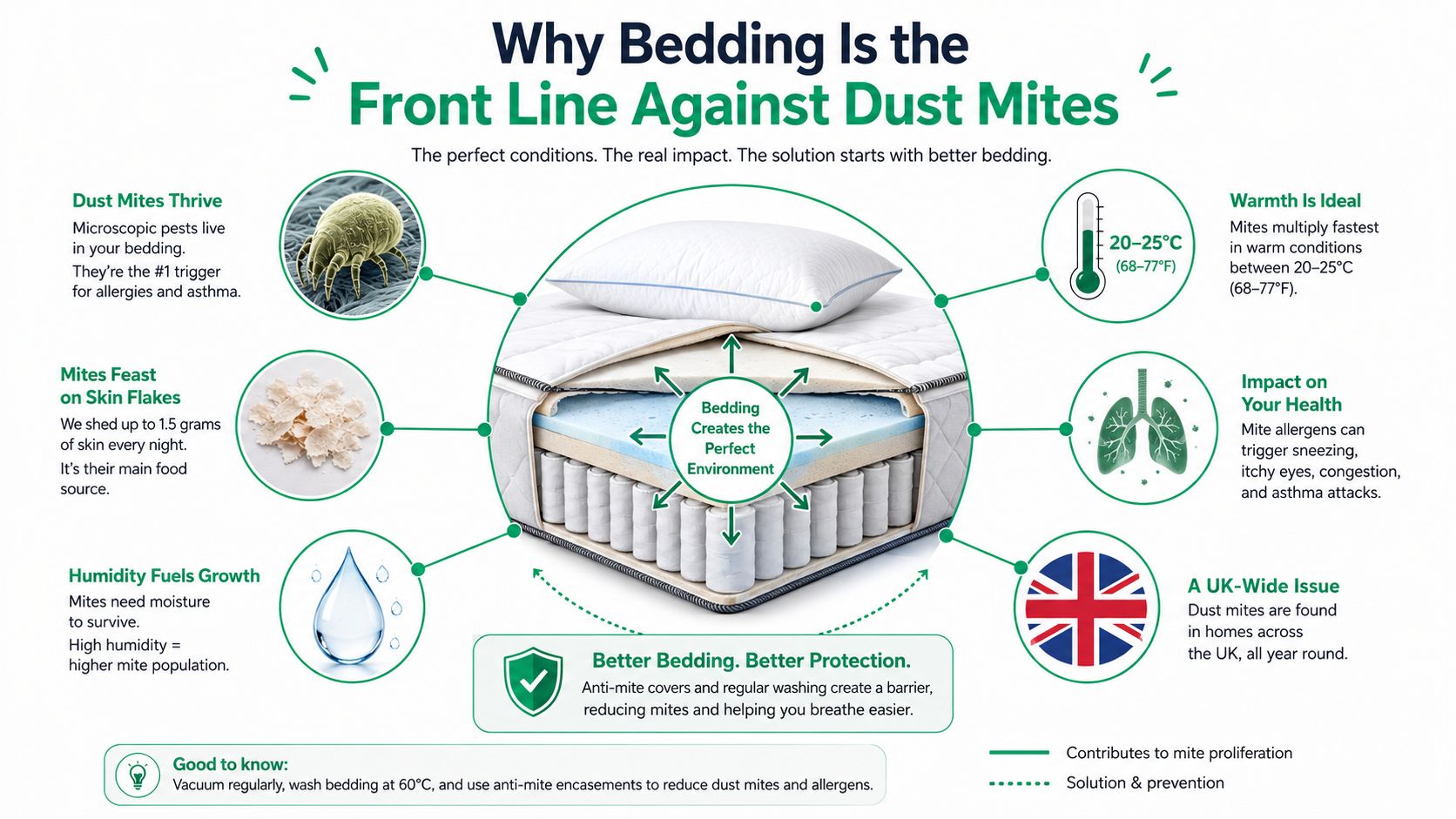
What bedding protection can and can't do
A barrier cover creates distance between the sleeper and allergens inside the mattress, pillow or duvet. It can also contain existing material within the item, reducing the amount that moves towards the sleeping surface. That doesn't promise symptom-free sleep, and it won't address allergens held in nearby furnishings.
Think of the protector as a filter at the point of contact. You still need to manage the room around it, particularly if allergy or asthma symptoms continue. Anyone choosing bedding for a young child may also find this hypoallergenic mattress guide for toddlers useful when comfort, fit and material choices need to be considered together.
Practical rule: Treat the bed as one exposure zone. Mattress, pillow and duvet protection work together more sensibly than a single cover used in isolation.
What Dust Mites Are and How Bedding Protectors Actually Work
Dust mites are microscopic arachnids, not insects and not parasites. They feed mainly on flakes of human and animal skin, and they favour environments where food, warmth and humidity remain available. Bedding provides all three, particularly when fibres trap skin particles and absorb moisture overnight.
Ordinary pillowcases and basic mattress pads are designed for comfort, appearance or liquid protection. They usually aren't engineered to stop fine allergen particles passing through the fabric. A purpose-made barrier cover works more like a very fine sieve. Air and water vapour can pass through the material, while the construction is designed to restrict the movement of mites, fragments and faecal particles.
The barrier doesn't need to kill every mite to be useful. It changes the route between the allergen reservoir and the sleeper. A complete enclosure also holds material already inside the mattress or pillow, while a secure closure helps prevent leakage around the edges.
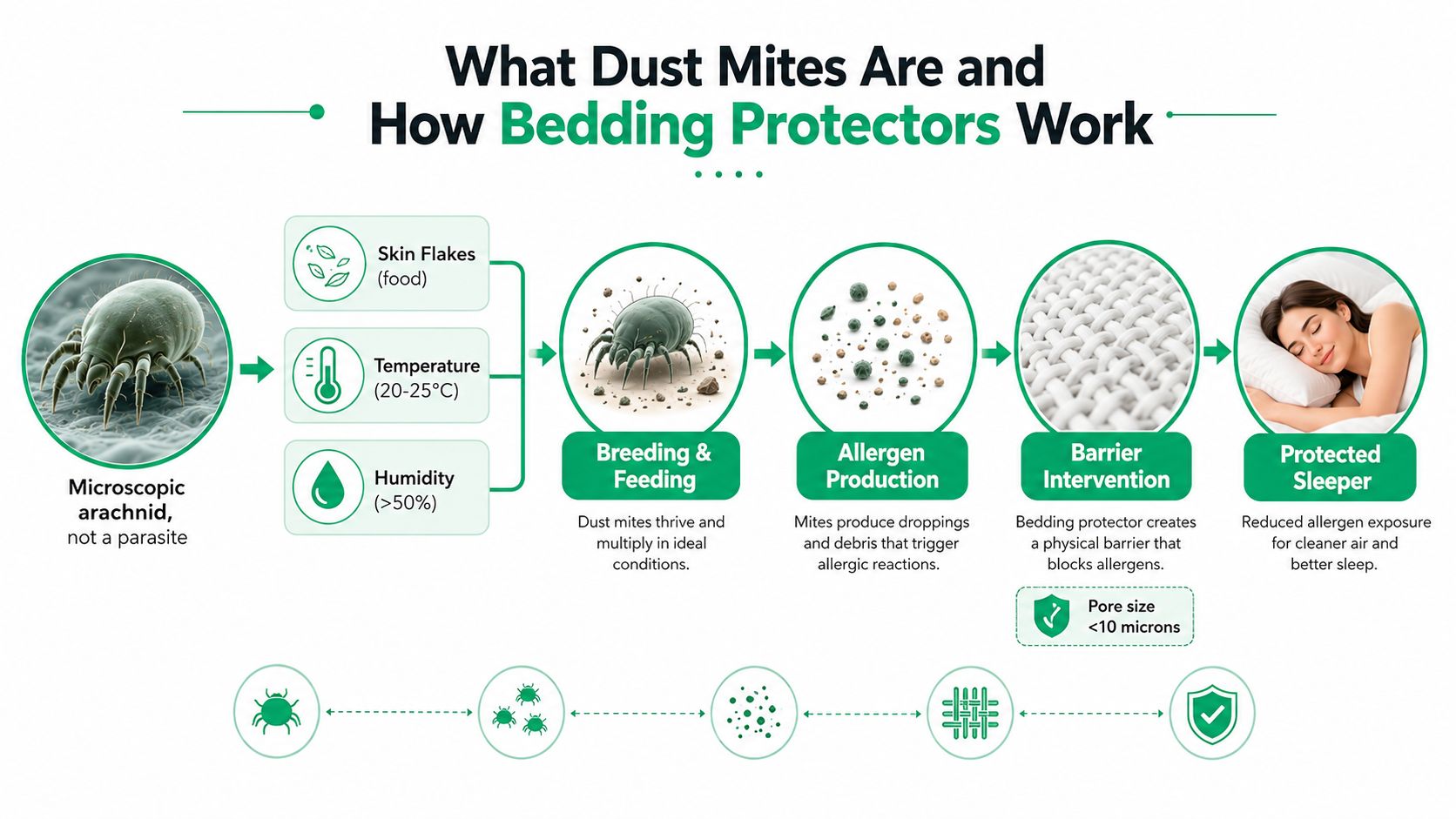
Encasement or fitted protector
An encasement wraps around the whole mattress, pillow or duvet and closes with a zip. That design gives more complete coverage, including the underside and sides, provided the zip and seams remain intact.
A fitted protector covers the sleeping surface and often the sides, using elastic to stay in place. It's easier to remove for laundering, but the underside remains exposed. That may suit a household prioritising convenience, but it isn't the same level of enclosure.
UK patient guidance recommends allergen-proof barriers that are breathable and completely enclose the item. It also recommends covering mattresses, duvets and pillows rather than relying on one protected surface, as set out in dust mite advice from a UK hospital service. For a closer explanation of how allergens can remain in bedding and how covers interrupt that exposure, see this guide to dust mites in bedding.
Materials and Construction Options Compared
Material choice affects feel, heat, noise and durability, but construction determines whether the product forms a reliable barrier. A tightly woven fabric can perform well when the manufacturer provides meaningful pore-size or test information. A membrane-backed cover can add another layer of protection, although it may feel warmer or make more noise depending on the face fabric and finish.
The main material routes
Closely woven microfibre creates a dense textile barrier without a separate plastic film. It tends to be light, quiet and easy to fold, which helps when laundering or storing spare bedding. The trade-off is that performance depends on consistent weaving, stated pore size and the quality of seams and closures.
Membrane-backed protectors place a microporous film beneath a textile surface. These products may also limit liquid movement, but breathability varies. A well-made version can feel smooth and quiet, while a poorly finished one may retain more heat or produce rustling when the sleeper turns.
Plastic or vinyl barriers can offer reliable liquid resistance and may be inexpensive. They can also feel crinkly, less breathable and less comfortable against the body, so they make more sense when liquid protection is the primary need rather than nightly comfort.
Construction choices at a glance
| Option | Main benefit | Key trade-off | Best fit |
|---|---|---|---|
| Woven microfibre | Light, quiet and textile-based | Needs credible pore-size and seam information | Sleepers who prioritise a softer feel |
| Membrane-backed fabric | Combines a fabric face with a microporous barrier | Breathability and heat retention vary | Allergy-aware buyers who also want liquid resistance |
| Plastic or vinyl | Strong resistance to liquids and allergen movement | Can feel hot or noisy | Occasional or utility-focused protection |
| Zipped encasement | Covers the complete item when properly closed | Takes longer to fit and inspect | Maximum mattress, pillow or duvet enclosure |
| Fitted protector | Quick to remove and wash | Leaves the underside exposed | Practical surface-level protection |
Look for bound seams, reinforced zip areas and a closure that reaches around the item without gaps. A cover that's technically dense but too small will strain at the corners. One that's too loose can bunch beneath the sheet, allowing movement and making sleep less comfortable.
The 2002 clinical study referenced in UK patient guidance found that anti-allergic mattress covers significantly reduced Der p 1 levels in carpet-free bedrooms. That evidence is useful for understanding the barrier principle, but it's old and focused on allergen reduction rather than modern concerns such as fabric feel, washability and long-term adherence. The sensible decision is therefore a balance of tested barrier performance, accurate fit and a routine you'll consistently maintain.
How to Verify Real Barrier Performance
Packaging language can make ordinary bedding sound specialised. “Hypoallergenic”, “anti-allergy” and “anti-mite” aren't interchangeable unless the product documentation explains what was tested and what the barrier blocks.
A pore-size claim can be useful when it's linked to a named test method. Claims such as under 10 microns describe the size of openings in the barrier, but the wording alone isn't proof. Ask whether the measurement applies to the finished product, including seams and the closure, rather than only to a fabric sample.
Thread count is a weaker shortcut. A high thread count may describe the number of threads in a fabric, but it doesn't automatically confirm a consistent allergen barrier. Weave tightness, membrane structure, seam construction and testing are more relevant to this specific job.
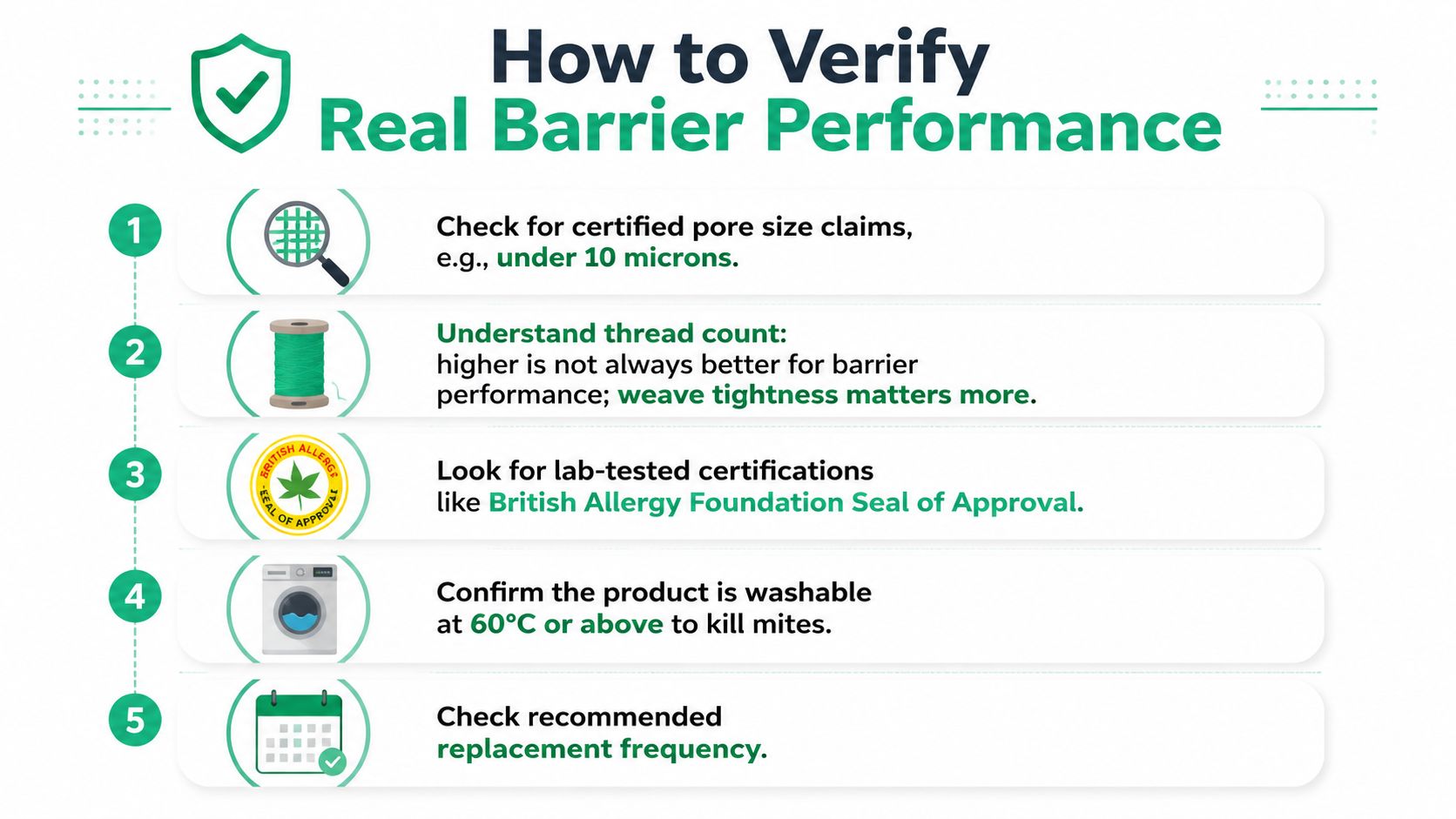
A product-page verification checklist
- Find the test method: Look for a named laboratory method, the material tested and the barrier result.
- Check certification details: A logo should link to a verifiable certification record or registration number, not appear as an unexplained badge.
- Separate safety from performance: OEKO-TEX-style chemical-safety certification addresses tested substances and manufacturing safety. It doesn't, by itself, prove dust mite impermeability.
- Read the scope: Confirm whether the claim covers mites, allergens, liquids or a combination, and whether it applies to the cover, seams and zip.
- Inspect care instructions: A product must tolerate the washing routine you can realistically follow.
UK and European manufacturers may refer to allergy-barrier testing, textile safety standards or allergy-focused approval marks. Treat each as evidence of a particular attribute, not a universal guarantee. A chemical-safety mark isn't an allergen-barrier test, and a waterproof claim isn't automatically a mite-barrier claim.
Check before buying: If a seller can't explain the test, the covered item and the closure design, the product page hasn't given you enough information to judge performance.
A useful companion question is whether a waterproof product remains breathable and comfortable. This guide to waterproof mattress protectors can help separate liquid protection from the wider question of allergen control.
UK Buying Considerations from Sizes to Warranty
A technically suitable cover can still fail if it doesn't fit the UK mattress. Measure the length, width and depth, including any pillow-top or built-in comfort layer. Depth matters because a shallow fitted protector can pull off the corners, while an oversized one may wrinkle and shift under the sheet.
UK mattresses commonly use the size names shown below. Dimensions can vary by manufacturer, so check the retailer's measurement chart rather than relying on the label alone.
| UK size | Typical dimensions (cm) | Common mattress depths to cover | Notes |
|---|---|---|---|
| Small single | 75 × 190 | Varies by model | Check children's and compact-room sizing carefully |
| Single | 90 × 190 | Varies by model | Confirm whether the mattress has a deep comfort layer |
| Small double | 120 × 190 | Varies by model | Allow for extra depth around the fitted edge |
| Double | 135 × 190 | Varies by model | Match the protector to the actual mattress measurements |
| King | 150 × 200 | Varies by model | Check both length and depth before ordering |
| Super king | 180 × 200 | Varies by model | Large covers need a secure, smoothly running zip |
Pillow and duvet sizing deserves equal attention. UK pillows are often rectangular or square-ish, so measure the pillow itself rather than assuming an imported format will fit. Duvet covers should match the duvet dimensions, while a full duvet encasement needs enough room to close without compressing the filling.
Delivery and aftercare questions
Before paying, check whether the listing is on the UK storefront and whether the order dispatches from within the UK. Confirm delivery windows, including whether the seller offers a named or next-day option, and look for VAT-inclusive pricing so the checkout total doesn't change unexpectedly.
Hygiene rules can affect returns. Many bedding protectors can't be returned after opening, especially if the item has lost its sealed packaging. Read the conditions before unwrapping, then inspect the zip, seams and dimensions while the product is still eligible for return.
Finally, check what the warranty covers. A warranty on material or manufacturing defects may include seams and zips, but it won't normally cover damage from an incorrect wash cycle, sharp bed-frame edges or unsuitable fitting.
Why a Protector Is Only One Piece of the Bedroom Routine
A mattress encasement closes one major route, but allergens can still circulate from the rest of the room. Carpets, curtains, upholstered headboards, cushions and soft toys all provide places where dust and moisture can collect. The bedroom works as a connected environment, so improving one surface won't compensate for persistent humidity or heavily loaded furnishings.
UK guidance recommends combining barrier covers with practical controls. That includes washing unenclosed bedding weekly at 60°C or above, using allergen-proof barriers on mattresses and pillows, vacuuming with HEPA filtration and lowering indoor humidity, as outlined in UK allergy guidance on reducing dust mite allergens.
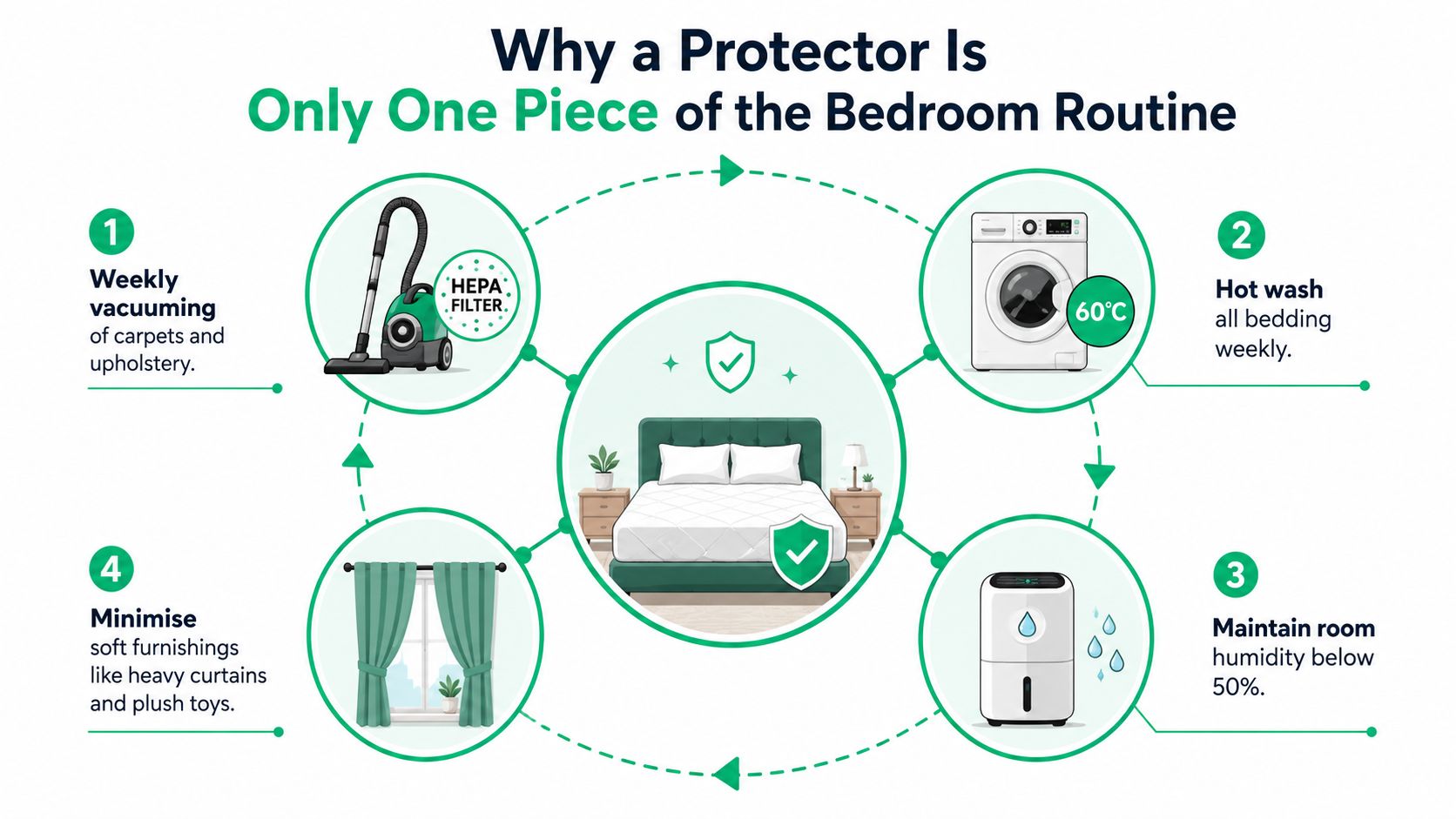
Build a routine you can sustain
Wash sheets, pillowcases and duvet covers weekly at the recommended hot temperature. Follow the protector's own care label for laundering, because some covers tolerate high heat while others require a different cycle. Never assume a cover is washable at a particular temperature just because its marketing describes it as protective.
Vacuum carpets and upholstery with suitable filtration, paying attention to the area around the bed. Reduce unnecessary soft furnishings where practical, improve ventilation and use a humidity monitor to identify damp periods rather than guessing.
The front-door analogy helps. The encasement is the front door of the mattress, but a damp, dusty room is still letting exposure in through the windows. The protector may be the most concentrated purchase in the bedroom plan because the mattress can't be put through a washing machine, but it works best when the rest of the room supports it.
For care instructions specific to a protector, follow this guide to washing a mattress protector. If symptoms remain troublesome, speak to a healthcare professional rather than treating bedding as a substitute for diagnosis or prescribed care.
Common Misconceptions That Lead to Wrong Purchases
Waterproof doesn't automatically mean anti-mite
A waterproof layer may restrict liquids and some particles, but the claim doesn't prove that the complete product blocks mite allergens. The face fabric, seams and zip still matter. Look for barrier testing that applies to the finished protector, not just a general statement about waterproofing.
Thicker isn't necessarily stronger
A bulky cover can feel substantial without having a sufficiently dense weave or suitable membrane. Barrier performance comes from controlled pore structure and intact construction, not fabric loft. A thinner cover with documented testing may be more useful than a thick, untested one.
One cover doesn't protect the whole bed
A mattress-only protector leaves the pillow and duvet outside the barrier. Those items remain close to the sleeper's face and can hold their own allergen load. UK recommendations address mattresses, duvets and pillows together because the sleeping microclimate includes all three.
Sprays don't replace physical barriers
Chemical treatments may be marketed as a way to repel or kill mites, but they don't create a lasting mechanical separation between the sleeper and allergens already present in the bedding. They also don't solve exposure from carpets or furnishings. A physical encasement, regular hot washing and humidity control address different parts of the problem.
Price doesn't certify performance
A higher price may reflect fabric, design, warranty or distribution, but it isn't evidence of a tested pore size. Conversely, a lower-priced cover may be suitable if it clearly documents its construction, fit and care requirements. Compare evidence, closure quality, washability and comfort, not just the product's position on a price list.
Your Next Steps and Frequently Asked Questions
Start with a short buying sequence:
- Measure the mattress: Record length, width and depth, including any topper or pillow-top layer.
- Confirm the UK size: Use the retailer's dimensions rather than assuming the size name is universal.
- Verify the barrier claim: Look for a named test method, certification details and a clear statement of what the product blocks.
- Protect the complete sleep system: Prioritise the mattress, then include pillows and the duvet where practical.
- Set the care routine: Wash unenclosed bedding weekly at 60°C or above, following the guidance cited earlier.
Does anti-dust-mite bedding really work?
It can reduce exposure when the cover forms a genuine, intact barrier and is properly closed. A UK clinical trial involving 284 children with asthma and mite allergy found fewer severe exacerbations in the group using mite-impermeable bedcovers. Emergency-room visit or hospitalisation combined with systemic corticosteroids occurred in 29.3% of the active-cover group compared with 41.5% in the placebo group, as reported in coverage of the UK clinical trial. This supports the barrier rationale, but it doesn't mean every sleeper will experience the same result.
How long will a protector last?
There isn't one universal lifespan. Inspect the fabric, elastic, seams and zip regularly, and replace the cover if it develops holes, opens at the corners or no longer fits securely. Follow the manufacturer's warranty and care instructions rather than relying on a generic replacement timetable.
Will it affect comfort?
Comfort depends on the face fabric, membrane, fit and the sheet used above it. Breathable construction can feel quieter and less clammy than basic plastic, but personal preference varies. Choose a cover that remains smooth, secure and suitable for your usual sleeping temperature.
Can it go in a tumble dryer?
Only if the care label allows it, and use the stated heat setting. Excessive heat can damage elastic, coatings or membrane-backed materials, so don't treat every protector as interchangeable.
Is VAT relief available?
Eligibility depends on the individual's clinical circumstances, the product and the supplier's requirements. Ask the seller and check the current UK rules before assuming a bedding purchase qualifies.
A well-chosen encasement is useful because it protects the item you sleep on every night, but its value grows when you pair it with hot washing, humidity control and whole-room housekeeping. Measure first, verify the evidence, and buy the level of coverage you can maintain.
Protect-A-Bed offers UK mattress protectors, pillow protectors and encasements designed around breathable barrier protection, with options for different fabrics, sleep preferences and bed sizes. Visit Protect-A-Bed to check the UK range, confirm fit and care details, and choose a practical starting point for your bedroom mite-control routine.