

Allergy Bedding Covers: The Complete UK Guide

You can have a spotless bedroom and still wake up congested, itchy-eyed, or sneezing as soon as you open your eyes. That's the frustrating part for many UK homeowners, the room looks clean, the sheets smell fresh, yet the mattress and pillows can keep feeding you the same allergens night after night.
Allergy bedding covers are designed for that exact problem. They don't clean the air in your room, but they do create a barrier around the biggest allergen reservoir in the bed, which is why they're often used as a targeted part of allergy control rather than a miracle fix. For broader context on indoor irritants, indoor pollutant health risks is a useful read alongside this guide.
Table of Contents
- Why Your Bedroom May Be Triggering Allergy Symptoms
- How Allergy Bedding Covers Reduce Allergen Exposure
- Membrane Barriers Versus Tightly Woven Fabrics
- Key Features to Look for When Buying Allergy Bedding Covers
- Integrating Bedding Covers Into a Broader Allergy Strategy
- Protect-A-Bed Products for Allergy and Asthma Sufferers
- Caring for Your Allergy Bedding Covers
Why Your Bedroom May Be Triggering Allergy Symptoms
You change the sheets, vacuum the floor, maybe even keep the window open, then you still wake up with a blocked nose. That pattern usually points away from surface dirt and towards the bed itself, because mattresses and pillows collect allergens over time and keep holding them long after the visible dust is gone. Protect-A-Bed's overview of dust mites in bedding makes the same basic point, the sleeping surface can stay loaded even when the room looks tidy.
The bed is where exposure builds up
Mattresses are especially important because people spend so much time in bed, and the practical issue is not just what's on top of the sheets. Dust mites, skin flakes, pet dander, and pollen can work their way into the filling and stay there, so every turn in the night can disturb the reservoir and put particles back into the air. That's why a bedroom can feel “clean” while still behaving like an allergy trigger.
Practical rule: if symptoms are worst on waking, the sleeping surface deserves more attention than the rest of the room.
For many households, that's the point at which allergy bedding covers become relevant. They're not a deep-cleaning method, they're a physical barrier between you and what's already trapped inside the mattress or pillow. That distinction matters, because a barrier can lower exposure even when ordinary cleaning can't reach the reservoir.
Why a barrier helps, but doesn't promise relief on its own
The most useful way to think about bedding covers is as one control measure, not a full cure. The cover can reduce contact with allergens, but symptom relief still depends on how sensitive the person is and what else is happening in the room. If humidity stays high, pets sleep on the bed, or pillows are left unprotected, the improvement can be smaller than people expect.
That's also why realistic expectations matter. The product can do its job and still not solve everything, especially if your symptoms come from more than one source. For UK homeowners, the goal is often to lower the allergen load where you spend about a third of the day, then build the rest of the routine around that gain.
How Allergy Bedding Covers Reduce Allergen Exposure
A bedroom can look tidy and still keep feeding symptoms if dust-mite allergens sit inside the mattress or pillow. Allergy bedding covers work by putting a sealed barrier around that reservoir, so the sleeper is separated from the filling rather than just sleeping on top of it. In simple terms, the cover creates a physical boundary that helps keep trapped material from moving back into the air or onto your skin.
What the trials showed
In one randomised trial of patients with allergic rhinitis, 232 patients completed the study, and after 12 months the geometric mean concentrations of the dust-mite allergens Der p 1 and Der f 1 were significantly lower in the impermeable-cover group than in controls, while the control group showed no comparable reduction, according to the trial report on impermeable bedding covers (European Respiratory Journal chapter PDF). A separate randomised placebo-controlled trial found an 87% reduction in Der p 1 in mattress dust after encasing mattresses with HDM-impermeable covers, which shows that the barrier effect at the bedding surface can be substantial.
Those results matter because they point to the same mechanism from two angles. The cover does not need to remove every allergen from the home to be useful. It needs to lower exposure where the sleeper has the closest, longest contact with the reservoir.
Why the mattress reservoir matters so much
The mattress is often the main indoor source of mite allergen in sensitised homes, which is why enclosure is such a common engineering approach. A good cover limits the passage of particles from the mattress filling into the sleep environment, and it also helps keep new material from moving inward. That chain is straightforward. Smaller effective pore size and full enclosure reduce allergen passage, which lowers the amount available for re-aerosolisation when the bedding is disturbed.
Key takeaway: the benefit comes from reducing exposure at the reservoir, not from “treating” the allergy itself.
That also explains the limit. The evidence is strong for allergen reduction, but symptom relief is not guaranteed for every patient, especially when covers are used alone rather than as part of a wider allergy-control plan. UK buyers should see that as a practical strength, not a promise of complete relief. A cover that lowers the allergen burden is still doing useful work, even if it is only one part of the bigger picture.
Membrane Barriers Versus Tightly Woven Fabrics
UK shoppers usually end up choosing between two technical routes. One uses a membrane barrier, the other relies on an ultra-tight weave. Both can help lower allergen exposure, but they behave differently in real bedrooms, especially once you add sweat, spills, laundering, and comfort preferences.
The trade-off is performance versus feel
A membrane-bonded cover can be waterproof while still staying breathable, which is useful in homes where night sweats, accidental spills, or frequent washing are part of daily life. That combination makes it easier to protect the mattress itself, not just the allergen barrier. The internal link on breathable waterproof membrane is helpful if you want to understand why that balance matters in practice.
Tightly woven covers take a different route. They may achieve mean pore sizes around 2.1 to 2.6 microns, which is a strong barrier for allergen blocking, but they are not automatically waterproof. That matters because a cover that feels great on paper can still fail the household test if it can't handle real-world moisture or routine cleaning.
Side by side comparison
| Feature | Membrane-Bonded Covers | Tightly Woven Covers |
|---|---|---|
| Water protection | Can be waterproof | Usually not waterproof |
| Breathability | Designed to remain breathable | Often prioritises airflow and fabric feel |
| Allergen blocking | Strong when fully enclosed | Strong when weave is sufficiently tight |
| Best for | Spills, sweat, frequent laundering, liquid protection | People who want a cotton-like hand feel and maximum airflow |
| Practical downside | Some buyers worry about the feel, so quality matters | Less suited to liquid protection needs |
The right choice depends on the main problem in the room. Families with children, pet owners, and anyone dealing with spills or perspiration often benefit from the membrane route. People who are mostly focused on airflow and a softer textile feel may prefer the woven option, as long as they understand that waterproofing isn't the point.
Matching the cover to the use case
Marketing language can be misleading. “Allergy-friendly” sounds broad, but the useful question is narrower, what problem are you trying to solve at night? If liquid protection and allergen control both matter, a membrane structure makes sense. If your priority is a more fabric-like feel with serious particle blocking, a tight weave can be the better fit.
The smartest purchase is the one that matches the bedroom's actual habits. A technically strong cover that gets used consistently is more valuable than a more glamorous product that stays in the wardrobe because it feels wrong to sleep on.
Key Features to Look for When Buying Allergy Bedding Covers
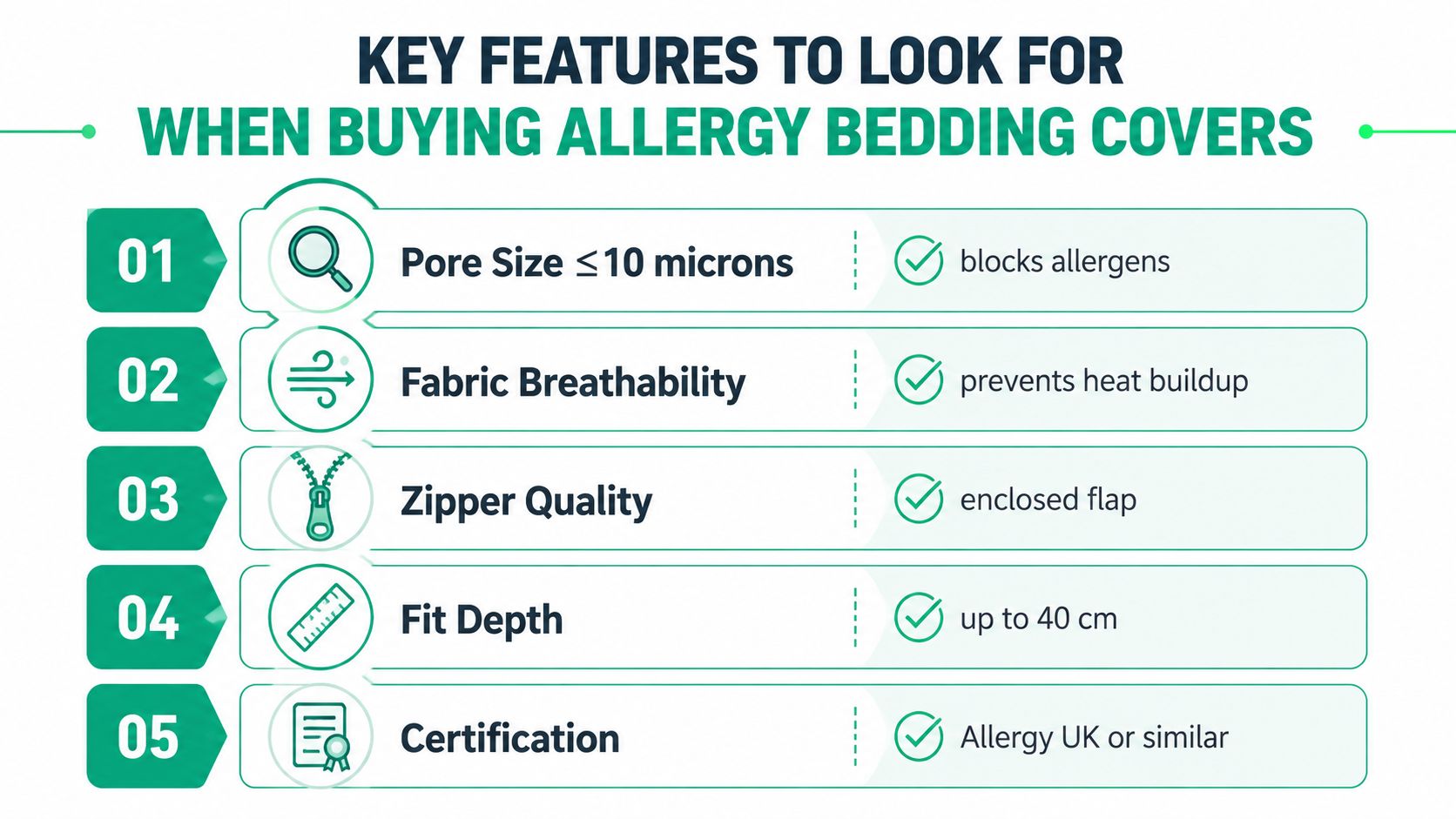
A cover can only do its job if the barrier is complete and practical enough to keep using in a UK bedroom. The weak points are usually easy to spot once you know what matters, gaps around the zip, a cover that does not fully enclose the mattress or pillow, poor durability after washing, or a finish that feels so awkward that people stop using it.
Check the enclosure, not just the fabric label
For dust-mite control, the most useful technical benchmark is pore size. Guidance on allergen-impermeable bedding commonly uses under 6 microns as the practical threshold for dust-mite allergens, with finer structures under 3 microns sometimes recommended for smaller dander particles (Cochrane review background on bedding encasements). That gives you a useful starting point, but the fabric itself is only part of the picture. A full-encasement design with a sealed zip matters because a partial cover still leaves another route for allergens to move.
A simple fitted-sheet style can help with surface protection, but it is not the same as a sealed barrier. If the mattress reservoir is the problem, the product needs to wrap the reservoir. The zip, seam finish, and fit depth all matter because any weak point gives the reservoir a path back into the room.
If you are comparing options, a guide to hypo-allergenic bedding covers can help you line up the technical details with the way the bed is used.
Use certification and comfort as part of the checklist
The Asthma & Allergy Friendly certification standard for bedding requires products to block allergens, stay breathable, be easy to clean, withstand recommended cleaning methods, and contain no chemicals known to trigger symptoms (Asthma & Allergy Friendly bedding standard overview). That mix is useful because it stops shoppers focusing on one feature, such as waterproofing, while ignoring whether the cover can be lived with.
A cover that performs well once but cannot survive normal washing is not a practical solution for most homes.
You can also narrow the choice by fabric feel. Some buyers prefer Tencel Cool for temperature regulation, others prefer cotton for a natural hand feel, and some like charcoal-style options for odour control. Those are comfort decisions, not allergen decisions, but comfort affects compliance, so they do matter.
For shoppers in real homes, the best cover is usually the one that combines a sealed barrier, breathable construction, and a fabric you will not resent on a hot night. If you need liquid protection as well, treat waterproofing as a separate requirement rather than assuming every allergy cover includes it.
Integrating Bedding Covers Into a Broader Allergy Strategy
A bedroom cover can do one job very well, it can reduce exposure to allergens that collect in the mattress or pillow. It cannot, on its own, remove every trigger from the room. That is why people sometimes buy the right cover and still feel disappointed, because the cover is only one layer in a wider allergy plan.
The gap between need and use is easy to see in the UK. Analysts in a primary-care and allergy review found that 48.8% of asthma patients in one representative sample were sensitised to house-dust-mite allergen, yet only 25.6% of those HDM-allergic asthma patients reported using HDM-impermeable bed covers (UK primary-care and allergy epidemiology review). That does not mean the cover is ineffective. It means many households never get to the point where a barrier can do its part.
Layer the controls
A bedroom works better when each control handles a different source of exposure. Humidity reduction matters because dust mites prefer damp conditions, while hot washing removes allergen from sheets, pillowcases, and washable bedding. UK-facing guidance commonly recommends washing bedding at 60°C for allergy sufferers, and broader allergy advice also points to lower humidity and hot washing as part of allergen control (Cleveland Clinic guidance). Regular vacuuming with a HEPA filter and keeping pets out of the bedroom help reduce the background dust load that the cover cannot address by itself.
- Humidity: keep the room dry enough that mites are less comfortable.
- Washing: use hot washing for bedding that can safely withstand it.
- Vacuuming: use HEPA filtration so dust is captured rather than stirred up.
- Pets: keep fur and dander out of the sleep space where you can.
- Covering the reservoir: use the mattress or pillow barrier to protect the hardest-to-clean surfaces.
That layered approach matters more in some settings than others. Multi-occupancy properties, rentals, hotels, and care facilities benefit from standardised hygiene routines because the room is used by different people and the bedding must cope with frequent turnover. In those settings, the cover is part of maintenance and exposure reduction, not just a comfort upgrade.
Know when the cover is doing enough
If humidity is under control, bedding is being washed hot, and the mattress or pillow is already protected but symptoms still continue, that does not automatically mean the cover has failed. The bedroom may have another trigger, or the symptom pattern may need a medical review. Covers are good at lowering allergen exposure, but ongoing symptoms usually call for a broader plan rather than just adding more of the same product.
Protect-A-Bed Products for Allergy and Asthma Sufferers
Protect-A-Bed's UK range fits the kind of technical decision many households are trying to make. The core idea is a Miracle Membrane that blocks dust mites, allergens, liquids, and sweat while staying flexible, silent, and air permeable. That combination places the focus on surface protection and breathability rather than on a stiff, noisy barrier that people won't want to use every night.
What the range is built to cover
The product family includes waterproof mattress protectors in several fabric options, including Charcoal, Premium, Tencel Cool, and Cotton. There are also advanced pillow protectors in Cotton, Snow, Tencel Cool, Copper, and Copper Cool variants, plus bed bug encasements designed for mattress protection. For households where the practical problem is allergens plus spills or sweat, that kind of membrane-based construction is easy to understand and easy to fit into a routine.
The broader appeal is in the details. UK fulfilment includes 1 to 3 working day delivery, free shipping on orders over £90, and delivery insurance. The brand also states a warranty of up to 10 years against material or manufacturing defects, and its products are sold in 49 countries and carried in nearly 15,000 stores worldwide. Those facts don't tell you whether a product will suit your own bed, but they do show the product line is built around bedding protection rather than gimmicks.
How to think about it as a shopper
The useful question is simple, does the cover match the thing you need most? If your mattress needs liquid protection as well as allergen control, a waterproof membrane design is the logical place to start. If your main problem is the pillow, a protector there may make a visible difference because that's where your face rests for hours at a time.
This is one option among several ways to build a barrier-based sleep environment, but it's the sort of option that makes sense when you want the barrier and the comfort layer in the same product family. For UK homeowners trying to avoid product guesswork, that can be a practical way to narrow the search without overcomplicating the purchase.
Caring for Your Allergy Bedding Covers
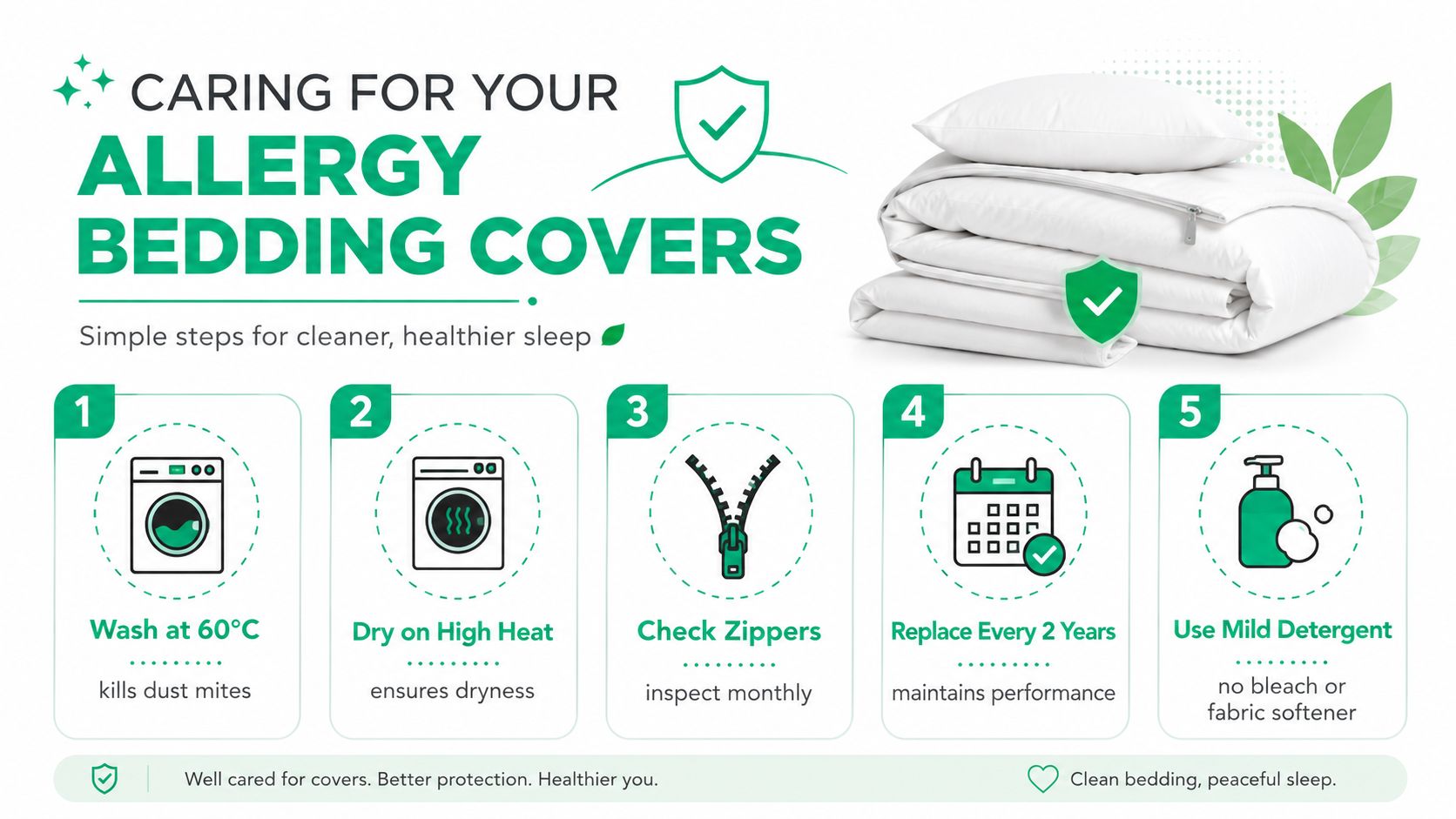
A well-made barrier still loses value if it is not cared for properly. If you want it to keep doing its job, wash bedding at 60°C where the care label allows it, dry it fully, and check the zip, seams, and surface for wear on a regular basis. Cleveland Clinic guidance is useful here because it keeps the focus on maintenance rather than expectation. The aim is not fussiness, it is preserving the barrier so it can keep limiting exposure.
Keep the barrier intact
Washing at the right temperature helps the cover do its job, while poor drying can leave it damp and less pleasant to sleep on. Mild detergent is usually the safer choice for the fabric and membrane, and harsh additives can shorten the useful life of the cover. If the protector has a sealed zip, inspect it from time to time so a damaged closure does not become the weak point.
Good habit: check the zip and seams when you change the bedding, not only when something looks wrong.
Replacement depends on condition, not just age, but wear does show up in practical ways. Fraying edges, a zip that no longer closes cleanly, or a membrane that no longer feels consistent are all signs that performance may be slipping. A barrier works only while it stays continuous, so even small defects matter.
Use the bedroom environment to support the cover
Humidity still matters after the cover is on the bed. If the room stays damp, the rest of the allergy-control routine becomes harder, because moisture encourages the conditions dust mites prefer. Cover care and room care need to work together, since a good protector can reduce allergen exposure while the wider bedroom environment still influences symptoms.
Keep spare bedding clean and dry, and do not store protectors in a way that traps moisture or dust. Pillow protectors usually get more frequent handling than mattress encasements, so they deserve more attention during routine laundry. If you want the cover to last, gentle but regular care beats occasional heavy-handed cleaning every time.
If you are comparing options for your own bedroom, Protect-A-Bed offers mattress protectors, pillow protectors, and encasements built around a waterproof, breathable membrane, which makes it relevant to the exact problems covered here. Visit Protect-A-Bed to review the UK range and choose the barrier that fits your mattress, your pillows, and your allergy routine.